Role of Management and Leadership in Dementia Care for BME Patients
VerifiedAdded on 2021/02/19
|9
|3365
|433
Report
AI Summary
This report provides a comprehensive literature review on the crucial roles of management and leadership within dementia care, particularly focusing on the support provided to patients from Black and Minority Ethnic (BME) backgrounds in the UK. The report explores the implementation of person-centered care, highlighting the significance of management styles and their impact on service quality. It delves into the responsibilities of care managers, coordinators, and service providers, such as dementia advisor services and local authorities, in coordinating health and social care. The report also examines the roles of healthcare practitioners, including GPs and social workers, in delivering holistic care. Furthermore, it addresses the challenges faced by the UK in dementia care, including the government's initiatives to improve diagnosis rates and access to services for BME communities. The analysis underscores the importance of tailored management approaches and the need for continuous improvement in healthcare practices to meet the diverse needs of dementia patients.
Role of Management
and Leadership in
Dementia
Care/Support for
Patients From Black
and Minority
Ethnicity in the UK
and Leadership in
Dementia
Care/Support for
Patients From Black
and Minority
Ethnicity in the UK

Paraphrase This Document
Need a fresh take? Get an instant paraphrase of this document with our AI Paraphraser
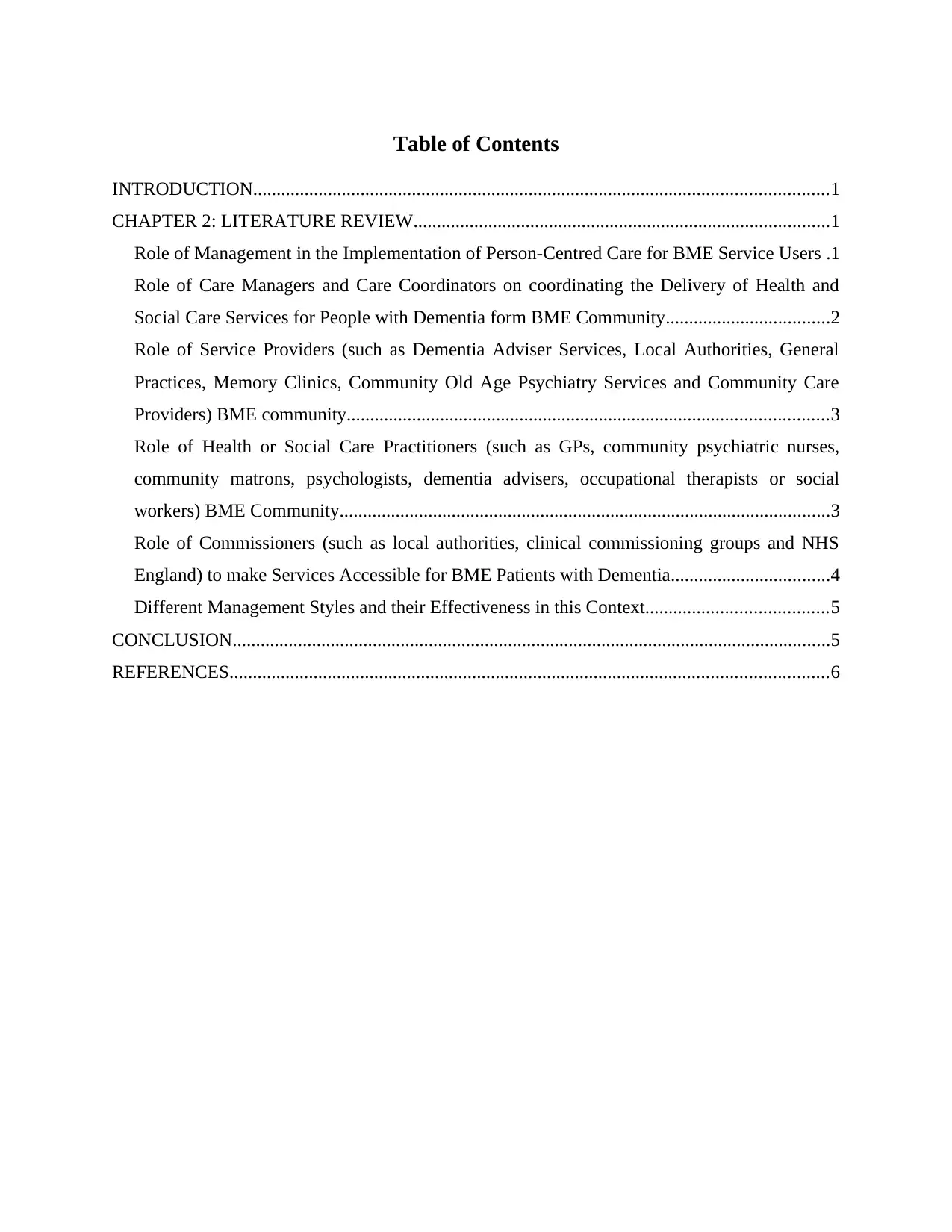
Table of Contents
INTRODUCTION...........................................................................................................................1
CHAPTER 2: LITERATURE REVIEW.........................................................................................1
Role of Management in the Implementation of Person-Centred Care for BME Service Users .1
Role of Care Managers and Care Coordinators on coordinating the Delivery of Health and
Social Care Services for People with Dementia form BME Community...................................2
Role of Service Providers (such as Dementia Adviser Services, Local Authorities, General
Practices, Memory Clinics, Community Old Age Psychiatry Services and Community Care
Providers) BME community.......................................................................................................3
Role of Health or Social Care Practitioners (such as GPs, community psychiatric nurses,
community matrons, psychologists, dementia advisers, occupational therapists or social
workers) BME Community.........................................................................................................3
Role of Commissioners (such as local authorities, clinical commissioning groups and NHS
England) to make Services Accessible for BME Patients with Dementia..................................4
Different Management Styles and their Effectiveness in this Context.......................................5
CONCLUSION................................................................................................................................5
REFERENCES................................................................................................................................6
INTRODUCTION...........................................................................................................................1
CHAPTER 2: LITERATURE REVIEW.........................................................................................1
Role of Management in the Implementation of Person-Centred Care for BME Service Users .1
Role of Care Managers and Care Coordinators on coordinating the Delivery of Health and
Social Care Services for People with Dementia form BME Community...................................2
Role of Service Providers (such as Dementia Adviser Services, Local Authorities, General
Practices, Memory Clinics, Community Old Age Psychiatry Services and Community Care
Providers) BME community.......................................................................................................3
Role of Health or Social Care Practitioners (such as GPs, community psychiatric nurses,
community matrons, psychologists, dementia advisers, occupational therapists or social
workers) BME Community.........................................................................................................3
Role of Commissioners (such as local authorities, clinical commissioning groups and NHS
England) to make Services Accessible for BME Patients with Dementia..................................4
Different Management Styles and their Effectiveness in this Context.......................................5
CONCLUSION................................................................................................................................5
REFERENCES................................................................................................................................6
INTRODUCTION
Literature Review refers to the comprehensive summary of the topic or concepts on
which different authors have provided their own views and the findings of those are included in
the current study or topic on which the working is going on (Nagington and et. al., 2017). The
following assignment will make its focus on presenting the literature review and also their
critical evaluation to have deep learning and understanding of the topic provided.
CHAPTER 2: LITERATURE REVIEW
Role of Management in the Implementation of Person-Centred Care for BME Service Users
According to L. Dellenborg, E. Wikström and A. Andersson Erichsen, 2019,
Management is an important concept which must be applied in the context of health and social
care services for providing the users with better results from the work done by them. Person
centred care is the fulfilment of the needs and demands of individual, personal needs, desires and
goals in order to make them central to the care and nursing process. With the help of
Management it is possible for the health care practitioners to know about the needs and demands
of those service users so that their fulfilment can also be done in the way in which they want.
However, it also depends upon the nature and behaviour of the care takers whether they provide
good quality services to their patients or not. Management will help in providing the individuals
with proper needs and this will make them to influence the users or patients in the way in which
the leaders wants from them to do.
They will be able to get better services and environment which will ensure proper and
early recovery of the patients from the diseases such as dementia (Rokstad and et. al., 2015).
With the help of positive Management culture in a health and social care organisation, it will be
possible for them to create a good working and person centred environment in the organisation
so that good services could be delivered to them and the speed of their recovery could be
enhanced. In case the culture of the organisation is not good and upto the level, than it will
negatively impact upon health condition of patients of health and social care organisation as well
as on the cooperation and coordination of employees as well. Dementia Diagnosis, which was
firstly met in the year 2015 and is continued since. The policies related to Dementia was firstly
introduced in November 2015 and the main objective of the implementation of this policy was
related to maintain minimum of two thirds diagnosis rate for people with dementia. In addition to
1
Literature Review refers to the comprehensive summary of the topic or concepts on
which different authors have provided their own views and the findings of those are included in
the current study or topic on which the working is going on (Nagington and et. al., 2017). The
following assignment will make its focus on presenting the literature review and also their
critical evaluation to have deep learning and understanding of the topic provided.
CHAPTER 2: LITERATURE REVIEW
Role of Management in the Implementation of Person-Centred Care for BME Service Users
According to L. Dellenborg, E. Wikström and A. Andersson Erichsen, 2019,
Management is an important concept which must be applied in the context of health and social
care services for providing the users with better results from the work done by them. Person
centred care is the fulfilment of the needs and demands of individual, personal needs, desires and
goals in order to make them central to the care and nursing process. With the help of
Management it is possible for the health care practitioners to know about the needs and demands
of those service users so that their fulfilment can also be done in the way in which they want.
However, it also depends upon the nature and behaviour of the care takers whether they provide
good quality services to their patients or not. Management will help in providing the individuals
with proper needs and this will make them to influence the users or patients in the way in which
the leaders wants from them to do.
They will be able to get better services and environment which will ensure proper and
early recovery of the patients from the diseases such as dementia (Rokstad and et. al., 2015).
With the help of positive Management culture in a health and social care organisation, it will be
possible for them to create a good working and person centred environment in the organisation
so that good services could be delivered to them and the speed of their recovery could be
enhanced. In case the culture of the organisation is not good and upto the level, than it will
negatively impact upon health condition of patients of health and social care organisation as well
as on the cooperation and coordination of employees as well. Dementia Diagnosis, which was
firstly met in the year 2015 and is continued since. The policies related to Dementia was firstly
introduced in November 2015 and the main objective of the implementation of this policy was
related to maintain minimum of two thirds diagnosis rate for people with dementia. In addition to
1
⊘ This is a preview!⊘
Do you want full access?
Subscribe today to unlock all pages.

Trusted by 1+ million students worldwide
this, these standards set by the government were also met to the end of April 2018. However,
there are different types of Management styles and their implementation in the working of the
organisation is to be done with due care and understanding the needs and conditions prevailing in
the organisation (Lewis, 2018). For example, the Transformational Management style, autocratic
Management style, participative Management style, persuasive Management style and many
more and their implementation and application in the working of an organisation is also done
with due care. As there is a lot of difference in the nature and behaviour from person to person so
the same Management style will not be applicable in the context of all the individuals or service
users in the organisation (Harrison-Dening and et. al., 2013). So, the proper application and
implementation of Management style by the health care practitioners in the working of their
organisation will provide them with the positive results which will help them in delivering the
best possible services to their users. Due to the increased impact of dementia in UK, the
government of UK has also set out work in order to deal with the challenges faced by UK in
relation to increasing negative impacts of Dementia. It also aims at improving the dementia for
black people, Asian and Minority Ethnic Groups. NHS has also started checking health
programmes for aged people who are in between the age of 65 to 74 so that improvement in the
health and well being could be made.
Role of Care Managers and Care Coordinators on coordinating the Delivery of Health and Social
Care Services for People with Dementia form BME Community
According to David Buck and Lillie Wenzel, 2018, the role of care managers and care
coordinators is very important for the service users in order to make improvement and provide
the best services to the service users. With the help of their coordination and cooperation, it will
be possible for the services users or patients to describe about their problems and issues in a clear
way and get the best resolution and treatment from the services of health and social care service
users (Moore and et. al., 2017). The Management styles are also involved in this aspect as the
treatment provided by the health care practitioners is impacted by the Management style. For
example, with the help of Transformational Management style, it will be possible for the health
care practitioners to have a deep knowledge about the condition of the patients and with the help
of this, treatment could be provided to them for their betterment. The knowledge about the way
of treating different patients in different way is developed with the help of experience and with
the help of treating different patients which makes an individual to know about the nature and the
2
there are different types of Management styles and their implementation in the working of the
organisation is to be done with due care and understanding the needs and conditions prevailing in
the organisation (Lewis, 2018). For example, the Transformational Management style, autocratic
Management style, participative Management style, persuasive Management style and many
more and their implementation and application in the working of an organisation is also done
with due care. As there is a lot of difference in the nature and behaviour from person to person so
the same Management style will not be applicable in the context of all the individuals or service
users in the organisation (Harrison-Dening and et. al., 2013). So, the proper application and
implementation of Management style by the health care practitioners in the working of their
organisation will provide them with the positive results which will help them in delivering the
best possible services to their users. Due to the increased impact of dementia in UK, the
government of UK has also set out work in order to deal with the challenges faced by UK in
relation to increasing negative impacts of Dementia. It also aims at improving the dementia for
black people, Asian and Minority Ethnic Groups. NHS has also started checking health
programmes for aged people who are in between the age of 65 to 74 so that improvement in the
health and well being could be made.
Role of Care Managers and Care Coordinators on coordinating the Delivery of Health and Social
Care Services for People with Dementia form BME Community
According to David Buck and Lillie Wenzel, 2018, the role of care managers and care
coordinators is very important for the service users in order to make improvement and provide
the best services to the service users. With the help of their coordination and cooperation, it will
be possible for the services users or patients to describe about their problems and issues in a clear
way and get the best resolution and treatment from the services of health and social care service
users (Moore and et. al., 2017). The Management styles are also involved in this aspect as the
treatment provided by the health care practitioners is impacted by the Management style. For
example, with the help of Transformational Management style, it will be possible for the health
care practitioners to have a deep knowledge about the condition of the patients and with the help
of this, treatment could be provided to them for their betterment. The knowledge about the way
of treating different patients in different way is developed with the help of experience and with
the help of treating different patients which makes an individual to know about the nature and the
2
Paraphrase This Document
Need a fresh take? Get an instant paraphrase of this document with our AI Paraphraser
way to treat to provide them with better treatment. There have been many challenges which are
faced by the country in relation to the increasing impacts of Dementia. The government has
worked upon finding the challenges that could be further faced by the people of the country. UK
Government jas also published “The Dementia 2020 Challenge: 2018 Review Phase 1” which
provides about the major challenges in relation to Dementia faced by the people of the country.
On the very basis of these challenges, there have been some objectives framed by the
Government of UK to overcome these challenges. The description of the objectives made in
order to overcome the challenges are provided as under:
Equal access to the Diagnosis
The Staff will receive proper training according to their job roles.
The patients will receive proper diagnosis according to their dementia.
However, it is not possible to influence an individual easily but there are many thing
which a health care practitioner and the care coordinators are required to do for the betterment in
their health and well being. As it is important first to provide the service users with the benefits
and to deal with them in a calm and patient way to influence them. They should be provided with
a good social environment so that they could interact with others, share their feelings and
emotions because in the case of dementia, the patients should be provided with due care and
importance which will make possible for them to recover from the problems and make their
communication strong (Keyes and et. al., 2016). The care coordinators also plays an important
role in improving the health conditions of service users. As they take care of many things of
patients such as the improvement in the health conditions of their patients, their timings of
medication, physical exercises and providing them with a good environment to deal with in order
to make favourable conditions for their well being and being healthy.
Role of Service Providers (such as Dementia Adviser Services, Local Authorities, General
Practices, Memory Clinics, Community Old Age Psychiatry Services and Community Care
Providers) BME community
According to Michael E. Porter and Thomas H. Lee, 2019, that the role of service
providers in health and social care is very important as with the help of their services, it has
become possible to make improvement in the condition of their patients. The contribution of the
local authorities, dementia service advisers, clinics are very important as with they work for the
betterment of the condition of people suffering from many diseases. So with the help of these
3
faced by the country in relation to the increasing impacts of Dementia. The government has
worked upon finding the challenges that could be further faced by the people of the country. UK
Government jas also published “The Dementia 2020 Challenge: 2018 Review Phase 1” which
provides about the major challenges in relation to Dementia faced by the people of the country.
On the very basis of these challenges, there have been some objectives framed by the
Government of UK to overcome these challenges. The description of the objectives made in
order to overcome the challenges are provided as under:
Equal access to the Diagnosis
The Staff will receive proper training according to their job roles.
The patients will receive proper diagnosis according to their dementia.
However, it is not possible to influence an individual easily but there are many thing
which a health care practitioner and the care coordinators are required to do for the betterment in
their health and well being. As it is important first to provide the service users with the benefits
and to deal with them in a calm and patient way to influence them. They should be provided with
a good social environment so that they could interact with others, share their feelings and
emotions because in the case of dementia, the patients should be provided with due care and
importance which will make possible for them to recover from the problems and make their
communication strong (Keyes and et. al., 2016). The care coordinators also plays an important
role in improving the health conditions of service users. As they take care of many things of
patients such as the improvement in the health conditions of their patients, their timings of
medication, physical exercises and providing them with a good environment to deal with in order
to make favourable conditions for their well being and being healthy.
Role of Service Providers (such as Dementia Adviser Services, Local Authorities, General
Practices, Memory Clinics, Community Old Age Psychiatry Services and Community Care
Providers) BME community
According to Michael E. Porter and Thomas H. Lee, 2019, that the role of service
providers in health and social care is very important as with the help of their services, it has
become possible to make improvement in the condition of their patients. The contribution of the
local authorities, dementia service advisers, clinics are very important as with they work for the
betterment of the condition of people suffering from many diseases. So with the help of these
3
services, it has been made possible to provide the patients with the proper treatment which will
improve their condition. The services of these health care service providers designs their services
in the way to fit best to the needs and requirements of the patients. In case, it has not been done
than there will be no benefit of these services to patients or services users because they will not
get appropriate treatment for the diseases caused to them. In dementia, it is important to provide
the patients with due treatment, care and importance in order to make the recovery possible soon.
Lack of proper treatment provided to the patients may worsen the condition of patients. The
recruitment of talented medical experts is also important with the help of which the deliver the
best services to the users. It is also included in their roles and responsibilities to have proper
knowledge and understanding about the problem being faced by the individuals working in the
health and social care organisations. As with the help of having clear understanding and
knowledge about the problem and issues faced by the patients, it will be possible to provide
proper treatment and work for the betterment of the health and well being of individuals
(Howlett and Scott, 2018). The local authorities and the dementia adviser services could also
provide the BME Community such as providing free treatment to the patients living there, the
local authorities could also provide become a source of funding for these organisations. This will
help the organisations to take care of their patients in the best way for their betterment and well
being. In addition to this, the continuous upgradation in the technology is also an important
aspect about the which different organisations could help BME Community to treat their patients
in the best way. As with the help of improved technology, the cost of BME Community will also
decrease and it will be possible for the BME Community to look over other important issues and
concerns of the patients.
Role of Health or Social Care Practitioners (such as GPs, community psychiatric nurses,
community matrons, psychologists, dementia advisers, occupational therapists or social
workers) BME Community
According to DUBRAVKO HULJEV and TATJANA PANDAK, 2016, the holistic
approach is to be applied in context of health and social care organisations in order to provide
good treatment to their patients. The same can also be done in case of BME Community as there
are also people suffering from issues such as dementia that impacts very badly on the health and
well being of the patients over there. In the holistic approach, the overall consideration of the
individual is taken up as with the help of this approach the physical, social, psychological and
4
improve their condition. The services of these health care service providers designs their services
in the way to fit best to the needs and requirements of the patients. In case, it has not been done
than there will be no benefit of these services to patients or services users because they will not
get appropriate treatment for the diseases caused to them. In dementia, it is important to provide
the patients with due treatment, care and importance in order to make the recovery possible soon.
Lack of proper treatment provided to the patients may worsen the condition of patients. The
recruitment of talented medical experts is also important with the help of which the deliver the
best services to the users. It is also included in their roles and responsibilities to have proper
knowledge and understanding about the problem being faced by the individuals working in the
health and social care organisations. As with the help of having clear understanding and
knowledge about the problem and issues faced by the patients, it will be possible to provide
proper treatment and work for the betterment of the health and well being of individuals
(Howlett and Scott, 2018). The local authorities and the dementia adviser services could also
provide the BME Community such as providing free treatment to the patients living there, the
local authorities could also provide become a source of funding for these organisations. This will
help the organisations to take care of their patients in the best way for their betterment and well
being. In addition to this, the continuous upgradation in the technology is also an important
aspect about the which different organisations could help BME Community to treat their patients
in the best way. As with the help of improved technology, the cost of BME Community will also
decrease and it will be possible for the BME Community to look over other important issues and
concerns of the patients.
Role of Health or Social Care Practitioners (such as GPs, community psychiatric nurses,
community matrons, psychologists, dementia advisers, occupational therapists or social
workers) BME Community
According to DUBRAVKO HULJEV and TATJANA PANDAK, 2016, the holistic
approach is to be applied in context of health and social care organisations in order to provide
good treatment to their patients. The same can also be done in case of BME Community as there
are also people suffering from issues such as dementia that impacts very badly on the health and
well being of the patients over there. In the holistic approach, the overall consideration of the
individual is taken up as with the help of this approach the physical, social, psychological and
4
⊘ This is a preview!⊘
Do you want full access?
Subscribe today to unlock all pages.
Trusted by 1+ million students worldwide
spiritual consideration is taken in order to make improvement and prevention of an individual
from a disease (Prior, 2013). The health care practitioners are also enrolled in having a timely
inspection of the improvement in the condition of the patients in BME Community so that
accordingly their treatment can be done. Additionally, the health care practitioner can also
educate the employees working in the BME Community about the ways and improvement that
could be made in the current working of the organisation and they could adopt new ways of
working for providing right treatment and development in the health and well being of patients
suffering from diseases such as dementia. The focus of the health and social care service
providers should divert their mind from antibiotics to normal treatment which could impact more
positive way else than other treatments provided to them. It is because due to the overuse of
drugs and medicines, it causes negative impact as well on the health and well being of an
individual. So in order to avoid these negative impacts, it is important for the physical exercises
and good social environment where the people can interact with each other and could make
improvement in their health and well being.
Role of Commissioners (such as local authorities, clinical commissioning groups and NHS
England) to make Services Accessible for BME Patients with Dementia
According to Beccy Baird, Julia Cream and Lisa Weaks, 2018, there are many important
roles which have been played by the commissioners such as NHS England, Clinical
Commissioning Groups and Local Authorities to make available different services to the
communities such as BME. It includes the provisions related to providing services to the patients
as the quality standard level of which it should meet to those which have been prescribed by the
NHS England. With the help of these standards, it will be possible to improve the ways of
working of employees and to deliver the best possible services. Likewise, the roles of local
authorities also includes about the availability of proper equipments and employees in the
working of these organisation. In addition to this, they also look over the working of the
communities such as BME as they are performing good at their work or not (Wilkinson and et.
al., 2016). The Clinical Commissioning Groups also takes care of the working of these
communities as they are doing their work in an ethical way or not. Not only this but it also takes
care of other issues also which are being faced by these communities for the betterment in the
health and well being of the patients in these organisations or communities. So in this way, these
5
from a disease (Prior, 2013). The health care practitioners are also enrolled in having a timely
inspection of the improvement in the condition of the patients in BME Community so that
accordingly their treatment can be done. Additionally, the health care practitioner can also
educate the employees working in the BME Community about the ways and improvement that
could be made in the current working of the organisation and they could adopt new ways of
working for providing right treatment and development in the health and well being of patients
suffering from diseases such as dementia. The focus of the health and social care service
providers should divert their mind from antibiotics to normal treatment which could impact more
positive way else than other treatments provided to them. It is because due to the overuse of
drugs and medicines, it causes negative impact as well on the health and well being of an
individual. So in order to avoid these negative impacts, it is important for the physical exercises
and good social environment where the people can interact with each other and could make
improvement in their health and well being.
Role of Commissioners (such as local authorities, clinical commissioning groups and NHS
England) to make Services Accessible for BME Patients with Dementia
According to Beccy Baird, Julia Cream and Lisa Weaks, 2018, there are many important
roles which have been played by the commissioners such as NHS England, Clinical
Commissioning Groups and Local Authorities to make available different services to the
communities such as BME. It includes the provisions related to providing services to the patients
as the quality standard level of which it should meet to those which have been prescribed by the
NHS England. With the help of these standards, it will be possible to improve the ways of
working of employees and to deliver the best possible services. Likewise, the roles of local
authorities also includes about the availability of proper equipments and employees in the
working of these organisation. In addition to this, they also look over the working of the
communities such as BME as they are performing good at their work or not (Wilkinson and et.
al., 2016). The Clinical Commissioning Groups also takes care of the working of these
communities as they are doing their work in an ethical way or not. Not only this but it also takes
care of other issues also which are being faced by these communities for the betterment in the
health and well being of the patients in these organisations or communities. So in this way, these
5
Paraphrase This Document
Need a fresh take? Get an instant paraphrase of this document with our AI Paraphraser
commissions plays an important role in delivering high quality services to organisations working
for the betterment of their patients.
Different Management Styles and their Effectiveness in this Context
Management can be defined as the process with the help of which the different tasks in an
organisation are managed properly for the effective working of an organisation (Oliviere and
Hargreaves, 2017). However, there are different management styles but the most suitable
according to the following situation in BME Community, it is related to the democratic and
persuasive management styles as with the help of these leadership styles, it will be possible to
treat the patients in an easy way and to influence them in an easy way. These will prove to be
effective as the patients will be easily influenced with these leadership styles.
CONCLUSION
From the above assignment, it has been concluded that health and social care is an
important part of today's world working for the betterment of the patients suffering from
different diseases. Additionally, the conclusion has been made about the communities dealing in
these sectors should adopt suitable leadership and management styles depending upon the
situation so that proper and required treatment could be provided to them for making
improvement in their health and well being.
6
for the betterment of their patients.
Different Management Styles and their Effectiveness in this Context
Management can be defined as the process with the help of which the different tasks in an
organisation are managed properly for the effective working of an organisation (Oliviere and
Hargreaves, 2017). However, there are different management styles but the most suitable
according to the following situation in BME Community, it is related to the democratic and
persuasive management styles as with the help of these leadership styles, it will be possible to
treat the patients in an easy way and to influence them in an easy way. These will prove to be
effective as the patients will be easily influenced with these leadership styles.
CONCLUSION
From the above assignment, it has been concluded that health and social care is an
important part of today's world working for the betterment of the patients suffering from
different diseases. Additionally, the conclusion has been made about the communities dealing in
these sectors should adopt suitable leadership and management styles depending upon the
situation so that proper and required treatment could be provided to them for making
improvement in their health and well being.
6
REFERENCES
Books and Journals
Harrison-Dening, K. and et. al., 2013. The role of leadership in the implementation of person
centred care using Dementia Care Mapping: a study in three nursing homes. British
Journal of Neuroscience Nursing. 9(3). pp.152-153.
Howlett, S. and Scott, R., 2018. Pulling it all together. The Changing Face of Volunteering in
Hospice and Palliative Care, p.208.
Keyes, S. E. and et. al., 2016. “We’re all thrown in the same boat…”: A qualitative analysis of
peer support in dementia care. Dementia. 15(4). pp.560-577.
Lewis, R., 2018. End-of-life care in non-malignant conditions. InnovAiT. 11(1). pp.41-47.
Nagington, M. and et. al., 2017, May. Collaboratively setting the priorities for health and social
care research for older lesbian, gay, bisexual and trans* people. The British
Psychological Society.
Oliviere, D. and Hargreaves, R., 2017. Good practices in palliative care: a psychosocial
perspective. Routledge.
Rokstad, A. M. M. and et. al., 2015. The role of leadership in the implementation of person‐
centred care using Dementia Care Mapping: a study in three nursing homes. Journal of
nursing management. 23(1). pp.15-26.
Wilkinson, E. and et. al., 2016. Meeting the challenge of diabetes in ageing and diverse
populations: a review of the literature from the UK. Journal of diabetes research. 2016.
Moore, L. and et. al., 2017. Barriers and facilitators to the implementation of person‐centred care
in different healthcare contexts. Scandinavian journal of caring sciences. 31(4). pp.662-
673.
Prior, P., 2013. SUPPORT AND CARE FOR PEOPLE LIVING WITH DEMENTIA FROM
MINORITY COMMUNITIES.
Online
Baird, B., Cream, J., and Weaks, L., 2018. Commissioner perspectives on working with the
voluntary, community and social enterprise sector. [Online]. Available Through:
<https://www.kingsfund.org.uk/publications/commissioner-perspectives-voluntary-
community-social-enterprise-sector>
Buck, D., and Wenzel, L., 2018. Communities and health. [Online]. Available Through:
<https://www.kingsfund.org.uk/publications/communities-and-health?
gclid=EAIaIQobChMI_Oviy5n14wIVDSQrCh0SVgM7EAMYASAAEgL_PfD_BwE>
Dellenborg, L., Wikström, E., and Erichsen, E., E., 2019. Factors that may promote the learning
of person-centred care: an ethnographic study of an implementation programme for
healthcare professionals in a medical emergency ward in Sweden. [Online]. Available
Through: <https://link.springer.com/article/10.1007/s10459-018-09869-y>
HULJEV, D., and PANDAK, T., 2016. Commissioner perspectives on working with the
voluntary, community and social enterprise sector. [Online]. Available Through:
<https://www.kingsfund.org.uk/publications/commissioner-perspectives-voluntary-
community-social-enterprise-sector>
Porter, M., E., and Lee, T., H., 2019. The Strategy That Will Fix Health Care. [Online].
Available Through: <https://hbr.org/2013/10/the-strategy-that-will-fix-health-care>
7
Books and Journals
Harrison-Dening, K. and et. al., 2013. The role of leadership in the implementation of person
centred care using Dementia Care Mapping: a study in three nursing homes. British
Journal of Neuroscience Nursing. 9(3). pp.152-153.
Howlett, S. and Scott, R., 2018. Pulling it all together. The Changing Face of Volunteering in
Hospice and Palliative Care, p.208.
Keyes, S. E. and et. al., 2016. “We’re all thrown in the same boat…”: A qualitative analysis of
peer support in dementia care. Dementia. 15(4). pp.560-577.
Lewis, R., 2018. End-of-life care in non-malignant conditions. InnovAiT. 11(1). pp.41-47.
Nagington, M. and et. al., 2017, May. Collaboratively setting the priorities for health and social
care research for older lesbian, gay, bisexual and trans* people. The British
Psychological Society.
Oliviere, D. and Hargreaves, R., 2017. Good practices in palliative care: a psychosocial
perspective. Routledge.
Rokstad, A. M. M. and et. al., 2015. The role of leadership in the implementation of person‐
centred care using Dementia Care Mapping: a study in three nursing homes. Journal of
nursing management. 23(1). pp.15-26.
Wilkinson, E. and et. al., 2016. Meeting the challenge of diabetes in ageing and diverse
populations: a review of the literature from the UK. Journal of diabetes research. 2016.
Moore, L. and et. al., 2017. Barriers and facilitators to the implementation of person‐centred care
in different healthcare contexts. Scandinavian journal of caring sciences. 31(4). pp.662-
673.
Prior, P., 2013. SUPPORT AND CARE FOR PEOPLE LIVING WITH DEMENTIA FROM
MINORITY COMMUNITIES.
Online
Baird, B., Cream, J., and Weaks, L., 2018. Commissioner perspectives on working with the
voluntary, community and social enterprise sector. [Online]. Available Through:
<https://www.kingsfund.org.uk/publications/commissioner-perspectives-voluntary-
community-social-enterprise-sector>
Buck, D., and Wenzel, L., 2018. Communities and health. [Online]. Available Through:
<https://www.kingsfund.org.uk/publications/communities-and-health?
gclid=EAIaIQobChMI_Oviy5n14wIVDSQrCh0SVgM7EAMYASAAEgL_PfD_BwE>
Dellenborg, L., Wikström, E., and Erichsen, E., E., 2019. Factors that may promote the learning
of person-centred care: an ethnographic study of an implementation programme for
healthcare professionals in a medical emergency ward in Sweden. [Online]. Available
Through: <https://link.springer.com/article/10.1007/s10459-018-09869-y>
HULJEV, D., and PANDAK, T., 2016. Commissioner perspectives on working with the
voluntary, community and social enterprise sector. [Online]. Available Through:
<https://www.kingsfund.org.uk/publications/commissioner-perspectives-voluntary-
community-social-enterprise-sector>
Porter, M., E., and Lee, T., H., 2019. The Strategy That Will Fix Health Care. [Online].
Available Through: <https://hbr.org/2013/10/the-strategy-that-will-fix-health-care>
7
⊘ This is a preview!⊘
Do you want full access?
Subscribe today to unlock all pages.
Trusted by 1+ million students worldwide

1 out of 9


Related Documents


Your All-in-One AI-Powered Toolkit for Academic Success.
+13062052269
info@desklib.com
Available 24*7 on WhatsApp / Email
![[object Object]](/_next/static/media/star-bottom.7253800d.svg)
Unlock your academic potential
Copyright © 2020–2026 A2Z Services. All Rights Reserved. Developed and managed by ZUCOL.