Leadership and Management Perspectives: H&M Analysis

Verified

Added on  2020/09/03

|6
|1487
|81
Report
AI Summary
This report provides an analysis of management and leadership perspectives within an organizational context, using H&M as a case study. It begins by identifying the key differences between management and leadership, highlighting their distinct approaches to decision-making, strategy formulation, and employee motivation. The report then evaluates various leadership styles, including autocratic, democratic, and laissez-faire approaches, and discusses their relevance in contemporary business environments. Furthermore, it examines the influence of management theories such as contingency theory and systems theory on team working and organizational effectiveness. The conclusion emphasizes the importance of understanding both leadership and management principles for achieving organizational goals. The report references academic sources to support its findings.
Document Page
Management Leadership
Perspective
tabler-icon-diamond-filled.svg

Paraphrase This Document

Need a fresh take? Get an instant paraphrase of this document with our AI Paraphraser
Document Page
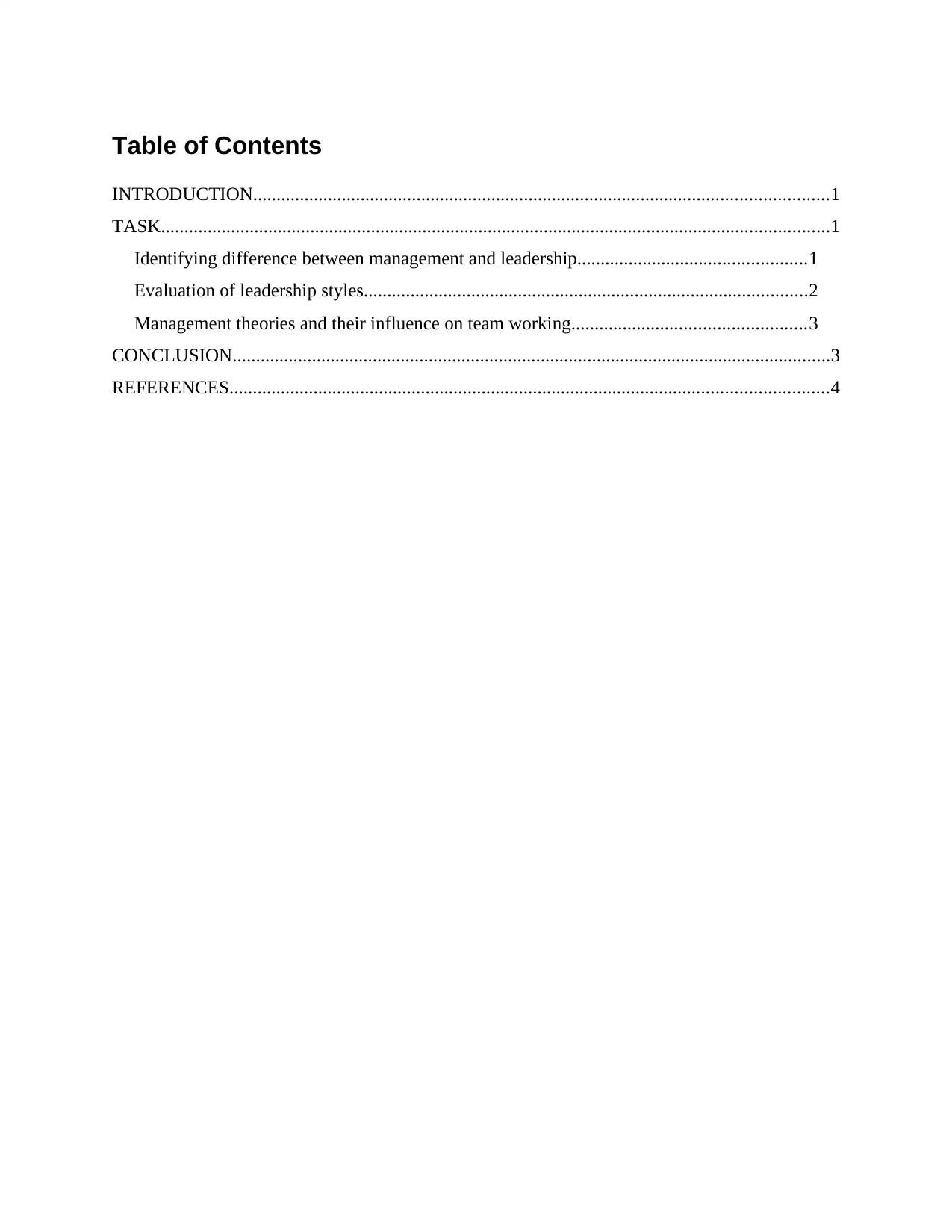
Table of Contents
INTRODUCTION...........................................................................................................................1
TASK...............................................................................................................................................1
Identifying difference between management and leadership.................................................1
Evaluation of leadership styles...............................................................................................2
Management theories and their influence on team working..................................................3
CONCLUSION................................................................................................................................3
REFERENCES................................................................................................................................4
Document Page
INTRODUCTION
Perspective is referred to an approach in one thinks and and operates largely relies upon
the beliefs and experiences of an individual. A management and leadership in an organisation
possess distinct perspectives and manner in which they wish to carry out their operations (Dinh
and et. al., 2014). This assignment focuses on H&M which is a private sector organisation
dealing in fulfilling clothing needs of people. This report will focus on identifying difference
between management and leadership perspectives in an organisation. The leadership styles will
be discussed critically discussed along with understanding of concepts of management theory
through self reflective approaches.
TASK
Identifying difference between management and leadership
The concepts of leadership and management overlaps quite often however there lies
major difference in how they are perceived by people. The perspective of a executive member of
H&M revolves around formulating of decision which are best suited to an organisation (Thomas,
2015). Along with formulating regular decision they are bound to produce strategy relating to
short and long term business approach. The management approach can also be perceived on how
managers working with retail organisation get the best performance out of their employees. On
the other hand leader utilises his belief and experience to make sure that employees are directed
in right directions. The tool of motivation is emphasized by leader so that employees are assisted
to perform ideally and achieve personal and professional targets (Doh and Quigley, 2014). The
manager working in business are persuaded to achieve ideal management and leadership skills so
that performance based outcomes of business are uplifted.
The historical stance of leadership and management of H&M can be traced back to the
year 1880 when Frederick Taylor emphasized on scientific management in an organisation. It
intended to apply scientific approaches while dealing with members in an organisation so that
better results could be availed (Management Theory of Frederick Taylor, 2018). In 1954,
hierarchy of needs popularised by Abraham Maslow defined new measures through employee
motivation and commitment could be achieved. Since then concepts of leadership and
management were on the horizon as improved results were ascertained by business. The
difference between leadership and management can be identified while dealing with employees
in an organisation. Leadership is opting for leading by example whereas management aim to
1
Document Page
supervise and manipulate their efforts so that better results could be achieved. Therefore it is
essential for managers to possess some extent of leadership tactics so that complex business
situation can be dealt in an effective manner producing outstanding results.
Evaluation of leadership styles
There are numerous approaches to leadership are present in a contemporary business
environment. Leaders are provided with heavy responsibility to manage distinct business
resources and environment so that favourable results could be produced. It is seen that approach
to leadership determines where goals and targets will be achieved or not. The evaluation of
different leadership styles which exist in the contemporary environment so that best or most
suitable measure to business could be identified and practiced by a manager.
At first, there are classical leadership styles which are simpler and commonly adopted in
business environment. The major leadership styles are Autocratic, democratic and laissez-faire.
In autocratic approach there is a centralised control and there is rapidness while formulating
decisions (Head and Alford, 2015). It is more of dictatorship which is not entertained within
organisation any-more as sentimental value of people tend to get hurt. Leaders in H&M
emphasize towards democratic approaches of carrying out of tasks. The reason for the same is
that employees in the organisation feel empowered and valued as they are involved in the
decision making process. The one thing that lacks in this approach is that processes and decisions
which are formulated takes time and cannot be achieved in a rapid manner. The least emphasized
is laissez-faire leadership style in which people are left on free play of forces and are not direct at
all. The people are empowered to be responsible and accountable for decisions which are being
formulated by them. Managers who are less experienced fails to manage organisation in the right
manner due to absence of proper guidance and supervision. Therefore H&M assures that an
individual is capable and experienced before awarding him post of a manager.
However there is presence of contemporary leadership approaches which relies upon
Vision, coaching and pace setting of members working for business. There is an increased
emphasis on manner in which employees are managed and commanded in the business. The
contemporary approach are a right mix of empowering and guiding them so that consumers are
served in an justified and creative manner.
2
tabler-icon-diamond-filled.svg

Paraphrase This Document

Need a fresh take? Get an instant paraphrase of this document with our AI Paraphraser
Document Page
Management theories and their influence on team working
Management theory defines the manner in which data is collected and ensured that right
business decisions are taken. The purpose of theory is to ensure that better productivity could be
attained through ideal management of resources and factor of production. H&M have takes
assistance from management theory so that customers are served with improved quality of
products and services offered. The organisation most often employs a combination of theories
and concepts depending upon circumstances of business. The crucial management theories are
mentioned below.
Contingency Theory: this theory states that there is no universal approach of dealing with
particular business circumstances. The manager working with H&M are recommended to
ascertain current situation so that it can be dealt in a right manner (Hempsall, 2014). In a team,
there are different circumstances which can take place therefore it is essential to evaluate
situation so that it can dealt in an ideal manner. For instance: A conflict situation is pretty
common in team working therefore to counter the same it is essential to take into consideration
views and opinion of both parties for its solution.
System theory: this theory perceives business organisation as a system in which there are
numerous factors which affect each other (Renz and Herman, 2016). The managers in this theory
are suggested to examine business circumstances and events at the workplace so that they can be
carried out as desired. Similar is the case in team working where number of distinct personalities
affect working of each other. Therefore manager working with this retail organisation are
recommended to monitor and supervise events and efforts so that collectively better results could
be achieved.
CONCLUSION
It can be concluded from the above report that leadership and management both
constitute as important feature in a business organisation. It not only helps in ideal management
of resources but also helps in achieving better results on behalf of organisation. It has been
identified that both leadership and management are distinct from each other and possess their
own manner of fulfilling objectives of business. It is essential to evaluate circumstances of
business so that most suitable concept and approach could be employed.
3
Document Page
REFERENCES
Books and Journal
Dinh, J. E. and et. al., 2014. Leadership theory and research in the new millennium: Current
theoretical trends and changing perspectives. The Leadership Quarterly. 25(1). pp.36-
62.
Doh, J. P. and Quigley, N. R., 2014. Responsible leadership and stakeholder management:
Influence pathways and organizational outcomes. The Academy of Management
Perspectives. 28(3). pp.255-274.
Head, B. W. and Alford, J., 2015. Wicked problems: Implications for public policy and
management. Administration & Society. 47(6). pp.711-739.
Hempsall, K., 2014. Developing leadership in higher education: Perspectives from the USA, the
UK and Australia. Journal of Higher Education Policy and Management. 36(4). pp.383-
394.
Renz, D. O. and Herman, R. D. eds., 2016. The Jossey-Bass handbook of nonprofit leadership
and management. John Wiley & Sons.
Thomas, T., 2015. Management and leadership for nurse administrators. Jones & Bartlett
Publishers.
Online
Management Theory of Frederick Taylor. 2018. [Online]. Available
through :<https://www.business.com/articles/management-theory-of-frederick-taylor/>.
4
chevron_up_icon
1 out of 6
circle_padding
hide_on_mobile
zoom_out_icon
[object Object]