NZ Diploma in Business: Management, Leadership & Organisations(L7)
VerifiedAdded on 2023/06/11
|23
|6436
|421
Report
AI Summary
This assignment provides a comprehensive overview of key management and leadership theories, focusing on different schools of thought, organizational structures, and motivational approaches. It critically evaluates classical, behavioral, and systems schools of management, comparing functional and divisional organizational structures. The report also explores formal and informal sources of power, traditional and current perspectives on delegation, and principles of vertical and horizontal coordination. Furthermore, it evaluates content and process theories of motivation, compares managerial approaches to motivation, describes management styles, and discusses the relationship between job design and employee motivation. The assignment concludes with a comparison of management and leadership, highlighting different leadership styles. Desklib is a platform where students can find such past papers and solved assignments.

Course qualification NZ Diploma in Business (Level 7)
US/Prescription title: Management, Leadership & Organisations
Course/Paper number: 9735
Student name:
Student ID:
Teacher: Bushra
Assessment type: 1st assignment
Due date: 10/06/2018
Student(s) to complete: Assignment/Report Plagiarism Declaration
For Individual Assignment / Report ONLY
I certify that this is my own work and I have read and
understood the Plagiarism and Dishonest Policy (7.7) of
Abacus Institute of Studies.
I understand that the submission of this form electronically is
the equivalent of me signing my name, in pen, on a paper
assignment cover sheet.
For Group assignments/reports ONLY:
Student name(s) & IDs:
1.
2.
3.
US/Prescription title: Management, Leadership & Organisations
Course/Paper number: 9735
Student name:
Student ID:
Teacher: Bushra
Assessment type: 1st assignment
Due date: 10/06/2018
Student(s) to complete: Assignment/Report Plagiarism Declaration
For Individual Assignment / Report ONLY
I certify that this is my own work and I have read and
understood the Plagiarism and Dishonest Policy (7.7) of
Abacus Institute of Studies.
I understand that the submission of this form electronically is
the equivalent of me signing my name, in pen, on a paper
assignment cover sheet.
For Group assignments/reports ONLY:
Student name(s) & IDs:
1.
2.
3.

Paraphrase This Document
Need a fresh take? Get an instant paraphrase of this document with our AI Paraphraser
1
Table of Contents
1. Management...................................................................................................................................2
1 .1 Critical evaluation of three schools of thought.....................................................................2
1.2 Compare two organizational structures and explain their different design principles.....2
Functional structure vs Divisional structure.................................................................................2
1.3 Formal and informal sources of organizational power, influence and authority...............3
1.4 Compare and contrast traditional and current perspectives of delegation.......................3
1.5 Identify principles of vertical and horizontal coordination....................................................5
2.0 Motivation......................................................................................................................................6
2.1 Evaluating two content theories and two process theories of motivation.........................6
2.2 Comparing two managerial approaches to motivation........................................................9
2.3 Describing two management styles.....................................................................................11
2.4 Explaining relationship between job design and employee motivation...........................12
2.5 Describing impact of job design...........................................................................................13
2.6 Discussing and evaluating ways different social influences affect groups.....................14
3.0 Leadership...................................................................................................................................15
3.1 Comparing and contrasting differences between management and leadership............15
3.2 Describing two leadership styles..........................................................................................16
Reference..........................................................................................................................................17
Table of Contents
1. Management...................................................................................................................................2
1 .1 Critical evaluation of three schools of thought.....................................................................2
1.2 Compare two organizational structures and explain their different design principles.....2
Functional structure vs Divisional structure.................................................................................2
1.3 Formal and informal sources of organizational power, influence and authority...............3
1.4 Compare and contrast traditional and current perspectives of delegation.......................3
1.5 Identify principles of vertical and horizontal coordination....................................................5
2.0 Motivation......................................................................................................................................6
2.1 Evaluating two content theories and two process theories of motivation.........................6
2.2 Comparing two managerial approaches to motivation........................................................9
2.3 Describing two management styles.....................................................................................11
2.4 Explaining relationship between job design and employee motivation...........................12
2.5 Describing impact of job design...........................................................................................13
2.6 Discussing and evaluating ways different social influences affect groups.....................14
3.0 Leadership...................................................................................................................................15
3.1 Comparing and contrasting differences between management and leadership............15
3.2 Describing two leadership styles..........................................................................................16
Reference..........................................................................................................................................17
2
1. Management
1 .1 Critical evaluations of three schools of thought
The classical school of management is established on the premise that
employees have physical and economical needs that they need to satisfy
organization productivity and efficiency. This is through utilizing the ability of
employees to increase output by examining the work process and scrutinizing the
skills of the workforce (Gomez-Mejia, Balkin, & Cardy, 2008). The theories presented
under this school of thought are includes the scientific management based on the
rule of thumb by creating the most efficient way to perform work through the
principles of division of work, authority and responsibility, discipline, unity of
command, unity of direction, subordination of individual interest, remuneration,
degree of centralization, scalar chain, order, equity, stability of tenure, initiative and
striving for excellence. The administrative management theory with the core
elements of utilization of a formalized structure, a clear division of labor, and
delegation of power and authority to administrators relevant to their areas of
responsibilities and bureaucratic management which the efficient and rational way of
organizing human activity through a systematic process and organized hierarchies to
maintain order, maximize efficiency and eliminate favourism. The contribution of
these theories is the ability to find ways of managing work through increasing
efficiency in the workplace thus leading to better results. For these theories, the
output is what matters most. This is the strength that makes the theories more useful
since they focus on results. However, their major weakness is the ability to focus
more on the organization and forget the employees who create the output required
for the organization.
The second school is the behavioral school which arose as a critic to the
classical approach which ignored the interactions and motivation of employees.
Since the classical approach failed to consider the social issues that affect
employees and failed to explain the behavior of employees, the human relations
approach came up as a revolution to address the human dimension of work (Bose,
2012). The theorists propose the need to understand human factors like motivation,
expectations, conflict and group dynamics and how they affect individual productivity.
Such theories include, Maslow’s hierarchy of needs where is organizes the needs
1. Management
1 .1 Critical evaluations of three schools of thought
The classical school of management is established on the premise that
employees have physical and economical needs that they need to satisfy
organization productivity and efficiency. This is through utilizing the ability of
employees to increase output by examining the work process and scrutinizing the
skills of the workforce (Gomez-Mejia, Balkin, & Cardy, 2008). The theories presented
under this school of thought are includes the scientific management based on the
rule of thumb by creating the most efficient way to perform work through the
principles of division of work, authority and responsibility, discipline, unity of
command, unity of direction, subordination of individual interest, remuneration,
degree of centralization, scalar chain, order, equity, stability of tenure, initiative and
striving for excellence. The administrative management theory with the core
elements of utilization of a formalized structure, a clear division of labor, and
delegation of power and authority to administrators relevant to their areas of
responsibilities and bureaucratic management which the efficient and rational way of
organizing human activity through a systematic process and organized hierarchies to
maintain order, maximize efficiency and eliminate favourism. The contribution of
these theories is the ability to find ways of managing work through increasing
efficiency in the workplace thus leading to better results. For these theories, the
output is what matters most. This is the strength that makes the theories more useful
since they focus on results. However, their major weakness is the ability to focus
more on the organization and forget the employees who create the output required
for the organization.
The second school is the behavioral school which arose as a critic to the
classical approach which ignored the interactions and motivation of employees.
Since the classical approach failed to consider the social issues that affect
employees and failed to explain the behavior of employees, the human relations
approach came up as a revolution to address the human dimension of work (Bose,
2012). The theorists propose the need to understand human factors like motivation,
expectations, conflict and group dynamics and how they affect individual productivity.
Such theories include, Maslow’s hierarchy of needs where is organizes the needs
⊘ This is a preview!⊘
Do you want full access?
Subscribe today to unlock all pages.

Trusted by 1+ million students worldwide
3
that employees have from the physiological needs to self-actualization. When an
employee satisfies one need, then they move to the next level of the hierarchy and
Herzberg’s two-factor which focus on motivators and hygiene factors. Motivators are
characteristics of the job that relate to job satisfaction and relate to other factors of
dissatisfaction while hygiene factors are those essential for existence of motivation
workplace. These theories have contributed to management thought through raising
awareness on the need to design open and flexible organizations that focus on the
growth of employees. This led to recognizing the role of employees within the
organization and developing ways that make the organization to accommodate
employee needs thus creating satisfaction. The strength of this school of thought lies
in the need to motivate employees thus through behavioral approaches that lead to
increased outputs. However, the theories have been criticized for lack of
communication on how ideas from employees reach managers thus making it
difficult for the theories to get top management attention.
Lastly, the systems school of thought views the organization as a whole
system with a set of subsystems that work together to achieve harmony. The
effectiveness of the organization depends on the coordination and efficiency
between the subsystems in the organization (Greenberg, 2011). Each part must
function well for the whole organization to work well. The organization can be an
open or closed system depending on the nature or management but the role of
leadership is to increase efficiency in the organization through creating harmony
between the different subsystems. This school contributed to management through
allowing managers to relate different specialties and parts of the organization to one
another and develop ways of coordinating them. One strength of the theory is its
ability to recognize the organization as a system and develop ways of linking
different system to make the organization run. Stability is achieved through proper
functioning of each part of the organization. However, it has been criticized for being
too abstract and complex in managing different elements of the organization.
1.2 Compare two organizational structures and explain their different design
principles.
Functional structure vs Divisional structure
The functional structure allows organizing work in common functions in
bottom-up manner in functional units controlled and coordinated from top level
that employees have from the physiological needs to self-actualization. When an
employee satisfies one need, then they move to the next level of the hierarchy and
Herzberg’s two-factor which focus on motivators and hygiene factors. Motivators are
characteristics of the job that relate to job satisfaction and relate to other factors of
dissatisfaction while hygiene factors are those essential for existence of motivation
workplace. These theories have contributed to management thought through raising
awareness on the need to design open and flexible organizations that focus on the
growth of employees. This led to recognizing the role of employees within the
organization and developing ways that make the organization to accommodate
employee needs thus creating satisfaction. The strength of this school of thought lies
in the need to motivate employees thus through behavioral approaches that lead to
increased outputs. However, the theories have been criticized for lack of
communication on how ideas from employees reach managers thus making it
difficult for the theories to get top management attention.
Lastly, the systems school of thought views the organization as a whole
system with a set of subsystems that work together to achieve harmony. The
effectiveness of the organization depends on the coordination and efficiency
between the subsystems in the organization (Greenberg, 2011). Each part must
function well for the whole organization to work well. The organization can be an
open or closed system depending on the nature or management but the role of
leadership is to increase efficiency in the organization through creating harmony
between the different subsystems. This school contributed to management through
allowing managers to relate different specialties and parts of the organization to one
another and develop ways of coordinating them. One strength of the theory is its
ability to recognize the organization as a system and develop ways of linking
different system to make the organization run. Stability is achieved through proper
functioning of each part of the organization. However, it has been criticized for being
too abstract and complex in managing different elements of the organization.
1.2 Compare two organizational structures and explain their different design
principles.
Functional structure vs Divisional structure
The functional structure allows organizing work in common functions in
bottom-up manner in functional units controlled and coordinated from top level
Paraphrase This Document
Need a fresh take? Get an instant paraphrase of this document with our AI Paraphraser
4
management (Robbins & Judge, 2008). Here, the tasks are organized in a technical
line more rather than product line. On the other hand, the divisional structure has
teams are organized in groups that correspond to the product that the department
benefits the organization. In this structure, a single product has its own line functional
divisions within it that relate to the whole organization (Jacobides., 2017). The
difference between the two structures is the fact that the functional structure
focusses on organizing work along functional areas of the organization while the
divisional structure organizes work along product lines. The number of products that
the organization produces determine the number of divisions that exist.
1.3 Formal and informal sources of organizational power, influence and
authority
Formal power refers to the authority that people have within the organization
that is listed in the organizational chart. On the other hand, informal power exists in
the relationships that people form with each other during their interaction. Such
power is defined by the experience and authority that people have (Lim, Griffiths, &
Sambrook, 2010).
The first source of formal power is the position that one holds which leads to
legitimate power. This is the common source of power and exists in hierarchies
within the organization.
The second source of formal power is coercion which leads to coercive
power. It’s the ability of an individual to influence others through threats, punishment
and sanctions.
Informal power can be acquired through expert power one uses the skills that
they have to influence the authority that they command. The second source of
informal power is referral which is acquired through relationships that people hold
with each other. In an organizational set up people have certain levels of respect that
they have acquired through experience, education or even status.
On the other hand, influence can be achieved through creating of change in
the organization to create the required influence in the organization.
This can also be achieved through personal motivation where the leader helps
employees to connect the sustainable behaviour that the leader wants and their own
personal values through motivation.
management (Robbins & Judge, 2008). Here, the tasks are organized in a technical
line more rather than product line. On the other hand, the divisional structure has
teams are organized in groups that correspond to the product that the department
benefits the organization. In this structure, a single product has its own line functional
divisions within it that relate to the whole organization (Jacobides., 2017). The
difference between the two structures is the fact that the functional structure
focusses on organizing work along functional areas of the organization while the
divisional structure organizes work along product lines. The number of products that
the organization produces determine the number of divisions that exist.
1.3 Formal and informal sources of organizational power, influence and
authority
Formal power refers to the authority that people have within the organization
that is listed in the organizational chart. On the other hand, informal power exists in
the relationships that people form with each other during their interaction. Such
power is defined by the experience and authority that people have (Lim, Griffiths, &
Sambrook, 2010).
The first source of formal power is the position that one holds which leads to
legitimate power. This is the common source of power and exists in hierarchies
within the organization.
The second source of formal power is coercion which leads to coercive
power. It’s the ability of an individual to influence others through threats, punishment
and sanctions.
Informal power can be acquired through expert power one uses the skills that
they have to influence the authority that they command. The second source of
informal power is referral which is acquired through relationships that people hold
with each other. In an organizational set up people have certain levels of respect that
they have acquired through experience, education or even status.
On the other hand, influence can be achieved through creating of change in
the organization to create the required influence in the organization.
This can also be achieved through personal motivation where the leader helps
employees to connect the sustainable behaviour that the leader wants and their own
personal values through motivation.
5
Personal ability is also used to create influence by encouraging personal
sustainability by improving the ability of employees and teaching them new skills.
Another way is the use of social ability where employees are pooled together
to get the solutions to the issues around them and then the leader implements these
suggestions to make him acceptable.
Lastly, authority has several formal ways of gaining it that include contracts or
agency where the individual is given the authority to execute certain decisions in the
organization through and agency relationship with the organization. The contract
defines the level of authority that once can execute.
Another formal source of authority is individual competency which defines the
level of authority that one can hold. Competency goes with skills in executing tasks
which define the level of influence that one has in the organization.
An informal source of authority in an organization is acceptance where others
accept one to have the authority and thus choose to be superior to the one holding
the authority.
The last source of informal authority is environmental factors which create
conditions for increasing and decreasing authority situations in environment. This
makes the environment favourable or less favourable to the one holding authority.
1.4 Compare and contrast traditional and current perspectives of delegation
Traditional
perspective
Current perspective
Delegation
is the act of empowering
to act for another
The traditional
perspective of delegation
was centralized due to a
hierarchical system that
required coordination from
above to increase
decision making and
management of resources
(Gomez-Mejia, Balkin, &
Cardy, 2008). However, it
lacks flexibility and
individual empowerment.
The current perspective of
decentralization disperses
power by allowing open
communication and
knowledge sharing.
Personal ability is also used to create influence by encouraging personal
sustainability by improving the ability of employees and teaching them new skills.
Another way is the use of social ability where employees are pooled together
to get the solutions to the issues around them and then the leader implements these
suggestions to make him acceptable.
Lastly, authority has several formal ways of gaining it that include contracts or
agency where the individual is given the authority to execute certain decisions in the
organization through and agency relationship with the organization. The contract
defines the level of authority that once can execute.
Another formal source of authority is individual competency which defines the
level of authority that one can hold. Competency goes with skills in executing tasks
which define the level of influence that one has in the organization.
An informal source of authority in an organization is acceptance where others
accept one to have the authority and thus choose to be superior to the one holding
the authority.
The last source of informal authority is environmental factors which create
conditions for increasing and decreasing authority situations in environment. This
makes the environment favourable or less favourable to the one holding authority.
1.4 Compare and contrast traditional and current perspectives of delegation
Traditional
perspective
Current perspective
Delegation
is the act of empowering
to act for another
The traditional
perspective of delegation
was centralized due to a
hierarchical system that
required coordination from
above to increase
decision making and
management of resources
(Gomez-Mejia, Balkin, &
Cardy, 2008). However, it
lacks flexibility and
individual empowerment.
The current perspective of
decentralization disperses
power by allowing open
communication and
knowledge sharing.
⊘ This is a preview!⊘
Do you want full access?
Subscribe today to unlock all pages.
Trusted by 1+ million students worldwide
6
Participation
is and act or instance of
participating
Structures specialization
was used as a system of
employee allocation of
duties thus each
employee was supposed
to work in a specialized
line where the only way
for an employee to
participate is through
improvement of efficiency
(Greenberg, 2011). The
system characterizes low
participation since most
decisions are made by top
management.
Current perspective
applies participation at all
levels through information
sharing, training and
development, rewards and
skills.
Decision-making
is a vital component of
small business success.
Decision making is a top-
bottom approach through
the hierarchy system. The
role of decision making is
to improve business
processes by evaluating
alternatives (Gomez-
Mejia, Balkin, & Cardy,
2008).
The current approach
focusses on evaluation of
the existing opportunities
and comparing alternative
solutions to determine the
best approach.
1.5 Identify principles of vertical and horizontal coordination
Coordination is horizontal when it has to be achieved between departments
on the same level in the managerial hierarchy. Vertical coordination is an
arrangement of network wellbeing medical caretakers who fill in as connections
between their levels in the association.
The principle of direct contact which deals with the ways in which activities are
coordinated between different individuals (Bose, 2012).
Participation
is and act or instance of
participating
Structures specialization
was used as a system of
employee allocation of
duties thus each
employee was supposed
to work in a specialized
line where the only way
for an employee to
participate is through
improvement of efficiency
(Greenberg, 2011). The
system characterizes low
participation since most
decisions are made by top
management.
Current perspective
applies participation at all
levels through information
sharing, training and
development, rewards and
skills.
Decision-making
is a vital component of
small business success.
Decision making is a top-
bottom approach through
the hierarchy system. The
role of decision making is
to improve business
processes by evaluating
alternatives (Gomez-
Mejia, Balkin, & Cardy,
2008).
The current approach
focusses on evaluation of
the existing opportunities
and comparing alternative
solutions to determine the
best approach.
1.5 Identify principles of vertical and horizontal coordination
Coordination is horizontal when it has to be achieved between departments
on the same level in the managerial hierarchy. Vertical coordination is an
arrangement of network wellbeing medical caretakers who fill in as connections
between their levels in the association.
The principle of direct contact which deals with the ways in which activities are
coordinated between different individuals (Bose, 2012).
Paraphrase This Document
Need a fresh take? Get an instant paraphrase of this document with our AI Paraphraser
7
The principle of continuity which means that coordination is a never ending activity
that keeps the organization going.
The principle of early start which that requires the coordination activity to be
included in the early phases of planning for organizational activities.
The principle of reciprocal relationships which suggests that all factors in a
reciprocal relationship are related.
The principle of continuity which means that coordination is a never ending activity
that keeps the organization going.
The principle of early start which that requires the coordination activity to be
included in the early phases of planning for organizational activities.
The principle of reciprocal relationships which suggests that all factors in a
reciprocal relationship are related.
8
2.0 Motivation
2.1 Evaluating two content theories and two process theories of motivation
Content theories
Maslow’s hierarchy of needs
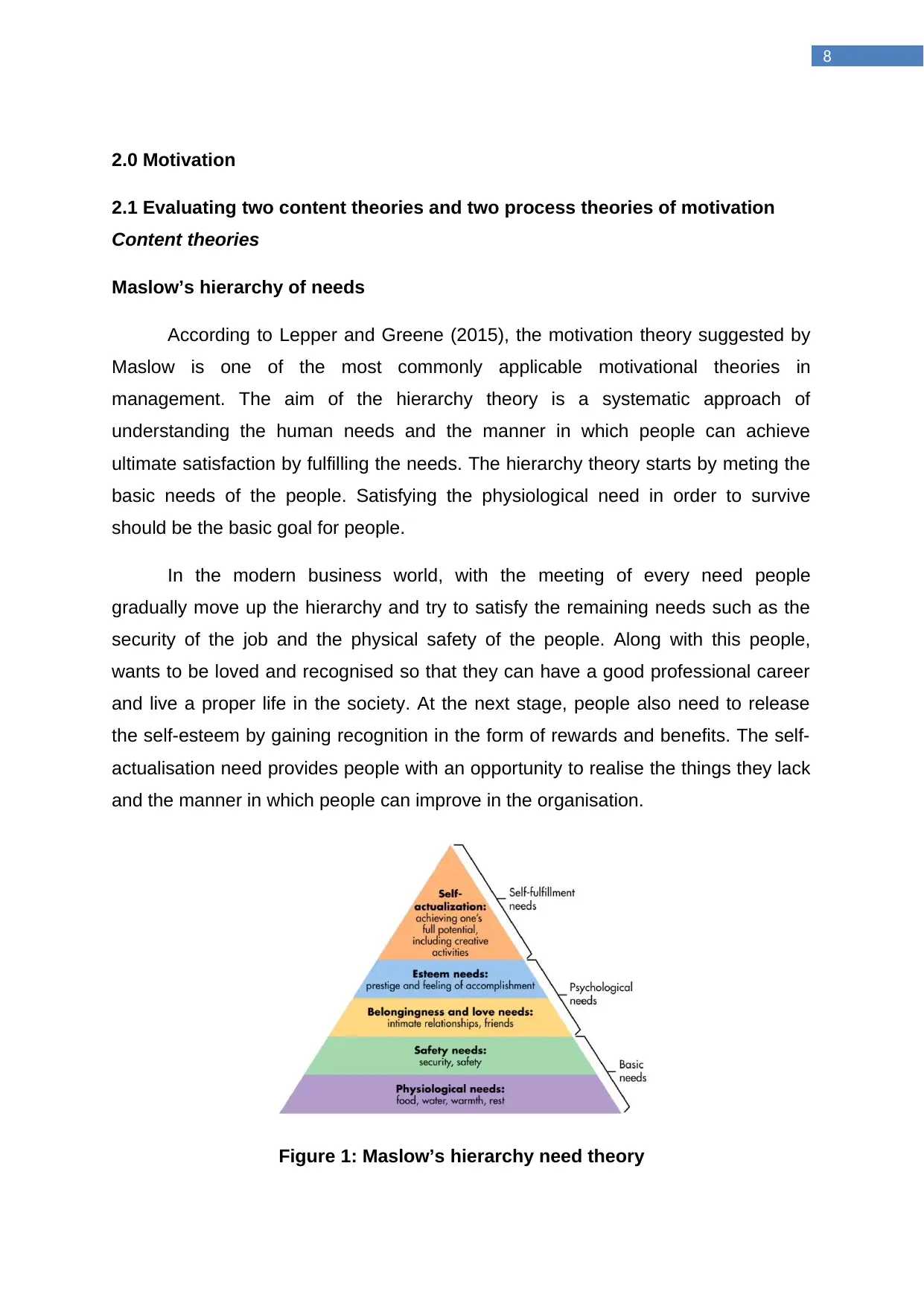
According to Lepper and Greene (2015), the motivation theory suggested by
Maslow is one of the most commonly applicable motivational theories in
management. The aim of the hierarchy theory is a systematic approach of
understanding the human needs and the manner in which people can achieve
ultimate satisfaction by fulfilling the needs. The hierarchy theory starts by meting the
basic needs of the people. Satisfying the physiological need in order to survive
should be the basic goal for people.
In the modern business world, with the meeting of every need people
gradually move up the hierarchy and try to satisfy the remaining needs such as the
security of the job and the physical safety of the people. Along with this people,
wants to be loved and recognised so that they can have a good professional career
and live a proper life in the society. At the next stage, people also need to release
the self-esteem by gaining recognition in the form of rewards and benefits. The self-
actualisation need provides people with an opportunity to realise the things they lack
and the manner in which people can improve in the organisation.
Figure 1: Maslow’s hierarchy need theory
2.0 Motivation
2.1 Evaluating two content theories and two process theories of motivation
Content theories
Maslow’s hierarchy of needs
According to Lepper and Greene (2015), the motivation theory suggested by
Maslow is one of the most commonly applicable motivational theories in
management. The aim of the hierarchy theory is a systematic approach of
understanding the human needs and the manner in which people can achieve
ultimate satisfaction by fulfilling the needs. The hierarchy theory starts by meting the
basic needs of the people. Satisfying the physiological need in order to survive
should be the basic goal for people.
In the modern business world, with the meeting of every need people
gradually move up the hierarchy and try to satisfy the remaining needs such as the
security of the job and the physical safety of the people. Along with this people,
wants to be loved and recognised so that they can have a good professional career
and live a proper life in the society. At the next stage, people also need to release
the self-esteem by gaining recognition in the form of rewards and benefits. The self-
actualisation need provides people with an opportunity to realise the things they lack
and the manner in which people can improve in the organisation.
Figure 1: Maslow’s hierarchy need theory
⊘ This is a preview!⊘
Do you want full access?
Subscribe today to unlock all pages.
Trusted by 1+ million students worldwide
9
(Source: Lepper & Greene, 2015)
Herzberg’s two-factor theory
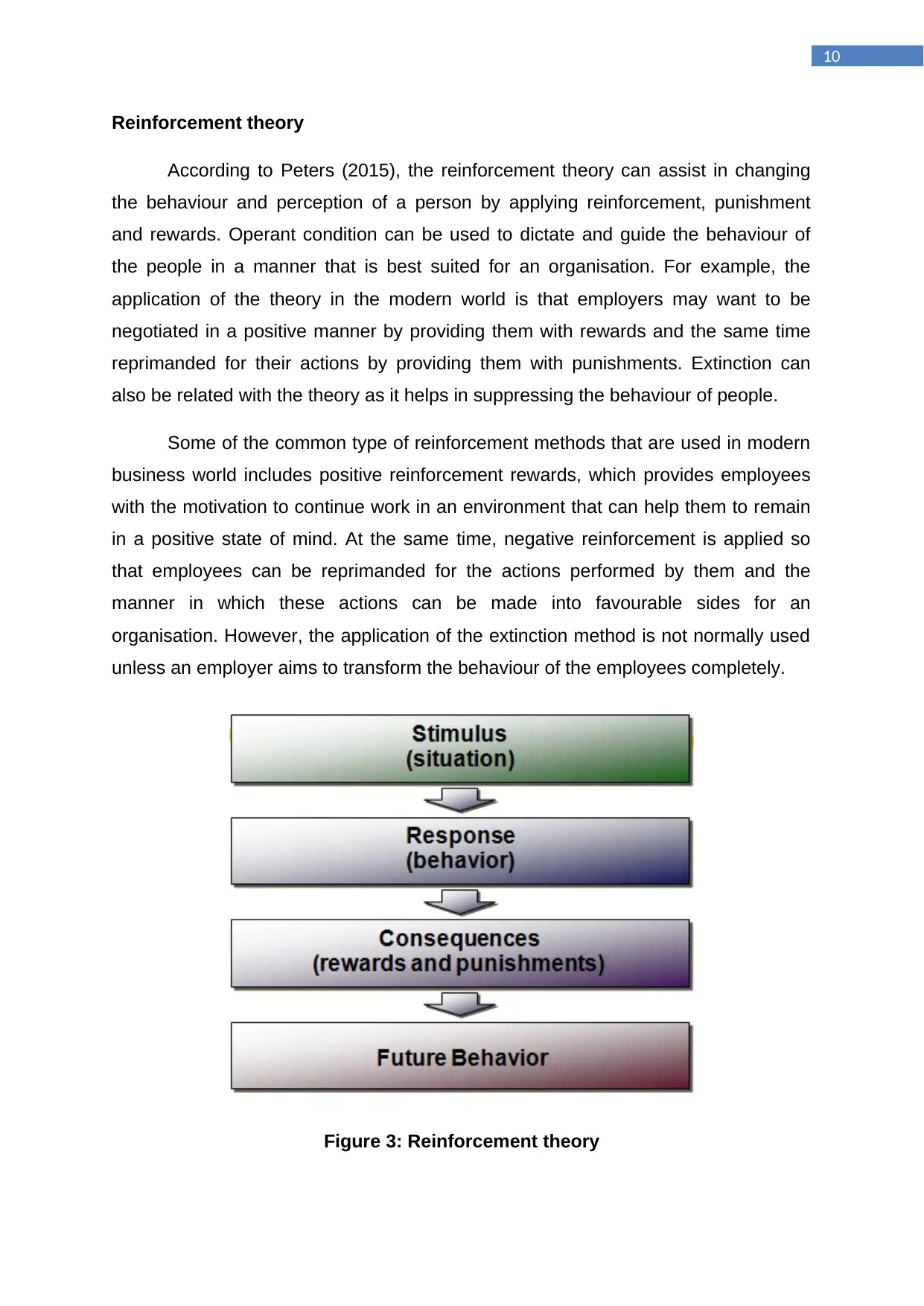
The two-factor theory proposed by Herzberg identifies two important features
that are required for the survival of an employee in an organisation. These include
the hygiene and the motivation factor. The hygiene factors are the job related factors
that are required for motivating people in an organisation. These factors include the
working condition, pay, fringe benefits and status. An employee does not always
require these factors, but the absence of these factors may cause dissatisfaction. As
stated by Reeve (2014) these factors are extrinsic to the work and include other
aspects that guide a company to success such as its policies, supervisory practises
and the amount of salary paid to the employees.
In the modern world, the application of the motivational factors provides
positivity among the people that arise from the type of job that is undertaken by the
employees. These can be related to the fourth and fifth stage of the hierarchical
theory of Maslow and include recognition, achievement and personal growth of the
employees. It can be difficult for employees to continue in an organisation for a long
time without these necessary factors. The motivation factors include recognition,
achievement, growth, promotion, development of skills and responsibility.
Figure 2: Herzberg’s two-factor theory
(Source: Reeve, 2014)
Process theories
(Source: Lepper & Greene, 2015)
Herzberg’s two-factor theory
The two-factor theory proposed by Herzberg identifies two important features
that are required for the survival of an employee in an organisation. These include
the hygiene and the motivation factor. The hygiene factors are the job related factors
that are required for motivating people in an organisation. These factors include the
working condition, pay, fringe benefits and status. An employee does not always
require these factors, but the absence of these factors may cause dissatisfaction. As
stated by Reeve (2014) these factors are extrinsic to the work and include other
aspects that guide a company to success such as its policies, supervisory practises
and the amount of salary paid to the employees.
In the modern world, the application of the motivational factors provides
positivity among the people that arise from the type of job that is undertaken by the
employees. These can be related to the fourth and fifth stage of the hierarchical
theory of Maslow and include recognition, achievement and personal growth of the
employees. It can be difficult for employees to continue in an organisation for a long
time without these necessary factors. The motivation factors include recognition,
achievement, growth, promotion, development of skills and responsibility.
Figure 2: Herzberg’s two-factor theory
(Source: Reeve, 2014)
Process theories
Paraphrase This Document
Need a fresh take? Get an instant paraphrase of this document with our AI Paraphraser
10
Reinforcement theory
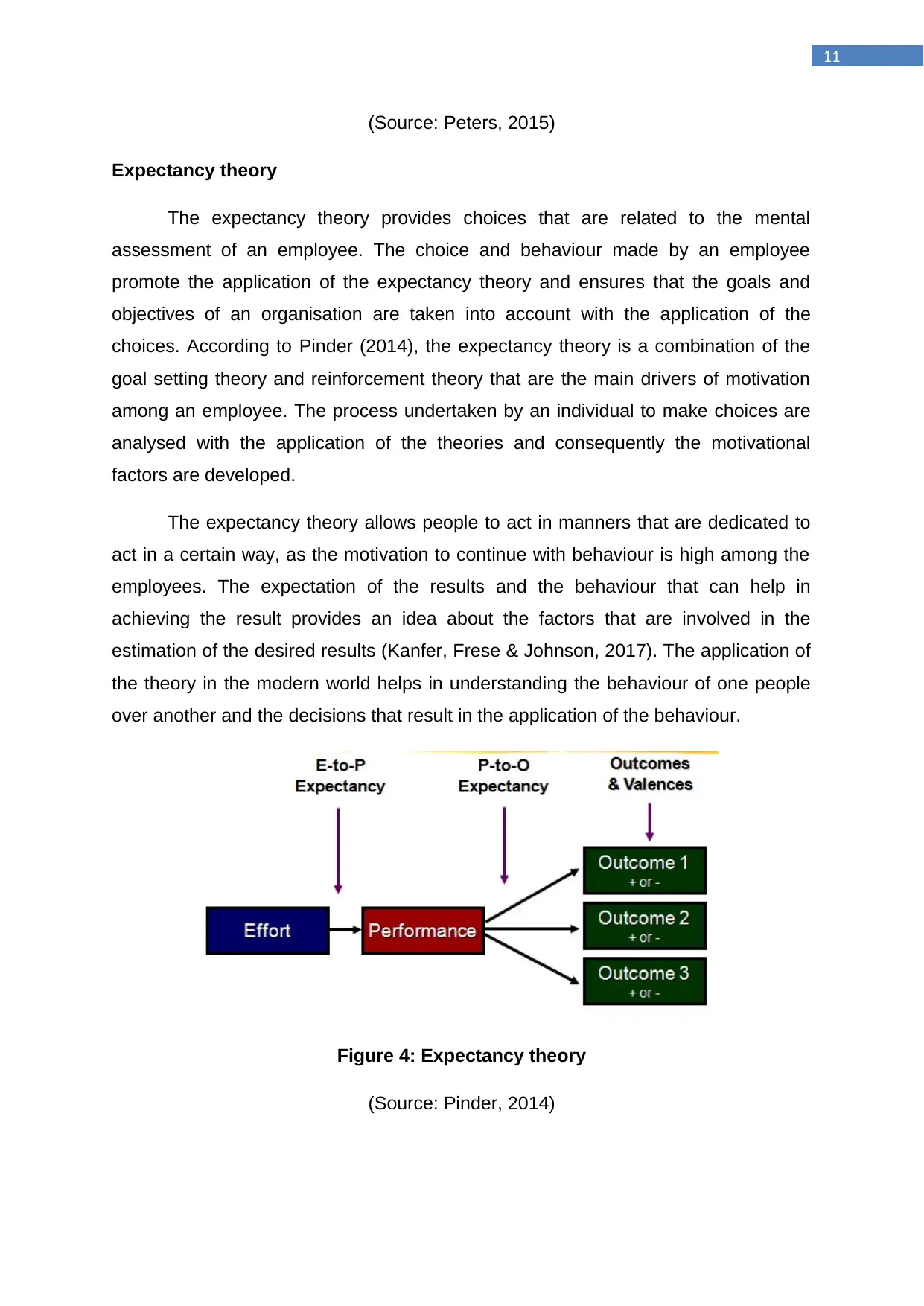
According to Peters (2015), the reinforcement theory can assist in changing
the behaviour and perception of a person by applying reinforcement, punishment
and rewards. Operant condition can be used to dictate and guide the behaviour of
the people in a manner that is best suited for an organisation. For example, the
application of the theory in the modern world is that employers may want to be
negotiated in a positive manner by providing them with rewards and the same time
reprimanded for their actions by providing them with punishments. Extinction can
also be related with the theory as it helps in suppressing the behaviour of people.
Some of the common type of reinforcement methods that are used in modern
business world includes positive reinforcement rewards, which provides employees
with the motivation to continue work in an environment that can help them to remain
in a positive state of mind. At the same time, negative reinforcement is applied so
that employees can be reprimanded for the actions performed by them and the
manner in which these actions can be made into favourable sides for an
organisation. However, the application of the extinction method is not normally used
unless an employer aims to transform the behaviour of the employees completely.
Figure 3: Reinforcement theory
Reinforcement theory
According to Peters (2015), the reinforcement theory can assist in changing
the behaviour and perception of a person by applying reinforcement, punishment
and rewards. Operant condition can be used to dictate and guide the behaviour of
the people in a manner that is best suited for an organisation. For example, the
application of the theory in the modern world is that employers may want to be
negotiated in a positive manner by providing them with rewards and the same time
reprimanded for their actions by providing them with punishments. Extinction can
also be related with the theory as it helps in suppressing the behaviour of people.
Some of the common type of reinforcement methods that are used in modern
business world includes positive reinforcement rewards, which provides employees
with the motivation to continue work in an environment that can help them to remain
in a positive state of mind. At the same time, negative reinforcement is applied so
that employees can be reprimanded for the actions performed by them and the
manner in which these actions can be made into favourable sides for an
organisation. However, the application of the extinction method is not normally used
unless an employer aims to transform the behaviour of the employees completely.
Figure 3: Reinforcement theory
11
(Source: Peters, 2015)
Expectancy theory
The expectancy theory provides choices that are related to the mental
assessment of an employee. The choice and behaviour made by an employee
promote the application of the expectancy theory and ensures that the goals and
objectives of an organisation are taken into account with the application of the
choices. According to Pinder (2014), the expectancy theory is a combination of the
goal setting theory and reinforcement theory that are the main drivers of motivation
among an employee. The process undertaken by an individual to make choices are
analysed with the application of the theories and consequently the motivational
factors are developed.
The expectancy theory allows people to act in manners that are dedicated to
act in a certain way, as the motivation to continue with behaviour is high among the
employees. The expectation of the results and the behaviour that can help in
achieving the result provides an idea about the factors that are involved in the
estimation of the desired results (Kanfer, Frese & Johnson, 2017). The application of
the theory in the modern world helps in understanding the behaviour of one people
over another and the decisions that result in the application of the behaviour.
Figure 4: Expectancy theory
(Source: Pinder, 2014)
(Source: Peters, 2015)
Expectancy theory
The expectancy theory provides choices that are related to the mental
assessment of an employee. The choice and behaviour made by an employee
promote the application of the expectancy theory and ensures that the goals and
objectives of an organisation are taken into account with the application of the
choices. According to Pinder (2014), the expectancy theory is a combination of the
goal setting theory and reinforcement theory that are the main drivers of motivation
among an employee. The process undertaken by an individual to make choices are
analysed with the application of the theories and consequently the motivational
factors are developed.
The expectancy theory allows people to act in manners that are dedicated to
act in a certain way, as the motivation to continue with behaviour is high among the
employees. The expectation of the results and the behaviour that can help in
achieving the result provides an idea about the factors that are involved in the
estimation of the desired results (Kanfer, Frese & Johnson, 2017). The application of
the theory in the modern world helps in understanding the behaviour of one people
over another and the decisions that result in the application of the behaviour.
Figure 4: Expectancy theory
(Source: Pinder, 2014)
⊘ This is a preview!⊘
Do you want full access?
Subscribe today to unlock all pages.
Trusted by 1+ million students worldwide

1 out of 23


Related Documents


Your All-in-One AI-Powered Toolkit for Academic Success.
+13062052269
info@desklib.com
Available 24*7 on WhatsApp / Email
![[object Object]](/_next/static/media/star-bottom.7253800d.svg)
Unlock your academic potential
Copyright © 2020–2026 A2Z Services. All Rights Reserved. Developed and managed by ZUCOL.