Leadership, Management and Operations: A Comprehensive Report
VerifiedAdded on 2020/10/22
|14
|4313
|316
Report
AI Summary
This report delves into the distinct roles and responsibilities of leaders and managers within an organization, emphasizing their collaborative efforts in driving business growth and achieving strategic objectives. It explores the core functions of managers, such as systematic work execution and strategy implementation, alongside the leader's role in employee motivation and productivity enhancement. The report further examines how these functions are applied in diverse situations, supported by various theories and models, including leadership traits, situational leadership, and contingency theory. A case study on Marks and Spencer (M&S) is used to illustrate the practical application of these concepts, highlighting the importance of operational management and the impact of external factors on decision-making. The analysis includes the strengths and weaknesses of different leadership approaches, providing a comprehensive overview of effective leadership and management practices in the retail sector.
Management and Operations

Paraphrase This Document
Need a fresh take? Get an instant paraphrase of this document with our AI Paraphraser
TABLE OF CONTENTS
INTRODUCTION...........................................................................................................................1
TASK 1............................................................................................................................................1
P1. Roles and characteristics of leader and manager..................................................................1
M1. Difference between leader and manager by applying theories and concepts......................3
P2. The way functions of managers and leaders are applied in different situations...................3
P3. Different theories and models of approach...........................................................................4
M2. Strengths and weakness of different approaches.................................................................6
TASK 2 CASE STUDY .................................................................................................................6
P4. Roles of leaders and managers of Amazon in operations management................................6
P5. Importance of operations management in achieving Amazon business objectives..............7
M3. The way efficiency can be improved by managers and leaders in operational management
.....................................................................................................................................................8
P6. Factors within business environment that impact on Amazon:- ..........................................8
M4. The way different factors affect business environment.....................................................10
CONCLUSION..............................................................................................................................10
REFERENCES..............................................................................................................................11
INTRODUCTION...........................................................................................................................1
TASK 1............................................................................................................................................1
P1. Roles and characteristics of leader and manager..................................................................1
M1. Difference between leader and manager by applying theories and concepts......................3
P2. The way functions of managers and leaders are applied in different situations...................3
P3. Different theories and models of approach...........................................................................4
M2. Strengths and weakness of different approaches.................................................................6
TASK 2 CASE STUDY .................................................................................................................6
P4. Roles of leaders and managers of Amazon in operations management................................6
P5. Importance of operations management in achieving Amazon business objectives..............7
M3. The way efficiency can be improved by managers and leaders in operational management
.....................................................................................................................................................8
P6. Factors within business environment that impact on Amazon:- ..........................................8
M4. The way different factors affect business environment.....................................................10
CONCLUSION..............................................................................................................................10
REFERENCES..............................................................................................................................11
INTRODUCTION
Managers and leader perform different types of roles and responsibilities in an
organisation. The growth and development of business is on their shoulders. Their main role is to
develop and implement strategies so that goals and objectives can be achieved (Caniani and
Mannina, 2015). Besides this, manager ensures that work is being done in a systematic way,
whereas, leader’s main role is to motivate employees so that their productivity can be enhanced.
Manager and leader have to work together in order to maintain efficiency and growth. In this
report, roles and characteristics of leader and manager are described. Also, the way functions are
applied in different situations with the help of theories and models are described. Moreover, the
importance of operational management and factors that impact decision making are studied. For
this present report organisation selected is Marks and Spencer. It belongs to retail sector and
operates globally.
TASK 1
P1. Roles and characteristics of leader and manager
Management- Henry Fayol said that management is a process to forecast, plan and organise
activities.
Leadership- It is the ability of individual to influence people or team within an organisation.
Managers and leaders in an organisation plays a crucial role that will help in suitable rise
in the overall operations of company (Jacobs, Chase and Lummus, 2014). They will see through
the better handling of the operations that will see through the better management of the
operations that will support a good growth and development of operational capability of the
organisation. Some major roles and responsibilities of the business organisations are as follows:
Roles and responsibilities of managers:
They will see through the effective handling of the operations and will see through a
good rise in effectiveness of the operations of the company. Managers will see through
adoption of innovative measures that will improve the quality of operations followed by
firm.
Managers and leader perform different types of roles and responsibilities in an
organisation. The growth and development of business is on their shoulders. Their main role is to
develop and implement strategies so that goals and objectives can be achieved (Caniani and
Mannina, 2015). Besides this, manager ensures that work is being done in a systematic way,
whereas, leader’s main role is to motivate employees so that their productivity can be enhanced.
Manager and leader have to work together in order to maintain efficiency and growth. In this
report, roles and characteristics of leader and manager are described. Also, the way functions are
applied in different situations with the help of theories and models are described. Moreover, the
importance of operational management and factors that impact decision making are studied. For
this present report organisation selected is Marks and Spencer. It belongs to retail sector and
operates globally.
TASK 1
P1. Roles and characteristics of leader and manager
Management- Henry Fayol said that management is a process to forecast, plan and organise
activities.
Leadership- It is the ability of individual to influence people or team within an organisation.
Managers and leaders in an organisation plays a crucial role that will help in suitable rise
in the overall operations of company (Jacobs, Chase and Lummus, 2014). They will see through
the better handling of the operations that will see through the better management of the
operations that will support a good growth and development of operational capability of the
organisation. Some major roles and responsibilities of the business organisations are as follows:
Roles and responsibilities of managers:
They will see through the effective handling of the operations and will see through a
good rise in effectiveness of the operations of the company. Managers will see through
adoption of innovative measures that will improve the quality of operations followed by
firm.
⊘ This is a preview!⊘
Do you want full access?
Subscribe today to unlock all pages.

Trusted by 1+ million students worldwide
Management will act as interlink between the employees and the top management of the
firm that will help in good rise in effectiveness of the operations (Lindström and
Ylinenpää, 2015) A good interpersonal communication will help in superior rise in the
functional capability of the operations which will support a good rise in effectiveness of
the operations of the company.
They motivate the work force of the firm to execute the operations of the company in an
effective and with efficiency. This will improve the operational capacity of the firm and
generate a good revenue and operations of the company.
They will manage the various needs and requirements of their customers as well as the
stake holders that will help in a good rise in operational functionality of the firm and
improve the productivity and revenue generation of the firm (Abapour and Abapour,
2015).
Roles and responsibilities of leaders:
A leader will provide the essential guidance and motivation to the work force that will
help in a good rise in operations and meeting of their targeted goals in a better way.
They will look after the better assessment of the various needs and requirements of their
team members and thus will help in suitable growth and development of the different
functions that are been taken in consideration by the firm.
They will assess the risk factors and will look after the different measures that will help
in better mitigation of these risks that will help in a good rise in operations of the
company (Hirayama and Morishima, 2014).
Apart from this, they will tell the company's management to take in consideration various
innovative measures and steps to improve the operations and maintain the sustainability
of the company.
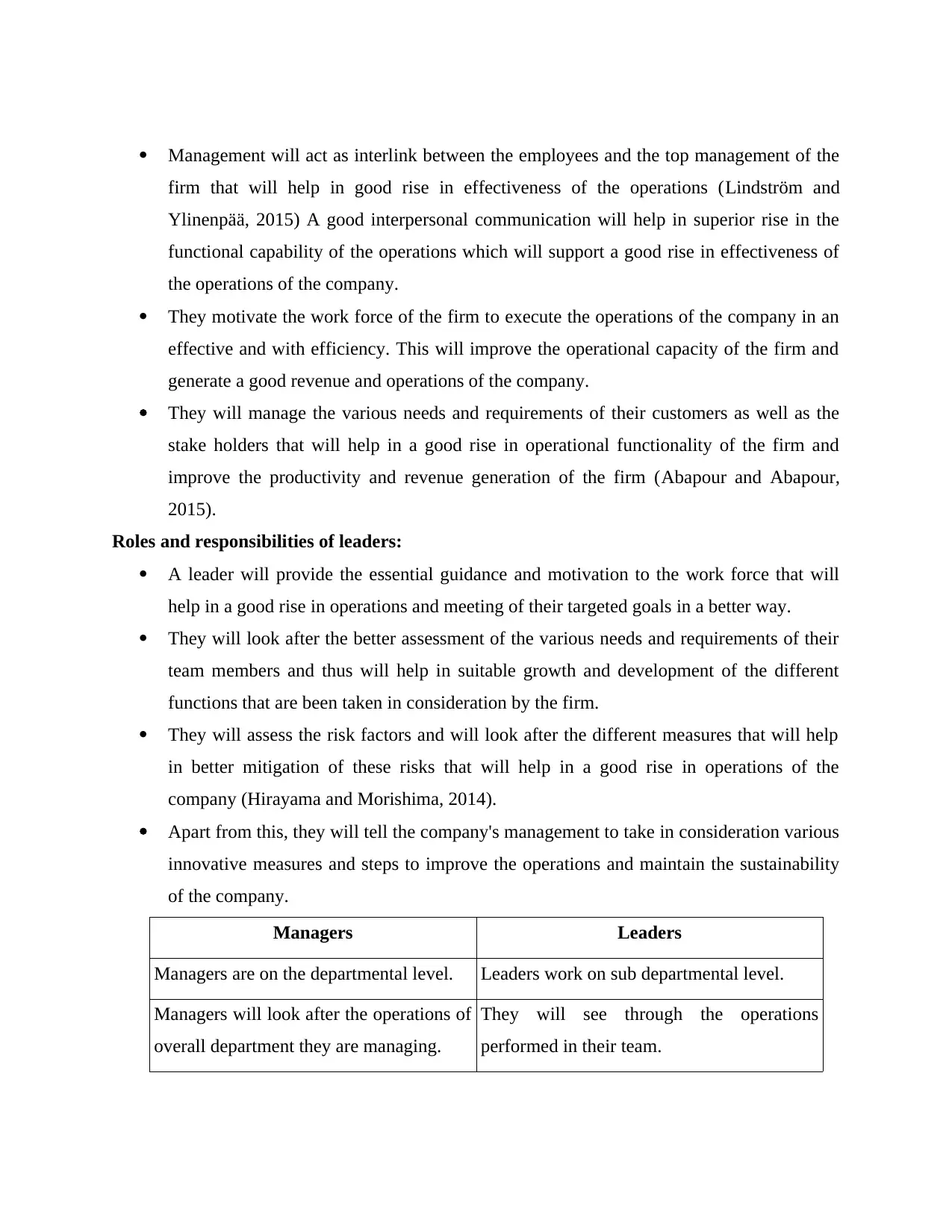
Managers Leaders
Managers are on the departmental level. Leaders work on sub departmental level.
Managers will look after the operations of
overall department they are managing.
They will see through the operations
performed in their team.
firm that will help in good rise in effectiveness of the operations (Lindström and
Ylinenpää, 2015) A good interpersonal communication will help in superior rise in the
functional capability of the operations which will support a good rise in effectiveness of
the operations of the company.
They motivate the work force of the firm to execute the operations of the company in an
effective and with efficiency. This will improve the operational capacity of the firm and
generate a good revenue and operations of the company.
They will manage the various needs and requirements of their customers as well as the
stake holders that will help in a good rise in operational functionality of the firm and
improve the productivity and revenue generation of the firm (Abapour and Abapour,
2015).
Roles and responsibilities of leaders:
A leader will provide the essential guidance and motivation to the work force that will
help in a good rise in operations and meeting of their targeted goals in a better way.
They will look after the better assessment of the various needs and requirements of their
team members and thus will help in suitable growth and development of the different
functions that are been taken in consideration by the firm.
They will assess the risk factors and will look after the different measures that will help
in better mitigation of these risks that will help in a good rise in operations of the
company (Hirayama and Morishima, 2014).
Apart from this, they will tell the company's management to take in consideration various
innovative measures and steps to improve the operations and maintain the sustainability
of the company.
Managers Leaders
Managers are on the departmental level. Leaders work on sub departmental level.
Managers will look after the operations of
overall department they are managing.
They will see through the operations
performed in their team.
Paraphrase This Document
Need a fresh take? Get an instant paraphrase of this document with our AI Paraphraser
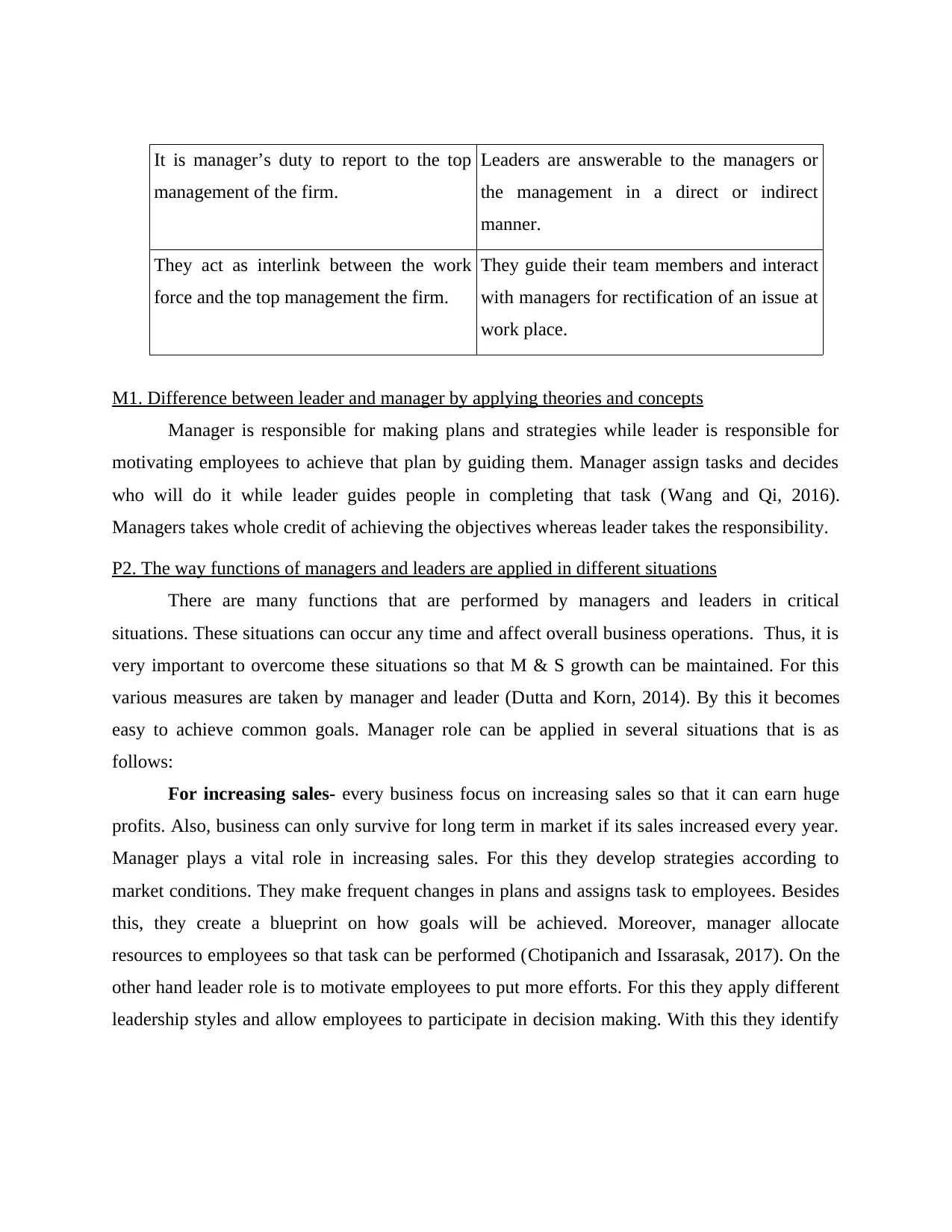
It is manager’s duty to report to the top
management of the firm.
Leaders are answerable to the managers or
the management in a direct or indirect
manner.
They act as interlink between the work
force and the top management the firm.
They guide their team members and interact
with managers for rectification of an issue at
work place.
M1. Difference between leader and manager by applying theories and concepts
Manager is responsible for making plans and strategies while leader is responsible for
motivating employees to achieve that plan by guiding them. Manager assign tasks and decides
who will do it while leader guides people in completing that task (Wang and Qi, 2016).
Managers takes whole credit of achieving the objectives whereas leader takes the responsibility.
P2. The way functions of managers and leaders are applied in different situations
There are many functions that are performed by managers and leaders in critical
situations. These situations can occur any time and affect overall business operations. Thus, it is
very important to overcome these situations so that M & S growth can be maintained. For this
various measures are taken by manager and leader (Dutta and Korn, 2014). By this it becomes
easy to achieve common goals. Manager role can be applied in several situations that is as
follows:
For increasing sales- every business focus on increasing sales so that it can earn huge
profits. Also, business can only survive for long term in market if its sales increased every year.
Manager plays a vital role in increasing sales. For this they develop strategies according to
market conditions. They make frequent changes in plans and assigns task to employees. Besides
this, they create a blueprint on how goals will be achieved. Moreover, manager allocate
resources to employees so that task can be performed (Chotipanich and Issarasak, 2017). On the
other hand leader role is to motivate employees to put more efforts. For this they apply different
leadership styles and allow employees to participate in decision making. With this they identify
management of the firm.
Leaders are answerable to the managers or
the management in a direct or indirect
manner.
They act as interlink between the work
force and the top management the firm.
They guide their team members and interact
with managers for rectification of an issue at
work place.
M1. Difference between leader and manager by applying theories and concepts
Manager is responsible for making plans and strategies while leader is responsible for
motivating employees to achieve that plan by guiding them. Manager assign tasks and decides
who will do it while leader guides people in completing that task (Wang and Qi, 2016).
Managers takes whole credit of achieving the objectives whereas leader takes the responsibility.
P2. The way functions of managers and leaders are applied in different situations
There are many functions that are performed by managers and leaders in critical
situations. These situations can occur any time and affect overall business operations. Thus, it is
very important to overcome these situations so that M & S growth can be maintained. For this
various measures are taken by manager and leader (Dutta and Korn, 2014). By this it becomes
easy to achieve common goals. Manager role can be applied in several situations that is as
follows:
For increasing sales- every business focus on increasing sales so that it can earn huge
profits. Also, business can only survive for long term in market if its sales increased every year.
Manager plays a vital role in increasing sales. For this they develop strategies according to
market conditions. They make frequent changes in plans and assigns task to employees. Besides
this, they create a blueprint on how goals will be achieved. Moreover, manager allocate
resources to employees so that task can be performed (Chotipanich and Issarasak, 2017). On the
other hand leader role is to motivate employees to put more efforts. For this they apply different
leadership styles and allow employees to participate in decision making. With this they identify
strength of each and accordingly guides them. Along with this, leader provides them a direction
that makes it easy to attain goals of M & S.
Product development- Business needs to make continuous development in their
products so that it can attract large number of people. Product development also helps in gaining
more market share and increasing sales. Change in taste and preference of customer forces M &
S to diversify their product range. In this manager assigns new roles and duties to employees.
They set standards so that performance is measured. Moreover, they develop strategies and set
short term goals (Loucks and Van Beek, 2017). While leaders try to build relationship with
stakeholders to make them aware about new products. This makes it easy for M & S to sell their
product in the market. Leader also create product demand.
To implement change – It is very difficult for business to implement change. It is
because in this overall business process and methods are changed. This also leads to change in
role and responsibilities of employees. For this they have to completely depend on managers and
leaders. To implement change manager defines new roles and methods through which task will
be completed (Lei, Xiaoxue and Li, 2014). They provide training to employee to implement
change. Moreover, procedures are created for communication between employees and
management. Whereas leaders on encourage employees to adopt changes. They help and guide
employees in implementing change. Also, leaders find out new ways of completing task.
Furthermore, they continuously communicate with employees and takes effective decisions.
P3. Different theories and models of approach
Manager and leader follows different theories and models according to business
situations. This helps in managing operations during critical situations. Also, models and theories
guides leaders on how it can be applied. There are different models that are as follows:-
Leadership traits – This model contains a scale on which traits of leaders are defined.
These traits are used to measure the leadership style of particular leader. On this basis points are
given to according to their skills and abilities (Strande and Brdjanovic, 2014). If leader has
achieved high points then relationship is defined as good where low points which means poor
relationship. There are two concepts in this that are relationship and task oriented leaders.
that makes it easy to attain goals of M & S.
Product development- Business needs to make continuous development in their
products so that it can attract large number of people. Product development also helps in gaining
more market share and increasing sales. Change in taste and preference of customer forces M &
S to diversify their product range. In this manager assigns new roles and duties to employees.
They set standards so that performance is measured. Moreover, they develop strategies and set
short term goals (Loucks and Van Beek, 2017). While leaders try to build relationship with
stakeholders to make them aware about new products. This makes it easy for M & S to sell their
product in the market. Leader also create product demand.
To implement change – It is very difficult for business to implement change. It is
because in this overall business process and methods are changed. This also leads to change in
role and responsibilities of employees. For this they have to completely depend on managers and
leaders. To implement change manager defines new roles and methods through which task will
be completed (Lei, Xiaoxue and Li, 2014). They provide training to employee to implement
change. Moreover, procedures are created for communication between employees and
management. Whereas leaders on encourage employees to adopt changes. They help and guide
employees in implementing change. Also, leaders find out new ways of completing task.
Furthermore, they continuously communicate with employees and takes effective decisions.
P3. Different theories and models of approach
Manager and leader follows different theories and models according to business
situations. This helps in managing operations during critical situations. Also, models and theories
guides leaders on how it can be applied. There are different models that are as follows:-
Leadership traits – This model contains a scale on which traits of leaders are defined.
These traits are used to measure the leadership style of particular leader. On this basis points are
given to according to their skills and abilities (Strande and Brdjanovic, 2014). If leader has
achieved high points then relationship is defined as good where low points which means poor
relationship. There are two concepts in this that are relationship and task oriented leaders.
⊘ This is a preview!⊘
Do you want full access?
Subscribe today to unlock all pages.
Trusted by 1+ million students worldwide
Relationship oriented leaders first develop relationship with employees than complete task while
task oriented fist complete task and then build relationship with employees.
Situational leadership style – This style is completely based on situations of company.
In this leaders can change their style that makes flexible. It also enhances leader’s skills and
knowledge. Along with this, it helps in taking effective decisions.
Autocratic style – In this style leader takes every decision alone. Employees are not
allowed to participate in decision making process. Also, decision taken has to be followed by
employees. This directly affects employee performance as it restricts them to work in creative
way. They are not allowed to make their own decisions.
Democratic style – It is a style in which there is a lot of employees participation (Parisio,
Rikos and Glielmo, 2016). Leaders allows employee to participate in decisions making process
so that each employee can be assigned task according to their skills and abilities. It also allows
employees to share their views and thoughts so that changes be made accordingly. It helps
leaders to identify specific problems so that solutions can be made to solve it. Basically, in this
final decision is taken leader. Moreover, this style is applied when change has to be implemented
in organisation.
Blanchard and heresy theory- It consists of four styles that can be used according to
situations. These are as follows:- Telling style – In this leader supervises a team by guiding and directing them.
Sometimes, leader does not involve in decision making as team members are experienced
enough and they know what they have to do. Selling- Leader is more closely engaged with team members so that they can help them
to compete their task (Caniani and Mannina, 2015). This style focuses on increasing
cooperation among employees. Participating – It is similar to participative style. But in this employees takes the final
decision under the guidance of leader.
Delegating- In this leader pass on the responsibility to employees to complete task. This
is done to make them to more responsible towards their role.
task oriented fist complete task and then build relationship with employees.
Situational leadership style – This style is completely based on situations of company.
In this leaders can change their style that makes flexible. It also enhances leader’s skills and
knowledge. Along with this, it helps in taking effective decisions.
Autocratic style – In this style leader takes every decision alone. Employees are not
allowed to participate in decision making process. Also, decision taken has to be followed by
employees. This directly affects employee performance as it restricts them to work in creative
way. They are not allowed to make their own decisions.
Democratic style – It is a style in which there is a lot of employees participation (Parisio,
Rikos and Glielmo, 2016). Leaders allows employee to participate in decisions making process
so that each employee can be assigned task according to their skills and abilities. It also allows
employees to share their views and thoughts so that changes be made accordingly. It helps
leaders to identify specific problems so that solutions can be made to solve it. Basically, in this
final decision is taken leader. Moreover, this style is applied when change has to be implemented
in organisation.
Blanchard and heresy theory- It consists of four styles that can be used according to
situations. These are as follows:- Telling style – In this leader supervises a team by guiding and directing them.
Sometimes, leader does not involve in decision making as team members are experienced
enough and they know what they have to do. Selling- Leader is more closely engaged with team members so that they can help them
to compete their task (Caniani and Mannina, 2015). This style focuses on increasing
cooperation among employees. Participating – It is similar to participative style. But in this employees takes the final
decision under the guidance of leader.
Delegating- In this leader pass on the responsibility to employees to complete task. This
is done to make them to more responsible towards their role.
Paraphrase This Document
Need a fresh take? Get an instant paraphrase of this document with our AI Paraphraser
System leadership style- it is an approach followed by leader in which leader determine the
factors of external environment and relationship among different elements. This approach
clarifies the though on complexity and dynamism of environment and provides a framework for
building ideas.
Contingency theory – it states that there is no best way to lead a company or make decisions.
Instead of it optimal solution is to depend upon the internal and external situation.
M2. Strengths and weakness of different approaches
The situational leadership style is effective if the decisions are solely taken by leaders but
sometimes it may not be effective because the leaders can take decisions for their benefit.
As firm operate in retail sector where change in taste and preference of customers is
constant. So it has to diversify their product range so that more people can be attracted. The
improved quality of product can help in increasing customer satisfaction. It will help in long
term success
TASK 2 CASE STUDY
In the context of given case study there are various approaches to operational
management ion Amazon that are as follows :-
Management by objectives- It stands for management by objectives and implies measuring the
activities of employees in contrast with the objectives of the business concern. Since in this
approach, every employee knows about his or her objectives, the managerial burden is lessened.
Management by objective is an approach that works towards bringing continuous improvement
in the quality of production of Amazon.
Lean production – It is an approach used by management to reduce the cost of goods produced
thus maintaining quality. It can be implemented in all levels of organisation. It generally focuses
on doing things in simple way and better by avoiding waste.
P4. Roles of leaders and managers of Amazon in operations management
The leaders at Amazon will look after the better handling of operations and management
to gain a good productivity and revenue generation (Jacobs, Chase and Lummus, 2014). They
factors of external environment and relationship among different elements. This approach
clarifies the though on complexity and dynamism of environment and provides a framework for
building ideas.
Contingency theory – it states that there is no best way to lead a company or make decisions.
Instead of it optimal solution is to depend upon the internal and external situation.
M2. Strengths and weakness of different approaches
The situational leadership style is effective if the decisions are solely taken by leaders but
sometimes it may not be effective because the leaders can take decisions for their benefit.
As firm operate in retail sector where change in taste and preference of customers is
constant. So it has to diversify their product range so that more people can be attracted. The
improved quality of product can help in increasing customer satisfaction. It will help in long
term success
TASK 2 CASE STUDY
In the context of given case study there are various approaches to operational
management ion Amazon that are as follows :-
Management by objectives- It stands for management by objectives and implies measuring the
activities of employees in contrast with the objectives of the business concern. Since in this
approach, every employee knows about his or her objectives, the managerial burden is lessened.
Management by objective is an approach that works towards bringing continuous improvement
in the quality of production of Amazon.
Lean production – It is an approach used by management to reduce the cost of goods produced
thus maintaining quality. It can be implemented in all levels of organisation. It generally focuses
on doing things in simple way and better by avoiding waste.
P4. Roles of leaders and managers of Amazon in operations management
The leaders at Amazon will look after the better handling of operations and management
to gain a good productivity and revenue generation (Jacobs, Chase and Lummus, 2014). They
will play a crucial role in the execution of operations that will help in suitable rise in operations.
Some major operational management approaches and role of leaders and manager in it is as
follows:
Total quality management: this is an approach of maintaining the overall quality of the
functions as well as the product or services that are been offered by the firm to their customers.
Managers and leaders will play a very deep role in maintaining the TQM at cited retail
enterprise. They will look after the different measures involving the proper utilization of
resources and maintaining the goodness of the product or services they are offering to their
customers (Lindström and Ylinenpää, 2015). This will ensure that the employee's get high
quality product and services and have a good satisfaction level, which will support the rise in
their satisfaction level.
Business process re-engineering - It is a function that is implemented to reduce per unit
cost. Usually, in this the production system is modified and redesigned. With this roles and
responsibilities also changes. Manager role is to plan what task will be done by whom. They
assign roles and duties to each employees. A leader tries to encourage employees to adopt
change. They support by guiding it. Also, employees are given benefits, bonus, etc. if they have
adopted it effectively. Manager at Amazon will try to develop new process so that delivery time
can be reduced. The products can be delivered timely to their customers.
Six Sigma - This method is implemented to improve efficiency of Amazon. It also
enables company in growth and development (Abapour and Abapour, 2015). In this manager has
to identify what changes has occurred and accordingly strategies and plans are developed. They
set goals so that it becomes easy to enhance overall productivity. Leader on other hand
communicate with employees to solve their problems. They also motivate and help them to
accomplish task that are assigned to them.
SMART method- It means Specific, Measurable, Attainable, Relevant and Timely goals.
In this manager monitor employee performance so that weak areas can be improved.
Implementing this helps in improving product quality and reducing cost.
Some major operational management approaches and role of leaders and manager in it is as
follows:
Total quality management: this is an approach of maintaining the overall quality of the
functions as well as the product or services that are been offered by the firm to their customers.
Managers and leaders will play a very deep role in maintaining the TQM at cited retail
enterprise. They will look after the different measures involving the proper utilization of
resources and maintaining the goodness of the product or services they are offering to their
customers (Lindström and Ylinenpää, 2015). This will ensure that the employee's get high
quality product and services and have a good satisfaction level, which will support the rise in
their satisfaction level.
Business process re-engineering - It is a function that is implemented to reduce per unit
cost. Usually, in this the production system is modified and redesigned. With this roles and
responsibilities also changes. Manager role is to plan what task will be done by whom. They
assign roles and duties to each employees. A leader tries to encourage employees to adopt
change. They support by guiding it. Also, employees are given benefits, bonus, etc. if they have
adopted it effectively. Manager at Amazon will try to develop new process so that delivery time
can be reduced. The products can be delivered timely to their customers.
Six Sigma - This method is implemented to improve efficiency of Amazon. It also
enables company in growth and development (Abapour and Abapour, 2015). In this manager has
to identify what changes has occurred and accordingly strategies and plans are developed. They
set goals so that it becomes easy to enhance overall productivity. Leader on other hand
communicate with employees to solve their problems. They also motivate and help them to
accomplish task that are assigned to them.
SMART method- It means Specific, Measurable, Attainable, Relevant and Timely goals.
In this manager monitor employee performance so that weak areas can be improved.
Implementing this helps in improving product quality and reducing cost.
⊘ This is a preview!⊘
Do you want full access?
Subscribe today to unlock all pages.
Trusted by 1+ million students worldwide
P5. Importance of operations management in achieving Amazon business objectives
Business operations are performed to achieve goals and objectives of organisation. The
role of operational management in this is to manage daily operations (Hirayama and Morishima,
2014). They ensure that operations are performed in systematic manner. They emphasize on
increasing productivity so that business can grow and develop. Along with this, it is
To improve productivity – Employees play a vital role in increasing efficiency of
operations. They put more efforts in performing their task. In Amazon management must focus
on improving quality of products so that customer satisfaction level can be increased. This can be
done by modifying methods of production system. It will bring change in way of doing
operations. Employee will be assigned new roles that will enhance their skills and abilities. This
will result in effectively working.
Total quality management – this function of operational management focuses on
improving products, services, etc. so that business can grow (Wang and Qi, 2016). Changing
these will help Amazon to a great extent. It will help in gaining strong competitive advantage in
the market.
Supply chain management – this is the most important operation of Amazon. In
includes the inflow and outflow of raw materials and finished goods in an organisation. If this is
proper then there will smooth flow of operations. Raw materials must be in proper quantity so
that market demand can be met easily. Apart from this, it will be beneficial in improving the
efficiency of production department as well as employees. Moreover, this will lead to proper
communication between suppliers and company.
M3. The way efficiency can be improved by managers and leaders in operational management
This can be done continuously evaluating their performance with the set standards. It will
help in modifying the strategies and taking corrective decisions (Dutta and Korn, 2014). Also, by
providing flexibility in completing task and decision making efficiency can be increased.
P6. Factors within business environment that impact on Amazon:-
Operational management :
Business operations are performed to achieve goals and objectives of organisation. The
role of operational management in this is to manage daily operations (Hirayama and Morishima,
2014). They ensure that operations are performed in systematic manner. They emphasize on
increasing productivity so that business can grow and develop. Along with this, it is
To improve productivity – Employees play a vital role in increasing efficiency of
operations. They put more efforts in performing their task. In Amazon management must focus
on improving quality of products so that customer satisfaction level can be increased. This can be
done by modifying methods of production system. It will bring change in way of doing
operations. Employee will be assigned new roles that will enhance their skills and abilities. This
will result in effectively working.
Total quality management – this function of operational management focuses on
improving products, services, etc. so that business can grow (Wang and Qi, 2016). Changing
these will help Amazon to a great extent. It will help in gaining strong competitive advantage in
the market.
Supply chain management – this is the most important operation of Amazon. In
includes the inflow and outflow of raw materials and finished goods in an organisation. If this is
proper then there will smooth flow of operations. Raw materials must be in proper quantity so
that market demand can be met easily. Apart from this, it will be beneficial in improving the
efficiency of production department as well as employees. Moreover, this will lead to proper
communication between suppliers and company.
M3. The way efficiency can be improved by managers and leaders in operational management
This can be done continuously evaluating their performance with the set standards. It will
help in modifying the strategies and taking corrective decisions (Dutta and Korn, 2014). Also, by
providing flexibility in completing task and decision making efficiency can be increased.
P6. Factors within business environment that impact on Amazon:-
Operational management :
Paraphrase This Document
Need a fresh take? Get an instant paraphrase of this document with our AI Paraphraser
Business decisions are highly affected by several factors within which business operates.
It is because these factors are related to business. Basically, factors can be classified into two that
is internal and external. Internal consists of owner, employees, etc. while external consists of
customers, government, etc. They are discussed as below:-
Owners- These are shareholders of Amazon as they contain voting rights therefore
operational decisions are affected. They develop policies and procedures.
Employees- they perform task in order to achieve goals and objectives of Amazon. If
employees resist any change then it impacts on decisions taken by managers.
Board of Director – They are elected by shareholders. They manage and controls overall
operations of Amazon. goals and objectives are set by them. So change in goals will have
an impact on operations (Chotipanich and Issarasak, 2017).
Culture – organisational culture reflects that how well values and ethics are followed in
Amazon. A change in behaviour of employees will have impact on culture. This will
affect manager in decision making.
Decision making by leader and manager of Amazon:
Business do not have any control on external environment. Change in this will force
Amazon to develop strategies and make modifications in decisions. Moreover, it is very
important for manager to analyse changes so that decisions can be taken accordingly. Failing to
this will result in ineffective decisions that will affect growth of Amazon..
Competitors – They highly affect decisions because strategies, number of competitors,
price, etc. are considered while taking decisions. Each competitor haver their own
policies and strategies (Loucks and Van Beek, 2017). Thus, decisions has to be taken by
analysing these elements.
Customers – By selling products to them Amazon earns profits. So change in taste and
preference or target customer will directly affect decision making. Manager have to
develop new strategies for this.
Government – The laws and policies of government is followed by Amazon. Moreover,
in this there are labour union, agencies that monitors business operations. Thus, any
change in them will force managers in decision making.
It is because these factors are related to business. Basically, factors can be classified into two that
is internal and external. Internal consists of owner, employees, etc. while external consists of
customers, government, etc. They are discussed as below:-
Owners- These are shareholders of Amazon as they contain voting rights therefore
operational decisions are affected. They develop policies and procedures.
Employees- they perform task in order to achieve goals and objectives of Amazon. If
employees resist any change then it impacts on decisions taken by managers.
Board of Director – They are elected by shareholders. They manage and controls overall
operations of Amazon. goals and objectives are set by them. So change in goals will have
an impact on operations (Chotipanich and Issarasak, 2017).
Culture – organisational culture reflects that how well values and ethics are followed in
Amazon. A change in behaviour of employees will have impact on culture. This will
affect manager in decision making.
Decision making by leader and manager of Amazon:
Business do not have any control on external environment. Change in this will force
Amazon to develop strategies and make modifications in decisions. Moreover, it is very
important for manager to analyse changes so that decisions can be taken accordingly. Failing to
this will result in ineffective decisions that will affect growth of Amazon..
Competitors – They highly affect decisions because strategies, number of competitors,
price, etc. are considered while taking decisions. Each competitor haver their own
policies and strategies (Loucks and Van Beek, 2017). Thus, decisions has to be taken by
analysing these elements.
Customers – By selling products to them Amazon earns profits. So change in taste and
preference or target customer will directly affect decision making. Manager have to
develop new strategies for this.
Government – The laws and policies of government is followed by Amazon. Moreover,
in this there are labour union, agencies that monitors business operations. Thus, any
change in them will force managers in decision making.
Partners - It includes firm that are dealing with Amazon change in activities of firm will
influence manager to develop plans.
Suppliers - They are agencies that provide raw materials. Amazon must maintain strong
and better relations with them (Lei, Xiaoxue and Li, 2014). If suppliers are reduced or
increased then manager have to take decisions accordingly. The cited firm will not be
able to achieve its goals and objectives.
M4. The way different factors affect business environment
Leaders and manager develop strategies while considering the external and internal
environment. Any change in these factors affects Amazon operations. Having flexibility in
policies will help in changing them according to the situation. This will lead to better and quick
decision-making and increasing productivity.
CONCLUSION
This report summarises that managers and leader play a crucial role in developing
strategies. They both are having different roles and responsibilities and accordingly, they take
various decisions. Also, there are many functions that are performed by the managers and leaders
in critical situations. These situations can occur any time and affect the overall business
operations. There are different leadership styles and models such as situational, autocratic style
applied by managers and leaders that help in dealing with the situations. The role of operational
management in this is to manage daily operations. They ensure that operations are performed in a
systematic manner. It has also been assessed that business decisions are highly affected by
several aspects within which business operates that are internal as well as external factors.
influence manager to develop plans.
Suppliers - They are agencies that provide raw materials. Amazon must maintain strong
and better relations with them (Lei, Xiaoxue and Li, 2014). If suppliers are reduced or
increased then manager have to take decisions accordingly. The cited firm will not be
able to achieve its goals and objectives.
M4. The way different factors affect business environment
Leaders and manager develop strategies while considering the external and internal
environment. Any change in these factors affects Amazon operations. Having flexibility in
policies will help in changing them according to the situation. This will lead to better and quick
decision-making and increasing productivity.
CONCLUSION
This report summarises that managers and leader play a crucial role in developing
strategies. They both are having different roles and responsibilities and accordingly, they take
various decisions. Also, there are many functions that are performed by the managers and leaders
in critical situations. These situations can occur any time and affect the overall business
operations. There are different leadership styles and models such as situational, autocratic style
applied by managers and leaders that help in dealing with the situations. The role of operational
management in this is to manage daily operations. They ensure that operations are performed in a
systematic manner. It has also been assessed that business decisions are highly affected by
several aspects within which business operates that are internal as well as external factors.
⊘ This is a preview!⊘
Do you want full access?
Subscribe today to unlock all pages.
Trusted by 1+ million students worldwide

1 out of 14


Related Documents


Your All-in-One AI-Powered Toolkit for Academic Success.
+13062052269
info@desklib.com
Available 24*7 on WhatsApp / Email
![[object Object]](/_next/static/media/star-bottom.7253800d.svg)
Unlock your academic potential
Copyright © 2020–2026 A2Z Services. All Rights Reserved. Developed and managed by ZUCOL.