A Detailed Report: Management and Leadership Functions at HSBC Bank
VerifiedAdded on 2020/09/17
|16
|5498
|34
Report
AI Summary
This report provides a comprehensive analysis of leadership and management functions within HSBC Bank. It begins by differentiating between management and leadership, examining their roles and implementations. The report delves into Management by Objectives (MBO), management role theories, and leadership traits, including autocratic and democratic styles. It further explores hard and soft management skills, emphasizing their importance in effective leadership. The report then examines the roles of leaders and managers in various organizational contexts, considering factors like stability, dynamism, and the impact of organizational conditions. Different leadership styles, such as direction, support, participation, and goal orientation, are discussed in relation to HSBC's practices. The report concludes by offering insights into how HSBC Bank's management and leadership strategies contribute to its overall success.

Management and Operations

Paraphrase This Document
Need a fresh take? Get an instant paraphrase of this document with our AI Paraphraser

TABLE OF CONTENTS
INTRODUCTION...........................................................................................................................1
TASK 1............................................................................................................................................1
TASK 2............................................................................................................................................4
TASK 3............................................................................................................................................6
TASK 4............................................................................................................................................8
CONCLUSION..............................................................................................................................11
REFERENCES..............................................................................................................................13
INTRODUCTION...........................................................................................................................1
TASK 1............................................................................................................................................1
TASK 2............................................................................................................................................4
TASK 3............................................................................................................................................6
TASK 4............................................................................................................................................8
CONCLUSION..............................................................................................................................11
REFERENCES..............................................................................................................................13
INTRODUCTION
Leadership and management are two approaches that play a crucial role in productive
management in a business process. In context of business world, leadership signifies a quality
that an individual possess where it can guide and lead others. On the other hand, management
signifies a quality to administer and control individuals. It is always expected that a manager
must possess qualities and abilities of a leader (Altés and et. al., 2015). By implementing
effective leadership, strategic management achieves success in the development of its employees
and excels them in their respective jobs. HSBC bank, a multinational brand for financial services
holds effective leadership strategies by its management team. It has proved its business growth
by generating revenue that crosses the past records which means effective utilisation of human
resources. In this report, a detailed analysis of various management and leadership functions
along with their roles has been done. Further, studies are conducted upon the management by
objectives and quality administration for business including its factors like cost of quality, just in
time approach etc. Effective measures and solutions have been given in this report as well to
achieve business objectives effectually.
TASK 1
Difference in management and leadership functions
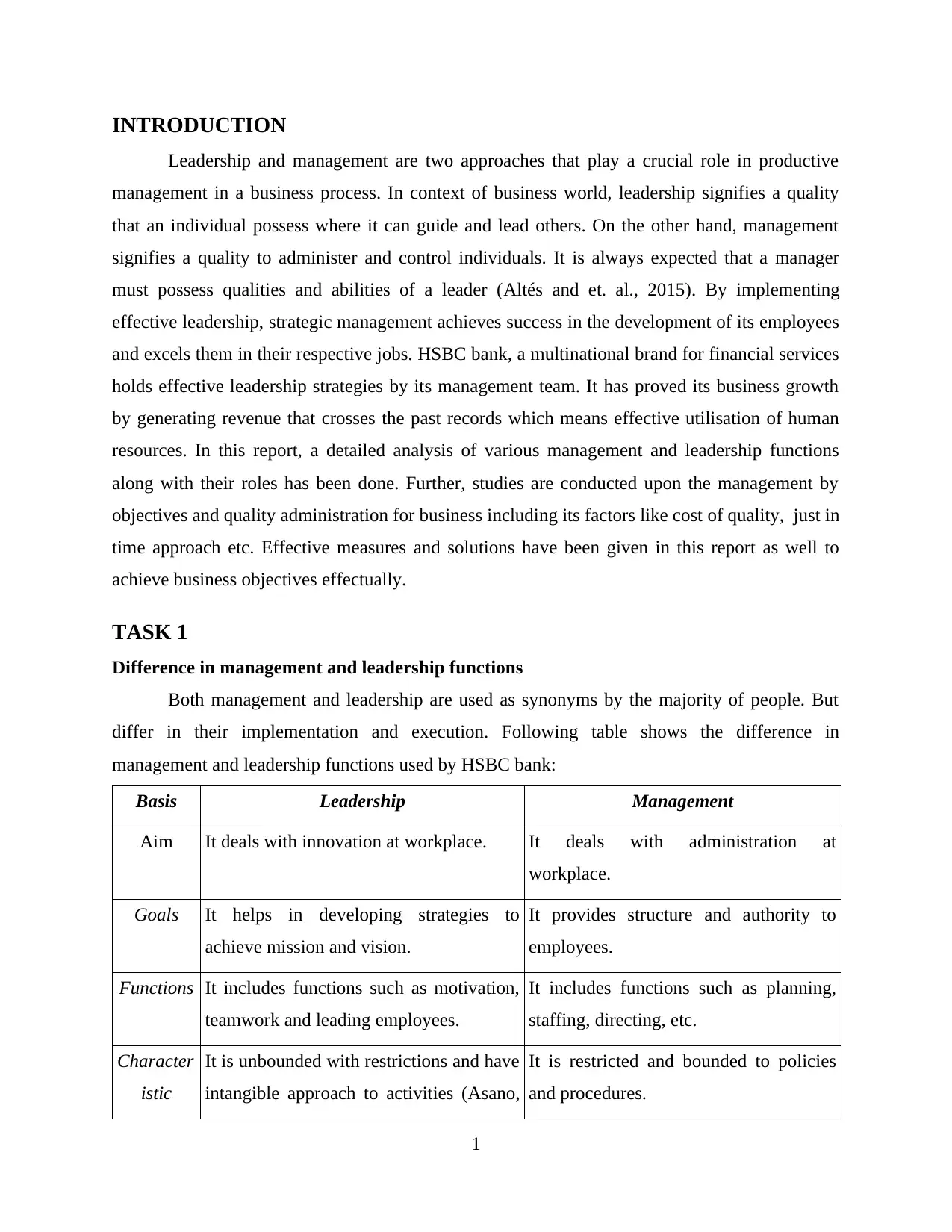
Both management and leadership are used as synonyms by the majority of people. But
differ in their implementation and execution. Following table shows the difference in
management and leadership functions used by HSBC bank:
Basis Leadership Management
Aim It deals with innovation at workplace. It deals with administration at
workplace.
Goals It helps in developing strategies to
achieve mission and vision.
It provides structure and authority to
employees.
Functions It includes functions such as motivation,
teamwork and leading employees.
It includes functions such as planning,
staffing, directing, etc.
Character
istic
It is unbounded with restrictions and have
intangible approach to activities (Asano,
It is restricted and bounded to policies
and procedures.
1
Leadership and management are two approaches that play a crucial role in productive
management in a business process. In context of business world, leadership signifies a quality
that an individual possess where it can guide and lead others. On the other hand, management
signifies a quality to administer and control individuals. It is always expected that a manager
must possess qualities and abilities of a leader (Altés and et. al., 2015). By implementing
effective leadership, strategic management achieves success in the development of its employees
and excels them in their respective jobs. HSBC bank, a multinational brand for financial services
holds effective leadership strategies by its management team. It has proved its business growth
by generating revenue that crosses the past records which means effective utilisation of human
resources. In this report, a detailed analysis of various management and leadership functions
along with their roles has been done. Further, studies are conducted upon the management by
objectives and quality administration for business including its factors like cost of quality, just in
time approach etc. Effective measures and solutions have been given in this report as well to
achieve business objectives effectually.
TASK 1
Difference in management and leadership functions
Both management and leadership are used as synonyms by the majority of people. But
differ in their implementation and execution. Following table shows the difference in
management and leadership functions used by HSBC bank:
Basis Leadership Management
Aim It deals with innovation at workplace. It deals with administration at
workplace.
Goals It helps in developing strategies to
achieve mission and vision.
It provides structure and authority to
employees.
Functions It includes functions such as motivation,
teamwork and leading employees.
It includes functions such as planning,
staffing, directing, etc.
Character
istic
It is unbounded with restrictions and have
intangible approach to activities (Asano,
It is restricted and bounded to policies
and procedures.
1
⊘ This is a preview!⊘
Do you want full access?
Subscribe today to unlock all pages.

Trusted by 1+ million students worldwide
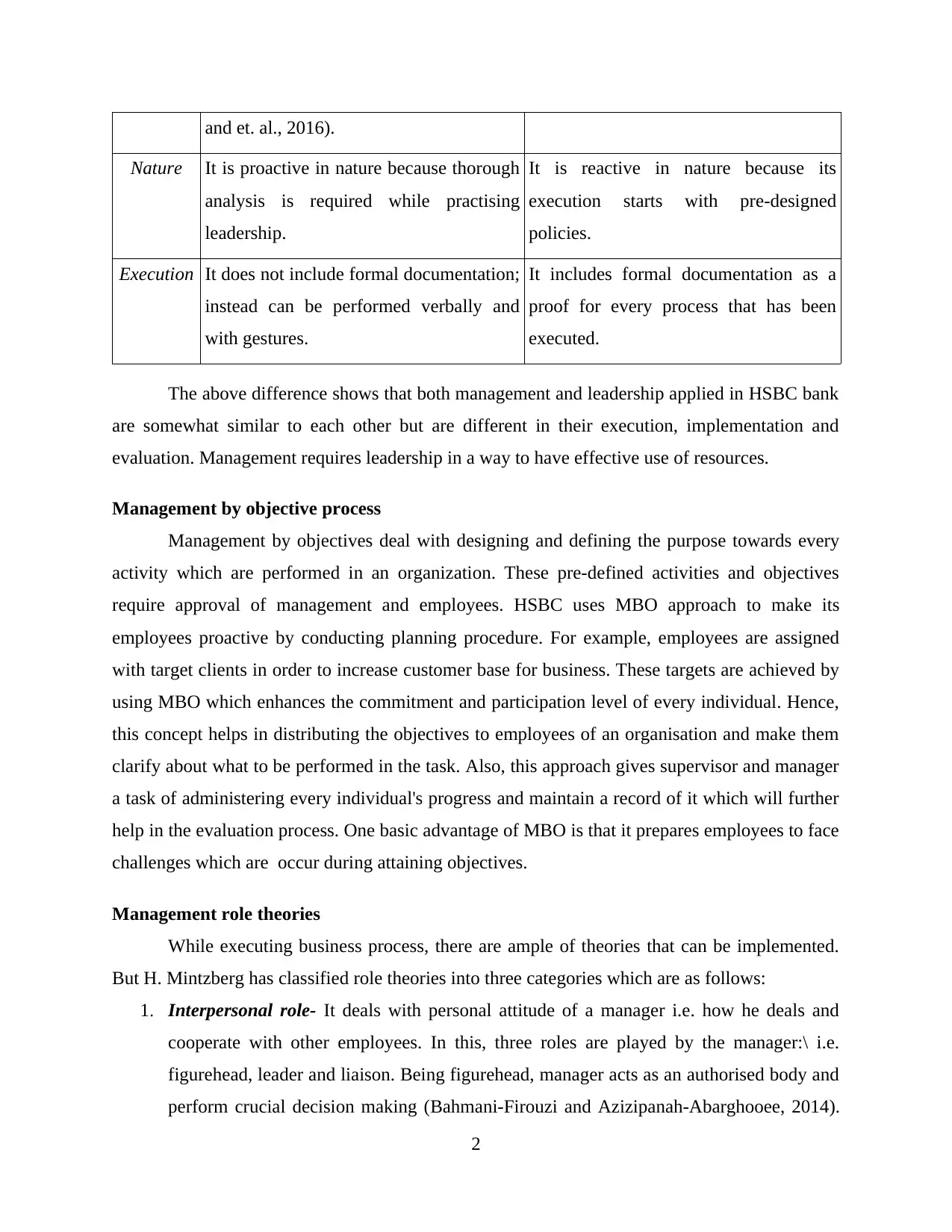
and et. al., 2016).
Nature It is proactive in nature because thorough
analysis is required while practising
leadership.
It is reactive in nature because its
execution starts with pre-designed
policies.
Execution It does not include formal documentation;
instead can be performed verbally and
with gestures.
It includes formal documentation as a
proof for every process that has been
executed.
The above difference shows that both management and leadership applied in HSBC bank
are somewhat similar to each other but are different in their execution, implementation and
evaluation. Management requires leadership in a way to have effective use of resources.
Management by objective process
Management by objectives deal with designing and defining the purpose towards every
activity which are performed in an organization. These pre-defined activities and objectives
require approval of management and employees. HSBC uses MBO approach to make its
employees proactive by conducting planning procedure. For example, employees are assigned
with target clients in order to increase customer base for business. These targets are achieved by
using MBO which enhances the commitment and participation level of every individual. Hence,
this concept helps in distributing the objectives to employees of an organisation and make them
clarify about what to be performed in the task. Also, this approach gives supervisor and manager
a task of administering every individual's progress and maintain a record of it which will further
help in the evaluation process. One basic advantage of MBO is that it prepares employees to face
challenges which are occur during attaining objectives.
Management role theories
While executing business process, there are ample of theories that can be implemented.
But H. Mintzberg has classified role theories into three categories which are as follows:
1. Interpersonal role- It deals with personal attitude of a manager i.e. how he deals and
cooperate with other employees. In this, three roles are played by the manager:\ i.e.
figurehead, leader and liaison. Being figurehead, manager acts as an authorised body and
perform crucial decision making (Bahmani-Firouzi and Azizipanah-Abarghooee, 2014).
2
Nature It is proactive in nature because thorough
analysis is required while practising
leadership.
It is reactive in nature because its
execution starts with pre-designed
policies.
Execution It does not include formal documentation;
instead can be performed verbally and
with gestures.
It includes formal documentation as a
proof for every process that has been
executed.
The above difference shows that both management and leadership applied in HSBC bank
are somewhat similar to each other but are different in their execution, implementation and
evaluation. Management requires leadership in a way to have effective use of resources.
Management by objective process
Management by objectives deal with designing and defining the purpose towards every
activity which are performed in an organization. These pre-defined activities and objectives
require approval of management and employees. HSBC uses MBO approach to make its
employees proactive by conducting planning procedure. For example, employees are assigned
with target clients in order to increase customer base for business. These targets are achieved by
using MBO which enhances the commitment and participation level of every individual. Hence,
this concept helps in distributing the objectives to employees of an organisation and make them
clarify about what to be performed in the task. Also, this approach gives supervisor and manager
a task of administering every individual's progress and maintain a record of it which will further
help in the evaluation process. One basic advantage of MBO is that it prepares employees to face
challenges which are occur during attaining objectives.
Management role theories
While executing business process, there are ample of theories that can be implemented.
But H. Mintzberg has classified role theories into three categories which are as follows:
1. Interpersonal role- It deals with personal attitude of a manager i.e. how he deals and
cooperate with other employees. In this, three roles are played by the manager:\ i.e.
figurehead, leader and liaison. Being figurehead, manager acts as an authorised body and
perform crucial decision making (Bahmani-Firouzi and Azizipanah-Abarghooee, 2014).
2
Paraphrase This Document
Need a fresh take? Get an instant paraphrase of this document with our AI Paraphraser
Being leader, manager analyses the needs of company and organises them in order to
attain and fulfil every need and requirement. At last, being liaison, manager have to
maintain its network and relationship.
2. Informational role- Here, manager acts as an informational body i.e. he collects and
transmits essential information to the associates so that communication process can be
performed effectively. Also, it acts as a spokesperson in business and monitors every
process on regular basis.
3. Decisional role- Decisional body is an important role which go through with every
measures that are acting upon various activities (Bruccoleri, Pasek and Koren, 2017).
Main task in this role is to allocate resources in an effective manner in order to have their
maximum utilization.
Considering above three roles, interpersonal role of management is more appropriate for
HSBC bank to perform its day-to-day operations. It is because; by using this approach, manager
performs all three major activities that are required for a business.
Leadership traits theory
Trait model for leadership shows how effective a leadership style is and whether it is
successful or unsuccessful. To have effective leadership traits, one must have ability, interest and
personality. There are many models that determine the leadership quality. Two of them are given
as below:1. Autocratic leadership- Here, dominance and control approach is followed i.e. individuals
perform every action and decision without involving their group members (What Is
Autocratic Leadership?, 2018). It is more of bossy leadership style. These leaders gives
order to their employees as they doesn't prefer to include them in decisions. It sometimes
make their workers demotivate and unhappy while working in company.
2. Democratic leadership- Here, shared and participative approach is followed i.e. members
of group can take part in decision making process. It results in the idea generation and
full participation of employees. This style of leadership take suggestions with their
workers and exchange ideas and then have a decisions on a particular situation. This
make employee motivated and they efficiently and effectively work within a company.
3
attain and fulfil every need and requirement. At last, being liaison, manager have to
maintain its network and relationship.
2. Informational role- Here, manager acts as an informational body i.e. he collects and
transmits essential information to the associates so that communication process can be
performed effectively. Also, it acts as a spokesperson in business and monitors every
process on regular basis.
3. Decisional role- Decisional body is an important role which go through with every
measures that are acting upon various activities (Bruccoleri, Pasek and Koren, 2017).
Main task in this role is to allocate resources in an effective manner in order to have their
maximum utilization.
Considering above three roles, interpersonal role of management is more appropriate for
HSBC bank to perform its day-to-day operations. It is because; by using this approach, manager
performs all three major activities that are required for a business.
Leadership traits theory
Trait model for leadership shows how effective a leadership style is and whether it is
successful or unsuccessful. To have effective leadership traits, one must have ability, interest and
personality. There are many models that determine the leadership quality. Two of them are given
as below:1. Autocratic leadership- Here, dominance and control approach is followed i.e. individuals
perform every action and decision without involving their group members (What Is
Autocratic Leadership?, 2018). It is more of bossy leadership style. These leaders gives
order to their employees as they doesn't prefer to include them in decisions. It sometimes
make their workers demotivate and unhappy while working in company.
2. Democratic leadership- Here, shared and participative approach is followed i.e. members
of group can take part in decision making process. It results in the idea generation and
full participation of employees. This style of leadership take suggestions with their
workers and exchange ideas and then have a decisions on a particular situation. This
make employee motivated and they efficiently and effectively work within a company.
3
Considering the above models of leadership, autocratic style is more preferable by HSBC
bank. It is because; while operating in financial sector, affirmative decisions are required to be
taken.
Hard management skills and soft leadership skills
Management must possess analytic behaviour towards its employees. Here, hard
management skills include knowledge and abilities that are required to manage the structure of
organization. Also, it deals with decision making capabilities to solve the problems. These skills
can be measurable in order to evaluate the manager and his capabilities (Castellanos and et. al.,
2011). Whereas, soft leadership skills include personal traits such as motivation, creativity,
communication, team work, etc. These skills are not easy to be measured. Leaders must be able
to solve real-time problems only if he is capable enough to understand the objectives and
strategies of business. HSBC implements this strategy in order to have smooth functioning in its
production line. Management must be rigid in nature whereas leadership must be dynamic to
achieve goals and objectives of business.
TASK 2
Role of leader and functions of manager in different context
HSBC was found in 1865 and is one of the biggest multinational bank of Europe. It also
comes on 7th number from all financial companies who are delivering their services worldwide.
Generated revenue in 2017 was in amount of US$51.445 billion and earned US$11.879 billion as
profit. It has been analysed that, HSBC has gathered a reputed position at marketplace. Rapidly
hitting targets, keeping their customers happy and healthy environment to every individual of
corporation leaded HSBC created improve its brand image. Managers and leaders of this
organisation have many responsibilities and faces various issues on daily basis. Their duty differs
from each other but work for same thing and that is betterment of company (Cruz and Rincon,
2012).
Management has different purposes within an administration like recruiting, staffing,
managing and controlling. On the other hand leaders motivate, support, direct and coordinate
with their subordinates so that they can hit their own targets on a specific time period. It is
essential for management to select talented and well qualified candidates so that new and
4
bank. It is because; while operating in financial sector, affirmative decisions are required to be
taken.
Hard management skills and soft leadership skills
Management must possess analytic behaviour towards its employees. Here, hard
management skills include knowledge and abilities that are required to manage the structure of
organization. Also, it deals with decision making capabilities to solve the problems. These skills
can be measurable in order to evaluate the manager and his capabilities (Castellanos and et. al.,
2011). Whereas, soft leadership skills include personal traits such as motivation, creativity,
communication, team work, etc. These skills are not easy to be measured. Leaders must be able
to solve real-time problems only if he is capable enough to understand the objectives and
strategies of business. HSBC implements this strategy in order to have smooth functioning in its
production line. Management must be rigid in nature whereas leadership must be dynamic to
achieve goals and objectives of business.
TASK 2
Role of leader and functions of manager in different context
HSBC was found in 1865 and is one of the biggest multinational bank of Europe. It also
comes on 7th number from all financial companies who are delivering their services worldwide.
Generated revenue in 2017 was in amount of US$51.445 billion and earned US$11.879 billion as
profit. It has been analysed that, HSBC has gathered a reputed position at marketplace. Rapidly
hitting targets, keeping their customers happy and healthy environment to every individual of
corporation leaded HSBC created improve its brand image. Managers and leaders of this
organisation have many responsibilities and faces various issues on daily basis. Their duty differs
from each other but work for same thing and that is betterment of company (Cruz and Rincon,
2012).
Management has different purposes within an administration like recruiting, staffing,
managing and controlling. On the other hand leaders motivate, support, direct and coordinate
with their subordinates so that they can hit their own targets on a specific time period. It is
essential for management to select talented and well qualified candidates so that new and
4
⊘ This is a preview!⊘
Do you want full access?
Subscribe today to unlock all pages.
Trusted by 1+ million students worldwide
innovative ideas can come under so that administration can improvise and gain competitive
advantages at marketplace.
Role of leaders and managers various conditions are mentioned below:
Stability in nature: In this context, if everything is going smooth at workplace of HSBC
then both managers and leaders do not try to implement new things. But, to sustain at
marketplace it is mandatory for management of HSBC to implement updated tools and
techniques that are coming in market from time to time so that profitability and productivity gets
increases.
Low to average dynamical situation: HSBC is a public limited company of Europe
which already have ample number of financial institutes in all over world (Menezes, Wood and
Gelade, 2010). Apart from this they are also trying to increase its business in other countries as
well where they are not serving their services. Changes in taxes and culture of different countries
needs to be considered in various aspects while making decisions in betterment of HSBC.
Fast changing situation: HSBC a public company that imply policies and laws which
has been made by Government so that favourable conditions can be created for both employees
and for company as well (Losinger and Heinrichs, 2016). This organisation is already wide in
nature thus, they can easily consider alterations. HSBC have a big market share in United
Kingdom therefore, its decisions may put positive or negative impact on economic growth of the
country.
Effect of organisational conditions on functions of managers:
Small and middle level of financial institutes are getting connected with HSBC. By this,
SME's are rapidly upgrading their level at marketplace. Management of HSBC plays a vital role
while taking decisions. It is mandatory to look into every single aspect so that company do not
faces any sort of losses. Corporation has already gained a huge position and created immense
belief in their consumers thus, they can easily make changes or take risk without thinking about
any situation.
Away from this, there are some style of leadership are comprehended below:
Direction: Leaders are the one who plays an important role with in company. He/she
takes the decisions which are essential in nature in bettering the condition of corporation. Team
5
advantages at marketplace.
Role of leaders and managers various conditions are mentioned below:
Stability in nature: In this context, if everything is going smooth at workplace of HSBC
then both managers and leaders do not try to implement new things. But, to sustain at
marketplace it is mandatory for management of HSBC to implement updated tools and
techniques that are coming in market from time to time so that profitability and productivity gets
increases.
Low to average dynamical situation: HSBC is a public limited company of Europe
which already have ample number of financial institutes in all over world (Menezes, Wood and
Gelade, 2010). Apart from this they are also trying to increase its business in other countries as
well where they are not serving their services. Changes in taxes and culture of different countries
needs to be considered in various aspects while making decisions in betterment of HSBC.
Fast changing situation: HSBC a public company that imply policies and laws which
has been made by Government so that favourable conditions can be created for both employees
and for company as well (Losinger and Heinrichs, 2016). This organisation is already wide in
nature thus, they can easily consider alterations. HSBC have a big market share in United
Kingdom therefore, its decisions may put positive or negative impact on economic growth of the
country.
Effect of organisational conditions on functions of managers:
Small and middle level of financial institutes are getting connected with HSBC. By this,
SME's are rapidly upgrading their level at marketplace. Management of HSBC plays a vital role
while taking decisions. It is mandatory to look into every single aspect so that company do not
faces any sort of losses. Corporation has already gained a huge position and created immense
belief in their consumers thus, they can easily make changes or take risk without thinking about
any situation.
Away from this, there are some style of leadership are comprehended below:
Direction: Leaders are the one who plays an important role with in company. He/she
takes the decisions which are essential in nature in bettering the condition of corporation. Team
5
Paraphrase This Document
Need a fresh take? Get an instant paraphrase of this document with our AI Paraphraser
leader can show direction to subordinates who are in his/her team so that they can achieve their
own goals and objectives. Apart from this, while directing it is essential for leader to stay calm
and cooperative. By this, subordinates can easily give suggestions and have words with their
executives.
Support: Situations comes in front of leader where they find their workers demotivated at
workplace and gives less production than they are capable of. Under this scenario, leaders can
give training and developing programmes by which workers can get suggestions from leaders by
which they can enhance their capabilities and become more effective at HSBC.
Participation: This type of leadership style gives opportunities to leader by which he/she
can engage himself with employees at workplace (Moghaddam and et. al., 2011). This can
improve relation among them. HSBC's leader convey every single change that they are going to
make in policies, workstations and etc. and with the help of this staff members can get to know
about these new adapted alterations. Under this, suggestions and feedbacks can be taken from
employees by which management can take decisions in an appropriate manner.
Goal oriented: Leaders should be goal orientated in nature and apart from this,
management can resolve issue by which they improve their overall performance of the company
in most effective manner (Moghaddam, Seifi and Niknam, 2012). In context of HSBC bank,
leader should provide appropriate vision to their worker so that they effective perform their
assign task and attain positive outcomes. With the help of this employees easily enhance their
skills and knowledge which contribute in improving the performance level of the company at
market place.
TASK 3
Three transformation process in operation management
Administration require that business activities are being conducted in according to market
conditions. They need to make alterations and implementing modifications in system through
which they deliver products and services as per requirement of people (Menezes, Wood and
Gelade, 2010). As in HSBC bank, superior uses these transformation steps to execute operation
management in firm are stated beneath:
Redesign process: Management have to make improvement in operations; designing
system through which they deliver quality offerings to customers. This help company to function
6
own goals and objectives. Apart from this, while directing it is essential for leader to stay calm
and cooperative. By this, subordinates can easily give suggestions and have words with their
executives.
Support: Situations comes in front of leader where they find their workers demotivated at
workplace and gives less production than they are capable of. Under this scenario, leaders can
give training and developing programmes by which workers can get suggestions from leaders by
which they can enhance their capabilities and become more effective at HSBC.
Participation: This type of leadership style gives opportunities to leader by which he/she
can engage himself with employees at workplace (Moghaddam and et. al., 2011). This can
improve relation among them. HSBC's leader convey every single change that they are going to
make in policies, workstations and etc. and with the help of this staff members can get to know
about these new adapted alterations. Under this, suggestions and feedbacks can be taken from
employees by which management can take decisions in an appropriate manner.
Goal oriented: Leaders should be goal orientated in nature and apart from this,
management can resolve issue by which they improve their overall performance of the company
in most effective manner (Moghaddam, Seifi and Niknam, 2012). In context of HSBC bank,
leader should provide appropriate vision to their worker so that they effective perform their
assign task and attain positive outcomes. With the help of this employees easily enhance their
skills and knowledge which contribute in improving the performance level of the company at
market place.
TASK 3
Three transformation process in operation management
Administration require that business activities are being conducted in according to market
conditions. They need to make alterations and implementing modifications in system through
which they deliver products and services as per requirement of people (Menezes, Wood and
Gelade, 2010). As in HSBC bank, superior uses these transformation steps to execute operation
management in firm are stated beneath:
Redesign process: Management have to make improvement in operations; designing
system through which they deliver quality offerings to customers. This help company to function
6
in accordance to market situation. HSBC bank is providing adequate service; so they able to
retain clients for longer period. By implementing updated technologies in system to satisfy
customers by giving them appropriate information about their accounts.
Development process: Employer should conduct sessions to enhance abilities of staff
members; so that they function properly. HSBC bank, administration uses this step to make
improvement in operation management. By improving technical skills of employees to increase
their functionality and make them complete work timely.
Leadership process: Superior require that employees are dedicated and motivated
towards their duties (Mohammadi, Soleymani and Mozafari, 2014). HSBC bank provide
adequate instruction to workforce about tasks which they have to accomplish; so that they
function effectively.
Quality and Costs of quality for managers:
Quality refers to as rational element that helps in measuring customer satisfaction. HSBC
bank relate its quality the degree of customer satisfaction which is attained through their banking
and financial services. Managers has to deal with four costs of quality that are given below:
1. Prevention cost- Here, costs are associated with design and management of quality
management system in order to minimize or prevent quality degradation. These costs are
pre-planned so that company do not suffer loss (Niknam and et. al., 2011).
2. Appraisal cost- Here, costs are associated with measuring and monitoring of activities
with reference to supplier and customers. It include verification, audit and rating of
services.
3. Internal failure cost- Here, cost that exists act as remedy to defected quality of products
and services, before their actual delivery to customer. These cost may incur because of
waste, scrap or rectification.
4. External failure cost- Here, costs are defined and act as remedy to defected quality of
products and services that are discovered by customers. These cost may include warranty,
complaints or returns.
Role of manager in Total Quality Management approach
Total Quality Management approach focuses upon quality and standard maintained while
delivering product and service to customer. It helps in maintaining a standard where staff gets
7
retain clients for longer period. By implementing updated technologies in system to satisfy
customers by giving them appropriate information about their accounts.
Development process: Employer should conduct sessions to enhance abilities of staff
members; so that they function properly. HSBC bank, administration uses this step to make
improvement in operation management. By improving technical skills of employees to increase
their functionality and make them complete work timely.
Leadership process: Superior require that employees are dedicated and motivated
towards their duties (Mohammadi, Soleymani and Mozafari, 2014). HSBC bank provide
adequate instruction to workforce about tasks which they have to accomplish; so that they
function effectively.
Quality and Costs of quality for managers:
Quality refers to as rational element that helps in measuring customer satisfaction. HSBC
bank relate its quality the degree of customer satisfaction which is attained through their banking
and financial services. Managers has to deal with four costs of quality that are given below:
1. Prevention cost- Here, costs are associated with design and management of quality
management system in order to minimize or prevent quality degradation. These costs are
pre-planned so that company do not suffer loss (Niknam and et. al., 2011).
2. Appraisal cost- Here, costs are associated with measuring and monitoring of activities
with reference to supplier and customers. It include verification, audit and rating of
services.
3. Internal failure cost- Here, cost that exists act as remedy to defected quality of products
and services, before their actual delivery to customer. These cost may incur because of
waste, scrap or rectification.
4. External failure cost- Here, costs are defined and act as remedy to defected quality of
products and services that are discovered by customers. These cost may include warranty,
complaints or returns.
Role of manager in Total Quality Management approach
Total Quality Management approach focuses upon quality and standard maintained while
delivering product and service to customer. It helps in maintaining a standard where staff gets
7
⊘ This is a preview!⊘
Do you want full access?
Subscribe today to unlock all pages.
Trusted by 1+ million students worldwide
committed towards their work and promises to provide high standard of work in every phase of
company's operation. HSBC bank believes in delivering high quality services to its customers in
order maintain their market share. Managers of respective bank improve their work culture by
analysing customer demands and market trends. In order to achieve goals and objectives with
efficiency it is important to have optimize utilisation of resources that are available to company
by maintaining certain standards.
Just in time approach and waste reduction in operation
Organization require that raw material, funds and human resource are used efficiently.
For this administration uses just in time concept in firm, which specifies that they have
connection with suppliers (Niknam, Golestaneh and Malekpour, 2012). This help them to reduce
inventory expenses by eliminating storage cost. By conducting market survey to acknowledge
requirement of people; and also to enquire about competitors’ products and services. Reducing
and recycling are elements which are used to carry out business operations properly with that
superior are able to eliminate wastage and utilise resources properly. In HSBC bank,
management uses updated techniques to deliver quality services to people (Niknam, Meymand
and Mojarrad, 2011). By keeping record of everyday’s transactions, firm has information about
quantity of money that they will require to fulfil the demand of customers. This benefits the bank
to retain clients as they provide quality services to them.
Capacity management in operations
Capacity management deals with management of limited resources that are available to
the company such as labour, force, inventory, etc. In HSBC, company can manage its resources
using three methods given below:
1. Strategic- Here, operational management activities are set in priorities such as resource
allocation, operations procedures, forecasting of inventory, etc. It helps in managing
capacity of process to meet present and future needs of operational demands.
2. Incentive blocking- It deals in restriction of excess production in order to minimize cost.
Management of production can be done by working with respect to demands received.
This help in inventory management and quality production.
3. Incentive adjustment- In this method, process is adjusted according to productivity and
quality in business service. This is done in order to meet customer satisfaction. Also it
helps in optimize utilization of resources in order to maintain operation management.
8
company's operation. HSBC bank believes in delivering high quality services to its customers in
order maintain their market share. Managers of respective bank improve their work culture by
analysing customer demands and market trends. In order to achieve goals and objectives with
efficiency it is important to have optimize utilisation of resources that are available to company
by maintaining certain standards.
Just in time approach and waste reduction in operation
Organization require that raw material, funds and human resource are used efficiently.
For this administration uses just in time concept in firm, which specifies that they have
connection with suppliers (Niknam, Golestaneh and Malekpour, 2012). This help them to reduce
inventory expenses by eliminating storage cost. By conducting market survey to acknowledge
requirement of people; and also to enquire about competitors’ products and services. Reducing
and recycling are elements which are used to carry out business operations properly with that
superior are able to eliminate wastage and utilise resources properly. In HSBC bank,
management uses updated techniques to deliver quality services to people (Niknam, Meymand
and Mojarrad, 2011). By keeping record of everyday’s transactions, firm has information about
quantity of money that they will require to fulfil the demand of customers. This benefits the bank
to retain clients as they provide quality services to them.
Capacity management in operations
Capacity management deals with management of limited resources that are available to
the company such as labour, force, inventory, etc. In HSBC, company can manage its resources
using three methods given below:
1. Strategic- Here, operational management activities are set in priorities such as resource
allocation, operations procedures, forecasting of inventory, etc. It helps in managing
capacity of process to meet present and future needs of operational demands.
2. Incentive blocking- It deals in restriction of excess production in order to minimize cost.
Management of production can be done by working with respect to demands received.
This help in inventory management and quality production.
3. Incentive adjustment- In this method, process is adjusted according to productivity and
quality in business service. This is done in order to meet customer satisfaction. Also it
helps in optimize utilization of resources in order to maintain operation management.
8
Paraphrase This Document
Need a fresh take? Get an instant paraphrase of this document with our AI Paraphraser
TASK 4
Various theories and models of approaches including different leadership
Companies require that goals and objectives get accomplished within specified time
frame. For this, superior distribute duties to staff members in according to their capabilities.
They need to keep employees dedicated and motivated, so that employees function effectively.
By using theories and models of leadership; so that superior are able to utilise manpower and
make them attain targets within specified time frame. In HSBC bank, leader require that
subordinates have adequate skills through which they communicate with customers properly.
Superior even require that they conduct market survey to enquire about people requirement; so
that they deliver adequate services to customers (Parisio and Glielmo, 2013). These approaches
of leadership are used in firm so that system function effectively are stated beneath:
System leadership: This style of leadership specifies that superior should provide
adequate information to staff members. They require to implement appropriate tools and
techniques through which firm deliver adequate products and services to customers. Manager
should keep workforce dedicated, by acknowledging them clients demand so that they complete
tasks properly. So, superior require that they implement updated technologies in system through
which staff members provide adequate services to people (Sedaghati and Kavousi-Fard, 2014).
Thereby, making employees capable that they interact with clients and retain them for loner
period.
Situational leadership: This leadership style states that administration should make
system function in according to market conditions. They require firm offer products and services
as per requirement of people. By making changes in system and framing strategies by which
superior make their employees function effectively. Leader should have healthy relationship with
staff members; so that they are able to anticipate issues faced by them. Thereby, taking care that
subordinates perform tasks and deliver quality service to customers. Thus, bank is able to
enhance market position and reputation by transforming system according to market situations.
Contingency leadership: It is leadership style in which executive frame strategies
through which they are able to make system function properly. For this they require to examine
internal and external factors; so that superior encounter about their effects on business activities.
This is a reactive approach which stated that management should conduct market survey to
acknowledge demand of people. Thereby, manufacture products and services through which firm
9
Various theories and models of approaches including different leadership
Companies require that goals and objectives get accomplished within specified time
frame. For this, superior distribute duties to staff members in according to their capabilities.
They need to keep employees dedicated and motivated, so that employees function effectively.
By using theories and models of leadership; so that superior are able to utilise manpower and
make them attain targets within specified time frame. In HSBC bank, leader require that
subordinates have adequate skills through which they communicate with customers properly.
Superior even require that they conduct market survey to enquire about people requirement; so
that they deliver adequate services to customers (Parisio and Glielmo, 2013). These approaches
of leadership are used in firm so that system function effectively are stated beneath:
System leadership: This style of leadership specifies that superior should provide
adequate information to staff members. They require to implement appropriate tools and
techniques through which firm deliver adequate products and services to customers. Manager
should keep workforce dedicated, by acknowledging them clients demand so that they complete
tasks properly. So, superior require that they implement updated technologies in system through
which staff members provide adequate services to people (Sedaghati and Kavousi-Fard, 2014).
Thereby, making employees capable that they interact with clients and retain them for loner
period.
Situational leadership: This leadership style states that administration should make
system function in according to market conditions. They require firm offer products and services
as per requirement of people. By making changes in system and framing strategies by which
superior make their employees function effectively. Leader should have healthy relationship with
staff members; so that they are able to anticipate issues faced by them. Thereby, taking care that
subordinates perform tasks and deliver quality service to customers. Thus, bank is able to
enhance market position and reputation by transforming system according to market situations.
Contingency leadership: It is leadership style in which executive frame strategies
through which they are able to make system function properly. For this they require to examine
internal and external factors; so that superior encounter about their effects on business activities.
This is a reactive approach which stated that management should conduct market survey to
acknowledge demand of people. Thereby, manufacture products and services through which firm
9
is able to generate adequate profit for their business. So, leader keep workforce skilled so that
they provide efficient service to clients. By implementing updated technologies through which
they deliver adequate information to people.
Therefore, it can companies are able to accomplish goals and objectives. So superior of
HSBC bank are using situational leadership approaches through which they are able to make
employees function effectively. As manager frame strategies and distribute duties among staff
members, which they require to achieve their set goals and targets successfully. Besides them,
leader role is to keep workforce dedicated and motivated; so that they perform tasks and
complete targets within specified time frame. Hence, in HSBC bank superior organise sessions
and seminars to enhance skills and abilities of staff members; making them work with updated
technologies. So, firm is able to offer quality services to clients (Servi and Tarlton, Motorola
Solutions Inc, 2010). Thus, bank is able to generate adequate profit and also retain clients for
longer period.
Just in time approach and waste reduction in operation
Organization require that raw material, funds and human resource are used efficiently.
For this administration uses just in time concept in firm, which specifies that they have
connection with suppliers. This help them to reduce inventory expenses by eliminating storage
cost. By conducting market survey to acknowledge requirement of people; and also to enquire
about competitors’ products and services (Stoppato, 2012). For this reduce and recycle elements
are also used to carry out business operations properly. So, superior are able to reduce waste and
utilise resources properly. In HSBC bank, management use updated techniques to deliver quality
services to people. By keeping record of everyday transactions, firm has information about
quantity of money, they will require to fulfil demand of customers. This benefit bank to retain
clients, as they provide quality services to them.
Factors within Business environment that affect operational management and decision-
making
For better achievement of company's objectives and to gain sustainability, management
needs to make initiatives. Such initiatives are related to favour of society that affects
sustainability of a company at marketplace. There are many factors that create an impact on
operational management and decision-making process of a company. These factors can be
10
they provide efficient service to clients. By implementing updated technologies through which
they deliver adequate information to people.
Therefore, it can companies are able to accomplish goals and objectives. So superior of
HSBC bank are using situational leadership approaches through which they are able to make
employees function effectively. As manager frame strategies and distribute duties among staff
members, which they require to achieve their set goals and targets successfully. Besides them,
leader role is to keep workforce dedicated and motivated; so that they perform tasks and
complete targets within specified time frame. Hence, in HSBC bank superior organise sessions
and seminars to enhance skills and abilities of staff members; making them work with updated
technologies. So, firm is able to offer quality services to clients (Servi and Tarlton, Motorola
Solutions Inc, 2010). Thus, bank is able to generate adequate profit and also retain clients for
longer period.
Just in time approach and waste reduction in operation
Organization require that raw material, funds and human resource are used efficiently.
For this administration uses just in time concept in firm, which specifies that they have
connection with suppliers. This help them to reduce inventory expenses by eliminating storage
cost. By conducting market survey to acknowledge requirement of people; and also to enquire
about competitors’ products and services (Stoppato, 2012). For this reduce and recycle elements
are also used to carry out business operations properly. So, superior are able to reduce waste and
utilise resources properly. In HSBC bank, management use updated techniques to deliver quality
services to people. By keeping record of everyday transactions, firm has information about
quantity of money, they will require to fulfil demand of customers. This benefit bank to retain
clients, as they provide quality services to them.
Factors within Business environment that affect operational management and decision-
making
For better achievement of company's objectives and to gain sustainability, management
needs to make initiatives. Such initiatives are related to favour of society that affects
sustainability of a company at marketplace. There are many factors that create an impact on
operational management and decision-making process of a company. These factors can be
10
⊘ This is a preview!⊘
Do you want full access?
Subscribe today to unlock all pages.
Trusted by 1+ million students worldwide

1 out of 16


Related Documents


Your All-in-One AI-Powered Toolkit for Academic Success.
+13062052269
info@desklib.com
Available 24*7 on WhatsApp / Email
![[object Object]](/_next/static/media/star-bottom.7253800d.svg)
Unlock your academic potential
Copyright © 2020–2026 A2Z Services. All Rights Reserved. Developed and managed by ZUCOL.