Management and Operations at Tesco: Leadership Report
VerifiedAdded on 2021/02/22
|11
|3333
|218
Report
AI Summary
This report provides a comprehensive analysis of leadership and management practices within Tesco, a leading retail organization. It begins by defining the roles of leaders and managers, highlighting their distinct responsibilities and characteristics, and emphasizing the importance of effective communication and problem-solving skills. The report then delves into the application of various leadership theories, such as transformational and behavioral theories, and explores how these theories guide managerial approaches within Tesco. Furthermore, the report examines the functions of leaders and managers in different situational contexts, including conflict resolution, employee turnover, and employee motivation. It also discusses different leadership styles, such as situational leadership, and their impact on Tesco's operations. The report concludes by summarizing the key findings and emphasizing the importance of adapting leadership styles to meet the evolving needs of the company and its employees, offering valuable insights into Tesco's approach to achieving its business objectives and maintaining its leading position in the retail sector. This report is contributed by a student and is available on Desklib, a platform providing AI-based study tools for students.
MANAGEMENT AND
OPERATIONS
OPERATIONS

Paraphrase This Document
Need a fresh take? Get an instant paraphrase of this document with our AI Paraphraser
Table of Contents
INTRODUCTION………………………………………………………………………………..4
The role of a leader and the function of a manager at Tesco……………………………………..4
The role of a leader and the function of a manager in different situational context……………...7
Different theories and the model of approach………………………………………………...…..8
CONCLUSION………………………………………………………………………………….10
REFLECTION REPORT………………………………………………………………………..11
REFFERENCES…………………………………………………………………….….……….12
INTRODUCTION………………………………………………………………………………..4
The role of a leader and the function of a manager at Tesco……………………………………..4
The role of a leader and the function of a manager in different situational context……………...7
Different theories and the model of approach………………………………………………...…..8
CONCLUSION………………………………………………………………………………….10
REFLECTION REPORT………………………………………………………………………..11
REFFERENCES…………………………………………………………………….….……….12
INTRODUCTION
Management and operation is to administer the business practices that makes the
organisation efficient at the highest level to the extent it is possible in an organisation. It is
associated by converting the materials as well as labour into the goods and services to maximise
the profit of an organisation.
Tesco is the leading brand in the retail sector and having the top position in this industry
having the presence in more than 11 countries and it is expanded globally since 1990. As the
Human Resource Officer at Tesco, the author on the report will look into the impact of leaders
and managers on the operations in the company. This report explains the definition of leader and
manager and their different role in the organisation. This report contains the importance and
value of the operation management in achieving the objectives of the business. It will be
considered ongoing changes in the business environment and their influence to different
situations in Tesco.
The role of a leader and the function of a manager at Tesco
Tesco was founded by Jack Cohen in 1919 in the East End of London. As a leading
retailer, with 450 000 colleagues, the brand serve millions of customers in stores and online. The
current CEO of the company is Dave Lewis. The core purpose of the company is “serving
shoppers a little better every day”, so main goal of Tesco is to ensure the customers satisfaction
is a little better on each visit (Longoni and Cagliano, 2015 ).
Leader of Tesco is having the art to motivate the group of people for attaining the desired
goal that is being set by the management. It may include to directing the workers and colleagues
by making the strategy to meet the goals of company. Leader is the person who is full of
inspiration and direct the employees of the company and at the same he is the person who set the
example for everyone in the company (Jagoda and Kiridena, 2015)
Manager is the person who is responsible for the controlling and at the same
administering the particular department or any part of the company. It is an individual who is in
charge for the certain task or group or for the particular subset of the company. In Tesco every
department is having the particular line manager and perform their duties according to the
department functions.
Management and operation is to administer the business practices that makes the
organisation efficient at the highest level to the extent it is possible in an organisation. It is
associated by converting the materials as well as labour into the goods and services to maximise
the profit of an organisation.
Tesco is the leading brand in the retail sector and having the top position in this industry
having the presence in more than 11 countries and it is expanded globally since 1990. As the
Human Resource Officer at Tesco, the author on the report will look into the impact of leaders
and managers on the operations in the company. This report explains the definition of leader and
manager and their different role in the organisation. This report contains the importance and
value of the operation management in achieving the objectives of the business. It will be
considered ongoing changes in the business environment and their influence to different
situations in Tesco.
The role of a leader and the function of a manager at Tesco
Tesco was founded by Jack Cohen in 1919 in the East End of London. As a leading
retailer, with 450 000 colleagues, the brand serve millions of customers in stores and online. The
current CEO of the company is Dave Lewis. The core purpose of the company is “serving
shoppers a little better every day”, so main goal of Tesco is to ensure the customers satisfaction
is a little better on each visit (Longoni and Cagliano, 2015 ).
Leader of Tesco is having the art to motivate the group of people for attaining the desired
goal that is being set by the management. It may include to directing the workers and colleagues
by making the strategy to meet the goals of company. Leader is the person who is full of
inspiration and direct the employees of the company and at the same he is the person who set the
example for everyone in the company (Jagoda and Kiridena, 2015)
Manager is the person who is responsible for the controlling and at the same
administering the particular department or any part of the company. It is an individual who is in
charge for the certain task or group or for the particular subset of the company. In Tesco every
department is having the particular line manager and perform their duties according to the
department functions.
⊘ This is a preview!⊘
Do you want full access?
Subscribe today to unlock all pages.

Trusted by 1+ million students worldwide
Basis of comparison Leader Manager
Meaning Leaders means to exhibit the
morale and ethical courage and
they help in teaching the
leadership skills to the
employees.
In the company certain
departments have designated
the managers so the employees
can perform efficiently.
Types of leadership style Leaders of Tesco adopts the
democratic style.
Manager of Tesco adopts the
autocratic approach.
Purpose Purpose of leader is to deliver
the work through others and at
the same they make the vision
for the company
Main purpose of the manager is
to guide the employees of the
company to accomplish the
goal towards the organization.
Power Leader is having the authority
to influence the employees of
Tesco and having the power to
allocate the resources of an
organization (Longoni and
Cagliano, 2015).
Manager is having the power to
evaluate the performance of
employees and can delegate the
work, roles and responsibilities
to the employees of the
organization.
Control Leader will be controlling their
team members by personal
charm
While manager will be
controlling them by formal
influence only
Values Leader always value
achievement
While on other hand manager
will value the end results from
task done
Focus The focus of leader will be on
leading their people in proper
and efficient manner
However, focus of manger will
be on managing their work on
timely bases.
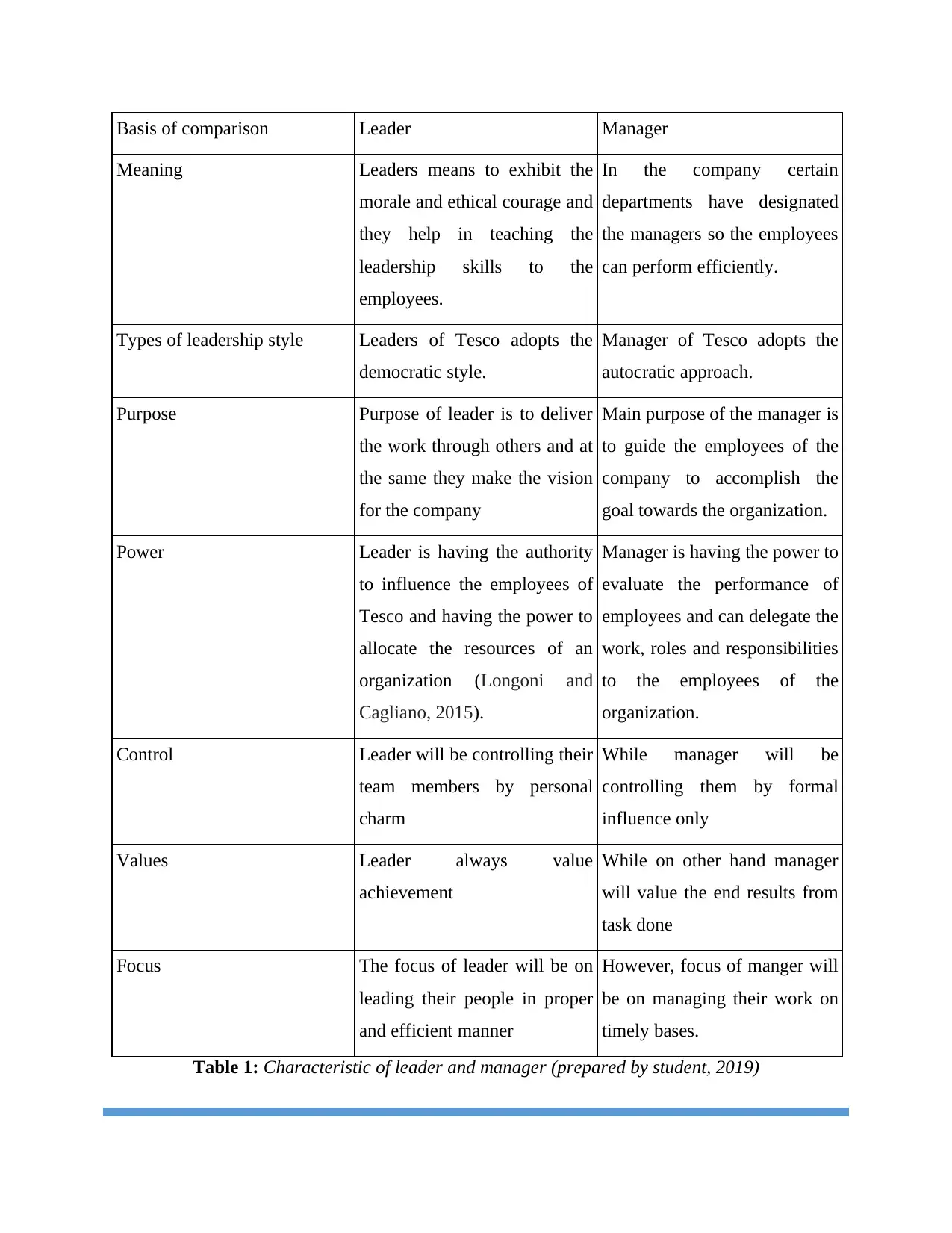
Table 1: Characteristic of leader and manager (prepared by student, 2019)
Meaning Leaders means to exhibit the
morale and ethical courage and
they help in teaching the
leadership skills to the
employees.
In the company certain
departments have designated
the managers so the employees
can perform efficiently.
Types of leadership style Leaders of Tesco adopts the
democratic style.
Manager of Tesco adopts the
autocratic approach.
Purpose Purpose of leader is to deliver
the work through others and at
the same they make the vision
for the company
Main purpose of the manager is
to guide the employees of the
company to accomplish the
goal towards the organization.
Power Leader is having the authority
to influence the employees of
Tesco and having the power to
allocate the resources of an
organization (Longoni and
Cagliano, 2015).
Manager is having the power to
evaluate the performance of
employees and can delegate the
work, roles and responsibilities
to the employees of the
organization.
Control Leader will be controlling their
team members by personal
charm
While manager will be
controlling them by formal
influence only
Values Leader always value
achievement
While on other hand manager
will value the end results from
task done
Focus The focus of leader will be on
leading their people in proper
and efficient manner
However, focus of manger will
be on managing their work on
timely bases.
Table 1: Characteristic of leader and manager (prepared by student, 2019)
Paraphrase This Document
Need a fresh take? Get an instant paraphrase of this document with our AI Paraphraser
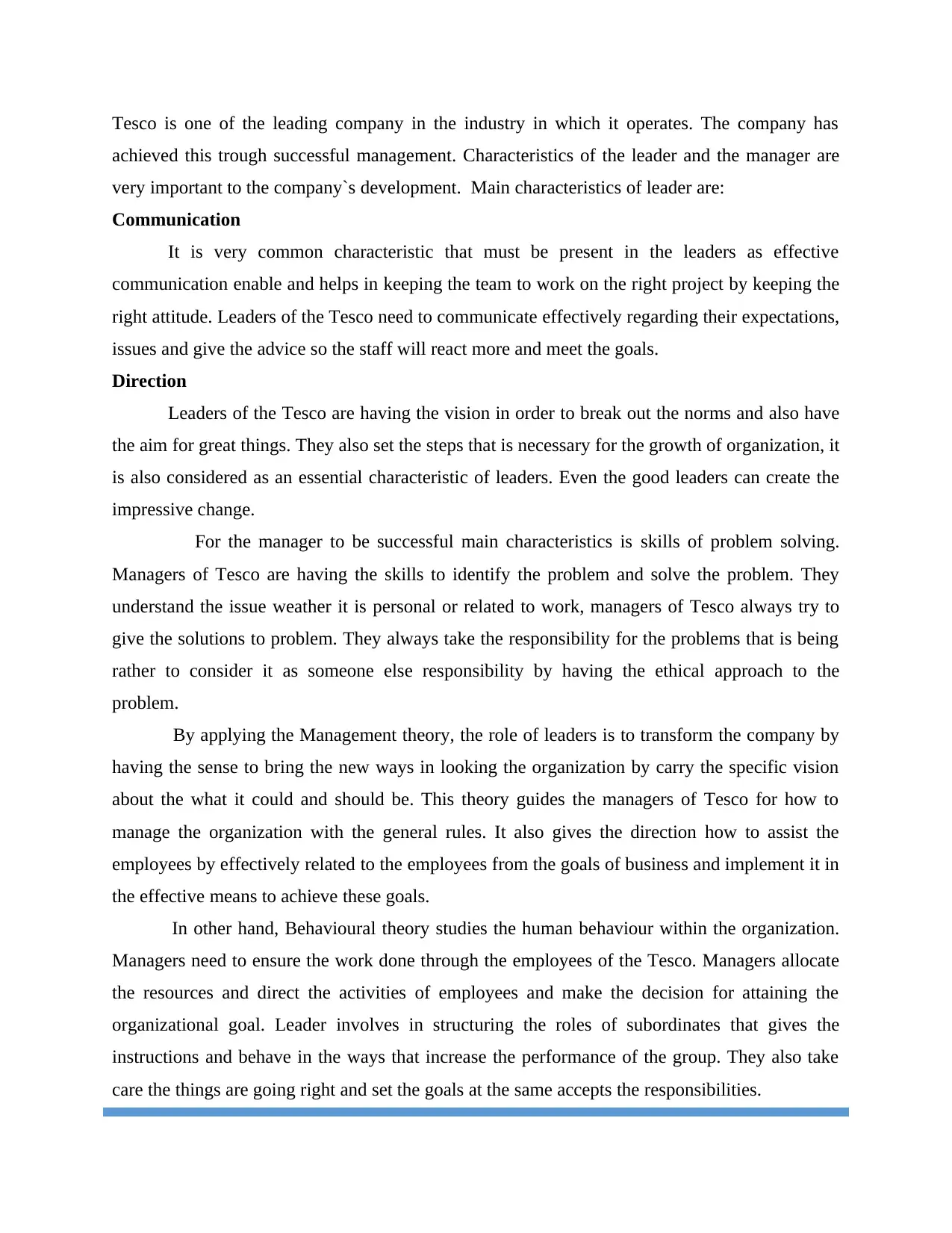
Tesco is one of the leading company in the industry in which it operates. The company has
achieved this trough successful management. Characteristics of the leader and the manager are
very important to the company`s development. Main characteristics of leader are:
Communication
It is very common characteristic that must be present in the leaders as effective
communication enable and helps in keeping the team to work on the right project by keeping the
right attitude. Leaders of the Tesco need to communicate effectively regarding their expectations,
issues and give the advice so the staff will react more and meet the goals.
Direction
Leaders of the Tesco are having the vision in order to break out the norms and also have
the aim for great things. They also set the steps that is necessary for the growth of organization, it
is also considered as an essential characteristic of leaders. Even the good leaders can create the
impressive change.
For the manager to be successful main characteristics is skills of problem solving.
Managers of Tesco are having the skills to identify the problem and solve the problem. They
understand the issue weather it is personal or related to work, managers of Tesco always try to
give the solutions to problem. They always take the responsibility for the problems that is being
rather to consider it as someone else responsibility by having the ethical approach to the
problem.
By applying the Management theory, the role of leaders is to transform the company by
having the sense to bring the new ways in looking the organization by carry the specific vision
about the what it could and should be. This theory guides the managers of Tesco for how to
manage the organization with the general rules. It also gives the direction how to assist the
employees by effectively related to the employees from the goals of business and implement it in
the effective means to achieve these goals.
In other hand, Behavioural theory studies the human behaviour within the organization.
Managers need to ensure the work done through the employees of the Tesco. Managers allocate
the resources and direct the activities of employees and make the decision for attaining the
organizational goal. Leader involves in structuring the roles of subordinates that gives the
instructions and behave in the ways that increase the performance of the group. They also take
care the things are going right and set the goals at the same accepts the responsibilities.
achieved this trough successful management. Characteristics of the leader and the manager are
very important to the company`s development. Main characteristics of leader are:
Communication
It is very common characteristic that must be present in the leaders as effective
communication enable and helps in keeping the team to work on the right project by keeping the
right attitude. Leaders of the Tesco need to communicate effectively regarding their expectations,
issues and give the advice so the staff will react more and meet the goals.
Direction
Leaders of the Tesco are having the vision in order to break out the norms and also have
the aim for great things. They also set the steps that is necessary for the growth of organization, it
is also considered as an essential characteristic of leaders. Even the good leaders can create the
impressive change.
For the manager to be successful main characteristics is skills of problem solving.
Managers of Tesco are having the skills to identify the problem and solve the problem. They
understand the issue weather it is personal or related to work, managers of Tesco always try to
give the solutions to problem. They always take the responsibility for the problems that is being
rather to consider it as someone else responsibility by having the ethical approach to the
problem.
By applying the Management theory, the role of leaders is to transform the company by
having the sense to bring the new ways in looking the organization by carry the specific vision
about the what it could and should be. This theory guides the managers of Tesco for how to
manage the organization with the general rules. It also gives the direction how to assist the
employees by effectively related to the employees from the goals of business and implement it in
the effective means to achieve these goals.
In other hand, Behavioural theory studies the human behaviour within the organization.
Managers need to ensure the work done through the employees of the Tesco. Managers allocate
the resources and direct the activities of employees and make the decision for attaining the
organizational goal. Leader involves in structuring the roles of subordinates that gives the
instructions and behave in the ways that increase the performance of the group. They also take
care the things are going right and set the goals at the same accepts the responsibilities.
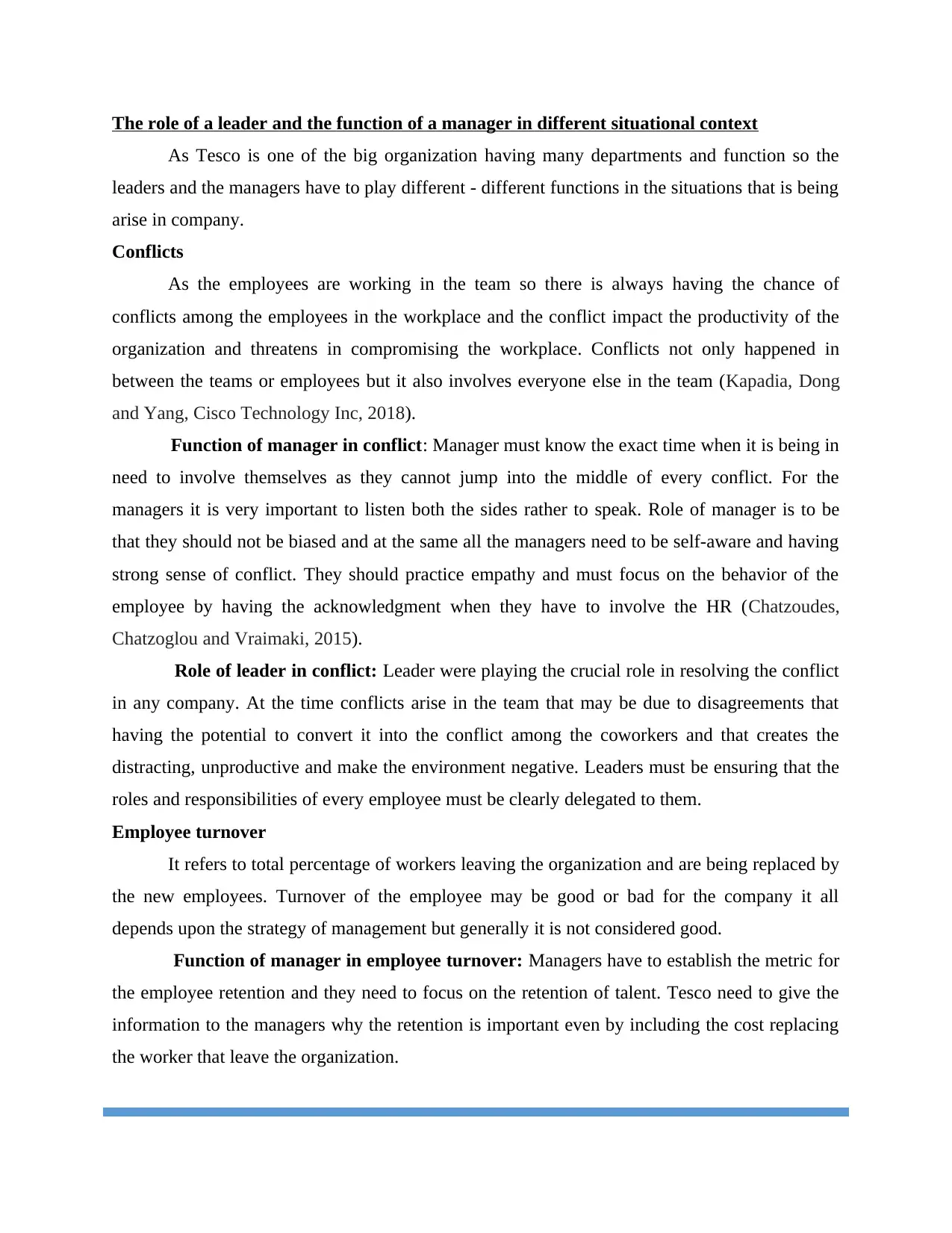
The role of a leader and the function of a manager in different situational context
As Tesco is one of the big organization having many departments and function so the
leaders and the managers have to play different - different functions in the situations that is being
arise in company.
Conflicts
As the employees are working in the team so there is always having the chance of
conflicts among the employees in the workplace and the conflict impact the productivity of the
organization and threatens in compromising the workplace. Conflicts not only happened in
between the teams or employees but it also involves everyone else in the team (Kapadia, Dong
and Yang, Cisco Technology Inc, 2018).
Function of manager in conflict: Manager must know the exact time when it is being in
need to involve themselves as they cannot jump into the middle of every conflict. For the
managers it is very important to listen both the sides rather to speak. Role of manager is to be
that they should not be biased and at the same all the managers need to be self-aware and having
strong sense of conflict. They should practice empathy and must focus on the behavior of the
employee by having the acknowledgment when they have to involve the HR (Chatzoudes,
Chatzoglou and Vraimaki, 2015).
Role of leader in conflict: Leader were playing the crucial role in resolving the conflict
in any company. At the time conflicts arise in the team that may be due to disagreements that
having the potential to convert it into the conflict among the coworkers and that creates the
distracting, unproductive and make the environment negative. Leaders must be ensuring that the
roles and responsibilities of every employee must be clearly delegated to them.
Employee turnover
It refers to total percentage of workers leaving the organization and are being replaced by
the new employees. Turnover of the employee may be good or bad for the company it all
depends upon the strategy of management but generally it is not considered good.
Function of manager in employee turnover: Managers have to establish the metric for
the employee retention and they need to focus on the retention of talent. Tesco need to give the
information to the managers why the retention is important even by including the cost replacing
the worker that leave the organization.
As Tesco is one of the big organization having many departments and function so the
leaders and the managers have to play different - different functions in the situations that is being
arise in company.
Conflicts
As the employees are working in the team so there is always having the chance of
conflicts among the employees in the workplace and the conflict impact the productivity of the
organization and threatens in compromising the workplace. Conflicts not only happened in
between the teams or employees but it also involves everyone else in the team (Kapadia, Dong
and Yang, Cisco Technology Inc, 2018).
Function of manager in conflict: Manager must know the exact time when it is being in
need to involve themselves as they cannot jump into the middle of every conflict. For the
managers it is very important to listen both the sides rather to speak. Role of manager is to be
that they should not be biased and at the same all the managers need to be self-aware and having
strong sense of conflict. They should practice empathy and must focus on the behavior of the
employee by having the acknowledgment when they have to involve the HR (Chatzoudes,
Chatzoglou and Vraimaki, 2015).
Role of leader in conflict: Leader were playing the crucial role in resolving the conflict
in any company. At the time conflicts arise in the team that may be due to disagreements that
having the potential to convert it into the conflict among the coworkers and that creates the
distracting, unproductive and make the environment negative. Leaders must be ensuring that the
roles and responsibilities of every employee must be clearly delegated to them.
Employee turnover
It refers to total percentage of workers leaving the organization and are being replaced by
the new employees. Turnover of the employee may be good or bad for the company it all
depends upon the strategy of management but generally it is not considered good.
Function of manager in employee turnover: Managers have to establish the metric for
the employee retention and they need to focus on the retention of talent. Tesco need to give the
information to the managers why the retention is important even by including the cost replacing
the worker that leave the organization.
⊘ This is a preview!⊘
Do you want full access?
Subscribe today to unlock all pages.
Trusted by 1+ million students worldwide
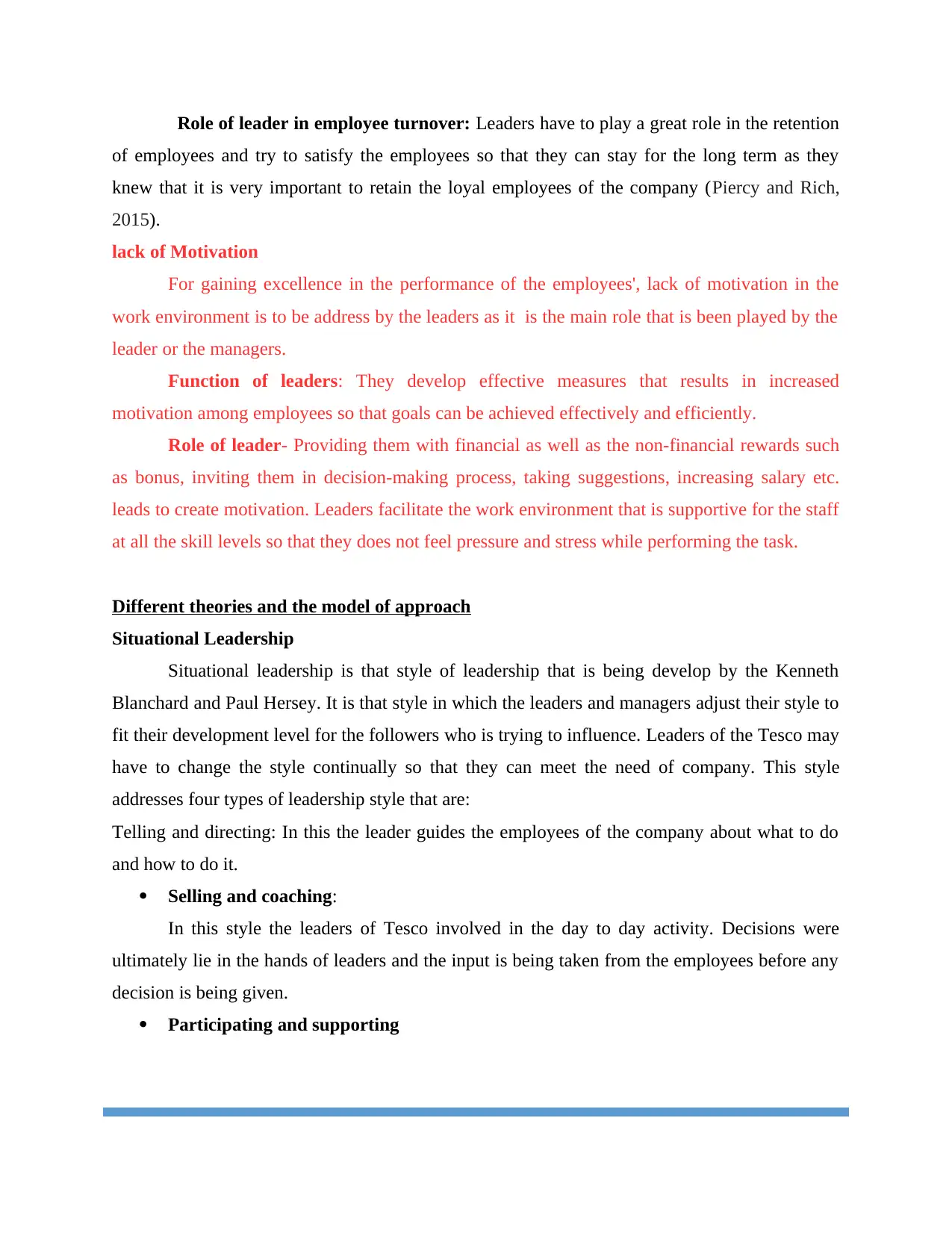
Role of leader in employee turnover: Leaders have to play a great role in the retention
of employees and try to satisfy the employees so that they can stay for the long term as they
knew that it is very important to retain the loyal employees of the company (Piercy and Rich,
2015).
lack of Motivation
For gaining excellence in the performance of the employees', lack of motivation in the
work environment is to be address by the leaders as it is the main role that is been played by the
leader or the managers.
Function of leaders: They develop effective measures that results in increased
motivation among employees so that goals can be achieved effectively and efficiently.
Role of leader- Providing them with financial as well as the non-financial rewards such
as bonus, inviting them in decision-making process, taking suggestions, increasing salary etc.
leads to create motivation. Leaders facilitate the work environment that is supportive for the staff
at all the skill levels so that they does not feel pressure and stress while performing the task.
Different theories and the model of approach
Situational Leadership
Situational leadership is that style of leadership that is being develop by the Kenneth
Blanchard and Paul Hersey. It is that style in which the leaders and managers adjust their style to
fit their development level for the followers who is trying to influence. Leaders of the Tesco may
have to change the style continually so that they can meet the need of company. This style
addresses four types of leadership style that are:
Telling and directing: In this the leader guides the employees of the company about what to do
and how to do it.
Selling and coaching:
In this style the leaders of Tesco involved in the day to day activity. Decisions were
ultimately lie in the hands of leaders and the input is being taken from the employees before any
decision is being given.
Participating and supporting
of employees and try to satisfy the employees so that they can stay for the long term as they
knew that it is very important to retain the loyal employees of the company (Piercy and Rich,
2015).
lack of Motivation
For gaining excellence in the performance of the employees', lack of motivation in the
work environment is to be address by the leaders as it is the main role that is been played by the
leader or the managers.
Function of leaders: They develop effective measures that results in increased
motivation among employees so that goals can be achieved effectively and efficiently.
Role of leader- Providing them with financial as well as the non-financial rewards such
as bonus, inviting them in decision-making process, taking suggestions, increasing salary etc.
leads to create motivation. Leaders facilitate the work environment that is supportive for the staff
at all the skill levels so that they does not feel pressure and stress while performing the task.
Different theories and the model of approach
Situational Leadership
Situational leadership is that style of leadership that is being develop by the Kenneth
Blanchard and Paul Hersey. It is that style in which the leaders and managers adjust their style to
fit their development level for the followers who is trying to influence. Leaders of the Tesco may
have to change the style continually so that they can meet the need of company. This style
addresses four types of leadership style that are:
Telling and directing: In this the leader guides the employees of the company about what to do
and how to do it.
Selling and coaching:
In this style the leaders of Tesco involved in the day to day activity. Decisions were
ultimately lie in the hands of leaders and the input is being taken from the employees before any
decision is being given.
Participating and supporting
Paraphrase This Document
Need a fresh take? Get an instant paraphrase of this document with our AI Paraphraser
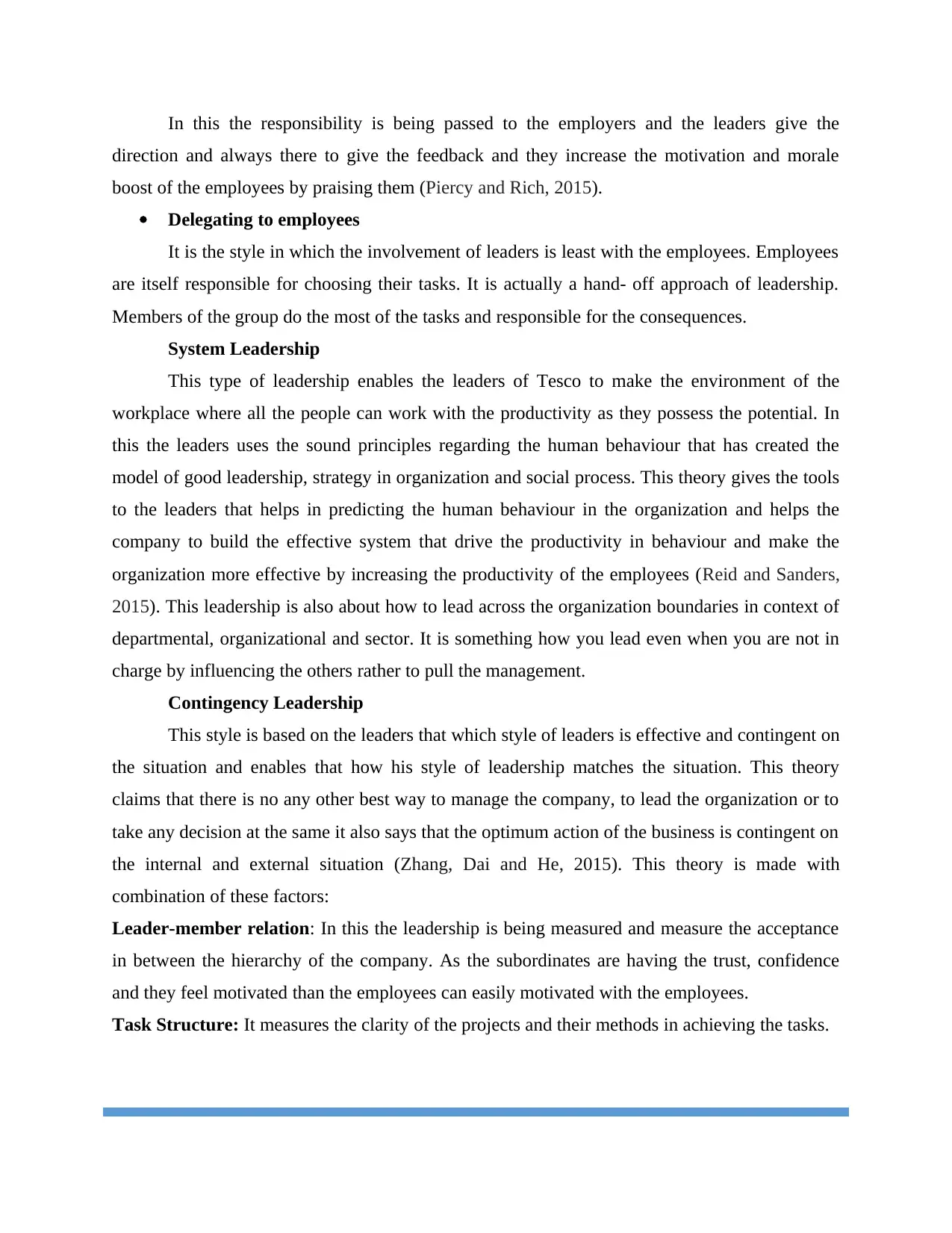
In this the responsibility is being passed to the employers and the leaders give the
direction and always there to give the feedback and they increase the motivation and morale
boost of the employees by praising them (Piercy and Rich, 2015).
Delegating to employees
It is the style in which the involvement of leaders is least with the employees. Employees
are itself responsible for choosing their tasks. It is actually a hand- off approach of leadership.
Members of the group do the most of the tasks and responsible for the consequences.
System Leadership
This type of leadership enables the leaders of Tesco to make the environment of the
workplace where all the people can work with the productivity as they possess the potential. In
this the leaders uses the sound principles regarding the human behaviour that has created the
model of good leadership, strategy in organization and social process. This theory gives the tools
to the leaders that helps in predicting the human behaviour in the organization and helps the
company to build the effective system that drive the productivity in behaviour and make the
organization more effective by increasing the productivity of the employees (Reid and Sanders,
2015). This leadership is also about how to lead across the organization boundaries in context of
departmental, organizational and sector. It is something how you lead even when you are not in
charge by influencing the others rather to pull the management.
Contingency Leadership
This style is based on the leaders that which style of leaders is effective and contingent on
the situation and enables that how his style of leadership matches the situation. This theory
claims that there is no any other best way to manage the company, to lead the organization or to
take any decision at the same it also says that the optimum action of the business is contingent on
the internal and external situation (Zhang, Dai and He, 2015). This theory is made with
combination of these factors:
Leader-member relation: In this the leadership is being measured and measure the acceptance
in between the hierarchy of the company. As the subordinates are having the trust, confidence
and they feel motivated than the employees can easily motivated with the employees.
Task Structure: It measures the clarity of the projects and their methods in achieving the tasks.
direction and always there to give the feedback and they increase the motivation and morale
boost of the employees by praising them (Piercy and Rich, 2015).
Delegating to employees
It is the style in which the involvement of leaders is least with the employees. Employees
are itself responsible for choosing their tasks. It is actually a hand- off approach of leadership.
Members of the group do the most of the tasks and responsible for the consequences.
System Leadership
This type of leadership enables the leaders of Tesco to make the environment of the
workplace where all the people can work with the productivity as they possess the potential. In
this the leaders uses the sound principles regarding the human behaviour that has created the
model of good leadership, strategy in organization and social process. This theory gives the tools
to the leaders that helps in predicting the human behaviour in the organization and helps the
company to build the effective system that drive the productivity in behaviour and make the
organization more effective by increasing the productivity of the employees (Reid and Sanders,
2015). This leadership is also about how to lead across the organization boundaries in context of
departmental, organizational and sector. It is something how you lead even when you are not in
charge by influencing the others rather to pull the management.
Contingency Leadership
This style is based on the leaders that which style of leaders is effective and contingent on
the situation and enables that how his style of leadership matches the situation. This theory
claims that there is no any other best way to manage the company, to lead the organization or to
take any decision at the same it also says that the optimum action of the business is contingent on
the internal and external situation (Zhang, Dai and He, 2015). This theory is made with
combination of these factors:
Leader-member relation: In this the leadership is being measured and measure the acceptance
in between the hierarchy of the company. As the subordinates are having the trust, confidence
and they feel motivated than the employees can easily motivated with the employees.
Task Structure: It measures the clarity of the projects and their methods in achieving the tasks.
Positional Power: It measures the authority that the leader is having to influence the
productivity of the employees. Positional power of Tesco leaders can become weak if the
subordinates directly not report to leaders (Song and Parola, 2015).
Model of approaches:
Task oriented approach
In this model of approach, the leaders mostly focus on the work or say job done on time
from the employees. This theory makes the employees alert and active also they have to
participate in completing the set goals define by leaders. Ultimately the work will be monitored
and managed by the head of the company (Chatzoudes, Chatzoglou and Vraimaki, 2015).
Laissez faire Model
This model of leadership is based on the phrase that is ' let it be' as it is considered as the
free mind job. It encourages the people to do the job in the way they want to execute. In this
model of approach, the leaders and the managers are also not having the much control over the
people. In this the leaders monitors the performance and also give their opinion to the members
of team on regular basis.
Different approaches have their strength and weakness of situations in the context of work
environment. In the situation of conflict, the strengths of leaders are that they have the ability to
compromise, collaborate, cooperate and having the vision. Leaders are flexible in this approach
and become the mediator between the parties. Weakness of leaders in this that they sometimes
become the biased and cannot give the correct decision and that impact the entire work culture of
Tesco (Song and Parola, 2015). Managing conflict is dealing with the expectations and
assumptions and even the leader looks before in the situation and realize that they can even
reduce the conflict if they pre-conceived the situation.
As per the view of Reid and Sanders, (2015) Situational leadership is very important for
the all types of organization as the leaders and managers have to change their style as per the
different situations arise in the company sometimes the leaders have to become friendly or may
become rigid in different situations for this it very important for the leaders to have the flexibility
and make the employees motivated for the work in any situation. In case of employee turnover,
the leaders need to analyse the issues why they are having turnover and make all the possible
effort to retain the capable employees. Leaders are having different approaches as in the laissez-
faire approach this make the employees to become independent and responsible towards their
productivity of the employees. Positional power of Tesco leaders can become weak if the
subordinates directly not report to leaders (Song and Parola, 2015).
Model of approaches:
Task oriented approach
In this model of approach, the leaders mostly focus on the work or say job done on time
from the employees. This theory makes the employees alert and active also they have to
participate in completing the set goals define by leaders. Ultimately the work will be monitored
and managed by the head of the company (Chatzoudes, Chatzoglou and Vraimaki, 2015).
Laissez faire Model
This model of leadership is based on the phrase that is ' let it be' as it is considered as the
free mind job. It encourages the people to do the job in the way they want to execute. In this
model of approach, the leaders and the managers are also not having the much control over the
people. In this the leaders monitors the performance and also give their opinion to the members
of team on regular basis.
Different approaches have their strength and weakness of situations in the context of work
environment. In the situation of conflict, the strengths of leaders are that they have the ability to
compromise, collaborate, cooperate and having the vision. Leaders are flexible in this approach
and become the mediator between the parties. Weakness of leaders in this that they sometimes
become the biased and cannot give the correct decision and that impact the entire work culture of
Tesco (Song and Parola, 2015). Managing conflict is dealing with the expectations and
assumptions and even the leader looks before in the situation and realize that they can even
reduce the conflict if they pre-conceived the situation.
As per the view of Reid and Sanders, (2015) Situational leadership is very important for
the all types of organization as the leaders and managers have to change their style as per the
different situations arise in the company sometimes the leaders have to become friendly or may
become rigid in different situations for this it very important for the leaders to have the flexibility
and make the employees motivated for the work in any situation. In case of employee turnover,
the leaders need to analyse the issues why they are having turnover and make all the possible
effort to retain the capable employees. Leaders are having different approaches as in the laissez-
faire approach this make the employees to become independent and responsible towards their
⊘ This is a preview!⊘
Do you want full access?
Subscribe today to unlock all pages.
Trusted by 1+ million students worldwide
work, they are allowed to do work independently, so they also do the growth as an individual at
the same leaders are always there to monitor their performance.
CONCLUSION
Operations is one of the main functions of all organisations. The operation management
must need to take into account a lot of factors in decision making. Right choices will contribute
to the success of the business, that`s why the operation management have a key role to the
company development.
From the above report it is being summarized about the roles and characteristic of the
leader and manager at Tesco. This report illustrates about the role of a leader and the function of
a manager in different situation that is arisen in the organization that are employee turnover,
conflicts. Different theories and the model of approach is also explained that includes the
situational leadership, system leadership and the contingency leadership.
the same leaders are always there to monitor their performance.
CONCLUSION
Operations is one of the main functions of all organisations. The operation management
must need to take into account a lot of factors in decision making. Right choices will contribute
to the success of the business, that`s why the operation management have a key role to the
company development.
From the above report it is being summarized about the roles and characteristic of the
leader and manager at Tesco. This report illustrates about the role of a leader and the function of
a manager in different situation that is arisen in the organization that are employee turnover,
conflicts. Different theories and the model of approach is also explained that includes the
situational leadership, system leadership and the contingency leadership.
Paraphrase This Document
Need a fresh take? Get an instant paraphrase of this document with our AI Paraphraser
REFERENCES
Books and Journals
Chatzoudes, D., Chatzoglou, P. and Vraimaki, E., 2015. The central role of knowledge
management in business operations: Developing a new conceptual framework. Business
Process Management Journal. 21(5). pp.1117-1139.
Jagoda, K. and Kiridena, S., 2015. Operations strategy processes and performance: Insights from
the contract apparel manufacturing industry. Journal of Manufacturing Technology
Management. 26(2). pp.261-279.
Kapadia, S., Dong, L. and Yang, Y., Cisco Technology Inc, 2018. Operations, administration
and management (OAM) in overlay data center environments. U.S. Patent Application
10/116,559.
Longoni, A. and Cagliano, R., 2015. Environmental and social sustainability priorities: Their
integration in operations strategies. International Journal of Operations & Production
Management. 35(2). pp.216-245.
Piercy, N. and Rich, N., 2015. The relationship between lean operations and sustainable
operations. International Journal of Operations & Production Management. 35(2). pp.282-
315.
Reid, R.D. and Sanders, N.R., 2015. Operations Management, Binder Ready Version: An
Integrated Approach. John Wiley & Sons.
Song, D.W. and Parola, F., 2015. Strategising port logistics management and operations for value
creation in global supply chains.
Song, N.O and et.al., 2015. Optimal energy management of multi-microgrids with sequentially
coordinated operations. Energies. 8(8). pp.8371-8390.
Online
Situational Theory of Leadership. 2019. [online]. Available through
<https://www.verywellmind.com/what-is-the-situational-theory-of-leadership-2795321>
Books and Journals
Chatzoudes, D., Chatzoglou, P. and Vraimaki, E., 2015. The central role of knowledge
management in business operations: Developing a new conceptual framework. Business
Process Management Journal. 21(5). pp.1117-1139.
Jagoda, K. and Kiridena, S., 2015. Operations strategy processes and performance: Insights from
the contract apparel manufacturing industry. Journal of Manufacturing Technology
Management. 26(2). pp.261-279.
Kapadia, S., Dong, L. and Yang, Y., Cisco Technology Inc, 2018. Operations, administration
and management (OAM) in overlay data center environments. U.S. Patent Application
10/116,559.
Longoni, A. and Cagliano, R., 2015. Environmental and social sustainability priorities: Their
integration in operations strategies. International Journal of Operations & Production
Management. 35(2). pp.216-245.
Piercy, N. and Rich, N., 2015. The relationship between lean operations and sustainable
operations. International Journal of Operations & Production Management. 35(2). pp.282-
315.
Reid, R.D. and Sanders, N.R., 2015. Operations Management, Binder Ready Version: An
Integrated Approach. John Wiley & Sons.
Song, D.W. and Parola, F., 2015. Strategising port logistics management and operations for value
creation in global supply chains.
Song, N.O and et.al., 2015. Optimal energy management of multi-microgrids with sequentially
coordinated operations. Energies. 8(8). pp.8371-8390.
Online
Situational Theory of Leadership. 2019. [online]. Available through
<https://www.verywellmind.com/what-is-the-situational-theory-of-leadership-2795321>

1 out of 11


Related Documents


Your All-in-One AI-Powered Toolkit for Academic Success.
+13062052269
info@desklib.com
Available 24*7 on WhatsApp / Email
![[object Object]](/_next/static/media/star-bottom.7253800d.svg)
Unlock your academic potential
Copyright © 2020–2025 A2Z Services. All Rights Reserved. Developed and managed by ZUCOL.