Management and Operations Report: Toyota Corporation Analysis
VerifiedAdded on 2020/11/23
|18
|6607
|267
Report
AI Summary
This report offers a comprehensive analysis of Toyota Motor Corporation's management and operational strategies. It begins with an introduction to the organization, its management structure, and a comparison of the roles of managers and leaders. The report delves into different leadership and management approaches, evaluating their strengths and weaknesses within the context of Toyota. It examines the impact of managers and leaders on the organization, proposing ways to enhance their effectiveness. Furthermore, the report explores Toyota's key operational functions, defining the roles of managers within these functions and explaining key operational management approaches. It also assesses the impact of external environmental factors on decision-making processes and suggests methods for improving operational efficiency. The report concludes with recommendations for future improvements within the organization, drawing upon various management and leadership theories to support its findings.
Management and Operations

Paraphrase This Document
Need a fresh take? Get an instant paraphrase of this document with our AI Paraphraser
TABLE OF CONTENTS
INTRODUCTION...........................................................................................................................1
TASK 1............................................................................................................................................1
Introduction to the organisation and its management structure..................................................1
P1. Defining the roles of manager and leader with the differences between management and
leadership....................................................................................................................................3
P2. Different roles of management and leadership in different organisational situation............5
P3. Evaluating the strength and weakness of different approaches to leadership and
management................................................................................................................................6
The impact of manager and leader on the organisation and ways to improve it.........................8
TASK 2............................................................................................................................................8
Key operation of Toyota corporation..........................................................................................8
Defining the operational function and roles of manager in these functions...............................9
P4 and P5. Explaining the key approaches to operational management.....................................9
P6 Evaluating the impact of external environment factors that can affect the decision making
process.......................................................................................................................................10
Ways to improve operational efficiency successfully...............................................................11
Suggestions for the future improvement in the organisation....................................................12
CONCLUSION..............................................................................................................................12
REFERENCES..............................................................................................................................13
INTRODUCTION...........................................................................................................................1
TASK 1............................................................................................................................................1
Introduction to the organisation and its management structure..................................................1
P1. Defining the roles of manager and leader with the differences between management and
leadership....................................................................................................................................3
P2. Different roles of management and leadership in different organisational situation............5
P3. Evaluating the strength and weakness of different approaches to leadership and
management................................................................................................................................6
The impact of manager and leader on the organisation and ways to improve it.........................8
TASK 2............................................................................................................................................8
Key operation of Toyota corporation..........................................................................................8
Defining the operational function and roles of manager in these functions...............................9
P4 and P5. Explaining the key approaches to operational management.....................................9
P6 Evaluating the impact of external environment factors that can affect the decision making
process.......................................................................................................................................10
Ways to improve operational efficiency successfully...............................................................11
Suggestions for the future improvement in the organisation....................................................12
CONCLUSION..............................................................................................................................12
REFERENCES..............................................................................................................................13
INTRODUCTION
Operational management can be termed as the area of management which is responsible
for designing, managing and controlling the production process. It is an essential part of any type
and size of organisation, which assist in managing and organising the process of converting the
raw material into finished quality products to offered to the customers. Toyota Motor
Corporation is a Japanese multinational automotive manufacturers, which is one of the largest
automotive manufacturers around the world. The present report will demonstrate different
aspects of operational management of Toyota and the role of leader and manager in it. The report
will discuss the management structure of Toyota. Role of manager and leader in different
situation in Toyota will be discuss. Different theories of management and leadership will be
evaluate in report. Present report will also discuss different approaches of operational
management in Toyota corporation. The impact of external factors on operational management
and the effectiveness’s of leader and manager will be discussed.
TASK 1 Introduction to the organisation and its management structure.
Toyota Motor Corporation is a Japanese multinational automotive manufacturer
headquarter in Toyota city, Aischi, Japan. It was founded on 28th August, 1937. It has 364445
employees working almost around the globe. It is sixth largest motor company in terms of
earning revenue and 2nd largest automotive manufacture company in world. It is well known for
its motor vehicle which includes auto-mobile, luxury vehicles, commercial vehicles, engines
etc.Management structure of Toyota:, P4 and P6.
1
Operational management can be termed as the area of management which is responsible
for designing, managing and controlling the production process. It is an essential part of any type
and size of organisation, which assist in managing and organising the process of converting the
raw material into finished quality products to offered to the customers. Toyota Motor
Corporation is a Japanese multinational automotive manufacturers, which is one of the largest
automotive manufacturers around the world. The present report will demonstrate different
aspects of operational management of Toyota and the role of leader and manager in it. The report
will discuss the management structure of Toyota. Role of manager and leader in different
situation in Toyota will be discuss. Different theories of management and leadership will be
evaluate in report. Present report will also discuss different approaches of operational
management in Toyota corporation. The impact of external factors on operational management
and the effectiveness’s of leader and manager will be discussed.
TASK 1 Introduction to the organisation and its management structure.
Toyota Motor Corporation is a Japanese multinational automotive manufacturer
headquarter in Toyota city, Aischi, Japan. It was founded on 28th August, 1937. It has 364445
employees working almost around the globe. It is sixth largest motor company in terms of
earning revenue and 2nd largest automotive manufacture company in world. It is well known for
its motor vehicle which includes auto-mobile, luxury vehicles, commercial vehicles, engines
etc.Management structure of Toyota:, P4 and P6.
1
⊘ This is a preview!⊘
Do you want full access?
Subscribe today to unlock all pages.

Trusted by 1+ million students worldwide
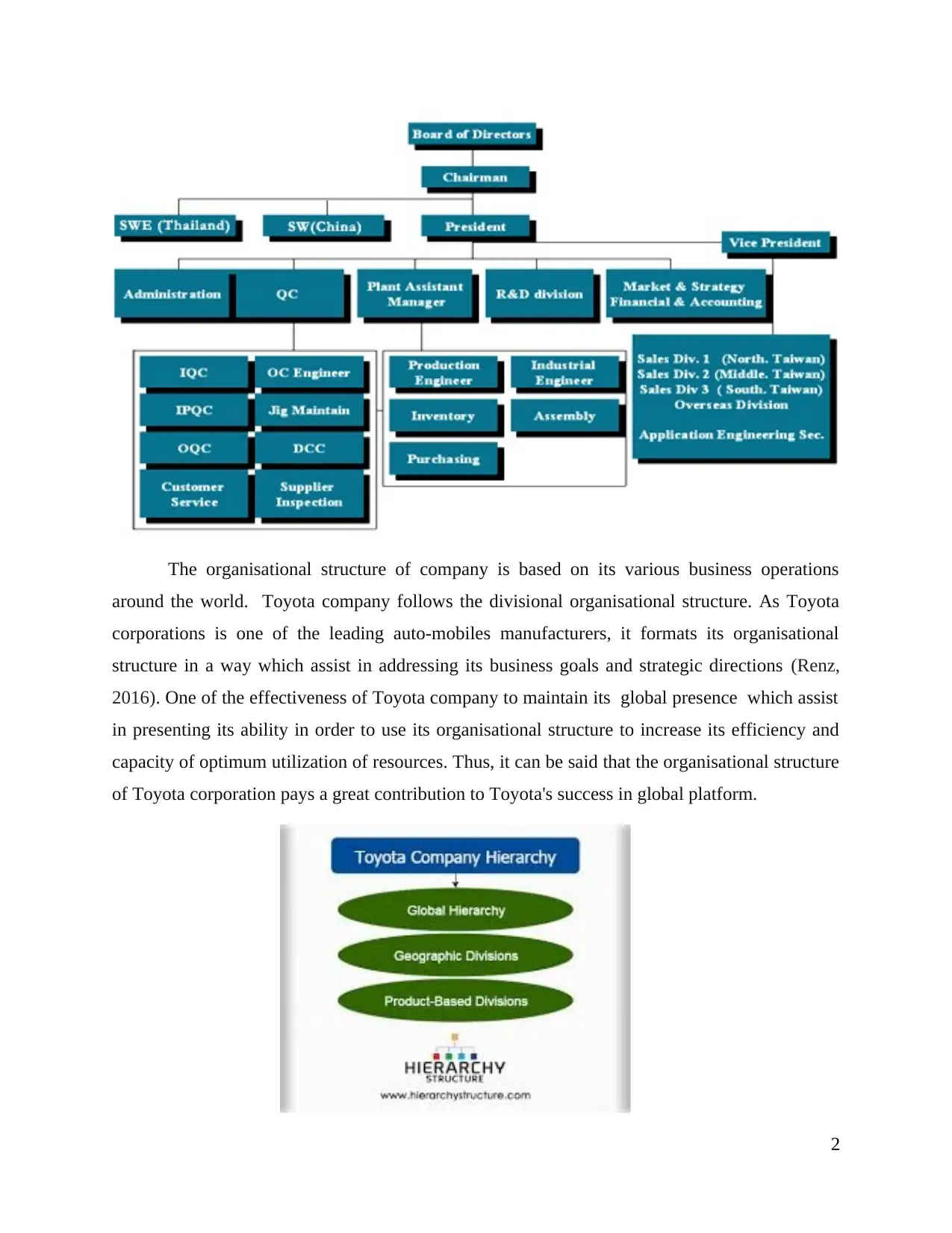
The organisational structure of company is based on its various business operations
around the world. Toyota company follows the divisional organisational structure. As Toyota
corporations is one of the leading auto-mobiles manufacturers, it formats its organisational
structure in a way which assist in addressing its business goals and strategic directions (Renz,
2016). One of the effectiveness of Toyota company to maintain its global presence which assist
in presenting its ability in order to use its organisational structure to increase its efficiency and
capacity of optimum utilization of resources. Thus, it can be said that the organisational structure
of Toyota corporation pays a great contribution to Toyota's success in global platform.
2
around the world. Toyota company follows the divisional organisational structure. As Toyota
corporations is one of the leading auto-mobiles manufacturers, it formats its organisational
structure in a way which assist in addressing its business goals and strategic directions (Renz,
2016). One of the effectiveness of Toyota company to maintain its global presence which assist
in presenting its ability in order to use its organisational structure to increase its efficiency and
capacity of optimum utilization of resources. Thus, it can be said that the organisational structure
of Toyota corporation pays a great contribution to Toyota's success in global platform.
2
Paraphrase This Document
Need a fresh take? Get an instant paraphrase of this document with our AI Paraphraser
Toyota's organisational structure has the following main characteristics:
Global Hierarchy: After the reorganisation of Toyota in 2013, it somehow also maintain
its global hierarchy where the management in headquarter Japan take all the main decision for
the company and its unit around the world. However, now the company has divided its decision
making power among regional head and business unit head (Goetsch and Davis, 2014). Under
this structure, the decision making process has become less centralised, they just report regarding
the business process to the headquarter in japan.
Geographic Division: In this structure, Toyota corporation has divided its structure in 8
regional division. Each regional had accountable to report to the headquarter in japan. This
structure assist the company in improve the quality of the product and services as per the needs
of the market condition of that region.
Product-based division: in this feature of structure, the company is divided in the set of
product based divisions. There are four types of product based division such as: Lexus
international. Toyota No.1, Toyota No.2 and Unit Centre, which is responsible for the operations
of engines, transmission and other related operations (Vaccaro and et.al., 2012). It assist the
organisational structure in development of brands and product line.
P1. Defining the roles of manager and leader with the differences between management and
leadership.
Leader and manager plays a significant role in a every level of organisation. It can be said
that, Toyota corporation is operating efficiently at global level because of its efficient
management and leadership . Both leader and manager fulfil their role efficiently that assist in
adding value to the organisational process.
Leader can be defined as a person who influences their employees or followers in order
to achieve the specific goal of a business enterprises. Leader has a clear vision of the future of
organisation and inspires and motivate employees so that they perform as the vision makes their
mission to be accomplished (Northouse, 2018).
The role of a leader in an organisation are:
3
Global Hierarchy: After the reorganisation of Toyota in 2013, it somehow also maintain
its global hierarchy where the management in headquarter Japan take all the main decision for
the company and its unit around the world. However, now the company has divided its decision
making power among regional head and business unit head (Goetsch and Davis, 2014). Under
this structure, the decision making process has become less centralised, they just report regarding
the business process to the headquarter in japan.
Geographic Division: In this structure, Toyota corporation has divided its structure in 8
regional division. Each regional had accountable to report to the headquarter in japan. This
structure assist the company in improve the quality of the product and services as per the needs
of the market condition of that region.
Product-based division: in this feature of structure, the company is divided in the set of
product based divisions. There are four types of product based division such as: Lexus
international. Toyota No.1, Toyota No.2 and Unit Centre, which is responsible for the operations
of engines, transmission and other related operations (Vaccaro and et.al., 2012). It assist the
organisational structure in development of brands and product line.
P1. Defining the roles of manager and leader with the differences between management and
leadership.
Leader and manager plays a significant role in a every level of organisation. It can be said
that, Toyota corporation is operating efficiently at global level because of its efficient
management and leadership . Both leader and manager fulfil their role efficiently that assist in
adding value to the organisational process.
Leader can be defined as a person who influences their employees or followers in order
to achieve the specific goal of a business enterprises. Leader has a clear vision of the future of
organisation and inspires and motivate employees so that they perform as the vision makes their
mission to be accomplished (Northouse, 2018).
The role of a leader in an organisation are:
3
A leader helps in making decision and policies in top-level, in middle level and lower
level they are important in order to well execute the plan and motivate the employees in
order to accomplishing the the programs framed buy upper management.
A leader act as a representative of the organisation to the outside world, in seminars,
conferences, press meetings etc. he plays important role in communicating the motive
and purpose of business enterprise to the outside public (Role of a Leader , 2019). Leader assist in integrating the goals of employees in the organisational goals, which
helps in encouraging the employees to enhance their performance level.
A manager can be said as a person who is accountable in managing all the activities of
organisation. In Toyota corporation, manager can be said to be accountable in order to efficiently
manage the business process and enhancing the operations of business efficiently (Block, 2016).
Manager exercise all the basic functions of management i.e. planning, leading, organising
and controlling. They delegate the task to the employees. There are many managers in
organisation who are responsible for the function of department (McCaffery, 2018).
Role of a manager:
The role of top-level manager is to make policies and procedure of operations which
assist in achieving the set objectives and goals of organisation. They are accountable to make
strategies and policies that will assist in Smooth running of operations of an organisation and
make decision in order to improve the performance of employees.
The difference between leadership and management are as follows:
Basis of difference Leadership Management
Meaning It can be define as the skills of a
leader to encourage and the
behaviour of others in Toyota.
It can be termed as an art of
getting activity done from
others.
Basis Leadership in Toyota is based on the
trust of employees.
Management of Toyota is based
on controlling the employees
Focus on Leaders focuses on encouraging
employees to bring change and
Managers focuses on stability of
different operations in the
4
level they are important in order to well execute the plan and motivate the employees in
order to accomplishing the the programs framed buy upper management.
A leader act as a representative of the organisation to the outside world, in seminars,
conferences, press meetings etc. he plays important role in communicating the motive
and purpose of business enterprise to the outside public (Role of a Leader , 2019). Leader assist in integrating the goals of employees in the organisational goals, which
helps in encouraging the employees to enhance their performance level.
A manager can be said as a person who is accountable in managing all the activities of
organisation. In Toyota corporation, manager can be said to be accountable in order to efficiently
manage the business process and enhancing the operations of business efficiently (Block, 2016).
Manager exercise all the basic functions of management i.e. planning, leading, organising
and controlling. They delegate the task to the employees. There are many managers in
organisation who are responsible for the function of department (McCaffery, 2018).
Role of a manager:
The role of top-level manager is to make policies and procedure of operations which
assist in achieving the set objectives and goals of organisation. They are accountable to make
strategies and policies that will assist in Smooth running of operations of an organisation and
make decision in order to improve the performance of employees.
The difference between leadership and management are as follows:
Basis of difference Leadership Management
Meaning It can be define as the skills of a
leader to encourage and the
behaviour of others in Toyota.
It can be termed as an art of
getting activity done from
others.
Basis Leadership in Toyota is based on the
trust of employees.
Management of Toyota is based
on controlling the employees
Focus on Leaders focuses on encouraging
employees to bring change and
Managers focuses on stability of
different operations in the
4
⊘ This is a preview!⊘
Do you want full access?
Subscribe today to unlock all pages.
Trusted by 1+ million students worldwide
improve their performance. business entity (Johnston and
Marshall, 2013).
Formulation of Guidelines and principles are the
formulation of leadership.
Policies and procedures are the
formulation of management in
Toyota.
P2. Different roles of management and leadership in different organisational situation
As Toyota corporation is operating in global platform, there could be various situation
which can arises that can leads to affect the performance of company. Managers and leaders are
responsible and plays an effective role in order to handle such situation with their traits and
styles. Manager will work as per his authority and functions, where leader will handle such
situation with his traits and influencing the behaviours of others. It can be better understand with
the help of different theories and concepts of management and leadership.
Taking as an example, Toyota Corporation is going to start a new manufacturing plant in
South Africa. It will assist the company to expand its market in new country which
enhance the sales and increases the revenue of business (Turner, 2014). in this situation
manager will make plan and policies regarding the new projects. Management will make
plans to recruit employees, search for infrastructure. On the other hand leader will
provide training to the hired employees, he can create innovative idea for the starting of
new operations.
Another situation can be, Toyota corporation is facing the issue of production efficiency
and quality, financial issues, team management etc. The manager will effectively operates
as per the function like planning to utilize the available resources in order to increase the
efficiency. Manager will make budget in order to control the financial uses which will
assist in responding to financial issues. On the other hand, leader will encourages the
employees in order to enhances their performance which can leads to increases overall
production efficiency. Leader will make innovative and creative idea for sales and
5
Marshall, 2013).
Formulation of Guidelines and principles are the
formulation of leadership.
Policies and procedures are the
formulation of management in
Toyota.
P2. Different roles of management and leadership in different organisational situation
As Toyota corporation is operating in global platform, there could be various situation
which can arises that can leads to affect the performance of company. Managers and leaders are
responsible and plays an effective role in order to handle such situation with their traits and
styles. Manager will work as per his authority and functions, where leader will handle such
situation with his traits and influencing the behaviours of others. It can be better understand with
the help of different theories and concepts of management and leadership.
Taking as an example, Toyota Corporation is going to start a new manufacturing plant in
South Africa. It will assist the company to expand its market in new country which
enhance the sales and increases the revenue of business (Turner, 2014). in this situation
manager will make plan and policies regarding the new projects. Management will make
plans to recruit employees, search for infrastructure. On the other hand leader will
provide training to the hired employees, he can create innovative idea for the starting of
new operations.
Another situation can be, Toyota corporation is facing the issue of production efficiency
and quality, financial issues, team management etc. The manager will effectively operates
as per the function like planning to utilize the available resources in order to increase the
efficiency. Manager will make budget in order to control the financial uses which will
assist in responding to financial issues. On the other hand, leader will encourages the
employees in order to enhances their performance which can leads to increases overall
production efficiency. Leader will make innovative and creative idea for sales and
5
Paraphrase This Document
Need a fresh take? Get an instant paraphrase of this document with our AI Paraphraser
marketing department to increases the sales and revenue so as to overcome from financial
crisis.
Further, according to the theory of Henry Fayol, manager of Toyota must have ability in
relation to division of work, unity of command and direction. According to Behavioural theory,
a leader or manager has to emphasis on using three skills in order to effectively manage and
influence his employees. Which are, technological, human and conceptual skills. This skills will
assist the manager and leader to effectively plan the procedures to implement the plan of new
manufacturing unit.
P3. Evaluating the strength and weakness of different approaches to leadership and management.
The role of leader in context of Toyota company is that they have to trained their
employee and also helps them to complete the task within the allotted time. They also manage
the behaviours of employees if they are not behaving well with other team members. In same
context the function of managers in Toyota is to enhance their communication skills with their co
workers so that they can easily discuss the issue which they face at the time of committing work.
They also provide such relief to employees to take their own decision and bring innovative ideas
to implement their work. There are various theories and approaches of leadership which assist a
leader in order to efficiently utilises his skills as per the situation arises in the organisation.
Different approaches of leadership and management are as follows:
Lewis leadership style Approach: As per this theory, there are three main styles of
leadership which assist in defining the approach of leadership in an organisation.
Autocratic style: In this style of leadership, a leader or manager has individual control
over all the decision regarding any activity in workplace. The leader or manager will not involve
their subordinate in decision making process and take little or no feedbacks from their
subordinates (Chi, Lan and Dorjgotov, 2012). A leader uses this approach is bossy and controls
their employees.
Strength:
This style assist in making quick decision as there are fewer level of administration from
where information needs to be gathered.
6
crisis.
Further, according to the theory of Henry Fayol, manager of Toyota must have ability in
relation to division of work, unity of command and direction. According to Behavioural theory,
a leader or manager has to emphasis on using three skills in order to effectively manage and
influence his employees. Which are, technological, human and conceptual skills. This skills will
assist the manager and leader to effectively plan the procedures to implement the plan of new
manufacturing unit.
P3. Evaluating the strength and weakness of different approaches to leadership and management.
The role of leader in context of Toyota company is that they have to trained their
employee and also helps them to complete the task within the allotted time. They also manage
the behaviours of employees if they are not behaving well with other team members. In same
context the function of managers in Toyota is to enhance their communication skills with their co
workers so that they can easily discuss the issue which they face at the time of committing work.
They also provide such relief to employees to take their own decision and bring innovative ideas
to implement their work. There are various theories and approaches of leadership which assist a
leader in order to efficiently utilises his skills as per the situation arises in the organisation.
Different approaches of leadership and management are as follows:
Lewis leadership style Approach: As per this theory, there are three main styles of
leadership which assist in defining the approach of leadership in an organisation.
Autocratic style: In this style of leadership, a leader or manager has individual control
over all the decision regarding any activity in workplace. The leader or manager will not involve
their subordinate in decision making process and take little or no feedbacks from their
subordinates (Chi, Lan and Dorjgotov, 2012). A leader uses this approach is bossy and controls
their employees.
Strength:
This style assist in making quick decision as there are fewer level of administration from
where information needs to be gathered.
6
Autocratic leadership helps in increasing efficient communication within the
organisation. It will also encourages the productivity in the organisation (What is
Autocratic Style Leadership? , 2019).
It is an effective style of leadership when there is less time in order to complete ant
activity or project.
Weakness:
Leader misses out the new ideas and concepts from their employees which can be
helpful in the business growth and development.
Democratic style: In this style of leadership, leaders are usually participative who keeps
on taking feedback and suggestions from their subordinates (Morrison, 2012). They encourages
their employees and involves in decision making process which assist the employees to be more
free in communicating to their employers.
Strength:
In this approach, the leader are typically excellent in solving complex issues as they
consult and take opinion from their employees which assist in getting various ideas
(Bolden, 2011).
This style can be utilised for almost all the businesses.
Weaknesses:
This style usually take more time in making decision and policies as there are various
layers of administration.
Situational approach: As per this theory, a leader has to change its style with the change
in situation in organisation. According to this theory, leader will encourage his staffs and
employees to successfully implement the plan of new manufacturing plant which assist in their
and organisational growth and development (Mujtaba, 2013). The manager has to adapt his style
of talking making strategies and policing and implement those policies effectively. Hence, by
taking into account such approach concerned authorities of Toyota can take suitable decision as
per the situation and thereby contributes in organizational success.
7
organisation. It will also encourages the productivity in the organisation (What is
Autocratic Style Leadership? , 2019).
It is an effective style of leadership when there is less time in order to complete ant
activity or project.
Weakness:
Leader misses out the new ideas and concepts from their employees which can be
helpful in the business growth and development.
Democratic style: In this style of leadership, leaders are usually participative who keeps
on taking feedback and suggestions from their subordinates (Morrison, 2012). They encourages
their employees and involves in decision making process which assist the employees to be more
free in communicating to their employers.
Strength:
In this approach, the leader are typically excellent in solving complex issues as they
consult and take opinion from their employees which assist in getting various ideas
(Bolden, 2011).
This style can be utilised for almost all the businesses.
Weaknesses:
This style usually take more time in making decision and policies as there are various
layers of administration.
Situational approach: As per this theory, a leader has to change its style with the change
in situation in organisation. According to this theory, leader will encourage his staffs and
employees to successfully implement the plan of new manufacturing plant which assist in their
and organisational growth and development (Mujtaba, 2013). The manager has to adapt his style
of talking making strategies and policing and implement those policies effectively. Hence, by
taking into account such approach concerned authorities of Toyota can take suitable decision as
per the situation and thereby contributes in organizational success.
7
⊘ This is a preview!⊘
Do you want full access?
Subscribe today to unlock all pages.
Trusted by 1+ million students worldwide
E.g. If any conflict arises between the employees at the time working in Toyota company than
the role of leaders is to settle their matter through their leadership style. They use democratic
style to settle the matter between them but the leaders have no power to take action against any
person inn case of any damage to one person. In such cases mangers can take further action and
settle the matter if it affects their productivity at the time of achieving goals.
Strength:
This approach assists a leader or manager to adapt various style at different situation with
different employees effectively.
Weaknesses:
Education, age, experience and gender influence each sub-ordinate's preference for
certain forms of leadership. Yet, demographic characteristics are also not considered in the
situational-leadership approach.
System leadership theory:
This theory assists the leader in an organisation in order to create such environment
where the employees can work more productively to their potential. This theory assist the
manager of leader of Toyota in using an effective principle regarding the human behaviours in
order to create models of good leadership.
Strengths
Assists in achieving both individual as well as organizational goals
Adaptive and dynamic in nature Facilitates uniformity in decision making
Weaknesses
Ineffectual classification pertaining to inter relationship creates issues It relies on specific systems which in turn leads delay in decision making under critical
situations
Contingency leadership:
8
the role of leaders is to settle their matter through their leadership style. They use democratic
style to settle the matter between them but the leaders have no power to take action against any
person inn case of any damage to one person. In such cases mangers can take further action and
settle the matter if it affects their productivity at the time of achieving goals.
Strength:
This approach assists a leader or manager to adapt various style at different situation with
different employees effectively.
Weaknesses:
Education, age, experience and gender influence each sub-ordinate's preference for
certain forms of leadership. Yet, demographic characteristics are also not considered in the
situational-leadership approach.
System leadership theory:
This theory assists the leader in an organisation in order to create such environment
where the employees can work more productively to their potential. This theory assist the
manager of leader of Toyota in using an effective principle regarding the human behaviours in
order to create models of good leadership.
Strengths
Assists in achieving both individual as well as organizational goals
Adaptive and dynamic in nature Facilitates uniformity in decision making
Weaknesses
Ineffectual classification pertaining to inter relationship creates issues It relies on specific systems which in turn leads delay in decision making under critical
situations
Contingency leadership:
8
Paraphrase This Document
Need a fresh take? Get an instant paraphrase of this document with our AI Paraphraser
As per this theory, there is no best style for a leader in order to organise a corporation, or
to lead the employees or to make any decisions. This theory states that the decision of a leader is
contingent or depends on the situation which arises in Toyota Corporation.
Strengths
Facilitates flexibility and change management within an organization This approach emphasizes on evaluating every factor from the perspective of both present
and future
Weaknesses
Complex in implementation because it is based on particular situation
Not feasible because sometimes leaders face difficulty in considering every factor while
making decisionsThe impact of manager and leader on the organisation and ways to
improve it.
A leader and a manager plays an significant role in the growth and development of
Toyota corporation. Their roles, responsibility and function is very effective in order to enhances
the efficiency of the business operations (Van Dierendonck, 2011). Manager leads to manage all
the activities in the organisation, he sets the goals and objective and on the basis of which the
policies and decision will be made in order to increase the increase the revenue and achieve the
desire goals. A leader helps in facilitating the decisions and policies and communicate it to the
employees. They influence and encourage the employees to increase their performance that will
help in achieving organisational as well as their own goals.
It can be recommanded that manager and leader should opt for democratic leadership
style which assist them in motivating the employees in order to increase their productivity which
is essential way to improve the organisational process in future (Söderhjelm and et.al., 2018).
The management of Toyota corporation should make their hierarchy culture more effective to
stimulate the efficiency of the whole organisation.
TASK 2Key operation of Toyota corporation
The key operational function of Toyota corporation is manufacturing of vehicles and
other automotive products. Toyota corporation is engaged in the operations of auto-mobiles,
9
to lead the employees or to make any decisions. This theory states that the decision of a leader is
contingent or depends on the situation which arises in Toyota Corporation.
Strengths
Facilitates flexibility and change management within an organization This approach emphasizes on evaluating every factor from the perspective of both present
and future
Weaknesses
Complex in implementation because it is based on particular situation
Not feasible because sometimes leaders face difficulty in considering every factor while
making decisionsThe impact of manager and leader on the organisation and ways to
improve it.
A leader and a manager plays an significant role in the growth and development of
Toyota corporation. Their roles, responsibility and function is very effective in order to enhances
the efficiency of the business operations (Van Dierendonck, 2011). Manager leads to manage all
the activities in the organisation, he sets the goals and objective and on the basis of which the
policies and decision will be made in order to increase the increase the revenue and achieve the
desire goals. A leader helps in facilitating the decisions and policies and communicate it to the
employees. They influence and encourage the employees to increase their performance that will
help in achieving organisational as well as their own goals.
It can be recommanded that manager and leader should opt for democratic leadership
style which assist them in motivating the employees in order to increase their productivity which
is essential way to improve the organisational process in future (Söderhjelm and et.al., 2018).
The management of Toyota corporation should make their hierarchy culture more effective to
stimulate the efficiency of the whole organisation.
TASK 2Key operation of Toyota corporation
The key operational function of Toyota corporation is manufacturing of vehicles and
other automotive products. Toyota corporation is engaged in the operations of auto-mobiles,
9
luxury vehicles, commercial vehicles and engines etc. Toyota production system is based on the
philosophy of completely eliminating all the waste which assist in the most efficient operational
processes (Peng and Lai, 2012). The production system of Toyota corporation included lean
manufacturing system. It is based the continuous improvement that have an objective of making
the vehicles for the customer in the quickest and most efficient manner. Toyota corporation's
production system is based on two concept which are Jidoka and Just-in-time.Defining the
operational function and roles of manager in these functions.
There are various operational function which ensures successful delivery of the project.
In Toyota corporation, operational management has various function and operational managers
plays an essential role in optimizing the operational process by make effective use of resources
and capital. The role of manager in operational function are:
Finance: It is the most significant function of operational management (Key Functions of
Operations Management , 2019). It is the responsibility of the manager to ensure that operational
finance has been utilising properly in order to carry out the functions of manufacturing the
vehicles and other products.
Operations: This function of operational management is mainly concerned with
planning, organising and controlling all the activities of organisation which leads to contribute in
operational process of Toyota. Managers assist the planning and controlling process so as to
ensure the smooth operational function in organisation.
Strategy: it can be termed as planning the tactics and action which assist the optimum
utilization of resources which assist in greater productivity. Operational manager is responsible
to formulate the strategy regarding supply chain, sales etc.
P4 and P5. Explaining the key approaches to operational management
Operational management can be defines as the process which aims to planning,
organising and supervising the process of production and manufacturing in Toyota Corporation.
This system is important to manufacture the products which assist in satisfying the customers
and increases the efficiency of organisation (Jacobs, Chase and Lummus, 2014). Following are
the key approaches of operational management which assist the operational function of Toyota
corporation are as follows:
10
philosophy of completely eliminating all the waste which assist in the most efficient operational
processes (Peng and Lai, 2012). The production system of Toyota corporation included lean
manufacturing system. It is based the continuous improvement that have an objective of making
the vehicles for the customer in the quickest and most efficient manner. Toyota corporation's
production system is based on two concept which are Jidoka and Just-in-time.Defining the
operational function and roles of manager in these functions.
There are various operational function which ensures successful delivery of the project.
In Toyota corporation, operational management has various function and operational managers
plays an essential role in optimizing the operational process by make effective use of resources
and capital. The role of manager in operational function are:
Finance: It is the most significant function of operational management (Key Functions of
Operations Management , 2019). It is the responsibility of the manager to ensure that operational
finance has been utilising properly in order to carry out the functions of manufacturing the
vehicles and other products.
Operations: This function of operational management is mainly concerned with
planning, organising and controlling all the activities of organisation which leads to contribute in
operational process of Toyota. Managers assist the planning and controlling process so as to
ensure the smooth operational function in organisation.
Strategy: it can be termed as planning the tactics and action which assist the optimum
utilization of resources which assist in greater productivity. Operational manager is responsible
to formulate the strategy regarding supply chain, sales etc.
P4 and P5. Explaining the key approaches to operational management
Operational management can be defines as the process which aims to planning,
organising and supervising the process of production and manufacturing in Toyota Corporation.
This system is important to manufacture the products which assist in satisfying the customers
and increases the efficiency of organisation (Jacobs, Chase and Lummus, 2014). Following are
the key approaches of operational management which assist the operational function of Toyota
corporation are as follows:
10
⊘ This is a preview!⊘
Do you want full access?
Subscribe today to unlock all pages.
Trusted by 1+ million students worldwide

1 out of 18


Related Documents


Your All-in-One AI-Powered Toolkit for Academic Success.
+13062052269
info@desklib.com
Available 24*7 on WhatsApp / Email
![[object Object]](/_next/static/media/star-bottom.7253800d.svg)
Unlock your academic potential
Copyright © 2020–2026 A2Z Services. All Rights Reserved. Developed and managed by ZUCOL.