BTEC Level 4 Management & Operations: Leadership and Management Report
VerifiedAdded on 2023/01/11
|16
|5740
|76
Report
AI Summary
This report delves into the distinct roles of leaders and managers, examining their application across various situational contexts. It begins by defining and comparing the characteristics of leaders and managers, emphasizing the differences in their functions and responsibilities. The report then explores how leadership and management styles adapt to different organizational needs, providing examples of situational contexts where these roles are crucial. Various leadership and management theories, including classical management, autocratic leadership, and transformational leadership, are discussed to illustrate their impact on organizational outcomes. Furthermore, the report evaluates operational management approaches, highlighting their importance in achieving business objectives and assessing the factors within the business environment that influence operational decision-making. The analysis includes models such as management by objectives, situational leadership, systems leadership, and contingency approaches. The report concludes by synthesizing the key findings and emphasizing the importance of understanding both leadership and management for effective organizational performance.
Management & Operations
1
1

Paraphrase This Document
Need a fresh take? Get an instant paraphrase of this document with our AI Paraphraser
Contents
INTRODUCTION...........................................................................................................................3
TASK 1............................................................................................................................................3
P1 Define and compare different roles and characteristics of a leader and a manager...............3
TASK 2............................................................................................................................................6
P2 Examine examples of how the role of a leader and the function of a manager apply in
different situational contexts........................................................................................................6
P3 Apply different theories and models of approach, including situational leadership, systems
leadership and contingency..........................................................................................................7
TASK 3............................................................................................................................................9
P4 Explain the key approaches to operations management and the role that leaders and
managers play..............................................................................................................................9
P5 Explain the importance and value of operations management in achieving business
objectives...................................................................................................................................11
TASK 4..........................................................................................................................................12
P6 Assess the factors within the business environment that impact upon operational
management and decision-making by leaders and managers....................................................12
CONCLUSION..............................................................................................................................14
REFERENCES..............................................................................................................................15
2
INTRODUCTION...........................................................................................................................3
TASK 1............................................................................................................................................3
P1 Define and compare different roles and characteristics of a leader and a manager...............3
TASK 2............................................................................................................................................6
P2 Examine examples of how the role of a leader and the function of a manager apply in
different situational contexts........................................................................................................6
P3 Apply different theories and models of approach, including situational leadership, systems
leadership and contingency..........................................................................................................7
TASK 3............................................................................................................................................9
P4 Explain the key approaches to operations management and the role that leaders and
managers play..............................................................................................................................9
P5 Explain the importance and value of operations management in achieving business
objectives...................................................................................................................................11
TASK 4..........................................................................................................................................12
P6 Assess the factors within the business environment that impact upon operational
management and decision-making by leaders and managers....................................................12
CONCLUSION..............................................................................................................................14
REFERENCES..............................................................................................................................15
2
INTRODUCTION
Leadership refers to the process of influencing someone’s behaviour to get desired results
whereas management refers to the art of getting things done. In the following project report, an
attempt has been made to compare the roles of a leader and a manager and examining the
application of their roles in different situational contexts. Various theories and approaches of
leadership and management are being discussed and evaluated in the report such as systems
leadership, management by objectives and situational leadership. An attempt has also been made
to evaluate the various approaches of operational management and determine the importance and
value of operational management in achieving business objectives. At last, the report aims to
evaluate and assess various factors which are present in the business environment of an
organisation which influence and impact the process of operational management and managerial
decision-making.
TASK 1
P1 Define and compare different roles and characteristics of a leader and a manager.
Leader and manager are two different terms which are very likely to be used
interchangeably and as a synonym of one another. It has always been presumed that the two
terms are similar and don’t have any difference and can be used in place of each other
(Crawford, 2014). However, leadership and management are two very different fundamental
concepts which makes the function and role of managers and leaders also very different. A
manager is a person who is responsible for organising, controlling and utilising the resources of
an organisation to accomplish the goals and objectives whereas a leader is a person who has the
primary responsibility of leading a group of people or giving them direction for achievement of
the group vision (Ibrahim and Cordes, 1996). Managers has people working for him and a leader
has people who follow him. Leadership is concerned with getting people to willingly work for
achieving a common vision while management is more related with administering and ensuring
that day-to-day operations are being executed smoothly.
Differences between a manager and a leader:
Manager Leader
A manager is responsible for setting the
objectives of a company.
A leader has the responsibility of encouraging
the employees to achieve those objectives.
3
Leadership refers to the process of influencing someone’s behaviour to get desired results
whereas management refers to the art of getting things done. In the following project report, an
attempt has been made to compare the roles of a leader and a manager and examining the
application of their roles in different situational contexts. Various theories and approaches of
leadership and management are being discussed and evaluated in the report such as systems
leadership, management by objectives and situational leadership. An attempt has also been made
to evaluate the various approaches of operational management and determine the importance and
value of operational management in achieving business objectives. At last, the report aims to
evaluate and assess various factors which are present in the business environment of an
organisation which influence and impact the process of operational management and managerial
decision-making.
TASK 1
P1 Define and compare different roles and characteristics of a leader and a manager.
Leader and manager are two different terms which are very likely to be used
interchangeably and as a synonym of one another. It has always been presumed that the two
terms are similar and don’t have any difference and can be used in place of each other
(Crawford, 2014). However, leadership and management are two very different fundamental
concepts which makes the function and role of managers and leaders also very different. A
manager is a person who is responsible for organising, controlling and utilising the resources of
an organisation to accomplish the goals and objectives whereas a leader is a person who has the
primary responsibility of leading a group of people or giving them direction for achievement of
the group vision (Ibrahim and Cordes, 1996). Managers has people working for him and a leader
has people who follow him. Leadership is concerned with getting people to willingly work for
achieving a common vision while management is more related with administering and ensuring
that day-to-day operations are being executed smoothly.
Differences between a manager and a leader:
Manager Leader
A manager is responsible for setting the
objectives of a company.
A leader has the responsibility of encouraging
the employees to achieve those objectives.
3
⊘ This is a preview!⊘
Do you want full access?
Subscribe today to unlock all pages.

Trusted by 1+ million students worldwide
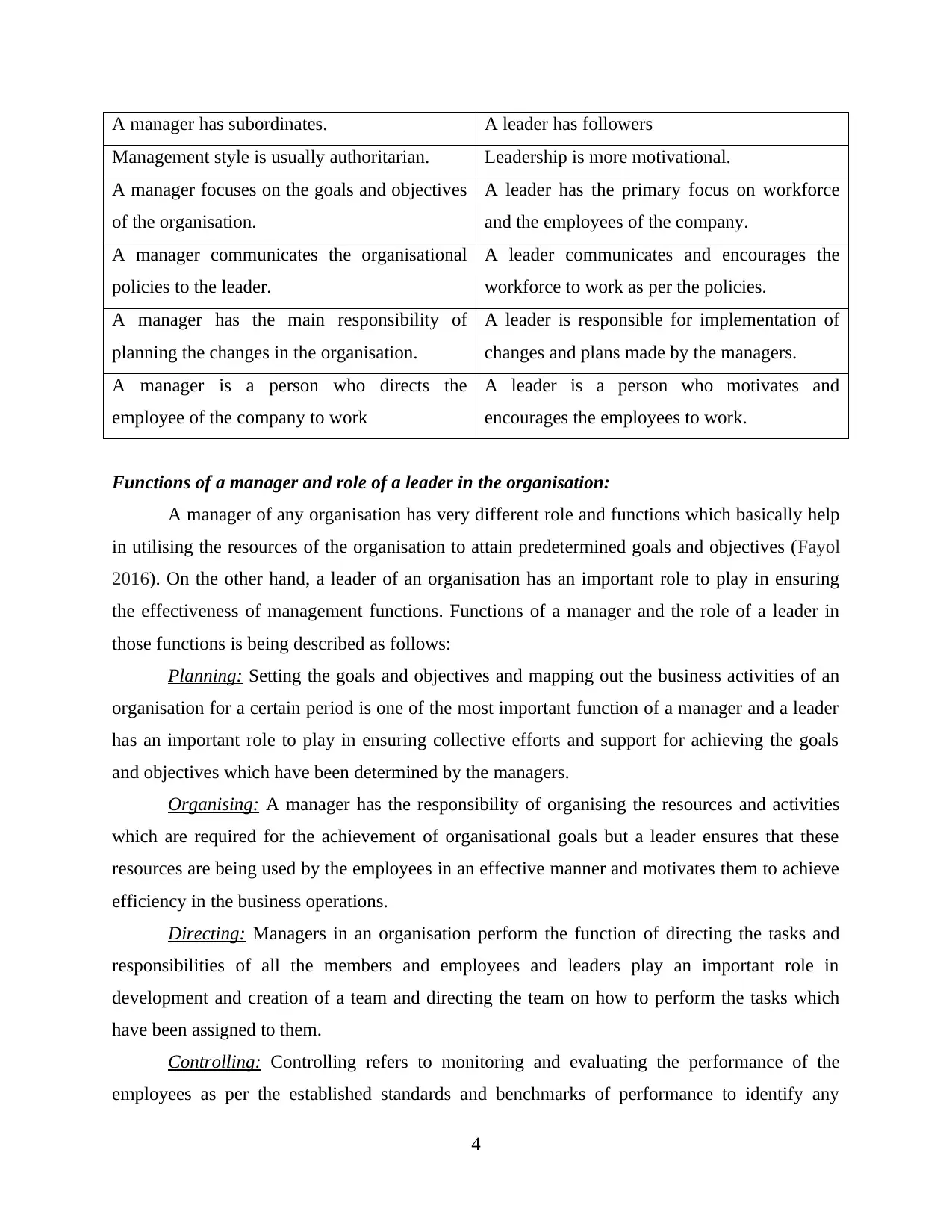
A manager has subordinates. A leader has followers
Management style is usually authoritarian. Leadership is more motivational.
A manager focuses on the goals and objectives
of the organisation.
A leader has the primary focus on workforce
and the employees of the company.
A manager communicates the organisational
policies to the leader.
A leader communicates and encourages the
workforce to work as per the policies.
A manager has the main responsibility of
planning the changes in the organisation.
A leader is responsible for implementation of
changes and plans made by the managers.
A manager is a person who directs the
employee of the company to work
A leader is a person who motivates and
encourages the employees to work.
Functions of a manager and role of a leader in the organisation:
A manager of any organisation has very different role and functions which basically help
in utilising the resources of the organisation to attain predetermined goals and objectives (Fayol
2016). On the other hand, a leader of an organisation has an important role to play in ensuring
the effectiveness of management functions. Functions of a manager and the role of a leader in
those functions is being described as follows:
Planning: Setting the goals and objectives and mapping out the business activities of an
organisation for a certain period is one of the most important function of a manager and a leader
has an important role to play in ensuring collective efforts and support for achieving the goals
and objectives which have been determined by the managers.
Organising: A manager has the responsibility of organising the resources and activities
which are required for the achievement of organisational goals but a leader ensures that these
resources are being used by the employees in an effective manner and motivates them to achieve
efficiency in the business operations.
Directing: Managers in an organisation perform the function of directing the tasks and
responsibilities of all the members and employees and leaders play an important role in
development and creation of a team and directing the team on how to perform the tasks which
have been assigned to them.
Controlling: Controlling refers to monitoring and evaluating the performance of the
employees as per the established standards and benchmarks of performance to identify any
4
Management style is usually authoritarian. Leadership is more motivational.
A manager focuses on the goals and objectives
of the organisation.
A leader has the primary focus on workforce
and the employees of the company.
A manager communicates the organisational
policies to the leader.
A leader communicates and encourages the
workforce to work as per the policies.
A manager has the main responsibility of
planning the changes in the organisation.
A leader is responsible for implementation of
changes and plans made by the managers.
A manager is a person who directs the
employee of the company to work
A leader is a person who motivates and
encourages the employees to work.
Functions of a manager and role of a leader in the organisation:
A manager of any organisation has very different role and functions which basically help
in utilising the resources of the organisation to attain predetermined goals and objectives (Fayol
2016). On the other hand, a leader of an organisation has an important role to play in ensuring
the effectiveness of management functions. Functions of a manager and the role of a leader in
those functions is being described as follows:
Planning: Setting the goals and objectives and mapping out the business activities of an
organisation for a certain period is one of the most important function of a manager and a leader
has an important role to play in ensuring collective efforts and support for achieving the goals
and objectives which have been determined by the managers.
Organising: A manager has the responsibility of organising the resources and activities
which are required for the achievement of organisational goals but a leader ensures that these
resources are being used by the employees in an effective manner and motivates them to achieve
efficiency in the business operations.
Directing: Managers in an organisation perform the function of directing the tasks and
responsibilities of all the members and employees and leaders play an important role in
development and creation of a team and directing the team on how to perform the tasks which
have been assigned to them.
Controlling: Controlling refers to monitoring and evaluating the performance of the
employees as per the established standards and benchmarks of performance to identify any
4
Paraphrase This Document
Need a fresh take? Get an instant paraphrase of this document with our AI Paraphraser
variation in actual performance and the standard performance which is an important managerial
function. To increase the effectiveness of controlling process, it is the role of a leader to motivate
and guide the employees in increasing work efficiency and productivity levels.
Various management and leadership theories exist which helps the managers and leaders
of an organisation to perform their duties and roles in an effective manner. These theories act as
guiding principles which can be followed for better outcome as a result of any style of
management and leadership. Some of the theories are as follows:
Classical management theory: Classical management theory is constructed on the belief
that an employee only has physical needs. Since the physical needs of the employees can only be
satisfied with money and funds, classical theory of management primarily focuses on solely the
economic aspect of workforce. As a consequence, this theory fails to include the personal and
social needs of employees which determine and influence the level of satisfaction a person
derives from his job (Mahmood, Basharat and Bashir, 2012). It accommodates seven key
principles which makes an ideal organisation which are maximisation of profit, specialisation of
labour, streamlined operations, high productivity, centralised leadership, few decision-making
and emphasis on improving the bottom line. In the organisations where classical theory of
management is preached, control of the decision-making and operations is with the top-
management with a primary objective of improving the financial and economic aspect related to
the job.
Autocratic leadership: Autocratic leadership is the style of leadership where the power to
make decisions and control of the organisation exists in the hands of only a few people at the
top-management level. The leaders take very little inputs from employees and employees are
expected to follow the instructions without any questioning.
Transformational leadership: Transformational leadership is a style of leadership in
which the leader makes a constant effort to motivate and encourage the employees to seek
changes and development which can help in shaping the future growth and success of the
company (Bass and Riggio, 2006). Flexibility and liberty is granted to employees to look for
creative and innovative solutions or alternatives which can help in improving the productivity in
organisations. Transformational leaders usually have a trust and faith in their employees and
gives the workforce room to be more creative and have the authority to take decisions related to
their job.
5
function. To increase the effectiveness of controlling process, it is the role of a leader to motivate
and guide the employees in increasing work efficiency and productivity levels.
Various management and leadership theories exist which helps the managers and leaders
of an organisation to perform their duties and roles in an effective manner. These theories act as
guiding principles which can be followed for better outcome as a result of any style of
management and leadership. Some of the theories are as follows:
Classical management theory: Classical management theory is constructed on the belief
that an employee only has physical needs. Since the physical needs of the employees can only be
satisfied with money and funds, classical theory of management primarily focuses on solely the
economic aspect of workforce. As a consequence, this theory fails to include the personal and
social needs of employees which determine and influence the level of satisfaction a person
derives from his job (Mahmood, Basharat and Bashir, 2012). It accommodates seven key
principles which makes an ideal organisation which are maximisation of profit, specialisation of
labour, streamlined operations, high productivity, centralised leadership, few decision-making
and emphasis on improving the bottom line. In the organisations where classical theory of
management is preached, control of the decision-making and operations is with the top-
management with a primary objective of improving the financial and economic aspect related to
the job.
Autocratic leadership: Autocratic leadership is the style of leadership where the power to
make decisions and control of the organisation exists in the hands of only a few people at the
top-management level. The leaders take very little inputs from employees and employees are
expected to follow the instructions without any questioning.
Transformational leadership: Transformational leadership is a style of leadership in
which the leader makes a constant effort to motivate and encourage the employees to seek
changes and development which can help in shaping the future growth and success of the
company (Bass and Riggio, 2006). Flexibility and liberty is granted to employees to look for
creative and innovative solutions or alternatives which can help in improving the productivity in
organisations. Transformational leaders usually have a trust and faith in their employees and
gives the workforce room to be more creative and have the authority to take decisions related to
their job.
5
On the basis of above discussion, it can be observed that Joan Pearson follows the
autocratic style of leadership which involves giving instructions to the employees and expecting
them to follow the instructions without any questioning. It can be identified that following a
classical style of management has not helped Joan Pearson to motivate the employees and boost
their morale mainly because no attention is being paid to the social and personal needs of the
employees.
TASK 2
P2 Examine examples of how the role of a leader and the function of a manager apply in
different situational contexts.
A manager and a leader has important and diverse functions and role to play in an
organisation context as per the changing business situations and needs. Dynamic nature of the
business environment makes it imperative for the managers and leaders to adjust their styles and
approaches as per the changing condition. On the basis of different organisation situations and
contexts, the role and function of a manager and leader might change. For example, in an
organisation where there exists a need to establish harmony between individual interests and
organisational interests and align the efforts which are being made by the employees in direction
of attainment of organisational goals, classical style of management might be followed where the
manager has the role of taking every important decision of the organisation with topmost priority
being given to the interests of the organisation. A conflict of interest can also be avoided with the
help of directing the employees and communicating the need to achieve organisational goals
which will eventually help the employees to achieve personal interests as well. It is the role of a
leader in such situation to gather employee support and encourage them to work towards
attainment of organisational goals (Manning, 2012). A conflict of interest might result into low
profitability and inefficiency in operations. Transformational style of leadership might be applied
in an organisation where the managers feel a need to improve the productivity and efficiency of
the operations by making creative and innovative changes. Under transformational style of
leadership, role and function of a leader and manager is limited to providing guidance and
autonomy to the employee to seek better creative solutions which can replace the existing
procedures in the organisation. In organisations where employees feel a constant need of
motivation and encouragement, democratic style of leadership can be used where the role of a
6
autocratic style of leadership which involves giving instructions to the employees and expecting
them to follow the instructions without any questioning. It can be identified that following a
classical style of management has not helped Joan Pearson to motivate the employees and boost
their morale mainly because no attention is being paid to the social and personal needs of the
employees.
TASK 2
P2 Examine examples of how the role of a leader and the function of a manager apply in
different situational contexts.
A manager and a leader has important and diverse functions and role to play in an
organisation context as per the changing business situations and needs. Dynamic nature of the
business environment makes it imperative for the managers and leaders to adjust their styles and
approaches as per the changing condition. On the basis of different organisation situations and
contexts, the role and function of a manager and leader might change. For example, in an
organisation where there exists a need to establish harmony between individual interests and
organisational interests and align the efforts which are being made by the employees in direction
of attainment of organisational goals, classical style of management might be followed where the
manager has the role of taking every important decision of the organisation with topmost priority
being given to the interests of the organisation. A conflict of interest can also be avoided with the
help of directing the employees and communicating the need to achieve organisational goals
which will eventually help the employees to achieve personal interests as well. It is the role of a
leader in such situation to gather employee support and encourage them to work towards
attainment of organisational goals (Manning, 2012). A conflict of interest might result into low
profitability and inefficiency in operations. Transformational style of leadership might be applied
in an organisation where the managers feel a need to improve the productivity and efficiency of
the operations by making creative and innovative changes. Under transformational style of
leadership, role and function of a leader and manager is limited to providing guidance and
autonomy to the employee to seek better creative solutions which can replace the existing
procedures in the organisation. In organisations where employees feel a constant need of
motivation and encouragement, democratic style of leadership can be used where the role of a
6
⊘ This is a preview!⊘
Do you want full access?
Subscribe today to unlock all pages.
Trusted by 1+ million students worldwide
leader is to take employee suggestions and encourage them to actively participate in the decision-
making process of the company. It helps the employees to feel as an important part of the
organisation and at the same time improves their motivation and morale. For example, in the
context of soft company, Joan Pearson can adopt a more democratic style of leadership where the
employees and the workforce have the liberty to take decisions which are related to their job as
this might help in motivating and encouraging the employees. Instead of giving strict
instructions, Joan Pearson can encourage involvement of the employees in activities of the
company and inspire them. Following an autocratic style of leadership is not beneficial for Soft
Company and Joan Pearson because it result into micromanagement of employees which is one
of the biggest weakness of this leadership approach (Taylor, 2012). Autocratic style of leadership
is appropriate for organisations where the nature of operations ask for a great deal of
centralisation and the leader is responsible for giving orders and taking the responsibility of the
results and outcomes of his decisions example military and defence. The major strength of
autocratic leadership is unity of command which is not required for improving the efficiency of
employees in the production department. However, Joan Pearson needs to follow a more
democratic approach for increasing the efficiency and motivation of employees in the production
department as being autocratic might affect the performance level of employees as well.
P3 Apply different theories and models of approach, including situational leadership, systems
leadership and contingency.
Management by objectives: Management by objectives is a model or a framework which
involves improving the operational efficiency, performance and productivity with the help of
clearly defining and establishing goals and objectives for the company which are decided as a
result of deliberate discussion between the management and the employees (Drucker, 2018). It is
important that both the parties in the organisation have mutually agreed in establishment of the
goals. The theory puts forward the argument that when employees are actively engaged in the
process of decision-making and goal establishment, it is natural for the workforce to feel more
dedicated and committed towards achieving them as a sense of responsibility is assumed by the
employees. In the context of Soft Company, this approach can be followed by the managers to
determine targets and goals which help in creating and fostering a positive relations between the
management and the employees and at the same time, motivate employees to achieve the targets
which they have set for themselves.
7
making process of the company. It helps the employees to feel as an important part of the
organisation and at the same time improves their motivation and morale. For example, in the
context of soft company, Joan Pearson can adopt a more democratic style of leadership where the
employees and the workforce have the liberty to take decisions which are related to their job as
this might help in motivating and encouraging the employees. Instead of giving strict
instructions, Joan Pearson can encourage involvement of the employees in activities of the
company and inspire them. Following an autocratic style of leadership is not beneficial for Soft
Company and Joan Pearson because it result into micromanagement of employees which is one
of the biggest weakness of this leadership approach (Taylor, 2012). Autocratic style of leadership
is appropriate for organisations where the nature of operations ask for a great deal of
centralisation and the leader is responsible for giving orders and taking the responsibility of the
results and outcomes of his decisions example military and defence. The major strength of
autocratic leadership is unity of command which is not required for improving the efficiency of
employees in the production department. However, Joan Pearson needs to follow a more
democratic approach for increasing the efficiency and motivation of employees in the production
department as being autocratic might affect the performance level of employees as well.
P3 Apply different theories and models of approach, including situational leadership, systems
leadership and contingency.
Management by objectives: Management by objectives is a model or a framework which
involves improving the operational efficiency, performance and productivity with the help of
clearly defining and establishing goals and objectives for the company which are decided as a
result of deliberate discussion between the management and the employees (Drucker, 2018). It is
important that both the parties in the organisation have mutually agreed in establishment of the
goals. The theory puts forward the argument that when employees are actively engaged in the
process of decision-making and goal establishment, it is natural for the workforce to feel more
dedicated and committed towards achieving them as a sense of responsibility is assumed by the
employees. In the context of Soft Company, this approach can be followed by the managers to
determine targets and goals which help in creating and fostering a positive relations between the
management and the employees and at the same time, motivate employees to achieve the targets
which they have set for themselves.
7
Paraphrase This Document
Need a fresh take? Get an instant paraphrase of this document with our AI Paraphraser
Chaos theory of management: Chaos theory of management is based on the concept and
argument that management of any organisation should ensure and make efforts to ensure that the
organisation is capable to handle any uncertain future event or situation which might have a
potential impact on the business operations and activities of the organisation (Levy, 1994). It
focuses on the need to develop a system of adaptability and flexibility which allows the
organisation to manage and control the damage in the event of an occurrence of chaos. In the
context of Soft company, this approach can be followed by the mangers of the company to avoid
losses in any unpredictable situation or business event which might lead to a hindrance in the
functioning of production department.
Situational leadership: The situational leadership lays emphasis on the need of managers
and leaders to adapt different kinds of leadership styles and behaviours as per the business
context and situations. In the rapidly changing business environment, it is almost impossible to
adapt a particular style or approach to leadership and management of the organisation which has
the potential to influence better and positive outcomes in every business situation or condition
(McCleskey, 2014). Thus, it is imperative for the managers and leaders to adapt flexibility in the
style of leadership and make changes in their leadership approach after evaluating the business
situation and what style could potentially be best suited. It puts forward the argument that
business situation and style of leadership are both contingent and there can’t be any specific style
which is applicable to every business situation. The managers of Soft company should evaluate
the context and the requirements of the organisation and then appropriate style of leadership
should be used by the management.
Systems leadership: Systems leadership is a framework or an approach which helps the
management of any organisation to develop the conditions and atmosphere which allows every
member and employee of the organisation to work with the best level of efficiency and
productivity (Lichtenstein and Plowman, 2009). It involves predicting and analysing behaviour
of the people in an organisation in response to different systems and making efforts to implement
the system of organisation structure, culture and work environment which is best suited to yield
positive results or the outcomes. This approach can be used by the managers of Soft Company to
maintain a positive work culture and environment in the company with the help of need
assessment.
8
argument that management of any organisation should ensure and make efforts to ensure that the
organisation is capable to handle any uncertain future event or situation which might have a
potential impact on the business operations and activities of the organisation (Levy, 1994). It
focuses on the need to develop a system of adaptability and flexibility which allows the
organisation to manage and control the damage in the event of an occurrence of chaos. In the
context of Soft company, this approach can be followed by the mangers of the company to avoid
losses in any unpredictable situation or business event which might lead to a hindrance in the
functioning of production department.
Situational leadership: The situational leadership lays emphasis on the need of managers
and leaders to adapt different kinds of leadership styles and behaviours as per the business
context and situations. In the rapidly changing business environment, it is almost impossible to
adapt a particular style or approach to leadership and management of the organisation which has
the potential to influence better and positive outcomes in every business situation or condition
(McCleskey, 2014). Thus, it is imperative for the managers and leaders to adapt flexibility in the
style of leadership and make changes in their leadership approach after evaluating the business
situation and what style could potentially be best suited. It puts forward the argument that
business situation and style of leadership are both contingent and there can’t be any specific style
which is applicable to every business situation. The managers of Soft company should evaluate
the context and the requirements of the organisation and then appropriate style of leadership
should be used by the management.
Systems leadership: Systems leadership is a framework or an approach which helps the
management of any organisation to develop the conditions and atmosphere which allows every
member and employee of the organisation to work with the best level of efficiency and
productivity (Lichtenstein and Plowman, 2009). It involves predicting and analysing behaviour
of the people in an organisation in response to different systems and making efforts to implement
the system of organisation structure, culture and work environment which is best suited to yield
positive results or the outcomes. This approach can be used by the managers of Soft Company to
maintain a positive work culture and environment in the company with the help of need
assessment.
8
On the basis of above discussion and application of various approaches and theories of
leadership and management, it can be concluded that Situational or contingency leadership is
best suited for the management of the Soft Company and Joan Pearson. For example, the current
situation in the organisation demands a more democratic approach of leadership which can
motivate the employees and encourage them to work harder and as per the changing
requirements of the business, style of leadership can also vary. For example, if the company
faces a problem of slow process of decision-making in key business areas, an autocratic style of
leadership can be followed to increase the speed and effectiveness of the decisions which are
important for the organisation as a whole. Thus, situational leadership style is best suited for Soft
Company.
TASK 3
P4 Explain the key approaches to operations management and the role that leaders and managers
play.
Operations management can be defined as the effective monitoring and controlling of the
key activities of production and manufacturing of a business organisation with an objective of
improving the overall efficiency and productivity in the operations (Reid and Sanders, 2015).
Primary objective of operations management is to achieve the topmost level of efficiency in
converting the raw materials of an organisation into finished goods and products. Leaders and
managers have an important role to play in managing the operations of any organisation. Various
approaches of operational management are being discussed as follows:
Six Sigma:
Six Sigma is one of the most important tool of operations management which is used by
any organisation to reduce the chances of any defects in the production and manufacturing
process. Under the Six Sigma approach, those areas and the functions are analysed which could
potentially have a defect and lead to the inefficiency of the production process. Six Sigma is an
important tool which can be used by the managers of Soft Company in offering the best quality
products and increase the customer satisfaction (Truscott, 2012). It aims at minimisation of the
likelihood of any defect in the processed goods or products. Managers and the leaders of the
company have an important role to play in effectively implementing the six sigma approach of
operations management by communicating the importance and need of this approach in
9
leadership and management, it can be concluded that Situational or contingency leadership is
best suited for the management of the Soft Company and Joan Pearson. For example, the current
situation in the organisation demands a more democratic approach of leadership which can
motivate the employees and encourage them to work harder and as per the changing
requirements of the business, style of leadership can also vary. For example, if the company
faces a problem of slow process of decision-making in key business areas, an autocratic style of
leadership can be followed to increase the speed and effectiveness of the decisions which are
important for the organisation as a whole. Thus, situational leadership style is best suited for Soft
Company.
TASK 3
P4 Explain the key approaches to operations management and the role that leaders and managers
play.
Operations management can be defined as the effective monitoring and controlling of the
key activities of production and manufacturing of a business organisation with an objective of
improving the overall efficiency and productivity in the operations (Reid and Sanders, 2015).
Primary objective of operations management is to achieve the topmost level of efficiency in
converting the raw materials of an organisation into finished goods and products. Leaders and
managers have an important role to play in managing the operations of any organisation. Various
approaches of operational management are being discussed as follows:
Six Sigma:
Six Sigma is one of the most important tool of operations management which is used by
any organisation to reduce the chances of any defects in the production and manufacturing
process. Under the Six Sigma approach, those areas and the functions are analysed which could
potentially have a defect and lead to the inefficiency of the production process. Six Sigma is an
important tool which can be used by the managers of Soft Company in offering the best quality
products and increase the customer satisfaction (Truscott, 2012). It aims at minimisation of the
likelihood of any defect in the processed goods or products. Managers and the leaders of the
company have an important role to play in effectively implementing the six sigma approach of
operations management by communicating the importance and need of this approach in
9
⊘ This is a preview!⊘
Do you want full access?
Subscribe today to unlock all pages.
Trusted by 1+ million students worldwide
improving business processes. It is the role of a leader to gather employee support and
encouragement in implementation of six sigma approach in the whole organisation.
Lean production:
Lean production is an approach of operations management which aims to minimise the
generation of waste in the manufacturing and production process and aims at optimum utilisation
of the resources of an organisation. It involves maximisation of value for the customer. Any step
or stage in the production or manufacturing process which is not adding any value to the final
product is considered as a waste of resources and efforts are made by the managers and leaders
to mitigate those steps or replace them with better alternatives (Dennis, 2016). In the context of
Soft Company, lean production system can help in reduction of costs and improving the
profitability of the operations. It the responsibility and role of the managers of Soft Company to
ensure that the resources of the company are being utilised in an optimum manner and the leader
of the company has the role to communicate the need of lean production system to the workers
and help them in identifying the ways in which they can contribute towards lean production
systems. Thus, to make the production systems lean for Soft Company, the managers and leaders
have an important role to play.
Total Quality Management:
Total Quality Management can be defined as the approach of managers of any
organisation to achieve long term success with the help of customer satisfaction. In TQM, an
organisation wide effort is made to constantly improve the quality of production and services
which are being offered by the organisation. It aims to deliver a high quality of products and
services which meets the expectations of customers. In the context of Soft Company, the TQM
approach can be used to improve the quality of products which are being offered to the
customers and at the same time operational efficiency can also be improved (Goetsch and Davis,
2014). It is the role of managers and leaders to cultivate and develop a work culture and
environment in the organisation which motivates the employees to improve the quality of work
which is being done by them. Leaders play an important role in quality management by applying
principles of continuous improvement such as Kaizen in the organisation to lay emphasis on a
constant need to improve the processes and seek better creative and innovative alternatives
which can improve the quality as well as efficiency.
Just In Time Inventory:
10
encouragement in implementation of six sigma approach in the whole organisation.
Lean production:
Lean production is an approach of operations management which aims to minimise the
generation of waste in the manufacturing and production process and aims at optimum utilisation
of the resources of an organisation. It involves maximisation of value for the customer. Any step
or stage in the production or manufacturing process which is not adding any value to the final
product is considered as a waste of resources and efforts are made by the managers and leaders
to mitigate those steps or replace them with better alternatives (Dennis, 2016). In the context of
Soft Company, lean production system can help in reduction of costs and improving the
profitability of the operations. It the responsibility and role of the managers of Soft Company to
ensure that the resources of the company are being utilised in an optimum manner and the leader
of the company has the role to communicate the need of lean production system to the workers
and help them in identifying the ways in which they can contribute towards lean production
systems. Thus, to make the production systems lean for Soft Company, the managers and leaders
have an important role to play.
Total Quality Management:
Total Quality Management can be defined as the approach of managers of any
organisation to achieve long term success with the help of customer satisfaction. In TQM, an
organisation wide effort is made to constantly improve the quality of production and services
which are being offered by the organisation. It aims to deliver a high quality of products and
services which meets the expectations of customers. In the context of Soft Company, the TQM
approach can be used to improve the quality of products which are being offered to the
customers and at the same time operational efficiency can also be improved (Goetsch and Davis,
2014). It is the role of managers and leaders to cultivate and develop a work culture and
environment in the organisation which motivates the employees to improve the quality of work
which is being done by them. Leaders play an important role in quality management by applying
principles of continuous improvement such as Kaizen in the organisation to lay emphasis on a
constant need to improve the processes and seek better creative and innovative alternatives
which can improve the quality as well as efficiency.
Just In Time Inventory:
10
Paraphrase This Document
Need a fresh take? Get an instant paraphrase of this document with our AI Paraphraser
Just-in-time inventory is an important technique of operations management which is
primarily concerned with ordering raw materials and inventory only at the time of production.
Various types of costs are associated with the inventory such as storage costs, carrying costs,
ordering costs etcetera. Just-in-time management helps a company to determine the economic
order quantity of materials which helps in reduction of various costs associated with inventory
management and also avoid the situations of understock and overstock to facilitate smooth flow
of production process (Omar and Zulkipli, 2014). The managers of Soft Company can use just-
in-time inventory management for reducing the cost of production and rising profitability
margins. It is the role of manager to determine the quantity of material which should be ordered
at a particular time and maintain healthy relationship with the supplier. For ensuring the
effectiveness of just-in-time management, a leader has to make sure that goods are being utilised
optimally in the production process by the employees.
P5 Explain the importance and value of operations management in achieving business objectives.
Operations management is an important function of managers of any business organisation
which helps in attainment of goals and objectives of the company. Various concepts and
functions under operations management contribute in some way or the other in achieving the
objectives of the company which are being discussed as follows:
Control & Distribution Systems: An important aspect of operations management includes
management of control and distributions systems in the organisation. Maintaining supply chain
networks and distribution channels helps the company to target a larger marker and area which
helps in increasing the sales and revenue of the company which is the ultimate objective of any
business organisation.
Transformation of Raw materials into finished goods/services: Operations management
involves monitoring the complete process of transformation of raw materials into finished
products and services. Quality and efficiency of the finished products and services is largely
determined by the quality of operations management. Hence, by improving the quality of the
products which are being produced in the organisation, operations management help the
company to achieve its objectives of customer satisfaction by providing goods of better quality.
Process Design: Process designing is an important part of operations management which
involves outlining and mapping the framework for production stages and various activities
involved in the production process. Operations management has the primary objective of
11
primarily concerned with ordering raw materials and inventory only at the time of production.
Various types of costs are associated with the inventory such as storage costs, carrying costs,
ordering costs etcetera. Just-in-time management helps a company to determine the economic
order quantity of materials which helps in reduction of various costs associated with inventory
management and also avoid the situations of understock and overstock to facilitate smooth flow
of production process (Omar and Zulkipli, 2014). The managers of Soft Company can use just-
in-time inventory management for reducing the cost of production and rising profitability
margins. It is the role of manager to determine the quantity of material which should be ordered
at a particular time and maintain healthy relationship with the supplier. For ensuring the
effectiveness of just-in-time management, a leader has to make sure that goods are being utilised
optimally in the production process by the employees.
P5 Explain the importance and value of operations management in achieving business objectives.
Operations management is an important function of managers of any business organisation
which helps in attainment of goals and objectives of the company. Various concepts and
functions under operations management contribute in some way or the other in achieving the
objectives of the company which are being discussed as follows:
Control & Distribution Systems: An important aspect of operations management includes
management of control and distributions systems in the organisation. Maintaining supply chain
networks and distribution channels helps the company to target a larger marker and area which
helps in increasing the sales and revenue of the company which is the ultimate objective of any
business organisation.
Transformation of Raw materials into finished goods/services: Operations management
involves monitoring the complete process of transformation of raw materials into finished
products and services. Quality and efficiency of the finished products and services is largely
determined by the quality of operations management. Hence, by improving the quality of the
products which are being produced in the organisation, operations management help the
company to achieve its objectives of customer satisfaction by providing goods of better quality.
Process Design: Process designing is an important part of operations management which
involves outlining and mapping the framework for production stages and various activities
involved in the production process. Operations management has the primary objective of
11
improving the efficiency of a company’s processes which helps in reduction of costs and
optimum utilisation of resources (Sharifzadeh, 2013). With the help of reduction of costs and
mitigation of waste generation, operations management helps in achieving the business
objectives of lower costs and improved profitability.
Capacity Management: Capacity management is the most important part of operations
management for manufacturing and production organisation in particular. It refers to the capacity
and ability of an organisation to produce goods and also maintain the quality of the products.
Increasing the capacity of the production while maintaining the quality is desirable by every
organisation (Bhat, 2013). Capacity management ensures that good which are being produced at
the maximum capacity of the company are of best quality which helps in earning a good
reputation and goodwill for the company which is another important business objective.
Logistics & Inventory Management: Without a provision of effectively managing the
logistics and inventory in an organisation, the goods and products which are being manufactured
can’t be launched in the market for selling purposes. Logistic management is an important
function of operations management which involves taking care of support functions and creating
an atmosphere which helps in effectively carrying out the business activities by arranging every
thing in advance. Incompetency of an organisation in logistic management and ensuring a regular
supply of goods and products in the market leads to a massive reduction in the demand of the
goods and services which affects the operational and financial performance (Márquez, Pardo and
Nieto, 2015). Inventory management is also another important part which helps the organisation
to reduce the various costs associated with inventory and reduction of costs bring increased
profitability. For an organisation to perform business activities effectively, it is important that
bottom line of the organisation is properly managed and controlled.
TASK 4
P6 Assess the factors within the business environment that impact upon operational management
and decision-making by leaders and managers.
There are various factors which are present in the business environment of Soft Company
that have an impact on the decision-making and operational management by the managers and
the leaders of the company which are being assessed briefly as follows:
12
optimum utilisation of resources (Sharifzadeh, 2013). With the help of reduction of costs and
mitigation of waste generation, operations management helps in achieving the business
objectives of lower costs and improved profitability.
Capacity Management: Capacity management is the most important part of operations
management for manufacturing and production organisation in particular. It refers to the capacity
and ability of an organisation to produce goods and also maintain the quality of the products.
Increasing the capacity of the production while maintaining the quality is desirable by every
organisation (Bhat, 2013). Capacity management ensures that good which are being produced at
the maximum capacity of the company are of best quality which helps in earning a good
reputation and goodwill for the company which is another important business objective.
Logistics & Inventory Management: Without a provision of effectively managing the
logistics and inventory in an organisation, the goods and products which are being manufactured
can’t be launched in the market for selling purposes. Logistic management is an important
function of operations management which involves taking care of support functions and creating
an atmosphere which helps in effectively carrying out the business activities by arranging every
thing in advance. Incompetency of an organisation in logistic management and ensuring a regular
supply of goods and products in the market leads to a massive reduction in the demand of the
goods and services which affects the operational and financial performance (Márquez, Pardo and
Nieto, 2015). Inventory management is also another important part which helps the organisation
to reduce the various costs associated with inventory and reduction of costs bring increased
profitability. For an organisation to perform business activities effectively, it is important that
bottom line of the organisation is properly managed and controlled.
TASK 4
P6 Assess the factors within the business environment that impact upon operational management
and decision-making by leaders and managers.
There are various factors which are present in the business environment of Soft Company
that have an impact on the decision-making and operational management by the managers and
the leaders of the company which are being assessed briefly as follows:
12
⊘ This is a preview!⊘
Do you want full access?
Subscribe today to unlock all pages.
Trusted by 1+ million students worldwide

1 out of 16


Related Documents


Your All-in-One AI-Powered Toolkit for Academic Success.
+13062052269
info@desklib.com
Available 24*7 on WhatsApp / Email
![[object Object]](/_next/static/media/star-bottom.7253800d.svg)
Unlock your academic potential
Copyright © 2020–2026 A2Z Services. All Rights Reserved. Developed and managed by ZUCOL.