BMO1102 Group Assignment: Manager Interview and Report Analysis
VerifiedAdded on 2020/05/16
|26
|5589
|411
Report
AI Summary
This report, a group assignment for BMO1102 Management & Organisation Behaviour at Victoria University, presents an analysis of an interview with a university manager. The report explores the manager's approach to planning, organizing, leading, and controlling within the organization. It examines the manager's daily routines, future career plans, and strategies for conflict resolution, drawing on theoretical frameworks such as the theory of planned behavior and scientific management. The report highlights the manager's emphasis on collaboration, innovation, and adapting to a changing environment. It assesses the manager's behavior in terms of its effectiveness and feasibility, providing a comprehensive overview of the manager's role and its impact on the university's operations and student experience. The report also includes an executive summary, table of contents, appendices with interview questions, manager contact details, and reflections on group skills, offering a thorough examination of the subject matter.
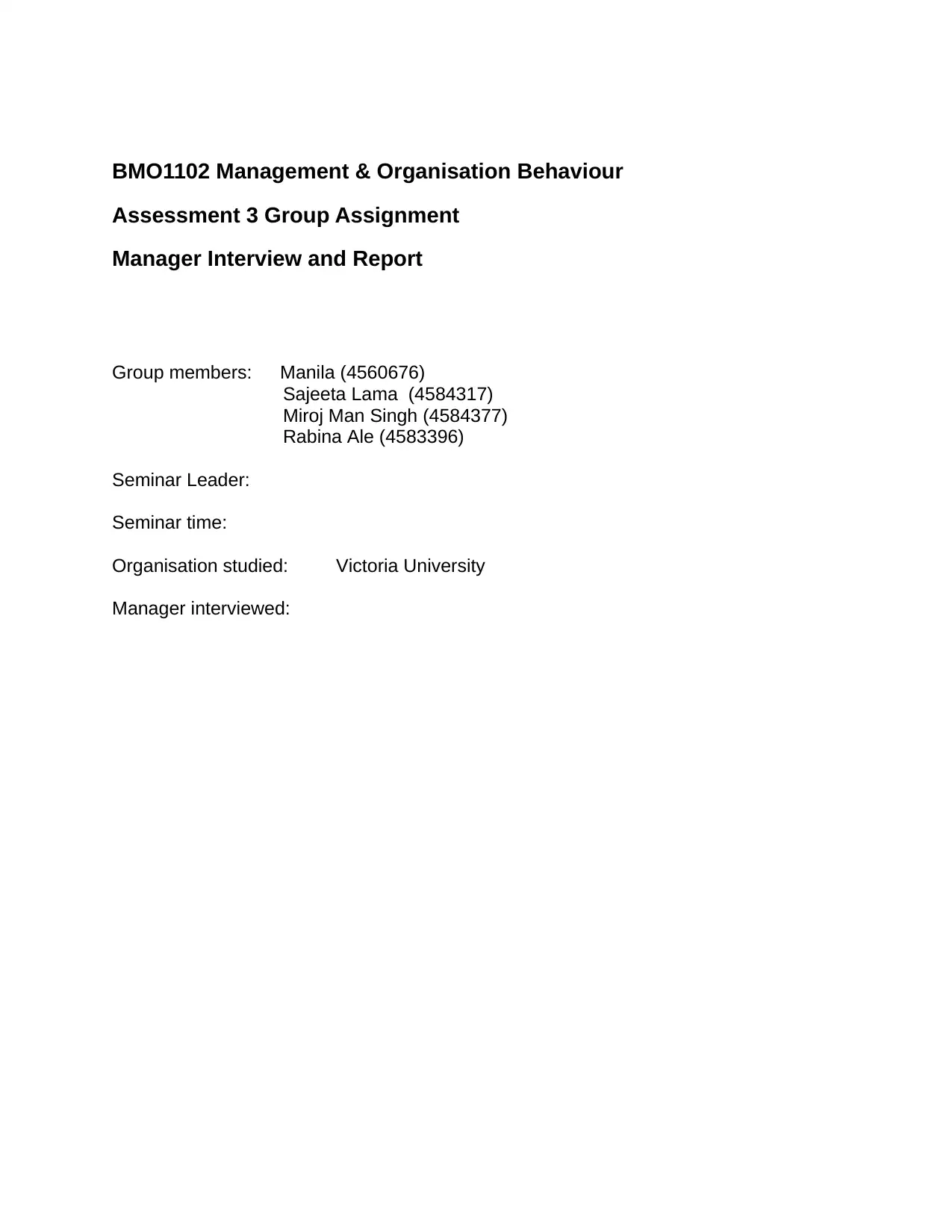
BMO1102 Management & Organisation Behaviour
Assessment 3 Group Assignment
Manager Interview and Report
Group members: Manila (4560676)
Sajeeta Lama (4584317)
Miroj Man Singh (4584377)
Rabina Ale (4583396)
Seminar Leader:
Seminar time:
Organisation studied: Victoria University
Manager interviewed:
Assessment 3 Group Assignment
Manager Interview and Report
Group members: Manila (4560676)
Sajeeta Lama (4584317)
Miroj Man Singh (4584377)
Rabina Ale (4583396)
Seminar Leader:
Seminar time:
Organisation studied: Victoria University
Manager interviewed:

Paraphrase This Document
Need a fresh take? Get an instant paraphrase of this document with our AI Paraphraser
Executive Summary
Behavior is an important aspect in terms of reflecting the kind of person an
individual is. In terms of workplace, behaviour is important in terms of expressing
professionalism in the right sense. This behaviour is applicable for all of the personnel in
a company or organization, especially the managers. This is because; they are the
persons, entrusted with the responsibility to manage the performance of the tasks.
Theoretical considerations prove beneficial in this direction in terms of enlivening the
knowledge, skills, capabilities and expertise of the managers regarding the exposure of
appropriate behaviour in the workplace.
The purpose of the report was to highlight the selfish mentality of the managers
regarding grabbing the hot seat in the competitive ambience. However, the excerpts of
the interview with the manager of Victoria University provide a new perspective and
weightage to the aspect of organizational behaviour in management. Theoretical
analysis of the responses provided by the manager validates the facts proposed about
the subject matter of the report.
The actions of planning, organizing, leading and controlling are important
components for the efficient execution of the business activities. Organizing the works
according to their priority helps the managers to complete them according to their
deadlines. Consciousness towards this makes leaders out of the managers. Maintaining
this cycle is important in terms of ensuring the betterment of the companies and
organizations like the Victorian University. Innovation in planning possesses flexibility
for the achievement of large scale customer satisfaction. Rationality in innovation
enhances the personality of the managers.
Behavior is an important aspect in terms of reflecting the kind of person an
individual is. In terms of workplace, behaviour is important in terms of expressing
professionalism in the right sense. This behaviour is applicable for all of the personnel in
a company or organization, especially the managers. This is because; they are the
persons, entrusted with the responsibility to manage the performance of the tasks.
Theoretical considerations prove beneficial in this direction in terms of enlivening the
knowledge, skills, capabilities and expertise of the managers regarding the exposure of
appropriate behaviour in the workplace.
The purpose of the report was to highlight the selfish mentality of the managers
regarding grabbing the hot seat in the competitive ambience. However, the excerpts of
the interview with the manager of Victoria University provide a new perspective and
weightage to the aspect of organizational behaviour in management. Theoretical
analysis of the responses provided by the manager validates the facts proposed about
the subject matter of the report.
The actions of planning, organizing, leading and controlling are important
components for the efficient execution of the business activities. Organizing the works
according to their priority helps the managers to complete them according to their
deadlines. Consciousness towards this makes leaders out of the managers. Maintaining
this cycle is important in terms of ensuring the betterment of the companies and
organizations like the Victorian University. Innovation in planning possesses flexibility
for the achievement of large scale customer satisfaction. Rationality in innovation
enhances the personality of the managers.
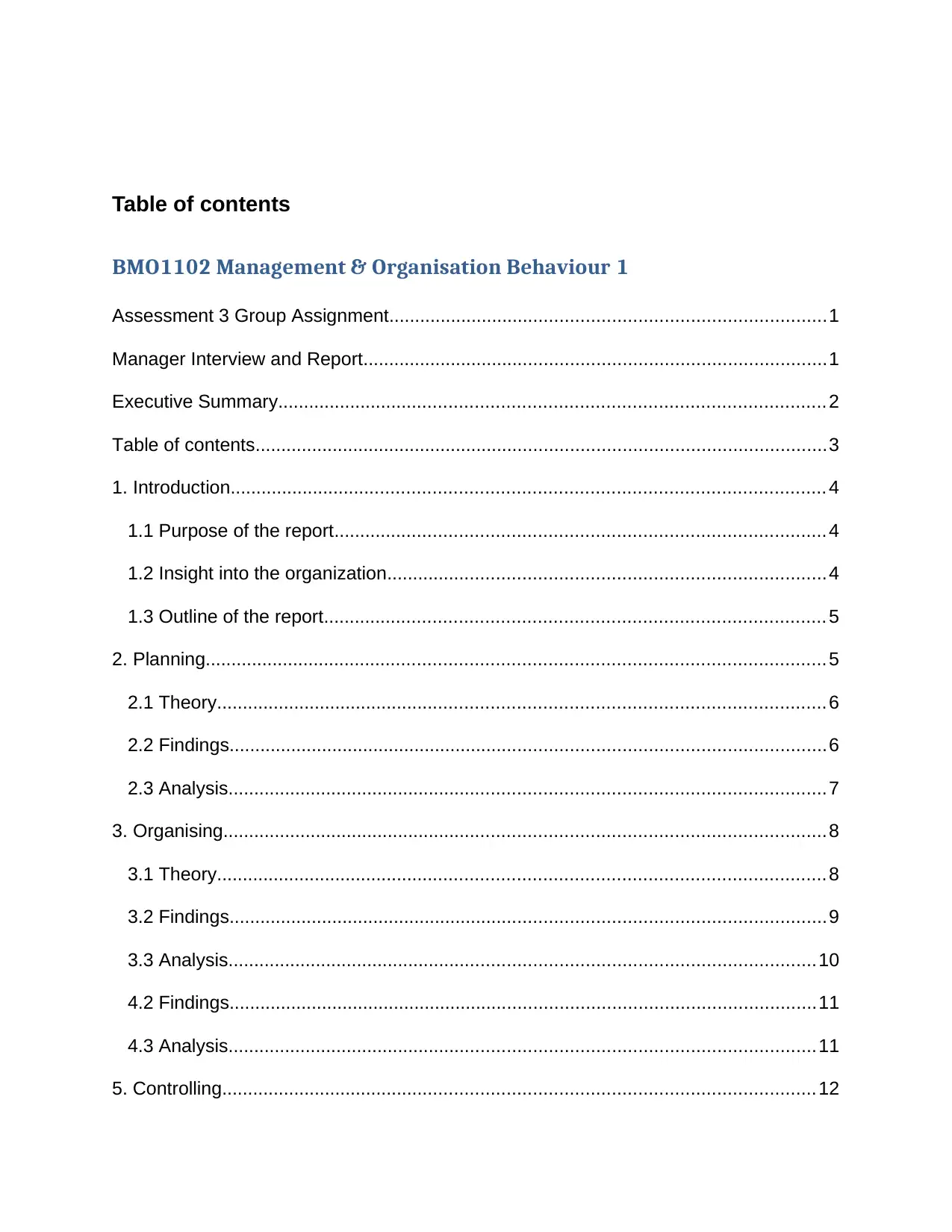
Table of contents
BMO1102 Management & Organisation Behaviour 1
Assessment 3 Group Assignment....................................................................................1
Manager Interview and Report.........................................................................................1
Executive Summary......................................................................................................... 2
Table of contents..............................................................................................................3
1. Introduction.................................................................................................................. 4
1.1 Purpose of the report.............................................................................................. 4
1.2 Insight into the organization....................................................................................4
1.3 Outline of the report................................................................................................ 5
2. Planning....................................................................................................................... 5
2.1 Theory..................................................................................................................... 6
2.2 Findings...................................................................................................................6
2.3 Analysis...................................................................................................................7
3. Organising....................................................................................................................8
3.1 Theory..................................................................................................................... 8
3.2 Findings...................................................................................................................9
3.3 Analysis.................................................................................................................10
4.2 Findings.................................................................................................................11
4.3 Analysis.................................................................................................................11
5. Controlling.................................................................................................................. 12
BMO1102 Management & Organisation Behaviour 1
Assessment 3 Group Assignment....................................................................................1
Manager Interview and Report.........................................................................................1
Executive Summary......................................................................................................... 2
Table of contents..............................................................................................................3
1. Introduction.................................................................................................................. 4
1.1 Purpose of the report.............................................................................................. 4
1.2 Insight into the organization....................................................................................4
1.3 Outline of the report................................................................................................ 5
2. Planning....................................................................................................................... 5
2.1 Theory..................................................................................................................... 6
2.2 Findings...................................................................................................................6
2.3 Analysis...................................................................................................................7
3. Organising....................................................................................................................8
3.1 Theory..................................................................................................................... 8
3.2 Findings...................................................................................................................9
3.3 Analysis.................................................................................................................10
4.2 Findings.................................................................................................................11
4.3 Analysis.................................................................................................................11
5. Controlling.................................................................................................................. 12
⊘ This is a preview!⊘
Do you want full access?
Subscribe today to unlock all pages.

Trusted by 1+ million students worldwide
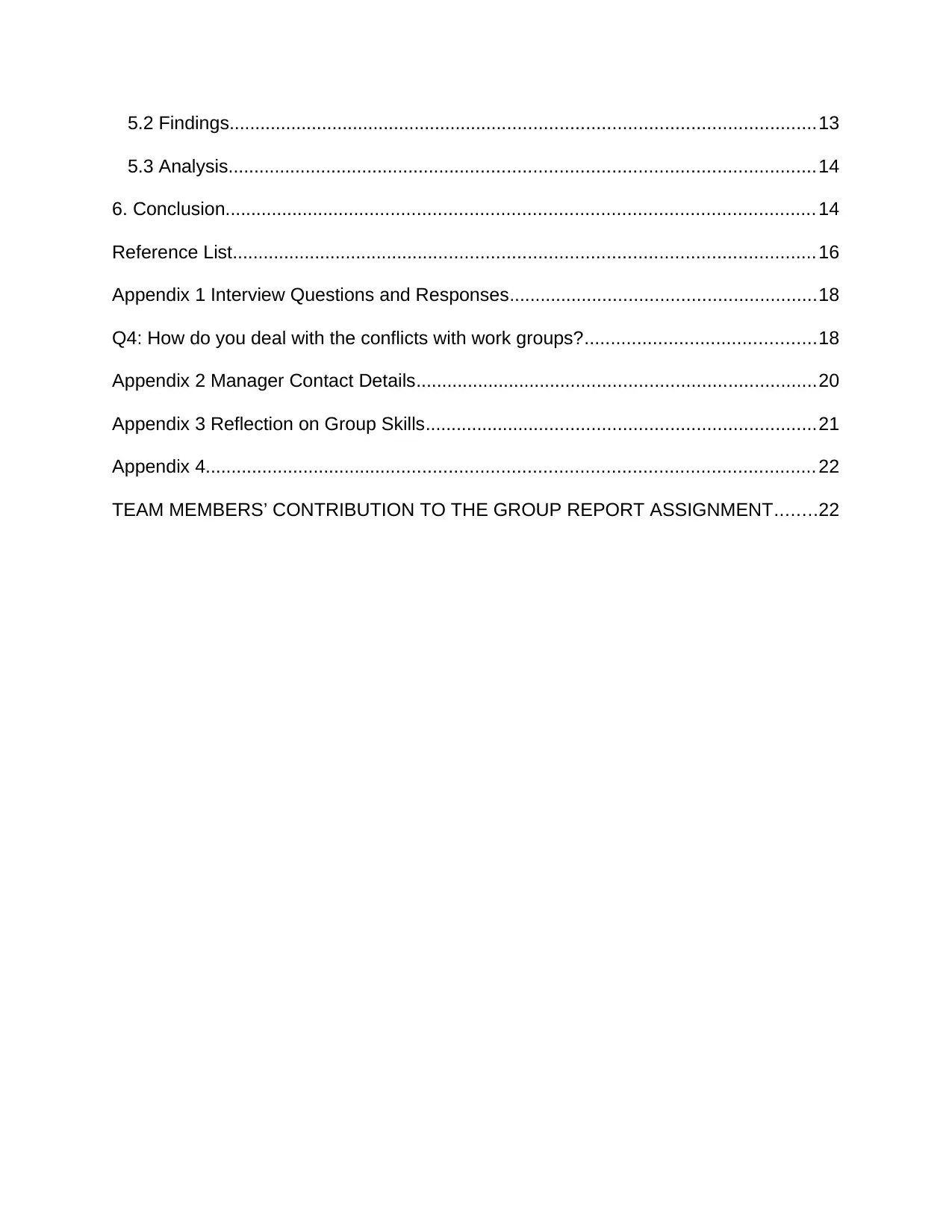
5.2 Findings.................................................................................................................13
5.3 Analysis.................................................................................................................14
6. Conclusion................................................................................................................. 14
Reference List................................................................................................................ 16
Appendix 1 Interview Questions and Responses...........................................................18
Q4: How do you deal with the conflicts with work groups?............................................18
Appendix 2 Manager Contact Details.............................................................................20
Appendix 3 Reflection on Group Skills...........................................................................21
Appendix 4..................................................................................................................... 22
TEAM MEMBERS’ CONTRIBUTION TO THE GROUP REPORT ASSIGNMENT........22
5.3 Analysis.................................................................................................................14
6. Conclusion................................................................................................................. 14
Reference List................................................................................................................ 16
Appendix 1 Interview Questions and Responses...........................................................18
Q4: How do you deal with the conflicts with work groups?............................................18
Appendix 2 Manager Contact Details.............................................................................20
Appendix 3 Reflection on Group Skills...........................................................................21
Appendix 4..................................................................................................................... 22
TEAM MEMBERS’ CONTRIBUTION TO THE GROUP REPORT ASSIGNMENT........22
Paraphrase This Document
Need a fresh take? Get an instant paraphrase of this document with our AI Paraphraser
1. Introduction
1.1 Purpose of the report
Managers hold the most important position within a company or organization.
However, in the present competitive ambience of the market, it has been seen that the
managers express selfish attitude in terms of grabbing hot seat, where they are
expected to expose professional behaviour for creating positive image in the minds of
the employees and the staffs (Luthans, Luthans and Luthans 2015). Exposure of
rational behaviour enhances the personality of the managers within the workplace.
Herein lays the effectiveness of the behavioural theory, which is one of the major
highlights of the assignment. The assignment upholds the viewpoints of a manager of
Victoria University in Melbourne, Australia. Reference to the interview validates the
assumptions regarding the organizational behaviour required for managing the business
activities in a workplace.
1.2 Insight into the organization
Victoria University has achieved accolades and glory by providing quality
education to the native as well as foreign students. The university falls under the tertiary
sector. One of the greatest strengths of the university is the provision of both higher
education and Technical and Further Education (Vu.edu.au 2018). Interview responses
by one of the manager’s of Victoria University validates the assumptions and
propositions of the assignment. Their prior experience regarding the organizational
behaviour and management is the major drive behind the selection of the manager. The
1.1 Purpose of the report
Managers hold the most important position within a company or organization.
However, in the present competitive ambience of the market, it has been seen that the
managers express selfish attitude in terms of grabbing hot seat, where they are
expected to expose professional behaviour for creating positive image in the minds of
the employees and the staffs (Luthans, Luthans and Luthans 2015). Exposure of
rational behaviour enhances the personality of the managers within the workplace.
Herein lays the effectiveness of the behavioural theory, which is one of the major
highlights of the assignment. The assignment upholds the viewpoints of a manager of
Victoria University in Melbourne, Australia. Reference to the interview validates the
assumptions regarding the organizational behaviour required for managing the business
activities in a workplace.
1.2 Insight into the organization
Victoria University has achieved accolades and glory by providing quality
education to the native as well as foreign students. The university falls under the tertiary
sector. One of the greatest strengths of the university is the provision of both higher
education and Technical and Further Education (Vu.edu.au 2018). Interview responses
by one of the manager’s of Victoria University validates the assumptions and
propositions of the assignment. Their prior experience regarding the organizational
behaviour and management is the major drive behind the selection of the manager. The
manager selected for interview, is in charge of sending emails for meetings; giving and
taking appointments for the meeting.
1.3 Outline of the report
The report is divided into four parts. At the initial stage, an introduction is
provided for enhancing the clarity of the readers regarding the organizational behaviour
of the managers in Victorian University. As a sequential step, theoretical considerations
would be considered for assessing the appropriateness, effectiveness and feasibility of
the behaviour exposed by the manager in terms of planning. After this, the findings from
the responses of the manager would be placed, followed by the analysis of the
anticipated findings. The third part of the assignment consists of the theoretical analysis
of the findings from the interview excerpt. The basis of this analysis is the approach of
the manager towards making effective and prospective plans for the betterment of the
university.
The fourth part of the report attempts to provide an insight into the analysis of
theoretical perspective of the manager in terms of leadership skills, abilities and
competencies. The function of the fifth part is analysing the theories and findings of the
interview responses provided by the manager in terms of controlling and regulating the
performance of the staffs. This analysis is followed by the deducing conclusions from all
the findings. As a final touch, references are attached for validating the key points
touched in the report.
2. Planning
taking appointments for the meeting.
1.3 Outline of the report
The report is divided into four parts. At the initial stage, an introduction is
provided for enhancing the clarity of the readers regarding the organizational behaviour
of the managers in Victorian University. As a sequential step, theoretical considerations
would be considered for assessing the appropriateness, effectiveness and feasibility of
the behaviour exposed by the manager in terms of planning. After this, the findings from
the responses of the manager would be placed, followed by the analysis of the
anticipated findings. The third part of the assignment consists of the theoretical analysis
of the findings from the interview excerpt. The basis of this analysis is the approach of
the manager towards making effective and prospective plans for the betterment of the
university.
The fourth part of the report attempts to provide an insight into the analysis of
theoretical perspective of the manager in terms of leadership skills, abilities and
competencies. The function of the fifth part is analysing the theories and findings of the
interview responses provided by the manager in terms of controlling and regulating the
performance of the staffs. This analysis is followed by the deducing conclusions from all
the findings. As a final touch, references are attached for validating the key points
touched in the report.
2. Planning
⊘ This is a preview!⊘
Do you want full access?
Subscribe today to unlock all pages.
Trusted by 1+ million students worldwide
2.1 Theory
Theoretical consideration enlivens the concepts, ideas, thoughts and feelings
about a subject. This is applicable also for the aspect of planning. Here, the theory of
planned behaviour and theory of reasoned action prove effective. Planned
behaviour relates with the consciousness of the individuals towards making plans. Here,
focus needs to be placed on “when the individuals feels the urge for making the plans”
(Vasu et al. 2017). If the basis of making the plans is following the footsteps of others,
the developmental stages proposed by Freud attach an interrogative parameter. On the
contrary, if the urge for planning comes as an initiative towards modifying the mistakes,
it is an example of reasoned action by the personnel. Countering this, the time of
planning is not that important in comparison to the inclusion of all the aspects of
change. Most important fact here is the behaviour of the personnel towards making
prospective plans for the betterment.
If the personnel plan to bring innovation within the ways and means of executing
the allocated duties and responsibilities, it adds positivity to the stages proposed by
Freud (Miner 2015). This is because innovation within the workplace possesses
flexibility towards gaining large scale customer satisfaction. Viewing it from other
perspective, proposal for innovation is also a reasoned action, as it is acceptable among
the staffs for altering the business scenario.
2.2 Findings
Everyday’s planning by the manager
Theoretical consideration enlivens the concepts, ideas, thoughts and feelings
about a subject. This is applicable also for the aspect of planning. Here, the theory of
planned behaviour and theory of reasoned action prove effective. Planned
behaviour relates with the consciousness of the individuals towards making plans. Here,
focus needs to be placed on “when the individuals feels the urge for making the plans”
(Vasu et al. 2017). If the basis of making the plans is following the footsteps of others,
the developmental stages proposed by Freud attach an interrogative parameter. On the
contrary, if the urge for planning comes as an initiative towards modifying the mistakes,
it is an example of reasoned action by the personnel. Countering this, the time of
planning is not that important in comparison to the inclusion of all the aspects of
change. Most important fact here is the behaviour of the personnel towards making
prospective plans for the betterment.
If the personnel plan to bring innovation within the ways and means of executing
the allocated duties and responsibilities, it adds positivity to the stages proposed by
Freud (Miner 2015). This is because innovation within the workplace possesses
flexibility towards gaining large scale customer satisfaction. Viewing it from other
perspective, proposal for innovation is also a reasoned action, as it is acceptable among
the staffs for altering the business scenario.
2.2 Findings
Everyday’s planning by the manager
Paraphrase This Document
Need a fresh take? Get an instant paraphrase of this document with our AI Paraphraser
The manager of Victoria University spends the morning in meetings for
discussing the procedures of executing the undertaken project. Here, his basic activities
are sending emails to the clients, in response to the request for appointments. Apart
from this, he also inspects the campus to ensure the smooth functioning of the activities.
Instead of resting, the manager spends him time in checking the mails, if any and
responds to the urgent mails (Vu.edu.au 2018).
Future job planning of the manager
According to the statements of the Victorian University manager, planning is a
crucial element. At the end of every semester, planning is done in order to discuss,
which courses need to be included in the curriculum. Collaboration of the academic and
the admin staffs proves helpful for the manager. This is in terms of gaining an insight
into the approaches of the staffs regarding the created plans. Changes are proposed
within the plans for making the semester studies interesting for the students.
Manager’s career planning
The manager highlights the fact that as the world is changing every second,
therefore he also needs to maintain the pace with the changing world. He thinks career
planning is important in terms of enhancing his position within the society. However, as
of now, he has made plans for couple of years (Vu.edu.au 2018). He envisions that in
these years he would achieve a higher scale in the professional development.
2.3 Analysis
The behaviour of the manager can be considered as planned and reasoned. This
is in terms of the planning. The manager makes plans before starting the allocated
discussing the procedures of executing the undertaken project. Here, his basic activities
are sending emails to the clients, in response to the request for appointments. Apart
from this, he also inspects the campus to ensure the smooth functioning of the activities.
Instead of resting, the manager spends him time in checking the mails, if any and
responds to the urgent mails (Vu.edu.au 2018).
Future job planning of the manager
According to the statements of the Victorian University manager, planning is a
crucial element. At the end of every semester, planning is done in order to discuss,
which courses need to be included in the curriculum. Collaboration of the academic and
the admin staffs proves helpful for the manager. This is in terms of gaining an insight
into the approaches of the staffs regarding the created plans. Changes are proposed
within the plans for making the semester studies interesting for the students.
Manager’s career planning
The manager highlights the fact that as the world is changing every second,
therefore he also needs to maintain the pace with the changing world. He thinks career
planning is important in terms of enhancing his position within the society. However, as
of now, he has made plans for couple of years (Vu.edu.au 2018). He envisions that in
these years he would achieve a higher scale in the professional development.
2.3 Analysis
The behaviour of the manager can be considered as planned and reasoned. This
is in terms of the planning. The manager makes plans before starting the allocated
duties and responsibilities. As a matter of specification, the manager jots down the
tasks, which he needs to complete on a priority basis. This systematization helps the
manager to achieve positive results. Thinking about the betterment of the students is a
reasoned action of the manager in terms of ensuring their career establishment.
Involving the academic and admin staffs for making the plans is a wise step for the
manager (Wagner and Hollenbeck 2014). This is in terms of knowing the mistakes he
has committed in the performance. This approach of the manager reflects his
inquisitiveness nature in terms of enriching the preconceived skills, knowledge and
expertise.
Spending the leisure time in doing works hampers the relaxation needed in terms
of gaining energy for undertaking the challenging and enduring tasks. On the contrary, a
manager needs to be active in the workplace, for abiding by the duties and the
responsibilities. Realizing the importance of altering pace of the world is a planned as
well as reasoned action exposed by the manager in terms of securing the societal
position. Here, career planning is a part for the altering the personality among the others
(Vu.edu.au 2018). 2 years is merely a time, which reflects the two selves of the
managers. One self reflects the manager in the current phase and the other self reflects
the manager after 2 years, when he would achieve a higher scale in his
professionalism.
3. Organising
3.1 Theory
tasks, which he needs to complete on a priority basis. This systematization helps the
manager to achieve positive results. Thinking about the betterment of the students is a
reasoned action of the manager in terms of ensuring their career establishment.
Involving the academic and admin staffs for making the plans is a wise step for the
manager (Wagner and Hollenbeck 2014). This is in terms of knowing the mistakes he
has committed in the performance. This approach of the manager reflects his
inquisitiveness nature in terms of enriching the preconceived skills, knowledge and
expertise.
Spending the leisure time in doing works hampers the relaxation needed in terms
of gaining energy for undertaking the challenging and enduring tasks. On the contrary, a
manager needs to be active in the workplace, for abiding by the duties and the
responsibilities. Realizing the importance of altering pace of the world is a planned as
well as reasoned action exposed by the manager in terms of securing the societal
position. Here, career planning is a part for the altering the personality among the others
(Vu.edu.au 2018). 2 years is merely a time, which reflects the two selves of the
managers. One self reflects the manager in the current phase and the other self reflects
the manager after 2 years, when he would achieve a higher scale in his
professionalism.
3. Organising
3.1 Theory
⊘ This is a preview!⊘
Do you want full access?
Subscribe today to unlock all pages.
Trusted by 1+ million students worldwide
The theory of scientific management can be applied here. This theory was
introduced by Frederick Winslow Taylor to enhance the clarity of the people about the
science behind management. According to the functionality, this theory proves
beneficial for the managers in terms of enhancing the productivity through the exposure
of logical approach. The theory upholds the managers’ perspective towards the output
they want from the staffs and measure the ways and means adopted by the staffs to
execute the duties allocated to them (Punnett 2015). In this process, the managers
need to adhere to four principles- creation of a scientific method for controlling the
performance of the staffs; provision of training to the staffs; stability in the relationship
between the employees and the management and equal distribution of labor.
3.2 Findings
When asked about managing the conflicts, the manager replied that he tried to
achieve solution by focusing on the issues, which gave rise to conflicts. Not getting
personal in the process of resolving conflicts is one of the strengths of the manager.
This approach reflects the reasoned action of the manager towards problem solving.
While solving the conflicts with the other managers, he focuses on the coordination.
Unity and coordination between the managers and the staffs possesses flexibility in
discovery of efficient and effective solutions towards the problems (Vu.edu.au 2018).
The path of management is not easy. In regulating the performance of the staffs,
the manager is compelled to encounter issues like bad lectures, complaints of the
students and inappropriate behaviours exposed by the students, professors and other
staffs. Solving these problems becomes easy for the manager through the exposure of
organized behaviour. At the initial stage, he communicates with the senior managers
introduced by Frederick Winslow Taylor to enhance the clarity of the people about the
science behind management. According to the functionality, this theory proves
beneficial for the managers in terms of enhancing the productivity through the exposure
of logical approach. The theory upholds the managers’ perspective towards the output
they want from the staffs and measure the ways and means adopted by the staffs to
execute the duties allocated to them (Punnett 2015). In this process, the managers
need to adhere to four principles- creation of a scientific method for controlling the
performance of the staffs; provision of training to the staffs; stability in the relationship
between the employees and the management and equal distribution of labor.
3.2 Findings
When asked about managing the conflicts, the manager replied that he tried to
achieve solution by focusing on the issues, which gave rise to conflicts. Not getting
personal in the process of resolving conflicts is one of the strengths of the manager.
This approach reflects the reasoned action of the manager towards problem solving.
While solving the conflicts with the other managers, he focuses on the coordination.
Unity and coordination between the managers and the staffs possesses flexibility in
discovery of efficient and effective solutions towards the problems (Vu.edu.au 2018).
The path of management is not easy. In regulating the performance of the staffs,
the manager is compelled to encounter issues like bad lectures, complaints of the
students and inappropriate behaviours exposed by the students, professors and other
staffs. Solving these problems becomes easy for the manager through the exposure of
organized behaviour. At the initial stage, he communicates with the senior managers
Paraphrase This Document
Need a fresh take? Get an instant paraphrase of this document with our AI Paraphraser
about progressing with the achievement of solutions. After this, he calls a meeting with
the students and the professors regarding the quality of the lectures delivered.
Transparency is maintained in the meetings, as the main aim is the provision of good
service to the students and the clients (Vu.edu.au 2018).
3.3 Analysis
Organizing meetings with the senior manager reflects the practice of scientific
management in case of the manager. Herein lays the appropriateness of enhancing
clarity regarding the type of output needed and the ways through which the staffs
execute the allocated duties and responsibilities. Focusing on the internal issues rather
than being personal is an example of logical thinking towards solving the problems.
Speaking the truth indicates the transparency in the approach of the manager towards
gaining trust, loyalty and dependence from the students and the clients (Pinder 2014).
Communicating with the senior managers is the manager’s initiative towards
maintaining stability in his relationship with his seniors. Communicating with the
students is the urge of the managers in terms of learning from them, as learning and
gaining knowledge has no age limit.
4. Leading
4.1 Theory
Leaders need to have a clear vision of their goals and objectives. Theoretical
perspective in this direction is assistance in terms of emerging as a successful leader.
Herein lays the effectiveness of the Great Man Theory. The tag “great” is attached to
the personality of a man on the basis of his approach towards execution of the allocated
the students and the professors regarding the quality of the lectures delivered.
Transparency is maintained in the meetings, as the main aim is the provision of good
service to the students and the clients (Vu.edu.au 2018).
3.3 Analysis
Organizing meetings with the senior manager reflects the practice of scientific
management in case of the manager. Herein lays the appropriateness of enhancing
clarity regarding the type of output needed and the ways through which the staffs
execute the allocated duties and responsibilities. Focusing on the internal issues rather
than being personal is an example of logical thinking towards solving the problems.
Speaking the truth indicates the transparency in the approach of the manager towards
gaining trust, loyalty and dependence from the students and the clients (Pinder 2014).
Communicating with the senior managers is the manager’s initiative towards
maintaining stability in his relationship with his seniors. Communicating with the
students is the urge of the managers in terms of learning from them, as learning and
gaining knowledge has no age limit.
4. Leading
4.1 Theory
Leaders need to have a clear vision of their goals and objectives. Theoretical
perspective in this direction is assistance in terms of emerging as a successful leader.
Herein lays the effectiveness of the Great Man Theory. The tag “great” is attached to
the personality of a man on the basis of his approach towards execution of the allocated
duties and responsibilities (Lazaroiu 2015). Rationality and tactfulness are the
attributes, which makes a man great, rather a leader. Accepting the mistakes pointed
out by others willingly; bring contingency theory into the discussion. Inquisitiveness
towards enriching the knowledge creates a positive image about the leader in the minds
of the people. Willingness and eagerness to alter the current personality indicates the
quest for emerging as a people’s leader rather than grabbing the hot seat.
4.2 Findings
The manager is proud to nominate the director as his mentor. He is happy to
guide Christine in achieving her goals and become well settled in her life. Not only
Christine, the managers provide coaching to the students as well as the subordinates,
so that they can upgrade their skills, knowledge and expertise in academics. The
manager believes in team work (Vu.edu.au 2018). After setting a deadline, the manager
guides the students regarding the doing the tasks properly. He personally talks with the
students in order to find out whether they are facing any problem in doing the tasks.
Moreover, he checks the progress of the team members to assess their capability. The
manager is very passionate about leading his staffs. Determination helps the manager
to set an example before the team members.
He believes that transparency in exposing the incapabilities. According to him,
communication solves the problem and possesses flexibility to bestow solutions. He
thinks logical approach is very important for a leader in terms of setting an example
before the team members (Vu.edu.au 2018).
4.3 Analysis
attributes, which makes a man great, rather a leader. Accepting the mistakes pointed
out by others willingly; bring contingency theory into the discussion. Inquisitiveness
towards enriching the knowledge creates a positive image about the leader in the minds
of the people. Willingness and eagerness to alter the current personality indicates the
quest for emerging as a people’s leader rather than grabbing the hot seat.
4.2 Findings
The manager is proud to nominate the director as his mentor. He is happy to
guide Christine in achieving her goals and become well settled in her life. Not only
Christine, the managers provide coaching to the students as well as the subordinates,
so that they can upgrade their skills, knowledge and expertise in academics. The
manager believes in team work (Vu.edu.au 2018). After setting a deadline, the manager
guides the students regarding the doing the tasks properly. He personally talks with the
students in order to find out whether they are facing any problem in doing the tasks.
Moreover, he checks the progress of the team members to assess their capability. The
manager is very passionate about leading his staffs. Determination helps the manager
to set an example before the team members.
He believes that transparency in exposing the incapabilities. According to him,
communication solves the problem and possesses flexibility to bestow solutions. He
thinks logical approach is very important for a leader in terms of setting an example
before the team members (Vu.edu.au 2018).
4.3 Analysis
⊘ This is a preview!⊘
Do you want full access?
Subscribe today to unlock all pages.
Trusted by 1+ million students worldwide

1 out of 26


Your All-in-One AI-Powered Toolkit for Academic Success.
+13062052269
info@desklib.com
Available 24*7 on WhatsApp / Email
![[object Object]](/_next/static/media/star-bottom.7253800d.svg)
Unlock your academic potential
Copyright © 2020–2026 A2Z Services. All Rights Reserved. Developed and managed by ZUCOL.