Blogs: Management and Organizational Concepts - Weeks 1 to 5 Analysis
VerifiedAdded on 2020/03/07
|14
|2571
|361
Homework Assignment
AI Summary
This homework assignment comprises a series of blog posts analyzing key concepts in management and organizational behavior across five weeks. The student explores foundational ideas such as the importance of management as organizations grow, the impact of globalization on businesses and consumers, and the significance of organizational culture in fostering growth. The analysis extends to organizational structure and design, emphasizing the alignment of structure with operational styles and core competencies, and concludes with a discussion on decision-making styles, particularly transformational leadership. Each week includes a section on key ideas and an application of those ideas to real-world companies, including Toyota, Hyundai, Amazon, Qantas Airways, Chipotle, and General Electric, providing practical examples of how management principles are applied in diverse business contexts. The assignment highlights the importance of adapting management styles to organizational culture and the dynamic nature of decision-making in a globalized and competitive environment.

Running Head: BLOGS WEEK 1 TO WEEK 5
Blogs week 1 to week 5
Student’s name
Name of the Institute
Blogs week 1 to week 5
Student’s name
Name of the Institute

Paraphrase This Document
Need a fresh take? Get an instant paraphrase of this document with our AI Paraphraser
BLOGS WEEK 1 TO WEEK 5
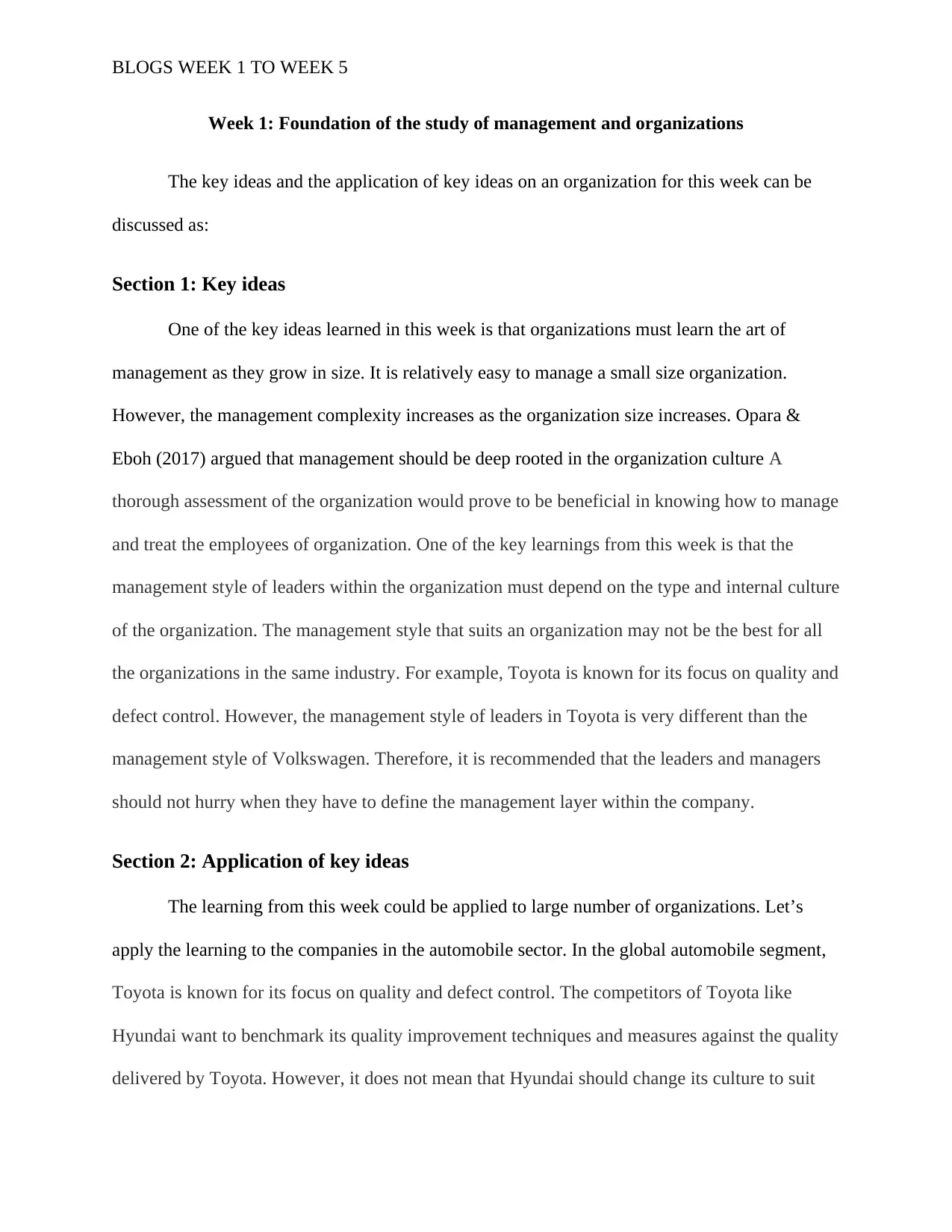
Table of Contents
Week 1: Foundation of the study of management and organizations................................3
Section 1: Key ideas........................................................................................................................................ 3
Section 2: Application of key ideas............................................................................................................ 3
Week 2: The nature of globalization: National culture............................................................5
Section 1: Key ideas........................................................................................................................................ 5
Section 2: Application of key ideas............................................................................................................ 5
Week 3: Organizational culture & management........................................................................7
Section 1: Key ideas........................................................................................................................................ 7
Section 2: Application of key ideas............................................................................................................ 7
Week 4: Organizational structure and design............................................................................9
Section 1: Key ideas........................................................................................................................................ 9
Section 2: Application of key ideas............................................................................................................ 9
Week 5: Decision making................................................................................................................ 11
Section 1: Key ideas...................................................................................................................................... 11
Section 2: Application of key ideas..........................................................................................................11
References............................................................................................................................................ 13
Table of Contents
Week 1: Foundation of the study of management and organizations................................3
Section 1: Key ideas........................................................................................................................................ 3
Section 2: Application of key ideas............................................................................................................ 3
Week 2: The nature of globalization: National culture............................................................5
Section 1: Key ideas........................................................................................................................................ 5
Section 2: Application of key ideas............................................................................................................ 5
Week 3: Organizational culture & management........................................................................7
Section 1: Key ideas........................................................................................................................................ 7
Section 2: Application of key ideas............................................................................................................ 7
Week 4: Organizational structure and design............................................................................9
Section 1: Key ideas........................................................................................................................................ 9
Section 2: Application of key ideas............................................................................................................ 9
Week 5: Decision making................................................................................................................ 11
Section 1: Key ideas...................................................................................................................................... 11
Section 2: Application of key ideas..........................................................................................................11
References............................................................................................................................................ 13
BLOGS WEEK 1 TO WEEK 5
Week 1: Foundation of the study of management and organizations
The key ideas and the application of key ideas on an organization for this week can be
discussed as:
Section 1: Key ideas
One of the key ideas learned in this week is that organizations must learn the art of
management as they grow in size. It is relatively easy to manage a small size organization.
However, the management complexity increases as the organization size increases. Opara &
Eboh (2017) argued that management should be deep rooted in the organization culture A
thorough assessment of the organization would prove to be beneficial in knowing how to manage
and treat the employees of organization. One of the key learnings from this week is that the
management style of leaders within the organization must depend on the type and internal culture
of the organization. The management style that suits an organization may not be the best for all
the organizations in the same industry. For example, Toyota is known for its focus on quality and
defect control. However, the management style of leaders in Toyota is very different than the
management style of Volkswagen. Therefore, it is recommended that the leaders and managers
should not hurry when they have to define the management layer within the company.
Section 2: Application of key ideas
The learning from this week could be applied to large number of organizations. Let’s
apply the learning to the companies in the automobile sector. In the global automobile segment,
Toyota is known for its focus on quality and defect control. The competitors of Toyota like
Hyundai want to benchmark its quality improvement techniques and measures against the quality
delivered by Toyota. However, it does not mean that Hyundai should change its culture to suit
Week 1: Foundation of the study of management and organizations
The key ideas and the application of key ideas on an organization for this week can be
discussed as:
Section 1: Key ideas
One of the key ideas learned in this week is that organizations must learn the art of
management as they grow in size. It is relatively easy to manage a small size organization.
However, the management complexity increases as the organization size increases. Opara &
Eboh (2017) argued that management should be deep rooted in the organization culture A
thorough assessment of the organization would prove to be beneficial in knowing how to manage
and treat the employees of organization. One of the key learnings from this week is that the
management style of leaders within the organization must depend on the type and internal culture
of the organization. The management style that suits an organization may not be the best for all
the organizations in the same industry. For example, Toyota is known for its focus on quality and
defect control. However, the management style of leaders in Toyota is very different than the
management style of Volkswagen. Therefore, it is recommended that the leaders and managers
should not hurry when they have to define the management layer within the company.
Section 2: Application of key ideas
The learning from this week could be applied to large number of organizations. Let’s
apply the learning to the companies in the automobile sector. In the global automobile segment,
Toyota is known for its focus on quality and defect control. The competitors of Toyota like
Hyundai want to benchmark its quality improvement techniques and measures against the quality
delivered by Toyota. However, it does not mean that Hyundai should change its culture to suit
⊘ This is a preview!⊘
Do you want full access?
Subscribe today to unlock all pages.

Trusted by 1+ million students worldwide
BLOGS WEEK 1 TO WEEK 5
the organizational culture of Toyota. Hyundai has its own strengths and weaknesses and it is
important that the organizational culture and the management style of Hyundai should be based
on that. Lee & Desai (2014) argued that organizations should never leave their core competency
to learn from others. For the organizations that value the focus on developing core competency,
learning comes naturally. Therefore, a good idea for Hyundai would be to an internal assessment
and decide upon the areas that needs improvement. The next step would be to develop a
framework where tangible efforts could be made to improve the quality of its products and
services.
the organizational culture of Toyota. Hyundai has its own strengths and weaknesses and it is
important that the organizational culture and the management style of Hyundai should be based
on that. Lee & Desai (2014) argued that organizations should never leave their core competency
to learn from others. For the organizations that value the focus on developing core competency,
learning comes naturally. Therefore, a good idea for Hyundai would be to an internal assessment
and decide upon the areas that needs improvement. The next step would be to develop a
framework where tangible efforts could be made to improve the quality of its products and
services.
Paraphrase This Document
Need a fresh take? Get an instant paraphrase of this document with our AI Paraphraser
BLOGS WEEK 1 TO WEEK 5
Week 2: The nature of globalization: National culture
The key ideas and the application of key ideas on an organization for this week can be
discussed as:
Section 1: Key ideas
One of the key ideas learned in this week is that globalization has helped a lot to
businesses to expand in new boundaries. There was a time when organizations have limited
target market. With globalization, organizations have started to target the people beyond
domestic boundaries as well. For example, a seller of precious stones in India can now sell its
products in Australia through Amazon. This has been possible only because of globalization.
Langley & Smallman (2013) argued that globalisation is a powerful force and it has changed the
way business are done. It is expected that globalization would further bring more changes in the
way businesses are conducted. One of the key learning from this week resources is that
globalization has been useful for end consumers as this has increased the choices for consumers.
For example, a buyer in Sydney can now buy a product from a domestic seller in Australian
market or from an international seller. It has also opened the avenues for organization to sell
their products and compete with the international brands. Due to this there has been an increase
in the competition and organizations realizes the importance of delivering high quality products
and services to consumers. It is expected that globalization would continue to make business
more competitive.
Section 2: Application of key ideas
The learning from this week could be applied to large number of organizations. Let’s
apply the learning to the companies in the e-commerce sector. The learning can be applied to the
Week 2: The nature of globalization: National culture
The key ideas and the application of key ideas on an organization for this week can be
discussed as:
Section 1: Key ideas
One of the key ideas learned in this week is that globalization has helped a lot to
businesses to expand in new boundaries. There was a time when organizations have limited
target market. With globalization, organizations have started to target the people beyond
domestic boundaries as well. For example, a seller of precious stones in India can now sell its
products in Australia through Amazon. This has been possible only because of globalization.
Langley & Smallman (2013) argued that globalisation is a powerful force and it has changed the
way business are done. It is expected that globalization would further bring more changes in the
way businesses are conducted. One of the key learning from this week resources is that
globalization has been useful for end consumers as this has increased the choices for consumers.
For example, a buyer in Sydney can now buy a product from a domestic seller in Australian
market or from an international seller. It has also opened the avenues for organization to sell
their products and compete with the international brands. Due to this there has been an increase
in the competition and organizations realizes the importance of delivering high quality products
and services to consumers. It is expected that globalization would continue to make business
more competitive.
Section 2: Application of key ideas
The learning from this week could be applied to large number of organizations. Let’s
apply the learning to the companies in the e-commerce sector. The learning can be applied to the
BLOGS WEEK 1 TO WEEK 5
business operations of Amazon. The company, Amazon, is a marketplace and there are millions
of buyers and sellers listed on Amazon (Vinkenburg & Jansen, 2014). With globalisation, it has
been possible for buyers and sellers to communicate and transact with the sellers and buyers in
different geographies. The best thing for Amazon would be to analyze the internal and the
external environment and variables and then lay down the management layer foundation of the
company.
business operations of Amazon. The company, Amazon, is a marketplace and there are millions
of buyers and sellers listed on Amazon (Vinkenburg & Jansen, 2014). With globalisation, it has
been possible for buyers and sellers to communicate and transact with the sellers and buyers in
different geographies. The best thing for Amazon would be to analyze the internal and the
external environment and variables and then lay down the management layer foundation of the
company.
⊘ This is a preview!⊘
Do you want full access?
Subscribe today to unlock all pages.
Trusted by 1+ million students worldwide
BLOGS WEEK 1 TO WEEK 5
Week 3: Organizational culture & management
The key ideas and the application of key ideas on an organization for this week can be
discussed as:
Section 1: Key ideas
One of the key ideas learned in this week is that organizational culture is one thing that
contributes a lot towards organizational growth and development. Therefore, it is important that
organizations must focus to develop a strong organizational culture. The support from various
internal and external stakeholders would help the leaders and managers to develop and establish
a strong organizational culture. Helms & Mills (2017) argued that organizational culture is one
thing that should be practiced by each and every employee of the organization. In an
organizational setting, organizational culture is more than the values of the organization. It is
important that these values should be demonstrated by all the internal and external stakeholders
of the organization and it can happen when the organizations have strong communication
strategy in place. There should not be an gap in the mission and vision of the organization and
the personal goals and objective of employees.
Section 2: Application of key ideas
The learning from this week could be applied to large number of organizations. Let’s
apply the learning to Qantas Airways. The organization, Qantas Airways is a reputed airline in
the country. The organization has been able to gain a lot of success in Australia market with a
strong organizational culture. The success of Qantas Airways in Australia can definitely be
attributed to its strong organizational culture. It is correct that Qantas must make efforts to learn
from other existing players in the global airline industry; however, this effort should be made
Week 3: Organizational culture & management
The key ideas and the application of key ideas on an organization for this week can be
discussed as:
Section 1: Key ideas
One of the key ideas learned in this week is that organizational culture is one thing that
contributes a lot towards organizational growth and development. Therefore, it is important that
organizations must focus to develop a strong organizational culture. The support from various
internal and external stakeholders would help the leaders and managers to develop and establish
a strong organizational culture. Helms & Mills (2017) argued that organizational culture is one
thing that should be practiced by each and every employee of the organization. In an
organizational setting, organizational culture is more than the values of the organization. It is
important that these values should be demonstrated by all the internal and external stakeholders
of the organization and it can happen when the organizations have strong communication
strategy in place. There should not be an gap in the mission and vision of the organization and
the personal goals and objective of employees.
Section 2: Application of key ideas
The learning from this week could be applied to large number of organizations. Let’s
apply the learning to Qantas Airways. The organization, Qantas Airways is a reputed airline in
the country. The organization has been able to gain a lot of success in Australia market with a
strong organizational culture. The success of Qantas Airways in Australia can definitely be
attributed to its strong organizational culture. It is correct that Qantas must make efforts to learn
from other existing players in the global airline industry; however, this effort should be made
Paraphrase This Document
Need a fresh take? Get an instant paraphrase of this document with our AI Paraphraser
BLOGS WEEK 1 TO WEEK 5
within the internal culture and management style of the company. Hogan and Coote (2014)
argued that the management of Qantas Airways must make continuous efforts to improve the
culture of the organization. It is also important that the management should take inputs from
various internal and external stakeholders while establishing the cultural values. The
management should also have frequent check on the internal culture as the organizational culture
should not be rigid. In fact, the organizational culture should be flexible so that organizations can
change themselves with any change in the market.
within the internal culture and management style of the company. Hogan and Coote (2014)
argued that the management of Qantas Airways must make continuous efforts to improve the
culture of the organization. It is also important that the management should take inputs from
various internal and external stakeholders while establishing the cultural values. The
management should also have frequent check on the internal culture as the organizational culture
should not be rigid. In fact, the organizational culture should be flexible so that organizations can
change themselves with any change in the market.
BLOGS WEEK 1 TO WEEK 5
Week 4: Organizational structure and design
The key ideas and the application of key ideas on an organization for this week can be
discussed as:
Section 1: Key ideas
One of the key ideas learned in this week is that organizational structure and design must
support organizational style of operations and its key competency. For example, Chipotle has to
position itself such that how it provides natural food free of chemical processing, fertilizers, and
pesticides. Chipotle is already doing it and hence it is very easy for them. They just have to
communicate it effectively to the people, make them health conscious by campaigning
aggressively. Likewise, the organizational structure and design of Chipotle must be able to
support this objective or vision of the organization (Janis, 2015).
Section 2: Application of key ideas
The learning from this week could be applied to large number of organizations. Let’s
apply the learning to the Quick Service Restaurant, Chipotle. The concepts of organizational
structure and design could be applied to Chipotle. The company operates in tough market
conditions and it has to ensure that its operations cost are minimal (Foss & Lyngsie, 2015). The
management realizes that operation cost could be minimal only when it has the right structre in
place. Currently, the existing strategy of the Chipotle targets age group of 18-36 in upper middle
class that belongs to mass affluent. People coming from such families or background are
educated and have better understanding of environment, carbon footprints, and healthier options
and thus are direct targets of Food with integrity strategy and are also ready to pay little extra
Week 4: Organizational structure and design
The key ideas and the application of key ideas on an organization for this week can be
discussed as:
Section 1: Key ideas
One of the key ideas learned in this week is that organizational structure and design must
support organizational style of operations and its key competency. For example, Chipotle has to
position itself such that how it provides natural food free of chemical processing, fertilizers, and
pesticides. Chipotle is already doing it and hence it is very easy for them. They just have to
communicate it effectively to the people, make them health conscious by campaigning
aggressively. Likewise, the organizational structure and design of Chipotle must be able to
support this objective or vision of the organization (Janis, 2015).
Section 2: Application of key ideas
The learning from this week could be applied to large number of organizations. Let’s
apply the learning to the Quick Service Restaurant, Chipotle. The concepts of organizational
structure and design could be applied to Chipotle. The company operates in tough market
conditions and it has to ensure that its operations cost are minimal (Foss & Lyngsie, 2015). The
management realizes that operation cost could be minimal only when it has the right structre in
place. Currently, the existing strategy of the Chipotle targets age group of 18-36 in upper middle
class that belongs to mass affluent. People coming from such families or background are
educated and have better understanding of environment, carbon footprints, and healthier options
and thus are direct targets of Food with integrity strategy and are also ready to pay little extra
⊘ This is a preview!⊘
Do you want full access?
Subscribe today to unlock all pages.
Trusted by 1+ million students worldwide

BLOGS WEEK 1 TO WEEK 5
given the quality they are getting. Likewise, the structure and the design of Chipotle is developed
to support its targeted audience.
given the quality they are getting. Likewise, the structure and the design of Chipotle is developed
to support its targeted audience.
Paraphrase This Document
Need a fresh take? Get an instant paraphrase of this document with our AI Paraphraser
BLOGS WEEK 1 TO WEEK 5
Week 5: Decision making
The key ideas and the application of key ideas on an organization for this week can be
discussed as:
Section 1: Key ideas
One of the key ideas learned in this week is that there are various styles of decision
making that leaders can learn. In this era of globalization and high competition, transformational
leadership style may the best style of leadership. The transformational leaders would often want
to focus on situational style of decision making. Transformational leaders are the one who are
visionary and who focuses at the end state. There are five key characteristics of transformational
leadership. These are extraversion, neuroticism, openness to experience, agreeableness and
conscientiousness (Govindan & Rajendran, 2015). One of the key tenets of situational type of
decision making is that leaders that practice situational leadership style are the one who was able
to show the vision of the organization to all the employees. The more important thing is that the
employees of the organizations always felt connected to their leader.
Section 2: Application of key ideas
The learning from this week could be applied to large number of organizations. Let’s
apply the learning General Electric. The success of GE could definitely be attributed to
leadership style of Jack Welch. Jack Welch come from a middle background. His initial school
says and education reveals that he was an average kid. He was the one who brought revolution in
GE during his tenure. He is the only CEO under whose leadership any company grew by
40000%. He joined GE as a junior engineer only. In his initial few years at GE, he was not
happy with the operations. He found various inefficient measures at GE (Graham, Harvey &
Week 5: Decision making
The key ideas and the application of key ideas on an organization for this week can be
discussed as:
Section 1: Key ideas
One of the key ideas learned in this week is that there are various styles of decision
making that leaders can learn. In this era of globalization and high competition, transformational
leadership style may the best style of leadership. The transformational leaders would often want
to focus on situational style of decision making. Transformational leaders are the one who are
visionary and who focuses at the end state. There are five key characteristics of transformational
leadership. These are extraversion, neuroticism, openness to experience, agreeableness and
conscientiousness (Govindan & Rajendran, 2015). One of the key tenets of situational type of
decision making is that leaders that practice situational leadership style are the one who was able
to show the vision of the organization to all the employees. The more important thing is that the
employees of the organizations always felt connected to their leader.
Section 2: Application of key ideas
The learning from this week could be applied to large number of organizations. Let’s
apply the learning General Electric. The success of GE could definitely be attributed to
leadership style of Jack Welch. Jack Welch come from a middle background. His initial school
says and education reveals that he was an average kid. He was the one who brought revolution in
GE during his tenure. He is the only CEO under whose leadership any company grew by
40000%. He joined GE as a junior engineer only. In his initial few years at GE, he was not
happy with the operations. He found various inefficient measures at GE (Graham, Harvey &
BLOGS WEEK 1 TO WEEK 5
Puri, 2015). In the year 1972, he entered the leadership position of the company. He was made
the VP of the company in the year 1972. IN next 4 years, he reached to the position of senior VP.
In the year 1982, Jack was promoted to CEO. There are various key traits of Jack’s leadership.
The five key leadership traits of Jack Welch were, positive energy, talent to execute, passion and
motivation, leading from front, and ability to make tough calls and all these traits leads to
situational based decision making. He did make some tough situational calls for GE. However,
those tough calls were successful for the company in long term.
Puri, 2015). In the year 1972, he entered the leadership position of the company. He was made
the VP of the company in the year 1972. IN next 4 years, he reached to the position of senior VP.
In the year 1982, Jack was promoted to CEO. There are various key traits of Jack’s leadership.
The five key leadership traits of Jack Welch were, positive energy, talent to execute, passion and
motivation, leading from front, and ability to make tough calls and all these traits leads to
situational based decision making. He did make some tough situational calls for GE. However,
those tough calls were successful for the company in long term.
⊘ This is a preview!⊘
Do you want full access?
Subscribe today to unlock all pages.
Trusted by 1+ million students worldwide

1 out of 14


Related Documents


Your All-in-One AI-Powered Toolkit for Academic Success.
+13062052269
info@desklib.com
Available 24*7 on WhatsApp / Email
![[object Object]](/_next/static/media/star-bottom.7253800d.svg)
Unlock your academic potential
Copyright © 2020–2026 A2Z Services. All Rights Reserved. Developed and managed by ZUCOL.