Requirements Management Plan: Our Language Matters, CQU University

Verified

Added on  2020/03/07

|4
|921
|97
Report
AI Summary
This report presents a Requirements Management Plan for the "Our Language Matters" project, focusing on key aspects such as planning requirement activities, requirements tracking, and prioritization. The plan addresses the selection of a senior supplier representing traditional landowners, the wording of an 'Acknowledgement of Country', and the importance of stakeholder involvement in information gathering for translation services. The document uses a requirements traceability matrix for tracking and analyzing requirements across CQUniversity campuses. Requirement prioritization is discussed, emphasizing the MoSCoW technique for managing the urgency and significance of requirements. The report also includes references and a project board role section to outline responsibilities and approvals within the project. The report emphasizes the importance of stakeholder engagement, proper documentation, and prioritization techniques for effective project execution. This report provides a detailed framework for managing project requirements.
Document Page
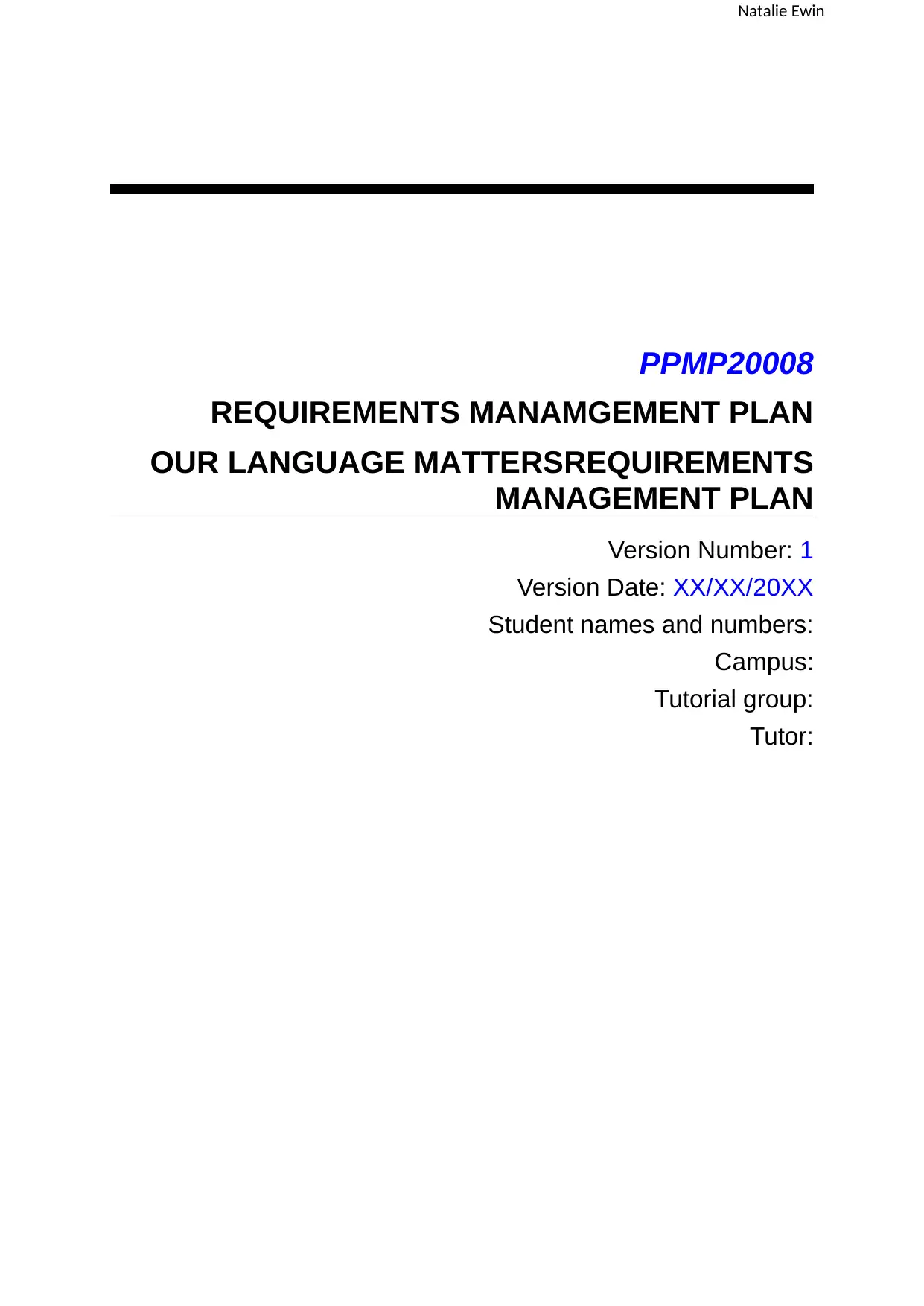
PPMP20008
REQUIREMENTS MANAMGEMENT PLAN
OUR LANGUAGE MATTERSREQUIREMENTS
MANAGEMENT PLAN
Version Number: 1
Version Date: XX/XX/20XX
Student names and numbers:
Campus:
Tutorial group:
Tutor:
Natalie Ewin
tabler-icon-diamond-filled.svg

Paraphrase This Document

Need a fresh take? Get an instant paraphrase of this document with our AI Paraphraser
Document Page
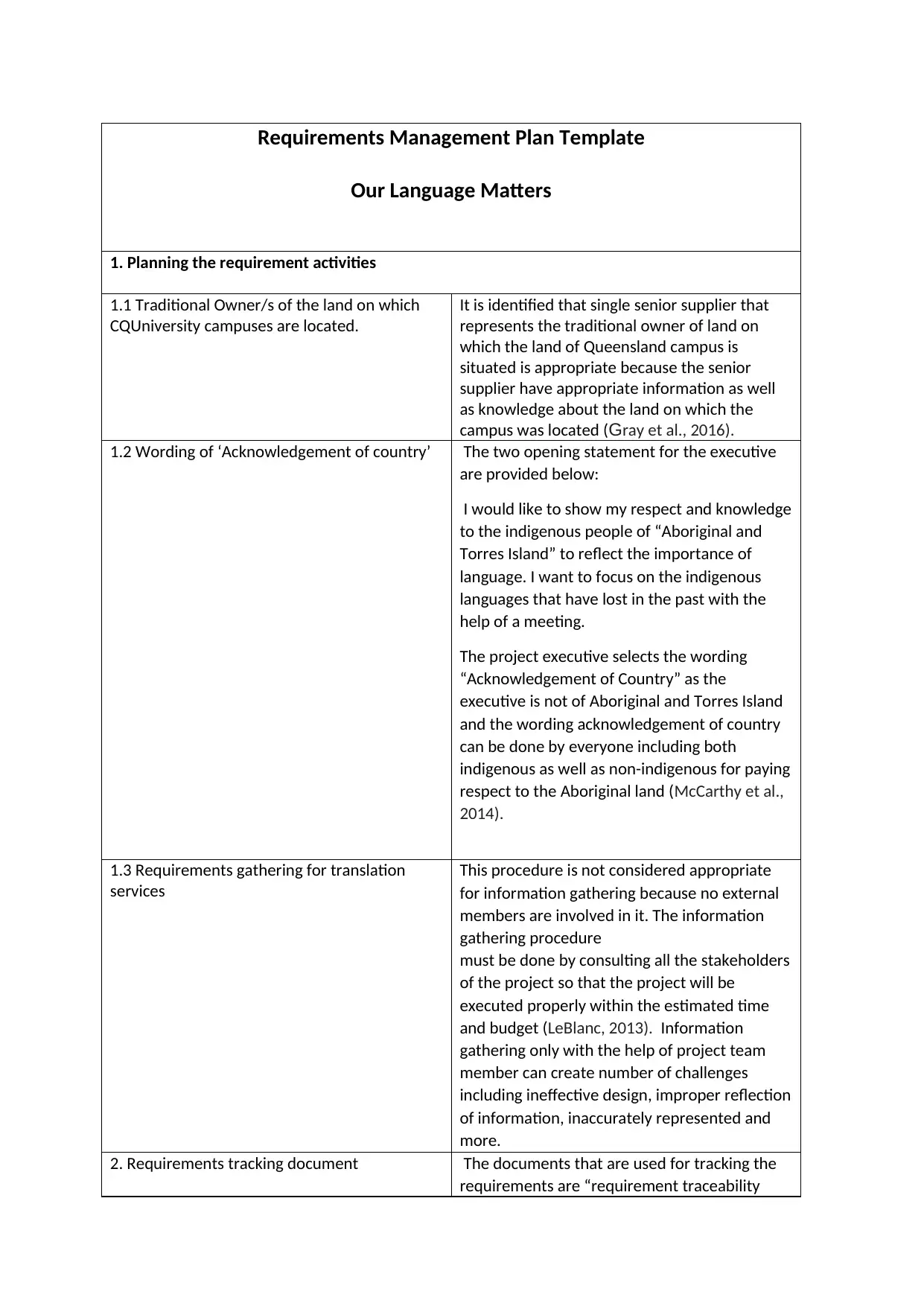
Requirements Management Plan Template
Our Language Matters
1. Planning the requirement activities
1.1 Traditional Owner/s of the land on which
CQUniversity campuses are located.
It is identified that single senior supplier that
represents the traditional owner of land on
which the land of Queensland campus is
situated is appropriate because the senior
supplier have appropriate information as well
as knowledge about the land on which the
campus was located (Gray et al., 2016).
1.2 Wording of ‘Acknowledgement of country’ The two opening statement for the executive
are provided below:
I would like to show my respect and knowledge
to the indigenous people of “Aboriginal and
Torres Island” to reflect the importance of
language. I want to focus on the indigenous
languages that have lost in the past with the
help of a meeting.
The project executive selects the wording
“Acknowledgement of Country” as the
executive is not of Aboriginal and Torres Island
and the wording acknowledgement of country
can be done by everyone including both
indigenous as well as non-indigenous for paying
respect to the Aboriginal land (McCarthy et al.,
2014).
1.3 Requirements gathering for translation
services
This procedure is not considered appropriate
for information gathering because no external
members are involved in it. The information
gathering procedure
must be done by consulting all the stakeholders
of the project so that the project will be
executed properly within the estimated time
and budget (LeBlanc, 2013). Information
gathering only with the help of project team
member can create number of challenges
including ineffective design, improper reflection
of information, inaccurately represented and
more.
2. Requirements tracking document The documents that are used for tracking the
requirements are “requirement traceability
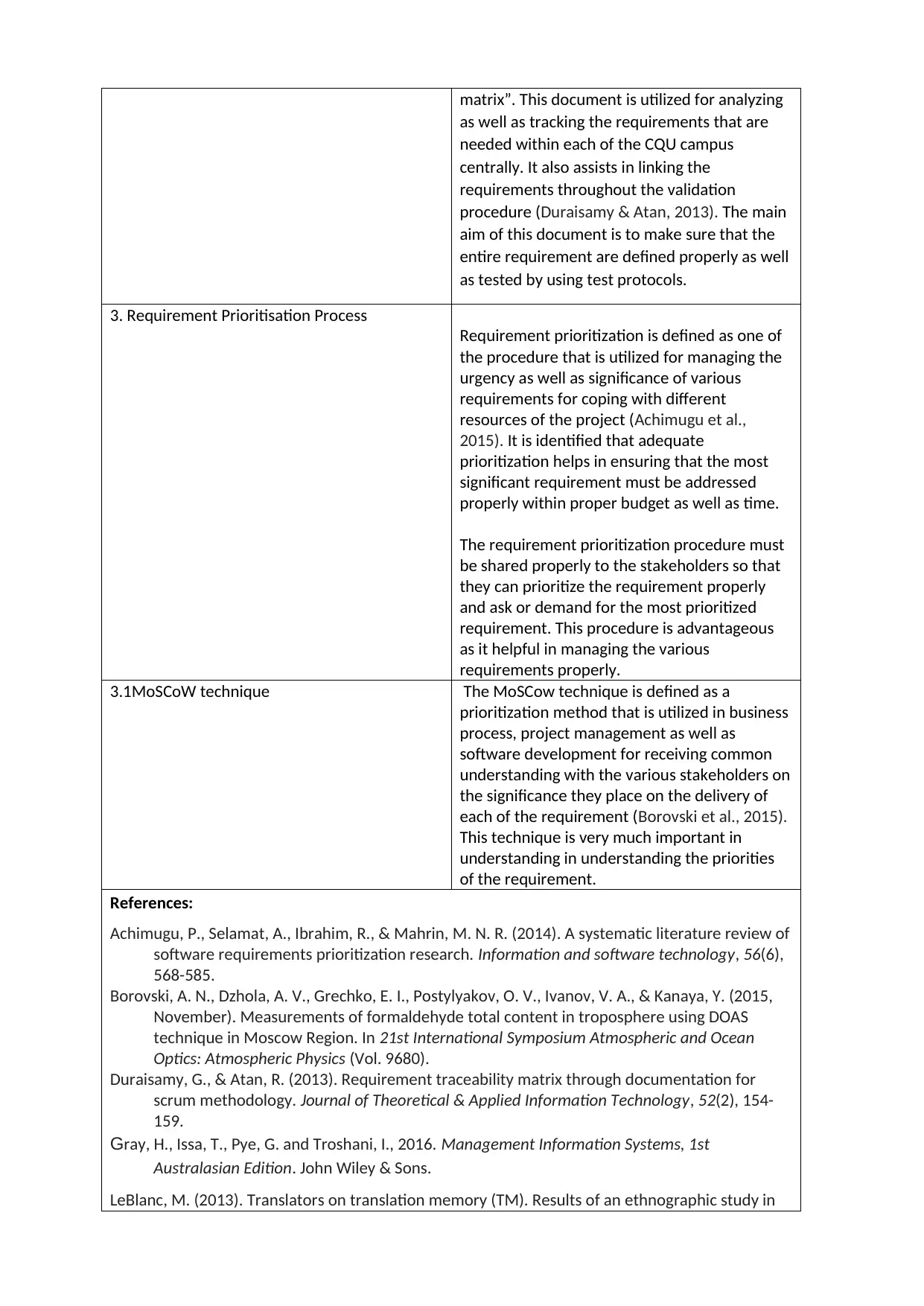
Document Page
matrix”. This document is utilized for analyzing
as well as tracking the requirements that are
needed within each of the CQU campus
centrally. It also assists in linking the
requirements throughout the validation
procedure (Duraisamy & Atan, 2013). The main
aim of this document is to make sure that the
entire requirement are defined properly as well
as tested by using test protocols.
3. Requirement Prioritisation Process
Requirement prioritization is defined as one of
the procedure that is utilized for managing the
urgency as well as significance of various
requirements for coping with different
resources of the project (Achimugu et al.,
2015). It is identified that adequate
prioritization helps in ensuring that the most
significant requirement must be addressed
properly within proper budget as well as time.
The requirement prioritization procedure must
be shared properly to the stakeholders so that
they can prioritize the requirement properly
and ask or demand for the most prioritized
requirement. This procedure is advantageous
as it helpful in managing the various
requirements properly.
3.1MoSCoW technique The MoSCow technique is defined as a
prioritization method that is utilized in business
process, project management as well as
software development for receiving common
understanding with the various stakeholders on
the significance they place on the delivery of
each of the requirement (Borovski et al., 2015).
This technique is very much important in
understanding in understanding the priorities
of the requirement.
References:
Achimugu, P., Selamat, A., Ibrahim, R., & Mahrin, M. N. R. (2014). A systematic literature review of
software requirements prioritization research. Information and software technology, 56(6),
568-585.
Borovski, A. N., Dzhola, A. V., Grechko, E. I., Postylyakov, O. V., Ivanov, V. A., & Kanaya, Y. (2015,
November). Measurements of formaldehyde total content in troposphere using DOAS
technique in Moscow Region. In 21st International Symposium Atmospheric and Ocean
Optics: Atmospheric Physics (Vol. 9680).
Duraisamy, G., & Atan, R. (2013). Requirement traceability matrix through documentation for
scrum methodology. Journal of Theoretical & Applied Information Technology, 52(2), 154-
159.
Gray, H., Issa, T., Pye, G. and Troshani, I., 2016. Management Information Systems, 1st
Australasian Edition. John Wiley & Sons.
LeBlanc, M. (2013). Translators on translation memory (TM). Results of an ethnographic study in
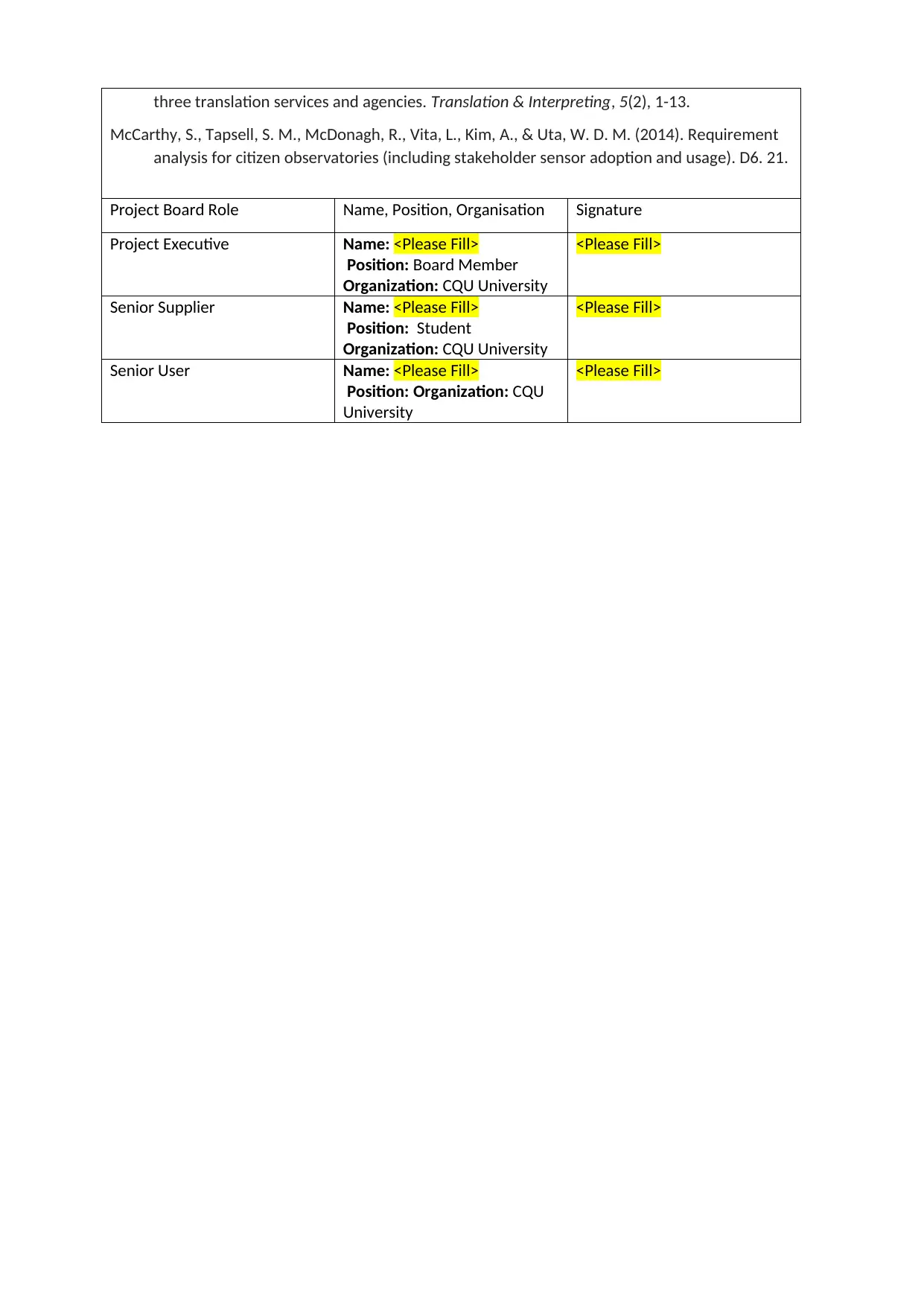
Document Page
three translation services and agencies. Translation & Interpreting, 5(2), 1-13.
McCarthy, S., Tapsell, S. M., McDonagh, R., Vita, L., Kim, A., & Uta, W. D. M. (2014). Requirement
analysis for citizen observatories (including stakeholder sensor adoption and usage). D6. 21.
Project Board Role Name, Position, Organisation Signature
Project Executive Name: <Please Fill>
Position: Board Member
Organization: CQU University
<Please Fill>
Senior Supplier Name: <Please Fill>
Position: Student
Organization: CQU University
<Please Fill>
Senior User Name: <Please Fill>
Position: Organization: CQU
University
<Please Fill>
chevron_up_icon
1 out of 4
circle_padding
hide_on_mobile
zoom_out_icon
[object Object]