Professional Practice & Communication in Management: A Report
VerifiedAdded on 2023/04/21
|14
|2970
|212
Report
AI Summary
This report provides a comprehensive overview of professional practice and communication within a management context. It includes analyses of various scenarios, such as conflict resolution between a regional manager and a sales representative, evaluating communication skills in an interview setting, and addressing challenges in project management. The report also covers strategies for information sharing in different contexts, including advising customers on new products, managing solid waste disposal and recycling, and developing emergency preparedness plans. Through case studies and practical examples, the report highlights the importance of effective communication, emotional intelligence, and strategic planning in successful management practices. Desklib provides a platform for students to access similar solved assignments and study resources.
Running head: MANAGEMENT
Professional Practice and Communication
Name of the Student:
Name of the University:
Author Note:
Professional Practice and Communication
Name of the Student:
Name of the University:
Author Note:

Paraphrase This Document
Need a fresh take? Get an instant paraphrase of this document with our AI Paraphraser

1MANAGEMENT
Table of Contents
Workshop 2......................................................................................................................................2
Question 1:.......................................................................................................................................2
Question 2........................................................................................................................................3
Workshop 3......................................................................................................................................5
Case study- Marco and Jim..............................................................................................................5
Question 1........................................................................................................................................5
Question 2........................................................................................................................................6
Question 3........................................................................................................................................8
Question 4:.......................................................................................................................................8
Case Study –Patrick and Danielle....................................................................................................9
Question 1........................................................................................................................................9
Question 2........................................................................................................................................9
Workshop 4....................................................................................................................................10
References:....................................................................................................................................11
Table of Contents
Workshop 2......................................................................................................................................2
Question 1:.......................................................................................................................................2
Question 2........................................................................................................................................3
Workshop 3......................................................................................................................................5
Case study- Marco and Jim..............................................................................................................5
Question 1........................................................................................................................................5
Question 2........................................................................................................................................6
Question 3........................................................................................................................................8
Question 4:.......................................................................................................................................8
Case Study –Patrick and Danielle....................................................................................................9
Question 1........................................................................................................................................9
Question 2........................................................................................................................................9
Workshop 4....................................................................................................................................10
References:....................................................................................................................................11
2MANAGEMENT
Workshop 2
Question 1:
The famous Australian sporting figure is Don Bradman (Donoghue and Tranter 2018).
He was an international cricketer and one of the greatest batsmen that Australia has ever
witnessed. The test batting average in Bradman’s career which is 99.94 is considered one the
great achievements by a sport person in a major sport like cricket.
Don Bradman practicing the sport alone with a golf ball and cricket stump has been part
of the Australian folklore. It a matter of two years, Bradman had a meteoric rise from the bush
cricket to the Australian Test team in simply a matter of two years. At the age o 22, he set
various top scoring records that made him the sporting idol of Australia.
During the career span of 20 years, Bradman scored at consistent level that made him
equivalent to three batsmen of Australia. As an administrator and captain, he had been
committed towards attacking, entertaining the cricket and drawing spectators in huge numbers.
He was a highly driven complex man who did not believe in closer personal relationships. Three
decades following his retirement he retained a pre- eminent position by acting as the selector,
administrator and the writer. His opinion was sought for even when he became a recluse in the
declining years. In the year 1997, 50 years following his retirement as the Test Player, John
Howard, the then Prime Minister gave him the recognition of one the greatest living Australian.
Besides, his image not only appeared in the postage coins and stamps but an entire museum
dedicated to Bradman’s life was opened while he was still alive (Ward 2013).
Workshop 2
Question 1:
The famous Australian sporting figure is Don Bradman (Donoghue and Tranter 2018).
He was an international cricketer and one of the greatest batsmen that Australia has ever
witnessed. The test batting average in Bradman’s career which is 99.94 is considered one the
great achievements by a sport person in a major sport like cricket.
Don Bradman practicing the sport alone with a golf ball and cricket stump has been part
of the Australian folklore. It a matter of two years, Bradman had a meteoric rise from the bush
cricket to the Australian Test team in simply a matter of two years. At the age o 22, he set
various top scoring records that made him the sporting idol of Australia.
During the career span of 20 years, Bradman scored at consistent level that made him
equivalent to three batsmen of Australia. As an administrator and captain, he had been
committed towards attacking, entertaining the cricket and drawing spectators in huge numbers.
He was a highly driven complex man who did not believe in closer personal relationships. Three
decades following his retirement he retained a pre- eminent position by acting as the selector,
administrator and the writer. His opinion was sought for even when he became a recluse in the
declining years. In the year 1997, 50 years following his retirement as the Test Player, John
Howard, the then Prime Minister gave him the recognition of one the greatest living Australian.
Besides, his image not only appeared in the postage coins and stamps but an entire museum
dedicated to Bradman’s life was opened while he was still alive (Ward 2013).
⊘ This is a preview!⊘
Do you want full access?
Subscribe today to unlock all pages.

Trusted by 1+ million students worldwide
3MANAGEMENT
Question 2
i. The strategies of sharing information most appropriate in advising customers about the
new range of paper products in the stock are as follows (Nayyar, Mahajan and Teneketzis 2013):
Defining the product: This involves providing a suitable description of the product in
stock and avoid any pitfalls related to the product development or shortage of resources
in developing the product.
Identification of the market needs: A successful new product development requires
thorough knowledge of target market along with the wants and needs. A strategic,
targeted and purposeful approach will ensure that the product fits the market.
Establishment of time frames: This involves allowing sufficient time in implementing
and developing the new paper products. The objectives for the development of the new
product will help in informing the time frames and the deadlines for the implementation.
Identification of the key approaches and issues: This involves screening and generating
ideas, development of the screening and the testing concept, analyzing the market and the
business strategy, marketing and developing testing products and the implementation of
the new products.
ii. The strategies for sharing information in managing the role of consultant for the project
Efficient Solid Waste Management – garbage disposal and recycling for the local council are as
follows (Guerrero, Maas and Hogland 2013):
Question 2
i. The strategies of sharing information most appropriate in advising customers about the
new range of paper products in the stock are as follows (Nayyar, Mahajan and Teneketzis 2013):
Defining the product: This involves providing a suitable description of the product in
stock and avoid any pitfalls related to the product development or shortage of resources
in developing the product.
Identification of the market needs: A successful new product development requires
thorough knowledge of target market along with the wants and needs. A strategic,
targeted and purposeful approach will ensure that the product fits the market.
Establishment of time frames: This involves allowing sufficient time in implementing
and developing the new paper products. The objectives for the development of the new
product will help in informing the time frames and the deadlines for the implementation.
Identification of the key approaches and issues: This involves screening and generating
ideas, development of the screening and the testing concept, analyzing the market and the
business strategy, marketing and developing testing products and the implementation of
the new products.
ii. The strategies for sharing information in managing the role of consultant for the project
Efficient Solid Waste Management – garbage disposal and recycling for the local council are as
follows (Guerrero, Maas and Hogland 2013):
Paraphrase This Document
Need a fresh take? Get an instant paraphrase of this document with our AI Paraphraser
4MANAGEMENT
Building of Suitable Infrastructure: This involves construction or refurbishing of
landfills, close dumps, up gradation of the treatment and the waste sorting facilities along
with providing trucks, dumpsters and the transfer stations.
Maintenance of Legal Structures and Institutions: This includes coordinated institutions
and sound policy measures for waste management sector
Ensuring Financial Sustainability: Through designing of fee structures and taxes along
with a plan for long term, the projects helped the government in improving the waste cost
and its recovery.
Engagement of Citizen: Public participation and behavior change represents the key for
functional waste system. Here, it is necessary for designing incentives and the awareness
system in motivating the source separation, waste reduction and the reuse.
Including Social Inclusion: This involves addressing strategies that put across provision
for safer working conditions, involving integration into formal system, restrictions of
child labor, social safety nets and education.
Environment and Climate Change: This involves supporting resilience through diversion
of organic waste and reducing the waste disposal in the waterways along with
safeguarding the infrastructure.
Ensure Safety and Health: This involves management of waste for improving public
livelihoods and health through reduction of pest mitigation and spread of vector disease.
Ensure Creation of Knowledge: Ensure exploration of the locally appropriate solutions
through the technical expertise, analytics and data.
iii. The development of emergency preparedness plans for saving the lives and minimizing
the damage that occurs during the disaster. During the phase of the emergency preparedness it is
Building of Suitable Infrastructure: This involves construction or refurbishing of
landfills, close dumps, up gradation of the treatment and the waste sorting facilities along
with providing trucks, dumpsters and the transfer stations.
Maintenance of Legal Structures and Institutions: This includes coordinated institutions
and sound policy measures for waste management sector
Ensuring Financial Sustainability: Through designing of fee structures and taxes along
with a plan for long term, the projects helped the government in improving the waste cost
and its recovery.
Engagement of Citizen: Public participation and behavior change represents the key for
functional waste system. Here, it is necessary for designing incentives and the awareness
system in motivating the source separation, waste reduction and the reuse.
Including Social Inclusion: This involves addressing strategies that put across provision
for safer working conditions, involving integration into formal system, restrictions of
child labor, social safety nets and education.
Environment and Climate Change: This involves supporting resilience through diversion
of organic waste and reducing the waste disposal in the waterways along with
safeguarding the infrastructure.
Ensure Safety and Health: This involves management of waste for improving public
livelihoods and health through reduction of pest mitigation and spread of vector disease.
Ensure Creation of Knowledge: Ensure exploration of the locally appropriate solutions
through the technical expertise, analytics and data.
iii. The development of emergency preparedness plans for saving the lives and minimizing
the damage that occurs during the disaster. During the phase of the emergency preparedness it is
5MANAGEMENT
vital to identify the groups who less likely prepares for the disaster and who lacks the vital
emergency response items. The strategies for sharing information in introduction an emergency
preparedness plan for a small building society is as follows (Wells et al. 2013):
Creation of a contingency and evacuation plan
Conduction of the community engagement and outreach
Determination of the resource allocations and needs
Preparation of the shelter, supplies, evacuation and the transportation plans.
Workshop 3
Case study- Marco and Jim
Question 1
Jim, the Regional Manager of Con Electrics decided to call a meeting with Marco for
discussing his performance whose sales figure was falling with every passing month. Marco was
nowhere close to reaching his target of $1 million in sales. On being asked for a justification he
said that he required time in building contact. He also told the manager to change some of their
products as they did not meet the commercial criteria to be sold to the larger clients. On being
asked about the sale of top priority product of Con Electrics, Galcore, he replied he did like the
product and prefers selling it in Metline range. After listening to his answer when Jim asked
wanted to know what he would have done in case he was in Jim’s position, he blatantly replied
that Jim always preferred others over him. He also added that he was deprived of the provision of
calling him at the office and never received a note of appreciation for whatever he did. This
resulted in a conflict between Marco and Jim.
vital to identify the groups who less likely prepares for the disaster and who lacks the vital
emergency response items. The strategies for sharing information in introduction an emergency
preparedness plan for a small building society is as follows (Wells et al. 2013):
Creation of a contingency and evacuation plan
Conduction of the community engagement and outreach
Determination of the resource allocations and needs
Preparation of the shelter, supplies, evacuation and the transportation plans.
Workshop 3
Case study- Marco and Jim
Question 1
Jim, the Regional Manager of Con Electrics decided to call a meeting with Marco for
discussing his performance whose sales figure was falling with every passing month. Marco was
nowhere close to reaching his target of $1 million in sales. On being asked for a justification he
said that he required time in building contact. He also told the manager to change some of their
products as they did not meet the commercial criteria to be sold to the larger clients. On being
asked about the sale of top priority product of Con Electrics, Galcore, he replied he did like the
product and prefers selling it in Metline range. After listening to his answer when Jim asked
wanted to know what he would have done in case he was in Jim’s position, he blatantly replied
that Jim always preferred others over him. He also added that he was deprived of the provision of
calling him at the office and never received a note of appreciation for whatever he did. This
resulted in a conflict between Marco and Jim.
⊘ This is a preview!⊘
Do you want full access?
Subscribe today to unlock all pages.
Trusted by 1+ million students worldwide
6MANAGEMENT
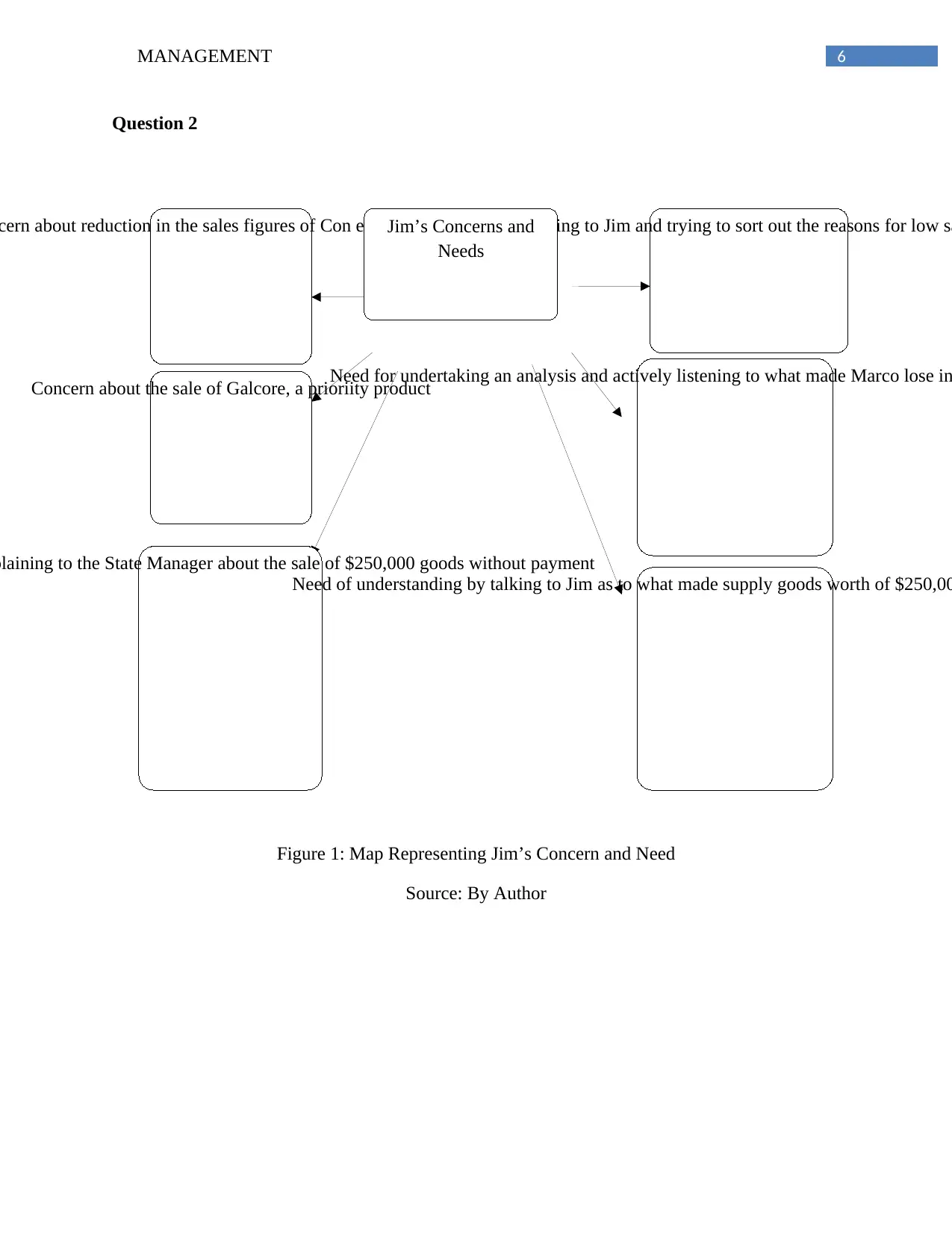
cern about reduction in the sales figures of Con electrics by Marco
Concern about the sale of Galcore, a prioriity product
plaining to the State Manager about the sale of $250,000 goods without payment
Need of talking to Jim and trying to sort out the reasons for low sa
Need for undertaking an analysis and actively listening to what made Marco lose in
Need of understanding by talking to Jim as to what made supply goods worth of $250,00
Question 2
Figure 1: Map Representing Jim’s Concern and Need
Source: By Author
Jim’s Concerns and
Needs
cern about reduction in the sales figures of Con electrics by Marco
Concern about the sale of Galcore, a prioriity product
plaining to the State Manager about the sale of $250,000 goods without payment
Need of talking to Jim and trying to sort out the reasons for low sa
Need for undertaking an analysis and actively listening to what made Marco lose in
Need of understanding by talking to Jim as to what made supply goods worth of $250,00
Question 2
Figure 1: Map Representing Jim’s Concern and Need
Source: By Author
Jim’s Concerns and
Needs
Paraphrase This Document
Need a fresh take? Get an instant paraphrase of this document with our AI Paraphraser
7MANAGEMENT
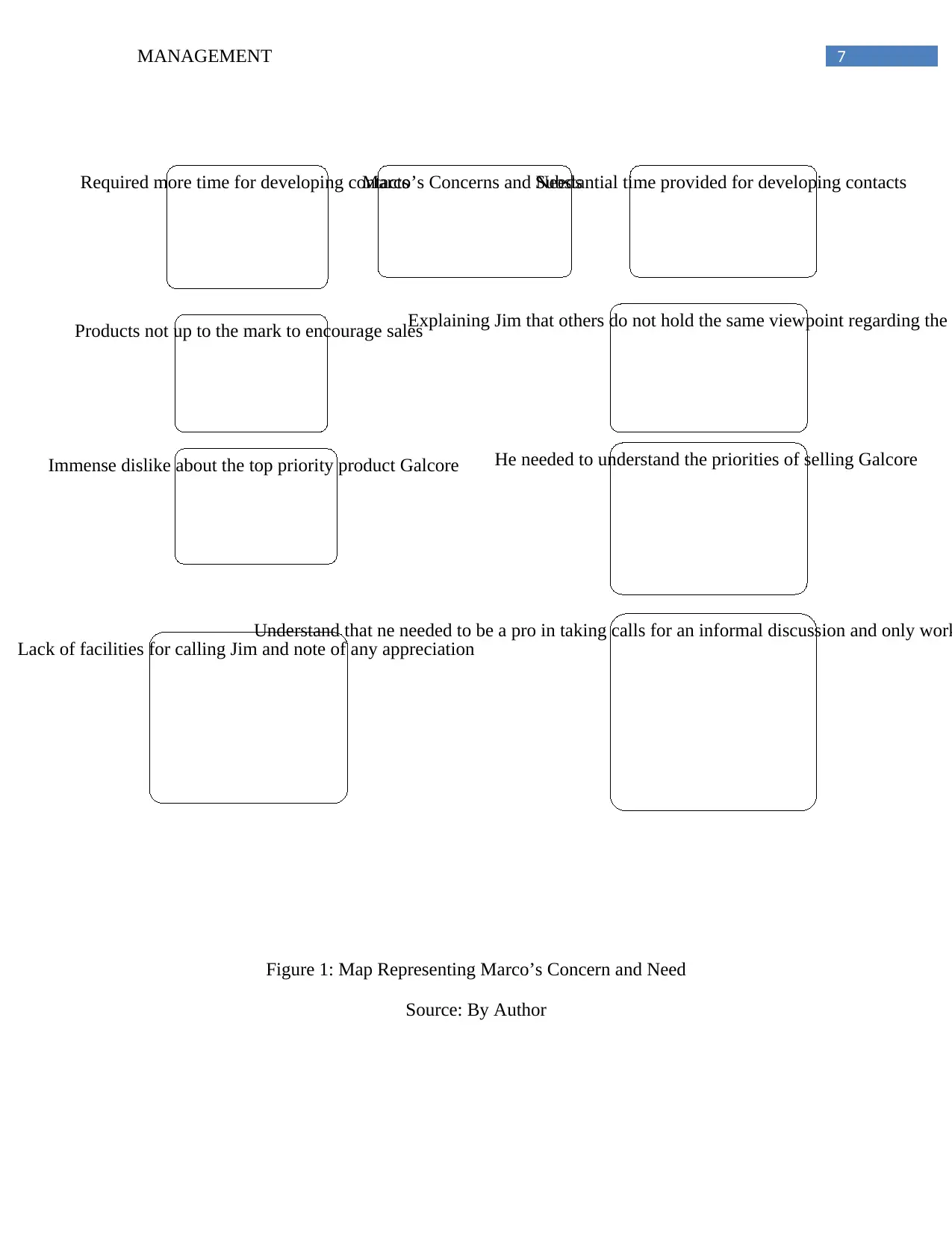
Marco’s Concerns and NeedsRequired more time for developing contacts
Products not up to the mark to encourage sales
Immense dislike about the top priority product Galcore
Lack of facilities for calling Jim and note of any appreciation
Substantial time provided for developing contacts
Explaining Jim that others do not hold the same viewpoint regarding the
He needed to understand the priorities of selling Galcore
Understand that ne needed to be a pro in taking calls for an informal discussion and only work
Figure 1: Map Representing Marco’s Concern and Need
Source: By Author
Marco’s Concerns and NeedsRequired more time for developing contacts
Products not up to the mark to encourage sales
Immense dislike about the top priority product Galcore
Lack of facilities for calling Jim and note of any appreciation
Substantial time provided for developing contacts
Explaining Jim that others do not hold the same viewpoint regarding the
He needed to understand the priorities of selling Galcore
Understand that ne needed to be a pro in taking calls for an informal discussion and only work
Figure 1: Map Representing Marco’s Concern and Need
Source: By Author
8MANAGEMENT
Question 3
In the meeting at 3.00 pm Jim could make the following constructive responses to Marco:
Jim could respond in a manner that would enable in handling the conflict better without
allowing it in becoming a major issue( Lederach 2015). He could ask Marco that they would
analyze the problems with the products but in the meantime he should try to enhance sales to
larger clients. As there is a need to maintain records so he should always make it a point in
generating invoice while providing goods to the suppliers. Most often conflict becomes a huge
issue through ignorance.
Jim could provide a constructive response by asking Marco to try selling Galcore and
can give him a call whenever he needed to discuss something informally. He could also motivate
Marco by talking about his past credibility. It is therefore necessary to recognize the problem
(Sarangi and Shah 2015).
To prevent the negative thoughts and emotions of Jim from impacting Marco he should
embrace his emotional intelligence (Goleman, Boyatzis and McKee 2013). This would not only
help in interpreting his behavior and perceptions but at the same time interpret others.
Question 4:
Before the meeting tomorrow, Marco resolve the conflict with Jim by maintaining a
positive outlook thereby providing an assurance that he would work towards reaching his target.
He could assure Jim that he would take up the products and sell them to larger clients without
focusing much on the flaws. In addition, he could also provide an assurance in generating an
invoice for the $250,000 worth of the goods sold. He could also indulge in active listening before
putting across any negative feedback (Potts and Potts 2013). He should also keep aside his
Question 3
In the meeting at 3.00 pm Jim could make the following constructive responses to Marco:
Jim could respond in a manner that would enable in handling the conflict better without
allowing it in becoming a major issue( Lederach 2015). He could ask Marco that they would
analyze the problems with the products but in the meantime he should try to enhance sales to
larger clients. As there is a need to maintain records so he should always make it a point in
generating invoice while providing goods to the suppliers. Most often conflict becomes a huge
issue through ignorance.
Jim could provide a constructive response by asking Marco to try selling Galcore and
can give him a call whenever he needed to discuss something informally. He could also motivate
Marco by talking about his past credibility. It is therefore necessary to recognize the problem
(Sarangi and Shah 2015).
To prevent the negative thoughts and emotions of Jim from impacting Marco he should
embrace his emotional intelligence (Goleman, Boyatzis and McKee 2013). This would not only
help in interpreting his behavior and perceptions but at the same time interpret others.
Question 4:
Before the meeting tomorrow, Marco resolve the conflict with Jim by maintaining a
positive outlook thereby providing an assurance that he would work towards reaching his target.
He could assure Jim that he would take up the products and sell them to larger clients without
focusing much on the flaws. In addition, he could also provide an assurance in generating an
invoice for the $250,000 worth of the goods sold. He could also indulge in active listening before
putting across any negative feedback (Potts and Potts 2013). He should also keep aside his
⊘ This is a preview!⊘
Do you want full access?
Subscribe today to unlock all pages.
Trusted by 1+ million students worldwide
9MANAGEMENT
likings about the priority product and indulge in selling it thereby contributing to the sales
figures. Besides, he could also ask Jim to suggest him a solution that would not only help him in
understanding the company’s perspective and decide accordingly.
Case Study –Patrick and Danielle
Question 1
Danielle demonstrated a higher level of communication skills by being clear and concise,
being assertive, consistent and calm. In other words, she tried to demonstrate communication
skills that involved listening, observing and speaking. Danielle tried to be immensely confident
by taking initiative of introducing herself, making the interviewee feel at ease and making use of
open ended questions in encouraging and involving Patrick (Stephenson and Yorke 2013). She
also demonstrated immediacy by providing accurate feedback that acknowledged the responses
of Patrick through non verbal language. She also portrayed interaction management thereby
questioning in a manner that offered Patrick an opportunity of participation. She also portrayed
expressiveness by trying to understand the accommodation needs of the interviewee and thereby
ask relevant questions (Xie, Batra and Peng 2015). She also tried acknowledging answers of
Patrick and asked for clarification that provided him with sufficient room for speaking without
any interruption.
Question 2
It can be said that Danielle demonstrated few communication skills as she did not
demonstrate empathy by paying a closer attention to the interviewee (Kinman and Grant 2016).
It has been observed that empathy is considered as a quality by the co workers due to the respect
likings about the priority product and indulge in selling it thereby contributing to the sales
figures. Besides, he could also ask Jim to suggest him a solution that would not only help him in
understanding the company’s perspective and decide accordingly.
Case Study –Patrick and Danielle
Question 1
Danielle demonstrated a higher level of communication skills by being clear and concise,
being assertive, consistent and calm. In other words, she tried to demonstrate communication
skills that involved listening, observing and speaking. Danielle tried to be immensely confident
by taking initiative of introducing herself, making the interviewee feel at ease and making use of
open ended questions in encouraging and involving Patrick (Stephenson and Yorke 2013). She
also demonstrated immediacy by providing accurate feedback that acknowledged the responses
of Patrick through non verbal language. She also portrayed interaction management thereby
questioning in a manner that offered Patrick an opportunity of participation. She also portrayed
expressiveness by trying to understand the accommodation needs of the interviewee and thereby
ask relevant questions (Xie, Batra and Peng 2015). She also tried acknowledging answers of
Patrick and asked for clarification that provided him with sufficient room for speaking without
any interruption.
Question 2
It can be said that Danielle demonstrated few communication skills as she did not
demonstrate empathy by paying a closer attention to the interviewee (Kinman and Grant 2016).
It has been observed that empathy is considered as a quality by the co workers due to the respect
Paraphrase This Document
Need a fresh take? Get an instant paraphrase of this document with our AI Paraphraser
10MANAGEMENT
and attention they pay others. This is in fact a skill that is not only hard to improve but also
develop. Danielle also did not try to adapt the communication style while interacting with the
interview (Floyd, Hesse and Generous 2017). She also did not try to portray friendliness
characterized by kindness and honesty thereby fostering understanding and trust. For instance,
simple gestures like asking someone about their doings and while smiling and offering praise can
foster in generating positive relationships.
Danielle performed poorly in terms of interpersonal effectiveness as she did not portray
emotional intelligence that refers to the ability of keeping emotions under the control and
navigating the social situations with sufficient amount of composure (Kulesza, Vallacher and
Nowak 2013). She also lacked the efficiency in leadership, negotiation and empathy.
Workshop 4
Jean who was a database programmer had been keen on writing a large statistical
program required by the company. However after months of toiling she remained stuck at
various parts of program. The complexity of the problem was not realized by the manager who
wanted to get the job completed within few days. Lack of knowledge in trying to solve the
problem, she found two areas of her code matching with a recent work of a coworker and an
earlier version of commercialized software package. Without any information or documentation
she incorporated part of the code from her co-worker as well as the commercialized software and
completed his project much ahead of time. Incorporating someone else’s work into one own
work without prior intimation is considered a legal as well as an ethical issue (Treviño et al.
2016).
and attention they pay others. This is in fact a skill that is not only hard to improve but also
develop. Danielle also did not try to adapt the communication style while interacting with the
interview (Floyd, Hesse and Generous 2017). She also did not try to portray friendliness
characterized by kindness and honesty thereby fostering understanding and trust. For instance,
simple gestures like asking someone about their doings and while smiling and offering praise can
foster in generating positive relationships.
Danielle performed poorly in terms of interpersonal effectiveness as she did not portray
emotional intelligence that refers to the ability of keeping emotions under the control and
navigating the social situations with sufficient amount of composure (Kulesza, Vallacher and
Nowak 2013). She also lacked the efficiency in leadership, negotiation and empathy.
Workshop 4
Jean who was a database programmer had been keen on writing a large statistical
program required by the company. However after months of toiling she remained stuck at
various parts of program. The complexity of the problem was not realized by the manager who
wanted to get the job completed within few days. Lack of knowledge in trying to solve the
problem, she found two areas of her code matching with a recent work of a coworker and an
earlier version of commercialized software package. Without any information or documentation
she incorporated part of the code from her co-worker as well as the commercialized software and
completed his project much ahead of time. Incorporating someone else’s work into one own
work without prior intimation is considered a legal as well as an ethical issue (Treviño et al.
2016).
11MANAGEMENT
Jean could be sued for incorporating some other person’s likeness, name and the personal
attributes without prior permission for exploitative purpose. It has been found that most of the
people land in trouble by using someone else’s identity for his/her personal benefit irrespective
of the purpose. There can be two different legal claims in relation to such unauthorized uses, the
first is invasion of the privacy through the misappropriation of the name and the second is the
violation of right to publicity(Greenberg 2014).
Jean could be sued for incorporating some other person’s likeness, name and the personal
attributes without prior permission for exploitative purpose. It has been found that most of the
people land in trouble by using someone else’s identity for his/her personal benefit irrespective
of the purpose. There can be two different legal claims in relation to such unauthorized uses, the
first is invasion of the privacy through the misappropriation of the name and the second is the
violation of right to publicity(Greenberg 2014).
⊘ This is a preview!⊘
Do you want full access?
Subscribe today to unlock all pages.
Trusted by 1+ million students worldwide

1 out of 14


Related Documents


Your All-in-One AI-Powered Toolkit for Academic Success.
+13062052269
info@desklib.com
Available 24*7 on WhatsApp / Email
![[object Object]](/_next/static/media/star-bottom.7253800d.svg)
Unlock your academic potential
Copyright © 2020–2026 A2Z Services. All Rights Reserved. Developed and managed by ZUCOL.