Management Practices and Team Dynamics Analysis at Walmart

Verified

Added on  2023/01/13

|7
|1225
|92
Homework Assignment
AI Summary
This assignment analyzes Walmart's management practices, focusing on organizational structure, job design, and team dynamics. The student identifies key contingencies influencing organizational structure, evaluates the motivational aspects of a typical employee's job using the job characteristics model, and suggests job enlargement and enrichment strategies. The assignment then examines team development stages, strengths, weaknesses, and methods to improve group effectiveness. It also explores group cohesiveness, comparing Carron's and Tuckman's models. The analysis covers factors such as group size, diversity, identity, and success, offering insights into effective management and team performance within Walmart's retail environment. The assignment provides a structured approach to understanding organizational behavior and management principles.
Document Page
Running head: MANAGEMENT PRACTICES
MANAGEMENT PRACTICES
Name of the Student
Name of the University
Author Note
tabler-icon-diamond-filled.svg

Paraphrase This Document

Need a fresh take? Get an instant paraphrase of this document with our AI Paraphraser
Document Page
MANAGEMENT PRACTICES 1
1.1
The chosen organization for the purpose of this assignment, is Walmart, which is a retail
chain for groceries.
The contingencies which are most important in determining how well an organization is
organized, are as follows:
Organizational environment.
Technology.
Strategy.
Human resources.
The organization is organized in the right way. This is because according to the
contingencies mentioned above, Walmart does comply with each of them. It has a healthy
organizational environment, has the necessary technologies to assist employees in their work, has
a clear strategy to achieve the objectives of the organization, and has a vast human resource
across all of the stores of the chain, with each having a definite and clear hierarchy.
1.2
Using the job characteristics model, the characteristics of the job of a typical employee in
the organization are as follows:
It does not require a variety of skills.
The task identity is made very clear to the employees.
Has a high task significance.
Document Page
2MANAGEMENT PRACTICES
Has poor autonomy.
Has erratic feedback systems.
Therefore, since the work role of a typical employee does not require a variety of skills, but
has clear identity and task significance, the employees experience moderate meaningfulness at
work, and little experiences of responsibility and knowledge of results, as a result of poor
autonomy and feedback systems.
Therefore, using the MPS (Skill variety + Task identity + Task significance)/3 X Autonomy
X Feedback), it can be said that the job motivation of a typical employee is moderately low.
1.3
Following are the ways in which a typical job could be enlarged or enriched:
Training to provide additional skills related to the work of a typical employee.
Elaborating and clarifying ways in which a typical employee can exercise his own
autonomy.
Providing regular feedbacks to every employee on performance.
2.1
The team is currently in the performing stage.
This is because the team members in the team are aware of each other and their identities
(Forming).
They have passed the phase of conflicts and have accepted of the differences of each
other (Storming).
Document Page
3MANAGEMENT PRACTICES
The team has also passed the stage of coming close to each other and creating bonds with
each other, and has agreed upon the norms of the team which they need to abide by (Norming).
Now, the team has been performing without any hindrance, and is highly task oriented.
2.2
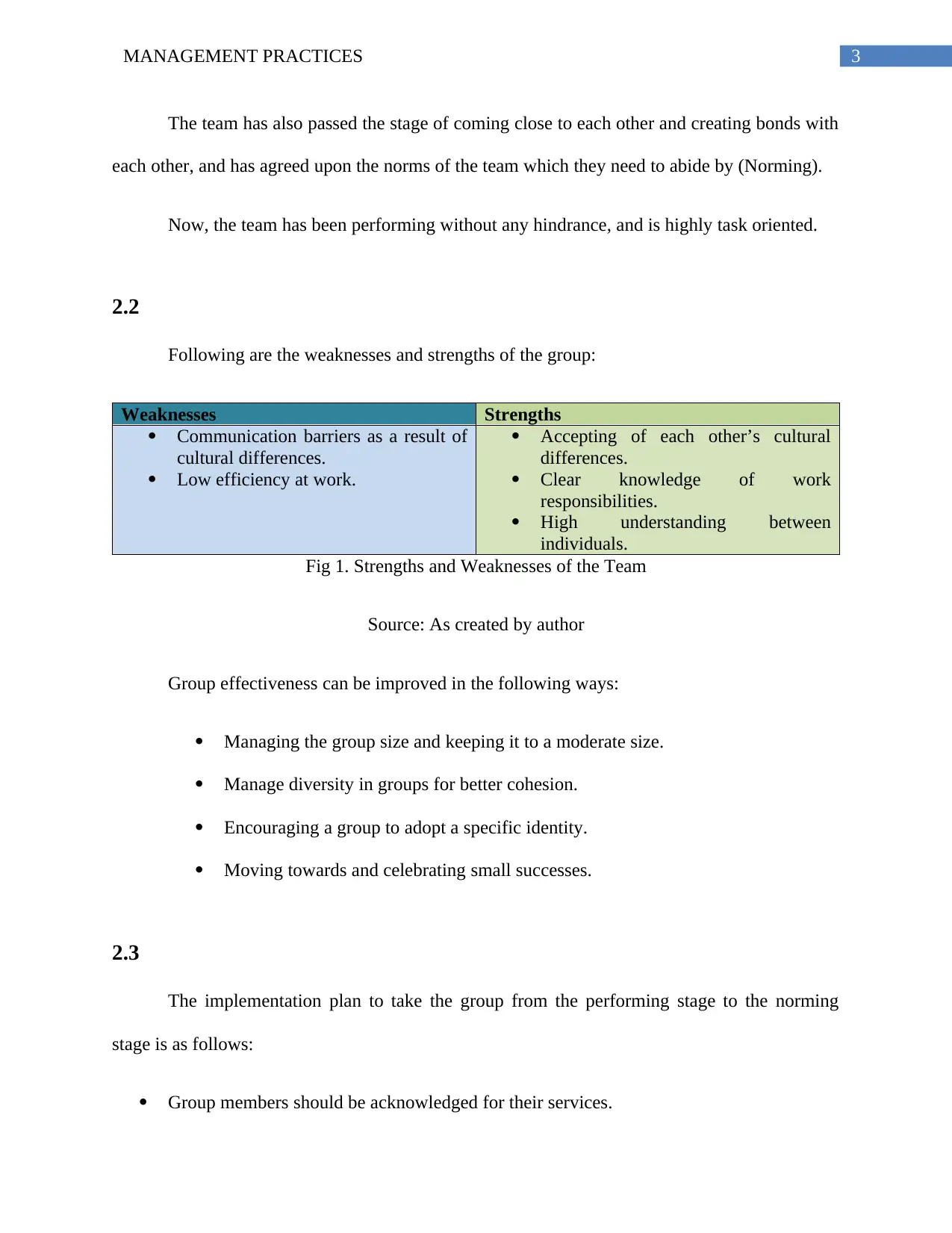
Following are the weaknesses and strengths of the group:
Weaknesses Strengths
Communication barriers as a result of
cultural differences.
Low efficiency at work.
Accepting of each other’s cultural
differences.
Clear knowledge of work
responsibilities.
High understanding between
individuals.
Fig 1. Strengths and Weaknesses of the Team
Source: As created by author
Group effectiveness can be improved in the following ways:
Managing the group size and keeping it to a moderate size.
Manage diversity in groups for better cohesion.
Encouraging a group to adopt a specific identity.
Moving towards and celebrating small successes.
2.3
The implementation plan to take the group from the performing stage to the norming
stage is as follows:
Group members should be acknowledged for their services.
tabler-icon-diamond-filled.svg

Paraphrase This Document

Need a fresh take? Get an instant paraphrase of this document with our AI Paraphraser
Document Page
4MANAGEMENT PRACTICES
They should be given their share of rewards.
Any existing conflicts should be resolved.
Performance of the overall team should be assessed.
3
Group cohesiveness is measured by the following factors:
Group size: It is said that the lower the group size, the higher is the group cohesiveness. This is
because in a small group, people get to interact with each other more frequently, and thereby has
a direct positive effect on the cohesiveness (Franz et al., 2016).
Group diversity: Diverse groups have the potential of coming up with innovative and a wide
range of solutions to a problem, which can increase group cohesiveness as a result of the success.
However, according to Cantle (2018), this same factor can be a barrier to group cohesiveness as
a result of existing differences between the group members.
Group identity: According to Huddy (2015), when group members have a feeling that they
share a common identity, it increases their group cohesiveness.
Success: Group cohesiveness is also dependent on the frequency of success which the group
achieves. It is directly proportional to the frequency of success of the group (Croy & Eva, 2018).
Carron’s model of group cohesion takes environmental, personal and leadership factors
into the estimation of group cohesion. It also considers team outcomes, individual outcomes and
team factors, and measures social cohesion and task cohesion (Gioldasis et al., 2016). Tuckman’s
model on the other hand, only takes the internal factors of a group to measure group cohesion
Document Page
5MANAGEMENT PRACTICES
and also takes the different stages of the group formation for the same purpose (Kiweewa et al.,
2018).
Carron’s model is a better model for group cohesion, since it provides for a
multidimensional view of group cohesion, taking various internal and external factors for the
measurement of group cohesion, and measures social and task cohesion of a group separately.
Document Page
6MANAGEMENT PRACTICES
References
Cantle, T. (2018). Community cohesion: A new framework for race and diversity. Springer.
Croy, G., & Eva, N. (2018). Student success in teams: intervention, cohesion and performance.
Education+ Training, 60(9), 1041-1056.
Franz, B., Leicht, R., Molenaar, K., & Messner, J. (2016). Impact of team integration and group
cohesion on project delivery performance. Journal of Construction Engineering and
Management, 143(1), 04016088.
Gioldasis, A., Stavrou, N., Mitrotasios, M., & Psychountaki, M. (2016). Cohesion and
performance in soccer: A causal model. Sport Science Review, 25(1-2), 97-112.
Huddy, L. (2015). Group identity and political cohesion. Emerging Trends in the Social and
Behavioral Sciences: An Interdisciplinary, Searchable, and Linkable Resource, 1-14.
Kiweewa, J. M., Gilbride, D., Luke, M., & Clingerman, T. (2018). Tracking growth factors in
experiential training groups through Tuckman’s conceptual model. The Journal for
Specialists in Group Work, 43(3), 274-296.
chevron_up_icon
1 out of 7
circle_padding
hide_on_mobile
zoom_out_icon
[object Object]