University Safety Performance Management Report Analysis
VerifiedAdded on 2020/05/28
|17
|3656
|126
Report
AI Summary
This report provides a comprehensive analysis of safety performance management, focusing on accident investigation and various causation models. It begins by establishing the importance of accident investigation in supporting continual improvement and managing occupational health and safety, emphasizing its role in preventing large-scale accidents and improving business performance. The report then discusses different accident causation models, including Heinrich’s Domino theory, epidemiological models, and the Swiss cheese model, highlighting their strengths and weaknesses. It explores the dynamic between humans and technology within work processes, especially in high-hazard industries. The report also examines the influence of organization size and proactive safety management on the effectiveness of accident investigation. The study concludes by emphasizing the significance of proactive safety measures and the continuous improvement of safety systems to prevent accidents and enhance overall organizational safety performance.
Running head: MANAGEMENT OF SAFETY PERFORMANCE
Management of Safety Performance
Name of the Student:
Name of the University:
Author Note:
Management of Safety Performance
Name of the Student:
Name of the University:
Author Note:

Paraphrase This Document
Need a fresh take? Get an instant paraphrase of this document with our AI Paraphraser
2
MANAGEMENT OF SAFETY PERFORMANCE
Table of Contents
Introduction......................................................................................................................................2
Purpose of Accident Investigation...................................................................................................3
Discussion on different Accident causation models and investigation methods.............................3
Heinrich’s Domino theory...............................................................................................................4
Epidemiological models..................................................................................................................6
Swiss cheese Accident Causation Model........................................................................................6
Dynamic between Humans & Technology within Work Processes & Environments....................6
High Hazard industries (investigating and acting upon small scale accidents is an effective way
to prevent larger scale events by identifying negative cultures responsible for latent failures)......7
Large and small organizations (can influence the effectiveness of Accident Investigation)...........9
Nature and extent of an organization’s Proactive Safety & Health Management (will influence
the scope, effectiveness and quality of Accident Investigation)....................................................10
Conclusion.....................................................................................................................................11
Reference List................................................................................................................................13
MANAGEMENT OF SAFETY PERFORMANCE
Table of Contents
Introduction......................................................................................................................................2
Purpose of Accident Investigation...................................................................................................3
Discussion on different Accident causation models and investigation methods.............................3
Heinrich’s Domino theory...............................................................................................................4
Epidemiological models..................................................................................................................6
Swiss cheese Accident Causation Model........................................................................................6
Dynamic between Humans & Technology within Work Processes & Environments....................6
High Hazard industries (investigating and acting upon small scale accidents is an effective way
to prevent larger scale events by identifying negative cultures responsible for latent failures)......7
Large and small organizations (can influence the effectiveness of Accident Investigation)...........9
Nature and extent of an organization’s Proactive Safety & Health Management (will influence
the scope, effectiveness and quality of Accident Investigation)....................................................10
Conclusion.....................................................................................................................................11
Reference List................................................................................................................................13
3
MANAGEMENT OF SAFETY PERFORMANCE
Introduction
This study deals with understanding the concept of Accident Investigation that fulfils the
critical role for supporting continual improvement process (Zohar 2014). The process can be
judged by managing occupational health as well as safety. The current segment help in
explaining the large scale accident that results in assessing the performance of business by
looking at the negative impacts like absence or injury, morale, higher insurance premiums,
reduced productivity, negative media attention as well as increased likelihood of enforcement
action and performance. It is necessary for both large and small organization to select
appropriate accident causation models in order to prevent such accidents in future. It is for this
reason why business enterprise should consider their approach for investigating certain accidents
by utilizing learning opportunities as well as identifying deficiencies within their Occupational
Safety and Health Management System. By adopting this method, business organization will be
able to understand the underlying cause behind the occurrence or accident. The present study
elaborates about the significance of accident or incident investigations for preventing such
repetitive cycle of misleading towards large-scale accident in case of any rail junction crash and
the Herald of Free Enterprises that capsizes several accidents (Zohar and Polachek 2014). Entire
study had been conducted to critically understand the success of accident causation theory,
models as well as technique for examining small-scale and large-scale industrial event and
accidents at the same time.
MANAGEMENT OF SAFETY PERFORMANCE
Introduction
This study deals with understanding the concept of Accident Investigation that fulfils the
critical role for supporting continual improvement process (Zohar 2014). The process can be
judged by managing occupational health as well as safety. The current segment help in
explaining the large scale accident that results in assessing the performance of business by
looking at the negative impacts like absence or injury, morale, higher insurance premiums,
reduced productivity, negative media attention as well as increased likelihood of enforcement
action and performance. It is necessary for both large and small organization to select
appropriate accident causation models in order to prevent such accidents in future. It is for this
reason why business enterprise should consider their approach for investigating certain accidents
by utilizing learning opportunities as well as identifying deficiencies within their Occupational
Safety and Health Management System. By adopting this method, business organization will be
able to understand the underlying cause behind the occurrence or accident. The present study
elaborates about the significance of accident or incident investigations for preventing such
repetitive cycle of misleading towards large-scale accident in case of any rail junction crash and
the Herald of Free Enterprises that capsizes several accidents (Zohar and Polachek 2014). Entire
study had been conducted to critically understand the success of accident causation theory,
models as well as technique for examining small-scale and large-scale industrial event and
accidents at the same time.
⊘ This is a preview!⊘
Do you want full access?
Subscribe today to unlock all pages.

Trusted by 1+ million students worldwide
4
MANAGEMENT OF SAFETY PERFORMANCE
Purpose of Accident Investigation
Even if there is proper planning and forward thinking in the world, there will be still
accidents happening at workplace. To avoid or minimize this type of accident in workplace,
effective health and safety training should be conducted, as it will reduce the likelihood of an
accident that take place. It is impossible to eliminate the possible for an incident or decrease the
chances down to zero. The main aim of accident investigation is to evaluate what led to
occurrence of such accidents with the ultimate aim of highlighting what can be enhanced such as
safety controls, changes to defensive equipment and working practice. By this, same accident
will not happen twice and even prevent serious accident taking place at some point of time in the
near future (Zhou, Goh and Li 2015).
Discussion on different “Accident causation models” as well as “investigation methods”
Various Accident Causation Models as well as investigation methods that are readily
available but it is treated crucial that business enterprise selects suitable model that reflects the
complexity of the organizational systems that needs to be investigated beforehand. It is important
to look at the greater likelihood for identifying deeper underlying causes of accidents. Selleck
(2017) opines certain key factors that take into account degree of flexibility within operations as
well as level of stability in association with the work environment and the involvement of
manageability process.
Accident Causation Theory is one of the theoretical models that display how an accident
takes place in business enterprise. Addition to that, this particular model relies upon both
organizational hierarchy as well as human error in given period. Furthermore, the model assumes
MANAGEMENT OF SAFETY PERFORMANCE
Purpose of Accident Investigation
Even if there is proper planning and forward thinking in the world, there will be still
accidents happening at workplace. To avoid or minimize this type of accident in workplace,
effective health and safety training should be conducted, as it will reduce the likelihood of an
accident that take place. It is impossible to eliminate the possible for an incident or decrease the
chances down to zero. The main aim of accident investigation is to evaluate what led to
occurrence of such accidents with the ultimate aim of highlighting what can be enhanced such as
safety controls, changes to defensive equipment and working practice. By this, same accident
will not happen twice and even prevent serious accident taking place at some point of time in the
near future (Zhou, Goh and Li 2015).
Discussion on different “Accident causation models” as well as “investigation methods”
Various Accident Causation Models as well as investigation methods that are readily
available but it is treated crucial that business enterprise selects suitable model that reflects the
complexity of the organizational systems that needs to be investigated beforehand. It is important
to look at the greater likelihood for identifying deeper underlying causes of accidents. Selleck
(2017) opines certain key factors that take into account degree of flexibility within operations as
well as level of stability in association with the work environment and the involvement of
manageability process.
Accident Causation Theory is one of the theoretical models that display how an accident
takes place in business enterprise. Addition to that, this particular model relies upon both
organizational hierarchy as well as human error in given period. Furthermore, the model assumes
Paraphrase This Document
Need a fresh take? Get an instant paraphrase of this document with our AI Paraphraser
5
MANAGEMENT OF SAFETY PERFORMANCE
that the distinctive accident occurs when numerous human errors have occurred at all levels in
the managerial hierarchy in a way so that no such accident can be avoided. Sequential linear
accident models is one of the model that display the idea where accidents are the result of a
sequence of proceedings that takes place in a detailed as well as identifiable order (Yuan, Li and
Tetrick 2015).
“Heinrich’s Domino theory”
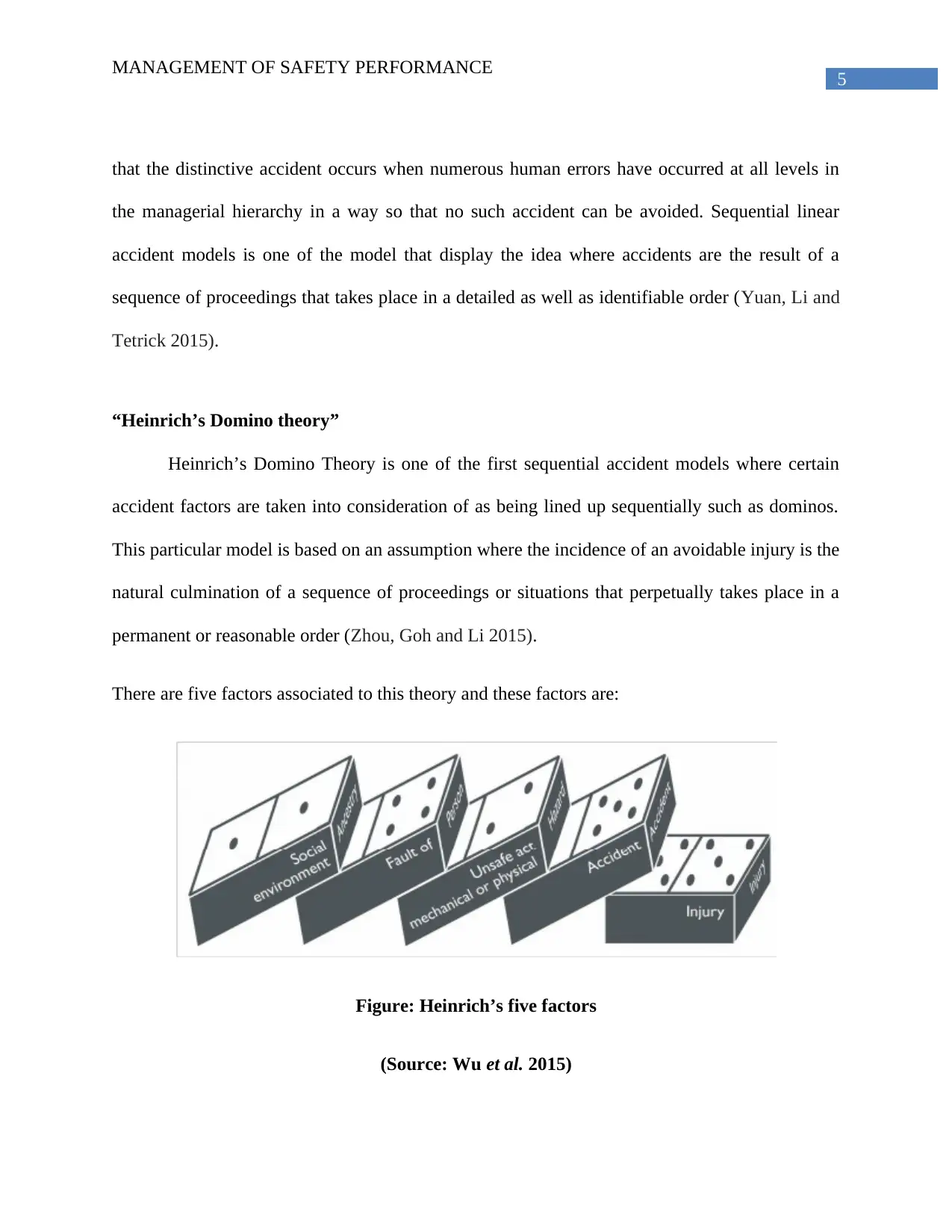
Heinrich’s Domino Theory is one of the first sequential accident models where certain
accident factors are taken into consideration of as being lined up sequentially such as dominos.
This particular model is based on an assumption where the incidence of an avoidable injury is the
natural culmination of a sequence of proceedings or situations that perpetually takes place in a
permanent or reasonable order (Zhou, Goh and Li 2015).
There are five factors associated to this theory and these factors are:
Figure: Heinrich’s five factors
(Source: Wu et al. 2015)
MANAGEMENT OF SAFETY PERFORMANCE
that the distinctive accident occurs when numerous human errors have occurred at all levels in
the managerial hierarchy in a way so that no such accident can be avoided. Sequential linear
accident models is one of the model that display the idea where accidents are the result of a
sequence of proceedings that takes place in a detailed as well as identifiable order (Yuan, Li and
Tetrick 2015).
“Heinrich’s Domino theory”
Heinrich’s Domino Theory is one of the first sequential accident models where certain
accident factors are taken into consideration of as being lined up sequentially such as dominos.
This particular model is based on an assumption where the incidence of an avoidable injury is the
natural culmination of a sequence of proceedings or situations that perpetually takes place in a
permanent or reasonable order (Zhou, Goh and Li 2015).
There are five factors associated to this theory and these factors are:
Figure: Heinrich’s five factors
(Source: Wu et al. 2015)
6
MANAGEMENT OF SAFETY PERFORMANCE
Fault of the person
Accident
Social environment or ancestry
Unsafe acts, physical hazards and mechanical hazards
Injury
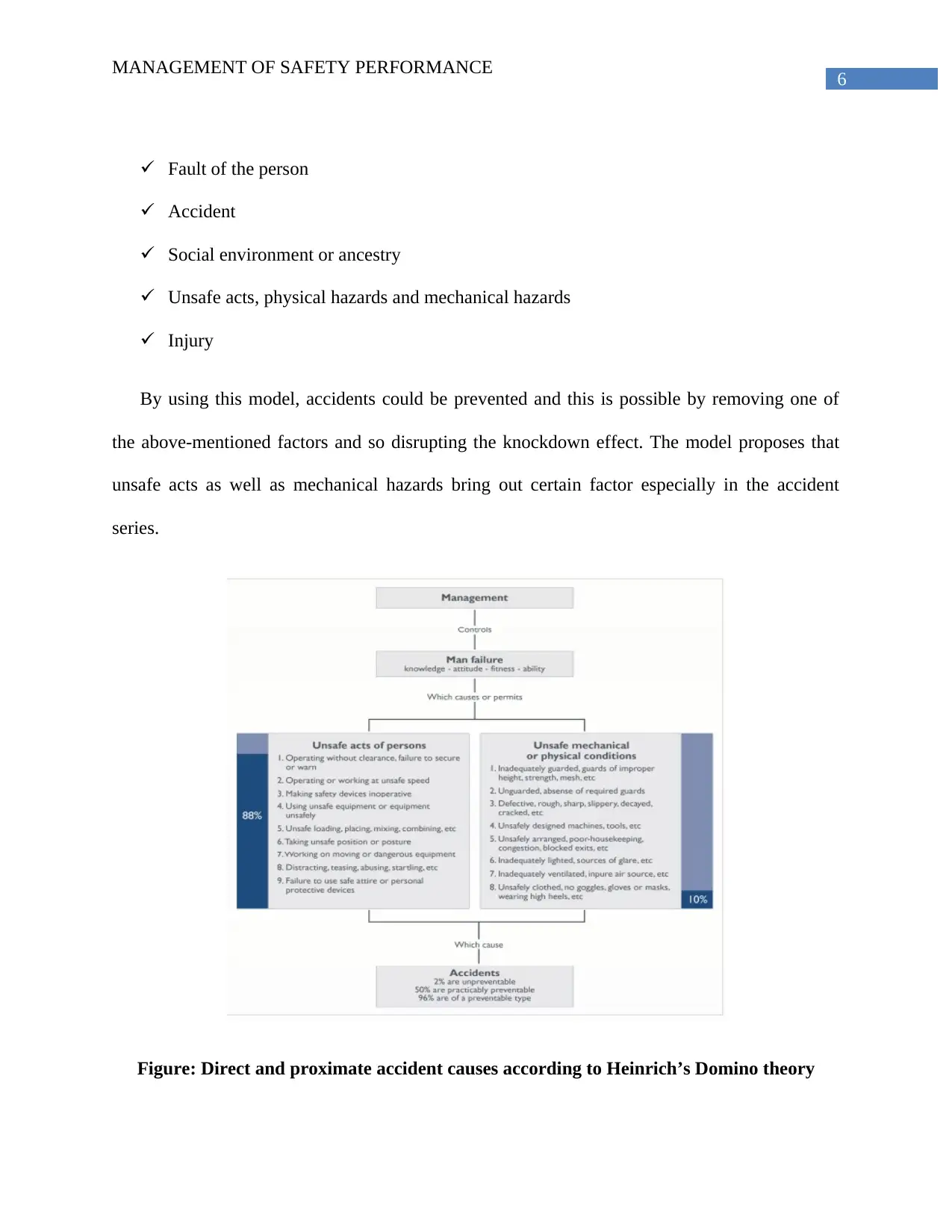
By using this model, accidents could be prevented and this is possible by removing one of
the above-mentioned factors and so disrupting the knockdown effect. The model proposes that
unsafe acts as well as mechanical hazards bring out certain factor especially in the accident
series.
Figure: Direct and proximate accident causes according to Heinrich’s Domino theory
MANAGEMENT OF SAFETY PERFORMANCE
Fault of the person
Accident
Social environment or ancestry
Unsafe acts, physical hazards and mechanical hazards
Injury
By using this model, accidents could be prevented and this is possible by removing one of
the above-mentioned factors and so disrupting the knockdown effect. The model proposes that
unsafe acts as well as mechanical hazards bring out certain factor especially in the accident
series.
Figure: Direct and proximate accident causes according to Heinrich’s Domino theory
⊘ This is a preview!⊘
Do you want full access?
Subscribe today to unlock all pages.
Trusted by 1+ million students worldwide

7
MANAGEMENT OF SAFETY PERFORMANCE
(Source: Wachter and Yorio 2014)
MANAGEMENT OF SAFETY PERFORMANCE
(Source: Wachter and Yorio 2014)
Paraphrase This Document
Need a fresh take? Get an instant paraphrase of this document with our AI Paraphraser
8
MANAGEMENT OF SAFETY PERFORMANCE
Epidemiological models
Epidemiological accident models are one of the models that can be traced back to the
reading of disease epidemics as well as the explore for causal factors around their expansion.
Podgórski (2015) predicts that injuries as differentiated from disease are evenly vulnerable to
these methods. Furthermore, accident prevention methods match equally with epidemiological
accident model emphasis upon mainly in performance deviations as well as explaining the
concept of underlying causes of the accident. Addition to that, the causes might be found in
divergence or unsafe acts that either are suppressed or eliminated that can prevent the accident
happening again (Zhou, Goh and Li 2015).
Swiss cheese Accident Causation Model
Swiss cheese model is one of the accident causation models that are used in risk analysis
as well as risk management. It mainly takes into account aviation safety, emergency service
business enterprise, engineering and health care service. The real reason behind implementing
this model is illustrating on how active and concealed failures combine for generating the
conditions needed to impulsive an unfavorable event (Sinelnikov, Inouye and Kerper 2015).
“Dynamic between Humans & Technology within Work Processes & Environments”
The dynamic between humans and technology within the work process and environment
had become multifaceted by nature that need to identify root causes of unfavorable events by
using linear based methods. Addition to that, accident causation models develops to keep pace
with this communal technological scheme. Furthermore, systematic causation models are one of
MANAGEMENT OF SAFETY PERFORMANCE
Epidemiological models
Epidemiological accident models are one of the models that can be traced back to the
reading of disease epidemics as well as the explore for causal factors around their expansion.
Podgórski (2015) predicts that injuries as differentiated from disease are evenly vulnerable to
these methods. Furthermore, accident prevention methods match equally with epidemiological
accident model emphasis upon mainly in performance deviations as well as explaining the
concept of underlying causes of the accident. Addition to that, the causes might be found in
divergence or unsafe acts that either are suppressed or eliminated that can prevent the accident
happening again (Zhou, Goh and Li 2015).
Swiss cheese Accident Causation Model
Swiss cheese model is one of the accident causation models that are used in risk analysis
as well as risk management. It mainly takes into account aviation safety, emergency service
business enterprise, engineering and health care service. The real reason behind implementing
this model is illustrating on how active and concealed failures combine for generating the
conditions needed to impulsive an unfavorable event (Sinelnikov, Inouye and Kerper 2015).
“Dynamic between Humans & Technology within Work Processes & Environments”
The dynamic between humans and technology within the work process and environment
had become multifaceted by nature that need to identify root causes of unfavorable events by
using linear based methods. Addition to that, accident causation models develops to keep pace
with this communal technological scheme. Furthermore, systematic causation models are one of
9
MANAGEMENT OF SAFETY PERFORMANCE
the models that aim at adopting holistic view of the overall system. The model shows
interrelationships between concepts like organizational culture as well as management
commitment to understand the behavior of the individuals (Mullen, Kelloway and Teed 2017).
The crucial feature of systematic models is that single component failings within the
systems like errors, but not direct causes of accidents (Zhou, Goh and Li 2015). Furthermore,
accidents are the consequences of dysfunctional inter-reactions between system mechanism as
well as creating recurring error traps. For instance, Bhopal, the Herald of Free Enterprise
capsizing and Chernobyl is one of the large scale accidents that was caused by patterns of
systematic organizational behavior for a given time frame as well as suggesting aggressive cost-
cutting strategy as it is important contributor to this behavior. However, the focus of accident
investigation is to rely upon why defense failed and blame individuals for mistakes (Luning et al.
2015).
High Hazard industries (examining and acting upon small scale accidents is an effectual
way to prevent larger scale events by classifying negative cultures accountable for
concealed breakdown)
One of the most common prevention strategy that are used by high hazard industries like
nuclear generation contains usage of multiple barriers as well as safeguarding activities that
creates an appropriately robust arrangement as it prevent the alignment of a chain of active as
well as latent failures. It is a known fact that business enterprise has very little understanding on
matters relating to each of the control barrier. It was opined by Cooper (2015) misinterpreted
accident investigation results from reinforcing as well as compounding the illusion of control as
MANAGEMENT OF SAFETY PERFORMANCE
the models that aim at adopting holistic view of the overall system. The model shows
interrelationships between concepts like organizational culture as well as management
commitment to understand the behavior of the individuals (Mullen, Kelloway and Teed 2017).
The crucial feature of systematic models is that single component failings within the
systems like errors, but not direct causes of accidents (Zhou, Goh and Li 2015). Furthermore,
accidents are the consequences of dysfunctional inter-reactions between system mechanism as
well as creating recurring error traps. For instance, Bhopal, the Herald of Free Enterprise
capsizing and Chernobyl is one of the large scale accidents that was caused by patterns of
systematic organizational behavior for a given time frame as well as suggesting aggressive cost-
cutting strategy as it is important contributor to this behavior. However, the focus of accident
investigation is to rely upon why defense failed and blame individuals for mistakes (Luning et al.
2015).
High Hazard industries (examining and acting upon small scale accidents is an effectual
way to prevent larger scale events by classifying negative cultures accountable for
concealed breakdown)
One of the most common prevention strategy that are used by high hazard industries like
nuclear generation contains usage of multiple barriers as well as safeguarding activities that
creates an appropriately robust arrangement as it prevent the alignment of a chain of active as
well as latent failures. It is a known fact that business enterprise has very little understanding on
matters relating to each of the control barrier. It was opined by Cooper (2015) misinterpreted
accident investigation results from reinforcing as well as compounding the illusion of control as
⊘ This is a preview!⊘
Do you want full access?
Subscribe today to unlock all pages.
Trusted by 1+ million students worldwide
10
MANAGEMENT OF SAFETY PERFORMANCE
remedial action from investigation purpose that takes into account implementing additional
layers of control. However, the absence of any of the crucial limit system reveals that business
enterprise can feel safe, protection as they have means where they can measure how close the
barrier is to breach (Cagno et al. 2014).
As rightly put forward by Zohar (2014), system safety is treated as one of the control
issue that need a continual focus upon improvement and it act as a proactive management system
approach. It is a known fact that examining and acting upon small-scale accidents can be treated
as an effective way for avoiding larger scale events by highlighting negative cultures that are
accountable for concealed failures. According to Selleck (2017), adopting the principles of High
Reliability Organization will guide business enterprise for addressing control imbalances in
alignment with defense in-depth systems by developing surroundings that is already occupied
with failures by using system of continual improvement.
On the contrary, the reliability system help in maintaining high levels of coordination in
all the situations that help in undertaking safety related decisions as it is consistent with central
aim of the tasks (Lu et al. 2016). Loss of coordination can be treated as one of the key factor in
the Tenerife air crash because of under pressure Air Traffic Controller that passes the
responsibility for undertaking crucial decision on matters relating to runaway movements to a
pilot of a back-taxing aircraft that failed to have a background score of aircraft manoeuvres at the
airport
On the other hand, critical decisions need to be made to deviate the overall aim of Air
Traffic Controller (Armstrong and Taylor 2014). One of the key considerations mainly helps in
MANAGEMENT OF SAFETY PERFORMANCE
remedial action from investigation purpose that takes into account implementing additional
layers of control. However, the absence of any of the crucial limit system reveals that business
enterprise can feel safe, protection as they have means where they can measure how close the
barrier is to breach (Cagno et al. 2014).
As rightly put forward by Zohar (2014), system safety is treated as one of the control
issue that need a continual focus upon improvement and it act as a proactive management system
approach. It is a known fact that examining and acting upon small-scale accidents can be treated
as an effective way for avoiding larger scale events by highlighting negative cultures that are
accountable for concealed failures. According to Selleck (2017), adopting the principles of High
Reliability Organization will guide business enterprise for addressing control imbalances in
alignment with defense in-depth systems by developing surroundings that is already occupied
with failures by using system of continual improvement.
On the contrary, the reliability system help in maintaining high levels of coordination in
all the situations that help in undertaking safety related decisions as it is consistent with central
aim of the tasks (Lu et al. 2016). Loss of coordination can be treated as one of the key factor in
the Tenerife air crash because of under pressure Air Traffic Controller that passes the
responsibility for undertaking crucial decision on matters relating to runaway movements to a
pilot of a back-taxing aircraft that failed to have a background score of aircraft manoeuvres at the
airport
On the other hand, critical decisions need to be made to deviate the overall aim of Air
Traffic Controller (Armstrong and Taylor 2014). One of the key considerations mainly helps in
Paraphrase This Document
Need a fresh take? Get an instant paraphrase of this document with our AI Paraphraser
11
MANAGEMENT OF SAFETY PERFORMANCE
influencing high reliability performance as it is developed in a positive culture for placing need
accountability on safety. Furthermore, it enhances an acknowledging the need for various as well
as flexible leadership styles for managing slack effectively and making the business more
responsive and dynamic at the same time. However, the further need high investment
commitment that shows the act may be inappropriate for smaller as well as less hazardous
business enterprise based on cost and risk-relevance in the most effective way (Idris, Dollard and
Tuckey 2015).
Large and small organizations (can influence the effectiveness of Accident Investigation)
Most of the large business enterprise that engages in dealing with complex and high
hazard based operations needs to adopt accident investigation methods. It is because these
methods render sufficient root cause detection as well as analyze continual improvement in the
near future. One of the theory or method known as Systems-Theoretic Accident Model and
Process shows a systems approach that contains both proactive as well as reactive measures.
These measures help in measuring the control problems as and when needed (Di Gravio et al.
2015). One of the basic philosophy of STAMP theory is to preserve an prepared equilibrium by
referring to repeated development criticism that help in informing and adjusting controls as it
acknowledges the view where accidents takes place for the time frame of disturbance. Other
model that can be used in large organization is Management Oversight ad Risk Tress model as it
helps in encouraging investigators for moving beyond immediate causes by drilling down into
particular area of interest (Han et al. 2014).
MANAGEMENT OF SAFETY PERFORMANCE
influencing high reliability performance as it is developed in a positive culture for placing need
accountability on safety. Furthermore, it enhances an acknowledging the need for various as well
as flexible leadership styles for managing slack effectively and making the business more
responsive and dynamic at the same time. However, the further need high investment
commitment that shows the act may be inappropriate for smaller as well as less hazardous
business enterprise based on cost and risk-relevance in the most effective way (Idris, Dollard and
Tuckey 2015).
Large and small organizations (can influence the effectiveness of Accident Investigation)
Most of the large business enterprise that engages in dealing with complex and high
hazard based operations needs to adopt accident investigation methods. It is because these
methods render sufficient root cause detection as well as analyze continual improvement in the
near future. One of the theory or method known as Systems-Theoretic Accident Model and
Process shows a systems approach that contains both proactive as well as reactive measures.
These measures help in measuring the control problems as and when needed (Di Gravio et al.
2015). One of the basic philosophy of STAMP theory is to preserve an prepared equilibrium by
referring to repeated development criticism that help in informing and adjusting controls as it
acknowledges the view where accidents takes place for the time frame of disturbance. Other
model that can be used in large organization is Management Oversight ad Risk Tress model as it
helps in encouraging investigators for moving beyond immediate causes by drilling down into
particular area of interest (Han et al. 2014).
12
MANAGEMENT OF SAFETY PERFORMANCE
On the other hand, smaller business enterprise mostly have incorrect viewpoint about
accident causation and they have limited understanding about the benefits that is linked with
using feedback loops as a part of frequent upgrading approach especially for health and safety.
The perception of this small organization is that accident causation is due to some unforeseen
situations. They treated it as a psychological reaction in association with injuring employee
whom they have close as well as informal relationship (Guchait, Paşamehmetoğlu and Dawson
2014).
It is recommended to this smaller organization to select suitable models and methods to
reduce the accident that takes place at workplace (Zhou, Goh and Li 2015). The decisions need
to be made based on complexity of systems as well as knowledge and skill base. Most of the
systematic models are too expensive and this smaller organization cannot afford these models for
solving the control issue faced. It is suggested to this smaller organization to use or adopt Work
Accidents Investigation Technique and HSG245 as these two investigation methods are treated
to be appropriate in and across a range of these small business enterprise. Adopting WAIT
method by this smaller organization will help in acknowledging the importance of latent failures
in accident causation. The other method (HSG245) accident investigation method is explained
with the help of templates and documents that increases its potential practicability for smaller
organization (Glendon, Clarke and McKenna 2016).
MANAGEMENT OF SAFETY PERFORMANCE
On the other hand, smaller business enterprise mostly have incorrect viewpoint about
accident causation and they have limited understanding about the benefits that is linked with
using feedback loops as a part of frequent upgrading approach especially for health and safety.
The perception of this small organization is that accident causation is due to some unforeseen
situations. They treated it as a psychological reaction in association with injuring employee
whom they have close as well as informal relationship (Guchait, Paşamehmetoğlu and Dawson
2014).
It is recommended to this smaller organization to select suitable models and methods to
reduce the accident that takes place at workplace (Zhou, Goh and Li 2015). The decisions need
to be made based on complexity of systems as well as knowledge and skill base. Most of the
systematic models are too expensive and this smaller organization cannot afford these models for
solving the control issue faced. It is suggested to this smaller organization to use or adopt Work
Accidents Investigation Technique and HSG245 as these two investigation methods are treated
to be appropriate in and across a range of these small business enterprise. Adopting WAIT
method by this smaller organization will help in acknowledging the importance of latent failures
in accident causation. The other method (HSG245) accident investigation method is explained
with the help of templates and documents that increases its potential practicability for smaller
organization (Glendon, Clarke and McKenna 2016).
⊘ This is a preview!⊘
Do you want full access?
Subscribe today to unlock all pages.
Trusted by 1+ million students worldwide

1 out of 17


Related Documents


Your All-in-One AI-Powered Toolkit for Academic Success.
+13062052269
info@desklib.com
Available 24*7 on WhatsApp / Email
![[object Object]](/_next/static/media/star-bottom.7253800d.svg)
Unlock your academic potential
Copyright © 2020–2026 A2Z Services. All Rights Reserved. Developed and managed by ZUCOL.