Leadership, Communication, and Career Development: A Report
VerifiedAdded on 2023/04/22
|12
|3422
|56
Report
AI Summary
This report provides an overview of management principles and skills necessary for managers to evaluate their potential. It compares different management and leadership styles, discusses leadership characteristics, and evaluates communication processes within businesses, using Sainsbury as a case study. The report includes an analysis of organizational culture and change, along with a personal SWOT analysis to assess management skills, strengths, weaknesses, opportunities, and threats. Objectives and targets are set to develop personal potential, and the report discusses leading and motivating a team. It concludes with an explanation of how managerial and personal skills support career development, reviewing career needs and future development to create a personal development plan. Desklib offers additional resources for students.

Developing Manager
1
1

Paraphrase This Document
Need a fresh take? Get an instant paraphrase of this document with our AI Paraphraser
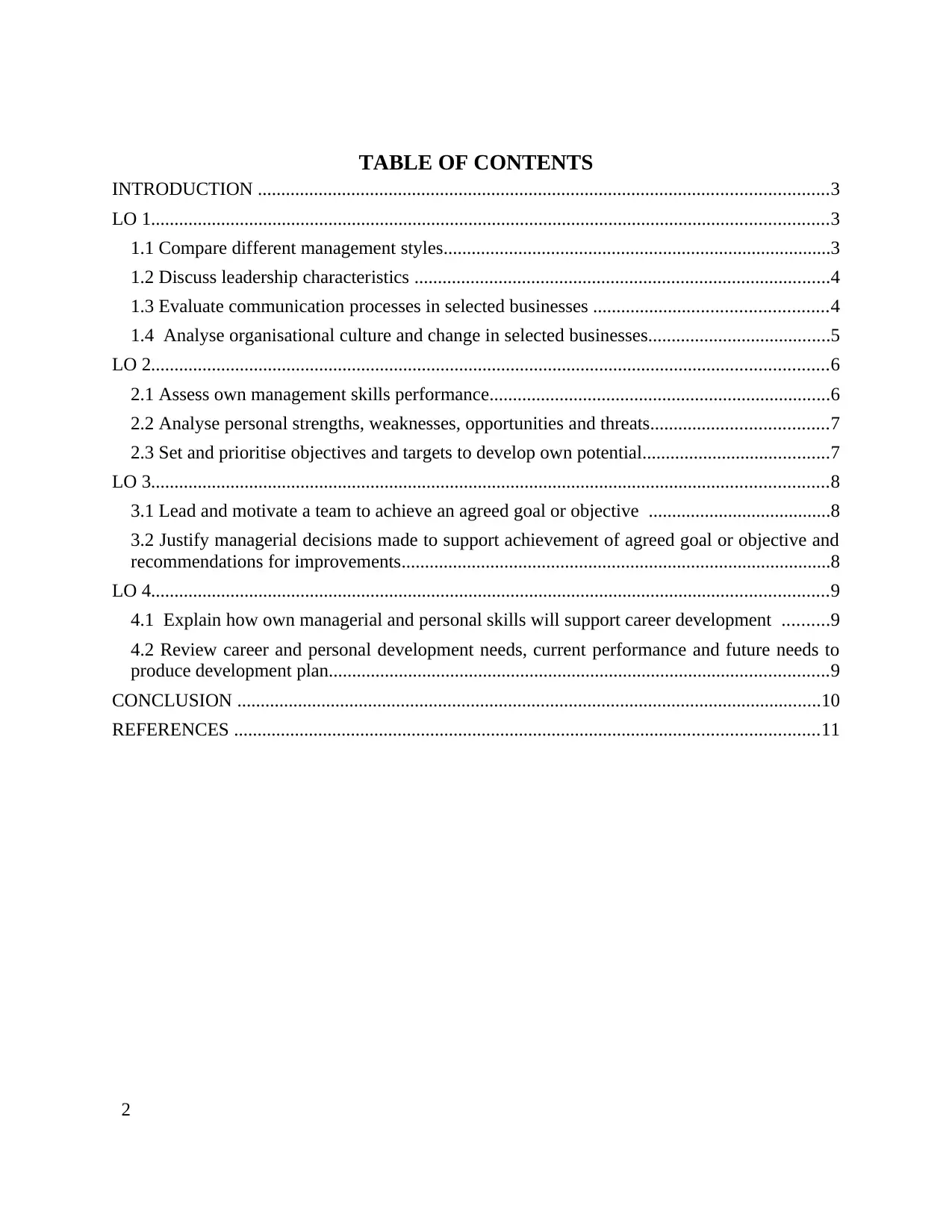
TABLE OF CONTENTS
INTRODUCTION ..........................................................................................................................3
LO 1.................................................................................................................................................3
1.1 Compare different management styles...................................................................................3
1.2 Discuss leadership characteristics .........................................................................................4
1.3 Evaluate communication processes in selected businesses ..................................................4
1.4 Analyse organisational culture and change in selected businesses.......................................5
LO 2.................................................................................................................................................6
2.1 Assess own management skills performance.........................................................................6
2.2 Analyse personal strengths, weaknesses, opportunities and threats......................................7
2.3 Set and prioritise objectives and targets to develop own potential........................................7
LO 3.................................................................................................................................................8
3.1 Lead and motivate a team to achieve an agreed goal or objective .......................................8
3.2 Justify managerial decisions made to support achievement of agreed goal or objective and
recommendations for improvements............................................................................................8
LO 4.................................................................................................................................................9
4.1 Explain how own managerial and personal skills will support career development ..........9
4.2 Review career and personal development needs, current performance and future needs to
produce development plan...........................................................................................................9
CONCLUSION .............................................................................................................................10
REFERENCES .............................................................................................................................11
2
INTRODUCTION ..........................................................................................................................3
LO 1.................................................................................................................................................3
1.1 Compare different management styles...................................................................................3
1.2 Discuss leadership characteristics .........................................................................................4
1.3 Evaluate communication processes in selected businesses ..................................................4
1.4 Analyse organisational culture and change in selected businesses.......................................5
LO 2.................................................................................................................................................6
2.1 Assess own management skills performance.........................................................................6
2.2 Analyse personal strengths, weaknesses, opportunities and threats......................................7
2.3 Set and prioritise objectives and targets to develop own potential........................................7
LO 3.................................................................................................................................................8
3.1 Lead and motivate a team to achieve an agreed goal or objective .......................................8
3.2 Justify managerial decisions made to support achievement of agreed goal or objective and
recommendations for improvements............................................................................................8
LO 4.................................................................................................................................................9
4.1 Explain how own managerial and personal skills will support career development ..........9
4.2 Review career and personal development needs, current performance and future needs to
produce development plan...........................................................................................................9
CONCLUSION .............................................................................................................................10
REFERENCES .............................................................................................................................11
2

INTRODUCTION
In the present corporate scenario, management principles have gained sufficient attention
for fulfilling the organizational objectives (Pattanayak, 2005). This unit aims at providing
sufficient knowledge of behaviour management principles and skills that are crucial for
managers to review their managerial potentials. Furthermore, different management and
leadership styles are explained while discussing the characteristics of leadership. In this unit, a
brief evaluation of different ways of communication within a team is showcased. Herewith, the
report is provided with an opportunity to review career and personal development needs as well
as current performance and future needs so as to produce development plan for becoming a
successful manager.
LO 1
1.1 Compare different management styles
Management styles are adopted by the managers for getting the best outcomes from their
people. However, selection of management style depends on the task, people and situation that
are to be managed in the organization. Here, comparison of different types of management styles
is made as follows:
Classical management theories: Such theories are focused towards providing
employees with the tools that are essential for maximizing their efficiency as well as output.
Classical theories focus on developing leadership as a standard method for performing each job
as per the scientific management. According to such theories, workers are to be selected on the
basis of their skills and abilities. Such workers are encouraged for enhancing outputs by
providing incentives and wages (Nevada and et.al., 2012). It could be said that management
styles are focused towards increasing production and organizational efficiency.
Neo- Classical approach: This theory of management is based on two different factors
such as human relation movement and behavioural management movement. As per such
approach, organizations are concerned with the employees instead of production, structure, and
technology. Management styles that are used by companies focus on motivating and providing
support to employees within the organization.
Comparison of System and Contingency Approaches
3
In the present corporate scenario, management principles have gained sufficient attention
for fulfilling the organizational objectives (Pattanayak, 2005). This unit aims at providing
sufficient knowledge of behaviour management principles and skills that are crucial for
managers to review their managerial potentials. Furthermore, different management and
leadership styles are explained while discussing the characteristics of leadership. In this unit, a
brief evaluation of different ways of communication within a team is showcased. Herewith, the
report is provided with an opportunity to review career and personal development needs as well
as current performance and future needs so as to produce development plan for becoming a
successful manager.
LO 1
1.1 Compare different management styles
Management styles are adopted by the managers for getting the best outcomes from their
people. However, selection of management style depends on the task, people and situation that
are to be managed in the organization. Here, comparison of different types of management styles
is made as follows:
Classical management theories: Such theories are focused towards providing
employees with the tools that are essential for maximizing their efficiency as well as output.
Classical theories focus on developing leadership as a standard method for performing each job
as per the scientific management. According to such theories, workers are to be selected on the
basis of their skills and abilities. Such workers are encouraged for enhancing outputs by
providing incentives and wages (Nevada and et.al., 2012). It could be said that management
styles are focused towards increasing production and organizational efficiency.
Neo- Classical approach: This theory of management is based on two different factors
such as human relation movement and behavioural management movement. As per such
approach, organizations are concerned with the employees instead of production, structure, and
technology. Management styles that are used by companies focus on motivating and providing
support to employees within the organization.
Comparison of System and Contingency Approaches
3
⊘ This is a preview!⊘
Do you want full access?
Subscribe today to unlock all pages.

Trusted by 1+ million students worldwide

A major difference between both the approaches is that system approach uses a richer
model of human beings as compared to contingency approach. In addition to that, system
approach is broad in considering organisational variables, while contingency approach is more
concerned towards the structural adaptation of organizational systems (Balmer and Thomson,
2009. ).
1.2 Discuss leadership characteristics
Leadership theories are used to motivate a group of people towards the common
objectives. There are various styles of leadership such as autocratic, democratic, laissez-faire that
can be used in accordance with the situation.
Autocratic leadership: In this kind of leadership, authorities remain with the leader only
and the leader makes decisions without consulting with their team members. However, this kind
of leadership is appropriate in the situation where employees are new and quick decisions are
required (Moon, 2013).
Democratic leadership: This is also called as participative leadership style in which
employees are provided a chance to share their ideas for decision making process. This is the
best leadership style which is used for motivating people by involving them in decision-making
process. This is used when employees are old and trustworthy.
Laissez-Faire leadership: Using this leadership style, leaders put less direct supervision
on employees as this is used when employees are highly experienced and trained. However, in
the situation of less supervision efforts from managers, there can be seen that poor production
and control as well as increment in cost (Pattanayak, 2005).
The style of leadership significantly affects the motivation level and performance of
employees. In today's scenario, most of the organizations are focusing on adopting democratic
leadership style so as to encourage workforce for the better performance. In this regard, various
motivation techniques such as Maslow's hierarchy of need, Alderfer's ERG theory, Equity
Theory, Vroom Expectancy Theory are used.
1.3 Evaluate communication processes in selected businesses
Here, to explain the communication process, a leading organization of retail industry
named Sainsbury is taken into consideration. This is to be ensuring that organization must use
verbal, written and other kinds of communication. Behind using communication method, major
4
model of human beings as compared to contingency approach. In addition to that, system
approach is broad in considering organisational variables, while contingency approach is more
concerned towards the structural adaptation of organizational systems (Balmer and Thomson,
2009. ).
1.2 Discuss leadership characteristics
Leadership theories are used to motivate a group of people towards the common
objectives. There are various styles of leadership such as autocratic, democratic, laissez-faire that
can be used in accordance with the situation.
Autocratic leadership: In this kind of leadership, authorities remain with the leader only
and the leader makes decisions without consulting with their team members. However, this kind
of leadership is appropriate in the situation where employees are new and quick decisions are
required (Moon, 2013).
Democratic leadership: This is also called as participative leadership style in which
employees are provided a chance to share their ideas for decision making process. This is the
best leadership style which is used for motivating people by involving them in decision-making
process. This is used when employees are old and trustworthy.
Laissez-Faire leadership: Using this leadership style, leaders put less direct supervision
on employees as this is used when employees are highly experienced and trained. However, in
the situation of less supervision efforts from managers, there can be seen that poor production
and control as well as increment in cost (Pattanayak, 2005).
The style of leadership significantly affects the motivation level and performance of
employees. In today's scenario, most of the organizations are focusing on adopting democratic
leadership style so as to encourage workforce for the better performance. In this regard, various
motivation techniques such as Maslow's hierarchy of need, Alderfer's ERG theory, Equity
Theory, Vroom Expectancy Theory are used.
1.3 Evaluate communication processes in selected businesses
Here, to explain the communication process, a leading organization of retail industry
named Sainsbury is taken into consideration. This is to be ensuring that organization must use
verbal, written and other kinds of communication. Behind using communication method, major
4
Paraphrase This Document
Need a fresh take? Get an instant paraphrase of this document with our AI Paraphraser

aim of store managers is to interact with their employees about day to day operations and
performance objectives of the business. Store manager of Sainsbury always use verbal
communication with the employees of store. For this purpose, various meetings are arranged in
order to make people aware about their roles and responsibilities at the workplace. Instructions
are provided to the store employees by the respective store manager with following a hierarchical
structure. In this way, same types of operations are managed at each store (Hoon Yang, Lee and
Lee, 2007). There can be seen both kinds of communication within Sainsbury stores, however,
the employees use informal communication among them/. The management communicates with
the employees in a formal way. The following points show the barriers to effective
communication within Sainsbury store:
The use of outdated technology is a major barrier to communication process. For an
example: if organizations do not use technology to improve communication then it
becomes difficult to get quick flow of information.
Conflicts between store employees are also a factor that affects the effectiveness of
communication as the information can be wrongly interpreted.
1.4 Analyse organisational culture and change in selected businesses
Each and every organization has their style of unique culture but the ultimate aim is to
attain success. There are different cultures such as Power culture, Role culture, Task culture and
Person culture (Little, 2011). The culture used by Sainsbury in terms of discipline, sourcing with
integrity, respect for environment, serving the community. The company is committed to provide
a positive experience to the customers at the same time beating their competitors such as Asda,
Morrison’s and Tesco’s. Each employee of company is responsible for following body of learned
behaviour which includes collection of beliefs habits and tradition that are further shared by a
group of people (Marc, 2012). The mentioned company has developed a team culture so that the
common goals of an organization can be reached in a more efficient way. The adopted culture of
business organization is helpful in reaching shared goals and rendering effective quality by
creating a strong brand image. The organization has a power culture which is considered as a
way to define how business must include ownership, leadership style and so on.
According to this culture, the same message across from department to department is
carried out. In addition to that a hierarchical organizational structure is followed by the
5
performance objectives of the business. Store manager of Sainsbury always use verbal
communication with the employees of store. For this purpose, various meetings are arranged in
order to make people aware about their roles and responsibilities at the workplace. Instructions
are provided to the store employees by the respective store manager with following a hierarchical
structure. In this way, same types of operations are managed at each store (Hoon Yang, Lee and
Lee, 2007). There can be seen both kinds of communication within Sainsbury stores, however,
the employees use informal communication among them/. The management communicates with
the employees in a formal way. The following points show the barriers to effective
communication within Sainsbury store:
The use of outdated technology is a major barrier to communication process. For an
example: if organizations do not use technology to improve communication then it
becomes difficult to get quick flow of information.
Conflicts between store employees are also a factor that affects the effectiveness of
communication as the information can be wrongly interpreted.
1.4 Analyse organisational culture and change in selected businesses
Each and every organization has their style of unique culture but the ultimate aim is to
attain success. There are different cultures such as Power culture, Role culture, Task culture and
Person culture (Little, 2011). The culture used by Sainsbury in terms of discipline, sourcing with
integrity, respect for environment, serving the community. The company is committed to provide
a positive experience to the customers at the same time beating their competitors such as Asda,
Morrison’s and Tesco’s. Each employee of company is responsible for following body of learned
behaviour which includes collection of beliefs habits and tradition that are further shared by a
group of people (Marc, 2012). The mentioned company has developed a team culture so that the
common goals of an organization can be reached in a more efficient way. The adopted culture of
business organization is helpful in reaching shared goals and rendering effective quality by
creating a strong brand image. The organization has a power culture which is considered as a
way to define how business must include ownership, leadership style and so on.
According to this culture, the same message across from department to department is
carried out. In addition to that a hierarchical organizational structure is followed by the
5
mentioned entity that regulates the information from top level management to lower level
management (Waddell, 2009). The advantage of such kind of hierarchical structure is that
employees become loyal towards the organization and feel motivated to perform well. The
organization culture and the structure allow business entity to attain the goals.
LO 2
2.1 Assess own management skills performance
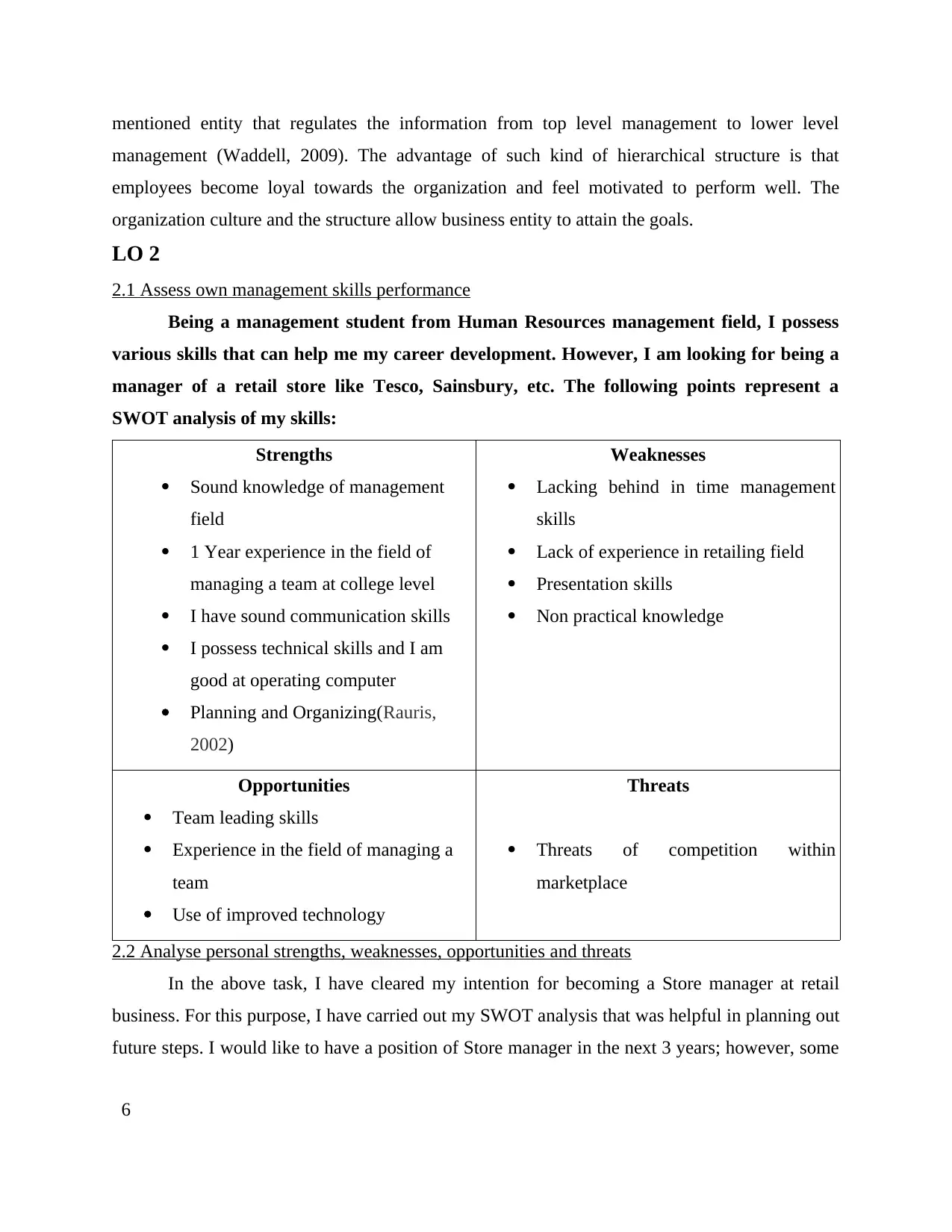
Being a management student from Human Resources management field, I possess
various skills that can help me my career development. However, I am looking for being a
manager of a retail store like Tesco, Sainsbury, etc. The following points represent a
SWOT analysis of my skills:
Strengths
Sound knowledge of management
field
1 Year experience in the field of
managing a team at college level
I have sound communication skills
I possess technical skills and I am
good at operating computer
Planning and Organizing(Rauris,
2002)
Weaknesses
Lacking behind in time management
skills
Lack of experience in retailing field
Presentation skills
Non practical knowledge
Opportunities
Team leading skills
Experience in the field of managing a
team
Use of improved technology
Threats
Threats of competition within
marketplace
2.2 Analyse personal strengths, weaknesses, opportunities and threats
In the above task, I have cleared my intention for becoming a Store manager at retail
business. For this purpose, I have carried out my SWOT analysis that was helpful in planning out
future steps. I would like to have a position of Store manager in the next 3 years; however, some
6
management (Waddell, 2009). The advantage of such kind of hierarchical structure is that
employees become loyal towards the organization and feel motivated to perform well. The
organization culture and the structure allow business entity to attain the goals.
LO 2
2.1 Assess own management skills performance
Being a management student from Human Resources management field, I possess
various skills that can help me my career development. However, I am looking for being a
manager of a retail store like Tesco, Sainsbury, etc. The following points represent a
SWOT analysis of my skills:
Strengths
Sound knowledge of management
field
1 Year experience in the field of
managing a team at college level
I have sound communication skills
I possess technical skills and I am
good at operating computer
Planning and Organizing(Rauris,
2002)
Weaknesses
Lacking behind in time management
skills
Lack of experience in retailing field
Presentation skills
Non practical knowledge
Opportunities
Team leading skills
Experience in the field of managing a
team
Use of improved technology
Threats
Threats of competition within
marketplace
2.2 Analyse personal strengths, weaknesses, opportunities and threats
In the above task, I have cleared my intention for becoming a Store manager at retail
business. For this purpose, I have carried out my SWOT analysis that was helpful in planning out
future steps. I would like to have a position of Store manager in the next 3 years; however, some
6
⊘ This is a preview!⊘
Do you want full access?
Subscribe today to unlock all pages.
Trusted by 1+ million students worldwide

skills are required to attain the positions of Store manager. As I have recently completed my
education in MBA field, now, I want to join Sainsbury as a mentioned post. My biggest strength
is my sound knowledge of management field and the degree of MBA. In addition to that I am
good at operating computer and I possess communication skills and technical skills. These skills
will be helpful for me in attaining the desirable position of Store manager. For being that
position, I require to have good communication and decision making skills. However, I am good
at communicating with people but I should work on my decision making skills (Waddell, 2009).
In my SWOT analysis, I proved that I don't have experience in the field of retailing activities.
Being at the mentioned post, I require some of the skills such as giving and receiving feedback,
influencing people, self-confidence, positive thinking, communication, presentation, team
building and membership, mentoring, coaching and so on. However, there are various
opportunities that can help me in applying for the post. I have good group leading skills and have
an experience in the field of managing a team that will help me in shaping my future.
2.3 Set and prioritise objectives and targets to develop own potential
As I have said that I want to become a Store manager at Sainsbury, so I have to
focus of designing objectives for my team and setting targets to develop own potentials.
Communication with team member will pay a major role in my task. I have to
communicate with team members for my objectives and setting the set deadline. Some of
the task assigned to the employees with their respective deadline is as follow:
Task assigned Deadline
Display management Daily
Handling quarries of customers On frequency basis
Account handing Daily
Cash management On daily basis
The major objective of manager is to improve sales of store and reducing the complaints
from clients. The employees are to be communicated with the specific objectives of a firm and
should provide targets to develop own potential. I will provide targets to my store employees and
will encourage them for attaining the same. In addition to that, I will arrange meeting to
communicate targets with the employees and will manage a meeting at the end of the day to
7
education in MBA field, now, I want to join Sainsbury as a mentioned post. My biggest strength
is my sound knowledge of management field and the degree of MBA. In addition to that I am
good at operating computer and I possess communication skills and technical skills. These skills
will be helpful for me in attaining the desirable position of Store manager. For being that
position, I require to have good communication and decision making skills. However, I am good
at communicating with people but I should work on my decision making skills (Waddell, 2009).
In my SWOT analysis, I proved that I don't have experience in the field of retailing activities.
Being at the mentioned post, I require some of the skills such as giving and receiving feedback,
influencing people, self-confidence, positive thinking, communication, presentation, team
building and membership, mentoring, coaching and so on. However, there are various
opportunities that can help me in applying for the post. I have good group leading skills and have
an experience in the field of managing a team that will help me in shaping my future.
2.3 Set and prioritise objectives and targets to develop own potential
As I have said that I want to become a Store manager at Sainsbury, so I have to
focus of designing objectives for my team and setting targets to develop own potentials.
Communication with team member will pay a major role in my task. I have to
communicate with team members for my objectives and setting the set deadline. Some of
the task assigned to the employees with their respective deadline is as follow:
Task assigned Deadline
Display management Daily
Handling quarries of customers On frequency basis
Account handing Daily
Cash management On daily basis
The major objective of manager is to improve sales of store and reducing the complaints
from clients. The employees are to be communicated with the specific objectives of a firm and
should provide targets to develop own potential. I will provide targets to my store employees and
will encourage them for attaining the same. In addition to that, I will arrange meeting to
communicate targets with the employees and will manage a meeting at the end of the day to
7
Paraphrase This Document
Need a fresh take? Get an instant paraphrase of this document with our AI Paraphraser

ensure that day to day activities are done in the pre-decided manner and to apprise employees for
their performance.
LO 3
3.1 Lead and motivate a team to achieve an agreed goal or objective
At my college, I have leaded a team at a national level event and we were a group of 10
students. That was an experience which is going to help me in leading the team at the store. For
motivating my team member, I must use the various motivational tactics at the workplace.
During my college events, I deal with various issues regarding low level of motivation
among team member. To overcome this, I took initiative to encourage my team members with
motivational speech. I understand the issue of people associated with this field and tried to
resolve them. The same kind of sprite should be maintained by me in Sainsbury store at the post
of store manager. I could say that Maslow need of hierarchy will be a suitable ways to motivate
the team of Sainsbury store. Becoming a store manager, I will look for the needs and wants of
people and will satisfy them so that I can motivate them for attaining predefined objectives.
3.2 Justify managerial decisions made to support achievement of agreed goal or objective and
recommendations for improvements
The major goals of business entity are to attain higher sales and reduce the complaints. In
this situation, I am responsible for designing the target performance and deadline for the same.
This is to be done for each individual working bin the organization. This decision will be helpful
in managing the performance of a team and attaining the objectives. I will communicate with the
objectives to my employees. Following recommendation to improve store operation as follows:
There should be a proper communication between the employees of store
Customer survey could be done to assess the performance of employees
Proper feedback to be given to the employees for improving their performance
LO 4
4.1 Explain how own managerial and personal skills will support career development
Currently, I am employed in Sainsbury store as an assistant store manager. Further, based
on the SWOT analysis, I can presume that after three years my position will be as a Store
Manager in Sainsbury. To achieve this position I am required to develop certain skills and
8
their performance.
LO 3
3.1 Lead and motivate a team to achieve an agreed goal or objective
At my college, I have leaded a team at a national level event and we were a group of 10
students. That was an experience which is going to help me in leading the team at the store. For
motivating my team member, I must use the various motivational tactics at the workplace.
During my college events, I deal with various issues regarding low level of motivation
among team member. To overcome this, I took initiative to encourage my team members with
motivational speech. I understand the issue of people associated with this field and tried to
resolve them. The same kind of sprite should be maintained by me in Sainsbury store at the post
of store manager. I could say that Maslow need of hierarchy will be a suitable ways to motivate
the team of Sainsbury store. Becoming a store manager, I will look for the needs and wants of
people and will satisfy them so that I can motivate them for attaining predefined objectives.
3.2 Justify managerial decisions made to support achievement of agreed goal or objective and
recommendations for improvements
The major goals of business entity are to attain higher sales and reduce the complaints. In
this situation, I am responsible for designing the target performance and deadline for the same.
This is to be done for each individual working bin the organization. This decision will be helpful
in managing the performance of a team and attaining the objectives. I will communicate with the
objectives to my employees. Following recommendation to improve store operation as follows:
There should be a proper communication between the employees of store
Customer survey could be done to assess the performance of employees
Proper feedback to be given to the employees for improving their performance
LO 4
4.1 Explain how own managerial and personal skills will support career development
Currently, I am employed in Sainsbury store as an assistant store manager. Further, based
on the SWOT analysis, I can presume that after three years my position will be as a Store
Manager in Sainsbury. To achieve this position I am required to develop certain skills and
8

abilities which can aid in reaching to that position after three years (Cooke, 2012). For this
purpose, managerial skills are required such as effective communication skills so that proper
communication can be done with all the employees of the retail store. Moreover, interpersonal
skills should be developed so that I can communicate with other people in an effective manner
and negotiations can be done by using such skills. In a similar aspect, personal skills should also
be required to develop such as development of positive attitude, behaviour towards customers
and work should be changed. In addition to this, learning curve should be enhanced by taking
experience from supervisors and also by doing self-managed learning these skills can be
developed (Kroth, and Christensen, 2009). This is how I can achieve the position of store
manager after 3 years. In case, my learning is fast and I acquire these mentioned skills in a
quicker manner than I can achieve this position before three years.
4.2 Review career and personal development needs, current performance and future needs to
produce development plan
Being a team leader, I was supposed to lead a team of various members in the college
Further, I also possess excellent communication skills and along with that I possess technical
skills which can help me reaching to the desired position in the near future (Patton and
McMahon, 2014). Moreover, to reach that position I require developing certain future needs
which can be acquired by following this plan.
Development
Needs
Actions Plan Success Criteria Application Deadline
Interpersonal
Skills
Negotiating with
external
stakeholders.
Able to interact
with others when
reach to the position
of store manager.
While interacting
with the external
stakeholders
during the
meeting.
5 weeks.
Personal Skills Taking feedback
from others.
Self-analysis using
personal SWOT
Able to build up a
positive attitude and
behaviour can be
changed.
While managing
the whole retail
store as store
manager.
8 weeks
9
purpose, managerial skills are required such as effective communication skills so that proper
communication can be done with all the employees of the retail store. Moreover, interpersonal
skills should be developed so that I can communicate with other people in an effective manner
and negotiations can be done by using such skills. In a similar aspect, personal skills should also
be required to develop such as development of positive attitude, behaviour towards customers
and work should be changed. In addition to this, learning curve should be enhanced by taking
experience from supervisors and also by doing self-managed learning these skills can be
developed (Kroth, and Christensen, 2009). This is how I can achieve the position of store
manager after 3 years. In case, my learning is fast and I acquire these mentioned skills in a
quicker manner than I can achieve this position before three years.
4.2 Review career and personal development needs, current performance and future needs to
produce development plan
Being a team leader, I was supposed to lead a team of various members in the college
Further, I also possess excellent communication skills and along with that I possess technical
skills which can help me reaching to the desired position in the near future (Patton and
McMahon, 2014). Moreover, to reach that position I require developing certain future needs
which can be acquired by following this plan.
Development
Needs
Actions Plan Success Criteria Application Deadline
Interpersonal
Skills
Negotiating with
external
stakeholders.
Able to interact
with others when
reach to the position
of store manager.
While interacting
with the external
stakeholders
during the
meeting.
5 weeks.
Personal Skills Taking feedback
from others.
Self-analysis using
personal SWOT
Able to build up a
positive attitude and
behaviour can be
changed.
While managing
the whole retail
store as store
manager.
8 weeks
9
⊘ This is a preview!⊘
Do you want full access?
Subscribe today to unlock all pages.
Trusted by 1+ million students worldwide

analysis.
Time-
management
Skills
By allotting time
frame to each tasks.
Able to complete
the given task on a
accurate deadline.
While handling
all the activities
at one point of
time.
4 weeks
CONCLUSION
The above report represented the different management and leadership styles along with
discussing the characteristics of leadership. Various ways of communication within the
Sainsbury retail store is showcased. I could say that various management skills such and
communication, leadership, managerial skills, self-confidence, positive thinking, presentation
and team building will help me in attaining desired position.
10
Time-
management
Skills
By allotting time
frame to each tasks.
Able to complete
the given task on a
accurate deadline.
While handling
all the activities
at one point of
time.
4 weeks
CONCLUSION
The above report represented the different management and leadership styles along with
discussing the characteristics of leadership. Various ways of communication within the
Sainsbury retail store is showcased. I could say that various management skills such and
communication, leadership, managerial skills, self-confidence, positive thinking, presentation
and team building will help me in attaining desired position.
10
Paraphrase This Document
Need a fresh take? Get an instant paraphrase of this document with our AI Paraphraser
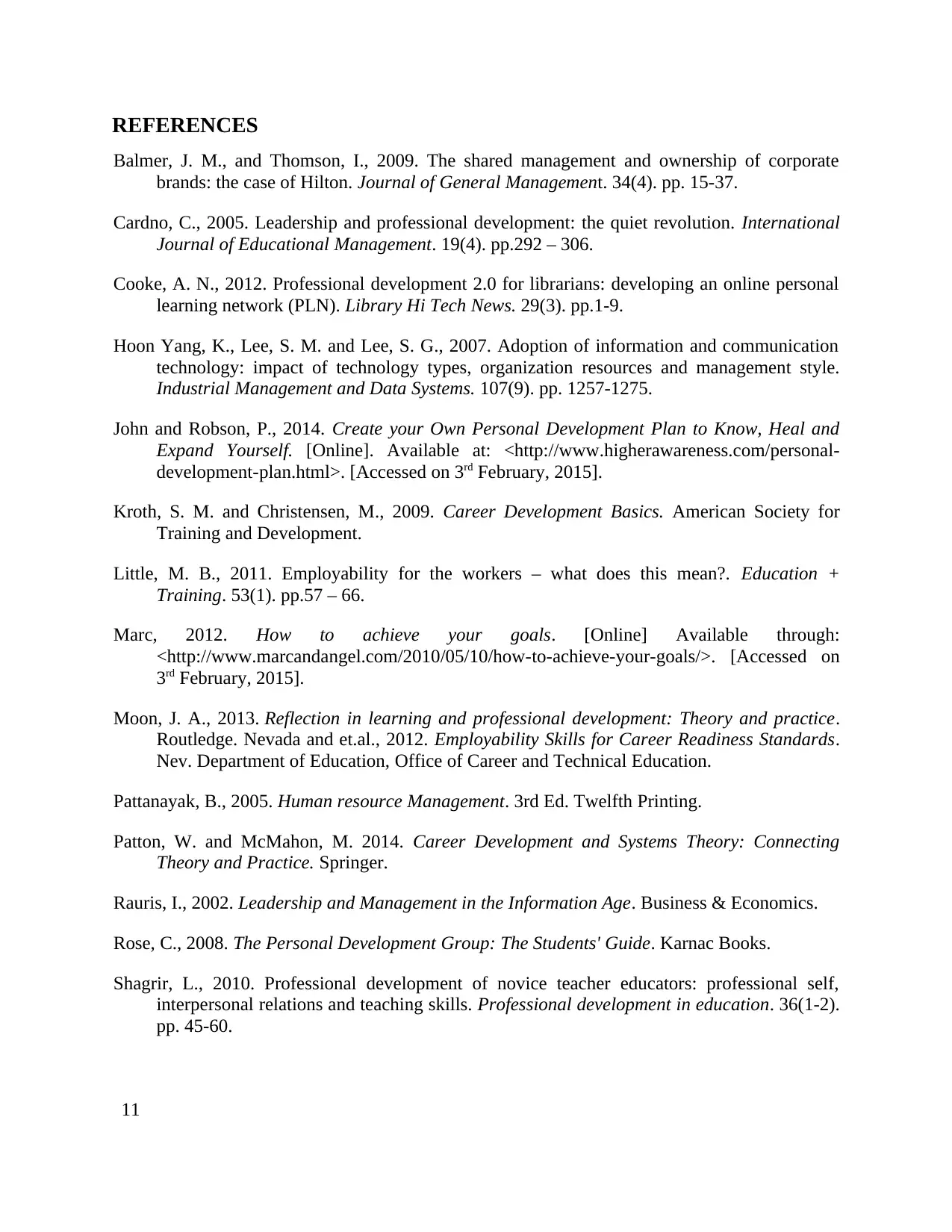
REFERENCES
Balmer, J. M., and Thomson, I., 2009. The shared management and ownership of corporate
brands: the case of Hilton. Journal of General Management. 34(4). pp. 15-37.
Cardno, C., 2005. Leadership and professional development: the quiet revolution. International
Journal of Educational Management. 19(4). pp.292 – 306.
Cooke, A. N., 2012. Professional development 2.0 for librarians: developing an online personal
learning network (PLN). Library Hi Tech News. 29(3). pp.1-9.
Hoon Yang, K., Lee, S. M. and Lee, S. G., 2007. Adoption of information and communication
technology: impact of technology types, organization resources and management style.
Industrial Management and Data Systems. 107(9). pp. 1257-1275.
John and Robson, P., 2014. Create your Own Personal Development Plan to Know, Heal and
Expand Yourself. [Online]. Available at: <http://www.higherawareness.com/personal-
development-plan.html>. [Accessed on 3rd February, 2015].
Kroth, S. M. and Christensen, M., 2009. Career Development Basics. American Society for
Training and Development.
Little, M. B., 2011. Employability for the workers – what does this mean?. Education +
Training. 53(1). pp.57 – 66.
Marc, 2012. How to achieve your goals. [Online] Available through:
<http://www.marcandangel.com/2010/05/10/how-to-achieve-your-goals/>. [Accessed on
3rd February, 2015].
Moon, J. A., 2013. Reflection in learning and professional development: Theory and practice.
Routledge. Nevada and et.al., 2012. Employability Skills for Career Readiness Standards.
Nev. Department of Education, Office of Career and Technical Education.
Pattanayak, B., 2005. Human resource Management. 3rd Ed. Twelfth Printing.
Patton, W. and McMahon, M. 2014. Career Development and Systems Theory: Connecting
Theory and Practice. Springer.
Rauris, I., 2002. Leadership and Management in the Information Age. Business & Economics.
Rose, C., 2008. The Personal Development Group: The Students' Guide. Karnac Books.
Shagrir, L., 2010. Professional development of novice teacher educators: professional self,
interpersonal relations and teaching skills. Professional development in education. 36(1-2).
pp. 45-60.
11
Balmer, J. M., and Thomson, I., 2009. The shared management and ownership of corporate
brands: the case of Hilton. Journal of General Management. 34(4). pp. 15-37.
Cardno, C., 2005. Leadership and professional development: the quiet revolution. International
Journal of Educational Management. 19(4). pp.292 – 306.
Cooke, A. N., 2012. Professional development 2.0 for librarians: developing an online personal
learning network (PLN). Library Hi Tech News. 29(3). pp.1-9.
Hoon Yang, K., Lee, S. M. and Lee, S. G., 2007. Adoption of information and communication
technology: impact of technology types, organization resources and management style.
Industrial Management and Data Systems. 107(9). pp. 1257-1275.
John and Robson, P., 2014. Create your Own Personal Development Plan to Know, Heal and
Expand Yourself. [Online]. Available at: <http://www.higherawareness.com/personal-
development-plan.html>. [Accessed on 3rd February, 2015].
Kroth, S. M. and Christensen, M., 2009. Career Development Basics. American Society for
Training and Development.
Little, M. B., 2011. Employability for the workers – what does this mean?. Education +
Training. 53(1). pp.57 – 66.
Marc, 2012. How to achieve your goals. [Online] Available through:
<http://www.marcandangel.com/2010/05/10/how-to-achieve-your-goals/>. [Accessed on
3rd February, 2015].
Moon, J. A., 2013. Reflection in learning and professional development: Theory and practice.
Routledge. Nevada and et.al., 2012. Employability Skills for Career Readiness Standards.
Nev. Department of Education, Office of Career and Technical Education.
Pattanayak, B., 2005. Human resource Management. 3rd Ed. Twelfth Printing.
Patton, W. and McMahon, M. 2014. Career Development and Systems Theory: Connecting
Theory and Practice. Springer.
Rauris, I., 2002. Leadership and Management in the Information Age. Business & Economics.
Rose, C., 2008. The Personal Development Group: The Students' Guide. Karnac Books.
Shagrir, L., 2010. Professional development of novice teacher educators: professional self,
interpersonal relations and teaching skills. Professional development in education. 36(1-2).
pp. 45-60.
11

Waddell, G., 2009. A Guide for Writing a Professional Development Plan. [PDF]. Available
through: <http://www.midsouthcc.org/documents/professional-development-planning-
guide.pdf>. [Accessed on 3rd February, 2016].
12
through: <http://www.midsouthcc.org/documents/professional-development-planning-
guide.pdf>. [Accessed on 3rd February, 2016].
12
⊘ This is a preview!⊘
Do you want full access?
Subscribe today to unlock all pages.
Trusted by 1+ million students worldwide

1 out of 12


Related Documents


Your All-in-One AI-Powered Toolkit for Academic Success.
+13062052269
info@desklib.com
Available 24*7 on WhatsApp / Email
![[object Object]](/_next/static/media/star-bottom.7253800d.svg)
Unlock your academic potential
Copyright © 2020–2026 A2Z Services. All Rights Reserved. Developed and managed by ZUCOL.