Management Support Systems and Decision Making in the Dairy Industry
VerifiedAdded on 2023/01/12
|12
|2753
|21
Essay
AI Summary
This essay delves into the application of management support systems (MSS) within South Africa's dairy industry, using Fairfield Dairy as a case study. The paper highlights the significance of MSS in aiding managerial decision-making, focusing on Decision Support Systems (DSS), Executive Information Systems, and Expert Systems. It examines the challenges faced by the South African dairy sector, such as supply-demand gaps and the influence of the informal market. The essay advocates for the implementation of Oracle Decision Support Systems to address these issues, detailing the system's features and application in financial and production aspects. The essay concludes by exploring normative and classical decision-making theories, offering insights into how MSS can facilitate optimal decision-making processes within the industry. The analysis also includes the benefits and limitations of DSS, emphasizing the need for a strategic approach to its deployment.
Running head: MANAGEMENT SUPPORT SYSTEM
Management Support System
March 31
2019
Management Support System
March 31
2019

Paraphrase This Document
Need a fresh take? Get an instant paraphrase of this document with our AI Paraphraser
MANAGEMENT SUPPORT SYSTEM 1
Management Support System
Management support systems are the systems that give emphases on administrative
use of information resources. This type of systems offers information to the management of
the company for taking decisions and planning. According to Wierenga & Bruggen (2012),
the information extracted through management support systems is used at both the levels that
are internal and external with the help of different data analysis tools. These types of systems
offer information to the managers at the top as well as the middle level of the business
structure. There are majorly three types of Management support systems that are used by the
businesses in order to have a system that could support in taking the proper decision into the
business. The three of them are a decision support system, executive information system, and
expert systems (Shaqiri, 2014). The intent of this essay is to highlight the role of the
management support system in South Africa's dairy industry. Besides this, the paper is also
presenting the application of decision making theories underpinning management support
systems.
Fairfield Dairy – Background of the Company
Fairfield Dairy is one of the well-known dairy businesses of South Africa, which is
strived towards offering quality milk and services to its consumers. The company is surviving
in the industry as one of the most respected and trusted dairies of the country. The company
started with humble behavior by providing the highest priority to their cow's well-being,
because only through their happiness and comfort they can possibly produce the best milk to
manufacture dairy products (Fairfield Dairy, 2019). The management of the company
believes that innovation is the key activities through which it can attain a successful future in
the industry.
Management Support System
Management support systems are the systems that give emphases on administrative
use of information resources. This type of systems offers information to the management of
the company for taking decisions and planning. According to Wierenga & Bruggen (2012),
the information extracted through management support systems is used at both the levels that
are internal and external with the help of different data analysis tools. These types of systems
offer information to the managers at the top as well as the middle level of the business
structure. There are majorly three types of Management support systems that are used by the
businesses in order to have a system that could support in taking the proper decision into the
business. The three of them are a decision support system, executive information system, and
expert systems (Shaqiri, 2014). The intent of this essay is to highlight the role of the
management support system in South Africa's dairy industry. Besides this, the paper is also
presenting the application of decision making theories underpinning management support
systems.
Fairfield Dairy – Background of the Company
Fairfield Dairy is one of the well-known dairy businesses of South Africa, which is
strived towards offering quality milk and services to its consumers. The company is surviving
in the industry as one of the most respected and trusted dairies of the country. The company
started with humble behavior by providing the highest priority to their cow's well-being,
because only through their happiness and comfort they can possibly produce the best milk to
manufacture dairy products (Fairfield Dairy, 2019). The management of the company
believes that innovation is the key activities through which it can attain a successful future in
the industry.
MANAGEMENT SUPPORT SYSTEM 2
South Africa Dairy Industry
According to the reports of Euro Monitor (2018), the contribution of South Africa in
the production of the milk is around 0.5% in the overall milk production at world level. There
are 4 key breeds of dairy in the country that are: Guernsey, Ayrshire, Holstein, and Jersey.
The dairy industry is comprised of numerous economic activities and major alterations exist
between dairy products processing and farming methods. These activities comprise the
marketing and production of pasteurized milk, fermented milk, yogurt, raw milk, long life
milk and cream, and by-product sweetened and unsweetened concentrated milk, butter oil,
and butter (Agriculture Forestry and Fisheries, 2017).
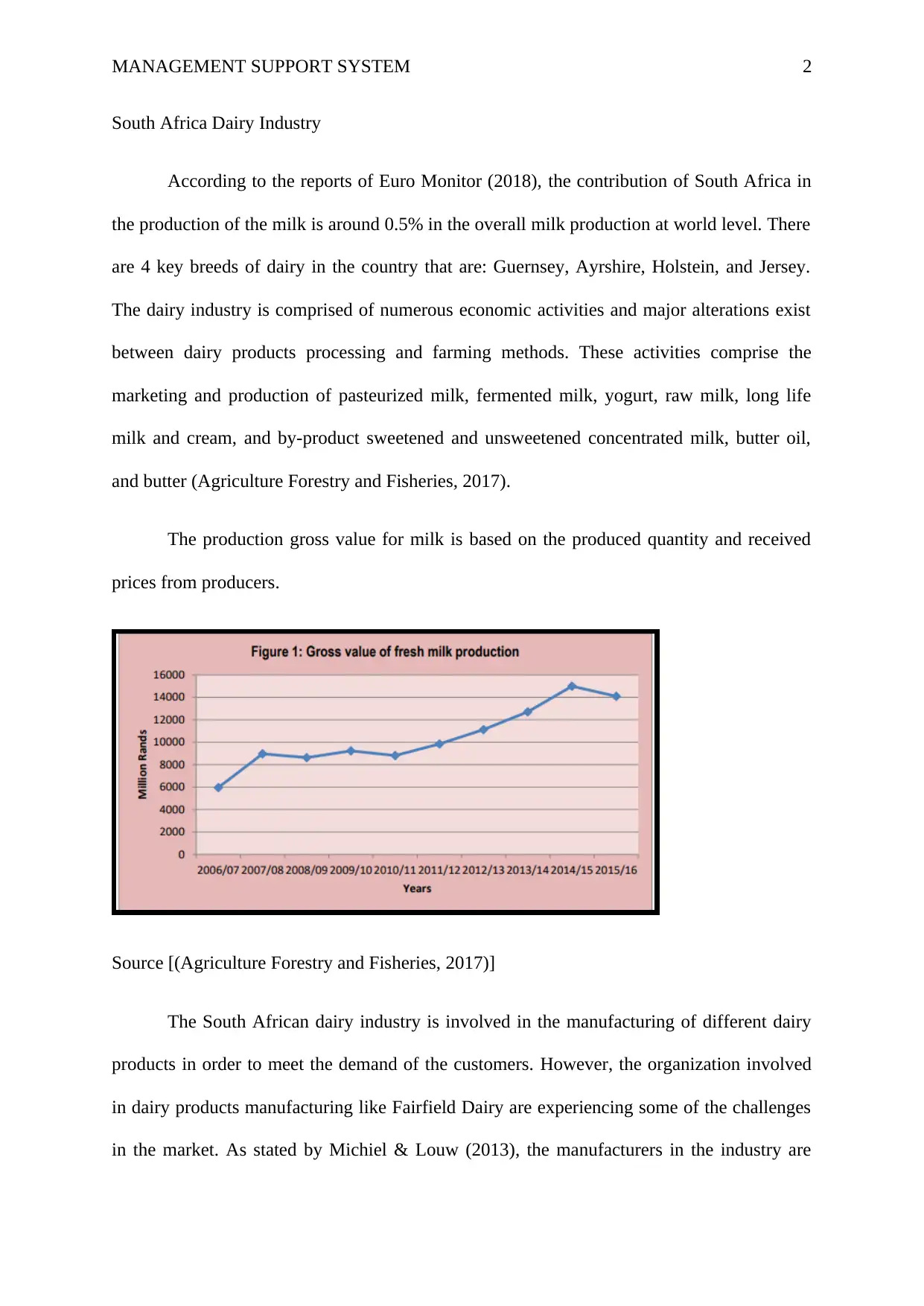
The production gross value for milk is based on the produced quantity and received
prices from producers.
Source [(Agriculture Forestry and Fisheries, 2017)]
The South African dairy industry is involved in the manufacturing of different dairy
products in order to meet the demand of the customers. However, the organization involved
in dairy products manufacturing like Fairfield Dairy are experiencing some of the challenges
in the market. As stated by Michiel & Louw (2013), the manufacturers in the industry are
South Africa Dairy Industry
According to the reports of Euro Monitor (2018), the contribution of South Africa in
the production of the milk is around 0.5% in the overall milk production at world level. There
are 4 key breeds of dairy in the country that are: Guernsey, Ayrshire, Holstein, and Jersey.
The dairy industry is comprised of numerous economic activities and major alterations exist
between dairy products processing and farming methods. These activities comprise the
marketing and production of pasteurized milk, fermented milk, yogurt, raw milk, long life
milk and cream, and by-product sweetened and unsweetened concentrated milk, butter oil,
and butter (Agriculture Forestry and Fisheries, 2017).
The production gross value for milk is based on the produced quantity and received
prices from producers.
Source [(Agriculture Forestry and Fisheries, 2017)]
The South African dairy industry is involved in the manufacturing of different dairy
products in order to meet the demand of the customers. However, the organization involved
in dairy products manufacturing like Fairfield Dairy are experiencing some of the challenges
in the market. As stated by Michiel & Louw (2013), the manufacturers in the industry are
⊘ This is a preview!⊘
Do you want full access?
Subscribe today to unlock all pages.

Trusted by 1+ million students worldwide
MANAGEMENT SUPPORT SYSTEM 3
unable to meet the supply and demand gap. The supply-demand gap between manufacturers
and processors, i.e. the present supply flowing by the prescribed processing value chain; do
not encounter the market demand. Besides this, the official market is experiencing price
rivalry from the informal market, offering low quality milk and lower transaction costs. The
flow of low quality milk is due to the absence of quality checks at the market’s consumer
level. Another challenge for the industry as well as formal manufacturers of dairy products is
the lack of training and knowledge accessible for the management of dairy cattle and business
skills leads to poor herd management and low production (Michiel & Louw, 2013).
The dairy industry of South Africa must now take steps to overcome these challenges
by adopting management support systems that could provide assistance to the management of
the businesses in the planning and decision making procedure.
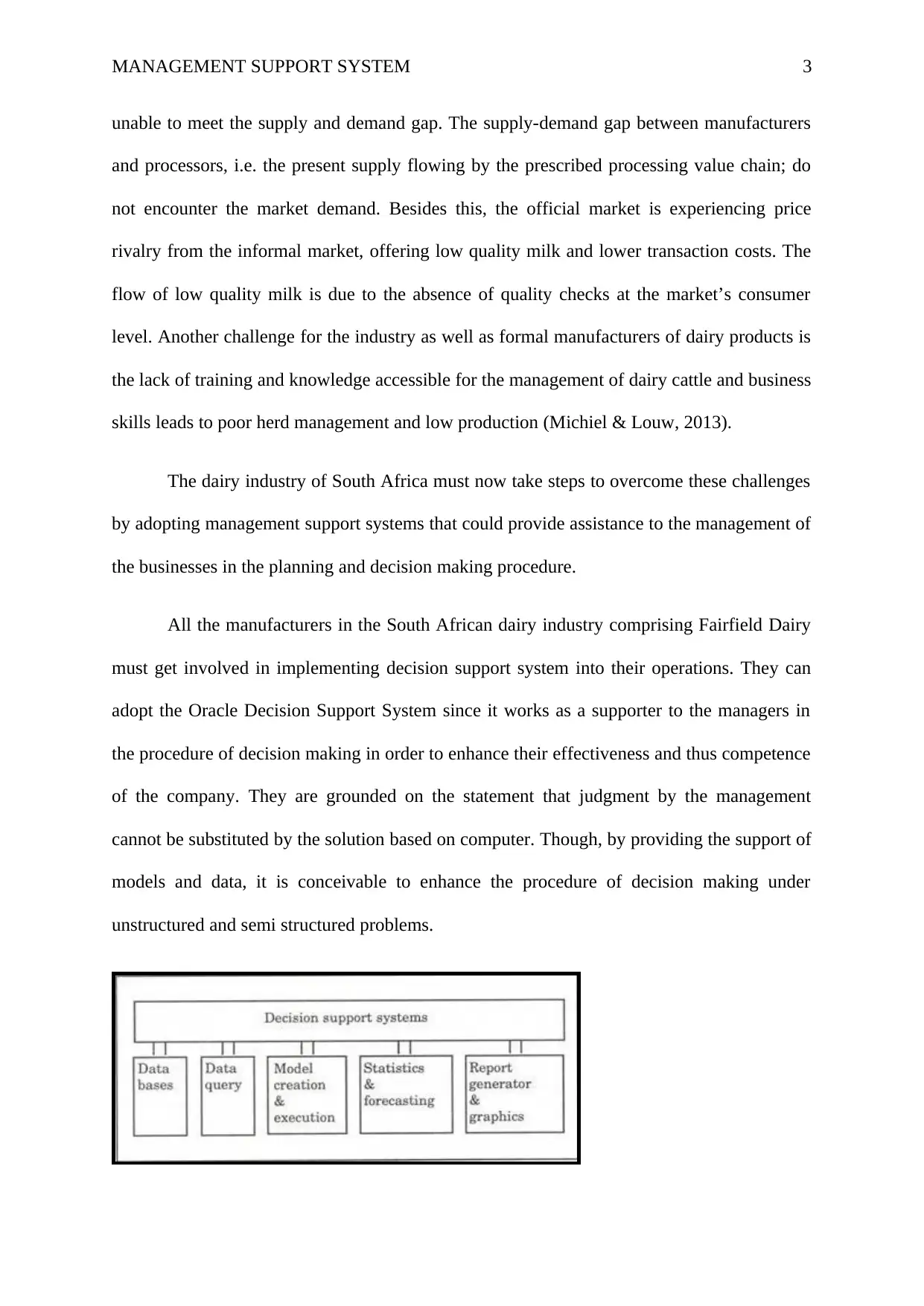
All the manufacturers in the South African dairy industry comprising Fairfield Dairy
must get involved in implementing decision support system into their operations. They can
adopt the Oracle Decision Support System since it works as a supporter to the managers in
the procedure of decision making in order to enhance their effectiveness and thus competence
of the company. They are grounded on the statement that judgment by the management
cannot be substituted by the solution based on computer. Though, by providing the support of
models and data, it is conceivable to enhance the procedure of decision making under
unstructured and semi structured problems.
unable to meet the supply and demand gap. The supply-demand gap between manufacturers
and processors, i.e. the present supply flowing by the prescribed processing value chain; do
not encounter the market demand. Besides this, the official market is experiencing price
rivalry from the informal market, offering low quality milk and lower transaction costs. The
flow of low quality milk is due to the absence of quality checks at the market’s consumer
level. Another challenge for the industry as well as formal manufacturers of dairy products is
the lack of training and knowledge accessible for the management of dairy cattle and business
skills leads to poor herd management and low production (Michiel & Louw, 2013).
The dairy industry of South Africa must now take steps to overcome these challenges
by adopting management support systems that could provide assistance to the management of
the businesses in the planning and decision making procedure.
All the manufacturers in the South African dairy industry comprising Fairfield Dairy
must get involved in implementing decision support system into their operations. They can
adopt the Oracle Decision Support System since it works as a supporter to the managers in
the procedure of decision making in order to enhance their effectiveness and thus competence
of the company. They are grounded on the statement that judgment by the management
cannot be substituted by the solution based on computer. Though, by providing the support of
models and data, it is conceivable to enhance the procedure of decision making under
unstructured and semi structured problems.
Paraphrase This Document
Need a fresh take? Get an instant paraphrase of this document with our AI Paraphraser
MANAGEMENT SUPPORT SYSTEM 4
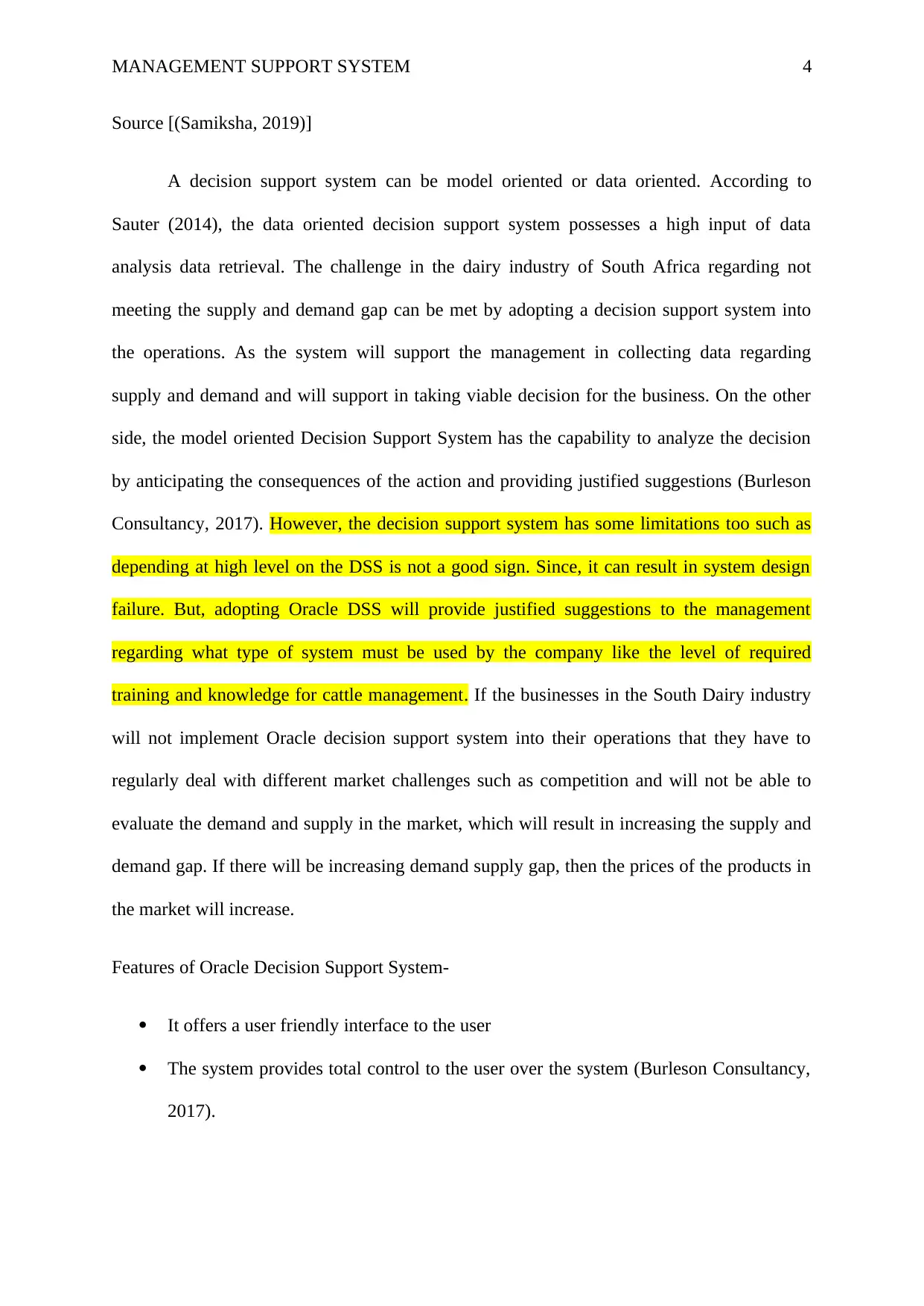
Source [(Samiksha, 2019)]
A decision support system can be model oriented or data oriented. According to
Sauter (2014), the data oriented decision support system possesses a high input of data
analysis data retrieval. The challenge in the dairy industry of South Africa regarding not
meeting the supply and demand gap can be met by adopting a decision support system into
the operations. As the system will support the management in collecting data regarding
supply and demand and will support in taking viable decision for the business. On the other
side, the model oriented Decision Support System has the capability to analyze the decision
by anticipating the consequences of the action and providing justified suggestions (Burleson
Consultancy, 2017). However, the decision support system has some limitations too such as
depending at high level on the DSS is not a good sign. Since, it can result in system design
failure. But, adopting Oracle DSS will provide justified suggestions to the management
regarding what type of system must be used by the company like the level of required
training and knowledge for cattle management. If the businesses in the South Dairy industry
will not implement Oracle decision support system into their operations that they have to
regularly deal with different market challenges such as competition and will not be able to
evaluate the demand and supply in the market, which will result in increasing the supply and
demand gap. If there will be increasing demand supply gap, then the prices of the products in
the market will increase.
Features of Oracle Decision Support System-
It offers a user friendly interface to the user
The system provides total control to the user over the system (Burleson Consultancy,
2017).
Source [(Samiksha, 2019)]
A decision support system can be model oriented or data oriented. According to
Sauter (2014), the data oriented decision support system possesses a high input of data
analysis data retrieval. The challenge in the dairy industry of South Africa regarding not
meeting the supply and demand gap can be met by adopting a decision support system into
the operations. As the system will support the management in collecting data regarding
supply and demand and will support in taking viable decision for the business. On the other
side, the model oriented Decision Support System has the capability to analyze the decision
by anticipating the consequences of the action and providing justified suggestions (Burleson
Consultancy, 2017). However, the decision support system has some limitations too such as
depending at high level on the DSS is not a good sign. Since, it can result in system design
failure. But, adopting Oracle DSS will provide justified suggestions to the management
regarding what type of system must be used by the company like the level of required
training and knowledge for cattle management. If the businesses in the South Dairy industry
will not implement Oracle decision support system into their operations that they have to
regularly deal with different market challenges such as competition and will not be able to
evaluate the demand and supply in the market, which will result in increasing the supply and
demand gap. If there will be increasing demand supply gap, then the prices of the products in
the market will increase.
Features of Oracle Decision Support System-
It offers a user friendly interface to the user
The system provides total control to the user over the system (Burleson Consultancy,
2017).
MANAGEMENT SUPPORT SYSTEM 5
This system works towards saving time and money that is invested by the
management of the company in making decisions.
It facilities fast data analysis for unstructured decision making thus enhancing the
response speed in unpredicted circumstances of decision making (Respício, Adam,
Phillips-Wren & Telhada, 2010).
Application of Oracle Decision Support System
Oracle Decision Support System can be implemented in the large size and medium
size businesses in the decision situations demanding a detailed study of external and internal
data. The feat of DSS in the dairy industry of South Arica rests on, to a great extent, on the
support of the top executives of the companies, consistency, and length of use, managers
training and variation of decision making circumstances. If the procedure of the business is
simple and accessible in nature, Oracle Decision Support System will not be capable to
defend its costs. Applying Oracle DSS to the structured decisions can only contribute to the
cost and increase confusion. The system is useful in the areas where there is flexibility in the
modeling and data is needed for superior decision making. The major area where this system
must be implemented in the Fairfield Dairy and the entire dairy industry of South Africa is
finance and production of the business.
Finance - Tax planning, budgeting, debt and equity analysis, capital budgeting, strategic
financial planning, budgeting, management of working capital, cash planning, variance
analysis, etc. (Respício, Adam, Phillips-Wren & Telhada, 2010)
The Oracle decision support systems are designed by using a procedure diverse from
the procedure of traditional system development since they operate as the internal as well as
an external data processor.
This system works towards saving time and money that is invested by the
management of the company in making decisions.
It facilities fast data analysis for unstructured decision making thus enhancing the
response speed in unpredicted circumstances of decision making (Respício, Adam,
Phillips-Wren & Telhada, 2010).
Application of Oracle Decision Support System
Oracle Decision Support System can be implemented in the large size and medium
size businesses in the decision situations demanding a detailed study of external and internal
data. The feat of DSS in the dairy industry of South Arica rests on, to a great extent, on the
support of the top executives of the companies, consistency, and length of use, managers
training and variation of decision making circumstances. If the procedure of the business is
simple and accessible in nature, Oracle Decision Support System will not be capable to
defend its costs. Applying Oracle DSS to the structured decisions can only contribute to the
cost and increase confusion. The system is useful in the areas where there is flexibility in the
modeling and data is needed for superior decision making. The major area where this system
must be implemented in the Fairfield Dairy and the entire dairy industry of South Africa is
finance and production of the business.
Finance - Tax planning, budgeting, debt and equity analysis, capital budgeting, strategic
financial planning, budgeting, management of working capital, cash planning, variance
analysis, etc. (Respício, Adam, Phillips-Wren & Telhada, 2010)
The Oracle decision support systems are designed by using a procedure diverse from
the procedure of traditional system development since they operate as the internal as well as
an external data processor.
⊘ This is a preview!⊘
Do you want full access?
Subscribe today to unlock all pages.
Trusted by 1+ million students worldwide
MANAGEMENT SUPPORT SYSTEM 6
Production - Scheduling of the production, planning of stock, management of the supply,
demand analysis, cost estimation, inventory controlling, etc. are also managed by the Oracle
Support System. This will help the industry in meeting the gap between supply and demand
(Respício, Adam, Phillips-Wren & Telhada, 2010).
Theories and Models of Decision Making
Normative Decision Making Theory
Normative decision theory is focused on recognizing the best decisions for the
business by seeing a perfect decision maker with the capability to calculate with perfect
precision and is completely balanced. The applied presentation of this prescriptive method is
known as decision analysis and is focused on identifying tools, software, and methodologies
to support management in making superior decisions (Rapoport, 2013). According to this
theory, the dairy industry of South Africa and Fairfield Dairy need to identify the best
decision to solve the issues of the supply-demand gap and lack of knowledge and training for
cattle management. It has been identified that Oracle Decision Support System will be the
best suit for the Fairfield Dairy and also for the industry for taking proper decision to
overcome the specified challenges. By using Oracle DSS company will be able to get detailed
information and fast data analysis, which will eventually provide suggestions to solve the
problem.
Classical Approach to Decision Making
Production - Scheduling of the production, planning of stock, management of the supply,
demand analysis, cost estimation, inventory controlling, etc. are also managed by the Oracle
Support System. This will help the industry in meeting the gap between supply and demand
(Respício, Adam, Phillips-Wren & Telhada, 2010).
Theories and Models of Decision Making
Normative Decision Making Theory
Normative decision theory is focused on recognizing the best decisions for the
business by seeing a perfect decision maker with the capability to calculate with perfect
precision and is completely balanced. The applied presentation of this prescriptive method is
known as decision analysis and is focused on identifying tools, software, and methodologies
to support management in making superior decisions (Rapoport, 2013). According to this
theory, the dairy industry of South Africa and Fairfield Dairy need to identify the best
decision to solve the issues of the supply-demand gap and lack of knowledge and training for
cattle management. It has been identified that Oracle Decision Support System will be the
best suit for the Fairfield Dairy and also for the industry for taking proper decision to
overcome the specified challenges. By using Oracle DSS company will be able to get detailed
information and fast data analysis, which will eventually provide suggestions to solve the
problem.
Classical Approach to Decision Making
Paraphrase This Document
Need a fresh take? Get an instant paraphrase of this document with our AI Paraphraser
MANAGEMENT SUPPORT SYSTEM 7
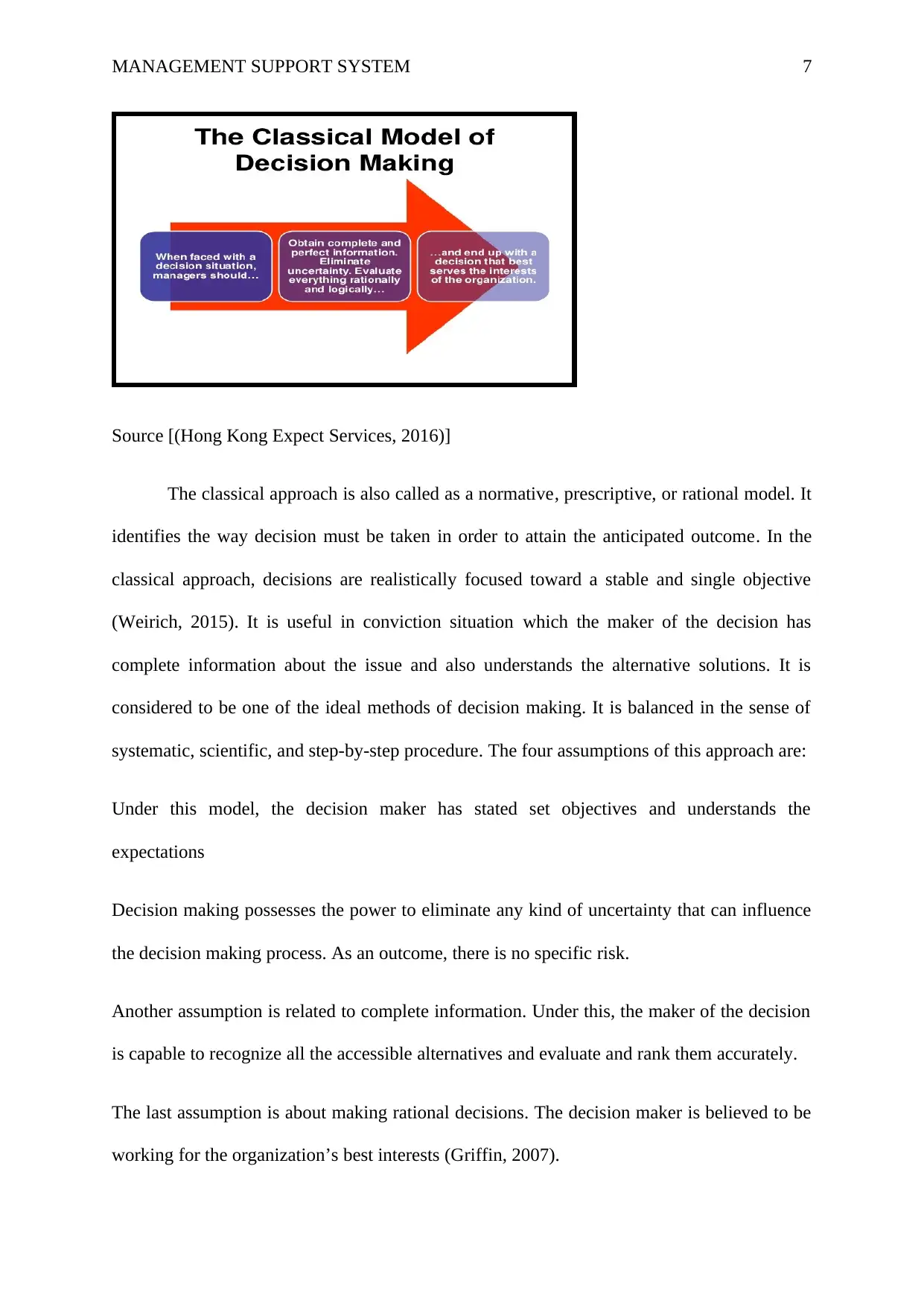
Source [(Hong Kong Expect Services, 2016)]
The classical approach is also called as a normative, prescriptive, or rational model. It
identifies the way decision must be taken in order to attain the anticipated outcome. In the
classical approach, decisions are realistically focused toward a stable and single objective
(Weirich, 2015). It is useful in conviction situation which the maker of the decision has
complete information about the issue and also understands the alternative solutions. It is
considered to be one of the ideal methods of decision making. It is balanced in the sense of
systematic, scientific, and step-by-step procedure. The four assumptions of this approach are:
Under this model, the decision maker has stated set objectives and understands the
expectations
Decision making possesses the power to eliminate any kind of uncertainty that can influence
the decision making process. As an outcome, there is no specific risk.
Another assumption is related to complete information. Under this, the maker of the decision
is capable to recognize all the accessible alternatives and evaluate and rank them accurately.
The last assumption is about making rational decisions. The decision maker is believed to be
working for the organization’s best interests (Griffin, 2007).
Source [(Hong Kong Expect Services, 2016)]
The classical approach is also called as a normative, prescriptive, or rational model. It
identifies the way decision must be taken in order to attain the anticipated outcome. In the
classical approach, decisions are realistically focused toward a stable and single objective
(Weirich, 2015). It is useful in conviction situation which the maker of the decision has
complete information about the issue and also understands the alternative solutions. It is
considered to be one of the ideal methods of decision making. It is balanced in the sense of
systematic, scientific, and step-by-step procedure. The four assumptions of this approach are:
Under this model, the decision maker has stated set objectives and understands the
expectations
Decision making possesses the power to eliminate any kind of uncertainty that can influence
the decision making process. As an outcome, there is no specific risk.
Another assumption is related to complete information. Under this, the maker of the decision
is capable to recognize all the accessible alternatives and evaluate and rank them accurately.
The last assumption is about making rational decisions. The decision maker is believed to be
working for the organization’s best interests (Griffin, 2007).
MANAGEMENT SUPPORT SYSTEM 8
Under the classical model, the objective of the dairy industry of South Africa is to
meet the demand and supply gap present within the industry. The demand and supply can be
properly met by identifying different system alternatives present in the market like decision
support systems, executive support system, and transaction processing systems. Considering
the challenge the industry is dealing with and the features of support systems, it could be said
that applying decision support system into the operations can provide proper information
regarding the market demand and available stock to the business and can support in analyzing
how the must product can be manufactured with the available stock. Besides this, the system
will also support the management of the company by suggesting the amount of stock required
to meet the market demand. In order to cope up with the price, competition company can
implement decision support system as it will reduce the human efforts and provide quick
information regarding demand in the market. This will reduce the operational cost of the
company.
The above paper is based on the detailed analysis of the Management support systems
that provide assistance to the management of the company in taking decisions for the
business and overcoming the challenges it deals within the market. The paper is based on the
market analysis and challenges present in the dairy industry of South Africa which is one of
the growing industry of the country. From the analysis, it has been identified that Fairfield
dairy and the entire industry is experiencing few of the challenges such as supply and demand
gap, lack of knowledge and training of cattle management, and high price competition. The
paper has suggested that the South African dairy industry must adopt Oracle Decision
Support System in order to identify the information related to demand and supply in the
market such that it can bridge the gap between supply as well as demand. Besides this, if
Fairfield dairy implements Oracle Decision Support System them it will be capable to give
strong price competition to its competitors because the system will provide quick information
Under the classical model, the objective of the dairy industry of South Africa is to
meet the demand and supply gap present within the industry. The demand and supply can be
properly met by identifying different system alternatives present in the market like decision
support systems, executive support system, and transaction processing systems. Considering
the challenge the industry is dealing with and the features of support systems, it could be said
that applying decision support system into the operations can provide proper information
regarding the market demand and available stock to the business and can support in analyzing
how the must product can be manufactured with the available stock. Besides this, the system
will also support the management of the company by suggesting the amount of stock required
to meet the market demand. In order to cope up with the price, competition company can
implement decision support system as it will reduce the human efforts and provide quick
information regarding demand in the market. This will reduce the operational cost of the
company.
The above paper is based on the detailed analysis of the Management support systems
that provide assistance to the management of the company in taking decisions for the
business and overcoming the challenges it deals within the market. The paper is based on the
market analysis and challenges present in the dairy industry of South Africa which is one of
the growing industry of the country. From the analysis, it has been identified that Fairfield
dairy and the entire industry is experiencing few of the challenges such as supply and demand
gap, lack of knowledge and training of cattle management, and high price competition. The
paper has suggested that the South African dairy industry must adopt Oracle Decision
Support System in order to identify the information related to demand and supply in the
market such that it can bridge the gap between supply as well as demand. Besides this, if
Fairfield dairy implements Oracle Decision Support System them it will be capable to give
strong price competition to its competitors because the system will provide quick information
⊘ This is a preview!⊘
Do you want full access?
Subscribe today to unlock all pages.
Trusted by 1+ million students worldwide
MANAGEMENT SUPPORT SYSTEM 9
regarding the demand in the market and will also reduce human efforts, which will
eventually, reduce the operational cost of the company. The paper has taken the support of
the normative theory of decision making and the classical approach of decision making to
rationalize the use of decision support system in the industry.
regarding the demand in the market and will also reduce human efforts, which will
eventually, reduce the operational cost of the company. The paper has taken the support of
the normative theory of decision making and the classical approach of decision making to
rationalize the use of decision support system in the industry.
Paraphrase This Document
Need a fresh take? Get an instant paraphrase of this document with our AI Paraphraser
MANAGEMENT SUPPORT SYSTEM 10
References
Hong Kong Expect Services. (2016). Compare and contrast ad hoc incrementalism and
rational decision making models. Retrieved from
https://www.hongkongexpatservices.com/compare-contrast-ad-hoc-incrementalism-
rational-decision-making-models/
Agriculture Forestry and Fisheries. (2017). South African Dairy Market. Retrieved from
https://www.nda.agric.za/doaDev/sideMenu/Marketing/Annual%20Publications/
Commodity%20Profiles/Dairy%20Market%20Value%20Chain%20Profile
%202017.pdf
Burleson Consultancy. (2017). Oracle Decision Support Systems and Data Warehouses.
Retrieved from
http://www.dba-oracle.com/data_warehouse/decision_support_system.htm
Euro Monitor. (2018). Dairy in South Africa. Retrieved from
https://www.euromonitor.com/dairy-in-south-africa/report
Fairfield Dairy. (2019). About us. Retrieved from https://www.fairfielddairy.com/
Griffin, R. (2007). Fundamentals of Management 5th ed. U.S: Cengage Learning.
Michiel, J., & Louw, A. (2013). Challenges of the Dairy Industry in Southern Africa.
Retrieved from http://citeseerx.ist.psu.edu/viewdoc/download?
doi=10.1.1.875.718&rep=rep1&type=pdf
Rapoport, A. (2013). Decision Theory and Decision Behaviour: Normative and Descriptive
Approaches 3rd ed. Germany: Springer Science & Business Media.
References
Hong Kong Expect Services. (2016). Compare and contrast ad hoc incrementalism and
rational decision making models. Retrieved from
https://www.hongkongexpatservices.com/compare-contrast-ad-hoc-incrementalism-
rational-decision-making-models/
Agriculture Forestry and Fisheries. (2017). South African Dairy Market. Retrieved from
https://www.nda.agric.za/doaDev/sideMenu/Marketing/Annual%20Publications/
Commodity%20Profiles/Dairy%20Market%20Value%20Chain%20Profile
%202017.pdf
Burleson Consultancy. (2017). Oracle Decision Support Systems and Data Warehouses.
Retrieved from
http://www.dba-oracle.com/data_warehouse/decision_support_system.htm
Euro Monitor. (2018). Dairy in South Africa. Retrieved from
https://www.euromonitor.com/dairy-in-south-africa/report
Fairfield Dairy. (2019). About us. Retrieved from https://www.fairfielddairy.com/
Griffin, R. (2007). Fundamentals of Management 5th ed. U.S: Cengage Learning.
Michiel, J., & Louw, A. (2013). Challenges of the Dairy Industry in Southern Africa.
Retrieved from http://citeseerx.ist.psu.edu/viewdoc/download?
doi=10.1.1.875.718&rep=rep1&type=pdf
Rapoport, A. (2013). Decision Theory and Decision Behaviour: Normative and Descriptive
Approaches 3rd ed. Germany: Springer Science & Business Media.
MANAGEMENT SUPPORT SYSTEM 11
Respício, A., Adam, F., Phillips-Wren, G., & Telhada, T.J. (2010). Bridging the Socio-
technical Gap in Decision Support Systems: Challenges for the Next Decade 1st ed.
U.S: IOS Press.
Samiksha, S. (2019). Importance of Management Support Systems for Business Enterprises.
Retrieved from http://www.yourarticlelibrary.com/database/importance-of-
management-support-systems-for-business-enterprises/10438
Sauter, V.L. (2014). Decision Support Systems for Business Intelligence 2nd ed. U.K: John
Wiley & Sons.
Shaqiri, A.B. (2014). Management Information System and Decision-Making. Academic
Journal of Interdisciplinary Studies, 3(2), 19-23.
Weirich, P. (2015). Models of Decision-Making 1st ed. U.S: Cambridge University Press.
Wierenga, B., & Bruggen, G.V. (2012). Marketing Management Support Systems: Principles,
Tools, and Implementation 2nd ed. Germany: Springer Science & Business Media.
Respício, A., Adam, F., Phillips-Wren, G., & Telhada, T.J. (2010). Bridging the Socio-
technical Gap in Decision Support Systems: Challenges for the Next Decade 1st ed.
U.S: IOS Press.
Samiksha, S. (2019). Importance of Management Support Systems for Business Enterprises.
Retrieved from http://www.yourarticlelibrary.com/database/importance-of-
management-support-systems-for-business-enterprises/10438
Sauter, V.L. (2014). Decision Support Systems for Business Intelligence 2nd ed. U.K: John
Wiley & Sons.
Shaqiri, A.B. (2014). Management Information System and Decision-Making. Academic
Journal of Interdisciplinary Studies, 3(2), 19-23.
Weirich, P. (2015). Models of Decision-Making 1st ed. U.S: Cambridge University Press.
Wierenga, B., & Bruggen, G.V. (2012). Marketing Management Support Systems: Principles,
Tools, and Implementation 2nd ed. Germany: Springer Science & Business Media.
⊘ This is a preview!⊘
Do you want full access?
Subscribe today to unlock all pages.
Trusted by 1+ million students worldwide

1 out of 12


Related Documents


Your All-in-One AI-Powered Toolkit for Academic Success.
+13062052269
info@desklib.com
Available 24*7 on WhatsApp / Email
![[object Object]](/_next/static/media/star-bottom.7253800d.svg)
Unlock your academic potential
Copyright © 2020–2026 A2Z Services. All Rights Reserved. Developed and managed by ZUCOL.