Project: Management System for Pre-schools and Kindergartens
VerifiedAdded on 2022/09/27
|31
|6353
|44
Project
AI Summary
This project report details the development of a management system for pre-schools and kindergartens, addressing the challenges of unstructured data management and communication gaps between parents and educators. The project analyzes the need for a technology-based solution, outlining research objectives, methodology, and data collection methods including primary and secondary sources. It explores the benefits of implementing a robust management system, emphasizing the positive impact on child health, safety, and development. The report includes business process mapping, system framework design, and use-case diagrams, along with a timeline Gantt chart for implementation. The project aims to create a 360-degree real-time view of children's activities and preferences, offering recommendations and lessons learned for a sustainable management system. The research incorporates literature reviews on existing technologies and their applications in education, along with ethical considerations and limitations. The findings highlight the importance of technology in streamlining processes, improving communication, and enhancing the overall quality of early childhood education.
MANAGEMENT SYSTEM FOR PRE-SCHOOLS AND KINDERGARTEN
MANAGEMENT SYSTEM FOR PRE-SCHOOLS AND KINDERGARTEN
DATE
STUDENT NAME
STUDENT ID
TUTOR’S NAME
TUTORIAL TIME
UNIVERSITY NAME
MANAGEMENT SYSTEM FOR PRE-SCHOOLS AND KINDERGARTEN
DATE
STUDENT NAME
STUDENT ID
TUTOR’S NAME
TUTORIAL TIME
UNIVERSITY NAME

Paraphrase This Document
Need a fresh take? Get an instant paraphrase of this document with our AI Paraphraser
Abstract
The report talks about the need for a development of a management system for the preschool
and kindergartens. The report describes about the problem, the analysis done from primary
and secondary sources followed by development of a system framework to mitigate the
challenges and have a structured process at the pre-schools to manage the children data. The
problem that the preschools and parents are facing is the unstructured process of managing
and maintaining the children’s data such as dietary habits, sleep time, allergies, meal timings
and many more. As there is no structured system to maintain such records for each and every
child, along with no proper communication channels between parents and educators, the
children are not able to develop to their full potential. This problem has been solved by a
robust system design of management system with offers a 360-degree real time view of the
children activities and preferences at the pre-schools.
Project Outline
The project is about creating a technology-based Management System for Pre-schools and
Kindergarten. This project aims to analyze the need for creating a robust management system
for Pre-schools and Kindergarten; by analyzing secondary narratives, business process
mapping, and outcomes of primary research to derive implications and recommendations for
a sustainable management system.
2 | P a g e
The report talks about the need for a development of a management system for the preschool
and kindergartens. The report describes about the problem, the analysis done from primary
and secondary sources followed by development of a system framework to mitigate the
challenges and have a structured process at the pre-schools to manage the children data. The
problem that the preschools and parents are facing is the unstructured process of managing
and maintaining the children’s data such as dietary habits, sleep time, allergies, meal timings
and many more. As there is no structured system to maintain such records for each and every
child, along with no proper communication channels between parents and educators, the
children are not able to develop to their full potential. This problem has been solved by a
robust system design of management system with offers a 360-degree real time view of the
children activities and preferences at the pre-schools.
Project Outline
The project is about creating a technology-based Management System for Pre-schools and
Kindergarten. This project aims to analyze the need for creating a robust management system
for Pre-schools and Kindergarten; by analyzing secondary narratives, business process
mapping, and outcomes of primary research to derive implications and recommendations for
a sustainable management system.
2 | P a g e
Table of Contents
Abstract......................................................................................................................................2
Project Outline...........................................................................................................................2
Table of Contents.......................................................................................................................3
Lists of Tables............................................................................................................................4
Lists of Figures...........................................................................................................................4
Lists of Abbreviations................................................................................................................4
Introduction................................................................................................................................5
The Project Definition (Problem statement)......................................................................5
Project Scope......................................................................................................................5
Research Objectives and Questions...................................................................................5
Background research/literature review/requirements analysis...........................................6
Research Methodology / Approach............................................................................................8
Research approach.............................................................................................................8
Data Collection...................................................................................................................8
Sample size and sampling technique..................................................................................9
Ethical consideration..........................................................................................................9
Research limitation and assumptions.................................................................................9
Results /Implementation...........................................................................................................10
Analysis and discussion of the project outcomes.....................................................................16
Business process mapping diagram & EMS Modelling..................................................17
Management system framework......................................................................................18
Use-case diagram for software developer........................................................................19
Timeline Gantt chart for implementation of Management system..................................20
Conclusions:.............................................................................................................................21
Recommendations & Lessons Learned....................................................................................21
Lesson Learned................................................................................................................22
References................................................................................................................................23
Appendices...............................................................................................................................27
3 | P a g e
Abstract......................................................................................................................................2
Project Outline...........................................................................................................................2
Table of Contents.......................................................................................................................3
Lists of Tables............................................................................................................................4
Lists of Figures...........................................................................................................................4
Lists of Abbreviations................................................................................................................4
Introduction................................................................................................................................5
The Project Definition (Problem statement)......................................................................5
Project Scope......................................................................................................................5
Research Objectives and Questions...................................................................................5
Background research/literature review/requirements analysis...........................................6
Research Methodology / Approach............................................................................................8
Research approach.............................................................................................................8
Data Collection...................................................................................................................8
Sample size and sampling technique..................................................................................9
Ethical consideration..........................................................................................................9
Research limitation and assumptions.................................................................................9
Results /Implementation...........................................................................................................10
Analysis and discussion of the project outcomes.....................................................................16
Business process mapping diagram & EMS Modelling..................................................17
Management system framework......................................................................................18
Use-case diagram for software developer........................................................................19
Timeline Gantt chart for implementation of Management system..................................20
Conclusions:.............................................................................................................................21
Recommendations & Lessons Learned....................................................................................21
Lesson Learned................................................................................................................22
References................................................................................................................................23
Appendices...............................................................................................................................27
3 | P a g e
⊘ This is a preview!⊘
Do you want full access?
Subscribe today to unlock all pages.

Trusted by 1+ million students worldwide
Lists of Tables
TABLE 1 PARENTS’ DEMAND WITH RESPECT TO THE FACILITIES AT KINDERGARTEN 11
TABLE 2 CHALLENGES FACED BY PRE-SCHOOL 12
TABLE 3 HAZARDS TAKING PLACE CURRENTLY WITH CHILDREN 13
TABLE 4 TECHNOLOGIES USED IN MANAGEMENT SYSTEMS FOR PRE-SCHOOL 14
TABLE 5 TECHNOLOGY DRIVEN MANAGEMENT SYSTEMS NEEDED TODAY 15
TABLE 6 HEALTH AND SAFETY FOR THE CHILDREN DUE TO IMS 16
TABLE 7 PAY MORE FOR ADVANCE IMS SYSTEM IN PLAY SCHOOL 17
TABLE 8 TIMELINE GANTT CHART FOR IMPLEMENTATION OF MANAGEMENT SYSTEM 21
Lists of Figures
FIGURE 1 PARENTS’ DEMAND WITH RESPECT TO THE FACILITIES AT KINDERGARTEN 12
FIGURE 2 CHALLENGES FACED BY PRE-SCHOOL 13
FIGURE 3 HAZARDS TAKING PLACE CURRENTLY WITH CHILDREN 14
FIGURE 4 TECHNOLOGIES USED IN MANAGEMENT SYSTEMS FOR PRE-SCHOOL 15
FIGURE 5 TECHNOLOGY DRIVEN MANAGEMENT SYSTEMS NEEDED TODAY 16
FIGURE 6 HEALTH AND SAFETY FOR THE CHILDREN DUE TO IMS 17
FIGURE 7 PAY MORE FOR ADVANCE IMS SYSTEM IN PLAY SCHOOL 18
FIGURE 8 BUSINESS PROCESS MAPPING DIAGRAM & EMS MODELLING 19
FIGURE 9 MANAGEMENT SYSTEM FRAMEWORK 20
FIGURE 10 USE-CASE DIAGRAM FOR SOFTWARE DEVELOPER 21
Lists of Abbreviations
NFC: Near Field Communications
MIS: Management Information System
4 | P a g e
TABLE 1 PARENTS’ DEMAND WITH RESPECT TO THE FACILITIES AT KINDERGARTEN 11
TABLE 2 CHALLENGES FACED BY PRE-SCHOOL 12
TABLE 3 HAZARDS TAKING PLACE CURRENTLY WITH CHILDREN 13
TABLE 4 TECHNOLOGIES USED IN MANAGEMENT SYSTEMS FOR PRE-SCHOOL 14
TABLE 5 TECHNOLOGY DRIVEN MANAGEMENT SYSTEMS NEEDED TODAY 15
TABLE 6 HEALTH AND SAFETY FOR THE CHILDREN DUE TO IMS 16
TABLE 7 PAY MORE FOR ADVANCE IMS SYSTEM IN PLAY SCHOOL 17
TABLE 8 TIMELINE GANTT CHART FOR IMPLEMENTATION OF MANAGEMENT SYSTEM 21
Lists of Figures
FIGURE 1 PARENTS’ DEMAND WITH RESPECT TO THE FACILITIES AT KINDERGARTEN 12
FIGURE 2 CHALLENGES FACED BY PRE-SCHOOL 13
FIGURE 3 HAZARDS TAKING PLACE CURRENTLY WITH CHILDREN 14
FIGURE 4 TECHNOLOGIES USED IN MANAGEMENT SYSTEMS FOR PRE-SCHOOL 15
FIGURE 5 TECHNOLOGY DRIVEN MANAGEMENT SYSTEMS NEEDED TODAY 16
FIGURE 6 HEALTH AND SAFETY FOR THE CHILDREN DUE TO IMS 17
FIGURE 7 PAY MORE FOR ADVANCE IMS SYSTEM IN PLAY SCHOOL 18
FIGURE 8 BUSINESS PROCESS MAPPING DIAGRAM & EMS MODELLING 19
FIGURE 9 MANAGEMENT SYSTEM FRAMEWORK 20
FIGURE 10 USE-CASE DIAGRAM FOR SOFTWARE DEVELOPER 21
Lists of Abbreviations
NFC: Near Field Communications
MIS: Management Information System
4 | P a g e
Paraphrase This Document
Need a fresh take? Get an instant paraphrase of this document with our AI Paraphraser
Introduction
There has been a significant growth in terms of usage of technology in all aspects of human
life. This includes implementing the technology for Health and safety of pre-school children
as well (Elvis, 2018). The aim of this report would be to analyze the business requirements of
a robust Management system (MIS) to automate the preferential records of children in line
with BAU processes at the preschools and kindergartens. Let us look into the problem
statement first (Prentzas & Theodosiou, 2013).
The Project Definition (Problem statement)
The purpose of this report is to create a robust management system for pre-schools and
kindergartens (en.kidsonline.edu.vn/, 2019). The problem that the preschools and parents are
facing is the unstructured process of managing and maintaining the children’s data such as
dietary habits, sleep time, allergies, meal timings and many more. As there is no structured
system to maintain such records for each and every child, along with no proper
communication channels between parents and educators, the children are not able to develop
to their full potential.
Project Scope
The scope of this study is confined to a group of educators and support staff including few
parents who were interviewed on implementation of such a management system. The project
only covers views of few pre-school stakeholders and public narratives from primary and
secondary sources. It is assumed that the context analyzed here is accurate to an extent and
expresses views of majority population across the globe (Andreja, 2011).
Research Objectives and Questions
5 | P a g e
There has been a significant growth in terms of usage of technology in all aspects of human
life. This includes implementing the technology for Health and safety of pre-school children
as well (Elvis, 2018). The aim of this report would be to analyze the business requirements of
a robust Management system (MIS) to automate the preferential records of children in line
with BAU processes at the preschools and kindergartens. Let us look into the problem
statement first (Prentzas & Theodosiou, 2013).
The Project Definition (Problem statement)
The purpose of this report is to create a robust management system for pre-schools and
kindergartens (en.kidsonline.edu.vn/, 2019). The problem that the preschools and parents are
facing is the unstructured process of managing and maintaining the children’s data such as
dietary habits, sleep time, allergies, meal timings and many more. As there is no structured
system to maintain such records for each and every child, along with no proper
communication channels between parents and educators, the children are not able to develop
to their full potential.
Project Scope
The scope of this study is confined to a group of educators and support staff including few
parents who were interviewed on implementation of such a management system. The project
only covers views of few pre-school stakeholders and public narratives from primary and
secondary sources. It is assumed that the context analyzed here is accurate to an extent and
expresses views of majority population across the globe (Andreja, 2011).
Research Objectives and Questions
5 | P a g e
The objective of this research is to record business requirements and design a robust
management system for pre-schools and kindergartens. The questions that we would be
analyzing based on the problem statement are:
What is the importance of a technology-based management information system for
pre-schools and kindergartens?
What are the factors that are positively affect the Health, safety and development of
children?
What are the implications of implementing management system, leveraging
technologies, for the pre-school stakeholders and parents?
Background research/literature review/requirements analysis
We would look at some of the renowned research materials around the implementation of a
management system for pre-schools and kindergartens. This would help us to know on the
benefits realized by implementing such a robust system, not only for the pre-school
stakeholder and educators but also for the parents and guardians of the children (Starcic,
2013).
As we look into the article published by research gate on development of young children to
become grown adults that contribute positively to the society, it has been mentioned that a
efficient environment at the pre-schools and kindergartens is an essential factor for the
children. Multiple schools are adopting next generation technologies to come up with robust
and intelligent management systems (TUka, et al., 2016). The purpose of such management
systems is to have a clear understanding about the children’s preferences and needs. The
efficiency of a management system, as per the study, revealed that it majorly depends on the
skills of the teachers and leadership qualities of the management, who manage the technical
system. The study also applied the Deming’s cycle of management principles to synthesize
the results (Sawaddemongkol, et al., 2017).
Another study on developing a new model for improving child care and education stated that
in order to improve the education quality, a structured modelling is required (Fang, et al.,
6 | P a g e
management system for pre-schools and kindergartens. The questions that we would be
analyzing based on the problem statement are:
What is the importance of a technology-based management information system for
pre-schools and kindergartens?
What are the factors that are positively affect the Health, safety and development of
children?
What are the implications of implementing management system, leveraging
technologies, for the pre-school stakeholders and parents?
Background research/literature review/requirements analysis
We would look at some of the renowned research materials around the implementation of a
management system for pre-schools and kindergartens. This would help us to know on the
benefits realized by implementing such a robust system, not only for the pre-school
stakeholder and educators but also for the parents and guardians of the children (Starcic,
2013).
As we look into the article published by research gate on development of young children to
become grown adults that contribute positively to the society, it has been mentioned that a
efficient environment at the pre-schools and kindergartens is an essential factor for the
children. Multiple schools are adopting next generation technologies to come up with robust
and intelligent management systems (TUka, et al., 2016). The purpose of such management
systems is to have a clear understanding about the children’s preferences and needs. The
efficiency of a management system, as per the study, revealed that it majorly depends on the
skills of the teachers and leadership qualities of the management, who manage the technical
system. The study also applied the Deming’s cycle of management principles to synthesize
the results (Sawaddemongkol, et al., 2017).
Another study on developing a new model for improving child care and education stated that
in order to improve the education quality, a structured modelling is required (Fang, et al.,
6 | P a g e
⊘ This is a preview!⊘
Do you want full access?
Subscribe today to unlock all pages.
Trusted by 1+ million students worldwide
2012). The structured model created for pre-school management requires mediation by the
teachers and parents as well to run this model efficiently and accurately. Such models could
be converted into a robust management system which possess a 2-way communication
channels between parents and educators for real time updates about the children (Shau,
2017).
A case study from Finland talks about the market potential of the management system
software in today’s digital world. The use of technology is continuously growing and fast
growing startups are coming up with technologies such as sensor based management systems,
HRM, CRMs and smart black boards. A demand for an automated management system,
especially for pre-schools and kindergartens, is growing significantly owing to insecurity
within parents about health and well-being of their children while they are at work.
Moreover, the pre-school managements also prefer to move to paperless administration with
real time details updated for each child in their systems (A.SARANYA, et al., 2016).
The article describes about the security concerns of children that is growing among the
parents today. The parents are adopting child monitoring systems to keep a close watch on
their children (Sinclair, 2018). These systems track the overall activities of the children using
GPS sensors. The implications here have also been towards adopting a management system
by the pre-schools that can help to establish a robust networking facility between educators
and parents. The parents and guardians could be kept updated in real time about their child’s
activities using interactive systems. Recently, the pre-schools have also started with
maintaining activity logs of the students and the care of children is based on the preferences
logged by the parents for their child in terms of sleep, meals, diet, fears, allergy, etc (Nguyen,
2015).
It has been observed that innovative technology has been used widely in several domains of
human activity and business. Considering the fact that technology has enabled the education
system to be more accurate and efficient, the report aimed to implemented the similar
management system in kinder garden to be more accurate in their processes (Prokopiadou,
2012). One of the researches which mentioned the technology used in Greek preschools, the
researcher has evaluated the extent to which routine processes of kindergartens can be
automated and influenced by installing MIS in school. Moreover, the government of Canada
7 | P a g e
teachers and parents as well to run this model efficiently and accurately. Such models could
be converted into a robust management system which possess a 2-way communication
channels between parents and educators for real time updates about the children (Shau,
2017).
A case study from Finland talks about the market potential of the management system
software in today’s digital world. The use of technology is continuously growing and fast
growing startups are coming up with technologies such as sensor based management systems,
HRM, CRMs and smart black boards. A demand for an automated management system,
especially for pre-schools and kindergartens, is growing significantly owing to insecurity
within parents about health and well-being of their children while they are at work.
Moreover, the pre-school managements also prefer to move to paperless administration with
real time details updated for each child in their systems (A.SARANYA, et al., 2016).
The article describes about the security concerns of children that is growing among the
parents today. The parents are adopting child monitoring systems to keep a close watch on
their children (Sinclair, 2018). These systems track the overall activities of the children using
GPS sensors. The implications here have also been towards adopting a management system
by the pre-schools that can help to establish a robust networking facility between educators
and parents. The parents and guardians could be kept updated in real time about their child’s
activities using interactive systems. Recently, the pre-schools have also started with
maintaining activity logs of the students and the care of children is based on the preferences
logged by the parents for their child in terms of sleep, meals, diet, fears, allergy, etc (Nguyen,
2015).
It has been observed that innovative technology has been used widely in several domains of
human activity and business. Considering the fact that technology has enabled the education
system to be more accurate and efficient, the report aimed to implemented the similar
management system in kinder garden to be more accurate in their processes (Prokopiadou,
2012). One of the researches which mentioned the technology used in Greek preschools, the
researcher has evaluated the extent to which routine processes of kindergartens can be
automated and influenced by installing MIS in school. Moreover, the government of Canada
7 | P a g e
Paraphrase This Document
Need a fresh take? Get an instant paraphrase of this document with our AI Paraphraser
has invested millions of dollars in Artificial intelligence research and its application in
education system since many years (Tan, 2017).
Considering the fact that Canada is emerging as an industry leader in researches related to
artificial intelligence. It is essential for parents and teachers to understand the need of AI and
its probable benefits in education system. It is matter of fact that the RFID system and QR
code systems are going to replace the bar code labels and traditional way of communication.
It is only a matter of time where radio frequency identification devices are a daily part of the
electronic age, and are fast becoming a part of passports, libraries and payment cards, and are
widely expected to replace bar-code labels on consumer goods (Shivhare, 2019).
Looking at the use of RFID in school, it is easy to identify children activities in schools using
tagging and sensor technology (N.A, 2011). The preschool named as Richmond has initiated
tagging each kid with RFID numbers on their clothing in the year of 2004. The number of
schools executed similar technology has reached to over 50,000 covering the region of
Houston, Texas and California. The sensors installed in schools are used to analyze the
activities of pre-school children (Kravets, 2012).
Research Methodology / Approach
Research approach
There are three types of research approaches that prevails as a part of theory which can be
used to solve research questions and attain the objectives (N.A, 2012). As part of this
assignment, inductive research approach is being used to evaluate the impact of integrated
management system on the kinder garden. Inductive research approach does not engage with
hypothesis, rather it starts with research aim, questions and follows by literature review, data
collection and analysis. The report has followed the similar pattern (Gabriel, 2013).
Data Collection
8 | P a g e
education system since many years (Tan, 2017).
Considering the fact that Canada is emerging as an industry leader in researches related to
artificial intelligence. It is essential for parents and teachers to understand the need of AI and
its probable benefits in education system. It is matter of fact that the RFID system and QR
code systems are going to replace the bar code labels and traditional way of communication.
It is only a matter of time where radio frequency identification devices are a daily part of the
electronic age, and are fast becoming a part of passports, libraries and payment cards, and are
widely expected to replace bar-code labels on consumer goods (Shivhare, 2019).
Looking at the use of RFID in school, it is easy to identify children activities in schools using
tagging and sensor technology (N.A, 2011). The preschool named as Richmond has initiated
tagging each kid with RFID numbers on their clothing in the year of 2004. The number of
schools executed similar technology has reached to over 50,000 covering the region of
Houston, Texas and California. The sensors installed in schools are used to analyze the
activities of pre-school children (Kravets, 2012).
Research Methodology / Approach
Research approach
There are three types of research approaches that prevails as a part of theory which can be
used to solve research questions and attain the objectives (N.A, 2012). As part of this
assignment, inductive research approach is being used to evaluate the impact of integrated
management system on the kinder garden. Inductive research approach does not engage with
hypothesis, rather it starts with research aim, questions and follows by literature review, data
collection and analysis. The report has followed the similar pattern (Gabriel, 2013).
Data Collection
8 | P a g e
Primary data denotes the original data collected by the author; here primary data is collected
with the help of questionnaire. The list of close ended and open-ended questions was asked to
participants for gathering required information (fao.org, n.d.). Secondary data can be
extracting from previous researches, journals and reports prepared on the similar topics.
Furthermore, as a part of primary data collection, admin has been asked to take interview of 2
parents who are currently associated with kindergarten situated in northern territory. This will
be structured interview where similar questions will be discussed with parents and their views
and opinions will be noted to analyze the need for MIS from their point of view.
Sample size and sampling technique
It is essential to decide sample size of the research along with sampling technique. There are
two types of sampling techniques which are majorly used by researcher: probability and non-
probability sampling (Barratt & Shantikumar, 2018). Questionnaire has been used to collect
primary data. Here, total 20 participants were asked to fill the survey. All the respondents
were randomly selected (convenience sampling) and were given equal chances for selection
as a part of non-probability sampling technique. The respondents were equally distributed,
with 10 males and 10 females.
Ethical consideration
Questionnaires has been filled after taking consent of each participant. It was ensured that all
data will be kept confidential and strictly used for academic purpose (Kaewkungwal &
Adams, 2019).
Research limitation and assumptions
The survey has been analyzed and data tables were prepared based on available survey and
interview information (https://research-methodology.net, 2015). The survey is prepared based
on 20 participants; the sample is too small to represent the view of population. The opinion of
20 participants may not match the opinions all stakeholders across the globe. Hence, the
study is limited to 20 samples and 2 interviews.
9 | P a g e
with the help of questionnaire. The list of close ended and open-ended questions was asked to
participants for gathering required information (fao.org, n.d.). Secondary data can be
extracting from previous researches, journals and reports prepared on the similar topics.
Furthermore, as a part of primary data collection, admin has been asked to take interview of 2
parents who are currently associated with kindergarten situated in northern territory. This will
be structured interview where similar questions will be discussed with parents and their views
and opinions will be noted to analyze the need for MIS from their point of view.
Sample size and sampling technique
It is essential to decide sample size of the research along with sampling technique. There are
two types of sampling techniques which are majorly used by researcher: probability and non-
probability sampling (Barratt & Shantikumar, 2018). Questionnaire has been used to collect
primary data. Here, total 20 participants were asked to fill the survey. All the respondents
were randomly selected (convenience sampling) and were given equal chances for selection
as a part of non-probability sampling technique. The respondents were equally distributed,
with 10 males and 10 females.
Ethical consideration
Questionnaires has been filled after taking consent of each participant. It was ensured that all
data will be kept confidential and strictly used for academic purpose (Kaewkungwal &
Adams, 2019).
Research limitation and assumptions
The survey has been analyzed and data tables were prepared based on available survey and
interview information (https://research-methodology.net, 2015). The survey is prepared based
on 20 participants; the sample is too small to represent the view of population. The opinion of
20 participants may not match the opinions all stakeholders across the globe. Hence, the
study is limited to 20 samples and 2 interviews.
9 | P a g e
⊘ This is a preview!⊘
Do you want full access?
Subscribe today to unlock all pages.
Trusted by 1+ million students worldwide
Results /Implementation
To give a brief on demographic aspect, throughout the survey it was analysed that 50%
respondents are male and 50% are female. Furthermore, 30% and 35% of the participants
were belonging to the age group of 25-35 and 36-45 years respectively. Out of 20
participants, 45% respondents were observed to be in teaching profession. 20% and 15%
were selected from admin and operations department.
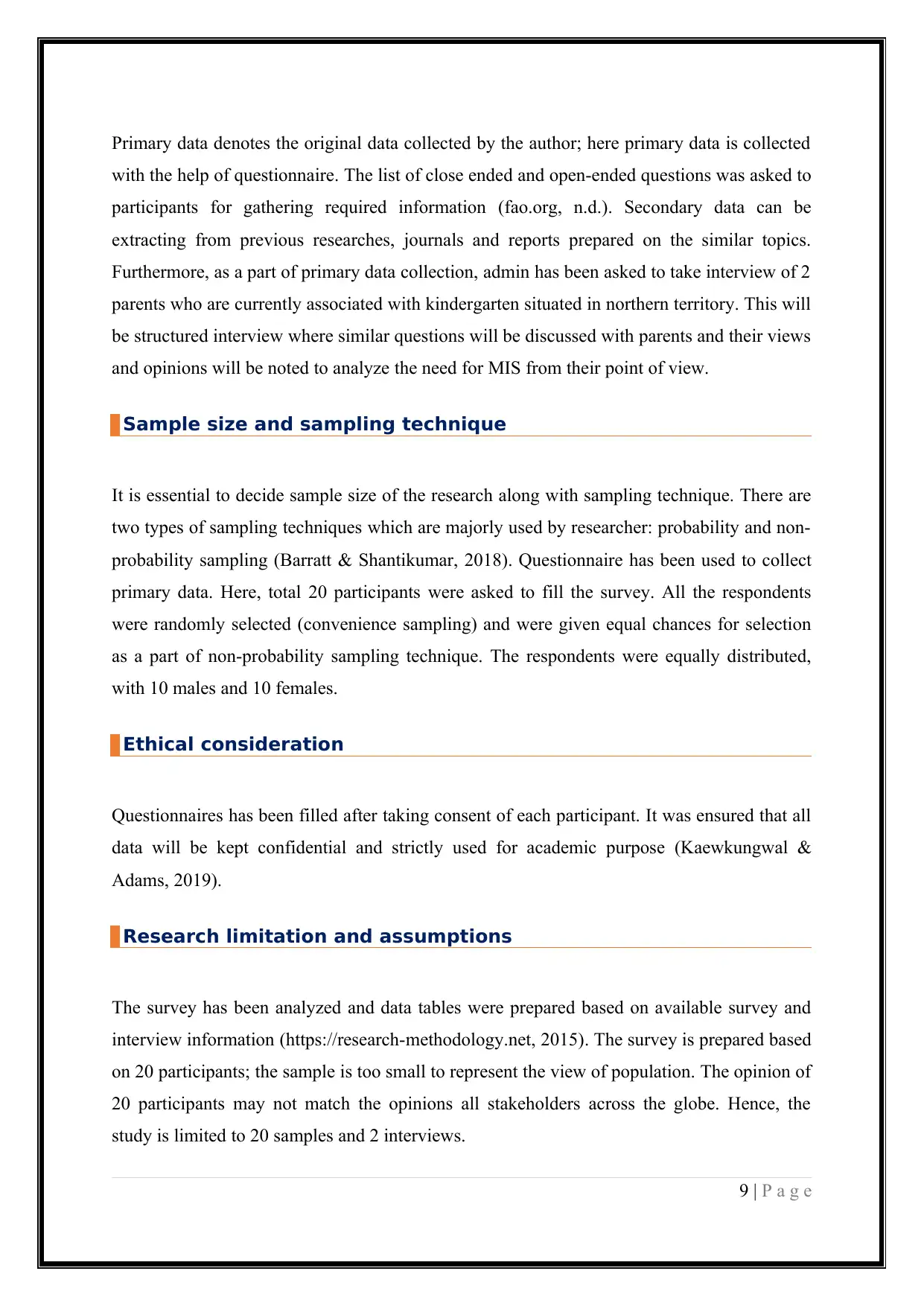
What do you think are the parents’ demand with respect to the facilities at
kindergarten?
Figure 1 Parents’ demand with respect to the facilities at kindergarten
Parents’ demand with respect to the facilities at kindergarten Response in %
Live video streaming of child activities 35
Activity logs 15
10 | P a g e
To give a brief on demographic aspect, throughout the survey it was analysed that 50%
respondents are male and 50% are female. Furthermore, 30% and 35% of the participants
were belonging to the age group of 25-35 and 36-45 years respectively. Out of 20
participants, 45% respondents were observed to be in teaching profession. 20% and 15%
were selected from admin and operations department.
What do you think are the parents’ demand with respect to the facilities at
kindergarten?
Figure 1 Parents’ demand with respect to the facilities at kindergarten
Parents’ demand with respect to the facilities at kindergarten Response in %
Live video streaming of child activities 35
Activity logs 15
10 | P a g e
Paraphrase This Document
Need a fresh take? Get an instant paraphrase of this document with our AI Paraphraser
Meals details 25
Day care details 25
Everyday learning updates 15
Table 1 Parents’ demand with respect to the facilities at kindergarten
Based on the survey, it was observed that most of the parents would like to know what their
kids are doing at the kindergartens for an entire day. They would love to check the live video
streaming child activity (Andreja, 2011). They want to introspect which activities are being
carried out for an entire day and how it is benefited to child’s growth. By implementing
appropriate integrated management system, parents can check on day care detail along with
activity log of the play center. Similar opinion was noticed throughout the interview and
literature review, hence now a day’s all play center management are encouraged to design
appropriate management system to perform better (Balram Korde, 2018).
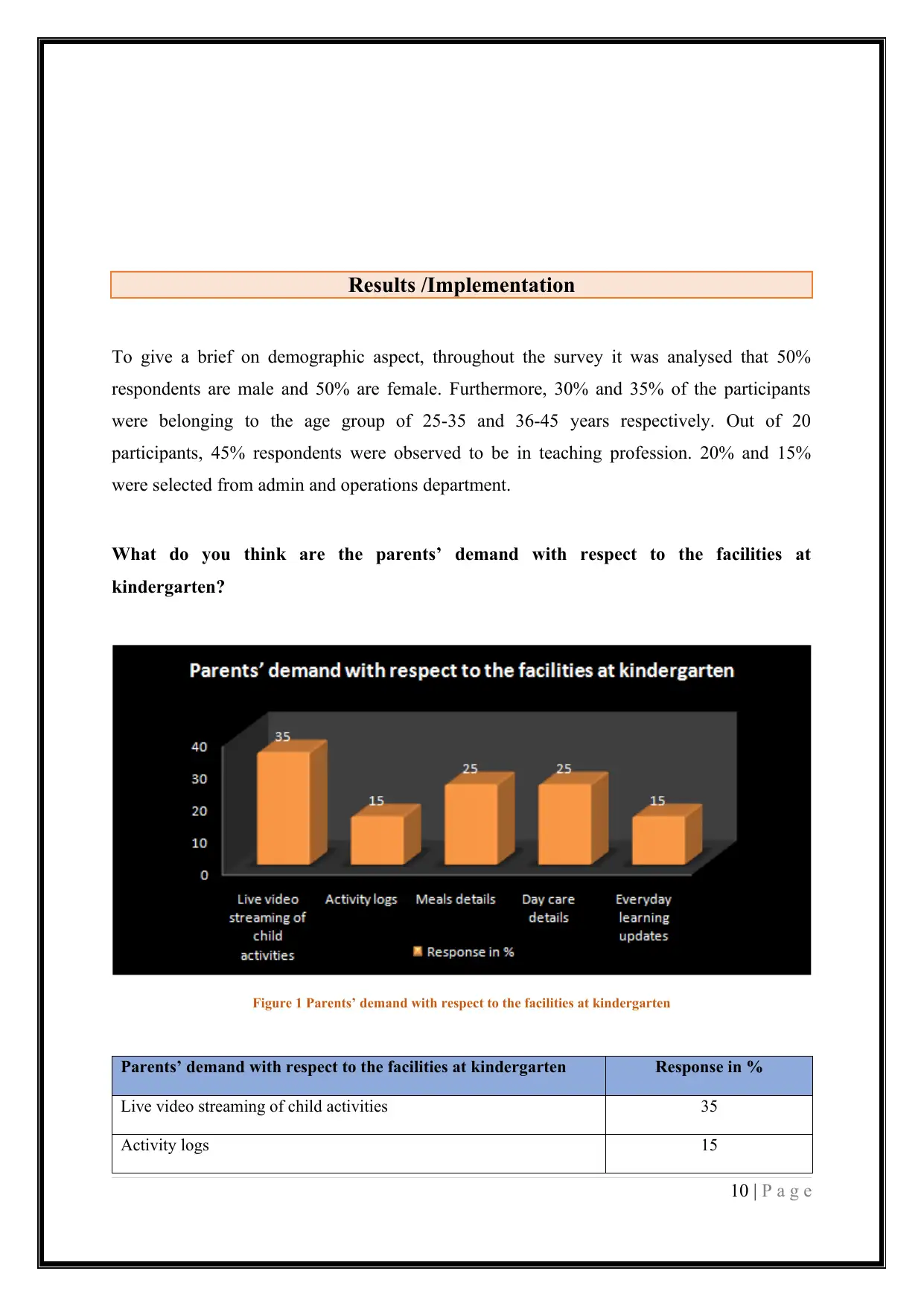
What are the challenges faced by pre-school and kindergartens and also parents in the
current scenario?
Figure 2 Challenges faced by pre-school
Challenges faced by pre-school Challenges faced
by pre-school
11 | P a g e
Day care details 25
Everyday learning updates 15
Table 1 Parents’ demand with respect to the facilities at kindergarten
Based on the survey, it was observed that most of the parents would like to know what their
kids are doing at the kindergartens for an entire day. They would love to check the live video
streaming child activity (Andreja, 2011). They want to introspect which activities are being
carried out for an entire day and how it is benefited to child’s growth. By implementing
appropriate integrated management system, parents can check on day care detail along with
activity log of the play center. Similar opinion was noticed throughout the interview and
literature review, hence now a day’s all play center management are encouraged to design
appropriate management system to perform better (Balram Korde, 2018).
What are the challenges faced by pre-school and kindergartens and also parents in the
current scenario?
Figure 2 Challenges faced by pre-school
Challenges faced by pre-school Challenges faced
by pre-school
11 | P a g e
Paper based manual administration 40
Unstructured data about children 25
No preferences of children known (Diet, Allergy, etc) 25
No visibility with parents 10
Table 2 Challenges faced by pre-school
However, there are several challenges by pre-school which are being mentioned in the
literature review. Some of the challenges were discussed with parents and preschool teachers,
it was analyzed that more than 40% of the respondents are fed up with paper based manual
administration. Furthermore, teachers at school do not aware about the allergies that children
have or special care that should have been given (TingSunga, et al., 2016).
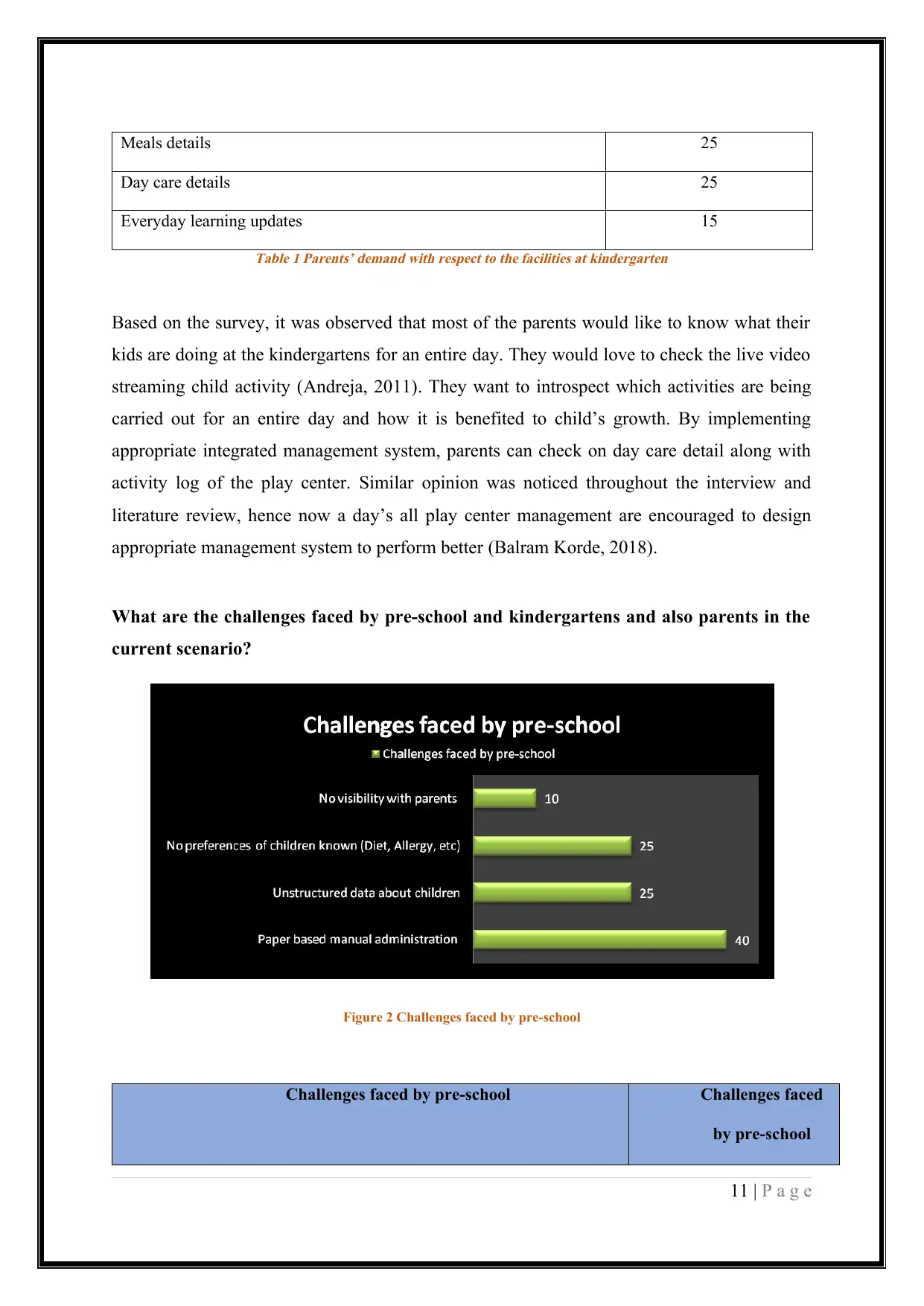
What are the hazards taking place currently with children due to unavailability of an
integrated management system?
Figure 3 Hazards taking place currently with children
Hazards taking place currently with children Response in %
Mal-Nutrition in Children 15
Safety issues 25
12 | P a g e
Unstructured data about children 25
No preferences of children known (Diet, Allergy, etc) 25
No visibility with parents 10
Table 2 Challenges faced by pre-school
However, there are several challenges by pre-school which are being mentioned in the
literature review. Some of the challenges were discussed with parents and preschool teachers,
it was analyzed that more than 40% of the respondents are fed up with paper based manual
administration. Furthermore, teachers at school do not aware about the allergies that children
have or special care that should have been given (TingSunga, et al., 2016).
What are the hazards taking place currently with children due to unavailability of an
integrated management system?
Figure 3 Hazards taking place currently with children
Hazards taking place currently with children Response in %
Mal-Nutrition in Children 15
Safety issues 25
12 | P a g e
⊘ This is a preview!⊘
Do you want full access?
Subscribe today to unlock all pages.
Trusted by 1+ million students worldwide

1 out of 31


Related Documents


Your All-in-One AI-Powered Toolkit for Academic Success.
+13062052269
info@desklib.com
Available 24*7 on WhatsApp / Email
![[object Object]](/_next/static/media/star-bottom.7253800d.svg)
Unlock your academic potential
Copyright © 2020–2025 A2Z Services. All Rights Reserved. Developed and managed by ZUCOL.