Management Theories: Application of Classical and Systems Thinking
VerifiedAdded on 2023/03/21
|9
|2157
|96
Report
AI Summary
This report explores two prominent management theories: the classical perspective and systems thinking. The classical perspective, originating from the industrial revolution, focuses on maximizing efficiency and productivity, often neglecting human needs. In contrast, systems thinking views an organization as an interconnected system with inputs, throughputs, and outputs, emphasizing a holistic approach. The report discusses the application of systems thinking within the Federal Aviation Administration (FAA), highlighting its use in maintaining global leadership in aviation. While the classical perspective isn't fully implemented by organizations today due to its primitive nature, elements can be seen in companies like Amazon. The report concludes that a blend of management theories is essential for modern business success, adapting to current market demands and fostering a strong brand image.

Last name 1
Title
Name
Institutional Affiliation
Dated
Title
Name
Institutional Affiliation
Dated

Paraphrase This Document
Need a fresh take? Get an instant paraphrase of this document with our AI Paraphraser
Last name 2
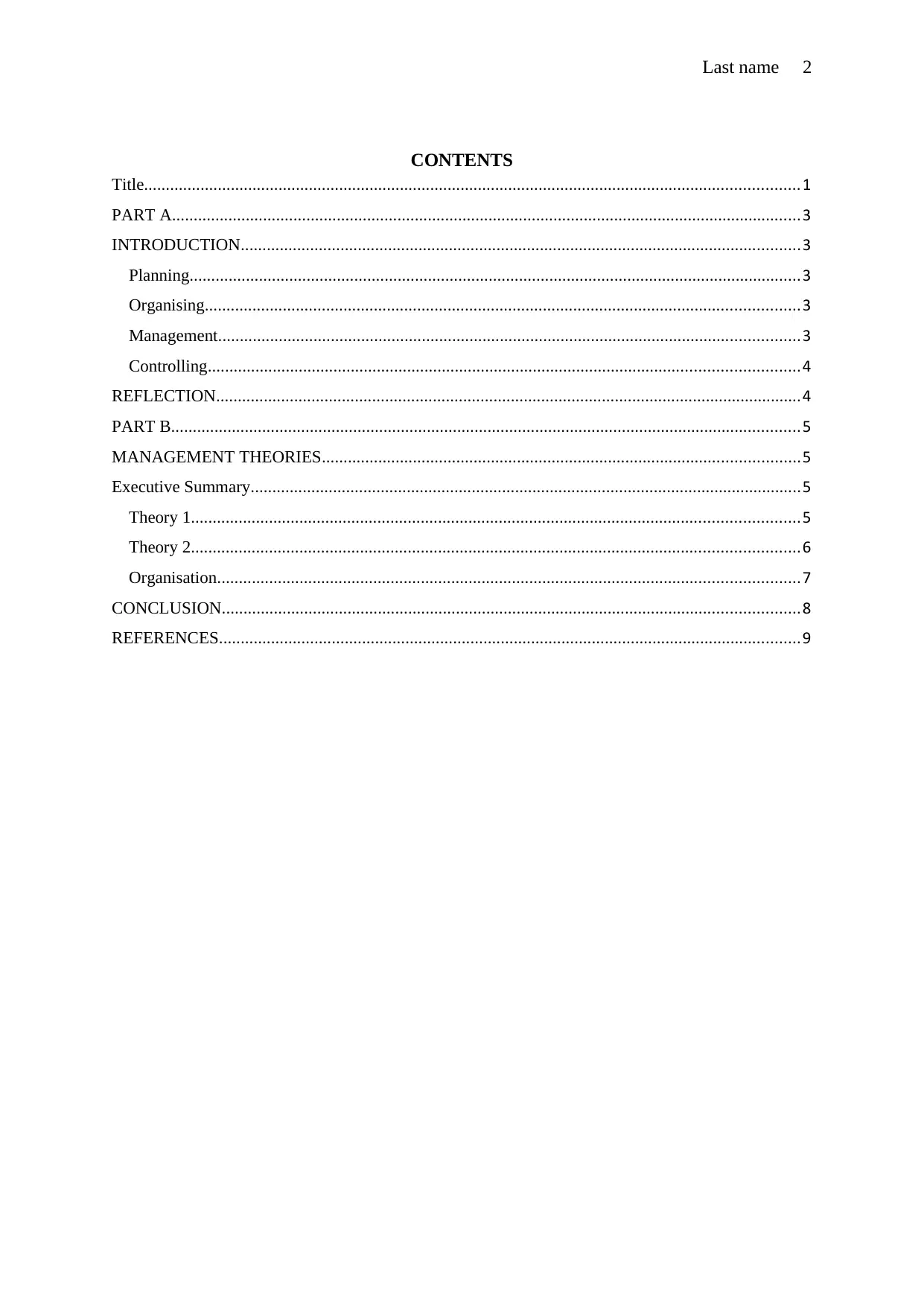
CONTENTS
Title.......................................................................................................................................................1
PART A.................................................................................................................................................3
INTRODUCTION.................................................................................................................................3
Planning.............................................................................................................................................3
Organising.........................................................................................................................................3
Management......................................................................................................................................3
Controlling........................................................................................................................................4
REFLECTION.......................................................................................................................................4
PART B.................................................................................................................................................5
MANAGEMENT THEORIES..............................................................................................................5
Executive Summary...............................................................................................................................5
Theory 1............................................................................................................................................5
Theory 2............................................................................................................................................6
Organisation......................................................................................................................................7
CONCLUSION.....................................................................................................................................8
REFERENCES......................................................................................................................................9
CONTENTS
Title.......................................................................................................................................................1
PART A.................................................................................................................................................3
INTRODUCTION.................................................................................................................................3
Planning.............................................................................................................................................3
Organising.........................................................................................................................................3
Management......................................................................................................................................3
Controlling........................................................................................................................................4
REFLECTION.......................................................................................................................................4
PART B.................................................................................................................................................5
MANAGEMENT THEORIES..............................................................................................................5
Executive Summary...............................................................................................................................5
Theory 1............................................................................................................................................5
Theory 2............................................................................................................................................6
Organisation......................................................................................................................................7
CONCLUSION.....................................................................................................................................8
REFERENCES......................................................................................................................................9
Last name 3
PART A
INTRODUCTION
There are numerous instances when I have used four core or fundamental tools of
management in my daily life. The use of planning, organising, leadership and controlling has
helped me a lot throughout my life. Once at my brother's wedding, the event manager could
not be arranged due to certain reasons. On that event, I served as the event manager and
attended by my brother's wedding simultaneously. Although it was difficult to perform two
functions simultaneously but due to the need and unavailability of event manager, I had to do
it.
Planning
Before deciding the site of the wedding ceremony, I planned a couple of things. These
plans included considerations like space and room for sitting of the guest, separate female
and male blocks, place to dine and certainly a stage where the bride and groom along with
their parents could sit so as to remain in the spot light. Not only this the chairs that were to be
rented, their colour, comfort, covers and shapes of tables to be placed before them so as to
meet the space needs were all planned.
Organising
After having done with the planning, I organised my plans. The former idea of
keeping separate male and female spaces was rejected instead one side of the hall chosen was
reserved for women and other for the males without any clear partition. For the dine-in space,
the lawn was preferred as the ceremony was held at night and the season was also spring.
Therefore, fresh out door dinner fascinated me. I took along a dozen of spot boys who
arranged furniture and kept everything well it its place.
Management
For the management stuff, I did use surveillance cameras where the food was being
cooked so as to ensure that no one gets the chance to add something unpleasant in the food.
Likewise, I checked all the preparations an hour before the arrival of the guest. I tasked three
to four boys with the task of keeping everything in place. For instance, if they saw a table
PART A
INTRODUCTION
There are numerous instances when I have used four core or fundamental tools of
management in my daily life. The use of planning, organising, leadership and controlling has
helped me a lot throughout my life. Once at my brother's wedding, the event manager could
not be arranged due to certain reasons. On that event, I served as the event manager and
attended by my brother's wedding simultaneously. Although it was difficult to perform two
functions simultaneously but due to the need and unavailability of event manager, I had to do
it.
Planning
Before deciding the site of the wedding ceremony, I planned a couple of things. These
plans included considerations like space and room for sitting of the guest, separate female
and male blocks, place to dine and certainly a stage where the bride and groom along with
their parents could sit so as to remain in the spot light. Not only this the chairs that were to be
rented, their colour, comfort, covers and shapes of tables to be placed before them so as to
meet the space needs were all planned.
Organising
After having done with the planning, I organised my plans. The former idea of
keeping separate male and female spaces was rejected instead one side of the hall chosen was
reserved for women and other for the males without any clear partition. For the dine-in space,
the lawn was preferred as the ceremony was held at night and the season was also spring.
Therefore, fresh out door dinner fascinated me. I took along a dozen of spot boys who
arranged furniture and kept everything well it its place.
Management
For the management stuff, I did use surveillance cameras where the food was being
cooked so as to ensure that no one gets the chance to add something unpleasant in the food.
Likewise, I checked all the preparations an hour before the arrival of the guest. I tasked three
to four boys with the task of keeping everything in place. For instance, if they saw a table
⊘ This is a preview!⊘
Do you want full access?
Subscribe today to unlock all pages.

Trusted by 1+ million students worldwide
Last name 4
cover is dirty or filled with sauces, they would change it. I ensured that every dining table
was provided with all the necessary food items and beverages. I personally supervised all the
activities taking place at the ceremony.
Controlling
I also kept the happening of unavoidable events in my mind. In this regard, I kept a
stock of additional food, furniture and space. This was done only to mitigate the
haphazardness that commences on the wedding ceremonies out of failure to supply sufficient
food and furniture. This also helped me to curtail the possibility of development of rush or
crowd around the tables as space was more than enough for the people present there.
REFLECTION
During this process, I recognised how difficult it is to apply all these principles
simultaneously. I have learned that in order to master these skills strong nerves and sturdiness
is required. Diligent employment of these tasks can work wonders for any project under
consideration.
cover is dirty or filled with sauces, they would change it. I ensured that every dining table
was provided with all the necessary food items and beverages. I personally supervised all the
activities taking place at the ceremony.
Controlling
I also kept the happening of unavoidable events in my mind. In this regard, I kept a
stock of additional food, furniture and space. This was done only to mitigate the
haphazardness that commences on the wedding ceremonies out of failure to supply sufficient
food and furniture. This also helped me to curtail the possibility of development of rush or
crowd around the tables as space was more than enough for the people present there.
REFLECTION
During this process, I recognised how difficult it is to apply all these principles
simultaneously. I have learned that in order to master these skills strong nerves and sturdiness
is required. Diligent employment of these tasks can work wonders for any project under
consideration.
Paraphrase This Document
Need a fresh take? Get an instant paraphrase of this document with our AI Paraphraser
Last name 5
PART B
MANAGEMENT THEORIES
Executive Summary
The two theories that are chosen for this report are the classical perspective and the
system thinking. These theories are explained hereunder in detail in reference to a particular
organisation. The report concludes that all the organisations that choose management styles
according to today's needs and brand requirements are progressing and their survival is in no
danger.
Introduction
The management style contributes a lot towards the success and progress of the
organization. A careful and concise synthesis of different theories should be adopted to meet
all business needs and requirements. The success of management theory can be measured
well by relative success and business expansion. The stronger the brand image; the most
effective is business management.
Theory 1
The classical perspective theory of management is one of the oldest streams of
management (Kitana, 2016). It emerged during the time period of the industrial revolution.
The core objectives of the classical perspective theory include maximising the productivity
and efficiency both of the employees as well as the organisation. This theory does not levy
the slightest importance to the human needs and betterment of the workplace (Mahmood,
Basharat and Bashir, 2012). The human rights concerns at the workplace that have become
utterly pronounced in the modern world are not taken into account by this stream of thought.
The aim and motive are to enhance productivity and efficiency by all means (Nhema, 2015).
This classical perspective of management contradicts with the behavioural perspective
of management. This theory takes into account only the physical and economic needs of the
workers. The need for mental development, skills enhancement and fundamental freedoms
are all denied by this stream of management. This is the reason that experts categorise the
PART B
MANAGEMENT THEORIES
Executive Summary
The two theories that are chosen for this report are the classical perspective and the
system thinking. These theories are explained hereunder in detail in reference to a particular
organisation. The report concludes that all the organisations that choose management styles
according to today's needs and brand requirements are progressing and their survival is in no
danger.
Introduction
The management style contributes a lot towards the success and progress of the
organization. A careful and concise synthesis of different theories should be adopted to meet
all business needs and requirements. The success of management theory can be measured
well by relative success and business expansion. The stronger the brand image; the most
effective is business management.
Theory 1
The classical perspective theory of management is one of the oldest streams of
management (Kitana, 2016). It emerged during the time period of the industrial revolution.
The core objectives of the classical perspective theory include maximising the productivity
and efficiency both of the employees as well as the organisation. This theory does not levy
the slightest importance to the human needs and betterment of the workplace (Mahmood,
Basharat and Bashir, 2012). The human rights concerns at the workplace that have become
utterly pronounced in the modern world are not taken into account by this stream of thought.
The aim and motive are to enhance productivity and efficiency by all means (Nhema, 2015).
This classical perspective of management contradicts with the behavioural perspective
of management. This theory takes into account only the physical and economic needs of the
workers. The need for mental development, skills enhancement and fundamental freedoms
are all denied by this stream of management. This is the reason that experts categorise the
Last name 6
classical perspective theory as the hardcore and rigid school of thought of management
because the workers are not given compensation at the workplace (Tsaturyan and Muller,
2015).
Theory 2
The second theory chosen is system thinking. System thinking is one of the dominant
organisational theories, and it has remained active and agile in the business world (Mjema,
2018). The system thinking manages the organisation in the form of a system. The system
refers to any apparatus be it as small as a jar and lid or as big as this entire universe. The
organisation, in this case, acts as a system. Three different actions or works are done on this
system. These include the inputs, the throughputs and the outputs. Everything that an
organisation takes in from the outside to gear starts its processes is termed as the inputs while
the processing of these resources into different departments makes it the throughputs and
what comes out of the organisation in the form of a product or a service is called the output.
System thinking management works on complex parameters and is labour extensive. Even
the minutest and slightest detail has to be taken into account while working on the system
thinking (William, Kennedy, Phillip and Whiteman, 2017).
The organisation is taken as a system that interacts with the environment. By taking
an organization as a complete and open system, its evaluation can be done in a better way.
The task of locating discrepancies prevalent in the organisation can be done in an effective
and efficient manner. Some core advantages that are offered by the system thinking theory
include reaping the full potential benefit from each and every element of the system. Not only
this but also it looks on the organisation with a dimensional perspective which allows
optimisation, problem solving, interconnectivity and inculcation of creativity in the
organisation (Haines, 2016).
classical perspective theory as the hardcore and rigid school of thought of management
because the workers are not given compensation at the workplace (Tsaturyan and Muller,
2015).
Theory 2
The second theory chosen is system thinking. System thinking is one of the dominant
organisational theories, and it has remained active and agile in the business world (Mjema,
2018). The system thinking manages the organisation in the form of a system. The system
refers to any apparatus be it as small as a jar and lid or as big as this entire universe. The
organisation, in this case, acts as a system. Three different actions or works are done on this
system. These include the inputs, the throughputs and the outputs. Everything that an
organisation takes in from the outside to gear starts its processes is termed as the inputs while
the processing of these resources into different departments makes it the throughputs and
what comes out of the organisation in the form of a product or a service is called the output.
System thinking management works on complex parameters and is labour extensive. Even
the minutest and slightest detail has to be taken into account while working on the system
thinking (William, Kennedy, Phillip and Whiteman, 2017).
The organisation is taken as a system that interacts with the environment. By taking
an organization as a complete and open system, its evaluation can be done in a better way.
The task of locating discrepancies prevalent in the organisation can be done in an effective
and efficient manner. Some core advantages that are offered by the system thinking theory
include reaping the full potential benefit from each and every element of the system. Not only
this but also it looks on the organisation with a dimensional perspective which allows
optimisation, problem solving, interconnectivity and inculcation of creativity in the
organisation (Haines, 2016).
⊘ This is a preview!⊘
Do you want full access?
Subscribe today to unlock all pages.
Trusted by 1+ million students worldwide
Last name 7
Organisation
The system thinking theory of management finds its usage in the aviation industry a
lot. The tasks of management which primarily include planning, organising, leadership and
control are needed in multiple amounts in the aviation industry. In the past, most of the
striving and promising airlines have used the system thinking management in their
organisations in order to boost the rise of their organisations and to ensure delivery of quality
services to their customers and clients. Presently, the Federal Aviation Administration of the
United States of America is using system thinking management. The aims of the application
of this management style by the Federal Aviation Administration are detailed hereunder.
The Federal Aviation Administration aims to retain the global leadership of the
United States of America in the aviation industry by dint of carefully analysing and
evaluating its various processes. By dint of system thinking, this organisation aims to provide
cost-effective and quality services to its clients and customers (Williams et al., 2017). Even to
the date a couple of salient features of system thinking are present in the working and
mechanism of the Federal Aviation Administration. Not only this but also the success of the
organisation shows that the system thinking the perspective of management does work
wonders are FAA is presently the global aviation leader. The standards set by this
organisation are followed by national aviation organisations of different countries. This
shows that the management of the organisation has taken it to such a prestigious stage where
it rules the aviation world (Chappell, Bolinger and Awwad, 2017).
As far as the application of the classic perspective of management is concerned, it is
not being applied by any single organisation in absolute entirety. The reason is that
innumerable advancements have commenced in the field of management and the classic
perspective is quite a primitive one. It is as old as the first rise of the big organisations and
businesses happened during the industrial revolution. The business conditions prevalent than
were utterly different as they are now. Therefore not all the features of the classical
Organisation
The system thinking theory of management finds its usage in the aviation industry a
lot. The tasks of management which primarily include planning, organising, leadership and
control are needed in multiple amounts in the aviation industry. In the past, most of the
striving and promising airlines have used the system thinking management in their
organisations in order to boost the rise of their organisations and to ensure delivery of quality
services to their customers and clients. Presently, the Federal Aviation Administration of the
United States of America is using system thinking management. The aims of the application
of this management style by the Federal Aviation Administration are detailed hereunder.
The Federal Aviation Administration aims to retain the global leadership of the
United States of America in the aviation industry by dint of carefully analysing and
evaluating its various processes. By dint of system thinking, this organisation aims to provide
cost-effective and quality services to its clients and customers (Williams et al., 2017). Even to
the date a couple of salient features of system thinking are present in the working and
mechanism of the Federal Aviation Administration. Not only this but also the success of the
organisation shows that the system thinking the perspective of management does work
wonders are FAA is presently the global aviation leader. The standards set by this
organisation are followed by national aviation organisations of different countries. This
shows that the management of the organisation has taken it to such a prestigious stage where
it rules the aviation world (Chappell, Bolinger and Awwad, 2017).
As far as the application of the classic perspective of management is concerned, it is
not being applied by any single organisation in absolute entirety. The reason is that
innumerable advancements have commenced in the field of management and the classic
perspective is quite a primitive one. It is as old as the first rise of the big organisations and
businesses happened during the industrial revolution. The business conditions prevalent than
were utterly different as they are now. Therefore not all the features of the classical
Paraphrase This Document
Need a fresh take? Get an instant paraphrase of this document with our AI Paraphraser
Last name 8
perspective can be implemented. A company which takes inspiration from the classic
perspective of management is Amazon. The reasons backing up these claims include the
profit-maximising organisational objective of Amazon, least attention to the rights of
employees and extensive work hours (Shefrin, 2018)
CONCLUSION
Management style has to do a lot with the success and progress of an organisation. All
those organisations which opt such a management style which align perfectly with the
modern day needs and demands of marker stay active in the competition and their survival
are not threatened. No one theory of management can suffice it all instead a keen and concise
amalgamation of different theories has to be adopted in order to meet all the needs and
requirements of the business. In the end, it will suffice to say that the success of management
theory can be well gauged by dint of the relative success and expansion of the business. The
stronger is the brand image; the more effective is the management of a business.
perspective can be implemented. A company which takes inspiration from the classic
perspective of management is Amazon. The reasons backing up these claims include the
profit-maximising organisational objective of Amazon, least attention to the rights of
employees and extensive work hours (Shefrin, 2018)
CONCLUSION
Management style has to do a lot with the success and progress of an organisation. All
those organisations which opt such a management style which align perfectly with the
modern day needs and demands of marker stay active in the competition and their survival
are not threatened. No one theory of management can suffice it all instead a keen and concise
amalgamation of different theories has to be adopted in order to meet all the needs and
requirements of the business. In the end, it will suffice to say that the success of management
theory can be well gauged by dint of the relative success and expansion of the business. The
stronger is the brand image; the more effective is the management of a business.
Last name 9
REFERENCES
Chappell, S.L., Bolinger, R.G. and Awwad, A.C., 2017. Federal Aviation Administration
Flight Deck Human Factors Research Program. In 19th International Symposium on Aviation
Psychology (p. 287).
Haines, S., 2016. The systems thinking the approach to strategic planning and management.
CRC Press.
Kitana, A., 2016. Overview of the managerial thoughts and theories from the history:
Classical management theory to modern management theory. Indian Journal of Management
Science, Vol. 6(1), pp.16.
Mahmood, Z., Basharat, M. and Bashir, Z., 2012. Review of Classical Management
Theories. International journal of social sciences & education, Vol. 2(1).
Mjema, E.A.M., 2018. A SYSTEM THINKING APPROACHING MAINTENANCE,
PRODUCTION AND QUALITY. Tanzania Journal of Engineering and Technology, Vol.
26(2).
Nhema, A.G., 2015. The relevance of classical management theories to modern public
administration: A review. Journal of Public Administration and Governance, Vol. 5(3),
pp.165-179.
Shefrin, H. 2018. Ending the Management Illusion: How to Drive Business Results Using the
Principles of Behavioral Finance. McGraw-Hill.
Tsaturyan, T. and Müller, R., 2015. Integration and governance of multiple project
management offices (PMOs) at large organisations. International Journal of Project
Management, Vol. 33(5), pp.1098-1110.
Williams, A., Kennedy, S., Philipp, F. and Whiteman, G., 2017. Systems thinking: A review
of sustainability management research. Journal of Cleaner Production, Vol. 148, pp.866-881
REFERENCES
Chappell, S.L., Bolinger, R.G. and Awwad, A.C., 2017. Federal Aviation Administration
Flight Deck Human Factors Research Program. In 19th International Symposium on Aviation
Psychology (p. 287).
Haines, S., 2016. The systems thinking the approach to strategic planning and management.
CRC Press.
Kitana, A., 2016. Overview of the managerial thoughts and theories from the history:
Classical management theory to modern management theory. Indian Journal of Management
Science, Vol. 6(1), pp.16.
Mahmood, Z., Basharat, M. and Bashir, Z., 2012. Review of Classical Management
Theories. International journal of social sciences & education, Vol. 2(1).
Mjema, E.A.M., 2018. A SYSTEM THINKING APPROACHING MAINTENANCE,
PRODUCTION AND QUALITY. Tanzania Journal of Engineering and Technology, Vol.
26(2).
Nhema, A.G., 2015. The relevance of classical management theories to modern public
administration: A review. Journal of Public Administration and Governance, Vol. 5(3),
pp.165-179.
Shefrin, H. 2018. Ending the Management Illusion: How to Drive Business Results Using the
Principles of Behavioral Finance. McGraw-Hill.
Tsaturyan, T. and Müller, R., 2015. Integration and governance of multiple project
management offices (PMOs) at large organisations. International Journal of Project
Management, Vol. 33(5), pp.1098-1110.
Williams, A., Kennedy, S., Philipp, F. and Whiteman, G., 2017. Systems thinking: A review
of sustainability management research. Journal of Cleaner Production, Vol. 148, pp.866-881
⊘ This is a preview!⊘
Do you want full access?
Subscribe today to unlock all pages.
Trusted by 1+ million students worldwide

1 out of 9


Your All-in-One AI-Powered Toolkit for Academic Success.
+13062052269
info@desklib.com
Available 24*7 on WhatsApp / Email
![[object Object]](/_next/static/media/star-bottom.7253800d.svg)
Unlock your academic potential
Copyright © 2020–2026 A2Z Services. All Rights Reserved. Developed and managed by ZUCOL.