Business Finance Report: Management and Financial Accounts Comparison
VerifiedAdded on 2023/01/12
|6
|1256
|80
Report
AI Summary
This report provides a comprehensive analysis of business finance, focusing on the distinctions between management and financial accounts. It elucidates the purpose of each type of account and their respective usefulness to various financial users, including investors, managers, shareholders, creditors, government entities, and customers. The report highlights the key differences in the creation, auditing, and application of these accounts, emphasizing how financial accounts assess liquidity and profitability while management accounts track internal performance. It also explores how stakeholders utilize these accounts to make informed decisions regarding investment, credit policies, and overall business performance. The conclusion summarizes the importance of both management and financial accounts in ensuring an organization's financial health and success.

Business Finance
Paraphrase This Document
Need a fresh take? Get an instant paraphrase of this document with our AI Paraphraser

Table of Contents
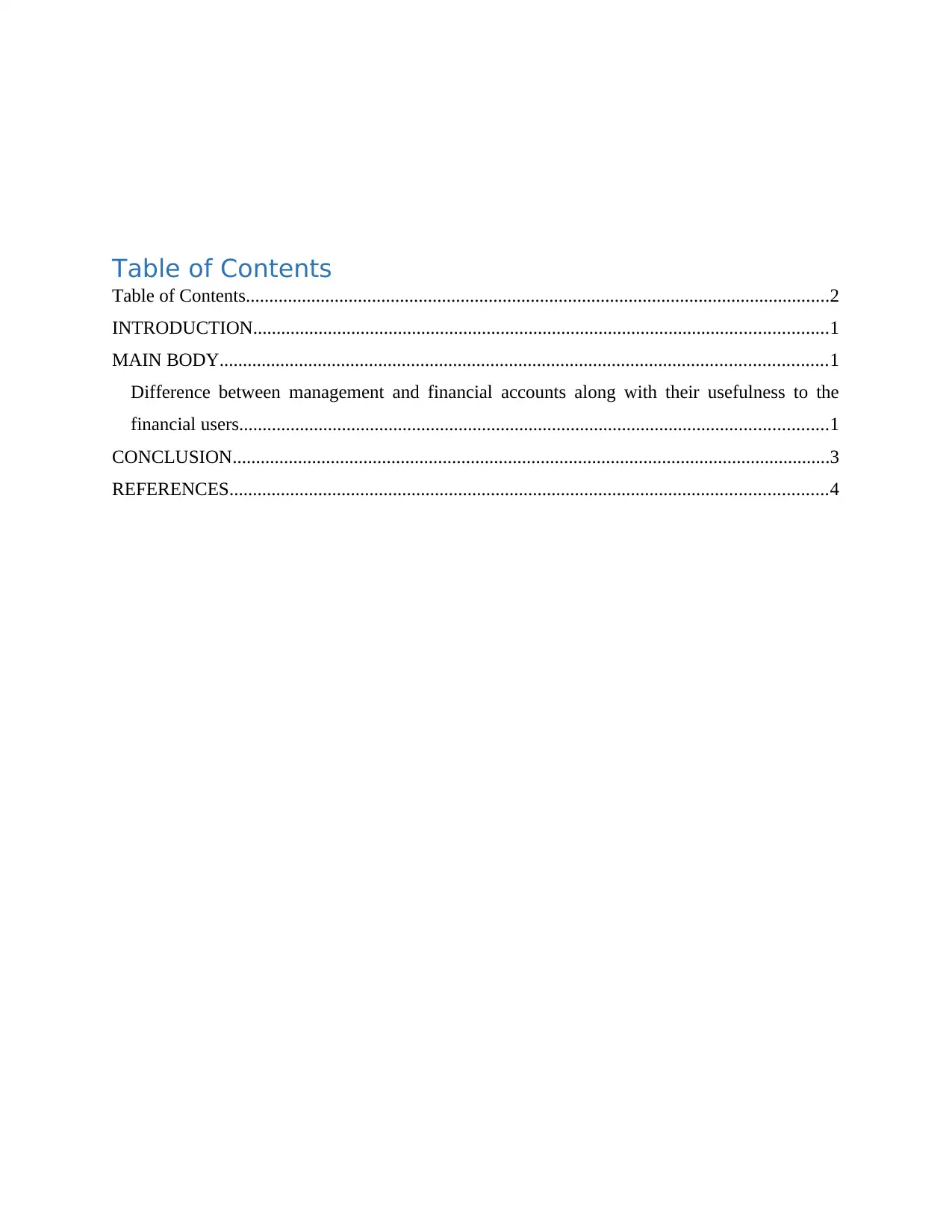
Table of Contents.............................................................................................................................2
INTRODUCTION...........................................................................................................................1
MAIN BODY..................................................................................................................................1
Difference between management and financial accounts along with their usefulness to the
financial users..............................................................................................................................1
CONCLUSION................................................................................................................................3
REFERENCES................................................................................................................................4
Table of Contents.............................................................................................................................2
INTRODUCTION...........................................................................................................................1
MAIN BODY..................................................................................................................................1
Difference between management and financial accounts along with their usefulness to the
financial users..............................................................................................................................1
CONCLUSION................................................................................................................................3
REFERENCES................................................................................................................................4

INTRODUCTION
Business finance can be defined as the monetary resources that are required by an organisation to
perform all its operational activities. With the help of it, all the predetermined goals could be
accomplished successfully (Adhikary and Kutsuna, 2016). Present essay is based upon analysis
of management and financial accounts and their usefulness for the financial users.
MAIN BODY
Difference between management and financial accounts along with their usefulness to the
financial users
Management accounts: These are the internal records that are generated by an
organisation for the purpose of keeping record actual performance of the entity. Main purpose of
them is to deliver accurate information of progress of business to the stakeholders so that they
can formulate strategic decision for future. It is beneficial to determine the cost which is taking
place due to execution of operational activities. These are also created to analyse the actual level
of inventory which is kept by the company or could be required in future to carry out operations
in systematic manner.
Financial accounts: All the accounts that are formulated to keep detailed information of
financial performance are known as financial accounts. Main purpose of them is to analyse that
the entity is able to generate sufficient funds to carry out future activities. There are three
different types of statements that are considered as the part of them. These are income statement,
balance sheet and cash flow statement. All of them can help to analyse profitability, liquidity and
financial performance of the organisation. In order to carry out all the operations properly it is
very important for the enterprises to make sure that they are forming all the final accounts
accurately as it will help to attract large number of investors. These are analysed by external
stakeholders such as investors, creditors, suppliers and government for the purpose of assessing
that business is performing well or not (Bendell and Doyle, 2017).
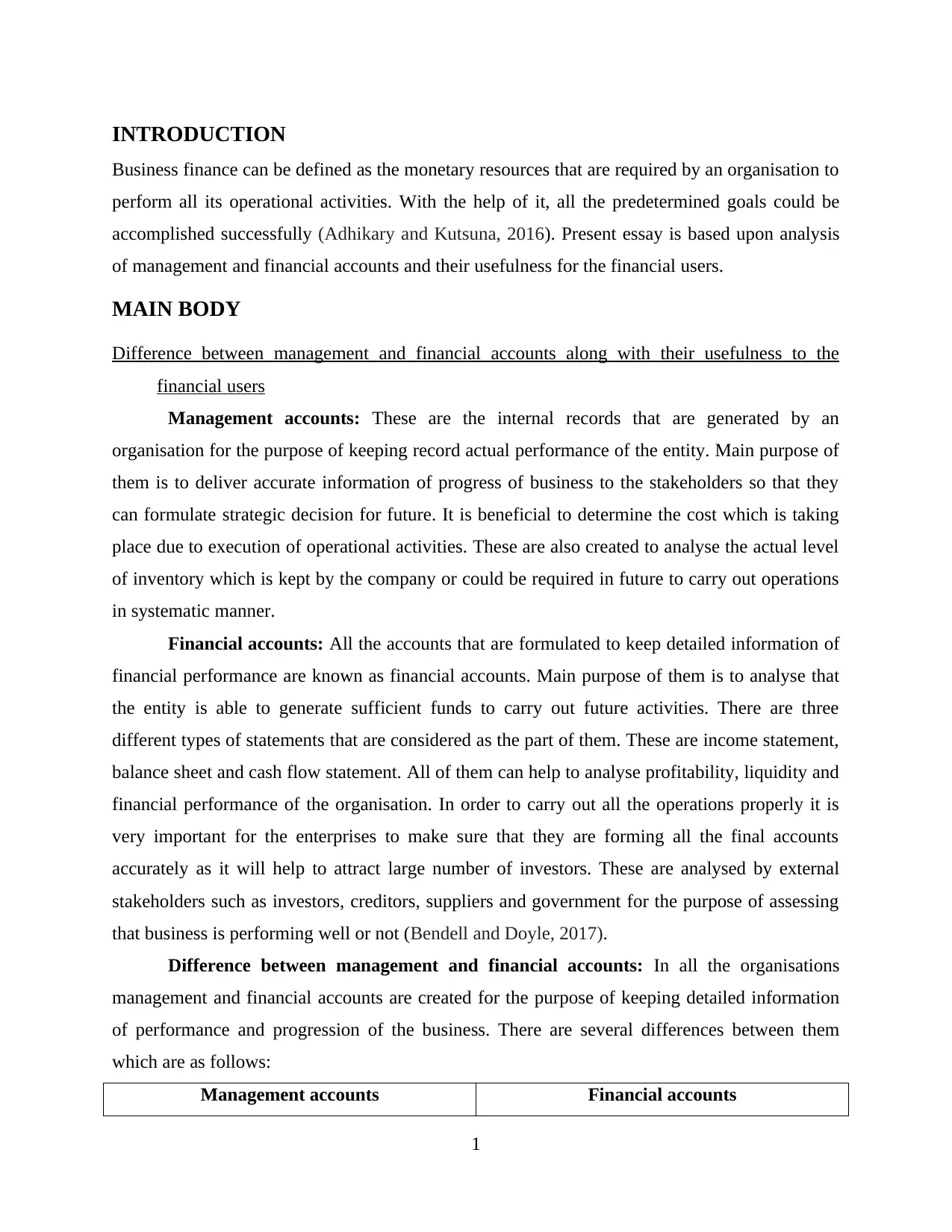
Difference between management and financial accounts: In all the organisations
management and financial accounts are created for the purpose of keeping detailed information
of performance and progression of the business. There are several differences between them
which are as follows:
Management accounts Financial accounts
1
Business finance can be defined as the monetary resources that are required by an organisation to
perform all its operational activities. With the help of it, all the predetermined goals could be
accomplished successfully (Adhikary and Kutsuna, 2016). Present essay is based upon analysis
of management and financial accounts and their usefulness for the financial users.
MAIN BODY
Difference between management and financial accounts along with their usefulness to the
financial users
Management accounts: These are the internal records that are generated by an
organisation for the purpose of keeping record actual performance of the entity. Main purpose of
them is to deliver accurate information of progress of business to the stakeholders so that they
can formulate strategic decision for future. It is beneficial to determine the cost which is taking
place due to execution of operational activities. These are also created to analyse the actual level
of inventory which is kept by the company or could be required in future to carry out operations
in systematic manner.
Financial accounts: All the accounts that are formulated to keep detailed information of
financial performance are known as financial accounts. Main purpose of them is to analyse that
the entity is able to generate sufficient funds to carry out future activities. There are three
different types of statements that are considered as the part of them. These are income statement,
balance sheet and cash flow statement. All of them can help to analyse profitability, liquidity and
financial performance of the organisation. In order to carry out all the operations properly it is
very important for the enterprises to make sure that they are forming all the final accounts
accurately as it will help to attract large number of investors. These are analysed by external
stakeholders such as investors, creditors, suppliers and government for the purpose of assessing
that business is performing well or not (Bendell and Doyle, 2017).
Difference between management and financial accounts: In all the organisations
management and financial accounts are created for the purpose of keeping detailed information
of performance and progression of the business. There are several differences between them
which are as follows:
Management accounts Financial accounts
1
⊘ This is a preview!⊘
Do you want full access?
Subscribe today to unlock all pages.

Trusted by 1+ million students worldwide

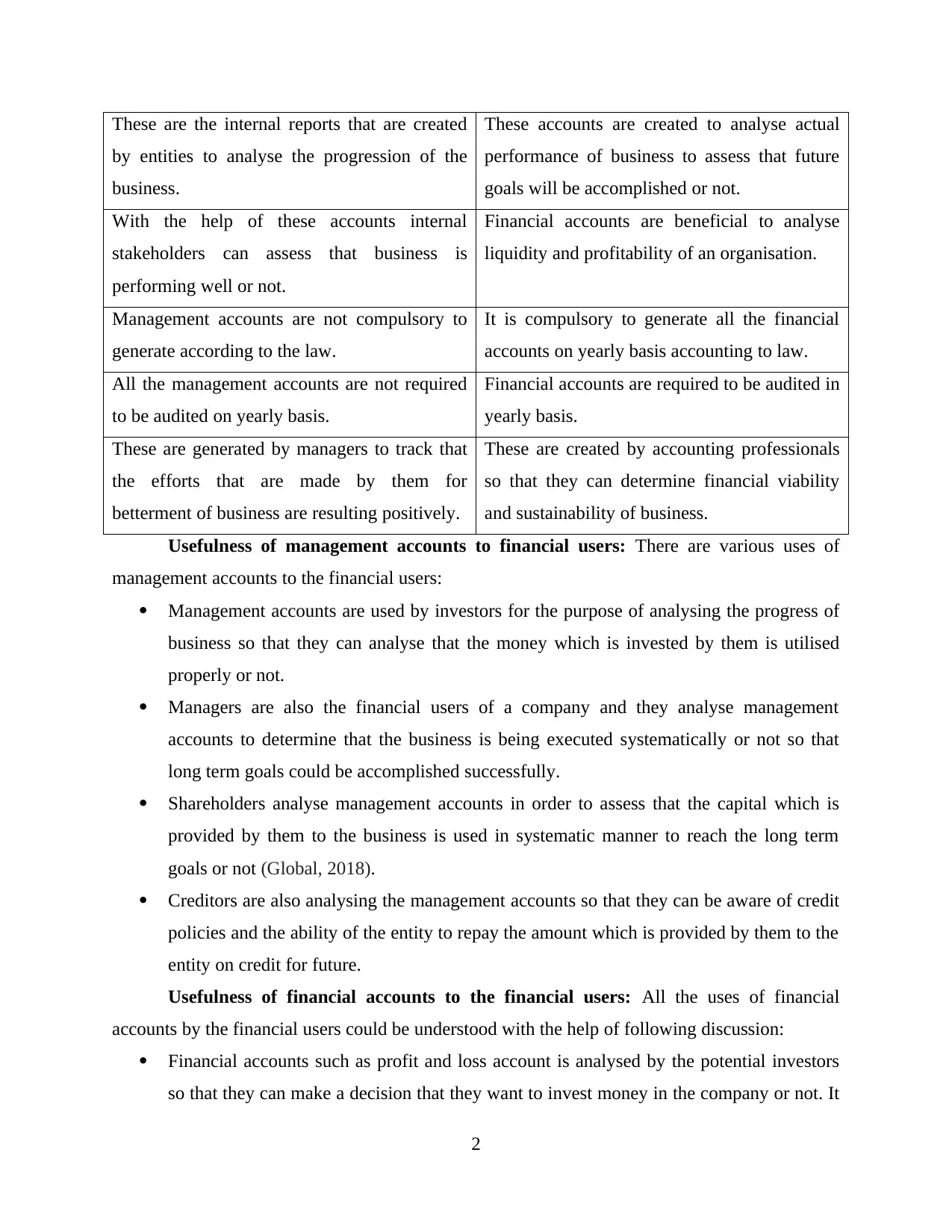
These are the internal reports that are created
by entities to analyse the progression of the
business.
These accounts are created to analyse actual
performance of business to assess that future
goals will be accomplished or not.
With the help of these accounts internal
stakeholders can assess that business is
performing well or not.
Financial accounts are beneficial to analyse
liquidity and profitability of an organisation.
Management accounts are not compulsory to
generate according to the law.
It is compulsory to generate all the financial
accounts on yearly basis accounting to law.
All the management accounts are not required
to be audited on yearly basis.
Financial accounts are required to be audited in
yearly basis.
These are generated by managers to track that
the efforts that are made by them for
betterment of business are resulting positively.
These are created by accounting professionals
so that they can determine financial viability
and sustainability of business.
Usefulness of management accounts to financial users: There are various uses of
management accounts to the financial users:
Management accounts are used by investors for the purpose of analysing the progress of
business so that they can analyse that the money which is invested by them is utilised
properly or not.
Managers are also the financial users of a company and they analyse management
accounts to determine that the business is being executed systematically or not so that
long term goals could be accomplished successfully.
Shareholders analyse management accounts in order to assess that the capital which is
provided by them to the business is used in systematic manner to reach the long term
goals or not (Global, 2018).
Creditors are also analysing the management accounts so that they can be aware of credit
policies and the ability of the entity to repay the amount which is provided by them to the
entity on credit for future.
Usefulness of financial accounts to the financial users: All the uses of financial
accounts by the financial users could be understood with the help of following discussion:
Financial accounts such as profit and loss account is analysed by the potential investors
so that they can make a decision that they want to invest money in the company or not. It
2
by entities to analyse the progression of the
business.
These accounts are created to analyse actual
performance of business to assess that future
goals will be accomplished or not.
With the help of these accounts internal
stakeholders can assess that business is
performing well or not.
Financial accounts are beneficial to analyse
liquidity and profitability of an organisation.
Management accounts are not compulsory to
generate according to the law.
It is compulsory to generate all the financial
accounts on yearly basis accounting to law.
All the management accounts are not required
to be audited on yearly basis.
Financial accounts are required to be audited in
yearly basis.
These are generated by managers to track that
the efforts that are made by them for
betterment of business are resulting positively.
These are created by accounting professionals
so that they can determine financial viability
and sustainability of business.
Usefulness of management accounts to financial users: There are various uses of
management accounts to the financial users:
Management accounts are used by investors for the purpose of analysing the progress of
business so that they can analyse that the money which is invested by them is utilised
properly or not.
Managers are also the financial users of a company and they analyse management
accounts to determine that the business is being executed systematically or not so that
long term goals could be accomplished successfully.
Shareholders analyse management accounts in order to assess that the capital which is
provided by them to the business is used in systematic manner to reach the long term
goals or not (Global, 2018).
Creditors are also analysing the management accounts so that they can be aware of credit
policies and the ability of the entity to repay the amount which is provided by them to the
entity on credit for future.
Usefulness of financial accounts to the financial users: All the uses of financial
accounts by the financial users could be understood with the help of following discussion:
Financial accounts such as profit and loss account is analysed by the potential investors
so that they can make a decision that they want to invest money in the company or not. It
2
Paraphrase This Document
Need a fresh take? Get an instant paraphrase of this document with our AI Paraphraser

helps them to analyse ability of the entity to pay them interest in future on the amount
which will be invested by them. If the profitability is low then they avoid to invest money
in the business.
Suppliers are also the financial information users who analyse the balance sheet of a
company before supplying the goods to it as they determine that the entity will be able to
pay the amount of supplied goods on time or not. If they analyse that liquidity or
financial position of the entity is not good then they do not deliver the inventory to the
organisation.
Government is also considered as the financial users of a company because detailed
information of business’s financial stability is assessed by legal authorities to determine
that appropriate tax is paid by the organisation or not (Kennickell, Kwast and Pogach,
2016).
Customers are such financial users of the financial information who remain the part of an
organisation if it is performing well in the market. For this purpose, financial position of
the company is analysed by them so that they can formulate best decisions for them.
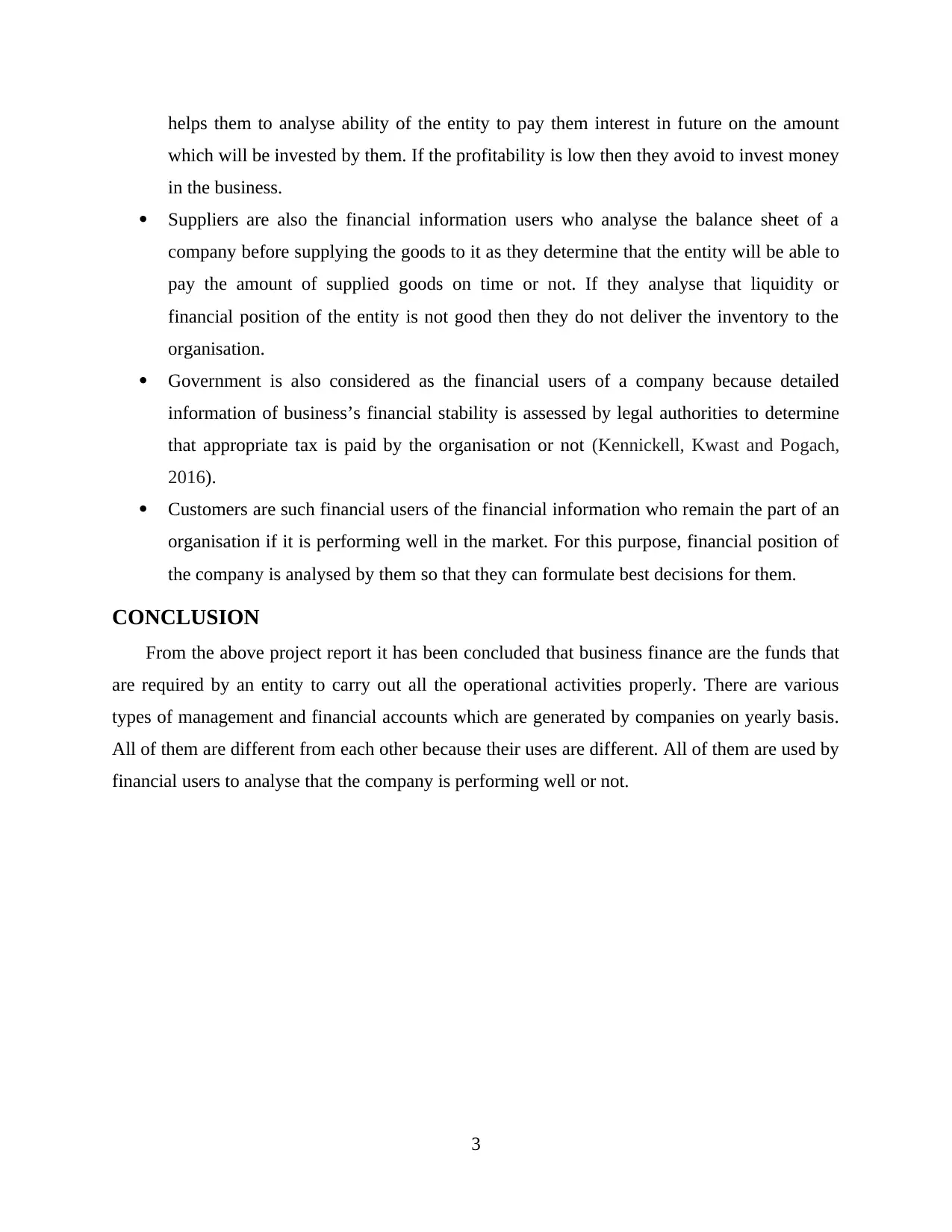
CONCLUSION
From the above project report it has been concluded that business finance are the funds that
are required by an entity to carry out all the operational activities properly. There are various
types of management and financial accounts which are generated by companies on yearly basis.
All of them are different from each other because their uses are different. All of them are used by
financial users to analyse that the company is performing well or not.
3
which will be invested by them. If the profitability is low then they avoid to invest money
in the business.
Suppliers are also the financial information users who analyse the balance sheet of a
company before supplying the goods to it as they determine that the entity will be able to
pay the amount of supplied goods on time or not. If they analyse that liquidity or
financial position of the entity is not good then they do not deliver the inventory to the
organisation.
Government is also considered as the financial users of a company because detailed
information of business’s financial stability is assessed by legal authorities to determine
that appropriate tax is paid by the organisation or not (Kennickell, Kwast and Pogach,
2016).
Customers are such financial users of the financial information who remain the part of an
organisation if it is performing well in the market. For this purpose, financial position of
the company is analysed by them so that they can formulate best decisions for them.
CONCLUSION
From the above project report it has been concluded that business finance are the funds that
are required by an entity to carry out all the operational activities properly. There are various
types of management and financial accounts which are generated by companies on yearly basis.
All of them are different from each other because their uses are different. All of them are used by
financial users to analyse that the company is performing well or not.
3

REFERENCES
Books and Journals:
Adhikary, B. and Kutsuna, K., 2016. Small Business Finance in Bangladesh:
Can'Crowdfunding'Be an Alternative?. Review of Integrative Business and Economics
Research, 4, pp.1-21.
Bendell, J. and Doyle, I., 2017. Healing capitalism: five years in the life of business, finance and
corporate responsibility. Routledge.
Global, A. C. C. A., 2018. Business Finance.
Kennickell, A. B., Kwast, M. L. and Pogach, J., 2016. Small businesses and small business
finance during the financial crisis and the great recession: New evidence from the
survey of consumer finances. In Measuring Entrepreneurial Businesses: Current
Knowledge and Challenges (pp. 291-349). University of Chicago Press.
4
Books and Journals:
Adhikary, B. and Kutsuna, K., 2016. Small Business Finance in Bangladesh:
Can'Crowdfunding'Be an Alternative?. Review of Integrative Business and Economics
Research, 4, pp.1-21.
Bendell, J. and Doyle, I., 2017. Healing capitalism: five years in the life of business, finance and
corporate responsibility. Routledge.
Global, A. C. C. A., 2018. Business Finance.
Kennickell, A. B., Kwast, M. L. and Pogach, J., 2016. Small businesses and small business
finance during the financial crisis and the great recession: New evidence from the
survey of consumer finances. In Measuring Entrepreneurial Businesses: Current
Knowledge and Challenges (pp. 291-349). University of Chicago Press.
4
⊘ This is a preview!⊘
Do you want full access?
Subscribe today to unlock all pages.

Trusted by 1+ million students worldwide
1 out of 6
Related Documents
Your All-in-One AI-Powered Toolkit for Academic Success.
+13062052269
info@desklib.com
Available 24*7 on WhatsApp / Email
Unlock your academic potential
Copyright © 2020–2025 A2Z Services. All Rights Reserved. Developed and managed by ZUCOL.