Managerial Roles & IT Systems: A Report on Organizational Progression

Verified

Added on  2023/06/13

|10
|1753
|200
Report
AI Summary
This report examines the relationship between managers and the information systems they utilize as they progress within an organization. It delves into the different levels of management, including top-level, middle-level, and first-level managers, and describes how each level interacts with various information systems. The report highlights four key types of information systems: Transaction Processing Systems (TPS), Customer Relationship Management (CRM), Business Intelligence Systems (BIS), and Knowledge Management Systems (KMS), detailing how managers leverage these systems for data collection, decision-making, customer interaction, and knowledge retention. Ultimately, the report emphasizes the crucial role of these systems in supporting managers and enhancing organizational efficiency.
Document Page
RUNNING HEAD: ICT
ICT
Name of the Student
Name of the University
Authors Note:
tabler-icon-diamond-filled.svg

Paraphrase This Document

Need a fresh take? Get an instant paraphrase of this document with our AI Paraphraser
Document Page
1ICT
Executive summary
The development of the information system in last few years has been used by managers for
implementing a decision in the organization. Management information system is a well-known
decision-making tool. A manager makes use of MIS for carrying out the business operation and
process in an organization. Organization management generally refers to the method of getting
people together as a team and focus them working towards a common goal in an organization.
Document Page
2ICT
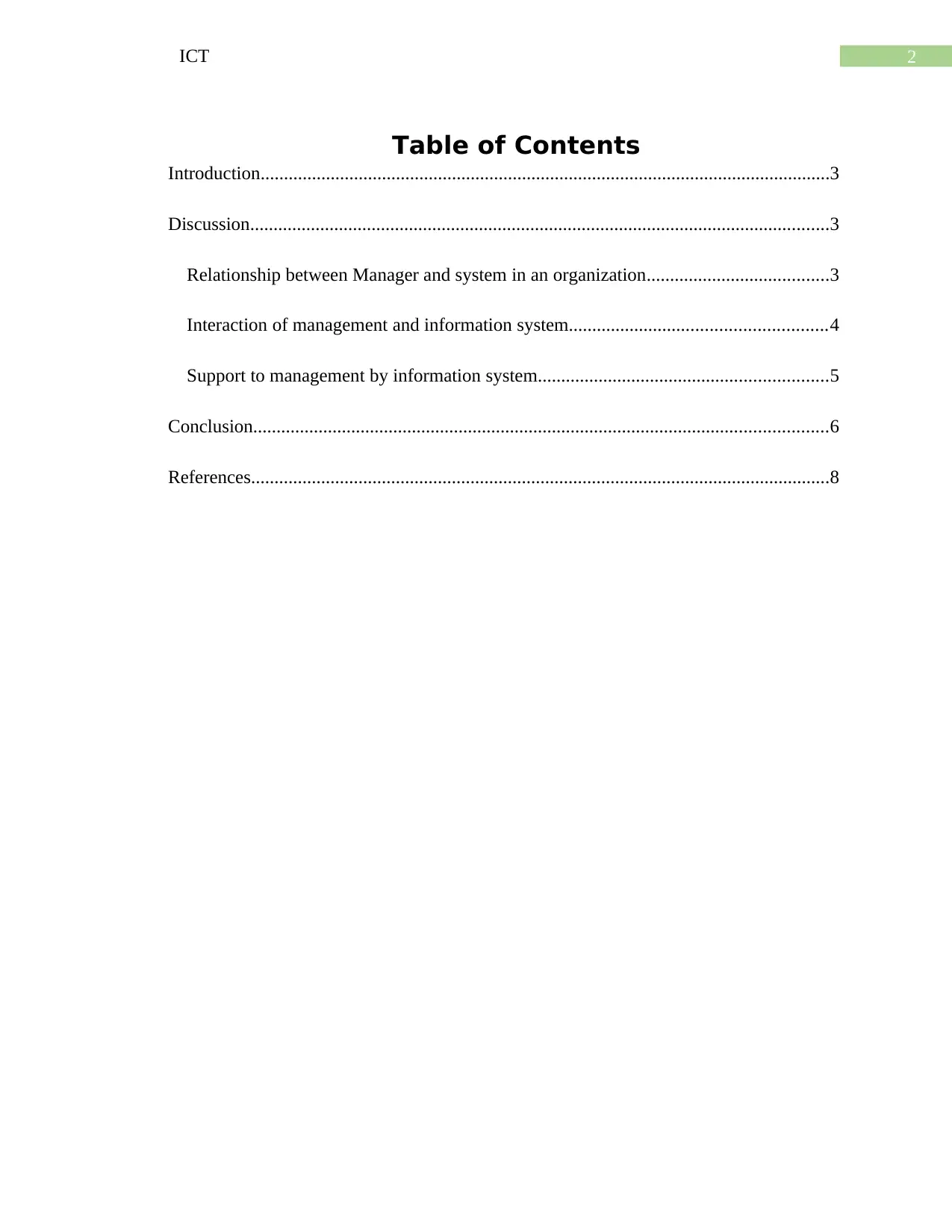
Table of Contents
Introduction..........................................................................................................................3
Discussion............................................................................................................................3
Relationship between Manager and system in an organization.......................................3
Interaction of management and information system.......................................................4
Support to management by information system..............................................................5
Conclusion...........................................................................................................................6
References............................................................................................................................8
Document Page
3ICT
Introduction
A Manager is known to be an expert in his or her domain, they tend to provide support to
a large number of employees working in an organization. Managers work in a business together
as a team for achieving goals and objective of an organization. Managers of various organization
around the globe make use of four basic kinds of system that is transaction processing system
(TPS), customer relationship management, business intelligence system, knowledge management
system (Laudon and Laudon, 2016). This information system is used by managers as he
progresses through an organization. Management support system (MSS) generally creates
visibility and ensures sustainability by providing a framework for people, process, and system.
MSS is mainly used for managing the business process by making use of input and output link
along with the different level of management in an organization.
In the coming pages of the report, the various level of management has been discussed in
details. After that various kind of the information system used by managers in the organization
has been discussed briefly.
Discussion
The relationship between Manager and system in an organization
Management of various organization around the globe makes use of Management
information system for gathering of data from the various online system. After that analyzing of
information is done which ultimately helps in decision making. Growth in system based
information technology in last few years has been used by managers for making and
implementing a large number of decisions. The difference of level of success and failure in an
organization is the extent to which manager can make effective use of various kinds of system
tabler-icon-diamond-filled.svg

Paraphrase This Document

Need a fresh take? Get an instant paraphrase of this document with our AI Paraphraser
Document Page
4ICT
(Galliers and Leidner, 2014). Various organization around the globe make use of information
system for interacting with various customers and partners so that organization can easily have
generated cost and revenue.
Interaction of management and information system
Transaction processing system is generally needed for collection of data, storage,
processing and outputting of facilities for the proper operations of a business (Abbasi, Sarker and
Chiang, 2016). In this system data is collected from various kinds of user inputs and after that
output is provided from the data which is collected. TPS is generally based on real-time or batch
processing and can easily help business owners to meet the ongoing demands without any need
of any person. Various kinds of business owners and organization around the globe make use of
customer relationship model for synchronization of various kinds of sales and marketing efforts
(Abbasi, Sarker and Chiang, 2016).
CRM system can easily track various kinds of customer activities like purchasing trend,
defects of product and inquiries of various customers. CRM is used by managers for creating a
platform where customers can easily interact with the various organization for services and
feedback and solution to a given problem (Kavanagh and Johnson, 2017). The various
organization can easily make use of CRM system components internally as a component of
collaboration strategies. CRM system can easily interact with other personnel for interacting with
other for the development of ideas and various kinds of products.
Business systems can be considered to be complex as they can easily identify and analyze
data for various kinds of operational needs like decision making. BIS information system can
easily predict the pattern of future sales, add up current cost and can easily forecast various kinds
of sales revenue (Galliers and Leidner, 2014). Managers make use of this system for collecting
Document Page
5ICT
data from a different warehouse in an organization. It can easily provide management with
analysis as per lines of business, department for the breakdown of management desires. In an
organization, this system can be used for determining the probability of defaults in the loan.
Knowledge management system can easily organize and dissect various kinds of
knowledge followed by share it with an individual with an organization (Power, Sharda, and
Burstein, 2015). The ultimate aim of this information system is to bring innovation, integration,
performance and retaining of knowledge in an organization. Managers in the small and large
organization can easily make use of information system for harvesting knowledge. KMS
information system can easily use for retention of information in a standard way (Pearlson,
Saunders and Galletta, 2016). This particular system can easily help the business owners for
maintaining consistency and also enables speedy response to different customers.
Support to management by the information system
Management information system plays an important role in the smooth operation of an
organization. The reason behind the use of information system is that provides a lot of support to
employees of an organization. MIS generally claims to provide a high-level efficiency in the
management of the operation of an organization. The above-mentioned information like
transaction processing system, knowledge management system, customer relationship
management and business information system help the manager for properly managing the
organization.
Managers are nothing but organization members who are responsible for work
performance of other kinds of organization members (Galliers and Leidner, 2014). The manager
has right and authority to make use of organizational resource and take a decision. There is
generally three level of management that is a top-level manager, middle-level manager, and
Document Page
6ICT
lastly first level managers.Top level managers are also known as senior management or
executive. This kind of individual is considered to be top one or two level in an organization.
The decision taken by top-level managers can easily affect the entire firm (Power, Sharda, and
Burstein, 2015).
Top level managers are not involved in the day to day activities rather than they set goals
for the organization. They direct the staff to achieve the goal which is set by them. Top level
managers are mostly responsible for the performance of an organization (Mai et al., 2017). Top
level managers are considered to have the best kind of experience as they have moved through
the ranks of various management with an organization.
Middle-level managers are those people who are under top-level management. Middle-
level managers are mainly depended for carrying out of a number of goals which is set by an
organization (Power, Sharda, and Burstein, 2015). Middle managers can easily motivate and
provide assistance to middle-level managers for achieving various kinds of business objectives.
Middle-level managers can easily communicate by providing feedback to top-level managers.
Supervising the size of the group of employees totally depends on the size of the organization.
The first level of management is generally responsible for daily management of line
works like employees who produce the various kinds of product or service. First level managers
do not any kind of goal for any organization (Power, Sharda, and Burstein, 2015). With this kind
of manager employees generally, interact on daily basis. And if this kind of manager performs
poorly then it can demotivate the various kinds of employees working in the organization.
tabler-icon-diamond-filled.svg

Paraphrase This Document

Need a fresh take? Get an instant paraphrase of this document with our AI Paraphraser
Document Page
7ICT
Conclusion
From the above discussion, it can be easily be concluded that this report is all about the
relationship of manager with various kinds of information system in an organization. In the
above pages of the report, four kinds of information system namely transaction processing
system, customer relationship management, knowledge management system and business
intelligence system has been discussed in details. Various level of management in an
organization has been discussed in the report. Three main level of management that is top-level
managers, middle-level manager and first level managers has been discussed briefly in the
report.
Document Page
8ICT
References
Abbasi, A., Sarker, S. and Chiang, R.H., 2016. Big data research in information systems: Toward
an inclusive research agenda. Journal of the Association for Information Systems, 17(2).
Galliers, R.D. and Leidner, D.E. eds., 2014. Strategic information management: challenges and
strategies in managing information systems. Routledge.
Kavanagh, M.J. and Johnson, R.D. eds., 2017. Human resource information systems: Basics,
applications, and future directions. Sage Publications.
Laudon, K.C. and Laudon, J.P., 2016. Management information system. Pearson Education
India.
Lee, S.S., 2014. Management information systems. Management, 166137(01), p.02.
Mai, B., Parsons, T., Prybutok, V. and Namuduri, K., 2017. Neuroscience foundations for human
decision making in information security: a general framework and experiment design.
In Information Systems and Neuroscience (pp. 91-98). Springer, Cham.
Pearlson, K.E., Saunders, C.S. and Galletta, D.F., 2016. Managing and Using Information
Systems, Binder Ready Version: A Strategic Approach. John Wiley & Sons.
Power, D.J., Sharda, R. and Burstein, F., 2015. Decision support systems. John Wiley & Sons,
Ltd.
Document Page
9ICT
chevron_up_icon
1 out of 10
circle_padding
hide_on_mobile
zoom_out_icon
[object Object]