Accruals and Earnings Management: Techniques and Manipulation
VerifiedAdded on 2022/11/02
|6
|1445
|474
Essay
AI Summary
This essay explores the concept of accruals and how managers utilize them to manipulate the quality of earnings. It begins by highlighting the importance of earnings for stakeholders and the incentives managers have to meet or exceed analyst forecasts. The discussion covers various techniques, including real transaction structuring and accrual-based earnings management. The essay differentiates between discretionary and non-discretionary accruals, providing examples of how managers use discretionary accruals to inflate or deflate earnings. It also references research on the impact of regulations like the Sarbanes-Oxley Act. The conclusion emphasizes the global prevalence of earnings management and its dependence on regulatory frameworks. Overall, the essay offers a detailed examination of how accruals are used in financial reporting to influence the perception of a company's financial performance.

What are accruals and how can managers
manipulate the quality of earnings?
1
manipulate the quality of earnings?
1
Paraphrase This Document
Need a fresh take? Get an instant paraphrase of this document with our AI Paraphraser

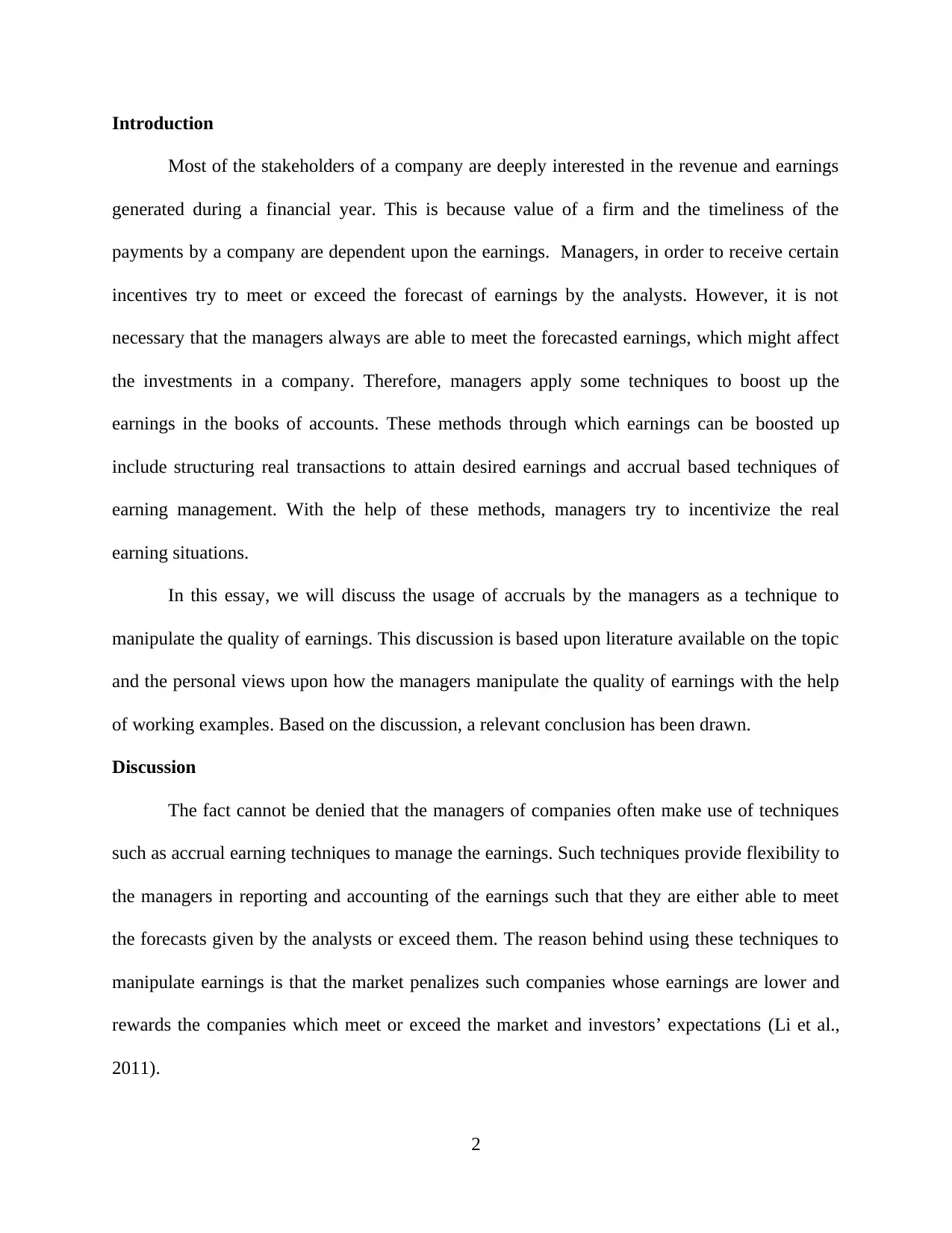
Introduction
Most of the stakeholders of a company are deeply interested in the revenue and earnings
generated during a financial year. This is because value of a firm and the timeliness of the
payments by a company are dependent upon the earnings. Managers, in order to receive certain
incentives try to meet or exceed the forecast of earnings by the analysts. However, it is not
necessary that the managers always are able to meet the forecasted earnings, which might affect
the investments in a company. Therefore, managers apply some techniques to boost up the
earnings in the books of accounts. These methods through which earnings can be boosted up
include structuring real transactions to attain desired earnings and accrual based techniques of
earning management. With the help of these methods, managers try to incentivize the real
earning situations.
In this essay, we will discuss the usage of accruals by the managers as a technique to
manipulate the quality of earnings. This discussion is based upon literature available on the topic
and the personal views upon how the managers manipulate the quality of earnings with the help
of working examples. Based on the discussion, a relevant conclusion has been drawn.
Discussion
The fact cannot be denied that the managers of companies often make use of techniques
such as accrual earning techniques to manage the earnings. Such techniques provide flexibility to
the managers in reporting and accounting of the earnings such that they are either able to meet
the forecasts given by the analysts or exceed them. The reason behind using these techniques to
manipulate earnings is that the market penalizes such companies whose earnings are lower and
rewards the companies which meet or exceed the market and investors’ expectations (Li et al.,
2011).
2
Most of the stakeholders of a company are deeply interested in the revenue and earnings
generated during a financial year. This is because value of a firm and the timeliness of the
payments by a company are dependent upon the earnings. Managers, in order to receive certain
incentives try to meet or exceed the forecast of earnings by the analysts. However, it is not
necessary that the managers always are able to meet the forecasted earnings, which might affect
the investments in a company. Therefore, managers apply some techniques to boost up the
earnings in the books of accounts. These methods through which earnings can be boosted up
include structuring real transactions to attain desired earnings and accrual based techniques of
earning management. With the help of these methods, managers try to incentivize the real
earning situations.
In this essay, we will discuss the usage of accruals by the managers as a technique to
manipulate the quality of earnings. This discussion is based upon literature available on the topic
and the personal views upon how the managers manipulate the quality of earnings with the help
of working examples. Based on the discussion, a relevant conclusion has been drawn.
Discussion
The fact cannot be denied that the managers of companies often make use of techniques
such as accrual earning techniques to manage the earnings. Such techniques provide flexibility to
the managers in reporting and accounting of the earnings such that they are either able to meet
the forecasts given by the analysts or exceed them. The reason behind using these techniques to
manipulate earnings is that the market penalizes such companies whose earnings are lower and
rewards the companies which meet or exceed the market and investors’ expectations (Li et al.,
2011).
2

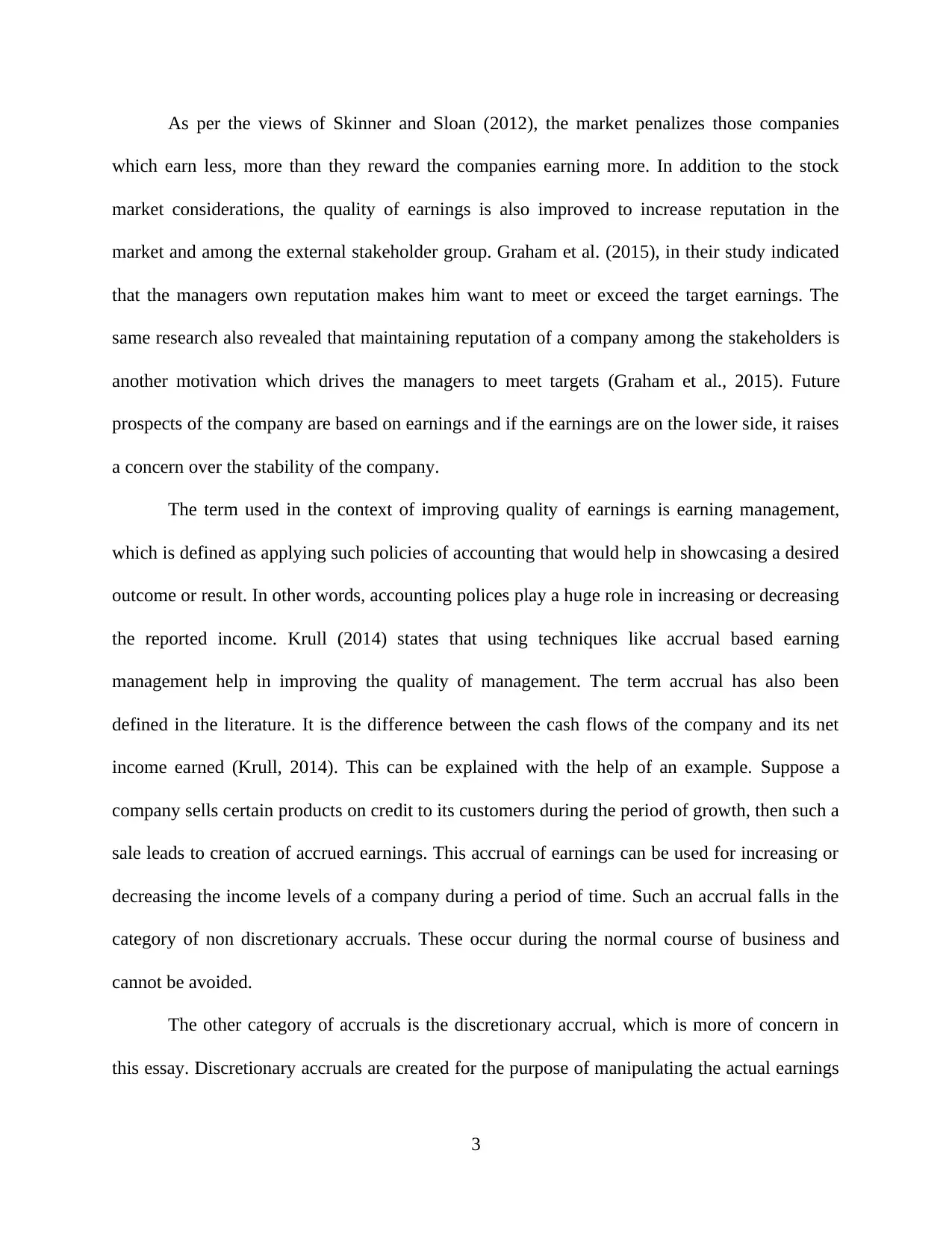
As per the views of Skinner and Sloan (2012), the market penalizes those companies
which earn less, more than they reward the companies earning more. In addition to the stock
market considerations, the quality of earnings is also improved to increase reputation in the
market and among the external stakeholder group. Graham et al. (2015), in their study indicated
that the managers own reputation makes him want to meet or exceed the target earnings. The
same research also revealed that maintaining reputation of a company among the stakeholders is
another motivation which drives the managers to meet targets (Graham et al., 2015). Future
prospects of the company are based on earnings and if the earnings are on the lower side, it raises
a concern over the stability of the company.
The term used in the context of improving quality of earnings is earning management,
which is defined as applying such policies of accounting that would help in showcasing a desired
outcome or result. In other words, accounting polices play a huge role in increasing or decreasing
the reported income. Krull (2014) states that using techniques like accrual based earning
management help in improving the quality of management. The term accrual has also been
defined in the literature. It is the difference between the cash flows of the company and its net
income earned (Krull, 2014). This can be explained with the help of an example. Suppose a
company sells certain products on credit to its customers during the period of growth, then such a
sale leads to creation of accrued earnings. This accrual of earnings can be used for increasing or
decreasing the income levels of a company during a period of time. Such an accrual falls in the
category of non discretionary accruals. These occur during the normal course of business and
cannot be avoided.
The other category of accruals is the discretionary accrual, which is more of concern in
this essay. Discretionary accruals are created for the purpose of manipulating the actual earnings
3
which earn less, more than they reward the companies earning more. In addition to the stock
market considerations, the quality of earnings is also improved to increase reputation in the
market and among the external stakeholder group. Graham et al. (2015), in their study indicated
that the managers own reputation makes him want to meet or exceed the target earnings. The
same research also revealed that maintaining reputation of a company among the stakeholders is
another motivation which drives the managers to meet targets (Graham et al., 2015). Future
prospects of the company are based on earnings and if the earnings are on the lower side, it raises
a concern over the stability of the company.
The term used in the context of improving quality of earnings is earning management,
which is defined as applying such policies of accounting that would help in showcasing a desired
outcome or result. In other words, accounting polices play a huge role in increasing or decreasing
the reported income. Krull (2014) states that using techniques like accrual based earning
management help in improving the quality of management. The term accrual has also been
defined in the literature. It is the difference between the cash flows of the company and its net
income earned (Krull, 2014). This can be explained with the help of an example. Suppose a
company sells certain products on credit to its customers during the period of growth, then such a
sale leads to creation of accrued earnings. This accrual of earnings can be used for increasing or
decreasing the income levels of a company during a period of time. Such an accrual falls in the
category of non discretionary accruals. These occur during the normal course of business and
cannot be avoided.
The other category of accruals is the discretionary accrual, which is more of concern in
this essay. Discretionary accruals are created for the purpose of manipulating the actual earnings
3
⊘ This is a preview!⊘
Do you want full access?
Subscribe today to unlock all pages.

Trusted by 1+ million students worldwide

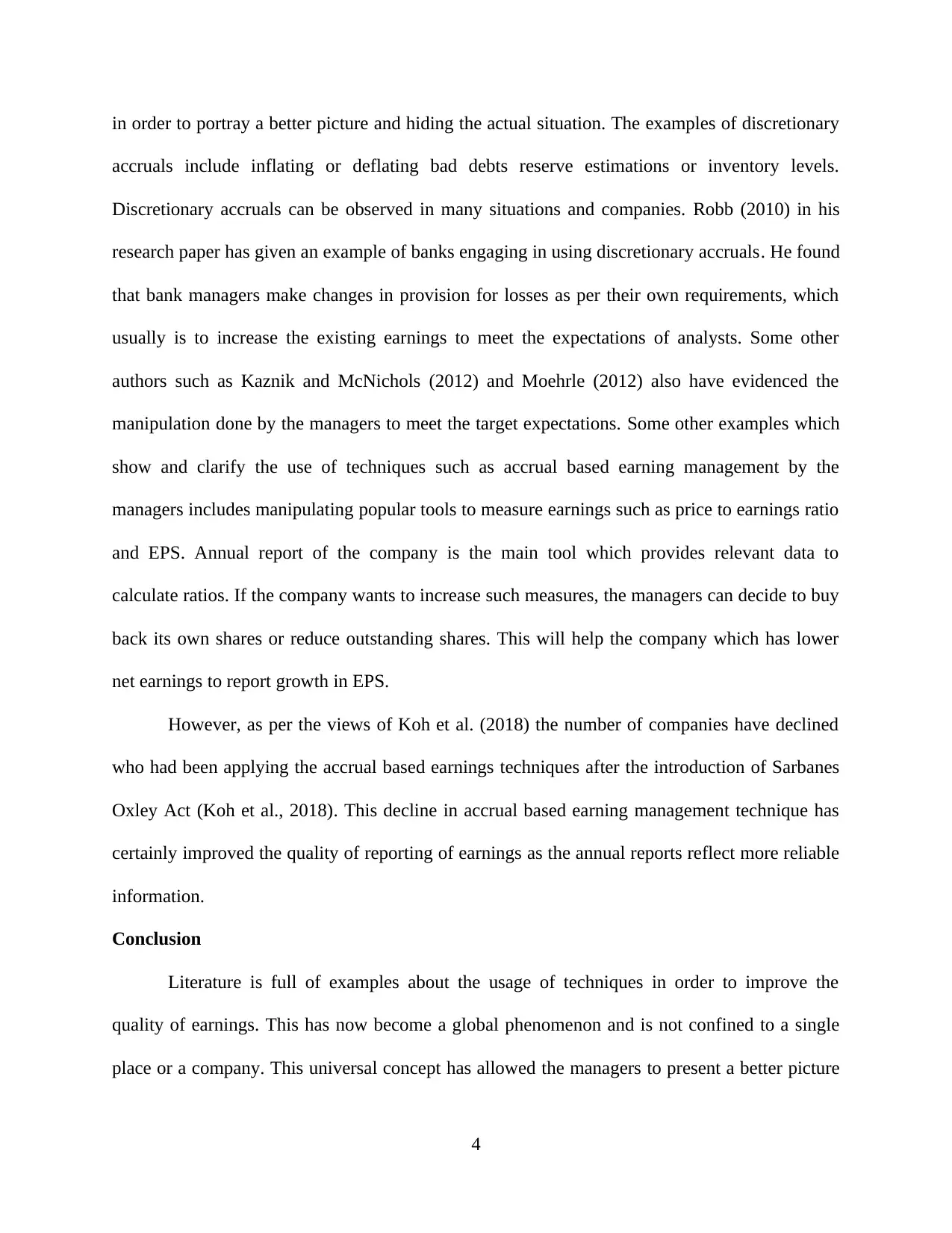
in order to portray a better picture and hiding the actual situation. The examples of discretionary
accruals include inflating or deflating bad debts reserve estimations or inventory levels.
Discretionary accruals can be observed in many situations and companies. Robb (2010) in his
research paper has given an example of banks engaging in using discretionary accruals. He found
that bank managers make changes in provision for losses as per their own requirements, which
usually is to increase the existing earnings to meet the expectations of analysts. Some other
authors such as Kaznik and McNichols (2012) and Moehrle (2012) also have evidenced the
manipulation done by the managers to meet the target expectations. Some other examples which
show and clarify the use of techniques such as accrual based earning management by the
managers includes manipulating popular tools to measure earnings such as price to earnings ratio
and EPS. Annual report of the company is the main tool which provides relevant data to
calculate ratios. If the company wants to increase such measures, the managers can decide to buy
back its own shares or reduce outstanding shares. This will help the company which has lower
net earnings to report growth in EPS.
However, as per the views of Koh et al. (2018) the number of companies have declined
who had been applying the accrual based earnings techniques after the introduction of Sarbanes
Oxley Act (Koh et al., 2018). This decline in accrual based earning management technique has
certainly improved the quality of reporting of earnings as the annual reports reflect more reliable
information.
Conclusion
Literature is full of examples about the usage of techniques in order to improve the
quality of earnings. This has now become a global phenomenon and is not confined to a single
place or a company. This universal concept has allowed the managers to present a better picture
4
accruals include inflating or deflating bad debts reserve estimations or inventory levels.
Discretionary accruals can be observed in many situations and companies. Robb (2010) in his
research paper has given an example of banks engaging in using discretionary accruals. He found
that bank managers make changes in provision for losses as per their own requirements, which
usually is to increase the existing earnings to meet the expectations of analysts. Some other
authors such as Kaznik and McNichols (2012) and Moehrle (2012) also have evidenced the
manipulation done by the managers to meet the target expectations. Some other examples which
show and clarify the use of techniques such as accrual based earning management by the
managers includes manipulating popular tools to measure earnings such as price to earnings ratio
and EPS. Annual report of the company is the main tool which provides relevant data to
calculate ratios. If the company wants to increase such measures, the managers can decide to buy
back its own shares or reduce outstanding shares. This will help the company which has lower
net earnings to report growth in EPS.
However, as per the views of Koh et al. (2018) the number of companies have declined
who had been applying the accrual based earnings techniques after the introduction of Sarbanes
Oxley Act (Koh et al., 2018). This decline in accrual based earning management technique has
certainly improved the quality of reporting of earnings as the annual reports reflect more reliable
information.
Conclusion
Literature is full of examples about the usage of techniques in order to improve the
quality of earnings. This has now become a global phenomenon and is not confined to a single
place or a company. This universal concept has allowed the managers to present a better picture
4
Paraphrase This Document
Need a fresh take? Get an instant paraphrase of this document with our AI Paraphraser

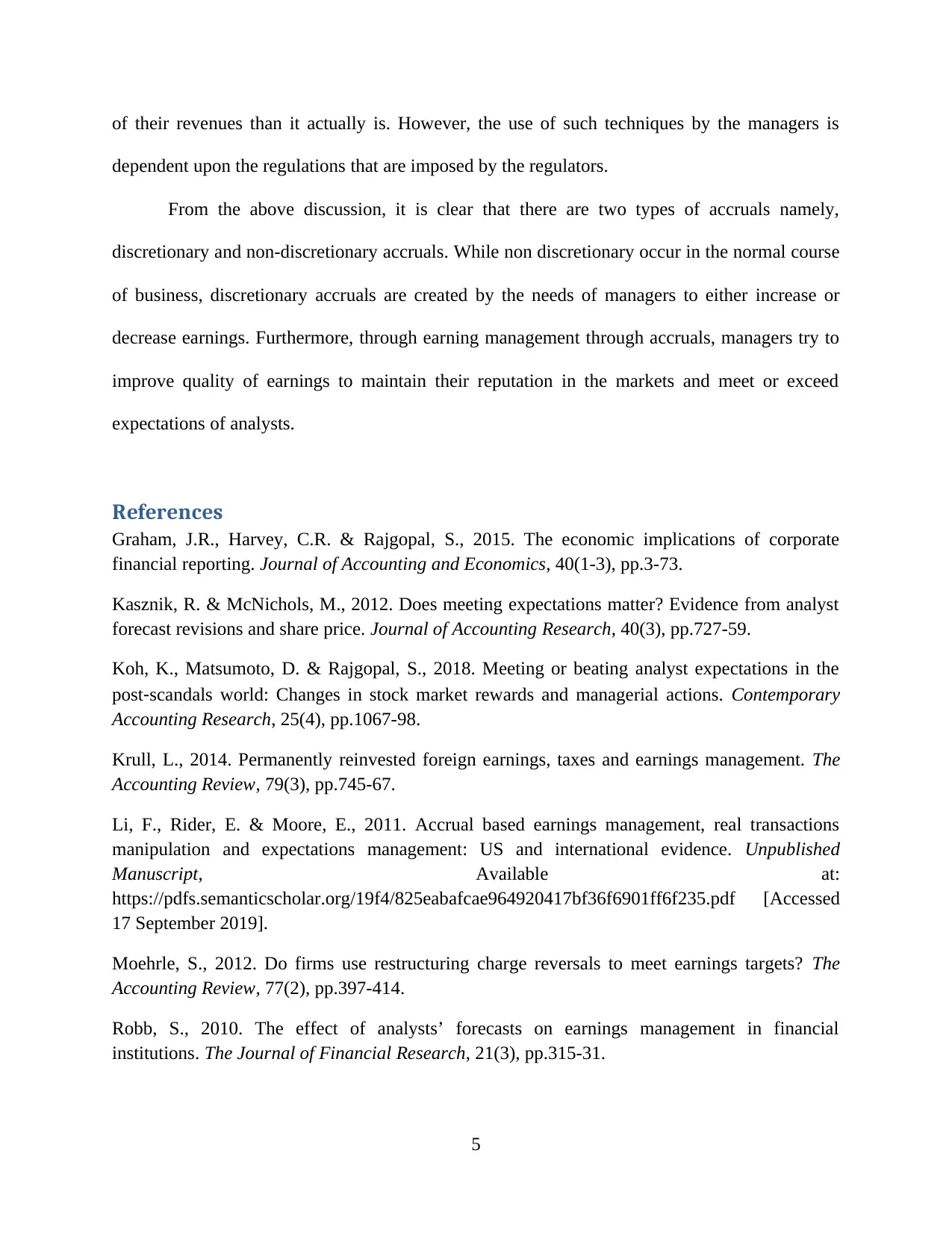
of their revenues than it actually is. However, the use of such techniques by the managers is
dependent upon the regulations that are imposed by the regulators.
From the above discussion, it is clear that there are two types of accruals namely,
discretionary and non-discretionary accruals. While non discretionary occur in the normal course
of business, discretionary accruals are created by the needs of managers to either increase or
decrease earnings. Furthermore, through earning management through accruals, managers try to
improve quality of earnings to maintain their reputation in the markets and meet or exceed
expectations of analysts.
References
Graham, J.R., Harvey, C.R. & Rajgopal, S., 2015. The economic implications of corporate
financial reporting. Journal of Accounting and Economics, 40(1-3), pp.3-73.
Kasznik, R. & McNichols, M., 2012. Does meeting expectations matter? Evidence from analyst
forecast revisions and share price. Journal of Accounting Research, 40(3), pp.727-59.
Koh, K., Matsumoto, D. & Rajgopal, S., 2018. Meeting or beating analyst expectations in the
post‐scandals world: Changes in stock market rewards and managerial actions. Contemporary
Accounting Research, 25(4), pp.1067-98.
Krull, L., 2014. Permanently reinvested foreign earnings, taxes and earnings management. The
Accounting Review, 79(3), pp.745-67.
Li, F., Rider, E. & Moore, E., 2011. Accrual based earnings management, real transactions
manipulation and expectations management: US and international evidence. Unpublished
Manuscript, Available at:
https://pdfs.semanticscholar.org/19f4/825eabafcae964920417bf36f6901ff6f235.pdf [Accessed
17 September 2019].
Moehrle, S., 2012. Do firms use restructuring charge reversals to meet earnings targets? The
Accounting Review, 77(2), pp.397-414.
Robb, S., 2010. The effect of analysts’ forecasts on earnings management in financial
institutions. The Journal of Financial Research, 21(3), pp.315-31.
5
dependent upon the regulations that are imposed by the regulators.
From the above discussion, it is clear that there are two types of accruals namely,
discretionary and non-discretionary accruals. While non discretionary occur in the normal course
of business, discretionary accruals are created by the needs of managers to either increase or
decrease earnings. Furthermore, through earning management through accruals, managers try to
improve quality of earnings to maintain their reputation in the markets and meet or exceed
expectations of analysts.
References
Graham, J.R., Harvey, C.R. & Rajgopal, S., 2015. The economic implications of corporate
financial reporting. Journal of Accounting and Economics, 40(1-3), pp.3-73.
Kasznik, R. & McNichols, M., 2012. Does meeting expectations matter? Evidence from analyst
forecast revisions and share price. Journal of Accounting Research, 40(3), pp.727-59.
Koh, K., Matsumoto, D. & Rajgopal, S., 2018. Meeting or beating analyst expectations in the
post‐scandals world: Changes in stock market rewards and managerial actions. Contemporary
Accounting Research, 25(4), pp.1067-98.
Krull, L., 2014. Permanently reinvested foreign earnings, taxes and earnings management. The
Accounting Review, 79(3), pp.745-67.
Li, F., Rider, E. & Moore, E., 2011. Accrual based earnings management, real transactions
manipulation and expectations management: US and international evidence. Unpublished
Manuscript, Available at:
https://pdfs.semanticscholar.org/19f4/825eabafcae964920417bf36f6901ff6f235.pdf [Accessed
17 September 2019].
Moehrle, S., 2012. Do firms use restructuring charge reversals to meet earnings targets? The
Accounting Review, 77(2), pp.397-414.
Robb, S., 2010. The effect of analysts’ forecasts on earnings management in financial
institutions. The Journal of Financial Research, 21(3), pp.315-31.
5

Skinner, D. & Sloan, R., 2012. Earnings surprises, growth expectations, and stock returns or
don't let an earnings torpedo sink your portfolio. Review of Accounting Studies, 7(2-3), pp.289-
312.
6
don't let an earnings torpedo sink your portfolio. Review of Accounting Studies, 7(2-3), pp.289-
312.
6
⊘ This is a preview!⊘
Do you want full access?
Subscribe today to unlock all pages.

Trusted by 1+ million students worldwide
1 out of 6
Related Documents
Your All-in-One AI-Powered Toolkit for Academic Success.
+13062052269
info@desklib.com
Available 24*7 on WhatsApp / Email
Unlock your academic potential
Copyright © 2020–2026 A2Z Services. All Rights Reserved. Developed and managed by ZUCOL.