B9MG009 Managerial Financial Analysis Assignment - Summer 2020

Verified

Added on  2022/08/02

|6
|645
|74
Homework Assignment
AI Summary
This assignment solution addresses key concepts in managerial financial analysis, providing a detailed breakdown of two main questions. Question 1 explores the preparation of income statements using both absorption costing and marginal costing methods, comparing profit calculations over two years. It analyzes the differences in profit arising from these costing approaches, considering the treatment of fixed and variable costs. Question 2 delves into capital budgeting techniques, evaluating two projects (A and B) using Net Present Value (NPV), Discounted Payback Period, Accounting Rate of Return, and Internal Rate of Return (IRR). The solution presents the calculations for each project and concludes with a comparative analysis, recommending the more financially viable project based on the results. The assignment demonstrates a solid understanding of financial statement preparation and investment appraisal techniques.
Document Page
MANAGERIAL FINANCIAL ANALYSIS
tabler-icon-diamond-filled.svg

Paraphrase This Document

Need a fresh take? Get an instant paraphrase of this document with our AI Paraphraser
Document Page
MANAGERIAL FINANCIAL ANALYSIS
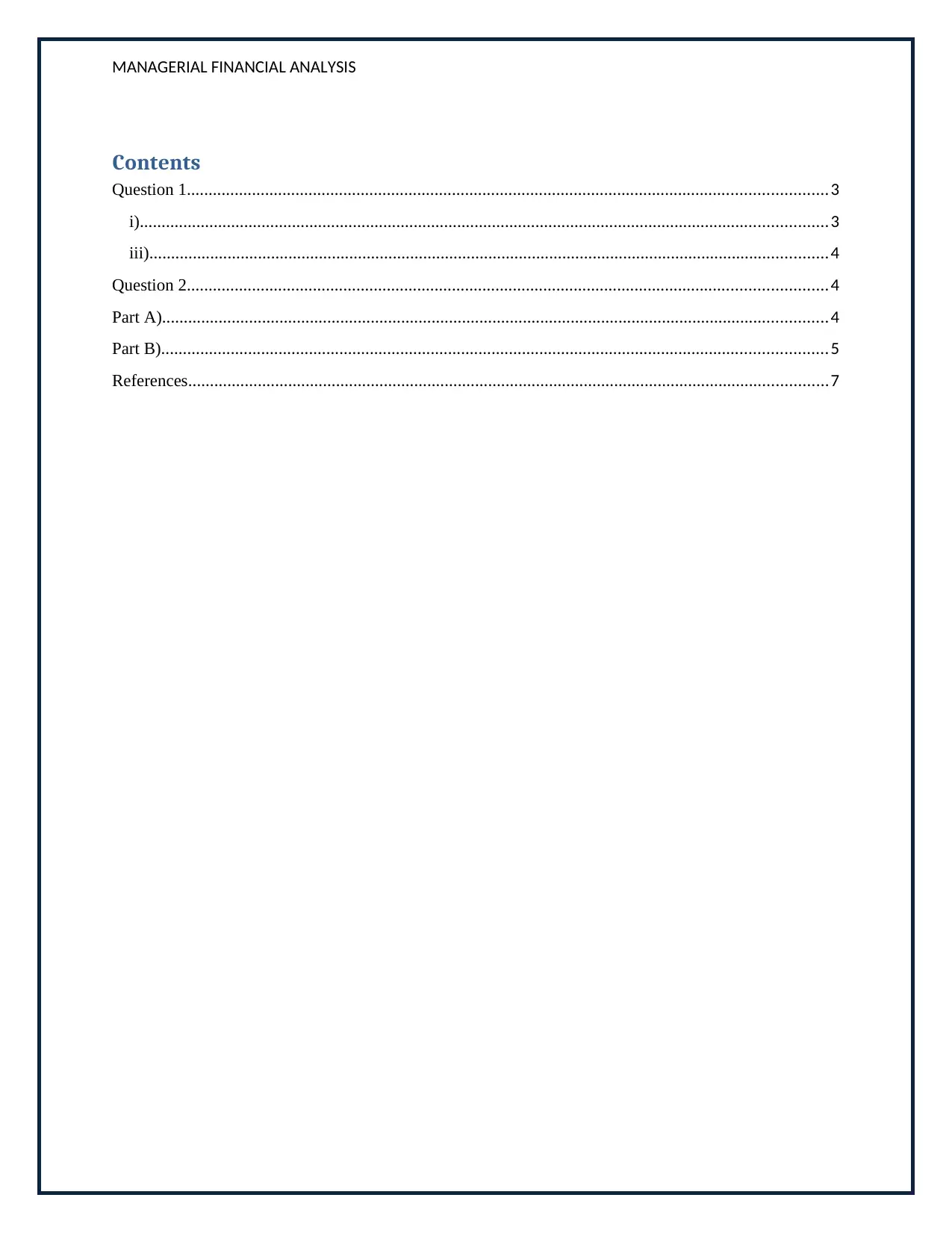
Contents
Question 1...................................................................................................................................................3
i)..............................................................................................................................................................3
iii)............................................................................................................................................................4
Question 2...................................................................................................................................................4
Part A).........................................................................................................................................................4
Part B).........................................................................................................................................................5
References...................................................................................................................................................7
Document Page
MANAGERIAL FINANCIAL ANALYSIS
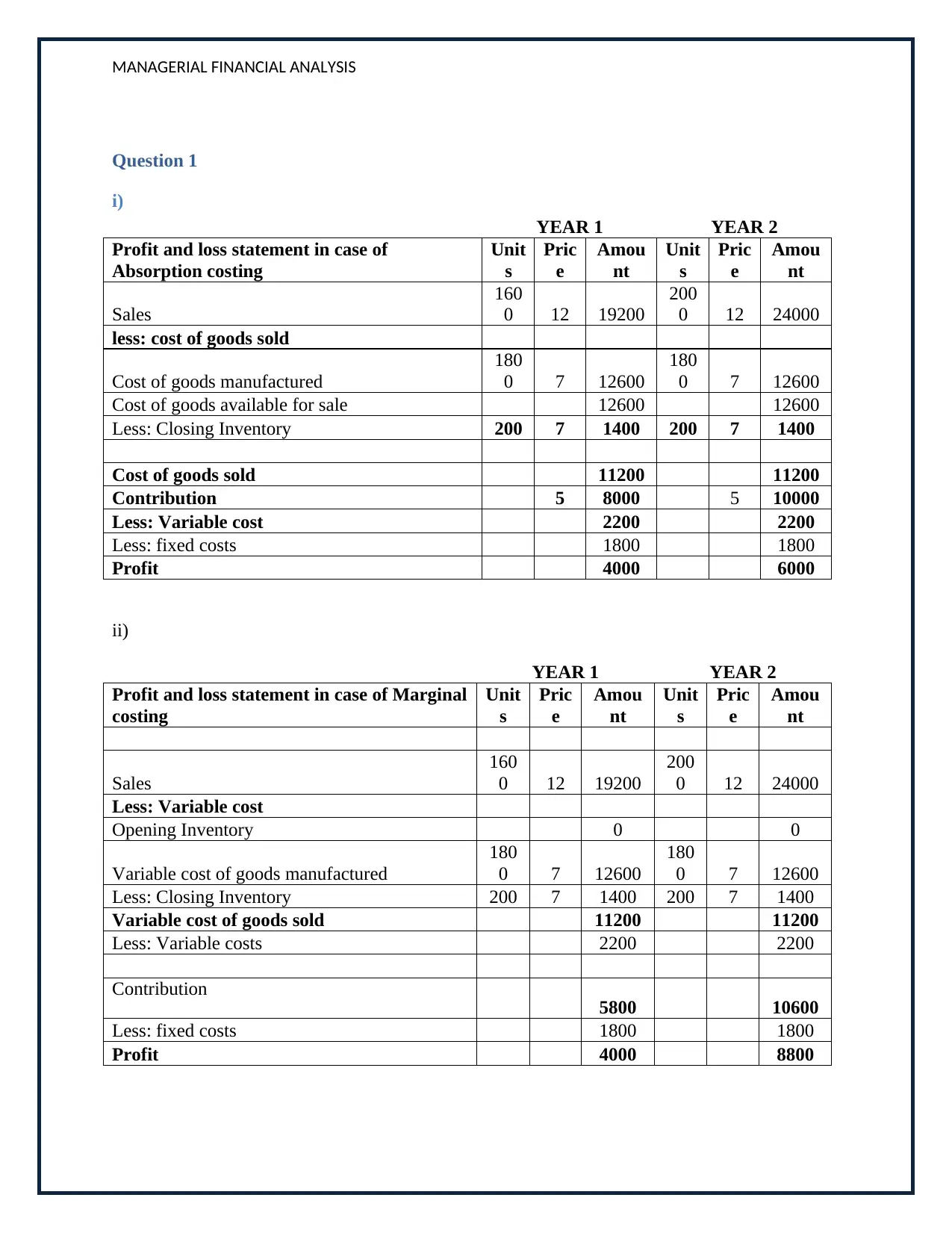
Question 1
i)
YEAR 1 YEAR 2
Profit and loss statement in case of
Absorption costing
Unit
s
Pric
e
Amou
nt
Unit
s
Pric
e
Amou
nt
Sales
160
0 12 19200
200
0 12 24000
less: cost of goods sold
Cost of goods manufactured
180
0 7 12600
180
0 7 12600
Cost of goods available for sale 12600 12600
Less: Closing Inventory 200 7 1400 200 7 1400
Cost of goods sold 11200 11200
Contribution 5 8000 5 10000
Less: Variable cost 2200 2200
Less: fixed costs 1800 1800
Profit 4000 6000
ii)
YEAR 1 YEAR 2
Profit and loss statement in case of Marginal
costing
Unit
s
Pric
e
Amou
nt
Unit
s
Pric
e
Amou
nt
Sales
160
0 12 19200
200
0 12 24000
Less: Variable cost
Opening Inventory 0 0
Variable cost of goods manufactured
180
0 7 12600
180
0 7 12600
Less: Closing Inventory 200 7 1400 200 7 1400
Variable cost of goods sold 11200 11200
Less: Variable costs 2200 2200
Contribution 5800 10600
Less: fixed costs 1800 1800
Profit 4000 8800
Document Page
MANAGERIAL FINANCIAL ANALYSIS
iii)
As per the above analysis it can be seen that the profit differs in the second year as the
contribution is calculated on the selling units in the absorption costing, and the variable costs are
deducted along with the fixed costs. In case of marginal costing, the variable costs are deducted
earlier and fixed costs are deducted separately. This creates a profit difference in second year of
$2800.
Question 2
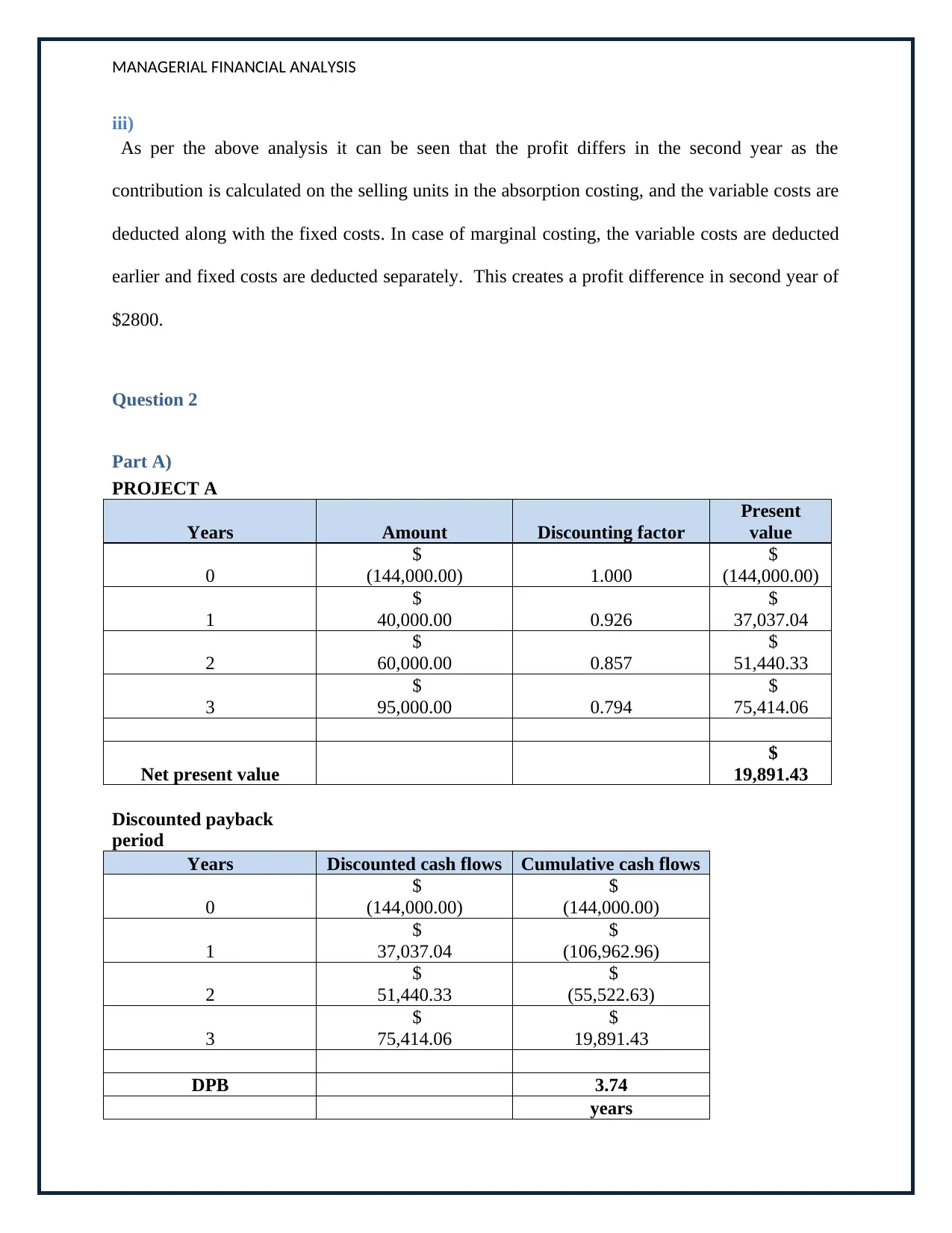
Part A)
PROJECT A
Years Amount Discounting factor
Present
value
0
$
(144,000.00) 1.000
$
(144,000.00)
1
$
40,000.00 0.926
$
37,037.04
2
$
60,000.00 0.857
$
51,440.33
3
$
95,000.00 0.794
$
75,414.06
Net present value
$
19,891.43
Discounted payback
period
Years Discounted cash flows Cumulative cash flows
0
$
(144,000.00)
$
(144,000.00)
1
$
37,037.04
$
(106,962.96)
2
$
51,440.33
$
(55,522.63)
3
$
75,414.06
$
19,891.43
DPB 3.74
years
tabler-icon-diamond-filled.svg

Paraphrase This Document

Need a fresh take? Get an instant paraphrase of this document with our AI Paraphraser
Document Page
MANAGERIAL FINANCIAL ANALYSIS
Accounting rate of
return
Avearge net profit
$
65,000.00 45.14%
Initial investment
$
144,000.00
PROJECT B
Years Amount Discounting factor
Present
value
0
$
(144,000.00) 1.000
$
(144,000.00)
1
$
83,000.00 0.926
$
76,851.85
2
$
65,000.00 0.857
$
55,727.02
3
$
76,000.00 0.794
$
60,331.25
Net present value 48910
Part B)
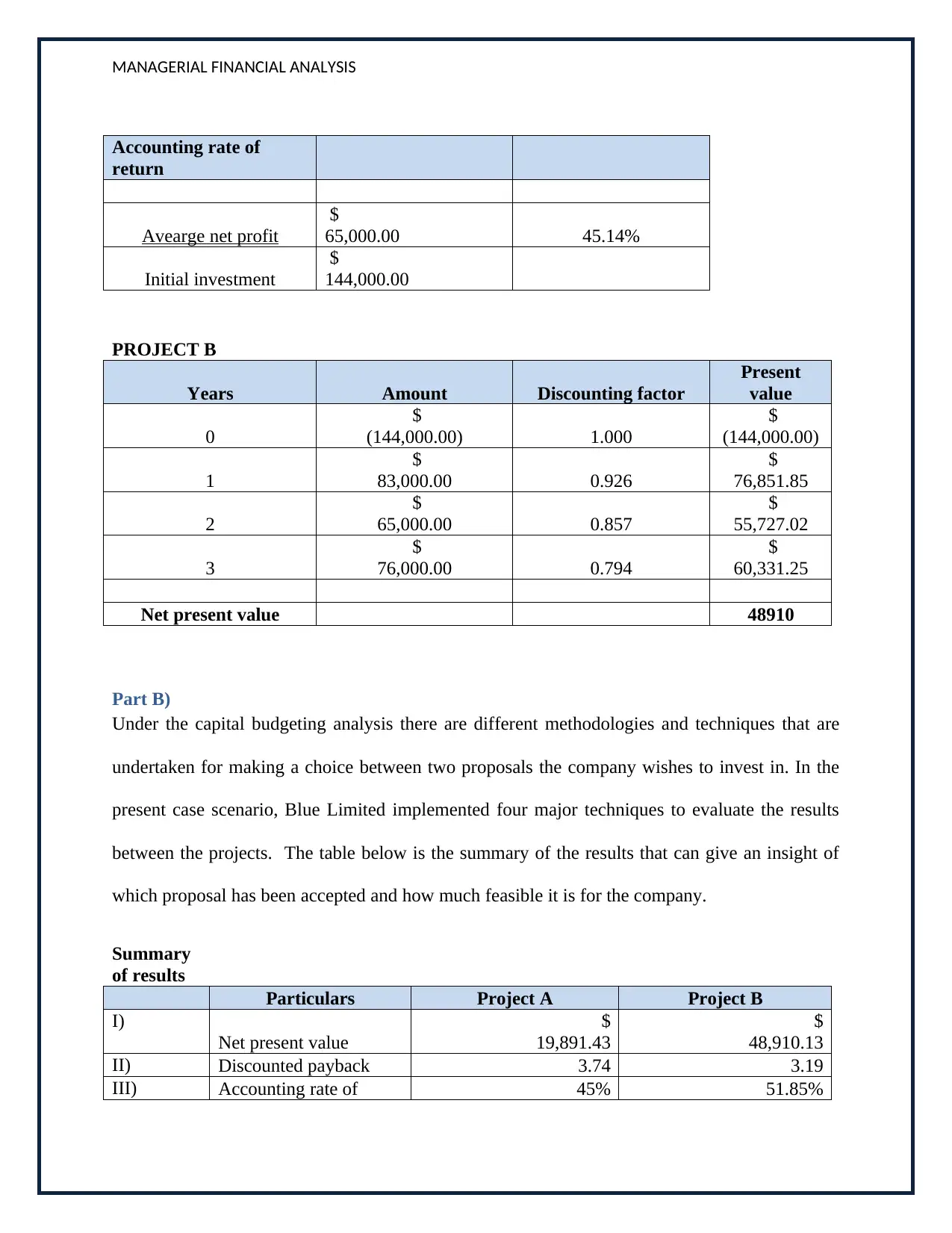
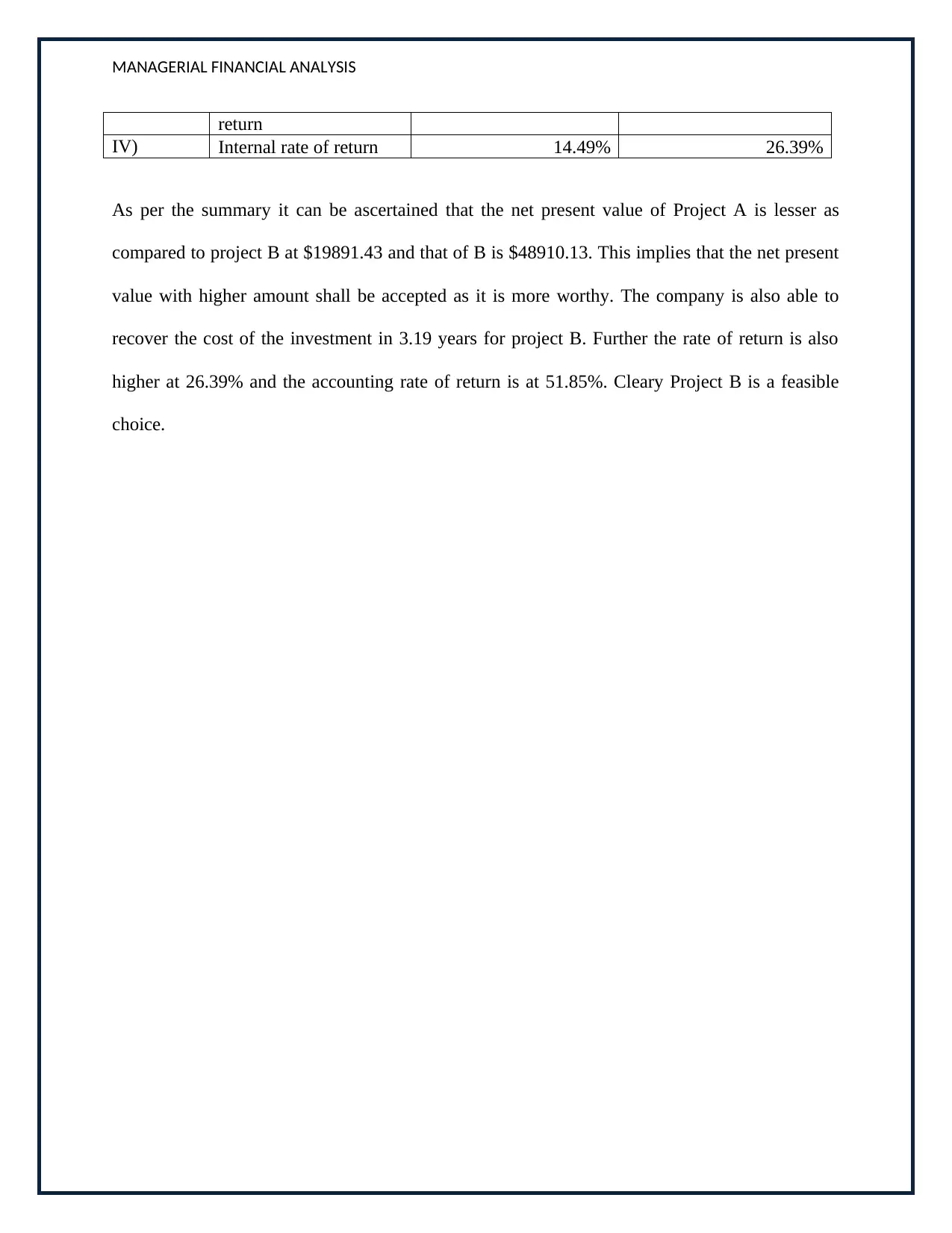
Under the capital budgeting analysis there are different methodologies and techniques that are
undertaken for making a choice between two proposals the company wishes to invest in. In the
present case scenario, Blue Limited implemented four major techniques to evaluate the results
between the projects. The table below is the summary of the results that can give an insight of
which proposal has been accepted and how much feasible it is for the company.
Summary
of results
Particulars Project A Project B
I)
Net present value
$
19,891.43
$
48,910.13
II) Discounted payback 3.74 3.19
III) Accounting rate of 45% 51.85%
Document Page
MANAGERIAL FINANCIAL ANALYSIS
return
IV) Internal rate of return 14.49% 26.39%
As per the summary it can be ascertained that the net present value of Project A is lesser as
compared to project B at $19891.43 and that of B is $48910.13. This implies that the net present
value with higher amount shall be accepted as it is more worthy. The company is also able to
recover the cost of the investment in 3.19 years for project B. Further the rate of return is also
higher at 26.39% and the accounting rate of return is at 51.85%. Cleary Project B is a feasible
choice.
chevron_up_icon
1 out of 6
circle_padding
hide_on_mobile
zoom_out_icon
[object Object]