Managerial Decision Making: Gender Discrimination Report - BUMGT5980
VerifiedAdded on 2022/08/28
|11
|2766
|17
Report
AI Summary
This report addresses the pervasive issue of gender discrimination within an organization. It begins by outlining the problem, highlighting operational challenges stemming from male domination, lack of diversity, and bullying. The report then generates solutions using mind mapping to identify root causes and propose mitigation strategies, emphasizing diversity, policy development, and employee education. The solution evaluation focuses on addressing employee weaknesses through training and promoting management decisions. An implementation and action plan are detailed, including employee induction, online feedback, training sessions, and role-playing to foster gender equality and improve employee performance. The report emphasizes the importance of creating a workplace culture that values gender equality, ultimately aiming to enhance operational efficiency and strategic advantage in a competitive market.
Running Head: GENDER DISCRIMINATION IN AN ORGANIZATION
GENDER DISCRIMINATION IN AN ORGANIZATION
Name of the Student:
Name of University:
Author Note:
GENDER DISCRIMINATION IN AN ORGANIZATION
Name of the Student:
Name of University:
Author Note:

Paraphrase This Document
Need a fresh take? Get an instant paraphrase of this document with our AI Paraphraser
1GENDER DISCRIMINATION IN AN ORGANIZATION
Table of Contents
Introduction......................................................................................................................................2
Problem in operations......................................................................................................................2
Solution generation..........................................................................................................................3
Solution evaluation..........................................................................................................................5
Addressing the employee weaknesses.........................................................................................5
Promoting the management decision...........................................................................................5
Make the employees accustomed with the change......................................................................6
Improve the employee performance............................................................................................6
Implementation and action plan.......................................................................................................6
Implementation............................................................................................................................6
Action plan...................................................................................................................................7
Conclusion.......................................................................................................................................7
Reference.........................................................................................................................................8
Table of Contents
Introduction......................................................................................................................................2
Problem in operations......................................................................................................................2
Solution generation..........................................................................................................................3
Solution evaluation..........................................................................................................................5
Addressing the employee weaknesses.........................................................................................5
Promoting the management decision...........................................................................................5
Make the employees accustomed with the change......................................................................6
Improve the employee performance............................................................................................6
Implementation and action plan.......................................................................................................6
Implementation............................................................................................................................6
Action plan...................................................................................................................................7
Conclusion.......................................................................................................................................7
Reference.........................................................................................................................................8
2GENDER DISCRIMINATION IN AN ORGANIZATION
Introduction
Gender discrimination is considered to be one of the leading problem and concern in the
current business companies where it is important for the organisation to establish a better
organisational practice where both male and female employees can perform equally and get
equal opportunities as well. In this regard, the research of Hideg and Ferris (2016) pointed out
that there is an ethical consideration that influences the business companies to adhere gender
indiscrimination in organisation. The practice is also coupled with motivating the employees to
provide a better organisational culture and maximise the performance of the employees (Roos &
Zanoni, 2017). On the other hand, the gender discrimination can also leave a great deal of impact
over the quality of performance in workplace because it is against the organisational purpose to
retain skilled employees. In response to this, this report is trying to identify the gender
discrimination problem in business and the prescribed solution that can help to erode the problem
effectively.
Problem in operations
In the organisation, the operation department recruits both male and female employees as
per their knowledge and skills to perform with the expectation of the organisation. Therefore, it
is obvious for the employees to have a transparent and flexible workplace culture which will help
to develop an effective and equal organisational practice. However, lack of professionalism
among most of the employees and management create serious problem for the company where
the female employees do not feel safe in working in the organisation. One of the main factors is
male domination in the organisation. The current ration of male and female employees are 5:1 so
that it seems a threat for the female employees to get enough opportunity to express their
opinions. Moreover, lack of diversity and bullying are also prevalent in the organisation where
the higher management does not endorse any anti-discriminatory approach to create a better
workplace environment. Therefore, it hampers the quality of operation and the production of the
company in a great scale. As an obvious result the strategic advantage of the company in
competitive market also curtails to an extensive manner so that it questions the existence of the
Introduction
Gender discrimination is considered to be one of the leading problem and concern in the
current business companies where it is important for the organisation to establish a better
organisational practice where both male and female employees can perform equally and get
equal opportunities as well. In this regard, the research of Hideg and Ferris (2016) pointed out
that there is an ethical consideration that influences the business companies to adhere gender
indiscrimination in organisation. The practice is also coupled with motivating the employees to
provide a better organisational culture and maximise the performance of the employees (Roos &
Zanoni, 2017). On the other hand, the gender discrimination can also leave a great deal of impact
over the quality of performance in workplace because it is against the organisational purpose to
retain skilled employees. In response to this, this report is trying to identify the gender
discrimination problem in business and the prescribed solution that can help to erode the problem
effectively.
Problem in operations
In the organisation, the operation department recruits both male and female employees as
per their knowledge and skills to perform with the expectation of the organisation. Therefore, it
is obvious for the employees to have a transparent and flexible workplace culture which will help
to develop an effective and equal organisational practice. However, lack of professionalism
among most of the employees and management create serious problem for the company where
the female employees do not feel safe in working in the organisation. One of the main factors is
male domination in the organisation. The current ration of male and female employees are 5:1 so
that it seems a threat for the female employees to get enough opportunity to express their
opinions. Moreover, lack of diversity and bullying are also prevalent in the organisation where
the higher management does not endorse any anti-discriminatory approach to create a better
workplace environment. Therefore, it hampers the quality of operation and the production of the
company in a great scale. As an obvious result the strategic advantage of the company in
competitive market also curtails to an extensive manner so that it questions the existence of the
⊘ This is a preview!⊘
Do you want full access?
Subscribe today to unlock all pages.

Trusted by 1+ million students worldwide
3GENDER DISCRIMINATION IN AN ORGANIZATION
Gender discriminationRoot causes Mitigation
Lack of professionalism
Workplace bullying
Lack of equal gender values
Absence of management perception
Focus on diversity
Educate employees
Policy development
Team building
Positive communication
Gender equality in workplace
organisation in the market. In fact, problems with meritocracy and skills of the employees are
also declined and hampers the way to meet the organisational objectives.
Solution generation
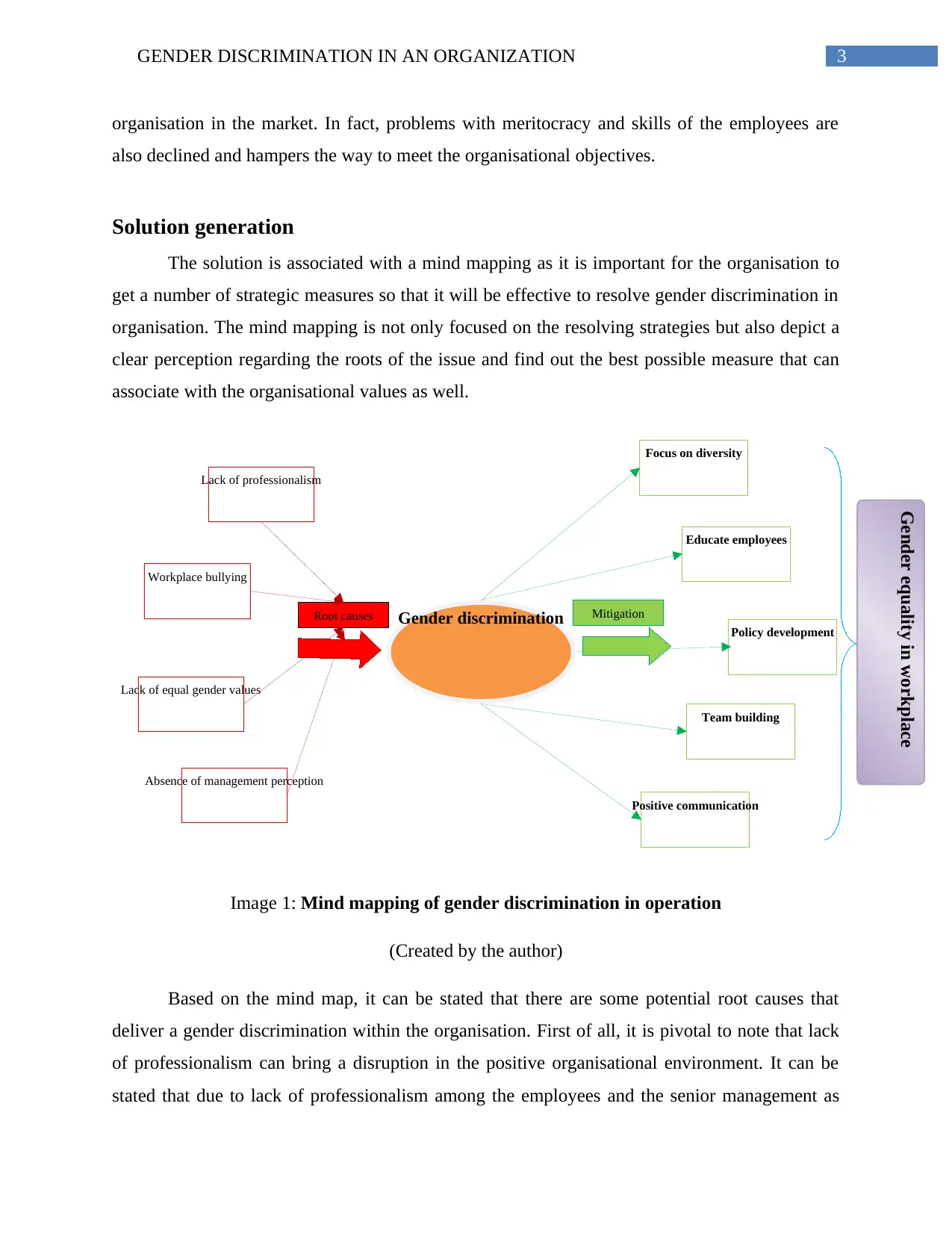
The solution is associated with a mind mapping as it is important for the organisation to
get a number of strategic measures so that it will be effective to resolve gender discrimination in
organisation. The mind mapping is not only focused on the resolving strategies but also depict a
clear perception regarding the roots of the issue and find out the best possible measure that can
associate with the organisational values as well.
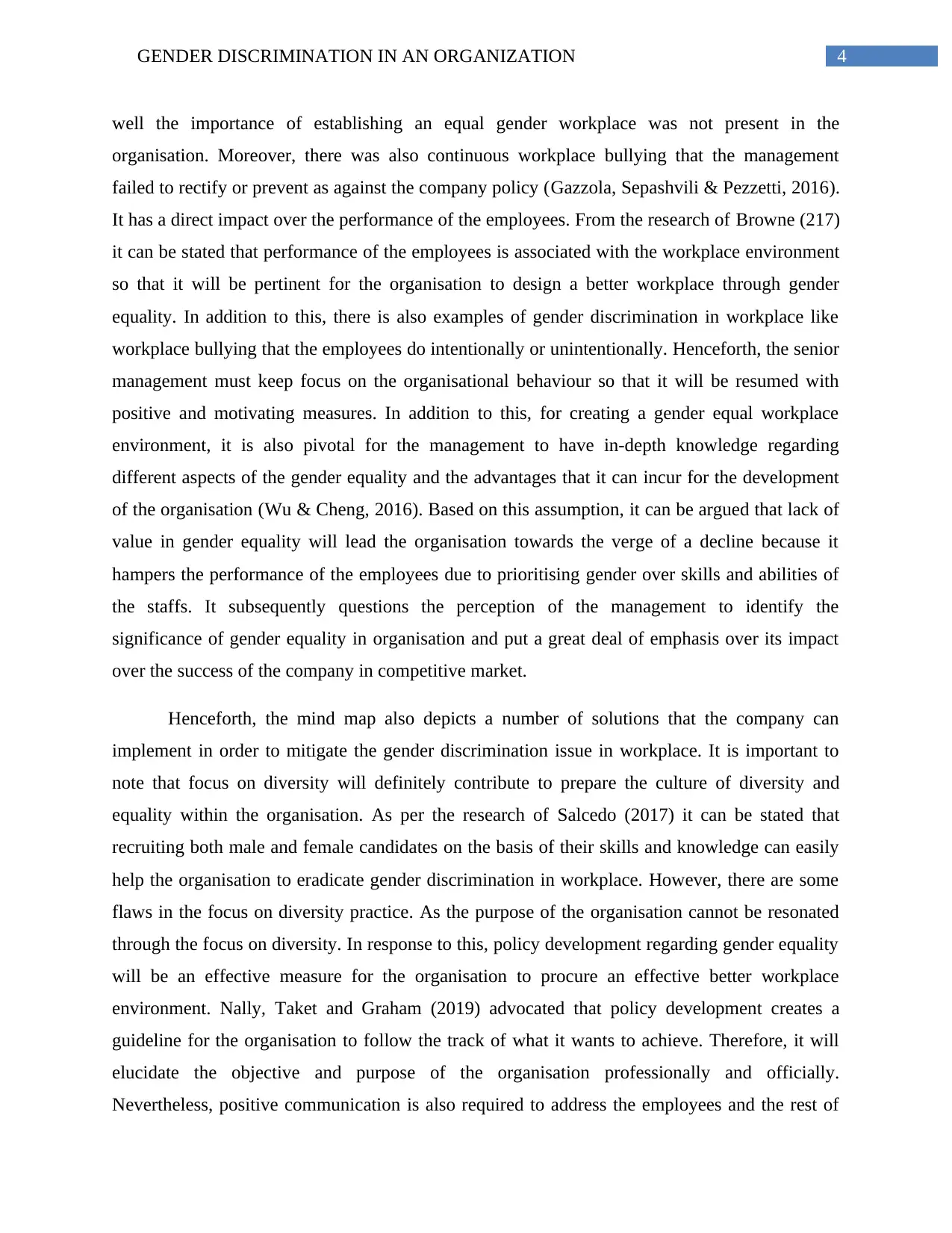
Image 1: Mind mapping of gender discrimination in operation
(Created by the author)
Based on the mind map, it can be stated that there are some potential root causes that
deliver a gender discrimination within the organisation. First of all, it is pivotal to note that lack
of professionalism can bring a disruption in the positive organisational environment. It can be
stated that due to lack of professionalism among the employees and the senior management as
Gender discriminationRoot causes Mitigation
Lack of professionalism
Workplace bullying
Lack of equal gender values
Absence of management perception
Focus on diversity
Educate employees
Policy development
Team building
Positive communication
Gender equality in workplace
organisation in the market. In fact, problems with meritocracy and skills of the employees are
also declined and hampers the way to meet the organisational objectives.
Solution generation
The solution is associated with a mind mapping as it is important for the organisation to
get a number of strategic measures so that it will be effective to resolve gender discrimination in
organisation. The mind mapping is not only focused on the resolving strategies but also depict a
clear perception regarding the roots of the issue and find out the best possible measure that can
associate with the organisational values as well.
Image 1: Mind mapping of gender discrimination in operation
(Created by the author)
Based on the mind map, it can be stated that there are some potential root causes that
deliver a gender discrimination within the organisation. First of all, it is pivotal to note that lack
of professionalism can bring a disruption in the positive organisational environment. It can be
stated that due to lack of professionalism among the employees and the senior management as
Paraphrase This Document
Need a fresh take? Get an instant paraphrase of this document with our AI Paraphraser
4GENDER DISCRIMINATION IN AN ORGANIZATION
well the importance of establishing an equal gender workplace was not present in the
organisation. Moreover, there was also continuous workplace bullying that the management
failed to rectify or prevent as against the company policy (Gazzola, Sepashvili & Pezzetti, 2016).
It has a direct impact over the performance of the employees. From the research of Browne (217)
it can be stated that performance of the employees is associated with the workplace environment
so that it will be pertinent for the organisation to design a better workplace through gender
equality. In addition to this, there is also examples of gender discrimination in workplace like
workplace bullying that the employees do intentionally or unintentionally. Henceforth, the senior
management must keep focus on the organisational behaviour so that it will be resumed with
positive and motivating measures. In addition to this, for creating a gender equal workplace
environment, it is also pivotal for the management to have in-depth knowledge regarding
different aspects of the gender equality and the advantages that it can incur for the development
of the organisation (Wu & Cheng, 2016). Based on this assumption, it can be argued that lack of
value in gender equality will lead the organisation towards the verge of a decline because it
hampers the performance of the employees due to prioritising gender over skills and abilities of
the staffs. It subsequently questions the perception of the management to identify the
significance of gender equality in organisation and put a great deal of emphasis over its impact
over the success of the company in competitive market.
Henceforth, the mind map also depicts a number of solutions that the company can
implement in order to mitigate the gender discrimination issue in workplace. It is important to
note that focus on diversity will definitely contribute to prepare the culture of diversity and
equality within the organisation. As per the research of Salcedo (2017) it can be stated that
recruiting both male and female candidates on the basis of their skills and knowledge can easily
help the organisation to eradicate gender discrimination in workplace. However, there are some
flaws in the focus on diversity practice. As the purpose of the organisation cannot be resonated
through the focus on diversity. In response to this, policy development regarding gender equality
will be an effective measure for the organisation to procure an effective better workplace
environment. Nally, Taket and Graham (2019) advocated that policy development creates a
guideline for the organisation to follow the track of what it wants to achieve. Therefore, it will
elucidate the objective and purpose of the organisation professionally and officially.
Nevertheless, positive communication is also required to address the employees and the rest of
well the importance of establishing an equal gender workplace was not present in the
organisation. Moreover, there was also continuous workplace bullying that the management
failed to rectify or prevent as against the company policy (Gazzola, Sepashvili & Pezzetti, 2016).
It has a direct impact over the performance of the employees. From the research of Browne (217)
it can be stated that performance of the employees is associated with the workplace environment
so that it will be pertinent for the organisation to design a better workplace through gender
equality. In addition to this, there is also examples of gender discrimination in workplace like
workplace bullying that the employees do intentionally or unintentionally. Henceforth, the senior
management must keep focus on the organisational behaviour so that it will be resumed with
positive and motivating measures. In addition to this, for creating a gender equal workplace
environment, it is also pivotal for the management to have in-depth knowledge regarding
different aspects of the gender equality and the advantages that it can incur for the development
of the organisation (Wu & Cheng, 2016). Based on this assumption, it can be argued that lack of
value in gender equality will lead the organisation towards the verge of a decline because it
hampers the performance of the employees due to prioritising gender over skills and abilities of
the staffs. It subsequently questions the perception of the management to identify the
significance of gender equality in organisation and put a great deal of emphasis over its impact
over the success of the company in competitive market.
Henceforth, the mind map also depicts a number of solutions that the company can
implement in order to mitigate the gender discrimination issue in workplace. It is important to
note that focus on diversity will definitely contribute to prepare the culture of diversity and
equality within the organisation. As per the research of Salcedo (2017) it can be stated that
recruiting both male and female candidates on the basis of their skills and knowledge can easily
help the organisation to eradicate gender discrimination in workplace. However, there are some
flaws in the focus on diversity practice. As the purpose of the organisation cannot be resonated
through the focus on diversity. In response to this, policy development regarding gender equality
will be an effective measure for the organisation to procure an effective better workplace
environment. Nally, Taket and Graham (2019) advocated that policy development creates a
guideline for the organisation to follow the track of what it wants to achieve. Therefore, it will
elucidate the objective and purpose of the organisation professionally and officially.
Nevertheless, positive communication is also required to address the employees and the rest of
5GENDER DISCRIMINATION IN AN ORGANIZATION
the management regarding the new policy. Therefore, direct communication with the employees
through induction and open channels will help to promote gender equality within the
organisation. Despite of all the efforts, it is also important for the employees to have the
perception of gender equality in workplace. As Périvier and Verdugo (2018) opined that there
should be a two way communication among the management and the employees so that it can
implement gender equality within the organisation. It needs education of the employees as well
to understand the importance of the gender equality in workplace and assist the management to
implement the process. Henceforth, education of the employees is the most crucial practice that
an organisation must follow before implementing the policy.
Solution evaluation
It is important for the organisation to educate the people at first so that an initial
environment can be created for the benefit of further establishment of the gender equality in the
workplace. In this regard, the education of the employees have a number of benefits that can
boost the process of implementing gender equality.
Addressing the employee weaknesses
The employee weaknesses are associated with the performance measurement of the entire
workforce. It is not a negative practice to highlight the weaknesses of the employees but ensure
them to get enough opportunity to mitigate the drawbacks and at least consider the weaknesses
properly. In this regard, the role of educating the employees is to train them such a manner that
they can take both the negative and positive feedbacks and act accordingly (Subašić et al., 2018).
It is important for the organisation to create an employee psyche of understanding the value of
gender equality in workplace and its relation with the performance.
Promoting the management decision
A top-down decision can never create flexible workplace culture and fails to make the
employees recognise their responsibility towards the organisation. As a result of that it becomes
important for the business organisation to ventilate the organisational decision towards the
employees. Training process is the best way to make a direct and practical communication with
the employees as they will go through the training and provide enough insights regarding
efficacy of the decision. Therefore, it can be stated that training process is the best way an
the management regarding the new policy. Therefore, direct communication with the employees
through induction and open channels will help to promote gender equality within the
organisation. Despite of all the efforts, it is also important for the employees to have the
perception of gender equality in workplace. As Périvier and Verdugo (2018) opined that there
should be a two way communication among the management and the employees so that it can
implement gender equality within the organisation. It needs education of the employees as well
to understand the importance of the gender equality in workplace and assist the management to
implement the process. Henceforth, education of the employees is the most crucial practice that
an organisation must follow before implementing the policy.
Solution evaluation
It is important for the organisation to educate the people at first so that an initial
environment can be created for the benefit of further establishment of the gender equality in the
workplace. In this regard, the education of the employees have a number of benefits that can
boost the process of implementing gender equality.
Addressing the employee weaknesses
The employee weaknesses are associated with the performance measurement of the entire
workforce. It is not a negative practice to highlight the weaknesses of the employees but ensure
them to get enough opportunity to mitigate the drawbacks and at least consider the weaknesses
properly. In this regard, the role of educating the employees is to train them such a manner that
they can take both the negative and positive feedbacks and act accordingly (Subašić et al., 2018).
It is important for the organisation to create an employee psyche of understanding the value of
gender equality in workplace and its relation with the performance.
Promoting the management decision
A top-down decision can never create flexible workplace culture and fails to make the
employees recognise their responsibility towards the organisation. As a result of that it becomes
important for the business organisation to ventilate the organisational decision towards the
employees. Training process is the best way to make a direct and practical communication with
the employees as they will go through the training and provide enough insights regarding
efficacy of the decision. Therefore, it can be stated that training process is the best way an
⊘ This is a preview!⊘
Do you want full access?
Subscribe today to unlock all pages.
Trusted by 1+ million students worldwide
6GENDER DISCRIMINATION IN AN ORGANIZATION
organisation can take to ventilate its decisions and waiting for the response of the employees so
that a harmony between the organisation and the employees will be set (Altawyan, 2017).
Make the employees accustomed with the change
From the research of Grant-Smith, Osborne and Marinelli (2017) it can be stated that
making the employees accustomed with the change is always considered to be a pertinent
measure that the business companies must take in order to meet the organisational objectives. It
is associated with the pro-activeness of the employees that shapes the success of the organisation
to implement a better gender equal workplace culture. Moreover, it will also endorse a healthy
workplace culture where the training facility help the employees to act in a proactive manner so
that it will be easier for the organisation to turn the plan into real.
Improve the employee performance
One of the major purposes of establishing a good gender equality within the organisation
is resembled with the employee performance. Therefore, training is necessary to boost the skills
and understanding of the employees to a certain extent that endorses a good environment to
implement the gender equality strategy. As a matter of fact, training will suffice the purpose of
establishing gender equality and enhance the performance of the employees at the same time
(Eriksson‐Zetterquist & Renemark, 2016). Therefore, it is pivotal for the business organisation to
deliver an effective training program that can avail the values and vision of the organisation.
Implementation and action plan
Implementation
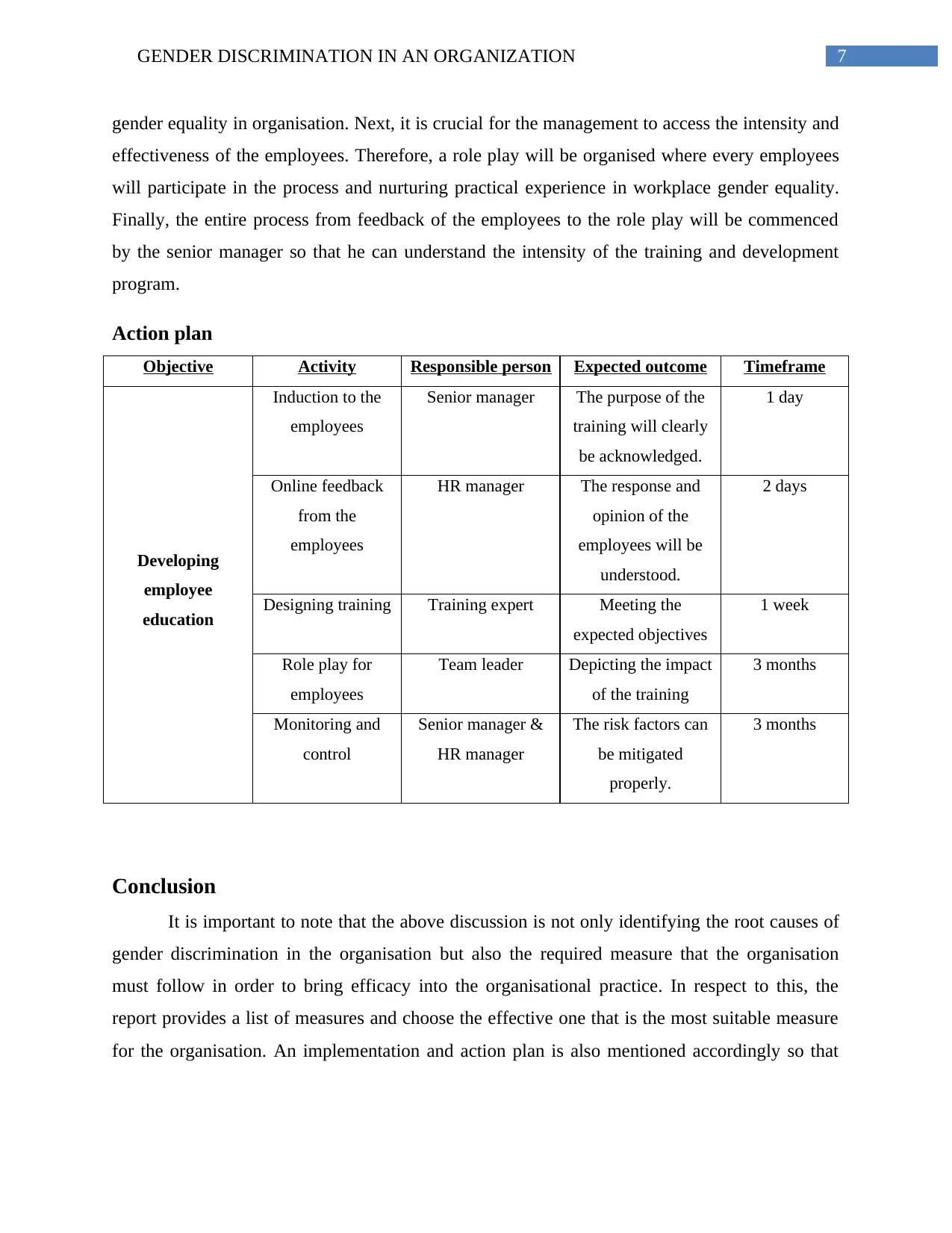
The first step is to brief the change process to the employees so that they can understand
the purpose of the organisation and the objectives that the companies will make in order to make
a better operational performance. In this regard, the induction will take only a day where the
senior manager will address the purpose of the new training process. After that an online
feedback form will be provided to the employees where they ventilate their opinions and views
regarding the process. Moreover, the organisation will also access the understanding of the
employees regarding gender equality. Based on this review, a training session will be planned by
the training manager so that the employees will get the education regarding the advantages of
organisation can take to ventilate its decisions and waiting for the response of the employees so
that a harmony between the organisation and the employees will be set (Altawyan, 2017).
Make the employees accustomed with the change
From the research of Grant-Smith, Osborne and Marinelli (2017) it can be stated that
making the employees accustomed with the change is always considered to be a pertinent
measure that the business companies must take in order to meet the organisational objectives. It
is associated with the pro-activeness of the employees that shapes the success of the organisation
to implement a better gender equal workplace culture. Moreover, it will also endorse a healthy
workplace culture where the training facility help the employees to act in a proactive manner so
that it will be easier for the organisation to turn the plan into real.
Improve the employee performance
One of the major purposes of establishing a good gender equality within the organisation
is resembled with the employee performance. Therefore, training is necessary to boost the skills
and understanding of the employees to a certain extent that endorses a good environment to
implement the gender equality strategy. As a matter of fact, training will suffice the purpose of
establishing gender equality and enhance the performance of the employees at the same time
(Eriksson‐Zetterquist & Renemark, 2016). Therefore, it is pivotal for the business organisation to
deliver an effective training program that can avail the values and vision of the organisation.
Implementation and action plan
Implementation
The first step is to brief the change process to the employees so that they can understand
the purpose of the organisation and the objectives that the companies will make in order to make
a better operational performance. In this regard, the induction will take only a day where the
senior manager will address the purpose of the new training process. After that an online
feedback form will be provided to the employees where they ventilate their opinions and views
regarding the process. Moreover, the organisation will also access the understanding of the
employees regarding gender equality. Based on this review, a training session will be planned by
the training manager so that the employees will get the education regarding the advantages of
Paraphrase This Document
Need a fresh take? Get an instant paraphrase of this document with our AI Paraphraser
7GENDER DISCRIMINATION IN AN ORGANIZATION
gender equality in organisation. Next, it is crucial for the management to access the intensity and
effectiveness of the employees. Therefore, a role play will be organised where every employees
will participate in the process and nurturing practical experience in workplace gender equality.
Finally, the entire process from feedback of the employees to the role play will be commenced
by the senior manager so that he can understand the intensity of the training and development
program.
Action plan
Objective Activity Responsible person Expected outcome Timeframe
Developing
employee
education
Induction to the
employees
Senior manager The purpose of the
training will clearly
be acknowledged.
1 day
Online feedback
from the
employees
HR manager The response and
opinion of the
employees will be
understood.
2 days
Designing training Training expert Meeting the
expected objectives
1 week
Role play for
employees
Team leader Depicting the impact
of the training
3 months
Monitoring and
control
Senior manager &
HR manager
The risk factors can
be mitigated
properly.
3 months
Conclusion
It is important to note that the above discussion is not only identifying the root causes of
gender discrimination in the organisation but also the required measure that the organisation
must follow in order to bring efficacy into the organisational practice. In respect to this, the
report provides a list of measures and choose the effective one that is the most suitable measure
for the organisation. An implementation and action plan is also mentioned accordingly so that
gender equality in organisation. Next, it is crucial for the management to access the intensity and
effectiveness of the employees. Therefore, a role play will be organised where every employees
will participate in the process and nurturing practical experience in workplace gender equality.
Finally, the entire process from feedback of the employees to the role play will be commenced
by the senior manager so that he can understand the intensity of the training and development
program.
Action plan
Objective Activity Responsible person Expected outcome Timeframe
Developing
employee
education
Induction to the
employees
Senior manager The purpose of the
training will clearly
be acknowledged.
1 day
Online feedback
from the
employees
HR manager The response and
opinion of the
employees will be
understood.
2 days
Designing training Training expert Meeting the
expected objectives
1 week
Role play for
employees
Team leader Depicting the impact
of the training
3 months
Monitoring and
control
Senior manager &
HR manager
The risk factors can
be mitigated
properly.
3 months
Conclusion
It is important to note that the above discussion is not only identifying the root causes of
gender discrimination in the organisation but also the required measure that the organisation
must follow in order to bring efficacy into the organisational practice. In respect to this, the
report provides a list of measures and choose the effective one that is the most suitable measure
for the organisation. An implementation and action plan is also mentioned accordingly so that
8GENDER DISCRIMINATION IN AN ORGANIZATION
the feasibility of the process can be projected. Therefore, it can be stated that the report generates
an in-depth analysis on gender discrimination in operation and the possible way to mitigate it.
the feasibility of the process can be projected. Therefore, it can be stated that the report generates
an in-depth analysis on gender discrimination in operation and the possible way to mitigate it.
⊘ This is a preview!⊘
Do you want full access?
Subscribe today to unlock all pages.
Trusted by 1+ million students worldwide
9GENDER DISCRIMINATION IN AN ORGANIZATION
Reference
Altawyan, A. (2017). Rethinking gender equality in the workplace. Review of Integrative
Business and Economics Research, 6(2), 142-146.
Browne, K. R. (2017). The Quixotic Quest for Gender Equality in the Workplace. U. Tol. L.
Rev., 49, 685.
Eriksson‐Zetterquist, U., & Renemark, D. (2016). Can changes to gender equality be
sustained?. Gender, Work & Organization, 23(4), 363-378.
Gazzola, P., Sepashvili, E., & Pezzetti, R. (2016). CSR as a mean to promote gender
equality. Economia Aziendale Online, 7(1), 95-99.
Grant-Smith, D., Osborne, N., & Marinelli, P. (2017). Transport and workplace accessibility:
Routes to improved equity. In Overcoming challenges to gender equality in the
workplace (pp. 107-123). Routledge.
Hideg, I., & Ferris, D. L. (2016). The compassionate sexist? How benevolent sexism promotes
and undermines gender equality in the workplace. Journal of Personality and Social
Psychology, 111(5), 706.
Nally, T., Taket, A., & Graham, M. (2019). Exploring the use of resources to support gender
equality in Australian workplaces. Health Promotion Journal of Australia, 30(3), 359-
370.
Périvier, H., & Verdugo, G. (2018). Is the European strategy to foster gender equality at the
workplace efficient?. Revue de l'OFCE, (4), 77-101.
Roos, H., & Zanoni, P. (2017). Disrupting gendered dichotomies: Gender equality in a high-tech
Belgian company. In Overcoming Challenges to Gender Equality in the Workplace (pp.
8-20). Routledge.
Reference
Altawyan, A. (2017). Rethinking gender equality in the workplace. Review of Integrative
Business and Economics Research, 6(2), 142-146.
Browne, K. R. (2017). The Quixotic Quest for Gender Equality in the Workplace. U. Tol. L.
Rev., 49, 685.
Eriksson‐Zetterquist, U., & Renemark, D. (2016). Can changes to gender equality be
sustained?. Gender, Work & Organization, 23(4), 363-378.
Gazzola, P., Sepashvili, E., & Pezzetti, R. (2016). CSR as a mean to promote gender
equality. Economia Aziendale Online, 7(1), 95-99.
Grant-Smith, D., Osborne, N., & Marinelli, P. (2017). Transport and workplace accessibility:
Routes to improved equity. In Overcoming challenges to gender equality in the
workplace (pp. 107-123). Routledge.
Hideg, I., & Ferris, D. L. (2016). The compassionate sexist? How benevolent sexism promotes
and undermines gender equality in the workplace. Journal of Personality and Social
Psychology, 111(5), 706.
Nally, T., Taket, A., & Graham, M. (2019). Exploring the use of resources to support gender
equality in Australian workplaces. Health Promotion Journal of Australia, 30(3), 359-
370.
Périvier, H., & Verdugo, G. (2018). Is the European strategy to foster gender equality at the
workplace efficient?. Revue de l'OFCE, (4), 77-101.
Roos, H., & Zanoni, P. (2017). Disrupting gendered dichotomies: Gender equality in a high-tech
Belgian company. In Overcoming Challenges to Gender Equality in the Workplace (pp.
8-20). Routledge.
Paraphrase This Document
Need a fresh take? Get an instant paraphrase of this document with our AI Paraphraser
10GENDER DISCRIMINATION IN AN ORGANIZATION
Salcedo, E. S. (2017). Expanding the Role of the Philippine Commission on Human Rights for
the Protection of Gender Equality in the Workplace: Practical Lessons from
Canada. Asia-Pacific Journal on Human Rights and the Law, 18(1), 48-77.
Subašić, E., Hardacre, S., Elton, B., Branscombe, N. R., Ryan, M. K., & Reynolds, K. J. (2018).
“We for She”: Mobilising men and women to act in solidarity for gender equality. Group
Processes & Intergroup Relations, 21(5), 707-724.
Wu, R., & Cheng, X. (2016). Gender equality in the workplace: the effect of gender equality on
productivity growth among the Chilean manufacturers. The Journal of Developing
Areas, 50(1), 257-274.
Salcedo, E. S. (2017). Expanding the Role of the Philippine Commission on Human Rights for
the Protection of Gender Equality in the Workplace: Practical Lessons from
Canada. Asia-Pacific Journal on Human Rights and the Law, 18(1), 48-77.
Subašić, E., Hardacre, S., Elton, B., Branscombe, N. R., Ryan, M. K., & Reynolds, K. J. (2018).
“We for She”: Mobilising men and women to act in solidarity for gender equality. Group
Processes & Intergroup Relations, 21(5), 707-724.
Wu, R., & Cheng, X. (2016). Gender equality in the workplace: the effect of gender equality on
productivity growth among the Chilean manufacturers. The Journal of Developing
Areas, 50(1), 257-274.

1 out of 11


Related Documents


Your All-in-One AI-Powered Toolkit for Academic Success.
+13062052269
info@desklib.com
Available 24*7 on WhatsApp / Email
![[object Object]](/_next/static/media/star-bottom.7253800d.svg)
Unlock your academic potential
Copyright © 2020–2026 A2Z Services. All Rights Reserved. Developed and managed by ZUCOL.