Evaluating Negative Managerial Policies & Motivation Impact

Verified

Added on  2023/06/18

|9
|553
|417
Report
AI Summary
This report examines the negative impact of managerial policies, specifically pay and benefits policies, on employee motivation. It highlights how performance-based reward systems can create a negative environment where employees feel unfairly treated or that partiality exists. The report suggests potential solutions such as implementing policies that benefit all employees, eliminating discrimination, and providing benefits after a defined period. Recommendations include setting clear performance standards, evaluating employee performance fairly, and gathering feedback to ensure equitable reward distribution. The ultimate goal is to improve the pay and benefits policy to foster a more motivated and positive work environment. Desklib offers this assignment solution, along with a wealth of other solved assignments and past papers, designed to support students in their academic endeavors.
Document Page
Negative Managerial Action
tabler-icon-diamond-filled.svg

Paraphrase This Document

Need a fresh take? Get an instant paraphrase of this document with our AI Paraphraser
Document Page
Table of contents
Introduction
Policy
Negative impact of policy on motivation
Some potential solutions
Recommendations
References
Document Page
INTRODUCTION
Managerial action and decision have significant impact on the motivation of
employees.
Policies made by managers have negative impact on motivation and it creates issue
among employees (Mitra, Jaggi and Al-Hayale, 2019).
Managers should make policies after analysing needs of workers so that they feel
motivated.
The report examines, policy which is applied in organisation, it has negative impact on
motivation, examples and some solutions for this problem.
Document Page
Policy
It is important to make policies so that
employees can work properly and there will be
no confusion among workers.
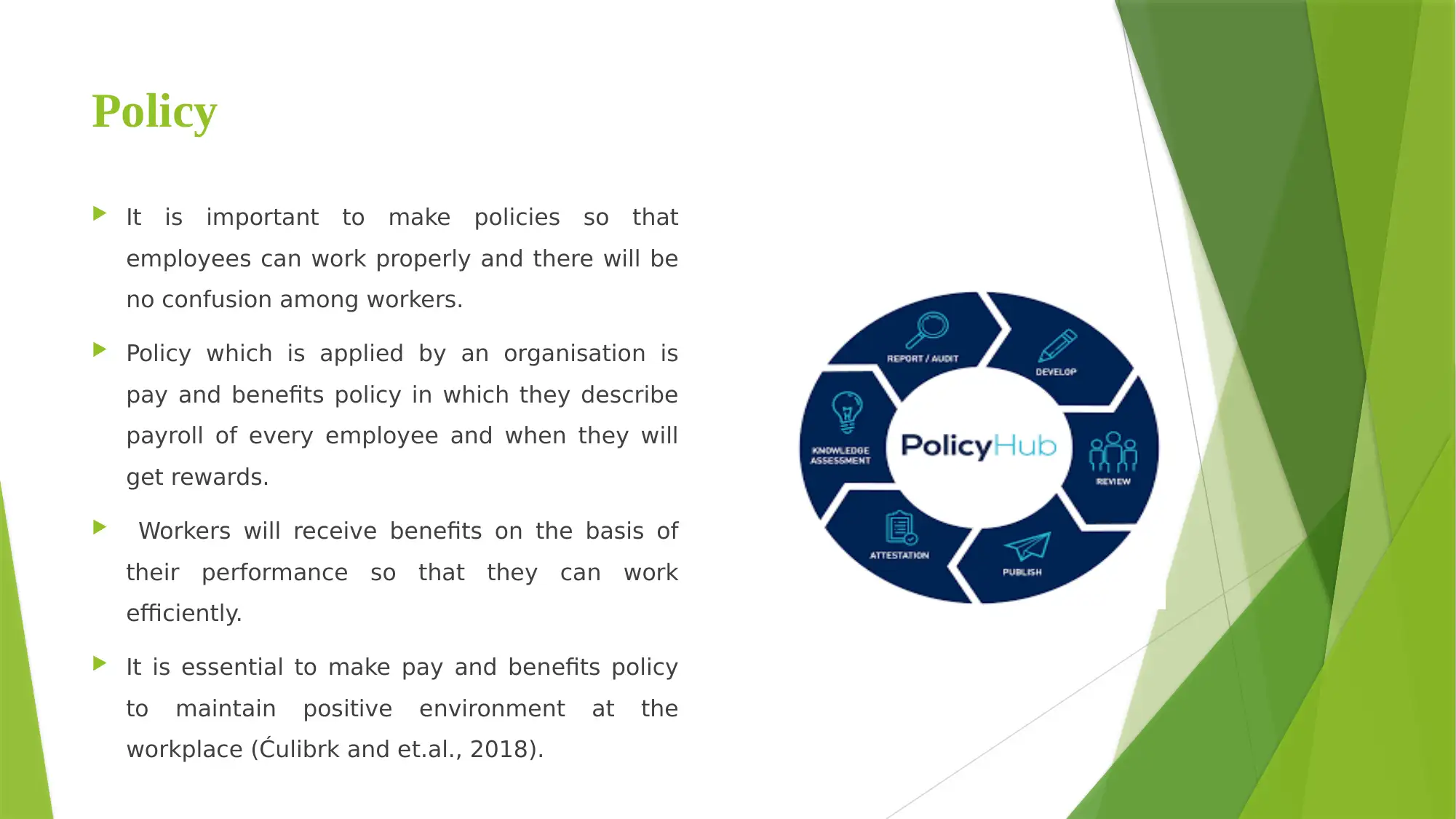
Policy which is applied by an organisation is
pay and benefits policy in which they describe
payroll of every employee and when they will
get rewards.
Workers will receive benefits on the basis of
their performance so that they can work
efficiently.
It is essential to make pay and benefits policy
to maintain positive environment at the
workplace (Ćulibrk and et.al., 2018).
tabler-icon-diamond-filled.svg

Paraphrase This Document

Need a fresh take? Get an instant paraphrase of this document with our AI Paraphraser
Document Page
Negative impact of policy on motivation
When managers make policies they do not know that
whether it will have positive or negative impact on
employee.
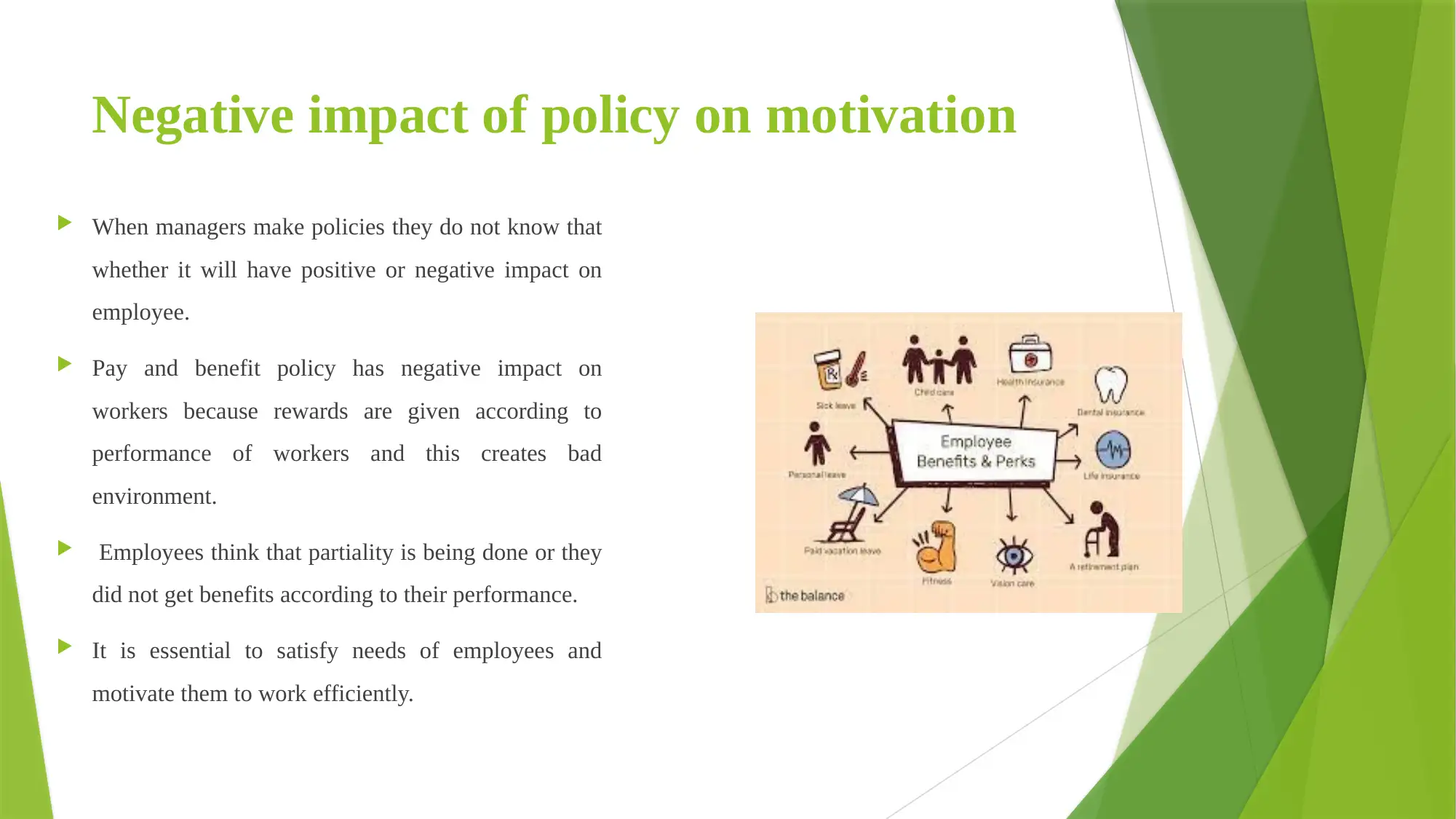
Pay and benefit policy has negative impact on
workers because rewards are given according to
performance of workers and this creates bad
environment.
Employees think that partiality is being done or they
did not get benefits according to their performance.
It is essential to satisfy needs of employees and
motivate them to work efficiently.
Document Page
Some potential solutions
Managers should make policies which is beneficial for all employees and helps in
motivating employees.
There should be no discrimination among workers on the basis of gender, caste,
religion or any other basis.
To eliminate conflicts among members, managers should make policy that after 3
months’ employee will get benefits according to their performance.
Benefits or rewards are not related to position.
Document Page
Recommendations
Some recommendations which can be applied by an organisation to improve pay and
benefit policy are, rewards will be given according to performance.
Managers should set standards for every employee and give task.
After completing work, managers should evaluate performance of every worker and
decide who has performed well.
Managers can take feedback from people present in the organisation and on the basis of
that rewards should be given.
tabler-icon-diamond-filled.svg

Paraphrase This Document

Need a fresh take? Get an instant paraphrase of this document with our AI Paraphraser
Document Page
REFRENCES
Mitra, S., Jaggi, B. and Al-Hayale, T., 2019. Managerial overconfidence, ability, firm-
governance and audit fees. Review of Quantitative Finance and Accounting. 52(3).
pp.841-870.
Abubakar, A. M., and et.al., 2019. Knowledge management, decision-making style and
organizational performance. Journal of Innovation & Knowledge. 4(2). pp.104-114.
Ćulibrk, J., and et.al., 2018. Job satisfaction, organizational commitment and job
involvement: The mediating role of job involvement. Frontiers in psychology. 9. p.132.
Document Page
chevron_up_icon
1 out of 9
circle_padding
hide_on_mobile
zoom_out_icon
[object Object]