Employability Skills Report: Travelodge Manager Evaluation
VerifiedAdded on 2020/01/23
|13
|4209
|250
Report
AI Summary
This report provides a comprehensive analysis of the employability skills required for a manager at Travelodge, a UK-based hotel and hospitality company. It begins by outlining the key responsibilities of a manager, including legal compliance, interpersonal relationship management, service standards, strategic decision-making, and effective leadership. The report evaluates the effectiveness of these responsibilities, highlighting areas of strength and suggesting recommendations for improvement, such as pursuing further education and fostering better employee relationships. It then delves into motivational techniques, discussing the importance of a positive work environment, setting goals, and recognizing achievements. The report also examines the role of individuals within a team, emphasizing the importance of each member's contribution to shared goals and analyzing the dynamics that influence team success. Finally, it explores methods for developing solutions to business challenges, specifically addressing labor turnover and its potential impact on the business. This report provides valuable insights into the practical application of employability skills in a real-world business context.
EMPLOYABILITY SKILLS

Paraphrase This Document
Need a fresh take? Get an instant paraphrase of this document with our AI Paraphraser
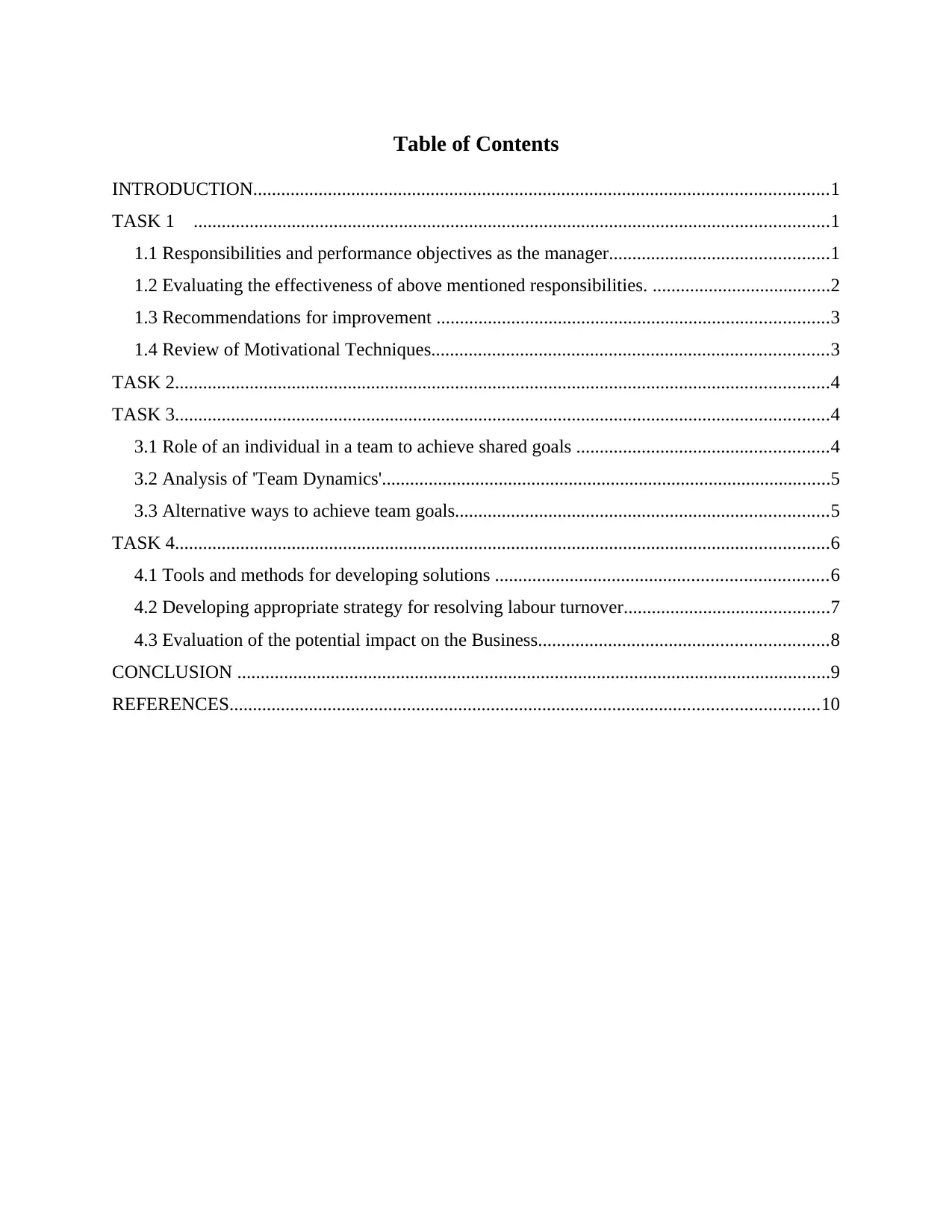
Table of Contents
INTRODUCTION...........................................................................................................................1
TASK 1 ........................................................................................................................................1
1.1 Responsibilities and performance objectives as the manager...............................................1
1.2 Evaluating the effectiveness of above mentioned responsibilities. ......................................2
1.3 Recommendations for improvement ....................................................................................3
1.4 Review of Motivational Techniques.....................................................................................3
TASK 2............................................................................................................................................4
TASK 3............................................................................................................................................4
3.1 Role of an individual in a team to achieve shared goals ......................................................4
3.2 Analysis of 'Team Dynamics'................................................................................................5
3.3 Alternative ways to achieve team goals................................................................................5
TASK 4............................................................................................................................................6
4.1 Tools and methods for developing solutions .......................................................................6
4.2 Developing appropriate strategy for resolving labour turnover............................................7
4.3 Evaluation of the potential impact on the Business..............................................................8
CONCLUSION ...............................................................................................................................9
REFERENCES..............................................................................................................................10
INTRODUCTION...........................................................................................................................1
TASK 1 ........................................................................................................................................1
1.1 Responsibilities and performance objectives as the manager...............................................1
1.2 Evaluating the effectiveness of above mentioned responsibilities. ......................................2
1.3 Recommendations for improvement ....................................................................................3
1.4 Review of Motivational Techniques.....................................................................................3
TASK 2............................................................................................................................................4
TASK 3............................................................................................................................................4
3.1 Role of an individual in a team to achieve shared goals ......................................................4
3.2 Analysis of 'Team Dynamics'................................................................................................5
3.3 Alternative ways to achieve team goals................................................................................5
TASK 4............................................................................................................................................6
4.1 Tools and methods for developing solutions .......................................................................6
4.2 Developing appropriate strategy for resolving labour turnover............................................7
4.3 Evaluation of the potential impact on the Business..............................................................8
CONCLUSION ...............................................................................................................................9
REFERENCES..............................................................................................................................10
INTRODUCTION
Pursuing one single job for life is no more preferable in the present times. People tend to
shift from one job to another to experience variety of work and learn something new. This
requires the employees to develop a versatile set of skills and be flexible with the working
practices followed and preferred. In addition, employers seek for skills and abilities which enable
the human resource to work beyond the technical qualifications and experience. Hence,
employability skills can be defined as skills required for being recruited and performing one's job
smoothly and successfully (Bratton and Gold, 2012). These skills assists an individual to not
only deliver at the specific job being assigned but also ensures to undertake the ancillary tasks in
a convenient manner.
The present report shall analyze the roles and responsibilities to be undertaken by
manager of Travelodge, a UK based private company, operative in the industry of hotel and
hospitality.
TASK 1
1.1 Responsibilities and performance objectives as the manager.
Hotel and Hospitality industry requires a the management to take a high standard of care
in providing its services and thereby assure customer satisfaction is achieved. Working as a
manager at Travelodge, my major objective is to attain high level of expertise in my work and
satisfy needs of the customers and visitors at Travelodge. The roles and responsibilities
undertaken by me as a manager are:
To undertake regular legal due diligence of operations: It is important for the hotel
industry to stay compliant with all national and state laws as well as various regulation
imposed on Hotel industry (O'Neil, 2014). The industry is required to obtain various
licenses for operating their business and then regularly renew the said licenses as and
when required. In addition, we need to be very vigilant in providing our services with
respect to health and safety needs of the customers.
To create and manage inter-personal relationship: As a manger of the hotel, I am
required to manage variety of people working in the organization. It is my job to make
them work in the right direction and keep them motivated to utilize the best of their
skills. Resultantly, working culture of the hotel stays positive in nature and the
1
Pursuing one single job for life is no more preferable in the present times. People tend to
shift from one job to another to experience variety of work and learn something new. This
requires the employees to develop a versatile set of skills and be flexible with the working
practices followed and preferred. In addition, employers seek for skills and abilities which enable
the human resource to work beyond the technical qualifications and experience. Hence,
employability skills can be defined as skills required for being recruited and performing one's job
smoothly and successfully (Bratton and Gold, 2012). These skills assists an individual to not
only deliver at the specific job being assigned but also ensures to undertake the ancillary tasks in
a convenient manner.
The present report shall analyze the roles and responsibilities to be undertaken by
manager of Travelodge, a UK based private company, operative in the industry of hotel and
hospitality.
TASK 1
1.1 Responsibilities and performance objectives as the manager.
Hotel and Hospitality industry requires a the management to take a high standard of care
in providing its services and thereby assure customer satisfaction is achieved. Working as a
manager at Travelodge, my major objective is to attain high level of expertise in my work and
satisfy needs of the customers and visitors at Travelodge. The roles and responsibilities
undertaken by me as a manager are:
To undertake regular legal due diligence of operations: It is important for the hotel
industry to stay compliant with all national and state laws as well as various regulation
imposed on Hotel industry (O'Neil, 2014). The industry is required to obtain various
licenses for operating their business and then regularly renew the said licenses as and
when required. In addition, we need to be very vigilant in providing our services with
respect to health and safety needs of the customers.
To create and manage inter-personal relationship: As a manger of the hotel, I am
required to manage variety of people working in the organization. It is my job to make
them work in the right direction and keep them motivated to utilize the best of their
skills. Resultantly, working culture of the hotel stays positive in nature and the
1
⊘ This is a preview!⊘
Do you want full access?
Subscribe today to unlock all pages.

Trusted by 1+ million students worldwide
employees stay encouraged to work. In pursuance to the same, I assure regular
communication with individual employees and have adopted an empathetic as well as
friendly approach towards maintaining relationships (Moore and Morton, 2015).
To maintain consistency in providing a high standard service: The customers of the
hotel industry are very sensitive in the approach and may change their hotel
preferences to address small needs and issues. Hence, it is of utmost importance for
employees to be performing at the best of their skills at all times and satisfying the
needs of the customers. In order to manage the same, I have taken the responsibility to
continuously monitor the working of employees and training them on a regular basis
(Employability skills, 2014).
To make correct strategic decisions: It is my responsibility as a manager to maintain
an integrated approach in taking decisions and also towards managing the people. My
ultimate target is to achieve goals and objectives of the organisation.
To become an effective leader: It is my job to make the team work in an effective
manner and maintain a participative approach in my working (Turner, 2016). I should
respect the opinions and ideas of others and take best decision considering the relevant
ones (HR roles and responsibilities, 2014).
1.2 Evaluating the effectiveness of above mentioned responsibilities.
I completely understand the roles and responsibilities required to be undertaken as the
manager and have effectively been able to develop the required skills to undertake the said
responsibilities. I keep myself updated about all laws and regulations applicable to the industry
and have developed a small team, headed by me to keep a track of all the updates/amendments.
Further, I assure a face-to-face interaction with the employees on a regular basis and develop a
strong relationship with each one of them. Regular training and development is provided to the
staff for sharpening and enhancing of their skills and capabilities. Also, an effective monitoring
system has been developed within the organisation to keep a continuous track of the individual
performance (Mehrotra, 2014).
As a manager, I have learned a lot from the past experience and have adopted a strategic
and critical approach in my way of working. I keep myself updated about various acts in the
organisation and have taken up a personal charge to evaluate the performance of the individuals.
2
communication with individual employees and have adopted an empathetic as well as
friendly approach towards maintaining relationships (Moore and Morton, 2015).
To maintain consistency in providing a high standard service: The customers of the
hotel industry are very sensitive in the approach and may change their hotel
preferences to address small needs and issues. Hence, it is of utmost importance for
employees to be performing at the best of their skills at all times and satisfying the
needs of the customers. In order to manage the same, I have taken the responsibility to
continuously monitor the working of employees and training them on a regular basis
(Employability skills, 2014).
To make correct strategic decisions: It is my responsibility as a manager to maintain
an integrated approach in taking decisions and also towards managing the people. My
ultimate target is to achieve goals and objectives of the organisation.
To become an effective leader: It is my job to make the team work in an effective
manner and maintain a participative approach in my working (Turner, 2016). I should
respect the opinions and ideas of others and take best decision considering the relevant
ones (HR roles and responsibilities, 2014).
1.2 Evaluating the effectiveness of above mentioned responsibilities.
I completely understand the roles and responsibilities required to be undertaken as the
manager and have effectively been able to develop the required skills to undertake the said
responsibilities. I keep myself updated about all laws and regulations applicable to the industry
and have developed a small team, headed by me to keep a track of all the updates/amendments.
Further, I assure a face-to-face interaction with the employees on a regular basis and develop a
strong relationship with each one of them. Regular training and development is provided to the
staff for sharpening and enhancing of their skills and capabilities. Also, an effective monitoring
system has been developed within the organisation to keep a continuous track of the individual
performance (Mehrotra, 2014).
As a manager, I have learned a lot from the past experience and have adopted a strategic
and critical approach in my way of working. I keep myself updated about various acts in the
organisation and have taken up a personal charge to evaluate the performance of the individuals.
2
Paraphrase This Document
Need a fresh take? Get an instant paraphrase of this document with our AI Paraphraser
100% intolerance strategy has been adopted towards negligence and wrong doings. I make sure
that the working of the employees is always directed towards the betterment of the hotel.
1.3 Recommendations for improvement
The above evaluation of my skills and responsibilities clearly establish that I have been
able to play the role of an efficient manager in the organisation. The performance of my team
demonstrates that I have good leadership skills as well as I have been able to maintain a positive
working culture within the hotel. In addition, I share strong relation with colleagues and
employees of the hotel. However, I have now reached a stagnant position in my capabilities and
skills and in order to address the said stagnancy, I shall pursue a higher post in the hotel and
work towards developing a new set of skills and abilities to achieve this goal and maintain my
position. In relation to this I should focus on increasing my theoretical knowledge on various
subjects and implement the same while working. Another important change which is required to
be made in the present system is for improving the relationship of the employees within
themselves (Corradini, Borthwick and Gallagher-Brett, 2016). Group activities and informal
meetings of the employees shall be encouraged and conducted on a frequent basis to create a
more employee friendly environment. This shall result in creating strong bonds among the
employees and encourage a motivated culture within the organisation.
1.4 Review of Motivational Techniques
Floating a motivated culture in the workplace improves the performance of the employees, raises
morale and enhances the productivity level of the organisation. Motivation is one of the crucial
skills required by every individual to work efficiently and effectively. Different motivational
techniques work for different employees and workplace. Hence, we shall review the following
motivational techniques:
Creating a Positive Work Environment: This technique focuses on improving the
working culture within an organisation. A positive environment is marked by engaged,
satisfied, motivated and enthusiastic employees. An organisation shall regularly take
feedbacks of the employees and appreciate the good work undertaken by them. Internal
bonding shall be developed so that a cooperative and efficient workforce can be
developed. This technique has been implemented by Travelodge by adopting a
participative approach towards the employees and let them be a part of the decision-
making process (Gallagher, 2013). This makes the employee feel that he is also
3
that the working of the employees is always directed towards the betterment of the hotel.
1.3 Recommendations for improvement
The above evaluation of my skills and responsibilities clearly establish that I have been
able to play the role of an efficient manager in the organisation. The performance of my team
demonstrates that I have good leadership skills as well as I have been able to maintain a positive
working culture within the hotel. In addition, I share strong relation with colleagues and
employees of the hotel. However, I have now reached a stagnant position in my capabilities and
skills and in order to address the said stagnancy, I shall pursue a higher post in the hotel and
work towards developing a new set of skills and abilities to achieve this goal and maintain my
position. In relation to this I should focus on increasing my theoretical knowledge on various
subjects and implement the same while working. Another important change which is required to
be made in the present system is for improving the relationship of the employees within
themselves (Corradini, Borthwick and Gallagher-Brett, 2016). Group activities and informal
meetings of the employees shall be encouraged and conducted on a frequent basis to create a
more employee friendly environment. This shall result in creating strong bonds among the
employees and encourage a motivated culture within the organisation.
1.4 Review of Motivational Techniques
Floating a motivated culture in the workplace improves the performance of the employees, raises
morale and enhances the productivity level of the organisation. Motivation is one of the crucial
skills required by every individual to work efficiently and effectively. Different motivational
techniques work for different employees and workplace. Hence, we shall review the following
motivational techniques:
Creating a Positive Work Environment: This technique focuses on improving the
working culture within an organisation. A positive environment is marked by engaged,
satisfied, motivated and enthusiastic employees. An organisation shall regularly take
feedbacks of the employees and appreciate the good work undertaken by them. Internal
bonding shall be developed so that a cooperative and efficient workforce can be
developed. This technique has been implemented by Travelodge by adopting a
participative approach towards the employees and let them be a part of the decision-
making process (Gallagher, 2013). This makes the employee feel that he is also
3
contributing to the growth of the organisation in a positive manner and shall always stay
motivated.
Setting Goals: The employees shall be motivated to use the best of their capacity within
minimum time to perform. This could be achieved only if the employees are given goals
with a deadline. This way the employees shall strive to achieve the goal in a timely
manner and challenge one's own strength in every task, thereby achieving new levels
each time. The goals if tied up to the business objectives shall lead to the growth of the
business as well as the individual employee (Judd and et. al., 2015). The HR department
of Travelodge has incorporated a system in every department to allot daily goals for the
teams, which helps the team as a whole to achieve its targets efficiently and in a timely
manner.
Recognizing Achievements: celebrating the achievements of the staff members on a
regular basis also helps them to stay motivated to perform well. Travelodge evaluates
quarterly feedbacks of employees and on basis of the same declare a new team leader.
The new position also offers extra incentives to the respective employee and hence, keep
the staff motivated throughout the year.
TASK 2
Covered in ppt.
TASK 3
3.1 Role of an individual in a team to achieve shared goals
In a organisation teams are made up of various individuals brought together in order to
attain a goal. It is the responsibility of a manager to manage a team and help them relate to each
other, so that a synergistic effect can be established. It is important for each individual to play its
role efficiently and contribute in the achievement of the shared goal of team. However, in the
event even if few team members do not cooperate and work with each other the same may prove
to be detrimental to the interests of the team the as a whole (Ruegg and Marshall, 2013). It is the
duty of manager to integrate the activities of each member with the objectives of the team, and
ensure that they are proceeding in the right direction.
Every individual plays an important role in the working of the team and play a distinct
role each time. He/she may be required to play his functional role or may be required to play the
4
motivated.
Setting Goals: The employees shall be motivated to use the best of their capacity within
minimum time to perform. This could be achieved only if the employees are given goals
with a deadline. This way the employees shall strive to achieve the goal in a timely
manner and challenge one's own strength in every task, thereby achieving new levels
each time. The goals if tied up to the business objectives shall lead to the growth of the
business as well as the individual employee (Judd and et. al., 2015). The HR department
of Travelodge has incorporated a system in every department to allot daily goals for the
teams, which helps the team as a whole to achieve its targets efficiently and in a timely
manner.
Recognizing Achievements: celebrating the achievements of the staff members on a
regular basis also helps them to stay motivated to perform well. Travelodge evaluates
quarterly feedbacks of employees and on basis of the same declare a new team leader.
The new position also offers extra incentives to the respective employee and hence, keep
the staff motivated throughout the year.
TASK 2
Covered in ppt.
TASK 3
3.1 Role of an individual in a team to achieve shared goals
In a organisation teams are made up of various individuals brought together in order to
attain a goal. It is the responsibility of a manager to manage a team and help them relate to each
other, so that a synergistic effect can be established. It is important for each individual to play its
role efficiently and contribute in the achievement of the shared goal of team. However, in the
event even if few team members do not cooperate and work with each other the same may prove
to be detrimental to the interests of the team the as a whole (Ruegg and Marshall, 2013). It is the
duty of manager to integrate the activities of each member with the objectives of the team, and
ensure that they are proceeding in the right direction.
Every individual plays an important role in the working of the team and play a distinct
role each time. He/she may be required to play his functional role or may be required to play the
4
⊘ This is a preview!⊘
Do you want full access?
Subscribe today to unlock all pages.
Trusted by 1+ million students worldwide
role of a team member, depending on the priority. The former is when the employee is required
to work for which he/she has been hired, using all the hard skills and abilities. Where as in the
case of latter the employee shall be required to act as per the demands of the objectives of the
team. This concept was very efficiently described by Meredith Belbin. His model explains nine
Team roles which can be classified into – Thinking Oriented, Action Oriented and People
Oriented.
In respect to Travelodge, a variety of roles may be required to be played by the
employees at different times. For instance, apart from undertaking the functional role, some may
be required to play the role of motivator in the team. Hence, they shall responsible to keep the
employees motivated and encouraged to work for the betterment of the team as well as for
individual goals (Damian and et. al., 2015). Hence, if each member of the team takes up a
responsibility towards achieving the goals and objectives of the team, and accomplish the same
smoothly, efficiently and in a timely manner, the shared goals can be easily attained by a team.
3.2 Analysis of 'Team Dynamics'
It is important to understand the success of a team is dependent on the team members as a
whole, irrespective of the qualities of individual members. A team's performance shall always be
constituted of teaming skills possessed by the whole team. The interactions of the members are
subject to external as well as internal force. External may be in the form of deadlines or budget
whereas internal may be in the form of relationships shared, specific nature of individuals etc. A
significant role is played by team dynamics in the success and performance of a unit. Various
forces present among the members, directing the behaviour and performance of the team as a
whole can be termed as Team Dynamics. These are complex forces existing within the members
and can be either positive or negative in nature.
Team performance to a major extent is affected by the negative or positive dynamics
existing within the members. For instance, positive dynamics would lead to a friendly culture
which shall cause better performance (Bratton and Gold, 2012). On the other hand, in case of
negative dynamics the members may not be able to cooperate with each other and fail to perform
their team role. This may prove to be detrimental to interests of the team.
3.3 Alternative ways to achieve team goals
In the event there is seen to exist negative Team dynamics within the teams of
Travelodge, or if the employees are serving their individual goals in place of team goals, the
5
to work for which he/she has been hired, using all the hard skills and abilities. Where as in the
case of latter the employee shall be required to act as per the demands of the objectives of the
team. This concept was very efficiently described by Meredith Belbin. His model explains nine
Team roles which can be classified into – Thinking Oriented, Action Oriented and People
Oriented.
In respect to Travelodge, a variety of roles may be required to be played by the
employees at different times. For instance, apart from undertaking the functional role, some may
be required to play the role of motivator in the team. Hence, they shall responsible to keep the
employees motivated and encouraged to work for the betterment of the team as well as for
individual goals (Damian and et. al., 2015). Hence, if each member of the team takes up a
responsibility towards achieving the goals and objectives of the team, and accomplish the same
smoothly, efficiently and in a timely manner, the shared goals can be easily attained by a team.
3.2 Analysis of 'Team Dynamics'
It is important to understand the success of a team is dependent on the team members as a
whole, irrespective of the qualities of individual members. A team's performance shall always be
constituted of teaming skills possessed by the whole team. The interactions of the members are
subject to external as well as internal force. External may be in the form of deadlines or budget
whereas internal may be in the form of relationships shared, specific nature of individuals etc. A
significant role is played by team dynamics in the success and performance of a unit. Various
forces present among the members, directing the behaviour and performance of the team as a
whole can be termed as Team Dynamics. These are complex forces existing within the members
and can be either positive or negative in nature.
Team performance to a major extent is affected by the negative or positive dynamics
existing within the members. For instance, positive dynamics would lead to a friendly culture
which shall cause better performance (Bratton and Gold, 2012). On the other hand, in case of
negative dynamics the members may not be able to cooperate with each other and fail to perform
their team role. This may prove to be detrimental to interests of the team.
3.3 Alternative ways to achieve team goals
In the event there is seen to exist negative Team dynamics within the teams of
Travelodge, or if the employees are serving their individual goals in place of team goals, the
5
Paraphrase This Document
Need a fresh take? Get an instant paraphrase of this document with our AI Paraphraser
manager has to play a pro-active role and make the team achieve targets with the assigned time.
The manager while keeping in mind the situation shall assign specific goals to each individual,
thereby diving the whole task. It is important for the manager to understand that the members
may not cooperate with each other and are practising negative competition. Hence, the manager
shall keep a continuous monitoring on the activities of the staff and shall be completely
intolerant towards malpractices or missing the deadlines. Every individual shall be required to
report the manager directly. Each members shall be allotted a definitive task, challenging the
capabilities in order to ensure maximum turnout of work in a minimum time. The tasks allotted
shall be such that the employees have to work to the best of their ability and provide quality
work in a timely manner (Budhwar and Debrah, 2013). In addition, performance strategies shall
be developed to enable the employees to have well directed approach towards completion of the
task and produce quality work. Special tactics shall be employed to assist the members to
achieve their target in a timely fashion. Existence of a critical situation requires the manager to
be available and approachable at all times. Effective inter-personal communication shall be
established for facilitating the smooth functioning of the tasks. Lastly, the manager shall stay
prepared with a contingent plan and alternative strategies in the event some of the members fail
to accomplish their tasks on time or otherwise.
TASK 4
4.1 Tools and methods for developing solutions
Employee turnover is defined as voluntarily or involuntarily leaving the organisation by
the employees. It has negative impact on social and economic values of the organisation. It is
necessary for an organisation to retain its competent workforce for its growth and development.
Various tools and techniques can be adopted for reducing labour turnover rate in the
organisation. Some of them are as follows. Organisation equilibrium theory: For any organisation most important assets are its
people. according to this theory Organization must have ability to attract required number
of contribution from employees to ensure its success and prosperity (Hoque, 2013). Each
participant receives incentives form the company for which the participant makes
contributions.
6
The manager while keeping in mind the situation shall assign specific goals to each individual,
thereby diving the whole task. It is important for the manager to understand that the members
may not cooperate with each other and are practising negative competition. Hence, the manager
shall keep a continuous monitoring on the activities of the staff and shall be completely
intolerant towards malpractices or missing the deadlines. Every individual shall be required to
report the manager directly. Each members shall be allotted a definitive task, challenging the
capabilities in order to ensure maximum turnout of work in a minimum time. The tasks allotted
shall be such that the employees have to work to the best of their ability and provide quality
work in a timely manner (Budhwar and Debrah, 2013). In addition, performance strategies shall
be developed to enable the employees to have well directed approach towards completion of the
task and produce quality work. Special tactics shall be employed to assist the members to
achieve their target in a timely fashion. Existence of a critical situation requires the manager to
be available and approachable at all times. Effective inter-personal communication shall be
established for facilitating the smooth functioning of the tasks. Lastly, the manager shall stay
prepared with a contingent plan and alternative strategies in the event some of the members fail
to accomplish their tasks on time or otherwise.
TASK 4
4.1 Tools and methods for developing solutions
Employee turnover is defined as voluntarily or involuntarily leaving the organisation by
the employees. It has negative impact on social and economic values of the organisation. It is
necessary for an organisation to retain its competent workforce for its growth and development.
Various tools and techniques can be adopted for reducing labour turnover rate in the
organisation. Some of them are as follows. Organisation equilibrium theory: For any organisation most important assets are its
people. according to this theory Organization must have ability to attract required number
of contribution from employees to ensure its success and prosperity (Hoque, 2013). Each
participant receives incentives form the company for which the participant makes
contributions.
6
Management by objective: It states that employees are motivated by goals and objectives
which they have decided for themselves. This technique makes involvement of
employees in strategic decision making process. Theory X and Theory Y: Theory X give need about external motivation among employees
whereas Theory Y on internal motivation.
Structure equation modelling(SEM): It is defined as set of mathematical models,
computer algorithms, and statistical method that are used as input in networks to
construct data (Stacks and Salwen, 2014). SEM includes latent growth modelling, path
analysis. Confirmatory factors, this model is generally used for the purpose of
unobservable latent constructs.
4.2 Developing appropriate strategy for resolving labour turnover
The manager shall be responsible to develop and adopt an appropriate strategy to reduce
the issue of labour turnover rate. The following strategies shall be adopted: Attractive compensation package to employees: Incentive is the prime factor for which
any employee work in the organisation. Company must ensure that it provides standard
industry compensation and benefit to the employees. Negotiation and collective
bargaining methods to determine salary and wages should be adopted. Performance based
incentives to increase morale and motivation level of the employee should be adopted.
Monetary incentives like bonus, gratuity, medical benefits should be provided to increase
job satisfaction of employees (Jackson, 2015). Healthy employee relation:Effective communication and sharing of ideas and suggestion
with employees helps in effective development of organisation culture. Communication
should be upward, downward and horizontal. Involvement of employees in decision
making process should be there. Feedback should be taken from time to time to rectify
any problem if occurred in the organisation. Grievance handling process should be
effective in the firm. Training and career development program: Employees are the most important assets of
any organisation and it is very important to enhance their skill and knowledge and help
them in career development process. Professional and personnel growth of the employee
is helpful in long run of the firm. Different task and multiple roles can be assigned to
7
which they have decided for themselves. This technique makes involvement of
employees in strategic decision making process. Theory X and Theory Y: Theory X give need about external motivation among employees
whereas Theory Y on internal motivation.
Structure equation modelling(SEM): It is defined as set of mathematical models,
computer algorithms, and statistical method that are used as input in networks to
construct data (Stacks and Salwen, 2014). SEM includes latent growth modelling, path
analysis. Confirmatory factors, this model is generally used for the purpose of
unobservable latent constructs.
4.2 Developing appropriate strategy for resolving labour turnover
The manager shall be responsible to develop and adopt an appropriate strategy to reduce
the issue of labour turnover rate. The following strategies shall be adopted: Attractive compensation package to employees: Incentive is the prime factor for which
any employee work in the organisation. Company must ensure that it provides standard
industry compensation and benefit to the employees. Negotiation and collective
bargaining methods to determine salary and wages should be adopted. Performance based
incentives to increase morale and motivation level of the employee should be adopted.
Monetary incentives like bonus, gratuity, medical benefits should be provided to increase
job satisfaction of employees (Jackson, 2015). Healthy employee relation:Effective communication and sharing of ideas and suggestion
with employees helps in effective development of organisation culture. Communication
should be upward, downward and horizontal. Involvement of employees in decision
making process should be there. Feedback should be taken from time to time to rectify
any problem if occurred in the organisation. Grievance handling process should be
effective in the firm. Training and career development program: Employees are the most important assets of
any organisation and it is very important to enhance their skill and knowledge and help
them in career development process. Professional and personnel growth of the employee
is helpful in long run of the firm. Different task and multiple roles can be assigned to
7
⊘ This is a preview!⊘
Do you want full access?
Subscribe today to unlock all pages.
Trusted by 1+ million students worldwide
them to gain insight. In basket exercise, understudy, critical incident techniques can be
used to achieve this task (Ibarraran and et. al., 2014). Effective work environment: A healthy work environment motivates the employees to
work with more proficiency. It increases their motivation and morale. providing an
environment with teamwork, healthy competition among employees, mutual
collaboration, sharing of thoughts and ideas. Managers must be trained to encourage
culture and respectfulness among subordinates.
Alternate roles for unhappy employees: Providing alternate jobs to employees reduces
monotony and boredom among employees and in turn utilises their full potential.
Productivity of employees can be increased by using this method.
4.3 Evaluation of the potential impact on the Business
The implementation of the appropriate strategies for resolving the issue of Employee
Turnover shall impact the performance of the business in the following manner: Increase in growth and development of the business: Strategies are coordinated plan for
running operations of the organisation. Retention of the employees helps in creating
values among firm and achieving goals without any complications. Reduction in cost- It is an costly affair to retrieve any existing employee. Average cost to
substitute a new employee in place of a old employee is a extravagant activity. Various
process like recruitment, selection, training and placement are include when any new
employee is to be hired in the business unit. Applying all these process increases cost of
operations and takes lot of time. New employee takes time to adapt at new place and
understand working culture. There are more chances of mistakes by a novice (Ju, S., and
et. al., 2014).
Regular production: Employee turnover has negative impact on production of the
company. When experienced people work continuously it causes less inevitable
interruption in production and operational activities of the company.
A new comer takes time to learn professional skills and working methods. Replacement
of any existing employees is economical as well as social depreciation for the company.
This problem is resolved by using strategies.
High morale of existing employees:- workforce departure leads to low morale among
employees of the organisation. Workload on existing employees increases and it generates stress
8
used to achieve this task (Ibarraran and et. al., 2014). Effective work environment: A healthy work environment motivates the employees to
work with more proficiency. It increases their motivation and morale. providing an
environment with teamwork, healthy competition among employees, mutual
collaboration, sharing of thoughts and ideas. Managers must be trained to encourage
culture and respectfulness among subordinates.
Alternate roles for unhappy employees: Providing alternate jobs to employees reduces
monotony and boredom among employees and in turn utilises their full potential.
Productivity of employees can be increased by using this method.
4.3 Evaluation of the potential impact on the Business
The implementation of the appropriate strategies for resolving the issue of Employee
Turnover shall impact the performance of the business in the following manner: Increase in growth and development of the business: Strategies are coordinated plan for
running operations of the organisation. Retention of the employees helps in creating
values among firm and achieving goals without any complications. Reduction in cost- It is an costly affair to retrieve any existing employee. Average cost to
substitute a new employee in place of a old employee is a extravagant activity. Various
process like recruitment, selection, training and placement are include when any new
employee is to be hired in the business unit. Applying all these process increases cost of
operations and takes lot of time. New employee takes time to adapt at new place and
understand working culture. There are more chances of mistakes by a novice (Ju, S., and
et. al., 2014).
Regular production: Employee turnover has negative impact on production of the
company. When experienced people work continuously it causes less inevitable
interruption in production and operational activities of the company.
A new comer takes time to learn professional skills and working methods. Replacement
of any existing employees is economical as well as social depreciation for the company.
This problem is resolved by using strategies.
High morale of existing employees:- workforce departure leads to low morale among
employees of the organisation. Workload on existing employees increases and it generates stress
8
Paraphrase This Document
Need a fresh take? Get an instant paraphrase of this document with our AI Paraphraser
among them. Remaining employees feel more pressurized and thus level of output and
productivity decreases due to this. Reducing employee turnover solve this problem in a better
way. When employees work for long time together it increases their bonding and in result
productivity and motivation level of employees increases (Jackson, 2014).
CONCLUSION
The present report is an attempt to explore various roles and responsibilities a manager is
required to undertake and evaluate the effectiveness of the same. Further the report reviews how
various motivational techniques improve the quality of the performance of employees. It enables
the writer to analyse interpersonal and transferable skills to deal with work based problems and
en effective manner to communicate the same throughout the team. Various time management
strategies have been identified to highlight the importance to manage time while working. In
addition, the nature and dynamics of working culture have been made to understand in respect of
Team building and performance. Finally, it enables us to develop strategies for solving various
problems faced at the workplace.
9
productivity decreases due to this. Reducing employee turnover solve this problem in a better
way. When employees work for long time together it increases their bonding and in result
productivity and motivation level of employees increases (Jackson, 2014).
CONCLUSION
The present report is an attempt to explore various roles and responsibilities a manager is
required to undertake and evaluate the effectiveness of the same. Further the report reviews how
various motivational techniques improve the quality of the performance of employees. It enables
the writer to analyse interpersonal and transferable skills to deal with work based problems and
en effective manner to communicate the same throughout the team. Various time management
strategies have been identified to highlight the importance to manage time while working. In
addition, the nature and dynamics of working culture have been made to understand in respect of
Team building and performance. Finally, it enables us to develop strategies for solving various
problems faced at the workplace.
9
REFERENCES
Books and Journals
Bratton, J. and Gold, J., 2012. Human resource management: theory and practice. Palgrave
Macmillan.
Budhwar, P. S. and Debrah, Y. A., 2013. Human resource management in developing countries.
Routledge.
Corradini, E., Borthwick, K. and Gallagher-Brett, A. eds., 2016. Employability for languages: a
handbook. Research-publishing. net.
Damian, I., and et. al., 2015. June. Games are better than books: in-situ comparison of an
interactive job interview game with conventional training. In International Conference on
Artificial Intelligence in Education . Springer International Publishing.
Gallagher, K., 2013. Skills Development for Business and Management Students: Study and
Employability. Oxford University Press.
Hoque, K., 2013. Human resource management in the hotel industry: Strategy, innovation and
performance. Routledge.
Ibarraran, P., and et. al., 2014. Life skills, employability and training for disadvantaged youth:
Evidence from a randomized evaluation design. IZA Journal of Labor & Development.
3(1). p.1.
Jackson, D., 2014. Testing a model of undergraduate competence in employability skills and its
implications for stakeholders. Journal of Education and Work. 27(2). pp. 220-242.
Jackson, D., 2015. Employability skill development in work-integrated learning: Barriers and
best practice. Studies in Higher Education. 40(2). pp. 350-367.
Ju, S., and et. al., 2014. Employability skills for entry-level employees with and without
disabilities: A comparison between the perspectives of educators and employers. Journal
of Vocational Rehabilitation. 40(3). pp. 203-212.
Judd, M., and et. al., 2015. Case studies to enhance graduate employability: Generalist
disciplines.
Mehrotra, S., 2014. India's Skill Challenge: Reforming Vocational Education and Training to
Harness the Demographic Dividend. Oxford University Press.
Moore, T. and Morton, J., 2015. The myth of job readiness? Written communication,
employability, and the ‘skills gap’in higher education. Studies in Higher Education.
10
Books and Journals
Bratton, J. and Gold, J., 2012. Human resource management: theory and practice. Palgrave
Macmillan.
Budhwar, P. S. and Debrah, Y. A., 2013. Human resource management in developing countries.
Routledge.
Corradini, E., Borthwick, K. and Gallagher-Brett, A. eds., 2016. Employability for languages: a
handbook. Research-publishing. net.
Damian, I., and et. al., 2015. June. Games are better than books: in-situ comparison of an
interactive job interview game with conventional training. In International Conference on
Artificial Intelligence in Education . Springer International Publishing.
Gallagher, K., 2013. Skills Development for Business and Management Students: Study and
Employability. Oxford University Press.
Hoque, K., 2013. Human resource management in the hotel industry: Strategy, innovation and
performance. Routledge.
Ibarraran, P., and et. al., 2014. Life skills, employability and training for disadvantaged youth:
Evidence from a randomized evaluation design. IZA Journal of Labor & Development.
3(1). p.1.
Jackson, D., 2014. Testing a model of undergraduate competence in employability skills and its
implications for stakeholders. Journal of Education and Work. 27(2). pp. 220-242.
Jackson, D., 2015. Employability skill development in work-integrated learning: Barriers and
best practice. Studies in Higher Education. 40(2). pp. 350-367.
Ju, S., and et. al., 2014. Employability skills for entry-level employees with and without
disabilities: A comparison between the perspectives of educators and employers. Journal
of Vocational Rehabilitation. 40(3). pp. 203-212.
Judd, M., and et. al., 2015. Case studies to enhance graduate employability: Generalist
disciplines.
Mehrotra, S., 2014. India's Skill Challenge: Reforming Vocational Education and Training to
Harness the Demographic Dividend. Oxford University Press.
Moore, T. and Morton, J., 2015. The myth of job readiness? Written communication,
employability, and the ‘skills gap’in higher education. Studies in Higher Education.
10
⊘ This is a preview!⊘
Do you want full access?
Subscribe today to unlock all pages.
Trusted by 1+ million students worldwide

1 out of 13


Related Documents


Your All-in-One AI-Powered Toolkit for Academic Success.
+13062052269
info@desklib.com
Available 24*7 on WhatsApp / Email
![[object Object]](/_next/static/media/star-bottom.7253800d.svg)
Unlock your academic potential
Copyright © 2020–2026 A2Z Services. All Rights Reserved. Developed and managed by ZUCOL.