Managing Across Global Cultures: HR, Cultural Shock & Global Teams
VerifiedAdded on 2023/06/11
|15
|3639
|431
Essay
AI Summary
This essay delves into the complexities of managing across global cultures, focusing on the challenges faced by human resource managers in training and development, the impact of cultural shock, and the dynamics of global teams. It examines specific issues such as differing learner needs, cultural clashes, and collaboration difficulties in training programs. The essay also analyzes Oberg's six-month cycle of cultural shock, detailing the honeymoon, frustration, adjustment, and acceptance stages. Furthermore, it addresses key elements of team structure, including togetherness, trust, accountability, results, and commitment, while also identifying barriers to meaningful participation in cross-cultural workplaces, such as language barriers, stereotypes, and behavioral differences. The essay explores the cultural shock issues faced by workforces relocating to China and returning home, including changes in adaptation, criticality, and marginality. Finally, it discusses the challenges faced by global teams, such as lack of trust and stifled diversity, and introduces the concept of a global mindset and its application in the given case, providing a comprehensive overview of managing effectively in a globalized environment. Desklib provides similar solved assignments for students.
Running head: MANAGING ACROSS GLOBAL CULTURES
Managing Across Global Cultures
Name of the Student:
Name of the University:
Author’s Note:
Managing Across Global Cultures
Name of the Student:
Name of the University:
Author’s Note:

Paraphrase This Document
Need a fresh take? Get an instant paraphrase of this document with our AI Paraphraser
1MANAGING ACROSS GLOBAL CULTURES
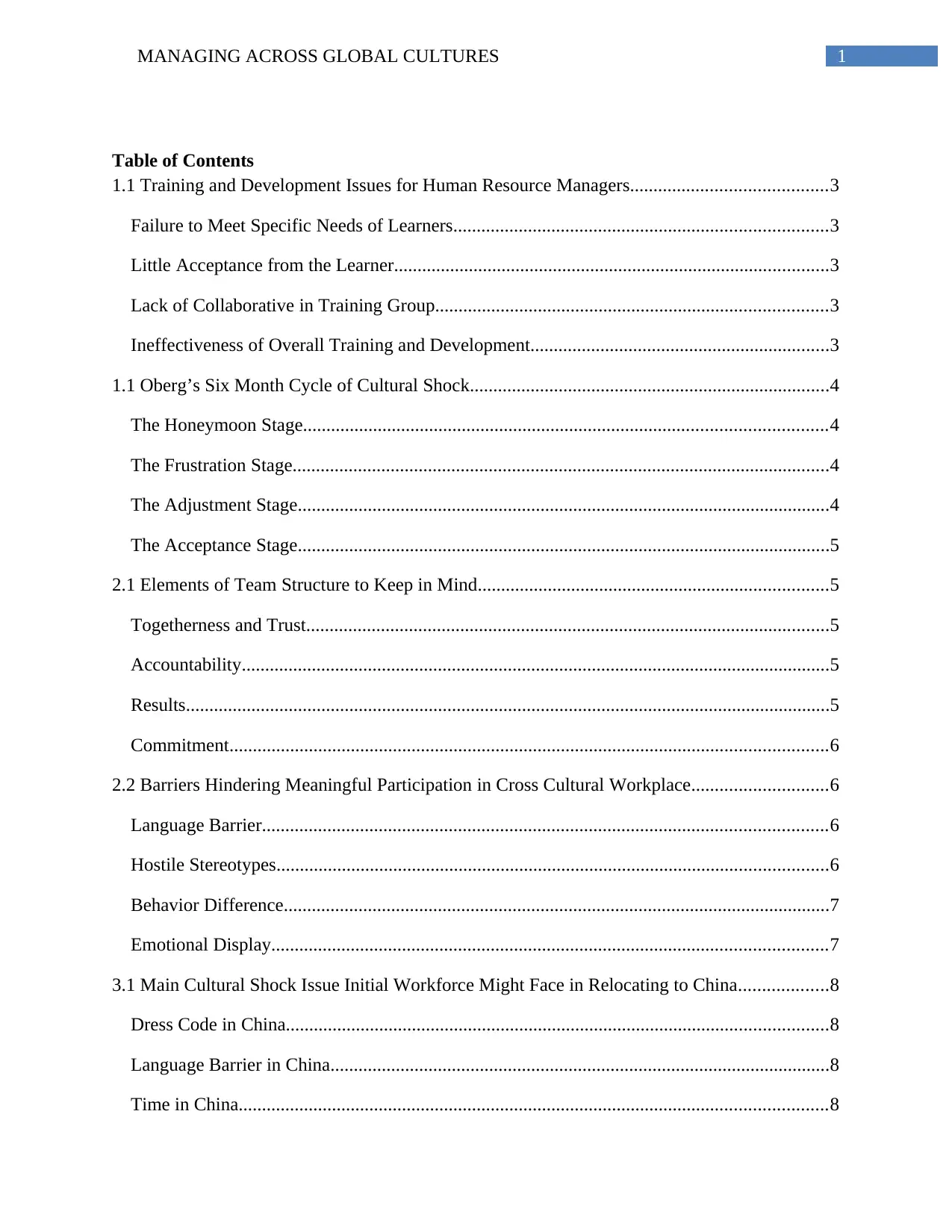
Table of Contents
1.1 Training and Development Issues for Human Resource Managers..........................................3
Failure to Meet Specific Needs of Learners................................................................................3
Little Acceptance from the Learner.............................................................................................3
Lack of Collaborative in Training Group....................................................................................3
Ineffectiveness of Overall Training and Development................................................................3
1.1 Oberg’s Six Month Cycle of Cultural Shock.............................................................................4
The Honeymoon Stage................................................................................................................4
The Frustration Stage...................................................................................................................4
The Adjustment Stage..................................................................................................................4
The Acceptance Stage..................................................................................................................5
2.1 Elements of Team Structure to Keep in Mind...........................................................................5
Togetherness and Trust................................................................................................................5
Accountability..............................................................................................................................5
Results..........................................................................................................................................5
Commitment................................................................................................................................6
2.2 Barriers Hindering Meaningful Participation in Cross Cultural Workplace.............................6
Language Barrier.........................................................................................................................6
Hostile Stereotypes......................................................................................................................6
Behavior Difference.....................................................................................................................7
Emotional Display.......................................................................................................................7
3.1 Main Cultural Shock Issue Initial Workforce Might Face in Relocating to China...................8
Dress Code in China....................................................................................................................8
Language Barrier in China...........................................................................................................8
Time in China..............................................................................................................................8
Table of Contents
1.1 Training and Development Issues for Human Resource Managers..........................................3
Failure to Meet Specific Needs of Learners................................................................................3
Little Acceptance from the Learner.............................................................................................3
Lack of Collaborative in Training Group....................................................................................3
Ineffectiveness of Overall Training and Development................................................................3
1.1 Oberg’s Six Month Cycle of Cultural Shock.............................................................................4
The Honeymoon Stage................................................................................................................4
The Frustration Stage...................................................................................................................4
The Adjustment Stage..................................................................................................................4
The Acceptance Stage..................................................................................................................5
2.1 Elements of Team Structure to Keep in Mind...........................................................................5
Togetherness and Trust................................................................................................................5
Accountability..............................................................................................................................5
Results..........................................................................................................................................5
Commitment................................................................................................................................6
2.2 Barriers Hindering Meaningful Participation in Cross Cultural Workplace.............................6
Language Barrier.........................................................................................................................6
Hostile Stereotypes......................................................................................................................6
Behavior Difference.....................................................................................................................7
Emotional Display.......................................................................................................................7
3.1 Main Cultural Shock Issue Initial Workforce Might Face in Relocating to China...................8
Dress Code in China....................................................................................................................8
Language Barrier in China...........................................................................................................8
Time in China..............................................................................................................................8
2MANAGING ACROSS GLOBAL CULTURES
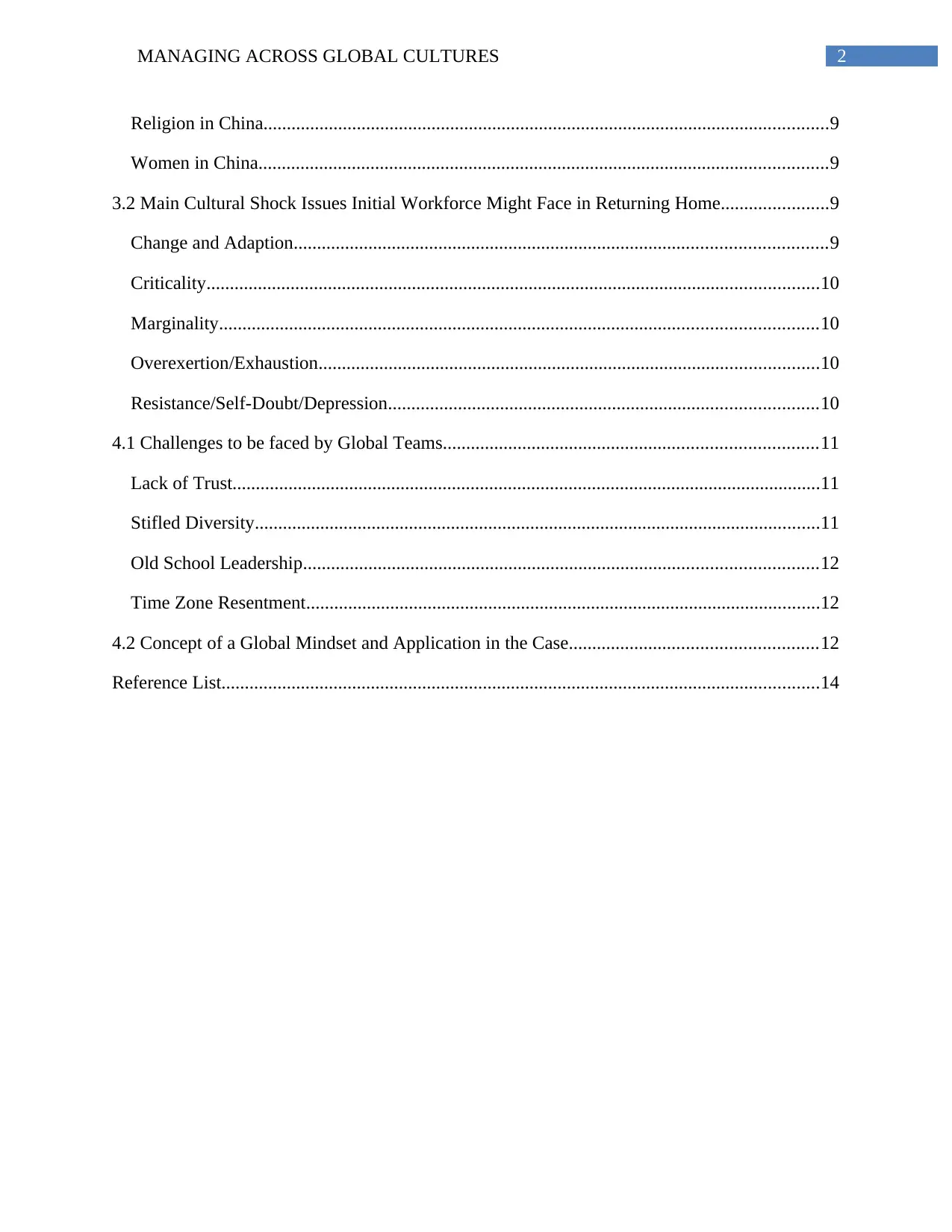
Religion in China.........................................................................................................................9
Women in China..........................................................................................................................9
3.2 Main Cultural Shock Issues Initial Workforce Might Face in Returning Home.......................9
Change and Adaption..................................................................................................................9
Criticality...................................................................................................................................10
Marginality................................................................................................................................10
Overexertion/Exhaustion...........................................................................................................10
Resistance/Self-Doubt/Depression............................................................................................10
4.1 Challenges to be faced by Global Teams................................................................................11
Lack of Trust..............................................................................................................................11
Stifled Diversity.........................................................................................................................11
Old School Leadership..............................................................................................................12
Time Zone Resentment..............................................................................................................12
4.2 Concept of a Global Mindset and Application in the Case.....................................................12
Reference List................................................................................................................................14
Religion in China.........................................................................................................................9
Women in China..........................................................................................................................9
3.2 Main Cultural Shock Issues Initial Workforce Might Face in Returning Home.......................9
Change and Adaption..................................................................................................................9
Criticality...................................................................................................................................10
Marginality................................................................................................................................10
Overexertion/Exhaustion...........................................................................................................10
Resistance/Self-Doubt/Depression............................................................................................10
4.1 Challenges to be faced by Global Teams................................................................................11
Lack of Trust..............................................................................................................................11
Stifled Diversity.........................................................................................................................11
Old School Leadership..............................................................................................................12
Time Zone Resentment..............................................................................................................12
4.2 Concept of a Global Mindset and Application in the Case.....................................................12
Reference List................................................................................................................................14
⊘ This is a preview!⊘
Do you want full access?
Subscribe today to unlock all pages.

Trusted by 1+ million students worldwide
3MANAGING ACROSS GLOBAL CULTURES
1.1 Training and Development Issues for Human Resource Managers
Failure to Meet Specific Needs of Learners
The learners from different cultural backgrounds can have different types of needs and
expectation from the training and development session. In this way, it can be extremely tough for
the human resource managers of McDonalds to identify the training and development needs of
the employees from different cultures.
Little Acceptance from the Learner
While working with staffs across the culture, there is always high potential of cultural
clashes between the human resource managers and the staffs from different culture. In case of
McDonald, the staffs from different cultures involved in the training and development program
may be unwilling to accept the human resource managers because of their differing culture.
Lack of Collaborative in Training Group
There can be lack of collaborative training group in the training and development session,
where the staffs are involved from different cultures. Likewise, the human resource managers of
McDonalds can also face the issues of lack of collaboration among the training staffs, as the
training staffs from different cultural background may be unwilling to cooperate and collaborate
with each other.
Ineffectiveness of Overall Training and Development
The trainees from different cultural backgrounds are not highly willing to be engaged in
the training and development session. In this case, the employees from different cultural
background may not understand the true objective of human resource managers because of
1.1 Training and Development Issues for Human Resource Managers
Failure to Meet Specific Needs of Learners
The learners from different cultural backgrounds can have different types of needs and
expectation from the training and development session. In this way, it can be extremely tough for
the human resource managers of McDonalds to identify the training and development needs of
the employees from different cultures.
Little Acceptance from the Learner
While working with staffs across the culture, there is always high potential of cultural
clashes between the human resource managers and the staffs from different culture. In case of
McDonald, the staffs from different cultures involved in the training and development program
may be unwilling to accept the human resource managers because of their differing culture.
Lack of Collaborative in Training Group
There can be lack of collaborative training group in the training and development session,
where the staffs are involved from different cultures. Likewise, the human resource managers of
McDonalds can also face the issues of lack of collaboration among the training staffs, as the
training staffs from different cultural background may be unwilling to cooperate and collaborate
with each other.
Ineffectiveness of Overall Training and Development
The trainees from different cultural backgrounds are not highly willing to be engaged in
the training and development session. In this case, the employees from different cultural
background may not understand the true objective of human resource managers because of
Paraphrase This Document
Need a fresh take? Get an instant paraphrase of this document with our AI Paraphraser
4MANAGING ACROSS GLOBAL CULTURES
differing culture. In this way, the overall effectiveness of the training and development session
gets disrupted.
1.1 Oberg’s Six Month Cycle of Cultural Shock
The Honeymoon Stage
In this stage, the manager of McDonald may find it exciting and new in the foreign
country. Nothing seems to be wrong to the manager in the different culture of overseas country.
In this stage, the manager of the organization may feel infatuated with the new language, new
culture and new foods of the foreign country.
The Frustration Stage
This stage is likely to occur within two to six months after going to overseas country. In
case of the manager in McDonalds, the manager would like to maintain a balance between what
he understands to be normal and what is new normal. In this way, the manager can be highly
stressed to understand the new gesture, sign and language of overseas country.
The Adjustment Stage
In this stage, the manager of McDonalds may feel more familiar and comfortable with the
new culture of the overseas country. The friends and community support are established and
details of languages of the foreign country get recognizable to the manager.
differing culture. In this way, the overall effectiveness of the training and development session
gets disrupted.
1.1 Oberg’s Six Month Cycle of Cultural Shock
The Honeymoon Stage
In this stage, the manager of McDonald may find it exciting and new in the foreign
country. Nothing seems to be wrong to the manager in the different culture of overseas country.
In this stage, the manager of the organization may feel infatuated with the new language, new
culture and new foods of the foreign country.
The Frustration Stage
This stage is likely to occur within two to six months after going to overseas country. In
case of the manager in McDonalds, the manager would like to maintain a balance between what
he understands to be normal and what is new normal. In this way, the manager can be highly
stressed to understand the new gesture, sign and language of overseas country.
The Adjustment Stage
In this stage, the manager of McDonalds may feel more familiar and comfortable with the
new culture of the overseas country. The friends and community support are established and
details of languages of the foreign country get recognizable to the manager.
5MANAGING ACROSS GLOBAL CULTURES
The Acceptance Stage
In this stage, the manager of McDonalds can be able to integrate completely with the host
culture of the overseas country. He can be able to celebrate with his cultural difference and be
the part of new culture in the new country.
2.1 Elements of Team Structure to Keep in Mind
Togetherness and Trust
The main element of an effective team structure is togetherness and trust. The team
members of an effective should work together with each other for achieving the common
organizational objectives. Therefore, the managers of McDonalds should always keep in mind
the importance of togetherness for engaging the team members in the overall organizational
goals. The managers should also establish a trusting relationship with the team members for
enhancing the engagement level of the team managers in organizational goals.
Accountability
Accountable team members are always likely to show more dedication in the success of
organization. Hence, the managers of McDonalds should be concerned about establishing
accountability among the team members. In this way, the team members with high level of
accountability will show high level of dedication towards achieving the success level of the
organization.
Results
The effectiveness of teamwork always comes through the result oriented nature of the
teamwork. Hence, the managers of McDonalds should always be concerned about making the
The Acceptance Stage
In this stage, the manager of McDonalds can be able to integrate completely with the host
culture of the overseas country. He can be able to celebrate with his cultural difference and be
the part of new culture in the new country.
2.1 Elements of Team Structure to Keep in Mind
Togetherness and Trust
The main element of an effective team structure is togetherness and trust. The team
members of an effective should work together with each other for achieving the common
organizational objectives. Therefore, the managers of McDonalds should always keep in mind
the importance of togetherness for engaging the team members in the overall organizational
goals. The managers should also establish a trusting relationship with the team members for
enhancing the engagement level of the team managers in organizational goals.
Accountability
Accountable team members are always likely to show more dedication in the success of
organization. Hence, the managers of McDonalds should be concerned about establishing
accountability among the team members. In this way, the team members with high level of
accountability will show high level of dedication towards achieving the success level of the
organization.
Results
The effectiveness of teamwork always comes through the result oriented nature of the
teamwork. Hence, the managers of McDonalds should always be concerned about making the
⊘ This is a preview!⊘
Do you want full access?
Subscribe today to unlock all pages.
Trusted by 1+ million students worldwide
6MANAGING ACROSS GLOBAL CULTURES
teamwork result oriented. It will make the team members highly focused on the direction of
organizational success.
Commitment
Trust based environment and commitment level of the team members are the key for the
success of teamwork. Hence, the managers of McDonalds should always keep in mind about the
level of commitment of the team members. Moreover, the committed employees are always
engaged and highly committed to achieve the success level of the organization.
2.2 Barriers Hindering Meaningful Participation in Cross Cultural Workplace
Language Barrier
Language is an extremely complex thing is communication. Language gets extremely
difficult, when it comes about the communication between people having different languages.
Hence, in cross cultural workplace, the participation levels of the employees get distorted, while
they do not understand the language of others. Apart from that, language is an effective way of
looking at the world. The skilled translators often find it difficult to understand and convey the
complex emotions and concepts (Cramton and Hinds 2014). In this way, in cross cultural
workplace, the employees can find it tricky to understand and convey their emotions to others
from different cultural background. Hence, it can lead to misunderstanding among the employees
leading to lack of proper employee participation at the workplace.
Hostile Stereotypes
Hostile and inaccurate stereotypes of the people from other places can lead to a barrier to
the communication in cross cultural workplaces. Stereotypes are the assumptions, which the
people perceive about the traits of specific groups of people. The danger in stereotypes is that an
teamwork result oriented. It will make the team members highly focused on the direction of
organizational success.
Commitment
Trust based environment and commitment level of the team members are the key for the
success of teamwork. Hence, the managers of McDonalds should always keep in mind about the
level of commitment of the team members. Moreover, the committed employees are always
engaged and highly committed to achieve the success level of the organization.
2.2 Barriers Hindering Meaningful Participation in Cross Cultural Workplace
Language Barrier
Language is an extremely complex thing is communication. Language gets extremely
difficult, when it comes about the communication between people having different languages.
Hence, in cross cultural workplace, the participation levels of the employees get distorted, while
they do not understand the language of others. Apart from that, language is an effective way of
looking at the world. The skilled translators often find it difficult to understand and convey the
complex emotions and concepts (Cramton and Hinds 2014). In this way, in cross cultural
workplace, the employees can find it tricky to understand and convey their emotions to others
from different cultural background. Hence, it can lead to misunderstanding among the employees
leading to lack of proper employee participation at the workplace.
Hostile Stereotypes
Hostile and inaccurate stereotypes of the people from other places can lead to a barrier to
the communication in cross cultural workplaces. Stereotypes are the assumptions, which the
people perceive about the traits of specific groups of people. The danger in stereotypes is that an
Paraphrase This Document
Need a fresh take? Get an instant paraphrase of this document with our AI Paraphraser
7MANAGING ACROSS GLOBAL CULTURES
individual is thought to posses the traits or characteristics, which are actually ascribed to their
group members. However, prejudging an individual beforehand can result in misconception and
barriers in communication at cross cultural workplace. It can lead to gaps among the employees
from different culture unnecessarily (Colomo-Palacios et al. 2014). Hence, hostile stereotypes
can hamper the ultimate level of employee participation among the employees with high level of
misunderstanding among them.
Behavior Difference
The behavioral difference among the employees of different culture can result in
misunderstanding among them in cross cultural workplace. Every culture has specific guidelines
regarding their appropriate behavior. Getting right to the point at the business meeting can be
impolite in some culture, where it is preferred to have some small talk before conducting
business meeting. In some culture, looking directly at the eye of someone during talking is
considered as rude, while in some other culture, refraining from doing so in somewhat
disgraceful. In this way, such differences can be barriers to the effective communication, if those
are not recognized properly (Wei, Thurasamy and Popa 2018). Ultimately, such barriers hinder
the level of employee participation at the workplace.
Emotional Display
Appropriate display of emotion can be different from one culture to other. In some
countries, display of fear or frustration and anger at the workplaces may be considered to be
inappropriate in business settings. The employees from such culture are bound to keep their
emotions hidden and discuss only the factual aspects related to their jobs. On the other hand, in
some other culture, the employees are free to express their emotions in a discussion. In this way,
when the employees display strong emotion at the workplace, where it is restricted can lead to
individual is thought to posses the traits or characteristics, which are actually ascribed to their
group members. However, prejudging an individual beforehand can result in misconception and
barriers in communication at cross cultural workplace. It can lead to gaps among the employees
from different culture unnecessarily (Colomo-Palacios et al. 2014). Hence, hostile stereotypes
can hamper the ultimate level of employee participation among the employees with high level of
misunderstanding among them.
Behavior Difference
The behavioral difference among the employees of different culture can result in
misunderstanding among them in cross cultural workplace. Every culture has specific guidelines
regarding their appropriate behavior. Getting right to the point at the business meeting can be
impolite in some culture, where it is preferred to have some small talk before conducting
business meeting. In some culture, looking directly at the eye of someone during talking is
considered as rude, while in some other culture, refraining from doing so in somewhat
disgraceful. In this way, such differences can be barriers to the effective communication, if those
are not recognized properly (Wei, Thurasamy and Popa 2018). Ultimately, such barriers hinder
the level of employee participation at the workplace.
Emotional Display
Appropriate display of emotion can be different from one culture to other. In some
countries, display of fear or frustration and anger at the workplaces may be considered to be
inappropriate in business settings. The employees from such culture are bound to keep their
emotions hidden and discuss only the factual aspects related to their jobs. On the other hand, in
some other culture, the employees are free to express their emotions in a discussion. In this way,
when the employees display strong emotion at the workplace, where it is restricted can lead to
8MANAGING ACROSS GLOBAL CULTURES
misunderstanding among the employees leading to disrupted employee participation at cross
cultural workplaces (Tenzer and Pudelko 2015).
3.1 Main Cultural Shock Issue Initial Workforce Might Face in Relocating to China
Dress Code in China
In usual daily life, Chinese people usually dress in Western cloths. Moreover, traditional
cloths are not usual for the Chinese people apart from the big festivals. In such situation, the
workforce relocated to China from Asian countries may face cultural shock of dress code in this
country.
Language Barrier in China
Language barriers in China can be a big barrier for the expatriates relocating in China.
Apart from the official language in China, which is Chinese Mandarin, there are also some other
dialects in this country (Dingsoyr and Smite 2014). The expatriates relocating to China can face
extreme difficulties in learning the Chinese Mandarin language.
Time in China
In real scenario, China stretches over several time zones. In some provinces, there can be
exist two version of time zone like the official one and the local one. Huge traffic jam and other
conditions on the road can make it difficult for the expatriates to predict the accuracy of time.
Hence, the expatriates relocating to China may face cultural shock issues in fixing the time of
appointments.
misunderstanding among the employees leading to disrupted employee participation at cross
cultural workplaces (Tenzer and Pudelko 2015).
3.1 Main Cultural Shock Issue Initial Workforce Might Face in Relocating to China
Dress Code in China
In usual daily life, Chinese people usually dress in Western cloths. Moreover, traditional
cloths are not usual for the Chinese people apart from the big festivals. In such situation, the
workforce relocated to China from Asian countries may face cultural shock of dress code in this
country.
Language Barrier in China
Language barriers in China can be a big barrier for the expatriates relocating in China.
Apart from the official language in China, which is Chinese Mandarin, there are also some other
dialects in this country (Dingsoyr and Smite 2014). The expatriates relocating to China can face
extreme difficulties in learning the Chinese Mandarin language.
Time in China
In real scenario, China stretches over several time zones. In some provinces, there can be
exist two version of time zone like the official one and the local one. Huge traffic jam and other
conditions on the road can make it difficult for the expatriates to predict the accuracy of time.
Hence, the expatriates relocating to China may face cultural shock issues in fixing the time of
appointments.
⊘ This is a preview!⊘
Do you want full access?
Subscribe today to unlock all pages.
Trusted by 1+ million students worldwide
9MANAGING ACROSS GLOBAL CULTURES
Religion in China
Religion is not quite common in China and religion is mostly found in the rural areas
instead of big cities. Most of the people in this country belong to Buddhist and Muslim, but
limited numbers of people belong to Christian religion. Hence, the initial workforces belong to
religion and relocating to China might face the issue of religion clash with others.
Women in China
Although the perception of people in China has changed, still the ancient concepts exist
in the minds of several Chinese people. Nowadays, Chinese women play significant roles in the
management of Chinese companies, but they are highly expected to fulfill their expected roles to
their home and children. In such situation, the women are often ignored to get the higher position
and are assigned to big job responsibilities to their organization (Neukam 2017). Hence, the
initial women workforces relocating to China might face the issue of lack of priorities provided
to them at this country.
3.2 Main Cultural Shock Issues Initial Workforce Might Face in Returning Home
Change and Adaption
More often, the repatriates expect their home to be just the same as it was previously,
when they left their home country. The natural changes during the time, while they were outside,
can now be shocking to them at their home country. Moreover, the adaption of foreign cultural
practice may change the perception of the repatriates about their home. The living experience in
the overseas country can be a life changing experience for the repatriates that can affect on their
feelings, attitude and relationship with their home. Hence, initial workforce might have to relearn
patterns and routine of their home that they have forgotten after living long in overseas country.
Religion in China
Religion is not quite common in China and religion is mostly found in the rural areas
instead of big cities. Most of the people in this country belong to Buddhist and Muslim, but
limited numbers of people belong to Christian religion. Hence, the initial workforces belong to
religion and relocating to China might face the issue of religion clash with others.
Women in China
Although the perception of people in China has changed, still the ancient concepts exist
in the minds of several Chinese people. Nowadays, Chinese women play significant roles in the
management of Chinese companies, but they are highly expected to fulfill their expected roles to
their home and children. In such situation, the women are often ignored to get the higher position
and are assigned to big job responsibilities to their organization (Neukam 2017). Hence, the
initial women workforces relocating to China might face the issue of lack of priorities provided
to them at this country.
3.2 Main Cultural Shock Issues Initial Workforce Might Face in Returning Home
Change and Adaption
More often, the repatriates expect their home to be just the same as it was previously,
when they left their home country. The natural changes during the time, while they were outside,
can now be shocking to them at their home country. Moreover, the adaption of foreign cultural
practice may change the perception of the repatriates about their home. The living experience in
the overseas country can be a life changing experience for the repatriates that can affect on their
feelings, attitude and relationship with their home. Hence, initial workforce might have to relearn
patterns and routine of their home that they have forgotten after living long in overseas country.
Paraphrase This Document
Need a fresh take? Get an instant paraphrase of this document with our AI Paraphraser
10MANAGING ACROSS GLOBAL CULTURES
Criticality
The depth of reverse cultural shock is always associated with the critical judgment of the
repatriates about their home. The renewed unfamiliarity with the culture of home and their
unfamiliarity with their home routines can lead to frustrating and unpleasant experience for the
repatriates (Lisak and Erez 2015). They are more likely to compare the pleasant things of
overseas countries with the unpleasant aspect of their home.
Marginality
The overseas experience can significantly impact on the identity of the repatriates, while
they return to their home. The repatriates immerse themselves to the new culture of overseas
country and open their minds to the new cultures. In such situation, when they return to their
home, they feel increasing tension existing between their new identity and mainstream society.
Moreover, the initial workforce might not feel fit in their home after returning from overseas
country.
Overexertion/Exhaustion
The repatriates after returning to USA must have to pay deep consciousness and attention
to perform the basic job functions, as there are increasing numbers of patterns, routines and
customs in USA culture (Gilson et al. 2015). In this way, such increasing routines and functions
in the home country may lead to exhaustion for the repatriates.
Resistance/Self-Doubt/Depression
It can become the common reaction for the repatriates to resist to readapting the home
culture, as they get disconnected from it during their overseas live experience. With all such
Criticality
The depth of reverse cultural shock is always associated with the critical judgment of the
repatriates about their home. The renewed unfamiliarity with the culture of home and their
unfamiliarity with their home routines can lead to frustrating and unpleasant experience for the
repatriates (Lisak and Erez 2015). They are more likely to compare the pleasant things of
overseas countries with the unpleasant aspect of their home.
Marginality
The overseas experience can significantly impact on the identity of the repatriates, while
they return to their home. The repatriates immerse themselves to the new culture of overseas
country and open their minds to the new cultures. In such situation, when they return to their
home, they feel increasing tension existing between their new identity and mainstream society.
Moreover, the initial workforce might not feel fit in their home after returning from overseas
country.
Overexertion/Exhaustion
The repatriates after returning to USA must have to pay deep consciousness and attention
to perform the basic job functions, as there are increasing numbers of patterns, routines and
customs in USA culture (Gilson et al. 2015). In this way, such increasing routines and functions
in the home country may lead to exhaustion for the repatriates.
Resistance/Self-Doubt/Depression
It can become the common reaction for the repatriates to resist to readapting the home
culture, as they get disconnected from it during their overseas live experience. With all such
11MANAGING ACROSS GLOBAL CULTURES
frustration and disillusionment about the home culture, it is more common for the repatriates to
make a self-doubt about themselves for their capability.
4.1 Challenges to be faced by Global Teams
Lack of Trust
Trust is an extremely essential factor for leading the success of global teams. Team
members must have to able to understand and rely on each other for achieving the common
organizational goals. Trust also acts as the glue for the virtual workplaces and leading the
success of virtual team members. Lack of trust may lead to the fear of admitting mistakes and
weaknesses among the virtual team members. It also discourages the virtual team members to
ask to help from each other (Neukam 2017). However, with lack of face-to-face interaction
among the virtual team members, it becomes quite difficult for them to trust on each other.
Stifled Diversity
Virtual team members lead to stifled diversity among the employees that can hinder the
actual advantages of diverse workforces. Moreover, virtual team building acts as force-fitting
universal process for leading increased organizational productivity. In such process, organization
tries to incorporated irrelevant and dissimilar workforces for exploring the new possibilities
associated with the virtual team members. However, in such process, the virtual team members
from dissimilar culture are not likely to cooperate and share innovative and creative ideas with
each others. In this way, such force fitting universal process ultimately becomes the hindrance
for the creativity of the organizations.
frustration and disillusionment about the home culture, it is more common for the repatriates to
make a self-doubt about themselves for their capability.
4.1 Challenges to be faced by Global Teams
Lack of Trust
Trust is an extremely essential factor for leading the success of global teams. Team
members must have to able to understand and rely on each other for achieving the common
organizational goals. Trust also acts as the glue for the virtual workplaces and leading the
success of virtual team members. Lack of trust may lead to the fear of admitting mistakes and
weaknesses among the virtual team members. It also discourages the virtual team members to
ask to help from each other (Neukam 2017). However, with lack of face-to-face interaction
among the virtual team members, it becomes quite difficult for them to trust on each other.
Stifled Diversity
Virtual team members lead to stifled diversity among the employees that can hinder the
actual advantages of diverse workforces. Moreover, virtual team building acts as force-fitting
universal process for leading increased organizational productivity. In such process, organization
tries to incorporated irrelevant and dissimilar workforces for exploring the new possibilities
associated with the virtual team members. However, in such process, the virtual team members
from dissimilar culture are not likely to cooperate and share innovative and creative ideas with
each others. In this way, such force fitting universal process ultimately becomes the hindrance
for the creativity of the organizations.
⊘ This is a preview!⊘
Do you want full access?
Subscribe today to unlock all pages.
Trusted by 1+ million students worldwide

1 out of 15


Related Documents


Your All-in-One AI-Powered Toolkit for Academic Success.
+13062052269
info@desklib.com
Available 24*7 on WhatsApp / Email
![[object Object]](/_next/static/media/star-bottom.7253800d.svg)
Unlock your academic potential
Copyright © 2020–2026 A2Z Services. All Rights Reserved. Developed and managed by ZUCOL.