Managing Change in Organizations: A Business Report
VerifiedAdded on  2023/01/20
|4
|799
|28
Report
AI Summary
This report examines five factors that can cause change in any business, including end-of-life products, governmental priority shifts, mergers and acquisitions, business strategy changes, and structural changes. It emphasizes the critical role of a clear shared vision in aligning resources, focusing employees, and shaping strategies to effectively manage these changes. The report also discusses the importance of capacity for change, addressing issues through innovative staffing and financial formulas. Furthermore, it highlights the Plan-Do-Check-Act (PDCA) cycle as a systematic approach to implementing change, involving problem identification, solution development, testing, and implementation. The report references key academic sources to support its arguments.
Running head: MANAGING CHANGE IN AN ORGANIZATION
Managing Change in an Organization
Name of the Student
Name of the University
Author Note
Managing Change in an Organization
Name of the Student
Name of the University
Author Note
Paraphrase This Document
Need a fresh take? Get an instant paraphrase of this document with our AI Paraphraser

1MANAGING CHANGE IN AN ORGANIZATION
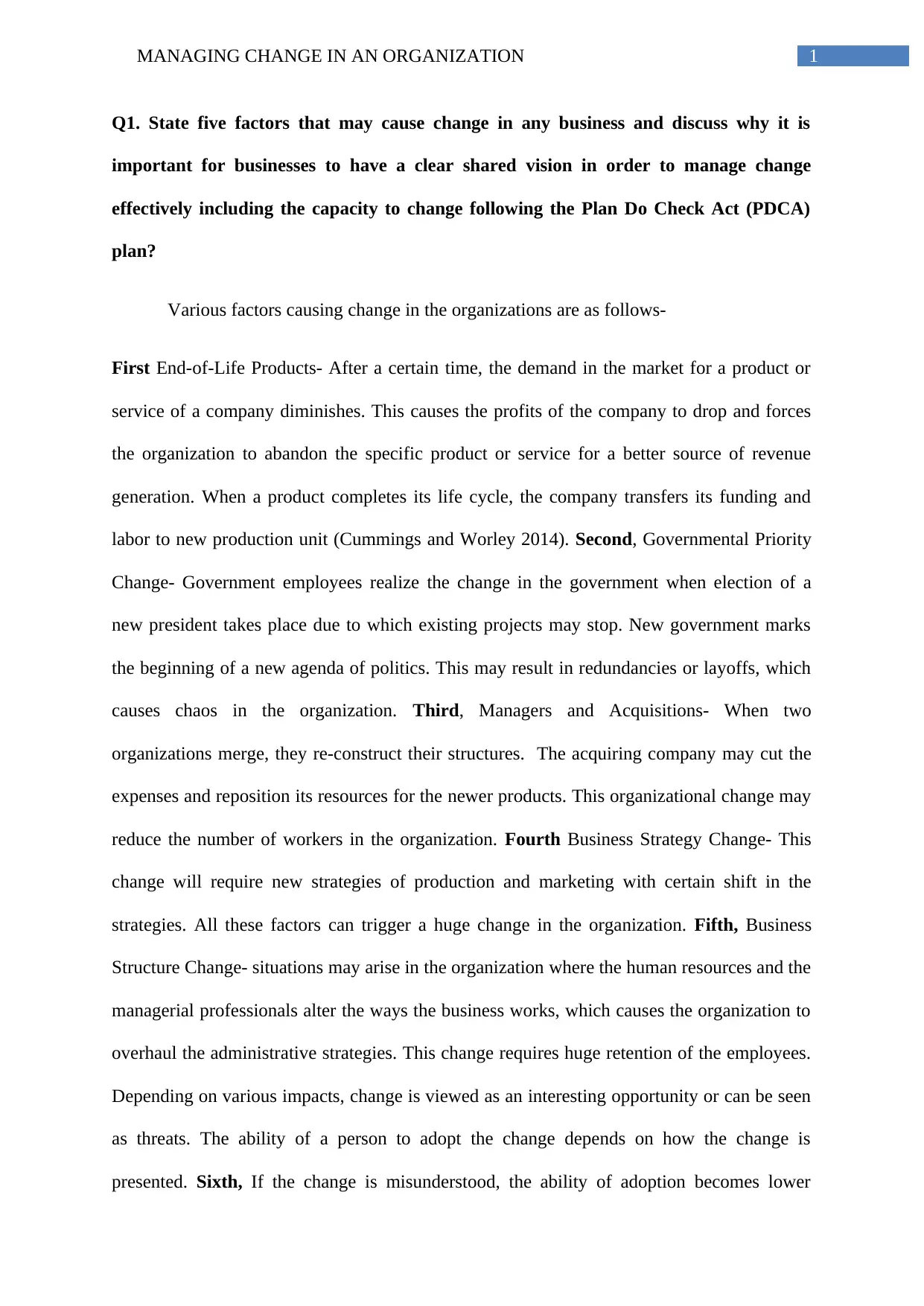
Q1. State five factors that may cause change in any business and discuss why it is
important for businesses to have a clear shared vision in order to manage change
effectively including the capacity to change following the Plan Do Check Act (PDCA)
plan?
Various factors causing change in the organizations are as follows-
First End-of-Life Products- After a certain time, the demand in the market for a product or
service of a company diminishes. This causes the profits of the company to drop and forces
the organization to abandon the specific product or service for a better source of revenue
generation. When a product completes its life cycle, the company transfers its funding and
labor to new production unit (Cummings and Worley 2014). Second, Governmental Priority
Change- Government employees realize the change in the government when election of a
new president takes place due to which existing projects may stop. New government marks
the beginning of a new agenda of politics. This may result in redundancies or layoffs, which
causes chaos in the organization. Third, Managers and Acquisitions- When two
organizations merge, they re-construct their structures. The acquiring company may cut the
expenses and reposition its resources for the newer products. This organizational change may
reduce the number of workers in the organization. Fourth Business Strategy Change- This
change will require new strategies of production and marketing with certain shift in the
strategies. All these factors can trigger a huge change in the organization. Fifth, Business
Structure Change- situations may arise in the organization where the human resources and the
managerial professionals alter the ways the business works, which causes the organization to
overhaul the administrative strategies. This change requires huge retention of the employees.
Depending on various impacts, change is viewed as an interesting opportunity or can be seen
as threats. The ability of a person to adopt the change depends on how the change is
presented. Sixth, If the change is misunderstood, the ability of adoption becomes lower
Q1. State five factors that may cause change in any business and discuss why it is
important for businesses to have a clear shared vision in order to manage change
effectively including the capacity to change following the Plan Do Check Act (PDCA)
plan?
Various factors causing change in the organizations are as follows-
First End-of-Life Products- After a certain time, the demand in the market for a product or
service of a company diminishes. This causes the profits of the company to drop and forces
the organization to abandon the specific product or service for a better source of revenue
generation. When a product completes its life cycle, the company transfers its funding and
labor to new production unit (Cummings and Worley 2014). Second, Governmental Priority
Change- Government employees realize the change in the government when election of a
new president takes place due to which existing projects may stop. New government marks
the beginning of a new agenda of politics. This may result in redundancies or layoffs, which
causes chaos in the organization. Third, Managers and Acquisitions- When two
organizations merge, they re-construct their structures. The acquiring company may cut the
expenses and reposition its resources for the newer products. This organizational change may
reduce the number of workers in the organization. Fourth Business Strategy Change- This
change will require new strategies of production and marketing with certain shift in the
strategies. All these factors can trigger a huge change in the organization. Fifth, Business
Structure Change- situations may arise in the organization where the human resources and the
managerial professionals alter the ways the business works, which causes the organization to
overhaul the administrative strategies. This change requires huge retention of the employees.
Depending on various impacts, change is viewed as an interesting opportunity or can be seen
as threats. The ability of a person to adopt the change depends on how the change is
presented. Sixth, If the change is misunderstood, the ability of adoption becomes lower

2MANAGING CHANGE IN AN ORGANIZATION
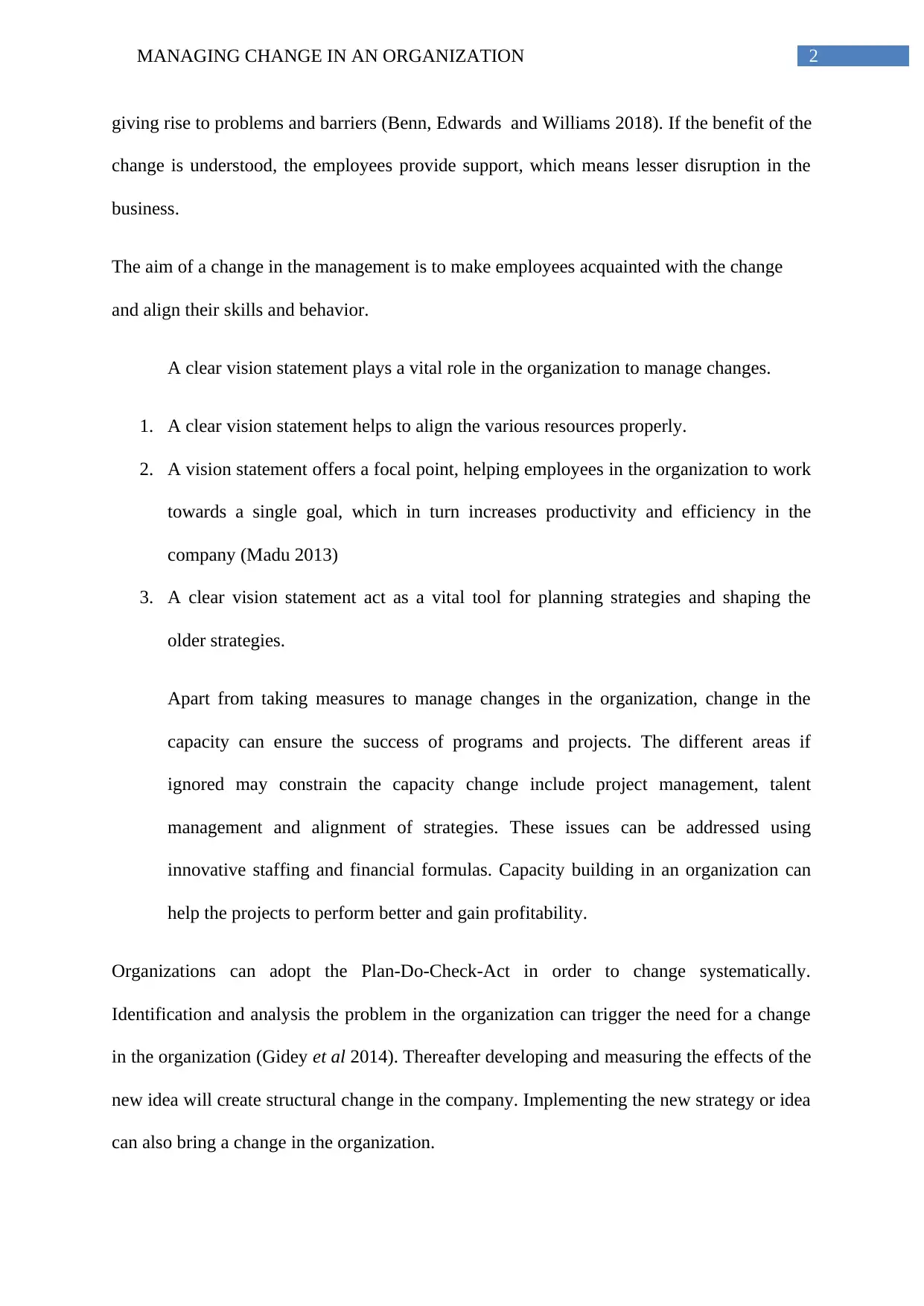
giving rise to problems and barriers (Benn, Edwards and Williams 2018). If the benefit of the
change is understood, the employees provide support, which means lesser disruption in the
business.
The aim of a change in the management is to make employees acquainted with the change
and align their skills and behavior.
A clear vision statement plays a vital role in the organization to manage changes.
1. A clear vision statement helps to align the various resources properly.
2. A vision statement offers a focal point, helping employees in the organization to work
towards a single goal, which in turn increases productivity and efficiency in the
company (Madu 2013)
3. A clear vision statement act as a vital tool for planning strategies and shaping the
older strategies.
Apart from taking measures to manage changes in the organization, change in the
capacity can ensure the success of programs and projects. The different areas if
ignored may constrain the capacity change include project management, talent
management and alignment of strategies. These issues can be addressed using
innovative staffing and financial formulas. Capacity building in an organization can
help the projects to perform better and gain profitability.
Organizations can adopt the Plan-Do-Check-Act in order to change systematically.
Identification and analysis the problem in the organization can trigger the need for a change
in the organization (Gidey et al 2014). Thereafter developing and measuring the effects of the
new idea will create structural change in the company. Implementing the new strategy or idea
can also bring a change in the organization.
giving rise to problems and barriers (Benn, Edwards and Williams 2018). If the benefit of the
change is understood, the employees provide support, which means lesser disruption in the
business.
The aim of a change in the management is to make employees acquainted with the change
and align their skills and behavior.
A clear vision statement plays a vital role in the organization to manage changes.
1. A clear vision statement helps to align the various resources properly.
2. A vision statement offers a focal point, helping employees in the organization to work
towards a single goal, which in turn increases productivity and efficiency in the
company (Madu 2013)
3. A clear vision statement act as a vital tool for planning strategies and shaping the
older strategies.
Apart from taking measures to manage changes in the organization, change in the
capacity can ensure the success of programs and projects. The different areas if
ignored may constrain the capacity change include project management, talent
management and alignment of strategies. These issues can be addressed using
innovative staffing and financial formulas. Capacity building in an organization can
help the projects to perform better and gain profitability.
Organizations can adopt the Plan-Do-Check-Act in order to change systematically.
Identification and analysis the problem in the organization can trigger the need for a change
in the organization (Gidey et al 2014). Thereafter developing and measuring the effects of the
new idea will create structural change in the company. Implementing the new strategy or idea
can also bring a change in the organization.
⊘ This is a preview!⊘
Do you want full access?
Subscribe today to unlock all pages.

Trusted by 1+ million students worldwide

3MANAGING CHANGE IN AN ORGANIZATION
Reference
Benn, S., Edwards, M. and Williams, T., 2018. Organizational change for corporate
sustainability. Routledge.
Cummings, T.G. and Worley, C.G., 2014. Organization development and change. Cengage
learning.
Gidey, E., Jilcha, K., Beshah, B. and Kitaw, D., 2014. The plan-do-check-act cycle of value
addition. Industrial Engineering & Management, 3(124), pp.2169-0316.
Madu, B.C., 2013. Vision: The relationship between a firm's strategy and business
model. Journal of behavioral studies in business, 6, p.1.
Reference
Benn, S., Edwards, M. and Williams, T., 2018. Organizational change for corporate
sustainability. Routledge.
Cummings, T.G. and Worley, C.G., 2014. Organization development and change. Cengage
learning.
Gidey, E., Jilcha, K., Beshah, B. and Kitaw, D., 2014. The plan-do-check-act cycle of value
addition. Industrial Engineering & Management, 3(124), pp.2169-0316.
Madu, B.C., 2013. Vision: The relationship between a firm's strategy and business
model. Journal of behavioral studies in business, 6, p.1.
1 out of 4
Related Documents
Your All-in-One AI-Powered Toolkit for Academic Success.
 +13062052269
info@desklib.com
Available 24*7 on WhatsApp / Email
Unlock your academic potential
Copyright © 2020–2026 A2Z Services. All Rights Reserved. Developed and managed by ZUCOL.