Managing Financial Resources: Strategies and Analysis Report
VerifiedAdded on 2020/10/22
|17
|3997
|125
Report
AI Summary
This report delves into the critical aspects of managing financial resources within an organization. It begins by examining the merits and demerits of listing on the stock exchange, specifically focusing on the London Stock Exchange, and outlines the steps involved in the listing process for a hypothetical company, Milner Chemicals Plc. The report further explores various methods for raising capital within this exchange. It then proceeds to calculate the cost of capital for ordinary shares, preference shares, and debentures, culminating in the determination of the weighted average cost of capital. The significance of financial planning is discussed, along with the information requirements for different levels of management and the impact of finance on financial statements. The report also covers the main financial statements prepared by business organizations, exploring different formats for manufacturing and trading companies, and concludes with the computation of financial ratios to analyze performance.

Managing Financial
Resources
Resources

Paraphrase This Document
Need a fresh take? Get an instant paraphrase of this document with our AI Paraphraser
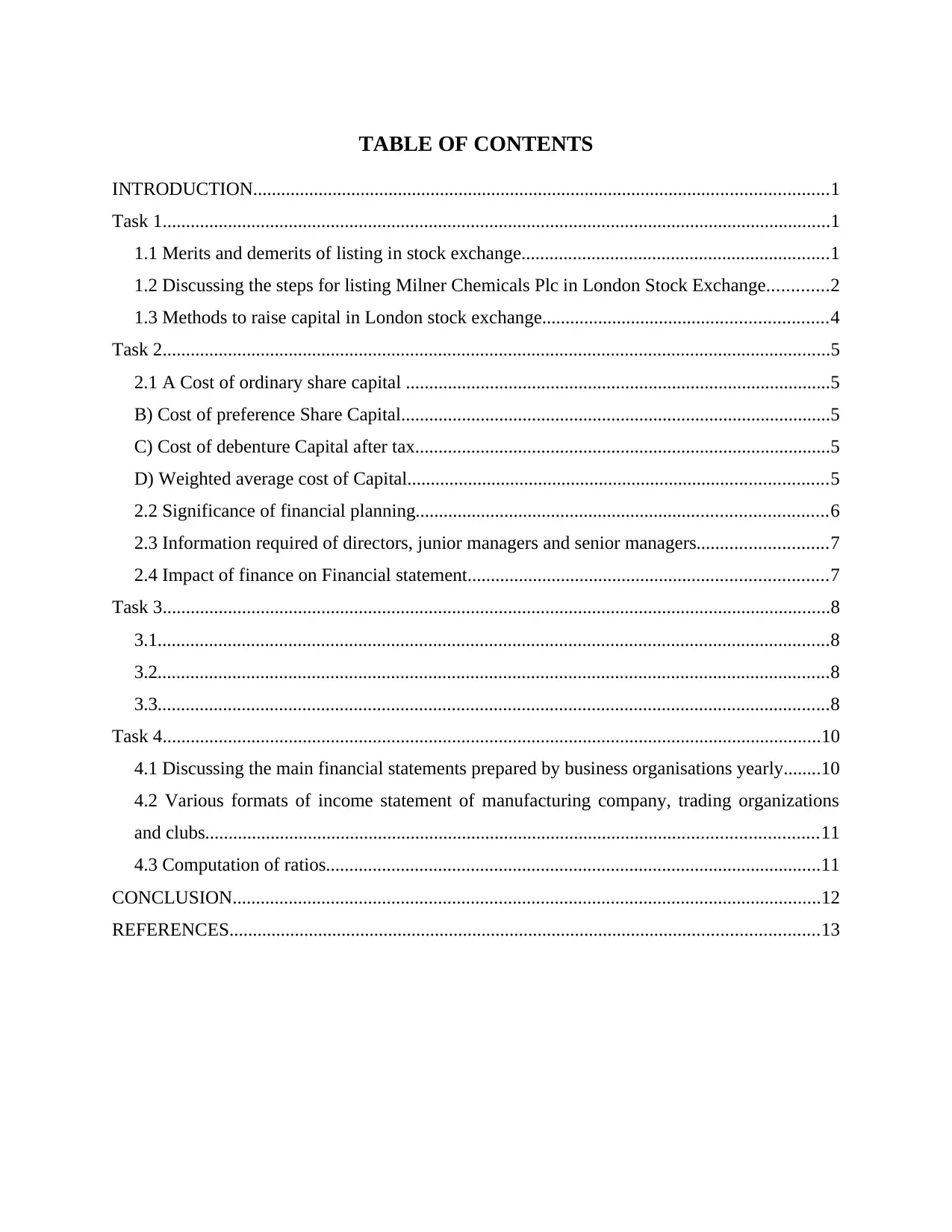
TABLE OF CONTENTS
INTRODUCTION...........................................................................................................................1
Task 1...............................................................................................................................................1
1.1 Merits and demerits of listing in stock exchange..................................................................1
1.2 Discussing the steps for listing Milner Chemicals Plc in London Stock Exchange.............2
1.3 Methods to raise capital in London stock exchange.............................................................4
Task 2...............................................................................................................................................5
2.1 A Cost of ordinary share capital ...........................................................................................5
B) Cost of preference Share Capital............................................................................................5
C) Cost of debenture Capital after tax.........................................................................................5
D) Weighted average cost of Capital..........................................................................................5
2.2 Significance of financial planning........................................................................................6
2.3 Information required of directors, junior managers and senior managers............................7
2.4 Impact of finance on Financial statement.............................................................................7
Task 3...............................................................................................................................................8
3.1................................................................................................................................................8
3.2................................................................................................................................................8
3.3................................................................................................................................................8
Task 4.............................................................................................................................................10
4.1 Discussing the main financial statements prepared by business organisations yearly........10
4.2 Various formats of income statement of manufacturing company, trading organizations
and clubs...................................................................................................................................11
4.3 Computation of ratios..........................................................................................................11
CONCLUSION..............................................................................................................................12
REFERENCES..............................................................................................................................13
INTRODUCTION...........................................................................................................................1
Task 1...............................................................................................................................................1
1.1 Merits and demerits of listing in stock exchange..................................................................1
1.2 Discussing the steps for listing Milner Chemicals Plc in London Stock Exchange.............2
1.3 Methods to raise capital in London stock exchange.............................................................4
Task 2...............................................................................................................................................5
2.1 A Cost of ordinary share capital ...........................................................................................5
B) Cost of preference Share Capital............................................................................................5
C) Cost of debenture Capital after tax.........................................................................................5
D) Weighted average cost of Capital..........................................................................................5
2.2 Significance of financial planning........................................................................................6
2.3 Information required of directors, junior managers and senior managers............................7
2.4 Impact of finance on Financial statement.............................................................................7
Task 3...............................................................................................................................................8
3.1................................................................................................................................................8
3.2................................................................................................................................................8
3.3................................................................................................................................................8
Task 4.............................................................................................................................................10
4.1 Discussing the main financial statements prepared by business organisations yearly........10
4.2 Various formats of income statement of manufacturing company, trading organizations
and clubs...................................................................................................................................11
4.3 Computation of ratios..........................................................................................................11
CONCLUSION..............................................................................................................................12
REFERENCES..............................................................................................................................13
INTRODUCTION
Managing financial is very important aspect of each and every organization. The present
report is giving brief about the sources of finance which are available to business. The
implications of finance as resource within the business has been elaborated by analyzing costs of
various sources. Further it has been briefed about financial decisions according to financial
information.
Task 1
1.1 Merits and demerits of listing in stock exchange
The benefits while listing in stock exchange can be in various forms like it provides
access to capital which will help Milner Chemical Plc for raising finance for development even
at the time of admission and via raising more capital (Rahman, And et.al., 2017). It will create
rise in profile i.e. it will create demand for shares and it will improve the liquidity of Milner
company as many investors prefer to invest in business which is listed on the main exchange as
theyare more comfortable, opportunities and for the issue of security. While listing on market, it
facilitates acquisitions or increases the ability of Milner Chemicals Plc for acquisitions with
listed shares as currency. Market valuation for the business has been created and all the
opportunities are enabled to raise fund and for expansion. Valuation has been objected as it helps
in creating independent value of business of Milner Company. The base of shareholder has been
broadened as it has created a market for the share of company. In the same series, shares have
been used as the employee incentive for giving motivation for long term i.e. improves employee
commitment. It improves investor, supplier and customer's confidence and the position in
marketplace.
It provides pure access to a currency acquisition and transparency related to the valuation
of busienss. The companies which listed uses shares instead of cash for acquisitions. This is a
perfect measure for applying buy and build strategy when cash ha snot been properly optimised
in other areas. The value of the business has been determined objectively by market not like
private company as requirement of assessing the relative value of the two business which are
different to each other. Employee commitment has been encouraged by giving them rewards
which represents clear value. The employees of listed company are gaining more advantage if
they have been allotted shares or options by which they can easily observe their worth. The
public profile has been heightened and it improves the capability for attracting high calibre
1
Managing financial is very important aspect of each and every organization. The present
report is giving brief about the sources of finance which are available to business. The
implications of finance as resource within the business has been elaborated by analyzing costs of
various sources. Further it has been briefed about financial decisions according to financial
information.
Task 1
1.1 Merits and demerits of listing in stock exchange
The benefits while listing in stock exchange can be in various forms like it provides
access to capital which will help Milner Chemical Plc for raising finance for development even
at the time of admission and via raising more capital (Rahman, And et.al., 2017). It will create
rise in profile i.e. it will create demand for shares and it will improve the liquidity of Milner
company as many investors prefer to invest in business which is listed on the main exchange as
theyare more comfortable, opportunities and for the issue of security. While listing on market, it
facilitates acquisitions or increases the ability of Milner Chemicals Plc for acquisitions with
listed shares as currency. Market valuation for the business has been created and all the
opportunities are enabled to raise fund and for expansion. Valuation has been objected as it helps
in creating independent value of business of Milner Company. The base of shareholder has been
broadened as it has created a market for the share of company. In the same series, shares have
been used as the employee incentive for giving motivation for long term i.e. improves employee
commitment. It improves investor, supplier and customer's confidence and the position in
marketplace.
It provides pure access to a currency acquisition and transparency related to the valuation
of busienss. The companies which listed uses shares instead of cash for acquisitions. This is a
perfect measure for applying buy and build strategy when cash ha snot been properly optimised
in other areas. The value of the business has been determined objectively by market not like
private company as requirement of assessing the relative value of the two business which are
different to each other. Employee commitment has been encouraged by giving them rewards
which represents clear value. The employees of listed company are gaining more advantage if
they have been allotted shares or options by which they can easily observe their worth. The
public profile has been heightened and it improves the capability for attracting high calibre
1
⊘ This is a preview!⊘
Do you want full access?
Subscribe today to unlock all pages.

Trusted by 1+ million students worldwide
members of board. To get more talent with respect to business, the liquidity of the company
which is listed gives the best incentive plan.
These issues should be considered by Milner Plc while listing on stock exchange like
market fluctuations, compliance and cost related to listing (Rubin and Patel, 2017). The market
got fluctuated by many external factors which consist of social, economic and political change as
all these will be affecting the share price of company in positive manner and even negative
manner. If the organisation is listed publicly, there is requirement of complying with the code of
United Kingdom with respect to Corporate Governance. The companies which are public are
directly linked to the property of public as they are purely expected for complying the rules of
the market which are populated by them. The services of nominated advisor have been used by
the companies on AIM and firm which are listed on London Stock Exchange, acts as the main
regulator of business and its listing should be managed with ongoing compliance. The shares
which are issued not only diluted but they also lack liquidity. Fundraising and activity of
acquisition is undermined because of less demand of the shares. Lack of demand will generally
convert into less share price and its application of shares as currency of acquisition will lose its
appeal. The amount of significant costs and time related to flotation and its ongoing listing must
not be underestimated. The beginning of flotation process consumes so much time and its
administration of announcements which are regular and constant. There are many other activities
which should be managed so in short it is very time consuming and labour intensive which does
not match the business.
1.2 Discussing the steps for listing Milner Chemicals Plc in London Stock Exchange
The major steps for listing Milner Plc on the London Stock Exchange:
Advisors should be appointed and those advisors must have the relevant public experience and
proper recommendations should be undertaken for appointing new ones. Every advisor has
significant role in the process of admission as:
Corporate advisor
Broker
Reporting accountant
Lawyer
2
which is listed gives the best incentive plan.
These issues should be considered by Milner Plc while listing on stock exchange like
market fluctuations, compliance and cost related to listing (Rubin and Patel, 2017). The market
got fluctuated by many external factors which consist of social, economic and political change as
all these will be affecting the share price of company in positive manner and even negative
manner. If the organisation is listed publicly, there is requirement of complying with the code of
United Kingdom with respect to Corporate Governance. The companies which are public are
directly linked to the property of public as they are purely expected for complying the rules of
the market which are populated by them. The services of nominated advisor have been used by
the companies on AIM and firm which are listed on London Stock Exchange, acts as the main
regulator of business and its listing should be managed with ongoing compliance. The shares
which are issued not only diluted but they also lack liquidity. Fundraising and activity of
acquisition is undermined because of less demand of the shares. Lack of demand will generally
convert into less share price and its application of shares as currency of acquisition will lose its
appeal. The amount of significant costs and time related to flotation and its ongoing listing must
not be underestimated. The beginning of flotation process consumes so much time and its
administration of announcements which are regular and constant. There are many other activities
which should be managed so in short it is very time consuming and labour intensive which does
not match the business.
1.2 Discussing the steps for listing Milner Chemicals Plc in London Stock Exchange
The major steps for listing Milner Plc on the London Stock Exchange:
Advisors should be appointed and those advisors must have the relevant public experience and
proper recommendations should be undertaken for appointing new ones. Every advisor has
significant role in the process of admission as:
Corporate advisor
Broker
Reporting accountant
Lawyer
2
Paraphrase This Document
Need a fresh take? Get an instant paraphrase of this document with our AI Paraphraser
Corporate advisor is also known as sponsor, he advises for listing on premium basis as he is
appointed for guiding company via admission or application process. The companies who need
to be standard listing, corporate advisors are required (Zhang and Reay, 2018).
Broker will be observing prices of shares which will be generating interest in business via
promoting or marketing when company is purely admitted for trading.
Accountant will be reviewing the company independently with its financial position and he will
generate many reports for achieving specific regulatory requirements and directors should be
assisted and for accomplishing the obligations, sponsor should be assisted.
Lawyer has the ability to understand legal issues which might arise with the admission in main
market which consists of all the requirements related to disclosure and obligations which are
continued.
The main requirements which should be complied are as follows: business should be
established or incorporated with some specific laws which have to be undertaken. Accounts
should be audited, filed and published for specific three year time. Trading records should be
traced for particular time and must be able to reflect the working capital for this particular
period. The minimum market capitalisation for equity is 700000 pounds and for debt it is about
200000. The 25 percent of shares must be specifically held by public. The essential requirements
should be reported and obligations should be continued for listing on London Stock Exchange.
The insider information should be disclosed as soon as possible via Regulatory Information
service. Insider information leaks in publicf then it will directly impact share price or the
instruments which are related to financial. Annual and semi annual reports of financials which
consists of financial information which is consolidated for specific period. Any of the
shareholder who has acquired 3% or more of voting share capital of company should disclose
information to the market and company. There is requirement of shareholder approval of
premium listed companies before undertaking disposal or acquisition. All the transactions which
are substantial even smaller transactions should be justified or notified in market. The directors
who are dealing in shares of company should give proper disclosure to the business and notifying
in the market.
Before listing Milner Plc, there are various aspects which should be reviewed such as
assets and liabilities, shareholder arrangements, share capital, contracts, intellectual property and
insurance. Company must have ability to own and control all the assets which are required for
3
appointed for guiding company via admission or application process. The companies who need
to be standard listing, corporate advisors are required (Zhang and Reay, 2018).
Broker will be observing prices of shares which will be generating interest in business via
promoting or marketing when company is purely admitted for trading.
Accountant will be reviewing the company independently with its financial position and he will
generate many reports for achieving specific regulatory requirements and directors should be
assisted and for accomplishing the obligations, sponsor should be assisted.
Lawyer has the ability to understand legal issues which might arise with the admission in main
market which consists of all the requirements related to disclosure and obligations which are
continued.
The main requirements which should be complied are as follows: business should be
established or incorporated with some specific laws which have to be undertaken. Accounts
should be audited, filed and published for specific three year time. Trading records should be
traced for particular time and must be able to reflect the working capital for this particular
period. The minimum market capitalisation for equity is 700000 pounds and for debt it is about
200000. The 25 percent of shares must be specifically held by public. The essential requirements
should be reported and obligations should be continued for listing on London Stock Exchange.
The insider information should be disclosed as soon as possible via Regulatory Information
service. Insider information leaks in publicf then it will directly impact share price or the
instruments which are related to financial. Annual and semi annual reports of financials which
consists of financial information which is consolidated for specific period. Any of the
shareholder who has acquired 3% or more of voting share capital of company should disclose
information to the market and company. There is requirement of shareholder approval of
premium listed companies before undertaking disposal or acquisition. All the transactions which
are substantial even smaller transactions should be justified or notified in market. The directors
who are dealing in shares of company should give proper disclosure to the business and notifying
in the market.
Before listing Milner Plc, there are various aspects which should be reviewed such as
assets and liabilities, shareholder arrangements, share capital, contracts, intellectual property and
insurance. Company must have ability to own and control all the assets which are required for
3
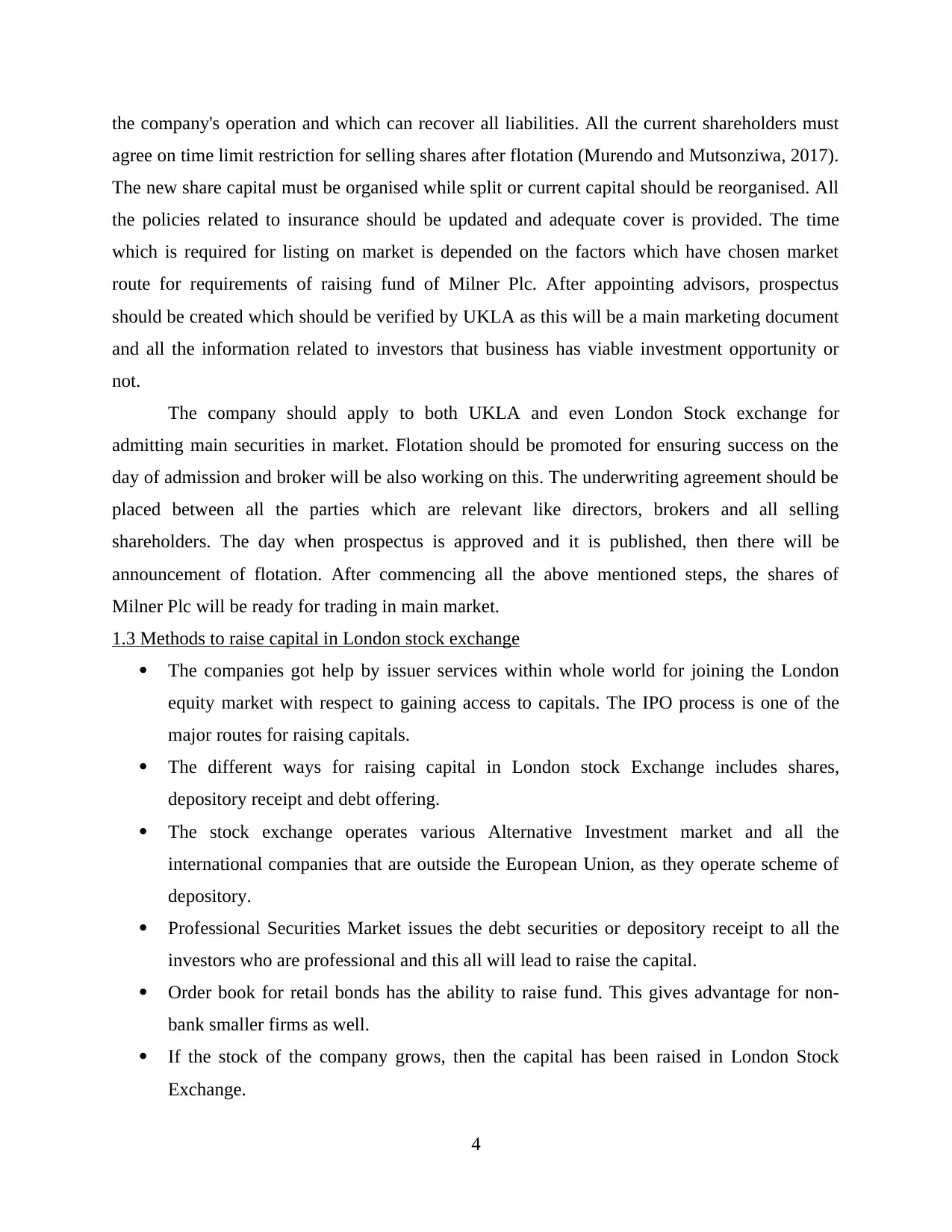
the company's operation and which can recover all liabilities. All the current shareholders must
agree on time limit restriction for selling shares after flotation (Murendo and Mutsonziwa, 2017).
The new share capital must be organised while split or current capital should be reorganised. All
the policies related to insurance should be updated and adequate cover is provided. The time
which is required for listing on market is depended on the factors which have chosen market
route for requirements of raising fund of Milner Plc. After appointing advisors, prospectus
should be created which should be verified by UKLA as this will be a main marketing document
and all the information related to investors that business has viable investment opportunity or
not.
The company should apply to both UKLA and even London Stock exchange for
admitting main securities in market. Flotation should be promoted for ensuring success on the
day of admission and broker will be also working on this. The underwriting agreement should be
placed between all the parties which are relevant like directors, brokers and all selling
shareholders. The day when prospectus is approved and it is published, then there will be
announcement of flotation. After commencing all the above mentioned steps, the shares of
Milner Plc will be ready for trading in main market.
1.3 Methods to raise capital in London stock exchange
The companies got help by issuer services within whole world for joining the London
equity market with respect to gaining access to capitals. The IPO process is one of the
major routes for raising capitals.
The different ways for raising capital in London stock Exchange includes shares,
depository receipt and debt offering.
The stock exchange operates various Alternative Investment market and all the
international companies that are outside the European Union, as they operate scheme of
depository.
Professional Securities Market issues the debt securities or depository receipt to all the
investors who are professional and this all will lead to raise the capital.
Order book for retail bonds has the ability to raise fund. This gives advantage for non-
bank smaller firms as well.
If the stock of the company grows, then the capital has been raised in London Stock
Exchange.
4
agree on time limit restriction for selling shares after flotation (Murendo and Mutsonziwa, 2017).
The new share capital must be organised while split or current capital should be reorganised. All
the policies related to insurance should be updated and adequate cover is provided. The time
which is required for listing on market is depended on the factors which have chosen market
route for requirements of raising fund of Milner Plc. After appointing advisors, prospectus
should be created which should be verified by UKLA as this will be a main marketing document
and all the information related to investors that business has viable investment opportunity or
not.
The company should apply to both UKLA and even London Stock exchange for
admitting main securities in market. Flotation should be promoted for ensuring success on the
day of admission and broker will be also working on this. The underwriting agreement should be
placed between all the parties which are relevant like directors, brokers and all selling
shareholders. The day when prospectus is approved and it is published, then there will be
announcement of flotation. After commencing all the above mentioned steps, the shares of
Milner Plc will be ready for trading in main market.
1.3 Methods to raise capital in London stock exchange
The companies got help by issuer services within whole world for joining the London
equity market with respect to gaining access to capitals. The IPO process is one of the
major routes for raising capitals.
The different ways for raising capital in London stock Exchange includes shares,
depository receipt and debt offering.
The stock exchange operates various Alternative Investment market and all the
international companies that are outside the European Union, as they operate scheme of
depository.
Professional Securities Market issues the debt securities or depository receipt to all the
investors who are professional and this all will lead to raise the capital.
Order book for retail bonds has the ability to raise fund. This gives advantage for non-
bank smaller firms as well.
If the stock of the company grows, then the capital has been raised in London Stock
Exchange.
4
⊘ This is a preview!⊘
Do you want full access?
Subscribe today to unlock all pages.
Trusted by 1+ million students worldwide
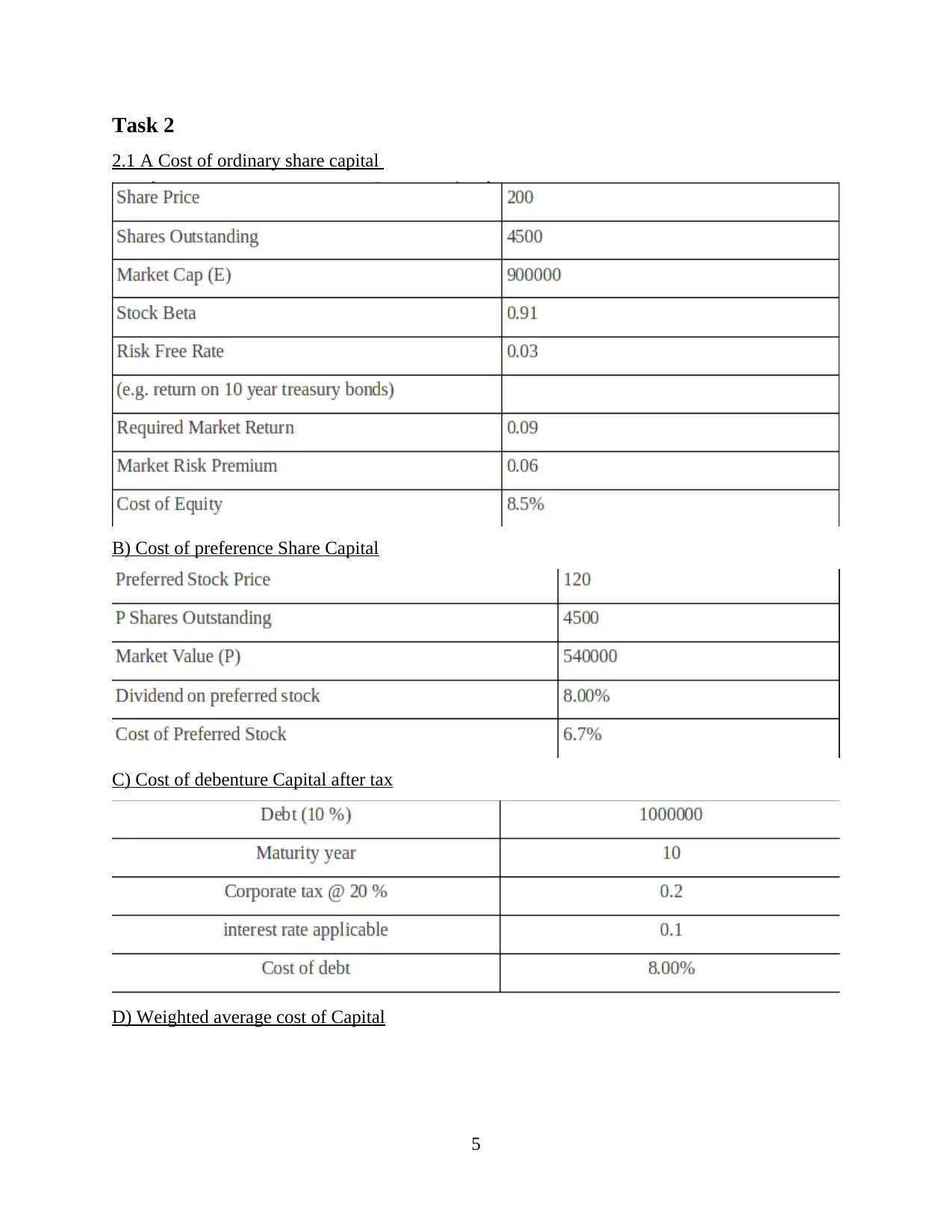
Task 2
2.1 A Cost of ordinary share capital
B) Cost of preference Share Capital
C) Cost of debenture Capital after tax
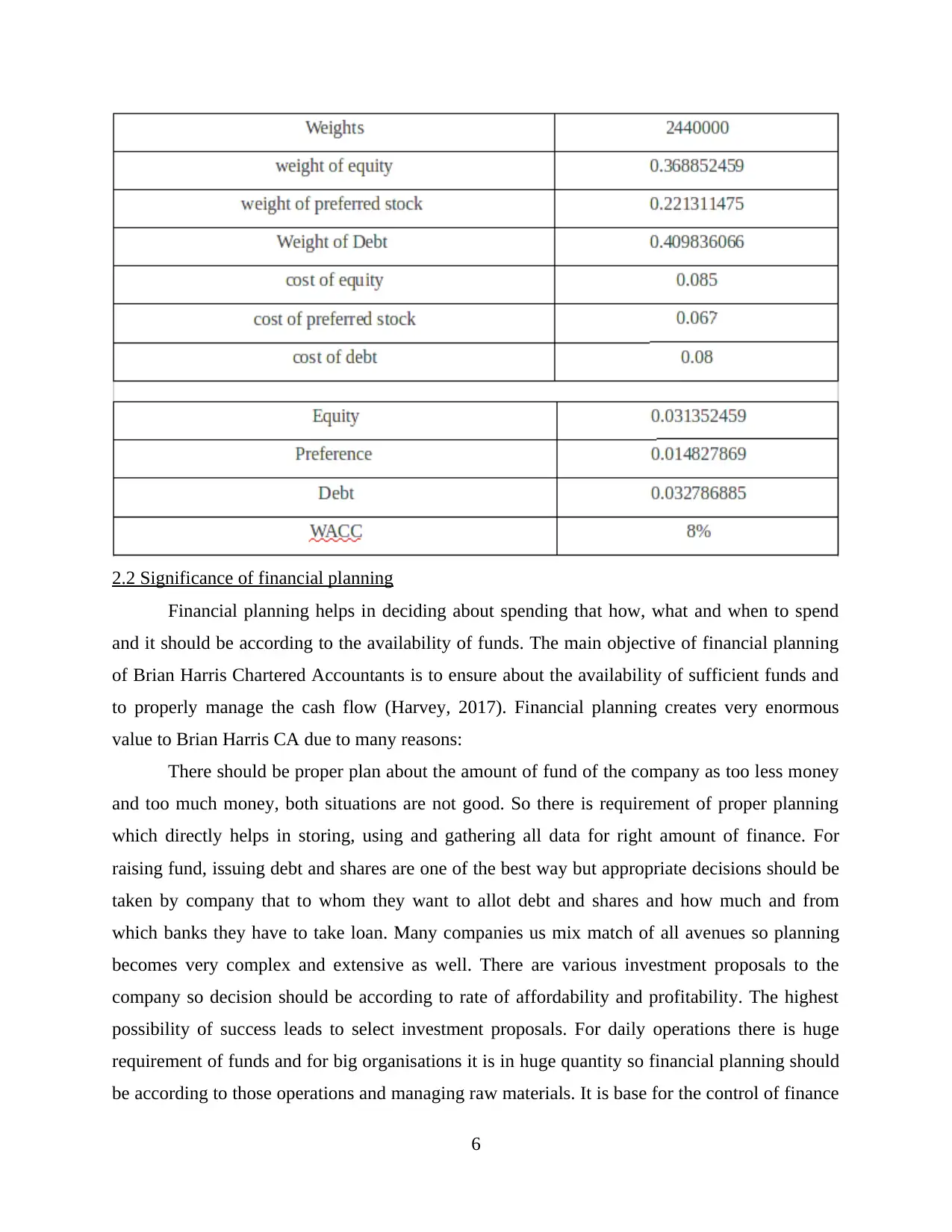
D) Weighted average cost of Capital
5
2.1 A Cost of ordinary share capital
B) Cost of preference Share Capital
C) Cost of debenture Capital after tax
D) Weighted average cost of Capital
5
Paraphrase This Document
Need a fresh take? Get an instant paraphrase of this document with our AI Paraphraser
2.2 Significance of financial planning
Financial planning helps in deciding about spending that how, what and when to spend
and it should be according to the availability of funds. The main objective of financial planning
of Brian Harris Chartered Accountants is to ensure about the availability of sufficient funds and
to properly manage the cash flow (Harvey, 2017). Financial planning creates very enormous
value to Brian Harris CA due to many reasons:
There should be proper plan about the amount of fund of the company as too less money
and too much money, both situations are not good. So there is requirement of proper planning
which directly helps in storing, using and gathering all data for right amount of finance. For
raising fund, issuing debt and shares are one of the best way but appropriate decisions should be
taken by company that to whom they want to allot debt and shares and how much and from
which banks they have to take loan. Many companies us mix match of all avenues so planning
becomes very complex and extensive as well. There are various investment proposals to the
company so decision should be according to rate of affordability and profitability. The highest
possibility of success leads to select investment proposals. For daily operations there is huge
requirement of funds and for big organisations it is in huge quantity so financial planning should
be according to those operations and managing raw materials. It is base for the control of finance
6
Financial planning helps in deciding about spending that how, what and when to spend
and it should be according to the availability of funds. The main objective of financial planning
of Brian Harris Chartered Accountants is to ensure about the availability of sufficient funds and
to properly manage the cash flow (Harvey, 2017). Financial planning creates very enormous
value to Brian Harris CA due to many reasons:
There should be proper plan about the amount of fund of the company as too less money
and too much money, both situations are not good. So there is requirement of proper planning
which directly helps in storing, using and gathering all data for right amount of finance. For
raising fund, issuing debt and shares are one of the best way but appropriate decisions should be
taken by company that to whom they want to allot debt and shares and how much and from
which banks they have to take loan. Many companies us mix match of all avenues so planning
becomes very complex and extensive as well. There are various investment proposals to the
company so decision should be according to rate of affordability and profitability. The highest
possibility of success leads to select investment proposals. For daily operations there is huge
requirement of funds and for big organisations it is in huge quantity so financial planning should
be according to those operations and managing raw materials. It is base for the control of finance
6
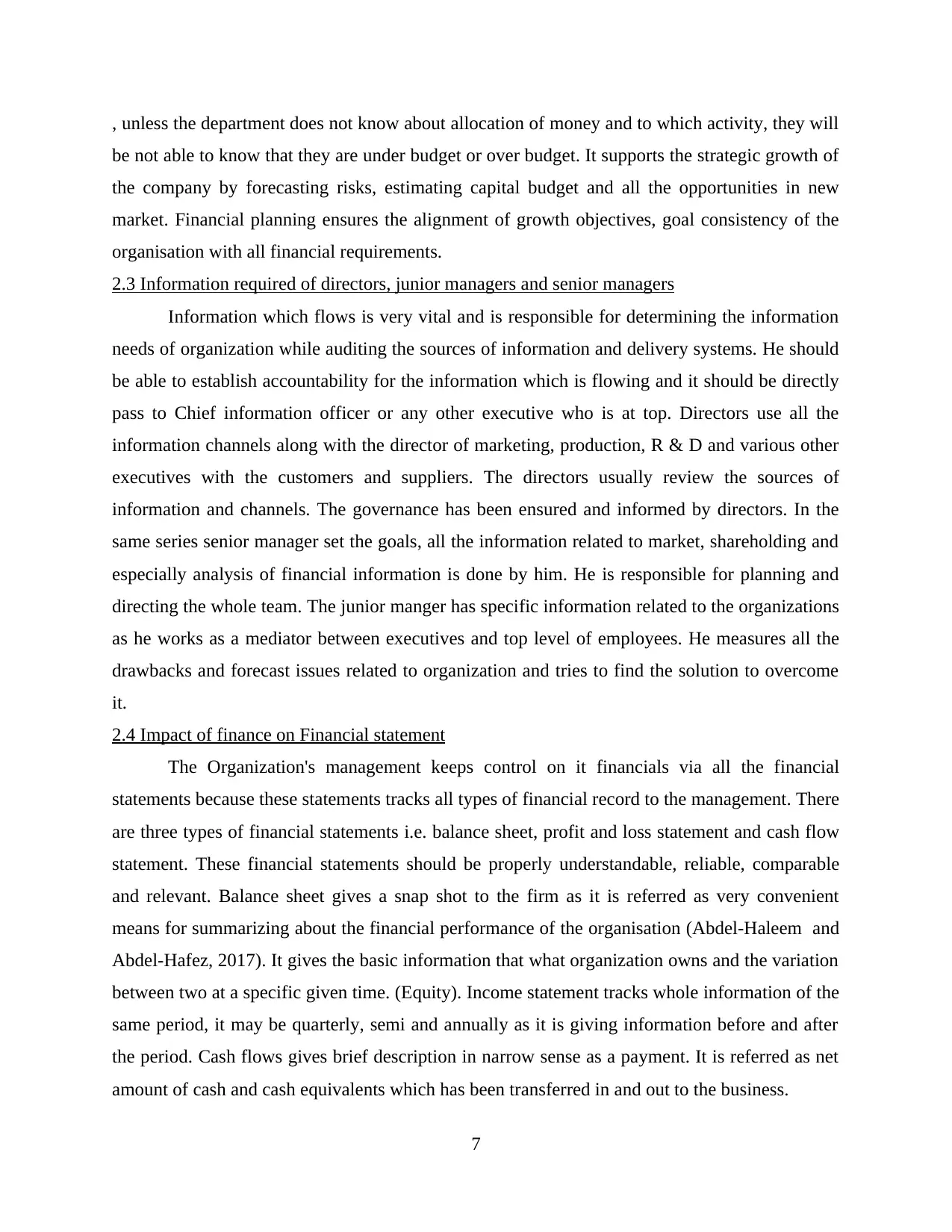
, unless the department does not know about allocation of money and to which activity, they will
be not able to know that they are under budget or over budget. It supports the strategic growth of
the company by forecasting risks, estimating capital budget and all the opportunities in new
market. Financial planning ensures the alignment of growth objectives, goal consistency of the
organisation with all financial requirements.
2.3 Information required of directors, junior managers and senior managers
Information which flows is very vital and is responsible for determining the information
needs of organization while auditing the sources of information and delivery systems. He should
be able to establish accountability for the information which is flowing and it should be directly
pass to Chief information officer or any other executive who is at top. Directors use all the
information channels along with the director of marketing, production, R & D and various other
executives with the customers and suppliers. The directors usually review the sources of
information and channels. The governance has been ensured and informed by directors. In the
same series senior manager set the goals, all the information related to market, shareholding and
especially analysis of financial information is done by him. He is responsible for planning and
directing the whole team. The junior manger has specific information related to the organizations
as he works as a mediator between executives and top level of employees. He measures all the
drawbacks and forecast issues related to organization and tries to find the solution to overcome
it.
2.4 Impact of finance on Financial statement
The Organization's management keeps control on it financials via all the financial
statements because these statements tracks all types of financial record to the management. There
are three types of financial statements i.e. balance sheet, profit and loss statement and cash flow
statement. These financial statements should be properly understandable, reliable, comparable
and relevant. Balance sheet gives a snap shot to the firm as it is referred as very convenient
means for summarizing about the financial performance of the organisation (Abdel-Haleem and
Abdel-Hafez, 2017). It gives the basic information that what organization owns and the variation
between two at a specific given time. (Equity). Income statement tracks whole information of the
same period, it may be quarterly, semi and annually as it is giving information before and after
the period. Cash flows gives brief description in narrow sense as a payment. It is referred as net
amount of cash and cash equivalents which has been transferred in and out to the business.
7
be not able to know that they are under budget or over budget. It supports the strategic growth of
the company by forecasting risks, estimating capital budget and all the opportunities in new
market. Financial planning ensures the alignment of growth objectives, goal consistency of the
organisation with all financial requirements.
2.3 Information required of directors, junior managers and senior managers
Information which flows is very vital and is responsible for determining the information
needs of organization while auditing the sources of information and delivery systems. He should
be able to establish accountability for the information which is flowing and it should be directly
pass to Chief information officer or any other executive who is at top. Directors use all the
information channels along with the director of marketing, production, R & D and various other
executives with the customers and suppliers. The directors usually review the sources of
information and channels. The governance has been ensured and informed by directors. In the
same series senior manager set the goals, all the information related to market, shareholding and
especially analysis of financial information is done by him. He is responsible for planning and
directing the whole team. The junior manger has specific information related to the organizations
as he works as a mediator between executives and top level of employees. He measures all the
drawbacks and forecast issues related to organization and tries to find the solution to overcome
it.
2.4 Impact of finance on Financial statement
The Organization's management keeps control on it financials via all the financial
statements because these statements tracks all types of financial record to the management. There
are three types of financial statements i.e. balance sheet, profit and loss statement and cash flow
statement. These financial statements should be properly understandable, reliable, comparable
and relevant. Balance sheet gives a snap shot to the firm as it is referred as very convenient
means for summarizing about the financial performance of the organisation (Abdel-Haleem and
Abdel-Hafez, 2017). It gives the basic information that what organization owns and the variation
between two at a specific given time. (Equity). Income statement tracks whole information of the
same period, it may be quarterly, semi and annually as it is giving information before and after
the period. Cash flows gives brief description in narrow sense as a payment. It is referred as net
amount of cash and cash equivalents which has been transferred in and out to the business.
7
⊘ This is a preview!⊘
Do you want full access?
Subscribe today to unlock all pages.
Trusted by 1+ million students worldwide
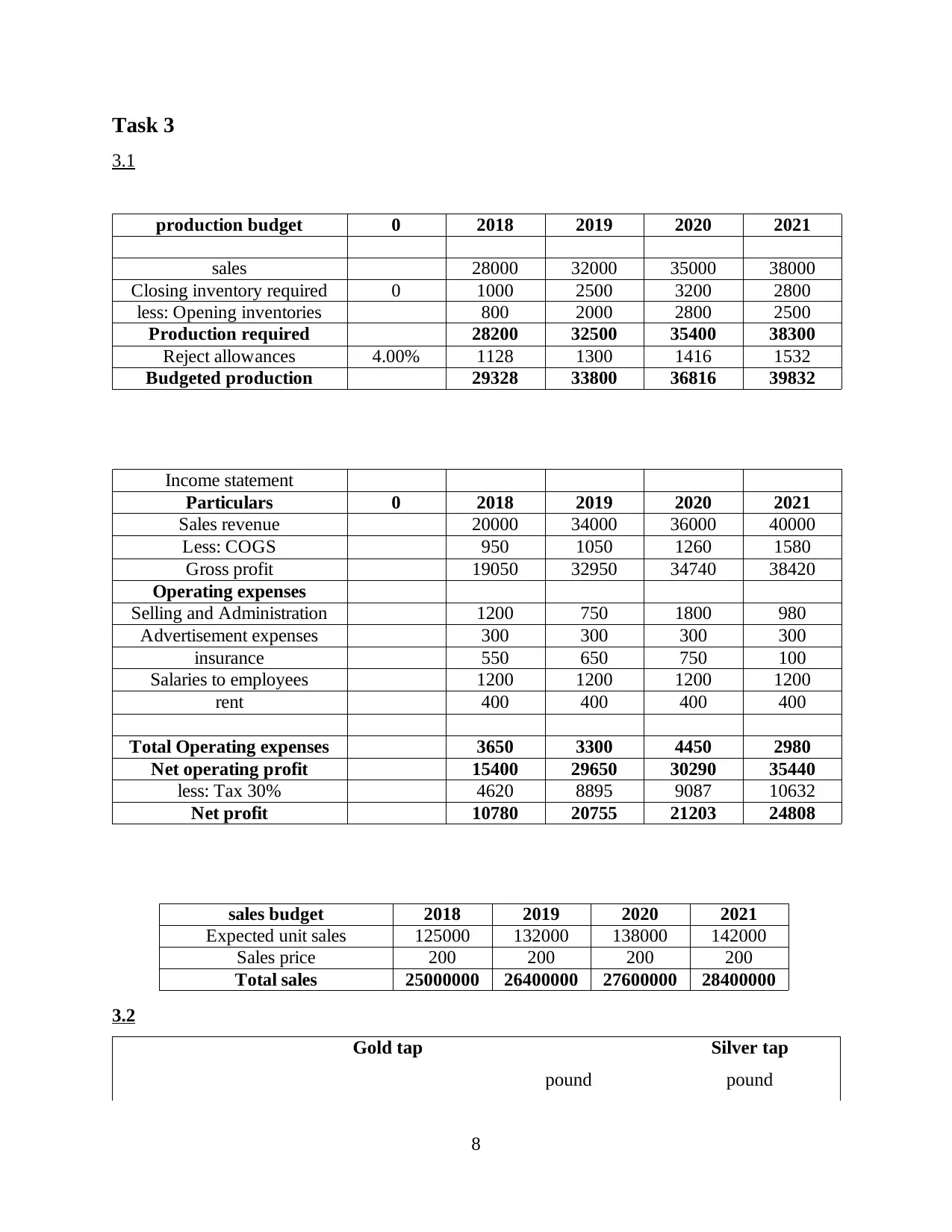
Task 3
3.1
production budget 0 2018 2019 2020 2021
sales 28000 32000 35000 38000
Closing inventory required 0 1000 2500 3200 2800
less: Opening inventories 800 2000 2800 2500
Production required 28200 32500 35400 38300
Reject allowances 4.00% 1128 1300 1416 1532
Budgeted production 29328 33800 36816 39832
Income statement
Particulars 0 2018 2019 2020 2021
Sales revenue 20000 34000 36000 40000
Less: COGS 950 1050 1260 1580
Gross profit 19050 32950 34740 38420
Operating expenses
Selling and Administration 1200 750 1800 980
Advertisement expenses 300 300 300 300
insurance 550 650 750 100
Salaries to employees 1200 1200 1200 1200
rent 400 400 400 400
Total Operating expenses 3650 3300 4450 2980
Net operating profit 15400 29650 30290 35440
less: Tax 30% 4620 8895 9087 10632
Net profit 10780 20755 21203 24808
sales budget 2018 2019 2020 2021
Expected unit sales 125000 132000 138000 142000
Sales price 200 200 200 200
Total sales 25000000 26400000 27600000 28400000
3.2
Gold tap Silver tap
pound pound
8
3.1
production budget 0 2018 2019 2020 2021
sales 28000 32000 35000 38000
Closing inventory required 0 1000 2500 3200 2800
less: Opening inventories 800 2000 2800 2500
Production required 28200 32500 35400 38300
Reject allowances 4.00% 1128 1300 1416 1532
Budgeted production 29328 33800 36816 39832
Income statement
Particulars 0 2018 2019 2020 2021
Sales revenue 20000 34000 36000 40000
Less: COGS 950 1050 1260 1580
Gross profit 19050 32950 34740 38420
Operating expenses
Selling and Administration 1200 750 1800 980
Advertisement expenses 300 300 300 300
insurance 550 650 750 100
Salaries to employees 1200 1200 1200 1200
rent 400 400 400 400
Total Operating expenses 3650 3300 4450 2980
Net operating profit 15400 29650 30290 35440
less: Tax 30% 4620 8895 9087 10632
Net profit 10780 20755 21203 24808
sales budget 2018 2019 2020 2021
Expected unit sales 125000 132000 138000 142000
Sales price 200 200 200 200
Total sales 25000000 26400000 27600000 28400000
3.2
Gold tap Silver tap
pound pound
8
Paraphrase This Document
Need a fresh take? Get an instant paraphrase of this document with our AI Paraphraser
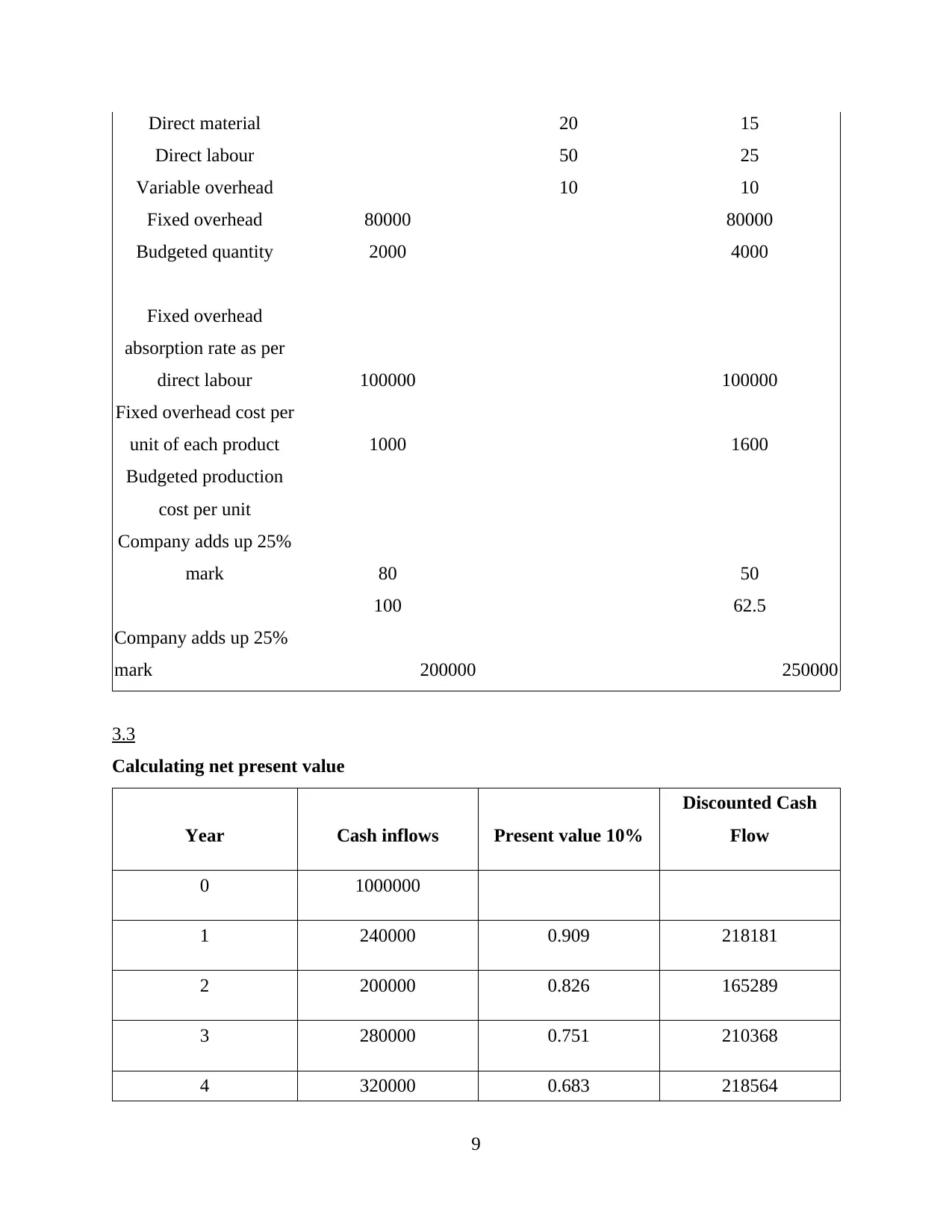
Direct material 20 15
Direct labour 50 25
Variable overhead 10 10
Fixed overhead 80000 80000
Budgeted quantity 2000 4000
Fixed overhead
absorption rate as per
direct labour 100000 100000
Fixed overhead cost per
unit of each product 1000 1600
Budgeted production
cost per unit
Company adds up 25%
mark 80 50
100 62.5
Company adds up 25%
mark 200000 250000
3.3
Calculating net present value
Year Cash inflows Present value 10%
Discounted Cash
Flow
0 1000000
1 240000 0.909 218181
2 200000 0.826 165289
3 280000 0.751 210368
4 320000 0.683 218564
9
Direct labour 50 25
Variable overhead 10 10
Fixed overhead 80000 80000
Budgeted quantity 2000 4000
Fixed overhead
absorption rate as per
direct labour 100000 100000
Fixed overhead cost per
unit of each product 1000 1600
Budgeted production
cost per unit
Company adds up 25%
mark 80 50
100 62.5
Company adds up 25%
mark 200000 250000
3.3
Calculating net present value
Year Cash inflows Present value 10%
Discounted Cash
Flow
0 1000000
1 240000 0.909 218181
2 200000 0.826 165289
3 280000 0.751 210368
4 320000 0.683 218564
9
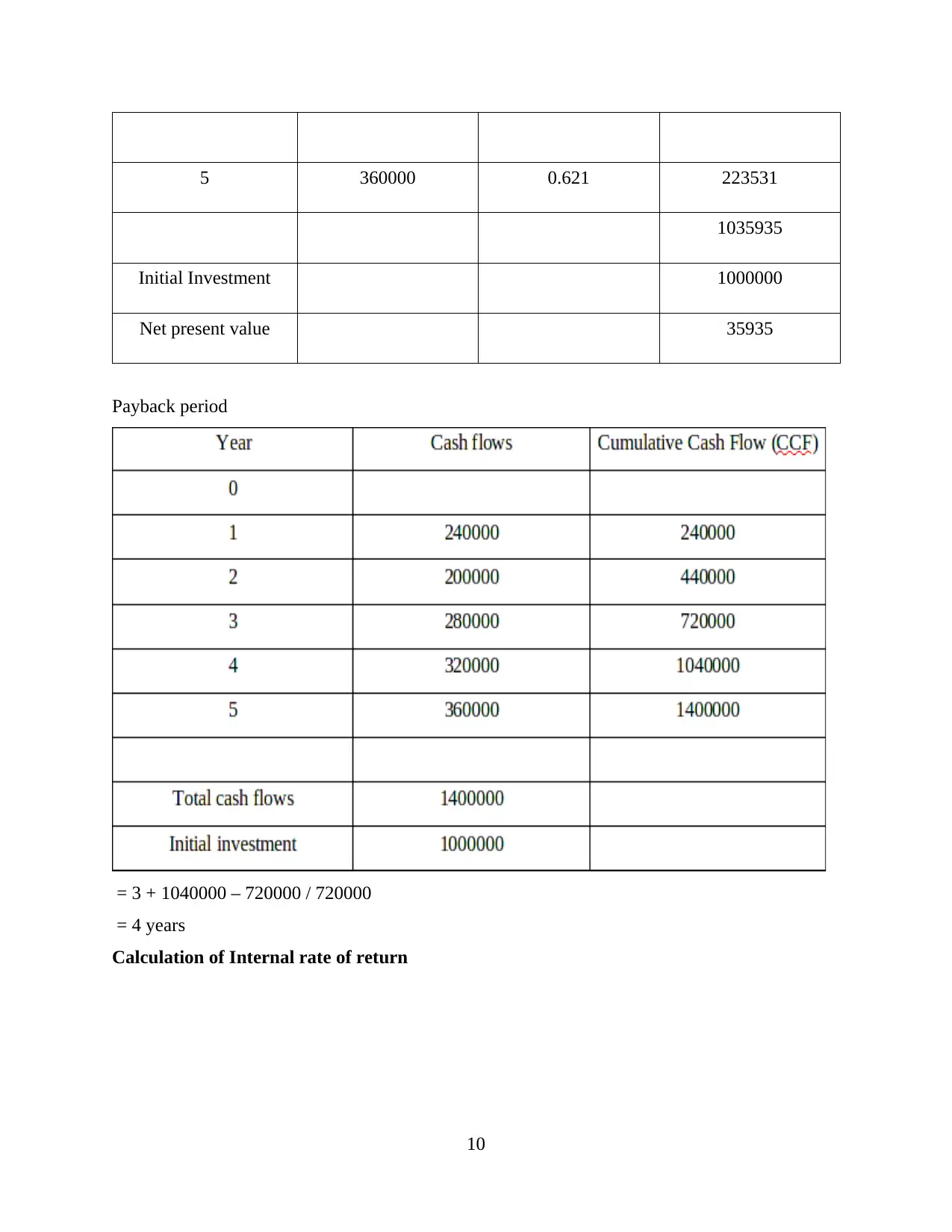
5 360000 0.621 223531
1035935
Initial Investment 1000000
Net present value 35935
Payback period
= 3 + 1040000 – 720000 / 720000
= 4 years
Calculation of Internal rate of return
10
1035935
Initial Investment 1000000
Net present value 35935
Payback period
= 3 + 1040000 – 720000 / 720000
= 4 years
Calculation of Internal rate of return
10
⊘ This is a preview!⊘
Do you want full access?
Subscribe today to unlock all pages.
Trusted by 1+ million students worldwide

1 out of 17


Related Documents


Your All-in-One AI-Powered Toolkit for Academic Success.
+13062052269
info@desklib.com
Available 24*7 on WhatsApp / Email
![[object Object]](/_next/static/media/star-bottom.7253800d.svg)
Unlock your academic potential
Copyright © 2020–2026 A2Z Services. All Rights Reserved. Developed and managed by ZUCOL.