Analyzing IS/IT Enabled Innovation in the Software Industry: A Report
VerifiedAdded on 2023/06/07
|15
|3492
|159
Report
AI Summary
This report provides a detailed analysis of how organizations, specifically within the software industry, strategically utilize Information Systems/Information Technology (IS/IT) to achieve innovation. It explores four examples of IS/IT applications, including Xero, WiseTech Global, Atlassian, and 3P Learning, highlighting how they leverage technology for competitive advantage. The report then delves into the success factors and lessons learned from these innovations, such as management commitment and innovation culture. Furthermore, it examines the impacts of both internal factors (organizational, individual, and management) and external factors (market, industry, social, economic, technological, and political) on the success of IS/IT enabled innovation. Finally, the report concludes with recommendations to help organizations succeed in their endeavors to use IS/IT for innovation, offering a comprehensive overview of the topic.
Running head: MANAGING INFORMATION SYSTEM
Managing Information System
Name of the Student:
Name of the University:
Managing Information System
Name of the Student:
Name of the University:

Paraphrase This Document
Need a fresh take? Get an instant paraphrase of this document with our AI Paraphraser
2MANAGING INFORMATION SYSTEM
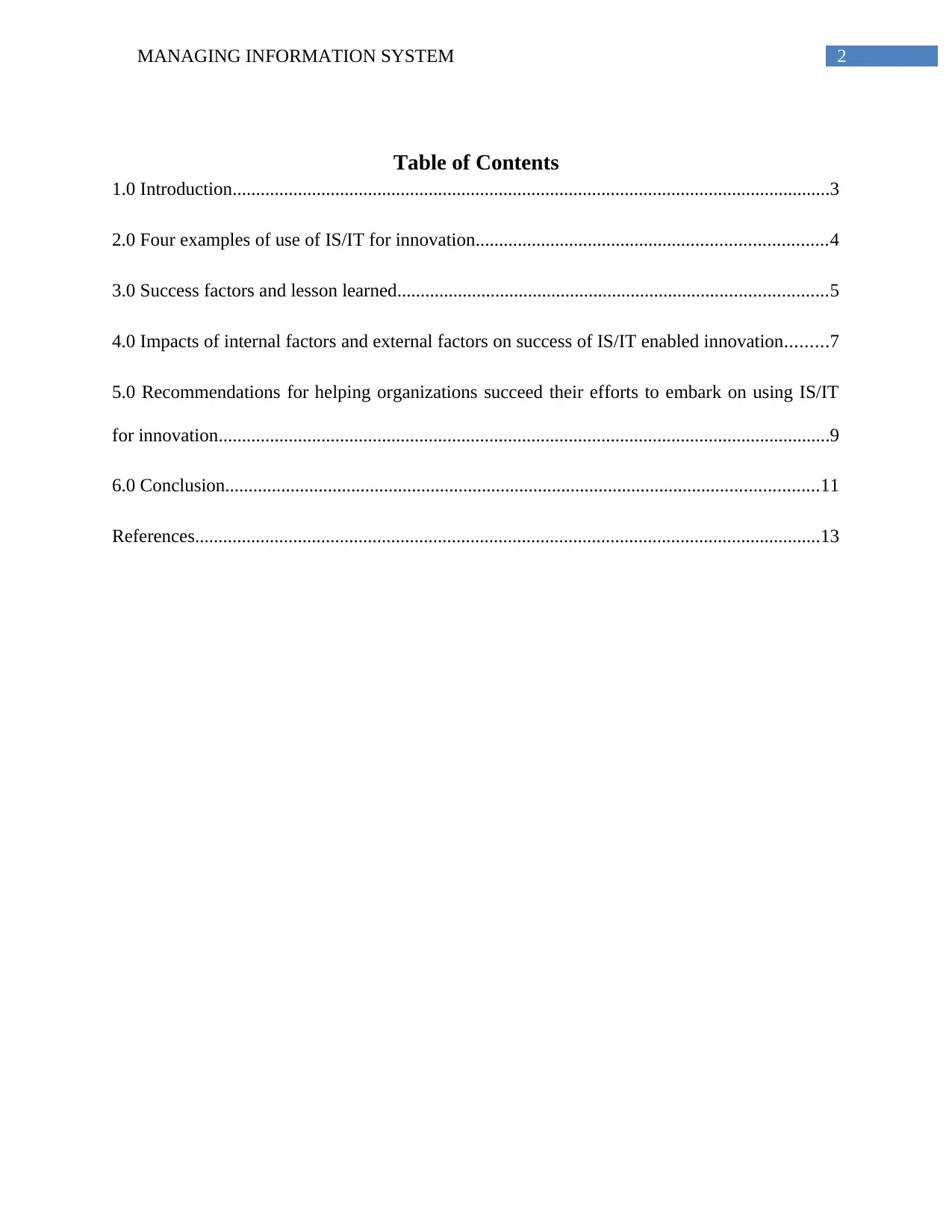
Table of Contents
1.0 Introduction................................................................................................................................3
2.0 Four examples of use of IS/IT for innovation...........................................................................4
3.0 Success factors and lesson learned............................................................................................5
4.0 Impacts of internal factors and external factors on success of IS/IT enabled innovation.........7
5.0 Recommendations for helping organizations succeed their efforts to embark on using IS/IT
for innovation...................................................................................................................................9
6.0 Conclusion...............................................................................................................................11
References......................................................................................................................................13
Table of Contents
1.0 Introduction................................................................................................................................3
2.0 Four examples of use of IS/IT for innovation...........................................................................4
3.0 Success factors and lesson learned............................................................................................5
4.0 Impacts of internal factors and external factors on success of IS/IT enabled innovation.........7
5.0 Recommendations for helping organizations succeed their efforts to embark on using IS/IT
for innovation...................................................................................................................................9
6.0 Conclusion...............................................................................................................................11
References......................................................................................................................................13
3MANAGING INFORMATION SYSTEM
1.0 Introduction
The report is based on analyzing that the organizations are applied of strategic use of
IS/IT to achieve IS/IT enabled innovation. The information applications are growing faster for
past decades. The selected industry for this report is software industry. The business
organizations are emphasized on the IT applications to gain of competitive advantage. The
present study demonstrates that IT is increasing a competitive advantage when it is acted with
the human resources (Christensen, Raynor and McDonald 2015). This paper is analyzed and
reviewed how the IT applications are used to provide the IT Company with a strategic advantage
over worldwide marketplace competitive forces. The role of information system in organization
encompasses use of IT to develop of products, services along with capabilities that provide the
company with strategic advantages over global marketplace. IS/IT is enabled to support the
competitive position of organization along with gain of business advantages for the companies.
IS/IT applications are effective along with efficient to convert plus share of knowledge
management system that effect the organizational management and manage members of the
organization.
The report is based on reviewing the use of IS/IT for the innovation of the IT
organizations. It highlighted success factors and lessons learned from the examples of IS/IT
innovation into the organization. It is also discussing the impact of internal factors such as
organizational, management as well as individual factors. The external factors are also analyzed
in this case such as market, industry, social, economic, technological as well as political factors
on success of IS/IT enabled innovation. Recommendations are also provided in this paper to help
the organization succeed in efforts to embark on use of IS/IT for the innovation of organization.
1.0 Introduction
The report is based on analyzing that the organizations are applied of strategic use of
IS/IT to achieve IS/IT enabled innovation. The information applications are growing faster for
past decades. The selected industry for this report is software industry. The business
organizations are emphasized on the IT applications to gain of competitive advantage. The
present study demonstrates that IT is increasing a competitive advantage when it is acted with
the human resources (Christensen, Raynor and McDonald 2015). This paper is analyzed and
reviewed how the IT applications are used to provide the IT Company with a strategic advantage
over worldwide marketplace competitive forces. The role of information system in organization
encompasses use of IT to develop of products, services along with capabilities that provide the
company with strategic advantages over global marketplace. IS/IT is enabled to support the
competitive position of organization along with gain of business advantages for the companies.
IS/IT applications are effective along with efficient to convert plus share of knowledge
management system that effect the organizational management and manage members of the
organization.
The report is based on reviewing the use of IS/IT for the innovation of the IT
organizations. It highlighted success factors and lessons learned from the examples of IS/IT
innovation into the organization. It is also discussing the impact of internal factors such as
organizational, management as well as individual factors. The external factors are also analyzed
in this case such as market, industry, social, economic, technological as well as political factors
on success of IS/IT enabled innovation. Recommendations are also provided in this paper to help
the organization succeed in efforts to embark on use of IS/IT for the innovation of organization.
⊘ This is a preview!⊘
Do you want full access?
Subscribe today to unlock all pages.

Trusted by 1+ million students worldwide
4MANAGING INFORMATION SYSTEM
2.0 Four examples of use of IS/IT for innovation
Orzen and Bell (2016) stated that innovation is different activity. Incremental innovation
is common form of the innovation. It is utilized with existing technology as well as increased in
value to the customers such as features and change in design in existing market. Jarzabkowski
and Kaplan (2015) argued that small updates to the user experiences can add value to the
customer. Innovation covers introduction of new good and quality of the products, introduction
of new methods for the production along with opening of new market, conquest of the new
sources of supply and establishment of new organization in the industry (Stark 2015). Following
are four examples of use of IS/IT for innovation in different software industries such as:
Xero: The Company wins best service innovation for its Xero Learn. The company has
considered development process which led to the educational platform, Xero Learn which is an
example of initiative towards the accounting information system. It builds support to the next
generation of the bookkeepers as well as accountants, which provides hand on learning
experiences into the educational environments (Tarhini, Al-Dmour and Obeidat 2015). The
product innovation is introduction of good as well as service which is new and has improved
characteristics and intended uses.
WiseTech Global: This Company provides cloud based software solutions for both
international as well as domestic logistics industry. The company innovates in the Australia
market by implementation of container freight station management system that can able to
handle import as well as export of container needs. It provides end-to-end integration for the
simplified shipments. It is included with significant changes in the production and delivery
methods, and software (Gold 2016). The process innovation can decrease unit cost of production
and delivery, increase in quality, produce and deliver new and improved products.
2.0 Four examples of use of IS/IT for innovation
Orzen and Bell (2016) stated that innovation is different activity. Incremental innovation
is common form of the innovation. It is utilized with existing technology as well as increased in
value to the customers such as features and change in design in existing market. Jarzabkowski
and Kaplan (2015) argued that small updates to the user experiences can add value to the
customer. Innovation covers introduction of new good and quality of the products, introduction
of new methods for the production along with opening of new market, conquest of the new
sources of supply and establishment of new organization in the industry (Stark 2015). Following
are four examples of use of IS/IT for innovation in different software industries such as:
Xero: The Company wins best service innovation for its Xero Learn. The company has
considered development process which led to the educational platform, Xero Learn which is an
example of initiative towards the accounting information system. It builds support to the next
generation of the bookkeepers as well as accountants, which provides hand on learning
experiences into the educational environments (Tarhini, Al-Dmour and Obeidat 2015). The
product innovation is introduction of good as well as service which is new and has improved
characteristics and intended uses.
WiseTech Global: This Company provides cloud based software solutions for both
international as well as domestic logistics industry. The company innovates in the Australia
market by implementation of container freight station management system that can able to
handle import as well as export of container needs. It provides end-to-end integration for the
simplified shipments. It is included with significant changes in the production and delivery
methods, and software (Gold 2016). The process innovation can decrease unit cost of production
and delivery, increase in quality, produce and deliver new and improved products.
Paraphrase This Document
Need a fresh take? Get an instant paraphrase of this document with our AI Paraphraser
5MANAGING INFORMATION SYSTEM
Atlassian: The Company has innovation its business operations by implementation of
confluence knowledge management system which can create idea sharing as well as innovation
by providing the team with power to create, share as well as manage the content. This
information system helps the company towards central repository for the knowledge (Nagle and
Muller 2017). This system can store as well as retrieve the knowledge, improve the
collaboration, locate the knowledge, capture and use knowledge which enhances the process of
knowledge management.
3P Learning: The organization transforms its business digitally for increasing
opportunities for the students so that they can connect with the customers towards information. It
is a mid way through the transformation. It can streamline as well as manage the sale processes
on Salesforce. By connection of sales along with services, it can start to analyze the response
times as well as usage of the products. Salesforce community cloud can allow the partners to
leverage sales as well as its service processes to develop the online education network (Lusch
and Nambisan 2015). Salesforce Einstein is a 3P learning transformation agenda which is used of
automated decisions will disrupt how the business is getting done and resulting in surge of the
business efficiency. Therefore, the organization can transform its customer business; connect the
customers towards the information in faster way.
3.0 Success factors and lesson learned
Each of the organization is successful in long term requires an innovation management
system that can innovate to enhance the business operations. In the retail industry, innovation is
required to raise the productivity along with profitability of the company. The innovation
management shapes structure as well as framework conditions such that innovation can
Atlassian: The Company has innovation its business operations by implementation of
confluence knowledge management system which can create idea sharing as well as innovation
by providing the team with power to create, share as well as manage the content. This
information system helps the company towards central repository for the knowledge (Nagle and
Muller 2017). This system can store as well as retrieve the knowledge, improve the
collaboration, locate the knowledge, capture and use knowledge which enhances the process of
knowledge management.
3P Learning: The organization transforms its business digitally for increasing
opportunities for the students so that they can connect with the customers towards information. It
is a mid way through the transformation. It can streamline as well as manage the sale processes
on Salesforce. By connection of sales along with services, it can start to analyze the response
times as well as usage of the products. Salesforce community cloud can allow the partners to
leverage sales as well as its service processes to develop the online education network (Lusch
and Nambisan 2015). Salesforce Einstein is a 3P learning transformation agenda which is used of
automated decisions will disrupt how the business is getting done and resulting in surge of the
business efficiency. Therefore, the organization can transform its customer business; connect the
customers towards the information in faster way.
3.0 Success factors and lesson learned
Each of the organization is successful in long term requires an innovation management
system that can innovate to enhance the business operations. In the retail industry, innovation is
required to raise the productivity along with profitability of the company. The innovation
management shapes structure as well as framework conditions such that innovation can
6MANAGING INFORMATION SYSTEM
identified, ideas can generate and implement (Jarzabkowski and Kaplan 2015). The success
factors of innovation into the retail industry are based on:
Management commitment: Success of the innovation management is based on
commitment of the organizational management in the business functions. Responsibilities and
budget is a framework conditions which are defined. If the management support is not provided,
then the leader can waste time to fight against the windmills (Wu, Straub and Liang 2015).
Commitment of the management team from top to bottom is a basis of the innovation process.
Management support is required for innovations as it happens outside of the day-to-day
operations of the business.
Search fields: The search field is strategic subject areas on basis of the markets and
product fields or technologies where the company can want to make improvement (Chang 2016).
It is identified by use of strategic tools such as trend and technology along with market analysis.
Innovation culture: Innovation is required to various structure as well as culture as
compared to operative management along with work. The operational business is built on the
business efficiency while innovation is always about the business innovation. The employees of
organization are raised of innovation throughout communication measurement (Adams et al.
2016). The employees are motivated towards innovation by incentives for promotion of
innovation. Training is required for creativity along with innovation processes.
Change management: Introducing of innovation management is required change as well
as implementing of innovation for possible changes. The changes are effective as it supports by
the employees and workforce is activity changed (Coltman et al. 2015). Change management is a
success factor for the organization as it is belonged to range of the innovation manager.
identified, ideas can generate and implement (Jarzabkowski and Kaplan 2015). The success
factors of innovation into the retail industry are based on:
Management commitment: Success of the innovation management is based on
commitment of the organizational management in the business functions. Responsibilities and
budget is a framework conditions which are defined. If the management support is not provided,
then the leader can waste time to fight against the windmills (Wu, Straub and Liang 2015).
Commitment of the management team from top to bottom is a basis of the innovation process.
Management support is required for innovations as it happens outside of the day-to-day
operations of the business.
Search fields: The search field is strategic subject areas on basis of the markets and
product fields or technologies where the company can want to make improvement (Chang 2016).
It is identified by use of strategic tools such as trend and technology along with market analysis.
Innovation culture: Innovation is required to various structure as well as culture as
compared to operative management along with work. The operational business is built on the
business efficiency while innovation is always about the business innovation. The employees of
organization are raised of innovation throughout communication measurement (Adams et al.
2016). The employees are motivated towards innovation by incentives for promotion of
innovation. Training is required for creativity along with innovation processes.
Change management: Introducing of innovation management is required change as well
as implementing of innovation for possible changes. The changes are effective as it supports by
the employees and workforce is activity changed (Coltman et al. 2015). Change management is a
success factor for the organization as it is belonged to range of the innovation manager.
⊘ This is a preview!⊘
Do you want full access?
Subscribe today to unlock all pages.
Trusted by 1+ million students worldwide
7MANAGING INFORMATION SYSTEM
Integration of employees: The success factor of innovation is aware and raise measures
to inspire along with motivate the employees for innovation, but it is structural measures for
active involvement like pitching of contests.
The lesson are learnt from success of IS/IT innovation. At first it is learnt that innovation
is successful introduction of new idea to marketplace. It is required to use of innovative idea to
increase sales, improve the customer services as well as maintain a position in the market. The
current trends as well as feedback are considered by the innovative leaders. Each of the software
business organization can begin their journey with ad hoc innovation which is influenced by task
as well as timeframe (Laudon and Laudon 2016). Ad hoc is an approach towards innovation. It is
learned that innovation comes from collaboration and teamwork and encourage the innovation
with the team member. Therefore, innovation is lead to shift the focus as well as view of people.
4.0 Impacts of internal factors and external factors on success of IS/IT
enabled innovation
The impacts of internal factors on success of IS/IT enable innovations are:
Organizational factors: The organizational factors which can impact success of IS/IT
innovation in the software industries are support from the top management, structure of decision
making, management style and allocation of resources. Support from the top management is
involved with participation of executive and top level management of organization within IS/IT
activities. Lack of support of top management inhibited strategic use of the IS/IT (Elmes and
Barry 2017). Decision making structure is type of control and delegation of decision making
throughout the organization and extent of participation by the organizational members towards
IS/IT.
Integration of employees: The success factor of innovation is aware and raise measures
to inspire along with motivate the employees for innovation, but it is structural measures for
active involvement like pitching of contests.
The lesson are learnt from success of IS/IT innovation. At first it is learnt that innovation
is successful introduction of new idea to marketplace. It is required to use of innovative idea to
increase sales, improve the customer services as well as maintain a position in the market. The
current trends as well as feedback are considered by the innovative leaders. Each of the software
business organization can begin their journey with ad hoc innovation which is influenced by task
as well as timeframe (Laudon and Laudon 2016). Ad hoc is an approach towards innovation. It is
learned that innovation comes from collaboration and teamwork and encourage the innovation
with the team member. Therefore, innovation is lead to shift the focus as well as view of people.
4.0 Impacts of internal factors and external factors on success of IS/IT
enabled innovation
The impacts of internal factors on success of IS/IT enable innovations are:
Organizational factors: The organizational factors which can impact success of IS/IT
innovation in the software industries are support from the top management, structure of decision
making, management style and allocation of resources. Support from the top management is
involved with participation of executive and top level management of organization within IS/IT
activities. Lack of support of top management inhibited strategic use of the IS/IT (Elmes and
Barry 2017). Decision making structure is type of control and delegation of decision making
throughout the organization and extent of participation by the organizational members towards
IS/IT.
Paraphrase This Document
Need a fresh take? Get an instant paraphrase of this document with our AI Paraphraser
8MANAGING INFORMATION SYSTEM
Individual factors: The factors are user acceptance of the innovation, social network, and
demographic factors of the individuals. Sometimes, it is possible that the individual are not
accepting the innovation of information system within the organization, therefore it can provide a
huge influence on success factor to innovate the system. There are poor social network to make a
relationship with the employees and management team (Pisano 2015). The demographic factors
such as age and gender of the individuals are not meeting with the implementation of system
requirements.
Management factors: The success of the IS/IT innovation is based on the IT leader
perspective. Therefore, success and failure of the technological innovation is based on support
from the top management level as they can motivate the employees to make possible changes in
implementation of information system (Coombs 2015).
The impacts of internal factors on success of IS/IT enable innovations are:
Market factors: The marketing strategies used for competition the companies provide an
influence on the business entities to alter the market structure. It has ability to interfere with
acquisition of required physical resources (Grant 2016). The customer behavior has strong
influence on demand for the innovation that is triggered by development of innovative relations.
Industry factors: The industry level factors are research and development intensity,
turbulence, uncertainty and adoption of open innovation (Pearlson, Saunders and Galletta 2016).
Those factors can influence as in innovation of information system, research and development of
new way to innovative in the market can provide a huge influence.
Social factors: There are poor relationships among the management team and employees,
so that it can affect the implementation work of the information system (Keyes 2016). When
Individual factors: The factors are user acceptance of the innovation, social network, and
demographic factors of the individuals. Sometimes, it is possible that the individual are not
accepting the innovation of information system within the organization, therefore it can provide a
huge influence on success factor to innovate the system. There are poor social network to make a
relationship with the employees and management team (Pisano 2015). The demographic factors
such as age and gender of the individuals are not meeting with the implementation of system
requirements.
Management factors: The success of the IS/IT innovation is based on the IT leader
perspective. Therefore, success and failure of the technological innovation is based on support
from the top management level as they can motivate the employees to make possible changes in
implementation of information system (Coombs 2015).
The impacts of internal factors on success of IS/IT enable innovations are:
Market factors: The marketing strategies used for competition the companies provide an
influence on the business entities to alter the market structure. It has ability to interfere with
acquisition of required physical resources (Grant 2016). The customer behavior has strong
influence on demand for the innovation that is triggered by development of innovative relations.
Industry factors: The industry level factors are research and development intensity,
turbulence, uncertainty and adoption of open innovation (Pearlson, Saunders and Galletta 2016).
Those factors can influence as in innovation of information system, research and development of
new way to innovative in the market can provide a huge influence.
Social factors: There are poor relationships among the management team and employees,
so that it can affect the implementation work of the information system (Keyes 2016). When
9MANAGING INFORMATION SYSTEM
there is lack of social network among the team, so that they are not able to communicate and
interact with the staffs. Therefore, the staffs are not motivated with adoption of the information
system.
Economic factors: The economic factors are that profit is considered as drive force of the
production in the market. There is high price and high maintenance work for implementation of
information system in the organization, therefore when innovative method is not used for
innovation, and then it will hamper the success of the organization (Chenhall and Moers 2015).
The nature of competition is faced by organization and its services along with financial resources
available in the economy.
Technological factors: Network, connection as well as information system enables that it
can share of resources among the acceptance of IS/IT which is one of the critical factor to
achieve the organization vision and mission (Wu, Straub and Liang 2015).
Political/policy factors: The organization is not implemented of strict organizational
policies so that the employees are not able to follow the organizational rules and regulations
regards to innovation work. The political factors such as government policies, administrative
practices are greater impact on the economic development of organization (Lusch and Nambisan
2015). It can also affect the performance of the organization.
5.0 Recommendations for helping organizations succeed their efforts to
embark on using IS/IT for innovation
Following are recommendations which are suggested to help organization in succeed
efforts to embark on use of IS/IT for innovation such as:
there is lack of social network among the team, so that they are not able to communicate and
interact with the staffs. Therefore, the staffs are not motivated with adoption of the information
system.
Economic factors: The economic factors are that profit is considered as drive force of the
production in the market. There is high price and high maintenance work for implementation of
information system in the organization, therefore when innovative method is not used for
innovation, and then it will hamper the success of the organization (Chenhall and Moers 2015).
The nature of competition is faced by organization and its services along with financial resources
available in the economy.
Technological factors: Network, connection as well as information system enables that it
can share of resources among the acceptance of IS/IT which is one of the critical factor to
achieve the organization vision and mission (Wu, Straub and Liang 2015).
Political/policy factors: The organization is not implemented of strict organizational
policies so that the employees are not able to follow the organizational rules and regulations
regards to innovation work. The political factors such as government policies, administrative
practices are greater impact on the economic development of organization (Lusch and Nambisan
2015). It can also affect the performance of the organization.
5.0 Recommendations for helping organizations succeed their efforts to
embark on using IS/IT for innovation
Following are recommendations which are suggested to help organization in succeed
efforts to embark on use of IS/IT for innovation such as:
⊘ This is a preview!⊘
Do you want full access?
Subscribe today to unlock all pages.
Trusted by 1+ million students worldwide
10MANAGING INFORMATION SYSTEM
Implementation of business strategies for innovation and development: The
organization should implement of new revenue opportunities, optimization of existing channels
and generation of higher profits. It provides the company with an advantage over the
competitors. The organization should focus on revenue model innovation when increasing
business profit is main driver for innovation in IS/IT.
Use of artificial intelligence in business: The organization should use of artificial
intelligence when it comes to the business innovation. Artificial intelligence (AI) can help by
detecting as well as reacting to the customer emotions. The artificial intelligence is formulated
own decisions without the human input and applied of AI to solve the business problems and
human behave. AI can explore growing usage of the artificial intelligence into the business
landscape. It is seen how AI can influence expansion as well as implementation of the business
strategy mainly in the software industries in order to create a high business value.
Meet the customer requirements: The first priority of the organization is meeting with
the customer’s requirements. The needs of customers are changed constantly. The innovators are
predicted to change in market and provide solutions before it realizes that they require. The
business organization should also require meeting with long term basis of the customer’s
requirements to innovative in the market. The organization has customer insights and decision
making benefits that come with them.
Technology innovation: The organization should implement of process where they can
embark the importance of technology as critical success factor among the staffs for increasing
market competitiveness. The business organization should develop new and innovative services
in market and fulfill undressed requirements and solve the problems which were not in past. The
Implementation of business strategies for innovation and development: The
organization should implement of new revenue opportunities, optimization of existing channels
and generation of higher profits. It provides the company with an advantage over the
competitors. The organization should focus on revenue model innovation when increasing
business profit is main driver for innovation in IS/IT.
Use of artificial intelligence in business: The organization should use of artificial
intelligence when it comes to the business innovation. Artificial intelligence (AI) can help by
detecting as well as reacting to the customer emotions. The artificial intelligence is formulated
own decisions without the human input and applied of AI to solve the business problems and
human behave. AI can explore growing usage of the artificial intelligence into the business
landscape. It is seen how AI can influence expansion as well as implementation of the business
strategy mainly in the software industries in order to create a high business value.
Meet the customer requirements: The first priority of the organization is meeting with
the customer’s requirements. The needs of customers are changed constantly. The innovators are
predicted to change in market and provide solutions before it realizes that they require. The
business organization should also require meeting with long term basis of the customer’s
requirements to innovative in the market. The organization has customer insights and decision
making benefits that come with them.
Technology innovation: The organization should implement of process where they can
embark the importance of technology as critical success factor among the staffs for increasing
market competitiveness. The business organization should develop new and innovative services
in market and fulfill undressed requirements and solve the problems which were not in past. The
Paraphrase This Document
Need a fresh take? Get an instant paraphrase of this document with our AI Paraphraser
11MANAGING INFORMATION SYSTEM
technological innovation is based on technological aspects of the product and service which can
cover entire organizational business model. Therefore, innovation is not driven by the
technology. This type of innovation is reflects on business consideration to improve the business
value by working with the technological aspects of the products and services.
6.0 Conclusion
It is concluded that emergence of the innovation models and implementation of
information system in the industry undergoes the IS/IT transformation methods. The internal
factors within the IT innovations reveal challenges that the organizations are facing in decision
processes. The industry related external factors are constitutive for innovation management
within the organization. It can determine if the organization rethinks about innovation
management. The external factors determine how the company can implement of innovation
models. The model affects management, decision making processes, culture plus communication
among the innovation management of software organization. Both internal along with external
knowledge are required to connect, manage and implement in information system of the
company. The innovation culture along with facilitation of knowledge communities are required
conditions for effective knowledge management. It is included management for basic situations
supports accumulation of the knowledge and information, communication along with learning
process which can increase innovativeness of the organizations. IS/IT innovation is involved to
use of technology for creating an effective organization and modify alignment among the
technological initiatives as well as business goals. While innovation is goal of the organization,
therefore the IT leaders can define about the technological innovation. It is recommended to the
technological innovation is based on technological aspects of the product and service which can
cover entire organizational business model. Therefore, innovation is not driven by the
technology. This type of innovation is reflects on business consideration to improve the business
value by working with the technological aspects of the products and services.
6.0 Conclusion
It is concluded that emergence of the innovation models and implementation of
information system in the industry undergoes the IS/IT transformation methods. The internal
factors within the IT innovations reveal challenges that the organizations are facing in decision
processes. The industry related external factors are constitutive for innovation management
within the organization. It can determine if the organization rethinks about innovation
management. The external factors determine how the company can implement of innovation
models. The model affects management, decision making processes, culture plus communication
among the innovation management of software organization. Both internal along with external
knowledge are required to connect, manage and implement in information system of the
company. The innovation culture along with facilitation of knowledge communities are required
conditions for effective knowledge management. It is included management for basic situations
supports accumulation of the knowledge and information, communication along with learning
process which can increase innovativeness of the organizations. IS/IT innovation is involved to
use of technology for creating an effective organization and modify alignment among the
technological initiatives as well as business goals. While innovation is goal of the organization,
therefore the IT leaders can define about the technological innovation. It is recommended to the
12MANAGING INFORMATION SYSTEM
organization to use of artificial intelligence for solving the business problems and human behave
and innovate more in the technological platform.
organization to use of artificial intelligence for solving the business problems and human behave
and innovate more in the technological platform.
⊘ This is a preview!⊘
Do you want full access?
Subscribe today to unlock all pages.
Trusted by 1+ million students worldwide

1 out of 15


Related Documents


Your All-in-One AI-Powered Toolkit for Academic Success.
+13062052269
info@desklib.com
Available 24*7 on WhatsApp / Email
![[object Object]](/_next/static/media/star-bottom.7253800d.svg)
Unlock your academic potential
Copyright © 2020–2025 A2Z Services. All Rights Reserved. Developed and managed by ZUCOL.