Managing People and Organizations: JOC Case Study Analysis
VerifiedAdded on  2023/02/03
|4
|1315
|97
Case Study
AI Summary
This case study analyzes the Joy of Chocolate (JOC), examining the relationship between organizational goals, objectives, and policies and their contribution to effective management. It differentiates between formal and informal organizations, highlighting their distinct focuses and structures. The analysis further explores the application of open system theory to JOC, illustrating how environmental factors influence the organization's operations, including market dynamics, supplier relationships, and financial challenges. The study showcases JOC's strategies for adapting to external pressures, managing cash flow, and fostering a positive work culture, ultimately leading to the company's success and competitive advantage. The case study covers various aspects of the business, from initial goals to expansion strategies, financial challenges, and adaptations to market changes, showing how Suzy managed to overcome obstacles and achieve targets by creating a unique product.
Student ID - 02000900
Managing people and Organisations
Case Study:Joy of Chocolate
Task 01- Analyse the relationship between organisational goals, objectives and
policies and explain their contribution to effective management in the case study.
Goalscan be explained as broad aims of desired outcomes. They focus extensively on the
results that are expected to be achieved over a specific period of time, especially in the
long run. But there, it does not describe the methods used to achieve it. In this case study
when Suzy created JOC, she had several goals. However, in its early days,her majorgoal
wassurvival but later he wanted the business to become known for excellence and
innovative products when growing business.
In order to achieve that goal, one of her main objectives was finding fair trade suppliers.
The objectives can be explained as the specific tasks and measurable steps that a company
should follow to achieve its goals. They are measurable and quantifiable. When setting
objectives, they should be SMART (Specific, Measurable, Achievable, Realistic and
Timely). They are used to measure the success and progress of an organization in
achieving goals and without them, it is difficult to reach goals.
In the journey of her success at JOC towards her goals, she had some policies such as
adherence to health and safety measures as well as to regulations of food production while
minimizing the wasteas a part of quality culture. Policies are sets of ideas, plans or
principles that guide to make decisions in a particular situation that is officially agreed
upon. They are clear and direct statements thatexplain the way organizations plan to
dotheir businesses, services or actions.
Task 02 - Identify the main differences between the formal organisation and informal
organisation.
Performance can be identified as the main focus of a formal organization while informal
organizations focus on interpersonal relationships. Formal organizations are focusing to
reach specific goals and informal organizations are focusing on human psychological needs
and are not defined properly. Establishing a formal organization occurred with a proper
[Type here]
Managing people and Organisations
Case Study:Joy of Chocolate
Task 01- Analyse the relationship between organisational goals, objectives and
policies and explain their contribution to effective management in the case study.
Goalscan be explained as broad aims of desired outcomes. They focus extensively on the
results that are expected to be achieved over a specific period of time, especially in the
long run. But there, it does not describe the methods used to achieve it. In this case study
when Suzy created JOC, she had several goals. However, in its early days,her majorgoal
wassurvival but later he wanted the business to become known for excellence and
innovative products when growing business.
In order to achieve that goal, one of her main objectives was finding fair trade suppliers.
The objectives can be explained as the specific tasks and measurable steps that a company
should follow to achieve its goals. They are measurable and quantifiable. When setting
objectives, they should be SMART (Specific, Measurable, Achievable, Realistic and
Timely). They are used to measure the success and progress of an organization in
achieving goals and without them, it is difficult to reach goals.
In the journey of her success at JOC towards her goals, she had some policies such as
adherence to health and safety measures as well as to regulations of food production while
minimizing the wasteas a part of quality culture. Policies are sets of ideas, plans or
principles that guide to make decisions in a particular situation that is officially agreed
upon. They are clear and direct statements thatexplain the way organizations plan to
dotheir businesses, services or actions.
Task 02 - Identify the main differences between the formal organisation and informal
organisation.
Performance can be identified as the main focus of a formal organization while informal
organizations focus on interpersonal relationships. Formal organizations are focusing to
reach specific goals and informal organizations are focusing on human psychological needs
and are not defined properly. Establishing a formal organization occurred with a proper
[Type here]
Paraphrase This Document
Need a fresh take? Get an instant paraphrase of this document with our AI Paraphraser

Student ID - 02000900
plan or proposal while an informal organization is made suddenly or without the usual
forms. Formal organizations are well-structured to reach the goals but informal
organizations are not that much since they have mostly temporary or social goals. Formal
organizations are having a clear hierarchy, authority is well defined and performs the chain
of command very well. Informal organizations are not like that. They do not act according
to the hierarchical authority. Sometimes it can be identified several hierarchical levels but
and do not persuade to take members to the target by the superiors. Formal organizations
manage the flow of communication and information according to accepted rules according
to their hierarchical structure. There is no such system in an informal organization. They
communicate freely and interact ignoring the hierarchy. Formal organizations manage their
behaviors and outcomes according to the laws and rules. Informal organizations are more
personal and follow norms than role-related and group consensus decides behaviors.
Informal organizations promote social interaction, and the main objective of formal
organizations is to make a profit.
Task 03 -Explain the composition of the open system theory and explain how it
applies in the case study.
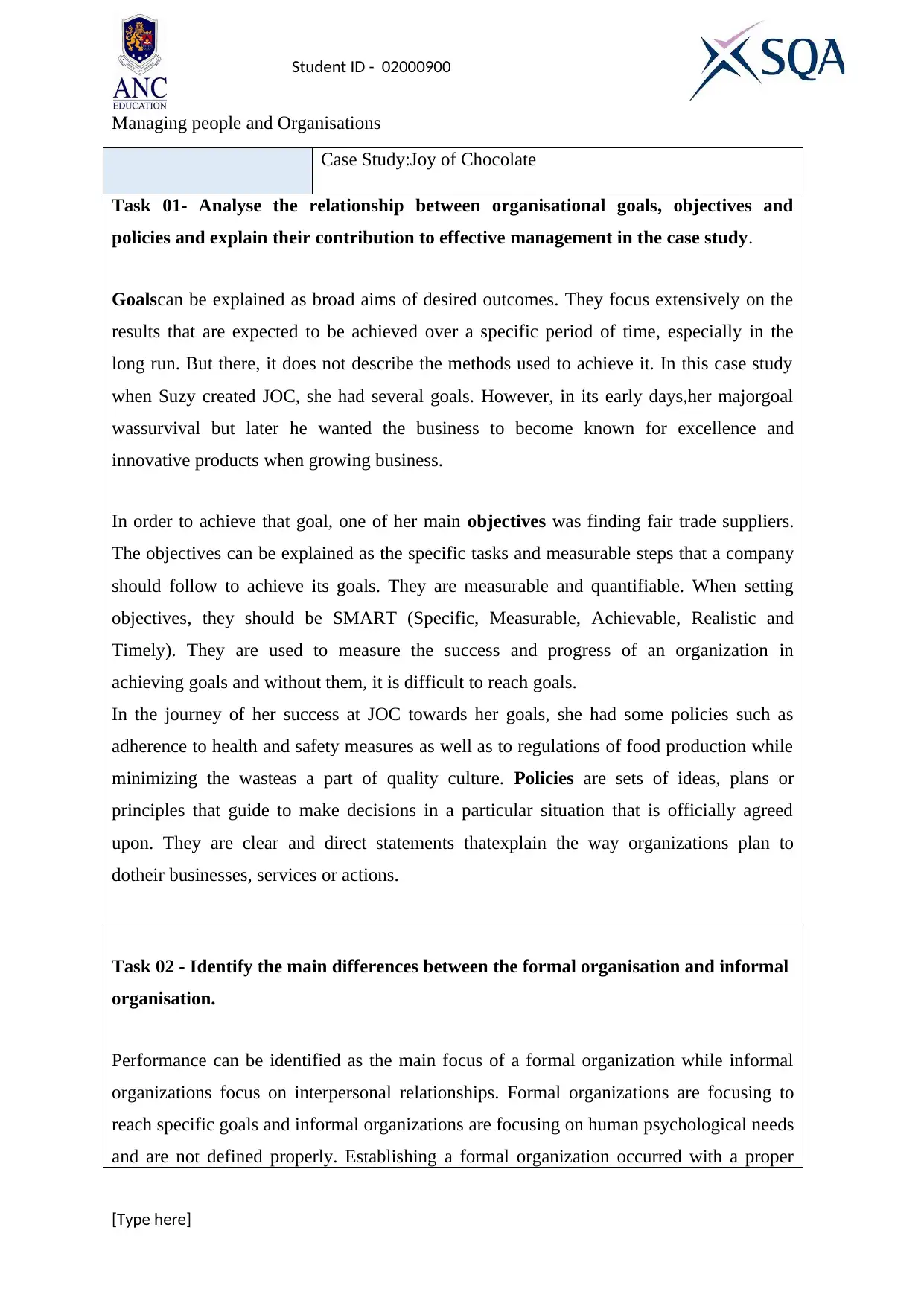
Organizations function on the basis of input and output systems. They are made up of
multiple subsystems. Those subsystems receive their inputs from other subsystems and
converts them to output which are useful for some other subsystems. Those systems are
influenced by the environment which provides key resources needed to maintain the
organizations and guide their transformation and survival. Those environmental
resources can be economic, political or social forces.The open system theory explains
the impact of such environmental factors onan organization.The key principle here is
that environmental change and impact greatly affect the efficiency of the organization.
[Type here]
plan or proposal while an informal organization is made suddenly or without the usual
forms. Formal organizations are well-structured to reach the goals but informal
organizations are not that much since they have mostly temporary or social goals. Formal
organizations are having a clear hierarchy, authority is well defined and performs the chain
of command very well. Informal organizations are not like that. They do not act according
to the hierarchical authority. Sometimes it can be identified several hierarchical levels but
and do not persuade to take members to the target by the superiors. Formal organizations
manage the flow of communication and information according to accepted rules according
to their hierarchical structure. There is no such system in an informal organization. They
communicate freely and interact ignoring the hierarchy. Formal organizations manage their
behaviors and outcomes according to the laws and rules. Informal organizations are more
personal and follow norms than role-related and group consensus decides behaviors.
Informal organizations promote social interaction, and the main objective of formal
organizations is to make a profit.
Task 03 -Explain the composition of the open system theory and explain how it
applies in the case study.
Organizations function on the basis of input and output systems. They are made up of
multiple subsystems. Those subsystems receive their inputs from other subsystems and
converts them to output which are useful for some other subsystems. Those systems are
influenced by the environment which provides key resources needed to maintain the
organizations and guide their transformation and survival. Those environmental
resources can be economic, political or social forces.The open system theory explains
the impact of such environmental factors onan organization.The key principle here is
that environmental change and impact greatly affect the efficiency of the organization.
[Type here]

Student ID - 02000900
When considering the applicability of open system theory to JOC, being in the
chocolate-making business. Initially, JOC started with a small number of employees and
gradually increased. In that process, the experienced staff were deployed as well as new
expertise got joined. With the appointment of Hafiz, Suzy expected to streamline the
manufacturing process while identifying the importance of adhering to hygiene
regulations and to get team spirit towards success while improving the manufacturing
process. When developingcash management was strengthened.Staff were on continuous
training and monitored. Those steps were taken to strengthen the organizational
processes. Suzy found business customers whom with wider market potential for a wide
range of confectionery chocolates.She saw the opportunity for unique products in the market.
She was able to achieve herobjectives; secure the sales and development of new products.
In doing so, she faced various challenges. Initially in the process of capturing the
market, invested in product development with the help of banks and established good
relationships with several exceptional buyers. She established good relationships
with raw material suppliers such as chocolate, cocoa and alternative source suppliers
that enhance the flavour. However, she managed to limit the number of suppliers in
order to keep the relationship very close. Recognizing the need for expansion, taking
into account the constant market demand, changes were made within the company,
and later, CG Chocolate was merged again with the bank assistance.
However, various steps were taken in difficult situations. With the economic
recession in the UK economy, there were major difficulties in finding the raw
[Type here]
When considering the applicability of open system theory to JOC, being in the
chocolate-making business. Initially, JOC started with a small number of employees and
gradually increased. In that process, the experienced staff were deployed as well as new
expertise got joined. With the appointment of Hafiz, Suzy expected to streamline the
manufacturing process while identifying the importance of adhering to hygiene
regulations and to get team spirit towards success while improving the manufacturing
process. When developingcash management was strengthened.Staff were on continuous
training and monitored. Those steps were taken to strengthen the organizational
processes. Suzy found business customers whom with wider market potential for a wide
range of confectionery chocolates.She saw the opportunity for unique products in the market.
She was able to achieve herobjectives; secure the sales and development of new products.
In doing so, she faced various challenges. Initially in the process of capturing the
market, invested in product development with the help of banks and established good
relationships with several exceptional buyers. She established good relationships
with raw material suppliers such as chocolate, cocoa and alternative source suppliers
that enhance the flavour. However, she managed to limit the number of suppliers in
order to keep the relationship very close. Recognizing the need for expansion, taking
into account the constant market demand, changes were made within the company,
and later, CG Chocolate was merged again with the bank assistance.
However, various steps were taken in difficult situations. With the economic
recession in the UK economy, there were major difficulties in finding the raw
[Type here]
⊘ This is a preview!⊘
Do you want full access?
Subscribe today to unlock all pages.

Trusted by 1+ million students worldwide

Student ID - 02000900
material, which severely affected Newcastle operations. The public sector budget
reduction made them turn to new markets from local councils. Despite the increasing
competition in the luxury gift market, JOC had been able to succeed in its business
on the demand for quality goods. Also, there may be some supply challenges when
obtaining certain raw materials from the Dominican Republic and Ivory
Coast.However, the JOC found new opportunities, such as the London Olympics and
the Glasgow Commonwealth Games.
In order to achieve the objectives by making structural changes from time to time to suit
these external influences, steps have been taken to develop and motivate the existing
staff and recruited the right persons where necessary focusing on the developments that
needed to be made within the organization for the organizational development and to
promote a positive culture which had been able to achieve the benefits. Employees were
rewarded and punished where necessary. Shift works were implemented for the
maximum utilization of labour.
When the JOC went close to bankruptcy in 2004, a bank employee was hired at the
request of the bank. The JOC identified the main reason for the bankruptcy as a
mismatch of cash flows. The reason for that was JOC failed to persuade hotels and
restaurants to pay their bills quickly, but maintaining their concept of ethical business
initiative they maintained regular payments to suppliers which need to pay monthly. The
cashflow issue was overcome by paying close attention to cash flow and ensuring the
survival of the business while minimizing costs and waste.
Later, in order to improve the company's profile, the local colleges were given
opportunity to be positioned students with a view to recruiting employees in the future.
Employees were given goals and empowered. With those strategies, JOC managed to
overcome the difficulties and to achieve targets by managing their products unique
which gave them a significant place above their competitors.
[Type here]
material, which severely affected Newcastle operations. The public sector budget
reduction made them turn to new markets from local councils. Despite the increasing
competition in the luxury gift market, JOC had been able to succeed in its business
on the demand for quality goods. Also, there may be some supply challenges when
obtaining certain raw materials from the Dominican Republic and Ivory
Coast.However, the JOC found new opportunities, such as the London Olympics and
the Glasgow Commonwealth Games.
In order to achieve the objectives by making structural changes from time to time to suit
these external influences, steps have been taken to develop and motivate the existing
staff and recruited the right persons where necessary focusing on the developments that
needed to be made within the organization for the organizational development and to
promote a positive culture which had been able to achieve the benefits. Employees were
rewarded and punished where necessary. Shift works were implemented for the
maximum utilization of labour.
When the JOC went close to bankruptcy in 2004, a bank employee was hired at the
request of the bank. The JOC identified the main reason for the bankruptcy as a
mismatch of cash flows. The reason for that was JOC failed to persuade hotels and
restaurants to pay their bills quickly, but maintaining their concept of ethical business
initiative they maintained regular payments to suppliers which need to pay monthly. The
cashflow issue was overcome by paying close attention to cash flow and ensuring the
survival of the business while minimizing costs and waste.
Later, in order to improve the company's profile, the local colleges were given
opportunity to be positioned students with a view to recruiting employees in the future.
Employees were given goals and empowered. With those strategies, JOC managed to
overcome the difficulties and to achieve targets by managing their products unique
which gave them a significant place above their competitors.
[Type here]
1 out of 4
Related Documents
Your All-in-One AI-Powered Toolkit for Academic Success.
 +13062052269
info@desklib.com
Available 24*7 on WhatsApp / Email
Unlock your academic potential
Copyright © 2020–2026 A2Z Services. All Rights Reserved. Developed and managed by ZUCOL.