PGBM02 Managing and Leading People: Critical Analysis of Key Roles
VerifiedAdded on 2023/06/11
|17
|6052
|216
Report
AI Summary
This report critically analyzes the roles of line managers and HR representatives in people management within organizations. It defines key practices in employee management and leadership, discusses appropriate models such as Path-Goal leadership, Transactional leadership, Trait theory, and Tuckman's theory of group development. The report evaluates the relationship between leaders and HR, considering benefits, limitations, clarity, tensions, and devolution. Recommendations are provided to improve employee management, emphasizing motivation, conflict mitigation, and the creation of a positive work environment. The analysis draws on relevant literature and best practices to provide a comprehensive overview of effective people management strategies.
Running head: MANAGING AND LEADING PEOPLE
Managing and Leading People
Student’s name:
Name of the university:
Author’s note:
Managing and Leading People
Student’s name:
Name of the university:
Author’s note:

Paraphrase This Document
Need a fresh take? Get an instant paraphrase of this document with our AI Paraphraser
1MANAGING AND LEADING PEOPLE
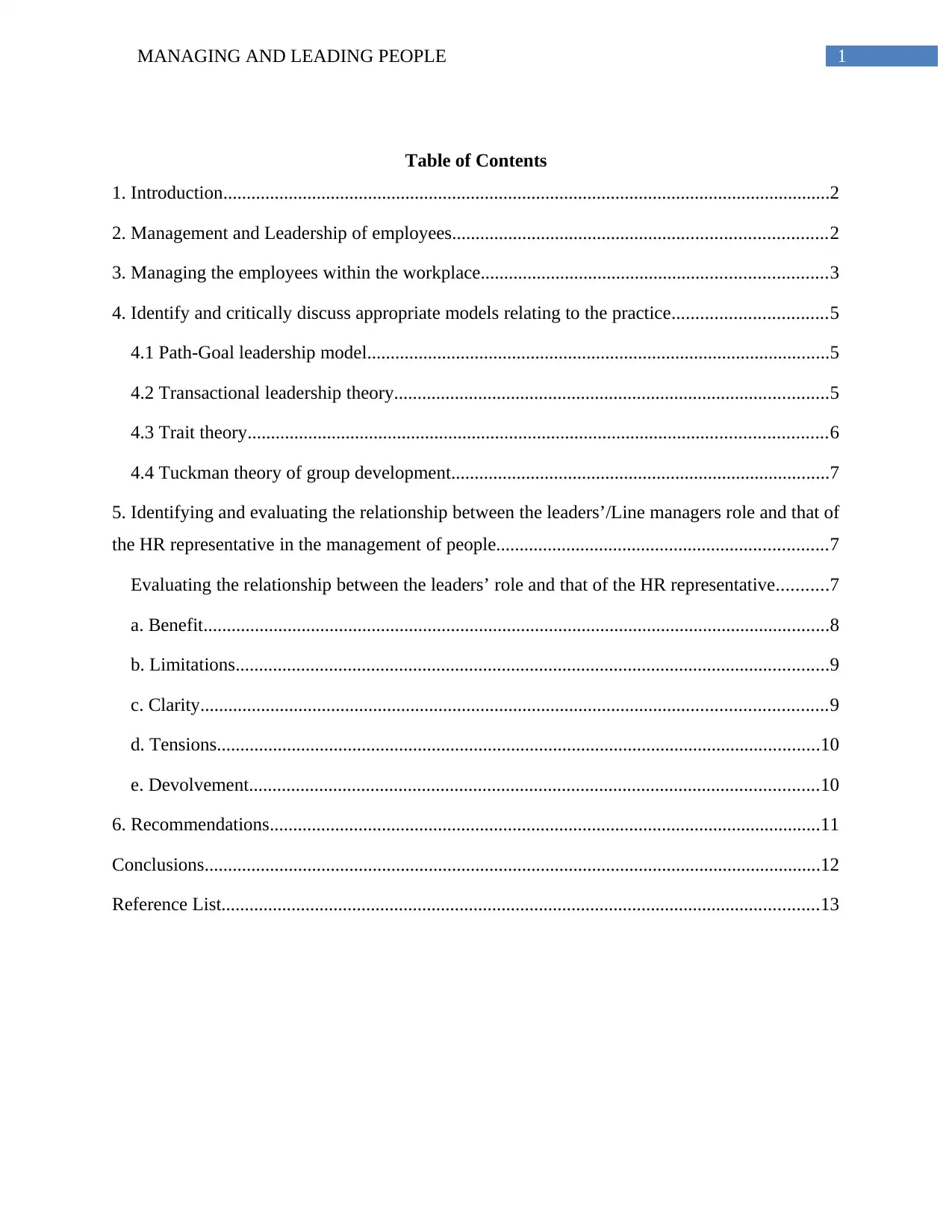
Table of Contents
1. Introduction..................................................................................................................................2
2. Management and Leadership of employees................................................................................2
3. Managing the employees within the workplace..........................................................................3
4. Identify and critically discuss appropriate models relating to the practice.................................5
4.1 Path-Goal leadership model...................................................................................................5
4.2 Transactional leadership theory.............................................................................................5
4.3 Trait theory............................................................................................................................6
4.4 Tuckman theory of group development.................................................................................7
5. Identifying and evaluating the relationship between the leaders’/Line managers role and that of
the HR representative in the management of people.......................................................................7
Evaluating the relationship between the leaders’ role and that of the HR representative...........7
a. Benefit......................................................................................................................................8
b. Limitations...............................................................................................................................9
c. Clarity......................................................................................................................................9
d. Tensions.................................................................................................................................10
e. Devolvement..........................................................................................................................10
6. Recommendations......................................................................................................................11
Conclusions....................................................................................................................................12
Reference List................................................................................................................................13
Table of Contents
1. Introduction..................................................................................................................................2
2. Management and Leadership of employees................................................................................2
3. Managing the employees within the workplace..........................................................................3
4. Identify and critically discuss appropriate models relating to the practice.................................5
4.1 Path-Goal leadership model...................................................................................................5
4.2 Transactional leadership theory.............................................................................................5
4.3 Trait theory............................................................................................................................6
4.4 Tuckman theory of group development.................................................................................7
5. Identifying and evaluating the relationship between the leaders’/Line managers role and that of
the HR representative in the management of people.......................................................................7
Evaluating the relationship between the leaders’ role and that of the HR representative...........7
a. Benefit......................................................................................................................................8
b. Limitations...............................................................................................................................9
c. Clarity......................................................................................................................................9
d. Tensions.................................................................................................................................10
e. Devolvement..........................................................................................................................10
6. Recommendations......................................................................................................................11
Conclusions....................................................................................................................................12
Reference List................................................................................................................................13
2MANAGING AND LEADING PEOPLE
1. Introduction
Leaders can manage the employees through motivating the employees in order to
encourage the productivity as well as ensuring the productivity. The leaders cannot force the
staffs to be successful in the workplace as the role of the leaders is to motivate the employees so
that they can work to achieve the organisational objectives. Leaders in the workplace can make
the plan of managing the employees after discussing with the Human Resource Manager (Bolden
2016). Line managers ask the HR manager to coordinate regarding the recruiting and hiring of
the employees and this coordination can benefit the organisation and the employees in
developing the training and development.
In this report highlights the critical analysis of the role of the leaders and their relationship with
the HR representatives in the management of people in the organisation today. In the first part of
the study, key practices of the leaders regarding the management and leadership of the
employees are explained with examples. In the next section, theories and models of management
and leadership of the employees are discussed; such as path-goal theory, transactional model of
leadership, trait theory and Tuckman theory of team management within the organisation. In the
final section of the study; the relationship between leaders’ role and that of the HR
representatives in the management is explained with limitations, benefits, clarity and tension.
Recommendations are also given regarding the management of the employees within the
organisation by the leaders.
2. Management and Leadership of employees
Within a workplace, it is required to manage the employees to develop the quality of the
work and the employees’ productivity. As stated by Thomas (2015), the performance
management can improve the quality of the employees' production and the responsibility of the
performance management goes to the leaders. Good leaders always value the employees' good
and happiness. However, a great leader provides values to the employees' engagement in the
workplace that results from the employees' happiness. The leaders can manage the employees
from their leadership styles and the leaders' styles can be autocratic, democratic or it can be
laissez-faire. When the leaders follow autocratic leadership; the leaders hold the ultimate
1. Introduction
Leaders can manage the employees through motivating the employees in order to
encourage the productivity as well as ensuring the productivity. The leaders cannot force the
staffs to be successful in the workplace as the role of the leaders is to motivate the employees so
that they can work to achieve the organisational objectives. Leaders in the workplace can make
the plan of managing the employees after discussing with the Human Resource Manager (Bolden
2016). Line managers ask the HR manager to coordinate regarding the recruiting and hiring of
the employees and this coordination can benefit the organisation and the employees in
developing the training and development.
In this report highlights the critical analysis of the role of the leaders and their relationship with
the HR representatives in the management of people in the organisation today. In the first part of
the study, key practices of the leaders regarding the management and leadership of the
employees are explained with examples. In the next section, theories and models of management
and leadership of the employees are discussed; such as path-goal theory, transactional model of
leadership, trait theory and Tuckman theory of team management within the organisation. In the
final section of the study; the relationship between leaders’ role and that of the HR
representatives in the management is explained with limitations, benefits, clarity and tension.
Recommendations are also given regarding the management of the employees within the
organisation by the leaders.
2. Management and Leadership of employees
Within a workplace, it is required to manage the employees to develop the quality of the
work and the employees’ productivity. As stated by Thomas (2015), the performance
management can improve the quality of the employees' production and the responsibility of the
performance management goes to the leaders. Good leaders always value the employees' good
and happiness. However, a great leader provides values to the employees' engagement in the
workplace that results from the employees' happiness. The leaders can manage the employees
from their leadership styles and the leaders' styles can be autocratic, democratic or it can be
laissez-faire. When the leaders follow autocratic leadership; the leaders hold the ultimate
⊘ This is a preview!⊘
Do you want full access?
Subscribe today to unlock all pages.

Trusted by 1+ million students worldwide
3MANAGING AND LEADING PEOPLE
authority and the responsibility for decisions within the organisation. On the other side,
Democratic leaders always take the decisions within the organisation after discussing with the
employees. Democratic leaders try to manage the employees including the subordinates into the
decision-making process. According to Goetsch and Davis (2014), democratic leaders take the
final responsibility; however, the leaders delegate the authority to other employees. Moreover,
sometimes the leaders give the authority to the employees as subordinates and departments are
allowed to work when they choose no interference. Laissez-Faire leadership style is applied by
the leaders in the least effective management and least satisfying workplace where the leaders
want to satisfy the employees through giving the power or authority (Shin et al. 2015).
The leaders try to motivate the employees to accomplish the work objectives. The leaders
control the work environment where the leaders try to motivate the employees and the workplace
should have positive work culture. The leaders must have good relationship with the employees
and it will provide important factor of establishing the organisational culture that facilitate the
workplace motivation. Workplace motivation is of two types; extrinsic motivation and intrinsic
motivation. As stated by Gruber et al. (2015), work culture comprises in the workplace where
employees must be trusted and treated like the adults. All the employees have their own set of
values, mission and strategic direction; the employees expect that their desires will be fulfilled in
the workplace. Team members in the workplace work under the supervision of the team leaders
and the team leaders ask the employees to share their vision. The leaders receive the frequent
communication and the leaders are treated with civility and respect (Bolman and Deal 2017).
Leaders in the workplace should show the respect for the team members and all the employees
irrespective of background they belong from. In order to maintain the cultural diversity at the
workplace, the team leaders can start the diversity training where the employees will be given
training. Team leaders discuss with the HR representatives about the new hiring and about the
vacant posts. The team leaders within the organisation manage the employees through
motivation, engaging the employees through their passion and the team bonding (Notrthouse
2018). The leaders have the responsibility to mitigate the employees’ conflict and they can
facilitate the peaceful and positive work environment through utter control on the team members.
authority and the responsibility for decisions within the organisation. On the other side,
Democratic leaders always take the decisions within the organisation after discussing with the
employees. Democratic leaders try to manage the employees including the subordinates into the
decision-making process. According to Goetsch and Davis (2014), democratic leaders take the
final responsibility; however, the leaders delegate the authority to other employees. Moreover,
sometimes the leaders give the authority to the employees as subordinates and departments are
allowed to work when they choose no interference. Laissez-Faire leadership style is applied by
the leaders in the least effective management and least satisfying workplace where the leaders
want to satisfy the employees through giving the power or authority (Shin et al. 2015).
The leaders try to motivate the employees to accomplish the work objectives. The leaders
control the work environment where the leaders try to motivate the employees and the workplace
should have positive work culture. The leaders must have good relationship with the employees
and it will provide important factor of establishing the organisational culture that facilitate the
workplace motivation. Workplace motivation is of two types; extrinsic motivation and intrinsic
motivation. As stated by Gruber et al. (2015), work culture comprises in the workplace where
employees must be trusted and treated like the adults. All the employees have their own set of
values, mission and strategic direction; the employees expect that their desires will be fulfilled in
the workplace. Team members in the workplace work under the supervision of the team leaders
and the team leaders ask the employees to share their vision. The leaders receive the frequent
communication and the leaders are treated with civility and respect (Bolman and Deal 2017).
Leaders in the workplace should show the respect for the team members and all the employees
irrespective of background they belong from. In order to maintain the cultural diversity at the
workplace, the team leaders can start the diversity training where the employees will be given
training. Team leaders discuss with the HR representatives about the new hiring and about the
vacant posts. The team leaders within the organisation manage the employees through
motivation, engaging the employees through their passion and the team bonding (Notrthouse
2018). The leaders have the responsibility to mitigate the employees’ conflict and they can
facilitate the peaceful and positive work environment through utter control on the team members.
Paraphrase This Document
Need a fresh take? Get an instant paraphrase of this document with our AI Paraphraser
4MANAGING AND LEADING PEOPLE
3. Managing the employees within the workplace
Bureaucratic management:
Management within an organisation can follow bureaucratic theory of employee
management where two essential elements of an organisation are followed: structure of the
organisation and defined rules within the organisation (Van der Voet 2014). If the senior leaders
follow the bureaucratic management; the senior leaders need to make clear hierarchy with strict
rules to govern the employees. The senior leaders within the organisation can follow the
bureaucratic management approach as it starts with proper division of labour where the
employees’ specialisation is fixed. Chain of command starts with the organisational hierarchy
where the senior management constructed the effective bottom line. In addition, the leaders can
separate the official and personal property of the employees. In addition, leaders within the
organisation apply the consistent and complete rules for running the workplace. As opined by
Sturdy et al. (2016), employee management is not easy thing as the leaders should try to select
and promote the employees based on the qualification. When the leaders focus to create the
bureaucratic organisational approach; the leaders use high-degree of division of the labour and
they can use the legal power to manage the employees.
Scientific management:
The managers in the workplace can use scientific management that synthesises and
analyse the workflows (Taylor 1914). The main objective of the scientific management is to
improve the economic efficiency and the productivity of the employees. Leaders in the
workplace can apply the engineering process to manage the employees. Frederick Taylor is the
founder of this scientific theory and the main target of using this concept in the workplace is to
manage the employees and to pursuit of the economic efficiency. Scientific management requires
the control of the employees from the leaders’ side and employees’ work practice. This process
is very detail and there is a chance of friction between employees and the leaders. In the
workplace, some of the employees are more gifted and talented than others; however; the smart
employees are unmotivated. Therefore, the leaders need to force the employees to do the relative
tasks. According to Shafriz et al. (2015), the management pay the same amount of money for the
employees who tend to do the work that can be the slowest among all.
3. Managing the employees within the workplace
Bureaucratic management:
Management within an organisation can follow bureaucratic theory of employee
management where two essential elements of an organisation are followed: structure of the
organisation and defined rules within the organisation (Van der Voet 2014). If the senior leaders
follow the bureaucratic management; the senior leaders need to make clear hierarchy with strict
rules to govern the employees. The senior leaders within the organisation can follow the
bureaucratic management approach as it starts with proper division of labour where the
employees’ specialisation is fixed. Chain of command starts with the organisational hierarchy
where the senior management constructed the effective bottom line. In addition, the leaders can
separate the official and personal property of the employees. In addition, leaders within the
organisation apply the consistent and complete rules for running the workplace. As opined by
Sturdy et al. (2016), employee management is not easy thing as the leaders should try to select
and promote the employees based on the qualification. When the leaders focus to create the
bureaucratic organisational approach; the leaders use high-degree of division of the labour and
they can use the legal power to manage the employees.
Scientific management:
The managers in the workplace can use scientific management that synthesises and
analyse the workflows (Taylor 1914). The main objective of the scientific management is to
improve the economic efficiency and the productivity of the employees. Leaders in the
workplace can apply the engineering process to manage the employees. Frederick Taylor is the
founder of this scientific theory and the main target of using this concept in the workplace is to
manage the employees and to pursuit of the economic efficiency. Scientific management requires
the control of the employees from the leaders’ side and employees’ work practice. This process
is very detail and there is a chance of friction between employees and the leaders. In the
workplace, some of the employees are more gifted and talented than others; however; the smart
employees are unmotivated. Therefore, the leaders need to force the employees to do the relative
tasks. According to Shafriz et al. (2015), the management pay the same amount of money for the
employees who tend to do the work that can be the slowest among all.
5MANAGING AND LEADING PEOPLE
4. Identify and critically discuss appropriate models relating to the practice
4.1 Path-Goal leadership model
Path-Goal leadership model is based on leaders’ style of leadership or the behaviour that
would best fit within the workplace in order to gain the objectives. The main aim of the
leadership is to enhance the employees’ motivation to empower the employees and provide the
employees satisfaction (Chemers 2014). The leaders need to focus on effective leadership style
so that the employees must become productive members of the firms. As stated by Phillips and
Phillips (2016), the path-goal theory of leadership is based on Expectancy theory of Vroom
(1994) and this theory states about an individual's actions in a certain situation on the basis of the
expectation that the act would be followed by the given result. Path-goal theory states that
leaders in the organisation select the behaviours that must be best suited for them and the
leaders’ behaviour must meet the employees’ needs as well. Path-Goal model of leadership
generally follows general steps as first step is to determine the employees and characteristics of
the working environment. In addition, the employees need to select the leadership style and the
leaders can focus on the motivational factors which will assist the employee to be successful.
The leaders’ behaviour is set based on the needs of the employees within the organisation
and leaders’ behaviour is based on the degree of structure, perceived level of ability and the
affiliation. Environmental characteristics of the team members are very important and leaders
follow the steps to help the employees to follow the path around this. The employees can ask the
leaders to support for the work as the design of work needs this. The task can be ambiguous and
the leaders can help the employees to make it structured. In addition, according to Downes et al.
(2017), leaders can provide standard goal as it can depend upon the clear goals. In addition,
work-group must be supportive for the team leaders to help them. The leaders must be cohesive
and they must have the sense of duty which provides enthusiasm, devotion and comradeship to
the employees.
4.2 Transactional leadership theory
Transactional leadership focuses on the management process of organising, controlling
and short-term planning. Transactional leadership theory is associated with directing and
motivating the employees primarily by affecting their self-interest (Antonakis and House 2014).
The power of transactional leaders generates from the responsibility and formal authority in the
4. Identify and critically discuss appropriate models relating to the practice
4.1 Path-Goal leadership model
Path-Goal leadership model is based on leaders’ style of leadership or the behaviour that
would best fit within the workplace in order to gain the objectives. The main aim of the
leadership is to enhance the employees’ motivation to empower the employees and provide the
employees satisfaction (Chemers 2014). The leaders need to focus on effective leadership style
so that the employees must become productive members of the firms. As stated by Phillips and
Phillips (2016), the path-goal theory of leadership is based on Expectancy theory of Vroom
(1994) and this theory states about an individual's actions in a certain situation on the basis of the
expectation that the act would be followed by the given result. Path-goal theory states that
leaders in the organisation select the behaviours that must be best suited for them and the
leaders’ behaviour must meet the employees’ needs as well. Path-Goal model of leadership
generally follows general steps as first step is to determine the employees and characteristics of
the working environment. In addition, the employees need to select the leadership style and the
leaders can focus on the motivational factors which will assist the employee to be successful.
The leaders’ behaviour is set based on the needs of the employees within the organisation
and leaders’ behaviour is based on the degree of structure, perceived level of ability and the
affiliation. Environmental characteristics of the team members are very important and leaders
follow the steps to help the employees to follow the path around this. The employees can ask the
leaders to support for the work as the design of work needs this. The task can be ambiguous and
the leaders can help the employees to make it structured. In addition, according to Downes et al.
(2017), leaders can provide standard goal as it can depend upon the clear goals. In addition,
work-group must be supportive for the team leaders to help them. The leaders must be cohesive
and they must have the sense of duty which provides enthusiasm, devotion and comradeship to
the employees.
4.2 Transactional leadership theory
Transactional leadership focuses on the management process of organising, controlling
and short-term planning. Transactional leadership theory is associated with directing and
motivating the employees primarily by affecting their self-interest (Antonakis and House 2014).
The power of transactional leaders generates from the responsibility and formal authority in the
⊘ This is a preview!⊘
Do you want full access?
Subscribe today to unlock all pages.
Trusted by 1+ million students worldwide
6MANAGING AND LEADING PEOPLE
workplace. Therefore, the main objective of the employees is to respect and obey the instructions
of the leaders. According to Breevaart et al. (2014), transactional leaders believe in motivation
which comes through the extrinsic motivation like bonuses, rewards and recognition. The
employees need to do what they desire and the employees may get the reward from this. There
are four dimensions are associated with this and the first dimension is about contingent rewards.
Transactional leaders always link the goal towards the rewards and they provide necessary
resources associated with this. The second dimension is about active management by exception
as the subordinates can watch from the deviation of the rules. Passive management by exception
is another dimension as it intervenes when standard when the performance is not as per the
expectation of the leaders (Tyssen et al. 2014). Lastly, the transactional leadership has it relation
with Laissez-faire where the subordinates are given opportunity to make the decisions of the
business. As argued by Birasnay (2014), transactional leadership has assumptions that employees
are motivated by the recognition and rewards; in addition the subordinates will obey the leaders
and the superiors. It can be concluded that transactional leadership is responsive in nature and it
works within the culture of the organisation. Transactional leaders help to motivate the
employees by appealing in their self-interest.
4.3 Trait theory
Trait theory of leadership is the concept which is based on the features and characteristics
of the leaders; the traits can be both successful and unsuccessful. According to Fleeson and
Jayawickreme (2014), trait theory attempts to recognise the physiology, demographic, self-
confidence and personality of the leaders and the employees as well. Trait theory takes into
consideration about the intellect of the employees, task-related issue of the employees and the
social characteristics of the employees. As pointed out by Lussier and Achua (2015), in order to
manage the team members, successful leaders show interests, personality traits and abilities
which are different from the less effective leaders in the workplace. The leaders identify the core
traits of successful leaders and these traits are not responsible to recognise whether the leaders
will be successful or unsuccessful. There are many of the core strengths which are important for
the leaders to posses which endow the people to have leadership potential. Achievement drive is
about effort of employees and the leaders must have the high ambition. According to Dinh et al.
(2014), leadership motivation is about intense desire that leads other employees to reach the
intent goals and honesty integrity tells about the belief that speaks about the ideas and ability.
workplace. Therefore, the main objective of the employees is to respect and obey the instructions
of the leaders. According to Breevaart et al. (2014), transactional leaders believe in motivation
which comes through the extrinsic motivation like bonuses, rewards and recognition. The
employees need to do what they desire and the employees may get the reward from this. There
are four dimensions are associated with this and the first dimension is about contingent rewards.
Transactional leaders always link the goal towards the rewards and they provide necessary
resources associated with this. The second dimension is about active management by exception
as the subordinates can watch from the deviation of the rules. Passive management by exception
is another dimension as it intervenes when standard when the performance is not as per the
expectation of the leaders (Tyssen et al. 2014). Lastly, the transactional leadership has it relation
with Laissez-faire where the subordinates are given opportunity to make the decisions of the
business. As argued by Birasnay (2014), transactional leadership has assumptions that employees
are motivated by the recognition and rewards; in addition the subordinates will obey the leaders
and the superiors. It can be concluded that transactional leadership is responsive in nature and it
works within the culture of the organisation. Transactional leaders help to motivate the
employees by appealing in their self-interest.
4.3 Trait theory
Trait theory of leadership is the concept which is based on the features and characteristics
of the leaders; the traits can be both successful and unsuccessful. According to Fleeson and
Jayawickreme (2014), trait theory attempts to recognise the physiology, demographic, self-
confidence and personality of the leaders and the employees as well. Trait theory takes into
consideration about the intellect of the employees, task-related issue of the employees and the
social characteristics of the employees. As pointed out by Lussier and Achua (2015), in order to
manage the team members, successful leaders show interests, personality traits and abilities
which are different from the less effective leaders in the workplace. The leaders identify the core
traits of successful leaders and these traits are not responsible to recognise whether the leaders
will be successful or unsuccessful. There are many of the core strengths which are important for
the leaders to posses which endow the people to have leadership potential. Achievement drive is
about effort of employees and the leaders must have the high ambition. According to Dinh et al.
(2014), leadership motivation is about intense desire that leads other employees to reach the
intent goals and honesty integrity tells about the belief that speaks about the ideas and ability.
Paraphrase This Document
Need a fresh take? Get an instant paraphrase of this document with our AI Paraphraser
7MANAGING AND LEADING PEOPLE
The cognitive ability of the leaders is about the capability of showing judgement and strong
analytical skills. Knowledge of business is needed as the leaders sometimes take the business
decisions on behalf of the employees. Emotional maturity is well adjustment and the leaders
should not suffer from psychological disorders.
4.4 Tuckman theory of group development
The leaders have their role to make the team within the organisation so that the team
members must be able to perform easily. Tuckman theory is about group development as this
theory talks about developmental sequence in small groups. There are four stages in group
development named; forming stage, storming stage, norming and performing. First stage is
forming stage where most of the team members are polite and positive. However, some of the
team members are anxious as they do not understand their roles in the workplace. The team
leaders plays very important role in this stage as team leaders are dominant to make the team
members understand about the responsibilities and roles (Thaibaut 2017). Second stage is about
storming and the employees begin to push against the wall or boundaries. In this stage, the team
leaders have the responsibility to make a solid bond as many of the teams fail in this stage. In
this phase, team members work naturally and their working styles might be different (Forsyth
2018). Norming stage is when the team members start resolving their issues and difference.
Informing stage, the leaders start identifying the strengths of the team members and the team
members start respecting the leaders (Lussier and Achua 2015). The team members start to
socialise together and the leaders provide constructive feedback. The employees develop
stronger commitment and the leaders can see good progress towards team. Performing stage is
about hardworking and team working can be done without friction. Performance is necessary
when to make structure and process the overall progress. The leaders should delegate the work
process as the leaders’ duty is to concentrate and development of the team members.
5. Identifying and evaluating the relationship between the leaders’/Line managers role and
that of the HR representative in the management of people
Evaluating the relationship between the leaders’ role and that of the HR representative
In order to maintain the productive relationship between leaders and the HR department;
the leaders can conduct occasionally meetings with the HR representatives. Successful leaders
The cognitive ability of the leaders is about the capability of showing judgement and strong
analytical skills. Knowledge of business is needed as the leaders sometimes take the business
decisions on behalf of the employees. Emotional maturity is well adjustment and the leaders
should not suffer from psychological disorders.
4.4 Tuckman theory of group development
The leaders have their role to make the team within the organisation so that the team
members must be able to perform easily. Tuckman theory is about group development as this
theory talks about developmental sequence in small groups. There are four stages in group
development named; forming stage, storming stage, norming and performing. First stage is
forming stage where most of the team members are polite and positive. However, some of the
team members are anxious as they do not understand their roles in the workplace. The team
leaders plays very important role in this stage as team leaders are dominant to make the team
members understand about the responsibilities and roles (Thaibaut 2017). Second stage is about
storming and the employees begin to push against the wall or boundaries. In this stage, the team
leaders have the responsibility to make a solid bond as many of the teams fail in this stage. In
this phase, team members work naturally and their working styles might be different (Forsyth
2018). Norming stage is when the team members start resolving their issues and difference.
Informing stage, the leaders start identifying the strengths of the team members and the team
members start respecting the leaders (Lussier and Achua 2015). The team members start to
socialise together and the leaders provide constructive feedback. The employees develop
stronger commitment and the leaders can see good progress towards team. Performing stage is
about hardworking and team working can be done without friction. Performance is necessary
when to make structure and process the overall progress. The leaders should delegate the work
process as the leaders’ duty is to concentrate and development of the team members.
5. Identifying and evaluating the relationship between the leaders’/Line managers role and
that of the HR representative in the management of people
Evaluating the relationship between the leaders’ role and that of the HR representative
In order to maintain the productive relationship between leaders and the HR department;
the leaders can conduct occasionally meetings with the HR representatives. Successful leaders
8MANAGING AND LEADING PEOPLE
within the organisation recognise that without the help of HR, they cannot assume the skills,
experience and knowledge of the employees to achieve the goals of the organisation. The HR
representatives can also help the leaders of the organisation to understand what is happening in
the workplace by doing the survey. Then, the effective leader can respond with sincerity and
empathy to address the issues of the employees and develop the productivity. Therefore, a
positive relationship between the leader and HR can be indicative of the health of the
organisation. The leaders like line managers have very significant role within the organisation
and the role is not just surrounded by the day-to-day operation and management of the people;
however, the leaders like line manager has the role of implementation of HR policies and
devolution of the HR activity (Ulrich and Dulebohn 2015). It is important to select the proper
line manager within the organisation to develop and manage the organisation in ongoing basis.
As stated by Bish et al. (2015), strategy execution can be hampered when the relationship
between HR representatives and the leaders’ mutual frustration come out.
a. Benefit
HR department has the function to support the workforce needs within the organisation
and leaders and line managers communicate frequently and regularly to discuss and determine
the qualifications and skills required for the new recruitment in the departments. Whenever there
is vacancy in the department; the HR representatives review the job description to fulfil the
vacant posts. The discussion between leaders and HR manager needs to be complete and
accurate in order to do the perfect staffing within the organisation (Auh et al. 2016). Leaders like
line managers do the strategic planning within the organisation discussing with the HR
representatives to involve the review projection regarding the future business needs to determine
the current employees. The line managers and the HR prepare the employees for their
promotions. Working together of the line managers and the HR representatives can provide the
benefit of understanding of the immediate and future staffing with reduced cost of turnover and
new hiring (Robert et al. 2016). The relationship between the line managers and HR
representatives discuss about the training requirement of the employees and they discuss about
the employee performance appraisals. HR trainers can start with training with constructive
feedback to the employees and the line managers discuss about the unbiased assessment.
Workplace conflict cannot be unavoidable as it is inevitable in nature; line managers and the HR
representatives work on to improve the workplace culture and personalities of the employees
within the organisation recognise that without the help of HR, they cannot assume the skills,
experience and knowledge of the employees to achieve the goals of the organisation. The HR
representatives can also help the leaders of the organisation to understand what is happening in
the workplace by doing the survey. Then, the effective leader can respond with sincerity and
empathy to address the issues of the employees and develop the productivity. Therefore, a
positive relationship between the leader and HR can be indicative of the health of the
organisation. The leaders like line managers have very significant role within the organisation
and the role is not just surrounded by the day-to-day operation and management of the people;
however, the leaders like line manager has the role of implementation of HR policies and
devolution of the HR activity (Ulrich and Dulebohn 2015). It is important to select the proper
line manager within the organisation to develop and manage the organisation in ongoing basis.
As stated by Bish et al. (2015), strategy execution can be hampered when the relationship
between HR representatives and the leaders’ mutual frustration come out.
a. Benefit
HR department has the function to support the workforce needs within the organisation
and leaders and line managers communicate frequently and regularly to discuss and determine
the qualifications and skills required for the new recruitment in the departments. Whenever there
is vacancy in the department; the HR representatives review the job description to fulfil the
vacant posts. The discussion between leaders and HR manager needs to be complete and
accurate in order to do the perfect staffing within the organisation (Auh et al. 2016). Leaders like
line managers do the strategic planning within the organisation discussing with the HR
representatives to involve the review projection regarding the future business needs to determine
the current employees. The line managers and the HR prepare the employees for their
promotions. Working together of the line managers and the HR representatives can provide the
benefit of understanding of the immediate and future staffing with reduced cost of turnover and
new hiring (Robert et al. 2016). The relationship between the line managers and HR
representatives discuss about the training requirement of the employees and they discuss about
the employee performance appraisals. HR trainers can start with training with constructive
feedback to the employees and the line managers discuss about the unbiased assessment.
Workplace conflict cannot be unavoidable as it is inevitable in nature; line managers and the HR
representatives work on to improve the workplace culture and personalities of the employees
⊘ This is a preview!⊘
Do you want full access?
Subscribe today to unlock all pages.
Trusted by 1+ million students worldwide
9MANAGING AND LEADING PEOPLE
(Kuo et al. 2015). When the conflict arises within the team; the management can solve the issues
while discussing with the HR representatives. Conflict resolution is possible when the line
managers and the HR representatives negotiate the matters. Positive working relationship is
needed in order to solve the issue and management facilitates the easier handling in order to
investigate the workplace issues between the employees.
b. Limitations
HR representatives and the leaders of the organisation sometimes face the issue in their
relationship when conflict arises. Trust is very important to HR representatives and the line
managers; however, line managers may not understand what the HR wants to convey in the
departmental cases contributing the business to focus on another thing. The line managers might
be concerned about the cost of the employees and the rewards and recognition of the employees.
The leaders might not trust the people in the department of HR; HR professionals might feel
insecure by the focus of the line managers as well. Abid et al. (2015) commented that there can
be ego issue between HR manager and the line manager within the organisation. Line managers
have their own set of responsibilities and the HR managers have their own set of responsibilities;
both have to work together in order to maintain the good relationship. If the line managers and
the HR managers stop doing meetings regularly; it will lead to create knowledge gap between
two departments. HR typically has the power to serve both the CEO and the board of directors
within the organisation. Line managers play the role in the operation of the business through
providing training to the employees and cross-training to ensure the job rotation (Reilly and
Williams 2017). Power is different for HR representatives and the line managers; power creates
the stressful situation between the HR representatives and the line managers and it can lead to
bringing some provoking situations.
c. Clarity
HR representatives and line managers have some common difference and when any kind
of conflict arises, the line managers seek the advice to HR to solve the issues between employees
and sometimes line managers ask the HR to resolve the problems between employees and the
managers. As stated by Van De Voorde and Beijer (2015), the positive working relationship
between line managers and the HR can accelerate the easier handling of the workplace and
mediate the differences between the staffs. The line managers have the role of providing
(Kuo et al. 2015). When the conflict arises within the team; the management can solve the issues
while discussing with the HR representatives. Conflict resolution is possible when the line
managers and the HR representatives negotiate the matters. Positive working relationship is
needed in order to solve the issue and management facilitates the easier handling in order to
investigate the workplace issues between the employees.
b. Limitations
HR representatives and the leaders of the organisation sometimes face the issue in their
relationship when conflict arises. Trust is very important to HR representatives and the line
managers; however, line managers may not understand what the HR wants to convey in the
departmental cases contributing the business to focus on another thing. The line managers might
be concerned about the cost of the employees and the rewards and recognition of the employees.
The leaders might not trust the people in the department of HR; HR professionals might feel
insecure by the focus of the line managers as well. Abid et al. (2015) commented that there can
be ego issue between HR manager and the line manager within the organisation. Line managers
have their own set of responsibilities and the HR managers have their own set of responsibilities;
both have to work together in order to maintain the good relationship. If the line managers and
the HR managers stop doing meetings regularly; it will lead to create knowledge gap between
two departments. HR typically has the power to serve both the CEO and the board of directors
within the organisation. Line managers play the role in the operation of the business through
providing training to the employees and cross-training to ensure the job rotation (Reilly and
Williams 2017). Power is different for HR representatives and the line managers; power creates
the stressful situation between the HR representatives and the line managers and it can lead to
bringing some provoking situations.
c. Clarity
HR representatives and line managers have some common difference and when any kind
of conflict arises, the line managers seek the advice to HR to solve the issues between employees
and sometimes line managers ask the HR to resolve the problems between employees and the
managers. As stated by Van De Voorde and Beijer (2015), the positive working relationship
between line managers and the HR can accelerate the easier handling of the workplace and
mediate the differences between the staffs. The line managers have the role of providing
Paraphrase This Document
Need a fresh take? Get an instant paraphrase of this document with our AI Paraphraser
10MANAGING AND LEADING PEOPLE
coaching and feedback of the performance to all the team and line managers can communicate
and ensure the understanding of departmental and functional goals. According to Pohler and
Schmidt (2016), line managers identify the needs of the corrective actions and they ensure the
quality standards for all process. The line managers evaluate the overall team and performance of
the individuals and deliver the reviews of the performance. There needs to be clarity between the
relationship of line managers and the HR representatives. Line managers make final employee
selection decision whereas HR representatives help the line managers with HR related topics
(Nafakhi et al. 2015). In addition, line managers provide departmental specific orientation where
the HR representatives select the employees as well as orientation of the employees. Line
managers initiate the ongoing training of the employees whereas HR representatives evaluate the
training process.
d. Tensions
Line managers within the organisation supervise the activities of the employees, for instance,
performance appraisal whereas the HR representatives can make the plan of compensation of the
employees. HR representatives can impact on the decision of the line managers as the can build
the effective leadership team. The tension between the HR and the line managers occur when the
talent of the HR representatives and the line managers clash (Amanchkwu et al. 2015). In
addition, when the line managers become unsympathetic towards the feelings of the employees;
Hr representatives face the issue. In addition, the HR representatives can approach the line
managers for help; tension will occur when the line managers do not help the HR specialists.
e. Devolvement
Management development does not always possess the good terms for the HR and line
managers’ relationship. Development of the relationship between HR and Line managers will
bring routine request for the business. HR faces the issue of ‘soft skills’ what line managers do
not provide their focus. Developing the relationship will focus on the development of the soft
skills. The performance of the employees will be exquisite when the employees’ HR
representatives and the line managers work together. Improving the skills through HR training
may not be successful for the employees; the line managers help the employees to resolve the
issues. Line managers are expected to communicate the organisation directly, vision and goals to
report the employees.
coaching and feedback of the performance to all the team and line managers can communicate
and ensure the understanding of departmental and functional goals. According to Pohler and
Schmidt (2016), line managers identify the needs of the corrective actions and they ensure the
quality standards for all process. The line managers evaluate the overall team and performance of
the individuals and deliver the reviews of the performance. There needs to be clarity between the
relationship of line managers and the HR representatives. Line managers make final employee
selection decision whereas HR representatives help the line managers with HR related topics
(Nafakhi et al. 2015). In addition, line managers provide departmental specific orientation where
the HR representatives select the employees as well as orientation of the employees. Line
managers initiate the ongoing training of the employees whereas HR representatives evaluate the
training process.
d. Tensions
Line managers within the organisation supervise the activities of the employees, for instance,
performance appraisal whereas the HR representatives can make the plan of compensation of the
employees. HR representatives can impact on the decision of the line managers as the can build
the effective leadership team. The tension between the HR and the line managers occur when the
talent of the HR representatives and the line managers clash (Amanchkwu et al. 2015). In
addition, when the line managers become unsympathetic towards the feelings of the employees;
Hr representatives face the issue. In addition, the HR representatives can approach the line
managers for help; tension will occur when the line managers do not help the HR specialists.
e. Devolvement
Management development does not always possess the good terms for the HR and line
managers’ relationship. Development of the relationship between HR and Line managers will
bring routine request for the business. HR faces the issue of ‘soft skills’ what line managers do
not provide their focus. Developing the relationship will focus on the development of the soft
skills. The performance of the employees will be exquisite when the employees’ HR
representatives and the line managers work together. Improving the skills through HR training
may not be successful for the employees; the line managers help the employees to resolve the
issues. Line managers are expected to communicate the organisation directly, vision and goals to
report the employees.
11MANAGING AND LEADING PEOPLE
6. Recommendations
a. Set goals: Managing team will be easy when each of the employees will be asked to
set the goals from the leaders’ side. Each of the employees within the organisation needs goals so
that they can strive for better. Goals provide the employees’ direction to achieve the
organisational objectives and leaders help the employees to set the realistic goals. The goals of
the employees can be SMART (specific, measurable, achievable and realistic and time specific)
as the SMART goals help the employees to regular monitor and the leaders will review the goals
of the employees to develop as better professionals.
b. Recognise achievements: The leaders want that employees must do the good job and
doing good job can bring recognition from the bosses and leaders. Sometimes, the leaders do not
recognise the good works that the employees for their team and the leaders always try to find
faults and flaws among the employees. It is completely wrong from the management and leaders’
side as the leaders need to recognise the achievements of the employees. Leaders can personally
approach the employees to congratulate the employees for their achievement. Most importantly,
the management can provide incentives to the employees so that the employees can meet the
target.
c. Communicate perfectly: Leaders should communicate with the employees as
employees may feel hesitate to communicate with the seniors; however, good communication
can break the ice between the employees and the leaders. In order to manage the employees
within the organisation; the leaders try to engage the employees. In this regard, the
communication can help the leaders to make contact with the employees. The leaders can keep
the employees up-to=-date about their latest organisational news and structures. The leaders can
make effort to get the employees’ vision and information as they need to do the job efficiently
and quickly.
d. Meet occasionally apart from formal meeting: Line managers are closer than the
HR to the employees and they can better place to reward and develop the relationship with the
employees. The line managers must be equipped to make the decisions within the organisation
on the spots. There should be good relationship between the HR representatives and the line
managers as both can go along in order to meet the expectations of the new generations’
employees. In order to increase the trust and performance management between the line
6. Recommendations
a. Set goals: Managing team will be easy when each of the employees will be asked to
set the goals from the leaders’ side. Each of the employees within the organisation needs goals so
that they can strive for better. Goals provide the employees’ direction to achieve the
organisational objectives and leaders help the employees to set the realistic goals. The goals of
the employees can be SMART (specific, measurable, achievable and realistic and time specific)
as the SMART goals help the employees to regular monitor and the leaders will review the goals
of the employees to develop as better professionals.
b. Recognise achievements: The leaders want that employees must do the good job and
doing good job can bring recognition from the bosses and leaders. Sometimes, the leaders do not
recognise the good works that the employees for their team and the leaders always try to find
faults and flaws among the employees. It is completely wrong from the management and leaders’
side as the leaders need to recognise the achievements of the employees. Leaders can personally
approach the employees to congratulate the employees for their achievement. Most importantly,
the management can provide incentives to the employees so that the employees can meet the
target.
c. Communicate perfectly: Leaders should communicate with the employees as
employees may feel hesitate to communicate with the seniors; however, good communication
can break the ice between the employees and the leaders. In order to manage the employees
within the organisation; the leaders try to engage the employees. In this regard, the
communication can help the leaders to make contact with the employees. The leaders can keep
the employees up-to=-date about their latest organisational news and structures. The leaders can
make effort to get the employees’ vision and information as they need to do the job efficiently
and quickly.
d. Meet occasionally apart from formal meeting: Line managers are closer than the
HR to the employees and they can better place to reward and develop the relationship with the
employees. The line managers must be equipped to make the decisions within the organisation
on the spots. There should be good relationship between the HR representatives and the line
managers as both can go along in order to meet the expectations of the new generations’
employees. In order to increase the trust and performance management between the line
⊘ This is a preview!⊘
Do you want full access?
Subscribe today to unlock all pages.
Trusted by 1+ million students worldwide

1 out of 17


Related Documents


Your All-in-One AI-Powered Toolkit for Academic Success.
+13062052269
info@desklib.com
Available 24*7 on WhatsApp / Email
![[object Object]](/_next/static/media/star-bottom.7253800d.svg)
Unlock your academic potential
Copyright © 2020–2026 A2Z Services. All Rights Reserved. Developed and managed by ZUCOL.