Managing and Leading People: Key Practices for Employee Engagement
VerifiedAdded on 2023/04/21
|19
|5198
|368
Report
AI Summary
This report delves into the critical role of line managers in motivating and engaging employees within an organizational context. It examines key practices such as focusing on employee happiness, fostering autonomy, providing respect, and implementing effective communication strategies. The report identifies and critically evaluates various models for motivating and engaging employees, including Maslow's Hierarchy of Needs, Alderfer's ERG theory, Herzberg's Two-Factor theory, and Adam's Equity Model, alongside engagement models like IES and Schmidt's. Furthermore, the report analyzes the relationship between line managers and HR representatives in this process, discussing the benefits, devolvement, and potential limitations. The analysis includes an understanding of performance evaluation, training and development, and ensuring equality of opportunity. The report concludes with a comprehensive overview of the discussed elements and their practical implications in fostering a productive and engaged workforce.

Running head: MANAGING AND LEADING PEOPLE
Managing and Leading People
Name of the Student
Name of the University
Author Note
Managing and Leading People
Name of the Student
Name of the University
Author Note

Paraphrase This Document
Need a fresh take? Get an instant paraphrase of this document with our AI Paraphraser
1MANAGING AND LEADING PEOPLE
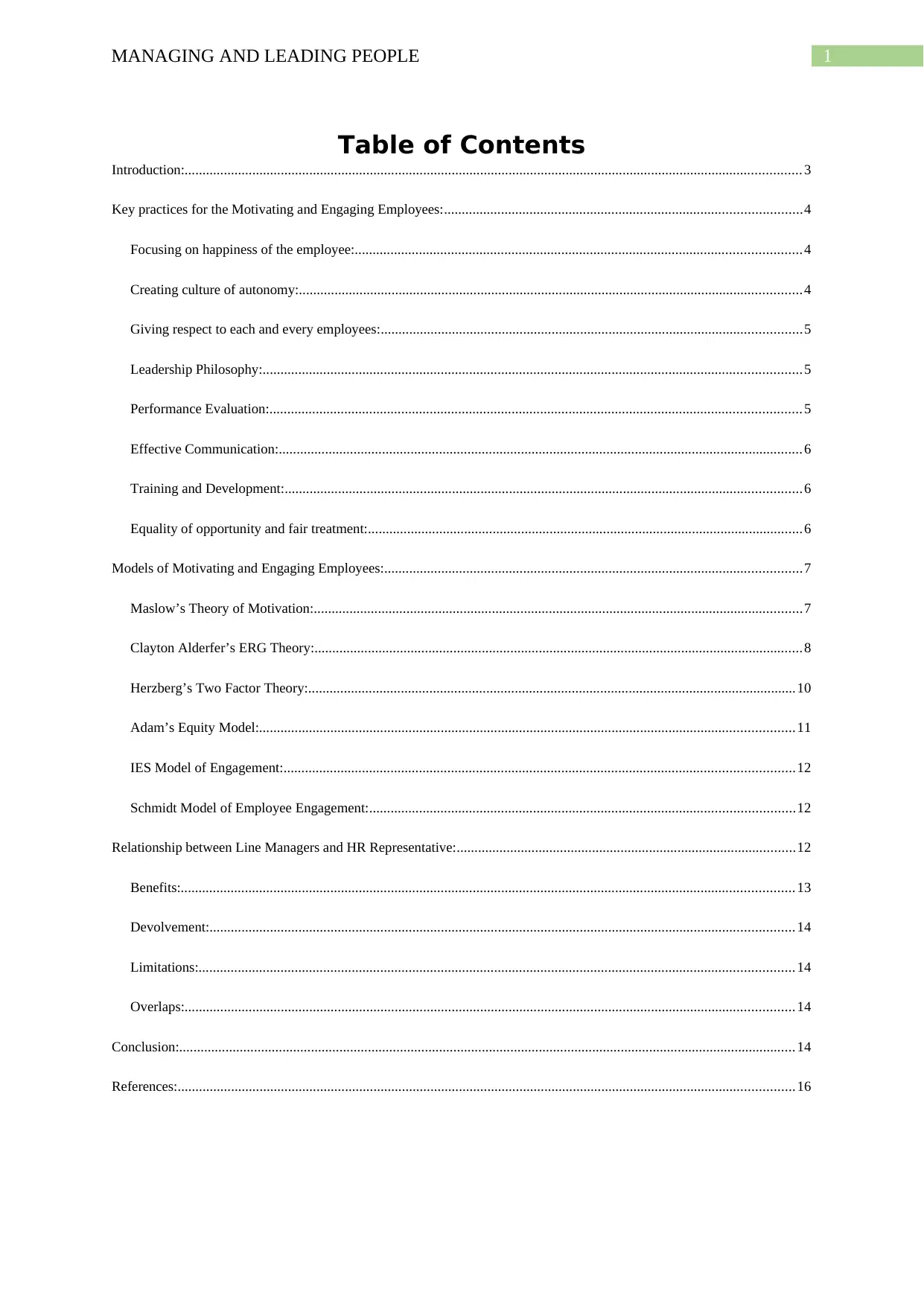
Table of Contents
Introduction:............................................................................................................................................................................. 3
Key practices for the Motivating and Engaging Employees:....................................................................................................4
Focusing on happiness of the employee:.............................................................................................................................4
Creating culture of autonomy:.............................................................................................................................................4
Giving respect to each and every employees:......................................................................................................................5
Leadership Philosophy:.......................................................................................................................................................5
Performance Evaluation:.....................................................................................................................................................5
Effective Communication:...................................................................................................................................................6
Training and Development:.................................................................................................................................................6
Equality of opportunity and fair treatment:..........................................................................................................................6
Models of Motivating and Engaging Employees:.....................................................................................................................7
Maslow’s Theory of Motivation:.........................................................................................................................................7
Clayton Alderfer’s ERG Theory:.........................................................................................................................................8
Herzberg’s Two Factor Theory:.........................................................................................................................................10
Adam’s Equity Model:......................................................................................................................................................11
IES Model of Engagement:...............................................................................................................................................12
Schmidt Model of Employee Engagement:.......................................................................................................................12
Relationship between Line Managers and HR Representative:...............................................................................................12
Benefits:............................................................................................................................................................................ 13
Devolvement:.................................................................................................................................................................... 14
Limitations:....................................................................................................................................................................... 14
Overlaps:........................................................................................................................................................................... 14
Conclusion:............................................................................................................................................................................. 14
References:............................................................................................................................................................................. 16
Table of Contents
Introduction:............................................................................................................................................................................. 3
Key practices for the Motivating and Engaging Employees:....................................................................................................4
Focusing on happiness of the employee:.............................................................................................................................4
Creating culture of autonomy:.............................................................................................................................................4
Giving respect to each and every employees:......................................................................................................................5
Leadership Philosophy:.......................................................................................................................................................5
Performance Evaluation:.....................................................................................................................................................5
Effective Communication:...................................................................................................................................................6
Training and Development:.................................................................................................................................................6
Equality of opportunity and fair treatment:..........................................................................................................................6
Models of Motivating and Engaging Employees:.....................................................................................................................7
Maslow’s Theory of Motivation:.........................................................................................................................................7
Clayton Alderfer’s ERG Theory:.........................................................................................................................................8
Herzberg’s Two Factor Theory:.........................................................................................................................................10
Adam’s Equity Model:......................................................................................................................................................11
IES Model of Engagement:...............................................................................................................................................12
Schmidt Model of Employee Engagement:.......................................................................................................................12
Relationship between Line Managers and HR Representative:...............................................................................................12
Benefits:............................................................................................................................................................................ 13
Devolvement:.................................................................................................................................................................... 14
Limitations:....................................................................................................................................................................... 14
Overlaps:........................................................................................................................................................................... 14
Conclusion:............................................................................................................................................................................. 14
References:............................................................................................................................................................................. 16

2MANAGING AND LEADING PEOPLE
⊘ This is a preview!⊘
Do you want full access?
Subscribe today to unlock all pages.

Trusted by 1+ million students worldwide
3MANAGING AND LEADING PEOPLE
Introduction:
In an organization the line managers plays a vital role as they are directly involved
with the managerial responsibility of the employees (Nielsen 2013). The line managers are
also involved in the activities which are very much important for organizations to run their
main businesses. The line managers plays various types of roles within the organization and
one of the most important role of the line managers is motivation and engaging the
employees towards the organization. Motivating the people is important for every
organization because this implies a highly productive staff which is actually beneficial for the
organization (Dobre 2013). Thus it is one of the main aspects of reaching to the business
goals. The line managers need to apply different types of strategies for motivating different
types of employees as needs of every employees are different. Also, engaging the employees
are important for the organization because it again leads to the fact of the better productivity.
When the employees are engaged with the organization, the organization gets a competitive
advantage over its market competitors. Also, better engagement creates strong trust among
the employees and organization.
To analyse the role of the line managers and their relationship with the HR
representatives for motivating and engaging employees the key practices chosen by the line
manager will be elaborated. For motivating and engaging the employees some appropriate
models need to be applied. In this discussion those models will be identified and will be
discussed critically. Following that, relationship between the line managers and the HR
representative identified and evaluated in this report.
Introduction:
In an organization the line managers plays a vital role as they are directly involved
with the managerial responsibility of the employees (Nielsen 2013). The line managers are
also involved in the activities which are very much important for organizations to run their
main businesses. The line managers plays various types of roles within the organization and
one of the most important role of the line managers is motivation and engaging the
employees towards the organization. Motivating the people is important for every
organization because this implies a highly productive staff which is actually beneficial for the
organization (Dobre 2013). Thus it is one of the main aspects of reaching to the business
goals. The line managers need to apply different types of strategies for motivating different
types of employees as needs of every employees are different. Also, engaging the employees
are important for the organization because it again leads to the fact of the better productivity.
When the employees are engaged with the organization, the organization gets a competitive
advantage over its market competitors. Also, better engagement creates strong trust among
the employees and organization.
To analyse the role of the line managers and their relationship with the HR
representatives for motivating and engaging employees the key practices chosen by the line
manager will be elaborated. For motivating and engaging the employees some appropriate
models need to be applied. In this discussion those models will be identified and will be
discussed critically. Following that, relationship between the line managers and the HR
representative identified and evaluated in this report.
Paraphrase This Document
Need a fresh take? Get an instant paraphrase of this document with our AI Paraphraser
4MANAGING AND LEADING PEOPLE
Key practices for the Motivating and Engaging Employees:
Motivating and engaging the employees in the organization is very much important
for the business purposes. There are many key practices are present for the motivating the
employees. These key practices for motivating the employees are discussed below.
Focusing on happiness of the employee:
One of the key practice for motivating the employees towards the organization is the
focusing on the happiness of the employees (Oswald, Proto and Sgroi 2015). When the
employees will be feeling happy within the organization they will be automatically motivated
towards their work. This is the responsibility of the line managers to ensure that the
employees are happy within the organization. An employee can be unhappy within the
organization for various kind of reasons. Thus it is important for the line manager to find out
why a particular employee is unhappy in the organization. Frequent personal interview with
the employees is one of the best way to determine the present mental condition of an
employee within the organization. As an example the happiness of the employees can be
increased by increment in the salary of the eligible employees. Also, the organization can
provide various types of services like the lodging to increase the happiness of the employees
within the organization.
Creating culture of autonomy:
It is important for the line mangers to create a culture of autonomy within the
organization so that the employees find joy within their working criteria (Wynen et al. 2014).
Creating an autonomy working environment within the organization implies that the
employees will have the autonomy of choosing what they will do in the organization with
respect to whom. This actually helps the employees to be master in a skill of employee’s
choice. This actually increase the job satisfaction of the employees that will motivate the
Key practices for the Motivating and Engaging Employees:
Motivating and engaging the employees in the organization is very much important
for the business purposes. There are many key practices are present for the motivating the
employees. These key practices for motivating the employees are discussed below.
Focusing on happiness of the employee:
One of the key practice for motivating the employees towards the organization is the
focusing on the happiness of the employees (Oswald, Proto and Sgroi 2015). When the
employees will be feeling happy within the organization they will be automatically motivated
towards their work. This is the responsibility of the line managers to ensure that the
employees are happy within the organization. An employee can be unhappy within the
organization for various kind of reasons. Thus it is important for the line manager to find out
why a particular employee is unhappy in the organization. Frequent personal interview with
the employees is one of the best way to determine the present mental condition of an
employee within the organization. As an example the happiness of the employees can be
increased by increment in the salary of the eligible employees. Also, the organization can
provide various types of services like the lodging to increase the happiness of the employees
within the organization.
Creating culture of autonomy:
It is important for the line mangers to create a culture of autonomy within the
organization so that the employees find joy within their working criteria (Wynen et al. 2014).
Creating an autonomy working environment within the organization implies that the
employees will have the autonomy of choosing what they will do in the organization with
respect to whom. This actually helps the employees to be master in a skill of employee’s
choice. This actually increase the job satisfaction of the employees that will motivate the
5MANAGING AND LEADING PEOPLE
employees (Braun et al. 2013). It is also beneficial of the organization as the employees
become specialised in a particular section.
Giving respect to each and every employees:
For motivating the employees towards the organization it is very much important for
the organization to provide proper respect to each and every employees (Ng 2016). It is the
responsibility of the line managers to ensure that each and every employees in the
organization is getting proper respect from the other employees and from the seniors. Giving
respect will highly boost the morale of the employees that will motivate them towards their
work (Cowart 2014). When the employees will be felling valued within the organization they
will give the respect back to the organization by hard work and diligence.
With motivating the employees it is also important for the organization to engage the
employees with the organization properly. Some of the best practices for engaging the
employees with the organization is discussed below.
Leadership Philosophy:
To engage the employees with the organization it is important to understand the
emotional undercurrent of the employees (Niven, Sprigg and Armitage 2013). The line
managers are able to understand these emotional undercurrent of the employees. This
emotional undercurrent of the employees affect how the business is conducted every day.
This strategy of engaging the employees ensures the cascading through rank of all the
managers to employees on the front line.
Performance Evaluation:
Performance evaluation is one of the best practice which helps the line managers to
keep engage the employees with the organization (Gallo et al. 2014). By using the
performance evaluation the line manager can evaluate how an employee is performing. Based
employees (Braun et al. 2013). It is also beneficial of the organization as the employees
become specialised in a particular section.
Giving respect to each and every employees:
For motivating the employees towards the organization it is very much important for
the organization to provide proper respect to each and every employees (Ng 2016). It is the
responsibility of the line managers to ensure that each and every employees in the
organization is getting proper respect from the other employees and from the seniors. Giving
respect will highly boost the morale of the employees that will motivate them towards their
work (Cowart 2014). When the employees will be felling valued within the organization they
will give the respect back to the organization by hard work and diligence.
With motivating the employees it is also important for the organization to engage the
employees with the organization properly. Some of the best practices for engaging the
employees with the organization is discussed below.
Leadership Philosophy:
To engage the employees with the organization it is important to understand the
emotional undercurrent of the employees (Niven, Sprigg and Armitage 2013). The line
managers are able to understand these emotional undercurrent of the employees. This
emotional undercurrent of the employees affect how the business is conducted every day.
This strategy of engaging the employees ensures the cascading through rank of all the
managers to employees on the front line.
Performance Evaluation:
Performance evaluation is one of the best practice which helps the line managers to
keep engage the employees with the organization (Gallo et al. 2014). By using the
performance evaluation the line manager can evaluate how an employee is performing. Based
⊘ This is a preview!⊘
Do you want full access?
Subscribe today to unlock all pages.
Trusted by 1+ million students worldwide
6MANAGING AND LEADING PEOPLE
on the performance of the employees line manager can motivate them which will engage the
employees towards the organization more.
Effective Communication:
Effective communication is also needed for engaging the employees within the
organization. In many cases due to ineffective communication the employees fails to engage
them with the workforce because proper instruction is not redirected to them (Austin and
Pinkleton 2015). The line managers can create an environment for effective communication
within the organization. Thus by achieving the proper communication can engage the
employees to the workforce in a better way.
Training and Development:
Training and Development is another best practice for engaging the employees in the
present workforce. Many employees disengage themselves from the organization and the
workforce due to that they were unable to understand their job role (Falola, Osibanjo and Ojo
2014). In such type of situations training and development is required of the employees. With
the proper training and development form the line manager, employees will be able to
understand their job role and they will be able to handle most of the organizational problem.
Thus this will help to engage the employees more with the organization.
Equality of opportunity and fair treatment:
It is very much essential for the line manager to ensure that same category of
employees in the organization are getting same opportunity and same facilities. Also, it is
crucial for the line manager to ensure that every employees are treated fairly within the
organization (Fishkin 2014). When the opportunity is not distributed equally among the
employees in the organization, the employees who are getting less opportunity gets
demotivated and disengage themselves from the organizational workforce. This is also same
on the performance of the employees line manager can motivate them which will engage the
employees towards the organization more.
Effective Communication:
Effective communication is also needed for engaging the employees within the
organization. In many cases due to ineffective communication the employees fails to engage
them with the workforce because proper instruction is not redirected to them (Austin and
Pinkleton 2015). The line managers can create an environment for effective communication
within the organization. Thus by achieving the proper communication can engage the
employees to the workforce in a better way.
Training and Development:
Training and Development is another best practice for engaging the employees in the
present workforce. Many employees disengage themselves from the organization and the
workforce due to that they were unable to understand their job role (Falola, Osibanjo and Ojo
2014). In such type of situations training and development is required of the employees. With
the proper training and development form the line manager, employees will be able to
understand their job role and they will be able to handle most of the organizational problem.
Thus this will help to engage the employees more with the organization.
Equality of opportunity and fair treatment:
It is very much essential for the line manager to ensure that same category of
employees in the organization are getting same opportunity and same facilities. Also, it is
crucial for the line manager to ensure that every employees are treated fairly within the
organization (Fishkin 2014). When the opportunity is not distributed equally among the
employees in the organization, the employees who are getting less opportunity gets
demotivated and disengage themselves from the organizational workforce. This is also same
Paraphrase This Document
Need a fresh take? Get an instant paraphrase of this document with our AI Paraphraser
7MANAGING AND LEADING PEOPLE
for the treatment of the employees. If the employees treated in the organization in an
improper way then it is natural that they will disengage themselves from the organizational
workforce and in higher discrepancy employees will also try to leave the organization. Thus
line manager plays a big role to maintain the equality in the organization.
Models of Motivating and Engaging Employees:
There are various models regarding the above demonstrated practices which helps to
motivate and engage the employees with the organization. For motivating the employees the
main models are the Maslow’s Theory of Motivation, Clayton Alderfer’s ERG Theory,
Herzberg’s Two Factor theory of motivation and Adam’s Equity Theory. For engaging the
employees with the workforce of the organization IES model of engagement can be used
Schmidt Model of Employee Engagement can be used.
Maslow’s Theory of Motivation:
This theory of motivation is introduced by Abraham Maslow in the year of 1943 in
his paper ‘The Theory of Human Motivation.’ In this theory or the model Maslow described
that the process of satisfying the human needs is a continuous process (Maslow 2013).
According to Maslow when a particular need of the human is satisfied another different needs
takes the place. Thus this theory implies that this needs of the employees acts as a motivator
for the employees within the organization but as soon as that need of the employee is satisfied
it does not act as an effective motivator for more.
As per the model of the Maslow’s theory of motivation when a lower order demand of
an employee is satisfied it not remains a strong motivator more. In such of the situations
individuals needs next high level demand which is present in the hierarchy demand
satisfaction and it becomes the next motivating factor for the individuals which is actually
stronger motivating factor that the previous one. It is not necessary that this hierarchy will be
for the treatment of the employees. If the employees treated in the organization in an
improper way then it is natural that they will disengage themselves from the organizational
workforce and in higher discrepancy employees will also try to leave the organization. Thus
line manager plays a big role to maintain the equality in the organization.
Models of Motivating and Engaging Employees:
There are various models regarding the above demonstrated practices which helps to
motivate and engage the employees with the organization. For motivating the employees the
main models are the Maslow’s Theory of Motivation, Clayton Alderfer’s ERG Theory,
Herzberg’s Two Factor theory of motivation and Adam’s Equity Theory. For engaging the
employees with the workforce of the organization IES model of engagement can be used
Schmidt Model of Employee Engagement can be used.
Maslow’s Theory of Motivation:
This theory of motivation is introduced by Abraham Maslow in the year of 1943 in
his paper ‘The Theory of Human Motivation.’ In this theory or the model Maslow described
that the process of satisfying the human needs is a continuous process (Maslow 2013).
According to Maslow when a particular need of the human is satisfied another different needs
takes the place. Thus this theory implies that this needs of the employees acts as a motivator
for the employees within the organization but as soon as that need of the employee is satisfied
it does not act as an effective motivator for more.
As per the model of the Maslow’s theory of motivation when a lower order demand of
an employee is satisfied it not remains a strong motivator more. In such of the situations
individuals needs next high level demand which is present in the hierarchy demand
satisfaction and it becomes the next motivating factor for the individuals which is actually
stronger motivating factor that the previous one. It is not necessary that this hierarchy will be
8MANAGING AND LEADING PEOPLE
fixed in an order. In an organization if this needs is not satisfied then employee likely going
to move away. According to this hierarchy there are total five numbers of hierarchy and the
highest hierarchy in the industrial context is the self-actualization. The other four hierarchy of
this model is the Esteem, Love/Belongings, Safety and Physiological needs.
From the critical analysis of the Maslow’s theory of motivation it is understood that
this model is actually not designed for the workplace fully. Thus there can be various types of
problems when applying this model to the workplace. The hierarchy which is provided by
Maslow is not properly goes with the industrial workplace. This is because in industry every
individuals has some order of needs, it is not necessary that every individual will follow the
hierarchy in the industry. Practically, in many situations it has been observed that employees
are not aware about their psychological needs. When the employees are not aware about their
psychological needs then how could be the line managers will be aware about the needs of
the employees. This is a big drawback of Maslow’s Theory of Motivation in industrial
situation. Also Maslow considered the satisfaction of the employees as the main motivating
factor for them to the organization but it is not necessary that job satisfaction will lead to
better performance of the employees. For this reasons this model might be not considered a
perfect model in the workplace context. Though this model has many problem which has
been analysed above this model can provide wide range of basic techniques that can help the
line managers to keep motivated their employees in the workplace context. Thus it is also
important for the line managers to understand the psychological process that involved in the
motivational factor so that the employees can be directed to the organizational goals.
Clayton Alderfer’s ERG Theory:
This model of the ERG theory is another concept for motivating the employees in the
organizations. This model is developed as an approach to the motivation of the employees.
This is the developed version of the Maslow’s theory of Motivation. Here the ERG stands for
fixed in an order. In an organization if this needs is not satisfied then employee likely going
to move away. According to this hierarchy there are total five numbers of hierarchy and the
highest hierarchy in the industrial context is the self-actualization. The other four hierarchy of
this model is the Esteem, Love/Belongings, Safety and Physiological needs.
From the critical analysis of the Maslow’s theory of motivation it is understood that
this model is actually not designed for the workplace fully. Thus there can be various types of
problems when applying this model to the workplace. The hierarchy which is provided by
Maslow is not properly goes with the industrial workplace. This is because in industry every
individuals has some order of needs, it is not necessary that every individual will follow the
hierarchy in the industry. Practically, in many situations it has been observed that employees
are not aware about their psychological needs. When the employees are not aware about their
psychological needs then how could be the line managers will be aware about the needs of
the employees. This is a big drawback of Maslow’s Theory of Motivation in industrial
situation. Also Maslow considered the satisfaction of the employees as the main motivating
factor for them to the organization but it is not necessary that job satisfaction will lead to
better performance of the employees. For this reasons this model might be not considered a
perfect model in the workplace context. Though this model has many problem which has
been analysed above this model can provide wide range of basic techniques that can help the
line managers to keep motivated their employees in the workplace context. Thus it is also
important for the line managers to understand the psychological process that involved in the
motivational factor so that the employees can be directed to the organizational goals.
Clayton Alderfer’s ERG Theory:
This model of the ERG theory is another concept for motivating the employees in the
organizations. This model is developed as an approach to the motivation of the employees.
This is the developed version of the Maslow’s theory of Motivation. Here the ERG stands for
⊘ This is a preview!⊘
Do you want full access?
Subscribe today to unlock all pages.
Trusted by 1+ million students worldwide
9MANAGING AND LEADING PEOPLE
the Existence, Relatedness and Growth. According to Alderfer this three are the basic needs
of an individuals.
Existence Needs: The existence needs include the basic requirement of an individual for his
or her physical safety and physiological needs (Kim, Moon and Seong 2014). In the
psychological desires of an employee it includes the material and energy requirement of an
individual which is important to exchange with the environment. These psychological needs
can be food, air, clothing, love, safety, affection and water.
Relatedness Needs: The relatedness needs are the aspiration of the individuals which are
important for maintaining the interpersonal relationships. According to this ERG model the
interrelationship is important for the individuals get recognition and public fame. This
interrelationships are maintained with friend, employers, family and co-workers. These needs
are satisfied by sharing the feelings and thoughts with each other.
Growth Needs: The growth needs are the important part for the individuals. This needs are
the self-development part which includes the personal growth and advancement. This growth
needs helps individuals to be creative and productive within a particular environment of
them. This needs are satisfied by the individuals by engaging with a problem and using their
skills to get out from the problem. This is actually the process of developing another skills.
According to the Aldefer individuals follows the hierarchal order form existence to
relatedness to growth but actually these needs are actually more continuum than the
hierarchical and two and more needs can be activated at the same time. Critically discussing
the ERG model, while considering this motivation model to the organizational work
situations, this refers that the line managers must be able to recognise the simultaneous needs
of the employees. Within the organizational situation if the line managers only focus on one
particular need for a particular time then it is not going to motivate the employees of the
the Existence, Relatedness and Growth. According to Alderfer this three are the basic needs
of an individuals.
Existence Needs: The existence needs include the basic requirement of an individual for his
or her physical safety and physiological needs (Kim, Moon and Seong 2014). In the
psychological desires of an employee it includes the material and energy requirement of an
individual which is important to exchange with the environment. These psychological needs
can be food, air, clothing, love, safety, affection and water.
Relatedness Needs: The relatedness needs are the aspiration of the individuals which are
important for maintaining the interpersonal relationships. According to this ERG model the
interrelationship is important for the individuals get recognition and public fame. This
interrelationships are maintained with friend, employers, family and co-workers. These needs
are satisfied by sharing the feelings and thoughts with each other.
Growth Needs: The growth needs are the important part for the individuals. This needs are
the self-development part which includes the personal growth and advancement. This growth
needs helps individuals to be creative and productive within a particular environment of
them. This needs are satisfied by the individuals by engaging with a problem and using their
skills to get out from the problem. This is actually the process of developing another skills.
According to the Aldefer individuals follows the hierarchal order form existence to
relatedness to growth but actually these needs are actually more continuum than the
hierarchical and two and more needs can be activated at the same time. Critically discussing
the ERG model, while considering this motivation model to the organizational work
situations, this refers that the line managers must be able to recognise the simultaneous needs
of the employees. Within the organizational situation if the line managers only focus on one
particular need for a particular time then it is not going to motivate the employees of the
Paraphrase This Document
Need a fresh take? Get an instant paraphrase of this document with our AI Paraphraser
10MANAGING AND LEADING PEOPLE
organization. This ERG model includes the frustration-regression principle which impacts the
motivation of the workplace. As an example when the growth opportunity is not provided to
the employees it will regress the relatedness needs and the employees will be socialize more
with colleagues. Thus this problems are related with ERG model of the Alderfer. Though this
minimal problem is related with the ERG motivation model it is still important as an
improved version of the Maslow’s Theory of Motivation. Also, this problem can be mitigated
easily by early recognition of the frustrated needs of the employees that will help the
employees to pursue their growth again.
Herzberg’s Two Factor Theory:
Herzberg’s Two Factor Theory model is also important for motivating individuals. As
per this model there are several factors within the workplace which are the reasons of the job
satisfaction, while another separate factor can be the cause of the job dissatisfaction (Yusoff,
Kian and Idris 2013). This theory was developed by the Herzberg by interviewing 203
individuals which includes accountant and engineer professionals. This theory is divided into
two factors which are the Motivators and the Hygiene factors.
Motivators Factors: According to Herzberg these are the factors that works itself within the
influenced people which motivates them to give some extraordinary performance. These
motivator factors are something that provides positive satisfaction to the employees that
arises from the intrinsic condition from the job. These factors are the achievement,
recognition and the personal growth.
Hygiene Factors: The hygiene factors or the maintenance factors are the aspects that are the
surrounding of the main task. These aspects can create discontent, prevent and dissatisfaction
and does not contribute to the psychological growth that means it does not contribute in the
organization. This ERG model includes the frustration-regression principle which impacts the
motivation of the workplace. As an example when the growth opportunity is not provided to
the employees it will regress the relatedness needs and the employees will be socialize more
with colleagues. Thus this problems are related with ERG model of the Alderfer. Though this
minimal problem is related with the ERG motivation model it is still important as an
improved version of the Maslow’s Theory of Motivation. Also, this problem can be mitigated
easily by early recognition of the frustrated needs of the employees that will help the
employees to pursue their growth again.
Herzberg’s Two Factor Theory:
Herzberg’s Two Factor Theory model is also important for motivating individuals. As
per this model there are several factors within the workplace which are the reasons of the job
satisfaction, while another separate factor can be the cause of the job dissatisfaction (Yusoff,
Kian and Idris 2013). This theory was developed by the Herzberg by interviewing 203
individuals which includes accountant and engineer professionals. This theory is divided into
two factors which are the Motivators and the Hygiene factors.
Motivators Factors: According to Herzberg these are the factors that works itself within the
influenced people which motivates them to give some extraordinary performance. These
motivator factors are something that provides positive satisfaction to the employees that
arises from the intrinsic condition from the job. These factors are the achievement,
recognition and the personal growth.
Hygiene Factors: The hygiene factors or the maintenance factors are the aspects that are the
surrounding of the main task. These aspects can create discontent, prevent and dissatisfaction
and does not contribute to the psychological growth that means it does not contribute in the
11MANAGING AND LEADING PEOPLE
motivation of the employees. These are some extrinsic works which includes the aspects such
as the supervisory practices, company policies and salary.
While Herzberg’s Two Factor model is analysed critically it is found that
methodology of the research was not quite scientific enough. The asked question was only
about good or bad job experience and this type of answers can be biased. Also, this model has
given most of the emphasis on the job enrichment and omitted the factor of job satisfaction.
This model has ignored the great motivating factors such as the status, pay and relationships.
Herzberg model has some kind of problems about the methodology and ignoring the main
motivating factors for the employees. Still, theory provided valuable instruction to the line
mangers about how to structure the jobs that it will provide satisfaction to the employees
which actually worked very well. This is considered because providing the job satisfaction is
the indirect way of motivating the employees.
Adam’s Equity Model:
This model is the process model of the employee motivation. This theory of this
model describes that the motivation of the employees is depends on the treating the
employees fairly compared with others. Peoples will be motivated more towards the job role
and the organization when treated fairly. As per this model motivation can be affected easily
through the perception of an individual of treating fairly in social exchanges (Osabiya 2015).
Every employees within the organization perceives what they got from the job compared with
what they put in to the job. Thus it is essential for the organization to balance the employee’s
input and the organization’s output. This belief regarding what is fair in the organization can
affect the behaviour, attitudes and most importantly the motivation of the employees.
From the critical discussion of Adam’s Equity model it has been assessed that the
fairness factor related to the job is important for motivating the employees. From the analysis
motivation of the employees. These are some extrinsic works which includes the aspects such
as the supervisory practices, company policies and salary.
While Herzberg’s Two Factor model is analysed critically it is found that
methodology of the research was not quite scientific enough. The asked question was only
about good or bad job experience and this type of answers can be biased. Also, this model has
given most of the emphasis on the job enrichment and omitted the factor of job satisfaction.
This model has ignored the great motivating factors such as the status, pay and relationships.
Herzberg model has some kind of problems about the methodology and ignoring the main
motivating factors for the employees. Still, theory provided valuable instruction to the line
mangers about how to structure the jobs that it will provide satisfaction to the employees
which actually worked very well. This is considered because providing the job satisfaction is
the indirect way of motivating the employees.
Adam’s Equity Model:
This model is the process model of the employee motivation. This theory of this
model describes that the motivation of the employees is depends on the treating the
employees fairly compared with others. Peoples will be motivated more towards the job role
and the organization when treated fairly. As per this model motivation can be affected easily
through the perception of an individual of treating fairly in social exchanges (Osabiya 2015).
Every employees within the organization perceives what they got from the job compared with
what they put in to the job. Thus it is essential for the organization to balance the employee’s
input and the organization’s output. This belief regarding what is fair in the organization can
affect the behaviour, attitudes and most importantly the motivation of the employees.
From the critical discussion of Adam’s Equity model it has been assessed that the
fairness factor related to the job is important for motivating the employees. From the analysis
⊘ This is a preview!⊘
Do you want full access?
Subscribe today to unlock all pages.
Trusted by 1+ million students worldwide

1 out of 19


Related Documents


Your All-in-One AI-Powered Toolkit for Academic Success.
+13062052269
info@desklib.com
Available 24*7 on WhatsApp / Email
![[object Object]](/_next/static/media/star-bottom.7253800d.svg)
Unlock your academic potential
Copyright © 2020–2026 A2Z Services. All Rights Reserved. Developed and managed by ZUCOL.