A Comprehensive Report on Managing People in the Waitrose Organisation
VerifiedAdded on 2020/10/05
|18
|5324
|265
Report
AI Summary
This report examines the management of people within the Waitrose organization, a leading UK grocery store. It analyzes key aspects of human resource management, including recruitment and selection processes, emphasizing the importance of job descriptions, job design, and person specifications. The report also explores the significance of induction programs and identifies potential challenges, such as employee confusion and lack of interaction. Furthermore, it delves into training programs, such as on-the-job and off-the-job training, while addressing associated challenges like employee engagement. The report discusses various motivational theories and strategies, and investigates factors influencing employee behavior at Waitrose. Finally, it offers recommendations for improving HR practices, particularly in the context of reducing employee turnover and enhancing overall organizational effectiveness. The report is a comprehensive analysis of people management strategies within Waitrose.
Managing People in
Organisation
Organisation

Paraphrase This Document
Need a fresh take? Get an instant paraphrase of this document with our AI Paraphraser
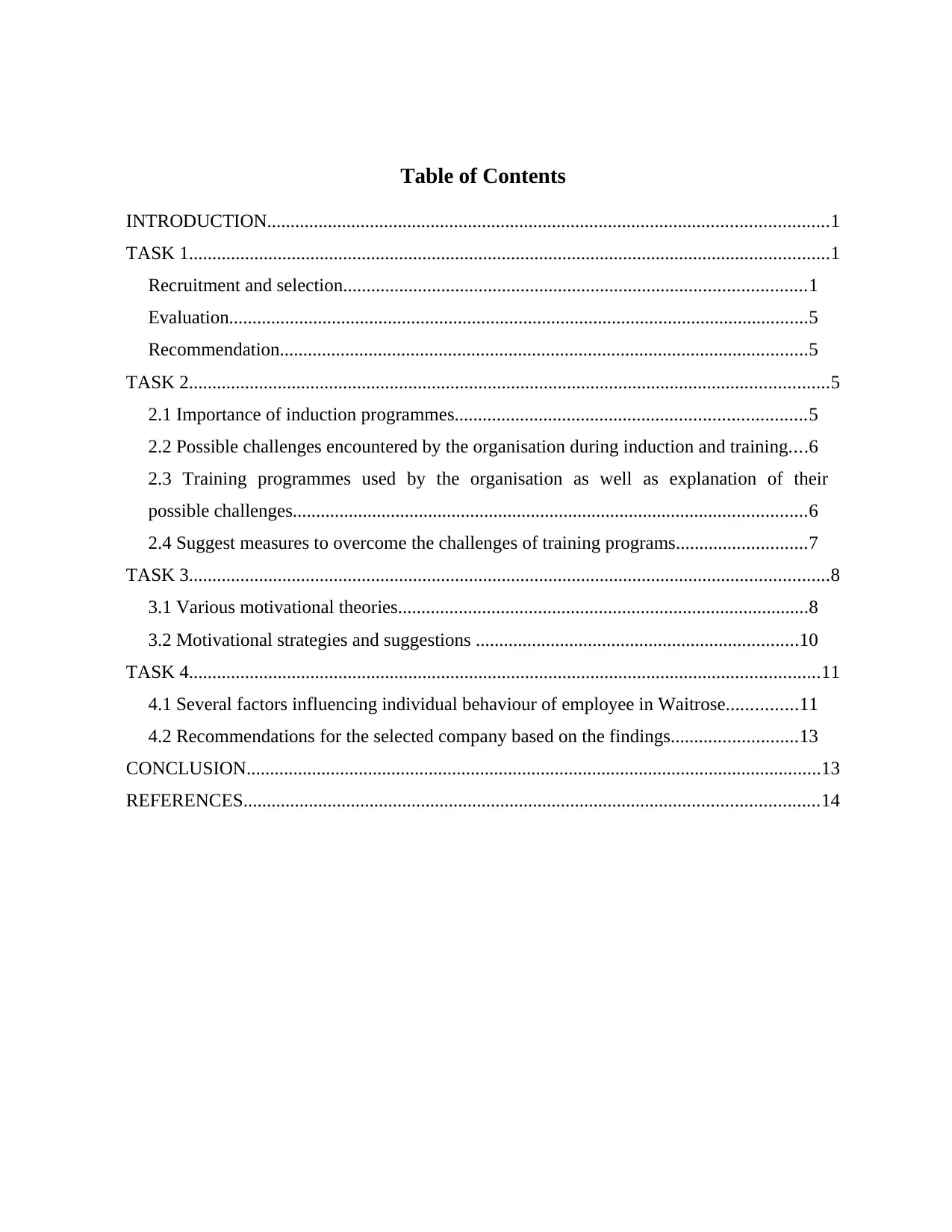
Table of Contents
INTRODUCTION........................................................................................................................1
TASK 1.........................................................................................................................................1
Recruitment and selection...................................................................................................1
Evaluation............................................................................................................................5
Recommendation.................................................................................................................5
TASK 2.........................................................................................................................................5
2.1 Importance of induction programmes...........................................................................5
2.2 Possible challenges encountered by the organisation during induction and training....6
2.3 Training programmes used by the organisation as well as explanation of their
possible challenges..............................................................................................................6
2.4 Suggest measures to overcome the challenges of training programs............................7
TASK 3.........................................................................................................................................8
3.1 Various motivational theories........................................................................................8
3.2 Motivational strategies and suggestions .....................................................................10
TASK 4.......................................................................................................................................11
4.1 Several factors influencing individual behaviour of employee in Waitrose...............11
4.2 Recommendations for the selected company based on the findings...........................13
CONCLUSION...........................................................................................................................13
REFERENCES...........................................................................................................................14
INTRODUCTION........................................................................................................................1
TASK 1.........................................................................................................................................1
Recruitment and selection...................................................................................................1
Evaluation............................................................................................................................5
Recommendation.................................................................................................................5
TASK 2.........................................................................................................................................5
2.1 Importance of induction programmes...........................................................................5
2.2 Possible challenges encountered by the organisation during induction and training....6
2.3 Training programmes used by the organisation as well as explanation of their
possible challenges..............................................................................................................6
2.4 Suggest measures to overcome the challenges of training programs............................7
TASK 3.........................................................................................................................................8
3.1 Various motivational theories........................................................................................8
3.2 Motivational strategies and suggestions .....................................................................10
TASK 4.......................................................................................................................................11
4.1 Several factors influencing individual behaviour of employee in Waitrose...............11
4.2 Recommendations for the selected company based on the findings...........................13
CONCLUSION...........................................................................................................................13
REFERENCES...........................................................................................................................14

⊘ This is a preview!⊘
Do you want full access?
Subscribe today to unlock all pages.

Trusted by 1+ million students worldwide
INTRODUCTION
Employees are the main assets for every business organization to attain success because
they put their best efforts for completing business activities. Thus, it is vital for company to
manage all the people effectively so that they can enhance their productivity level at market
place. Company that is taken in this report is Waitrose which is a leading grocery store in United
Kingdom. In this manager play important role in business organization to manage as well as
organize workers by leading and motivating them. In addition of this, people management also
consider as human resource management which refer to recruitment, direction, selection and
organization. All these are important for managing employees activities within business
organization. It contribute in attaining higher success. When managing the people within the
company, manager have to focus on hiring right candidates and getting most capable out of
these people. With the help of this, firm can easily make their workforce strong and capable. As
per current scenario, high staff turnover rates.
TASK 1
Recruitment and selection
Human resources are integral part of a company without whom it cannot operates
function in desired manner. In today's highly intense situation, competition has arise more
therefore, to get perfect employees in right position is taken as much complex procedure for an
organisation. Hiring a right people and well placed at workplace help in giving a large
contribution in achievement of business success. Along with this, it will be beneficial in terms of
offering potential for future replacement (Alpkan and et. al., 2010). Thus, this process is taken as
an important function in a firm which begins with planning human resource i.e. determining the
number of recruitment and type of employee need at workplace. It includes different kind of
procedures like job analysis and design which entails specification of task, roles and
responsibilities as well as qualification required for certain position. This ongoing process is
known as hiring which split into two broad categories that are:- Recruitment and Selection.
The concept of recruitment relates with procedure of finding and attracting the most
capable candidates either from internal and external environment of an organisation. It provides a
list of interested applicants among whom management of a company can select the best eligible
one for specific position. This process starts with identification of job requirement and ends with
Employees are the main assets for every business organization to attain success because
they put their best efforts for completing business activities. Thus, it is vital for company to
manage all the people effectively so that they can enhance their productivity level at market
place. Company that is taken in this report is Waitrose which is a leading grocery store in United
Kingdom. In this manager play important role in business organization to manage as well as
organize workers by leading and motivating them. In addition of this, people management also
consider as human resource management which refer to recruitment, direction, selection and
organization. All these are important for managing employees activities within business
organization. It contribute in attaining higher success. When managing the people within the
company, manager have to focus on hiring right candidates and getting most capable out of
these people. With the help of this, firm can easily make their workforce strong and capable. As
per current scenario, high staff turnover rates.
TASK 1
Recruitment and selection
Human resources are integral part of a company without whom it cannot operates
function in desired manner. In today's highly intense situation, competition has arise more
therefore, to get perfect employees in right position is taken as much complex procedure for an
organisation. Hiring a right people and well placed at workplace help in giving a large
contribution in achievement of business success. Along with this, it will be beneficial in terms of
offering potential for future replacement (Alpkan and et. al., 2010). Thus, this process is taken as
an important function in a firm which begins with planning human resource i.e. determining the
number of recruitment and type of employee need at workplace. It includes different kind of
procedures like job analysis and design which entails specification of task, roles and
responsibilities as well as qualification required for certain position. This ongoing process is
known as hiring which split into two broad categories that are:- Recruitment and Selection.
The concept of recruitment relates with procedure of finding and attracting the most
capable candidates either from internal and external environment of an organisation. It provides a
list of interested applicants among whom management of a company can select the best eligible
one for specific position. This process starts with identification of job requirement and ends with
Paraphrase This Document
Need a fresh take? Get an instant paraphrase of this document with our AI Paraphraser

getting a pool of required applicants. On the other hand, selection process refers to pick a best
individual having eligible qualifications and competences as per requirement of job. Therefore,
both processes are considered as important for introducing a right people at workplace.
2
individual having eligible qualifications and competences as per requirement of job. Therefore,
both processes are considered as important for introducing a right people at workplace.
2
As per present scenario, Waitrose is the sixth largest food retailer company in UK which
exports its products in more than 52 countries worldwide. Currently, near about 91,000 workers
are working in this firm and give their support in maintaining its reputation in marketplace by
giving high customer services. But as per statistical view, this enterprise facing various problems
due to high turnover rates in terms of employment. So, its managers has adopted various HR
practices like recruitment & selection, induction & training, motivation and more. Firstly to
reduce turnover and get retention of employees for long term profitability, its HR managers
needs to appoint some assistant in human resource department (Ling and Jaw, 2011). Therefore,
for this process they need to go through many procedures of recruitment and selection. It starts
from planing first in which HR managers used to draft a job specification for this vacant position
by outlining its major responsibilities, skills, qualifications, pay scale, experience, on role or off
role position and more. Job description: It is an important tool used for making proper arrangement of roles and
responsibilities for a specific position. The main purpose of this documentation is to
describe job purpose, scope, duties and more in proper manner so that occurrence of
miscommunication can be reduced. Job design: This process related with organising duties and task as per requirement of
job. It is influenced majorly by workflow analysis, organisational culture and strategy of
business. Job analysis: Under this procedure, managers need to gather information related to
content of a vacant position. Identification of similarities and differences among different
positions, knowledge and skills required for the same is main purpose of this kind of
document. Person specification: It is a written statement which explains characteristics,
qualification, skills, experience and so on. The main criteria of it is to measure an ability
to meet deadlines and knowledge in detail about same field. It helps interested employees
to match their profile with own.
Job Description
Job Details
Post: HR Assistant
3
exports its products in more than 52 countries worldwide. Currently, near about 91,000 workers
are working in this firm and give their support in maintaining its reputation in marketplace by
giving high customer services. But as per statistical view, this enterprise facing various problems
due to high turnover rates in terms of employment. So, its managers has adopted various HR
practices like recruitment & selection, induction & training, motivation and more. Firstly to
reduce turnover and get retention of employees for long term profitability, its HR managers
needs to appoint some assistant in human resource department (Ling and Jaw, 2011). Therefore,
for this process they need to go through many procedures of recruitment and selection. It starts
from planing first in which HR managers used to draft a job specification for this vacant position
by outlining its major responsibilities, skills, qualifications, pay scale, experience, on role or off
role position and more. Job description: It is an important tool used for making proper arrangement of roles and
responsibilities for a specific position. The main purpose of this documentation is to
describe job purpose, scope, duties and more in proper manner so that occurrence of
miscommunication can be reduced. Job design: This process related with organising duties and task as per requirement of
job. It is influenced majorly by workflow analysis, organisational culture and strategy of
business. Job analysis: Under this procedure, managers need to gather information related to
content of a vacant position. Identification of similarities and differences among different
positions, knowledge and skills required for the same is main purpose of this kind of
document. Person specification: It is a written statement which explains characteristics,
qualification, skills, experience and so on. The main criteria of it is to measure an ability
to meet deadlines and knowledge in detail about same field. It helps interested employees
to match their profile with own.
Job Description
Job Details
Post: HR Assistant
3
⊘ This is a preview!⊘
Do you want full access?
Subscribe today to unlock all pages.
Trusted by 1+ million students worldwide
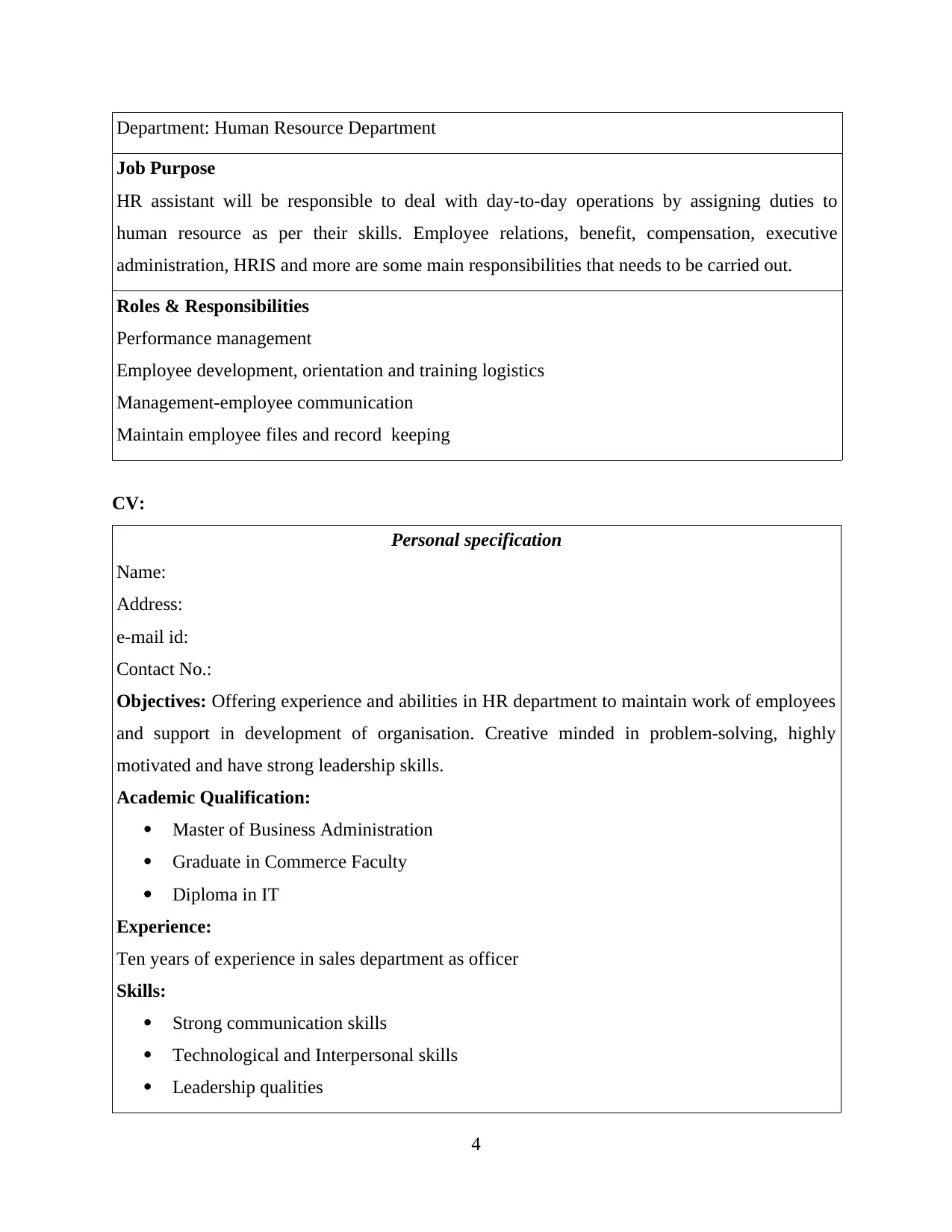
Department: Human Resource Department
Job Purpose
HR assistant will be responsible to deal with day-to-day operations by assigning duties to
human resource as per their skills. Employee relations, benefit, compensation, executive
administration, HRIS and more are some main responsibilities that needs to be carried out.
Roles & Responsibilities
Performance management
Employee development, orientation and training logistics
Management-employee communication
Maintain employee files and record keeping
CV:
Personal specification
Name:
Address:
e-mail id:
Contact No.:
Objectives: Offering experience and abilities in HR department to maintain work of employees
and support in development of organisation. Creative minded in problem-solving, highly
motivated and have strong leadership skills.
Academic Qualification:
Master of Business Administration
Graduate in Commerce Faculty
Diploma in IT
Experience:
Ten years of experience in sales department as officer
Skills:
Strong communication skills
Technological and Interpersonal skills
Leadership qualities
4
Job Purpose
HR assistant will be responsible to deal with day-to-day operations by assigning duties to
human resource as per their skills. Employee relations, benefit, compensation, executive
administration, HRIS and more are some main responsibilities that needs to be carried out.
Roles & Responsibilities
Performance management
Employee development, orientation and training logistics
Management-employee communication
Maintain employee files and record keeping
CV:
Personal specification
Name:
Address:
e-mail id:
Contact No.:
Objectives: Offering experience and abilities in HR department to maintain work of employees
and support in development of organisation. Creative minded in problem-solving, highly
motivated and have strong leadership skills.
Academic Qualification:
Master of Business Administration
Graduate in Commerce Faculty
Diploma in IT
Experience:
Ten years of experience in sales department as officer
Skills:
Strong communication skills
Technological and Interpersonal skills
Leadership qualities
4
Paraphrase This Document
Need a fresh take? Get an instant paraphrase of this document with our AI Paraphraser
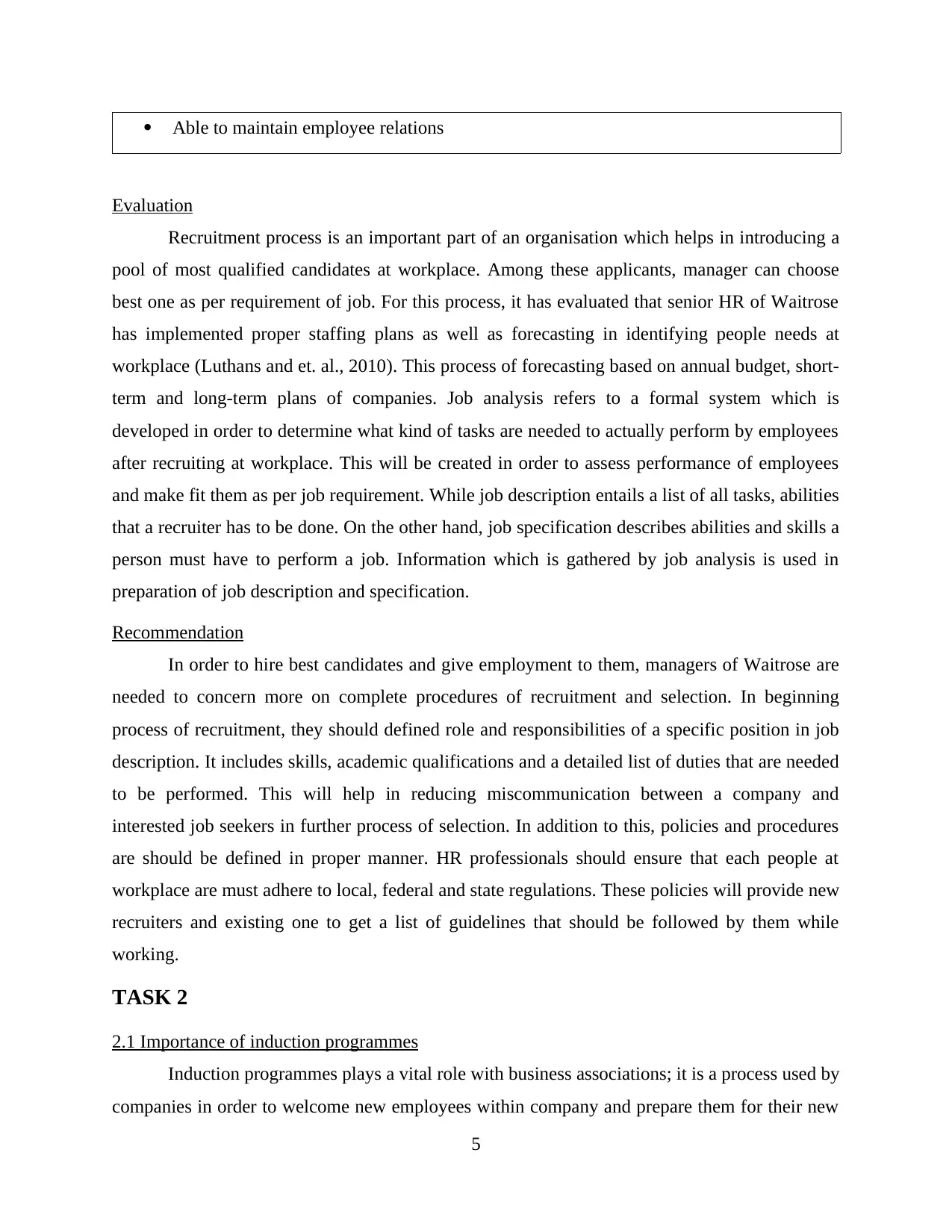
Able to maintain employee relations
Evaluation
Recruitment process is an important part of an organisation which helps in introducing a
pool of most qualified candidates at workplace. Among these applicants, manager can choose
best one as per requirement of job. For this process, it has evaluated that senior HR of Waitrose
has implemented proper staffing plans as well as forecasting in identifying people needs at
workplace (Luthans and et. al., 2010). This process of forecasting based on annual budget, short-
term and long-term plans of companies. Job analysis refers to a formal system which is
developed in order to determine what kind of tasks are needed to actually perform by employees
after recruiting at workplace. This will be created in order to assess performance of employees
and make fit them as per job requirement. While job description entails a list of all tasks, abilities
that a recruiter has to be done. On the other hand, job specification describes abilities and skills a
person must have to perform a job. Information which is gathered by job analysis is used in
preparation of job description and specification.
Recommendation
In order to hire best candidates and give employment to them, managers of Waitrose are
needed to concern more on complete procedures of recruitment and selection. In beginning
process of recruitment, they should defined role and responsibilities of a specific position in job
description. It includes skills, academic qualifications and a detailed list of duties that are needed
to be performed. This will help in reducing miscommunication between a company and
interested job seekers in further process of selection. In addition to this, policies and procedures
are should be defined in proper manner. HR professionals should ensure that each people at
workplace are must adhere to local, federal and state regulations. These policies will provide new
recruiters and existing one to get a list of guidelines that should be followed by them while
working.
TASK 2
2.1 Importance of induction programmes
Induction programmes plays a vital role with business associations; it is a process used by
companies in order to welcome new employees within company and prepare them for their new
5
Evaluation
Recruitment process is an important part of an organisation which helps in introducing a
pool of most qualified candidates at workplace. Among these applicants, manager can choose
best one as per requirement of job. For this process, it has evaluated that senior HR of Waitrose
has implemented proper staffing plans as well as forecasting in identifying people needs at
workplace (Luthans and et. al., 2010). This process of forecasting based on annual budget, short-
term and long-term plans of companies. Job analysis refers to a formal system which is
developed in order to determine what kind of tasks are needed to actually perform by employees
after recruiting at workplace. This will be created in order to assess performance of employees
and make fit them as per job requirement. While job description entails a list of all tasks, abilities
that a recruiter has to be done. On the other hand, job specification describes abilities and skills a
person must have to perform a job. Information which is gathered by job analysis is used in
preparation of job description and specification.
Recommendation
In order to hire best candidates and give employment to them, managers of Waitrose are
needed to concern more on complete procedures of recruitment and selection. In beginning
process of recruitment, they should defined role and responsibilities of a specific position in job
description. It includes skills, academic qualifications and a detailed list of duties that are needed
to be performed. This will help in reducing miscommunication between a company and
interested job seekers in further process of selection. In addition to this, policies and procedures
are should be defined in proper manner. HR professionals should ensure that each people at
workplace are must adhere to local, federal and state regulations. These policies will provide new
recruiters and existing one to get a list of guidelines that should be followed by them while
working.
TASK 2
2.1 Importance of induction programmes
Induction programmes plays a vital role with business associations; it is a process used by
companies in order to welcome new employees within company and prepare them for their new
5
role. It helps in the effective integration of the employee into the organisation. Along with this,
Induction Programme are also based upon providing safety training and helps people to interact
with each other before starting work.
2.2 Possible challenges encountered by the organisation during induction and training
With the joining of new employees it provides great advantages but at the same time
there are some of the limitations that has to be overcome by firms if they want to sustain a better
position at market area. Basically induction process is an ongoing process in which hiring of new
candidates and providing appropriate training are taken into considerations. Some of the
challenges that can be faced by company are like in their initial working days employees can get
confused whether the are best fit for the job or not because this can create problem for firm to
organise work in a better manner which can later work as a disadvantage. In terms of Waitrose
induction process starts before any new employee join and first come to the office. If the process
of induction is not carried out properly than answering questions of employees can create
problem.
Therefore, the possible disadvantage of induction process is that when panel interview is
conducted it is not possible that manager interact with every individual so workers may feel
alienated which can be harmful in future proceedings of business operations. Thus, coordination
between manager and fresh employees can create an issues as workers may show their lack of
engagement in work as they can get confused about the roles and responsibilities they have to
perform. Hence, it prime role of company to organise orientation programme in an effective
manner. Fresh candidates during their orientation and induction process all the details of roles
that are to be performed must be explained appropriately.
2.4 Training programmes used by the organisation as well as explanation of their
possible challenges
In over dynamic business environment, firms are required to provide training and
development assistance to their employees thus to improvise their skills and efficiencies. In this
relation, WAITROSE has decided to acquire two main methods of training which are stated as
under: -
On the job training – It is one of the most common methods which is acquired by
companies in order to improve specific skill of an individual or a group of people. In on the job
training program, trainees are placed for job and teach certain skills and knowledge which are
6
Induction Programme are also based upon providing safety training and helps people to interact
with each other before starting work.
2.2 Possible challenges encountered by the organisation during induction and training
With the joining of new employees it provides great advantages but at the same time
there are some of the limitations that has to be overcome by firms if they want to sustain a better
position at market area. Basically induction process is an ongoing process in which hiring of new
candidates and providing appropriate training are taken into considerations. Some of the
challenges that can be faced by company are like in their initial working days employees can get
confused whether the are best fit for the job or not because this can create problem for firm to
organise work in a better manner which can later work as a disadvantage. In terms of Waitrose
induction process starts before any new employee join and first come to the office. If the process
of induction is not carried out properly than answering questions of employees can create
problem.
Therefore, the possible disadvantage of induction process is that when panel interview is
conducted it is not possible that manager interact with every individual so workers may feel
alienated which can be harmful in future proceedings of business operations. Thus, coordination
between manager and fresh employees can create an issues as workers may show their lack of
engagement in work as they can get confused about the roles and responsibilities they have to
perform. Hence, it prime role of company to organise orientation programme in an effective
manner. Fresh candidates during their orientation and induction process all the details of roles
that are to be performed must be explained appropriately.
2.4 Training programmes used by the organisation as well as explanation of their
possible challenges
In over dynamic business environment, firms are required to provide training and
development assistance to their employees thus to improvise their skills and efficiencies. In this
relation, WAITROSE has decided to acquire two main methods of training which are stated as
under: -
On the job training – It is one of the most common methods which is acquired by
companies in order to improve specific skill of an individual or a group of people. In on the job
training program, trainees are placed for job and teach certain skills and knowledge which are
6
⊘ This is a preview!⊘
Do you want full access?
Subscribe today to unlock all pages.
Trusted by 1+ million students worldwide
required to perform a job role (Pryjmachuk and et. al., 2012). It saves time and costs as well as
flexible method of providing training to workers. There are various types of on the job training
programme, such as -
Job rotation
Coaching
Job instruction
Internship training
Off the job training – In this method employees' take away from job and taught
necessary skills and competencies. Here, individuals are provided training outside from work
station. Off the job training programmes is to good way of interacting with employees personally
which also build strong employee-employer relation. Forms of off the job training programmes
are -
Lectures and conferences
Vestibule training
Simulation exercise
Apart from this, while organising training and development programmes various
challenges are also being occurred which can affect learning activities, these threats are -
One of main challenge occurs while organising training events is employees' interest. If
employees are not willing to participate then the programmes will not be succeed
(Gillespie, Mullan and Harrison, 2014).
Ignorance of training providers or mentors, as if these people would not give proper
guidance to employees then they cannot learn in well being manner. It involves, does not
providing necessary resources to participate in training.
Due to technical advent, training programmes are getting expensive which can affect
financial performance of the company. Many business organisations cannot afford to hire
specialist and send their employees in various institutes.
Managers are not able to provide feedback and reviews to employees after training
programmes.
2.5 Suggest measures to overcome the challenges of training programs
As above discussed various challenges which can occur while providing training to
employees and affect the employees' learning activities. Thus to cope with these challenges,
7
flexible method of providing training to workers. There are various types of on the job training
programme, such as -
Job rotation
Coaching
Job instruction
Internship training
Off the job training – In this method employees' take away from job and taught
necessary skills and competencies. Here, individuals are provided training outside from work
station. Off the job training programmes is to good way of interacting with employees personally
which also build strong employee-employer relation. Forms of off the job training programmes
are -
Lectures and conferences
Vestibule training
Simulation exercise
Apart from this, while organising training and development programmes various
challenges are also being occurred which can affect learning activities, these threats are -
One of main challenge occurs while organising training events is employees' interest. If
employees are not willing to participate then the programmes will not be succeed
(Gillespie, Mullan and Harrison, 2014).
Ignorance of training providers or mentors, as if these people would not give proper
guidance to employees then they cannot learn in well being manner. It involves, does not
providing necessary resources to participate in training.
Due to technical advent, training programmes are getting expensive which can affect
financial performance of the company. Many business organisations cannot afford to hire
specialist and send their employees in various institutes.
Managers are not able to provide feedback and reviews to employees after training
programmes.
2.5 Suggest measures to overcome the challenges of training programs
As above discussed various challenges which can occur while providing training to
employees and affect the employees' learning activities. Thus to cope with these challenges,
7
Paraphrase This Document
Need a fresh take? Get an instant paraphrase of this document with our AI Paraphraser
managers are required to attain employees and teach them the benefits of training in current and
future scenario. They should also required to concrete proof, such as increase in productivity and
sales as well as analyse return on investment. Companies which cannot afford high costs training
programmes, there have to be acquire Online courses which are less costly and make learning
process easier. The firm can also use other training tools that do not cost anything, such as
mentoring, on-the-job training and shadowing (Olins, 2017). Apart from this, WAITROSE is
required to provide a learning environment where employees are encouraged to develop new
skills, acquire knowledge and strive for self-development. Without management support, staff
will not be motivated to upgrade their skills.
TASK 3
3.1 Various motivational theories
Every organisation uses motivational theories to encourage their employees in order to
meet organisational goals and business growth. In context to Waitrose, manager of this
organisation is using different-different motivational theories according to the requirement of the
situations to motivate its employees towards achieving organisational goals as well as personal
goals. Some of the motivational theories opted by Waitrose are evaluated as below:
Maslow's Need Hierarchy Theory: This theory is based on the needs of the employee
which is required to be fulfilled by the organisation. In this theory Maslow has measured
motivation with needs of the employees which can be measured by different levels. These levels
are discussed below:
Physiological needs- these are the basic need of the employees such as food, clothing, water,
air, shelter and basic necessity of employees required to be fulfilled by the manager of Waitrose
(Bell and et. al., 2012). Safety needs- These needs involves safety and security of employees. Social needs- Interaction, belongingness, groupism is usually considered as the social
needs of the employees. Esteem needs- Self respect, achievements, knowledge are the factors which is directly
linked with the motivation.
Self-actualisation- These are the higher needs of employees which involves potential and
creativity of the employee.
8
future scenario. They should also required to concrete proof, such as increase in productivity and
sales as well as analyse return on investment. Companies which cannot afford high costs training
programmes, there have to be acquire Online courses which are less costly and make learning
process easier. The firm can also use other training tools that do not cost anything, such as
mentoring, on-the-job training and shadowing (Olins, 2017). Apart from this, WAITROSE is
required to provide a learning environment where employees are encouraged to develop new
skills, acquire knowledge and strive for self-development. Without management support, staff
will not be motivated to upgrade their skills.
TASK 3
3.1 Various motivational theories
Every organisation uses motivational theories to encourage their employees in order to
meet organisational goals and business growth. In context to Waitrose, manager of this
organisation is using different-different motivational theories according to the requirement of the
situations to motivate its employees towards achieving organisational goals as well as personal
goals. Some of the motivational theories opted by Waitrose are evaluated as below:
Maslow's Need Hierarchy Theory: This theory is based on the needs of the employee
which is required to be fulfilled by the organisation. In this theory Maslow has measured
motivation with needs of the employees which can be measured by different levels. These levels
are discussed below:
Physiological needs- these are the basic need of the employees such as food, clothing, water,
air, shelter and basic necessity of employees required to be fulfilled by the manager of Waitrose
(Bell and et. al., 2012). Safety needs- These needs involves safety and security of employees. Social needs- Interaction, belongingness, groupism is usually considered as the social
needs of the employees. Esteem needs- Self respect, achievements, knowledge are the factors which is directly
linked with the motivation.
Self-actualisation- These are the higher needs of employees which involves potential and
creativity of the employee.
8
Manager of Waitrose uses this motivational theory to satisfy the need of employees according
the hierarchy needs in order to motivate them and achieve their personal as well as organisational
goal.
McGregor’s Participation Theory: This theory is based on the distinct behaviour of the
human being (Evans, 2012). It has divided human behaviour into types first is named Theory X
who are considered as negative people and second one is termed as Theory Y who are positive
thought people. Both types are explained below with their characteristics.
Theory X (Negative)
Employees are self centred and not interested in organisational goal.
Lazy by nature and usually avoids work.
Lack of ambition, avoid responsibility and likes to works as per instructions.
Theory Y (Positive)
Likes to take responsibility
Gives more preference to the organisational goal
Employees are self directed and have good power of self control in order to accomplish their
objectives (Jelinek and et. al., 2013). Always ready to learn, accepts changes and serve innovative ideas to the manager for
organisational development.
Manager of Waitrose organisation uses this theory in their stores which helps them in
knowing behaviour of employees and how they could motivate them fore achieving
organisational goal
McClelland’s Need Theory: This is the another motivational theory based on the needs
of the employees. In this theory, it is believed that the employee whose need is fulfilled will
behave in different manner as compared to the other employee whose needs are not fulfilled.
These needs are classified into three different parts which are evaluated below:
Need for achievement- This is the key for organisation as it is the for those employees
who are more interested in success and wants to increase their number of achievements. High-
need achiever are interested in taking high risk and have strong desire of taking their own
feedback.
9
the hierarchy needs in order to motivate them and achieve their personal as well as organisational
goal.
McGregor’s Participation Theory: This theory is based on the distinct behaviour of the
human being (Evans, 2012). It has divided human behaviour into types first is named Theory X
who are considered as negative people and second one is termed as Theory Y who are positive
thought people. Both types are explained below with their characteristics.
Theory X (Negative)
Employees are self centred and not interested in organisational goal.
Lazy by nature and usually avoids work.
Lack of ambition, avoid responsibility and likes to works as per instructions.
Theory Y (Positive)
Likes to take responsibility
Gives more preference to the organisational goal
Employees are self directed and have good power of self control in order to accomplish their
objectives (Jelinek and et. al., 2013). Always ready to learn, accepts changes and serve innovative ideas to the manager for
organisational development.
Manager of Waitrose organisation uses this theory in their stores which helps them in
knowing behaviour of employees and how they could motivate them fore achieving
organisational goal
McClelland’s Need Theory: This is the another motivational theory based on the needs
of the employees. In this theory, it is believed that the employee whose need is fulfilled will
behave in different manner as compared to the other employee whose needs are not fulfilled.
These needs are classified into three different parts which are evaluated below:
Need for achievement- This is the key for organisation as it is the for those employees
who are more interested in success and wants to increase their number of achievements. High-
need achiever are interested in taking high risk and have strong desire of taking their own
feedback.
9
⊘ This is a preview!⊘
Do you want full access?
Subscribe today to unlock all pages.
Trusted by 1+ million students worldwide

1 out of 18


Related Documents


Your All-in-One AI-Powered Toolkit for Academic Success.
+13062052269
info@desklib.com
Available 24*7 on WhatsApp / Email
![[object Object]](/_next/static/media/star-bottom.7253800d.svg)
Unlock your academic potential
Copyright © 2020–2026 A2Z Services. All Rights Reserved. Developed and managed by ZUCOL.