Detailed Report on Managing Quality Customer Service - Assessment 1
VerifiedAdded on  2020/09/17
|8
|1558
|28
Report
AI Summary
This report, submitted by a student and available on Desklib, analyzes the key elements of managing quality customer service. It begins by identifying internal and external customer relationships, emphasizing the importance of clear communication and accurate information. The report then delves into customer service issues, such as resource limitations and the need for personalized service, proposing solutions like staff training and improved coordination. It outlines a framework for addressing customer issues, including response times and complaint tracking. The report further differentiates between coaching and mentoring, advocating for a positive coaching approach. Finally, it presents a customer satisfaction survey, including open-ended questions and a case study illustrating the impact of poor customer service. The report concludes by emphasizing the importance of training and timely feedback in delivering quality service.
Manage quality
customer service
customer service
Paraphrase This Document
Need a fresh take? Get an instant paraphrase of this document with our AI Paraphraser

Table of Contents
ASSESSMENT 1.............................................................................................................................1
Task 1 a.).....................................................................................................................................1
Task 1 b.......................................................................................................................................1
Task 1 c.......................................................................................................................................1
Task 2 a)......................................................................................................................................1
Task 2 b)......................................................................................................................................2
Task 2 c)......................................................................................................................................2
Task 3 a)......................................................................................................................................3
Task 3 b)......................................................................................................................................5
Task 3 c)......................................................................................................................................5
ASSESSMENT 1.............................................................................................................................1
Task 1 a.).....................................................................................................................................1
Task 1 b.......................................................................................................................................1
Task 1 c.......................................................................................................................................1
Task 2 a)......................................................................................................................................1
Task 2 b)......................................................................................................................................2
Task 2 c)......................................................................................................................................2
Task 3 a)......................................................................................................................................3
Task 3 b)......................................................................................................................................5
Task 3 c)......................................................................................................................................5

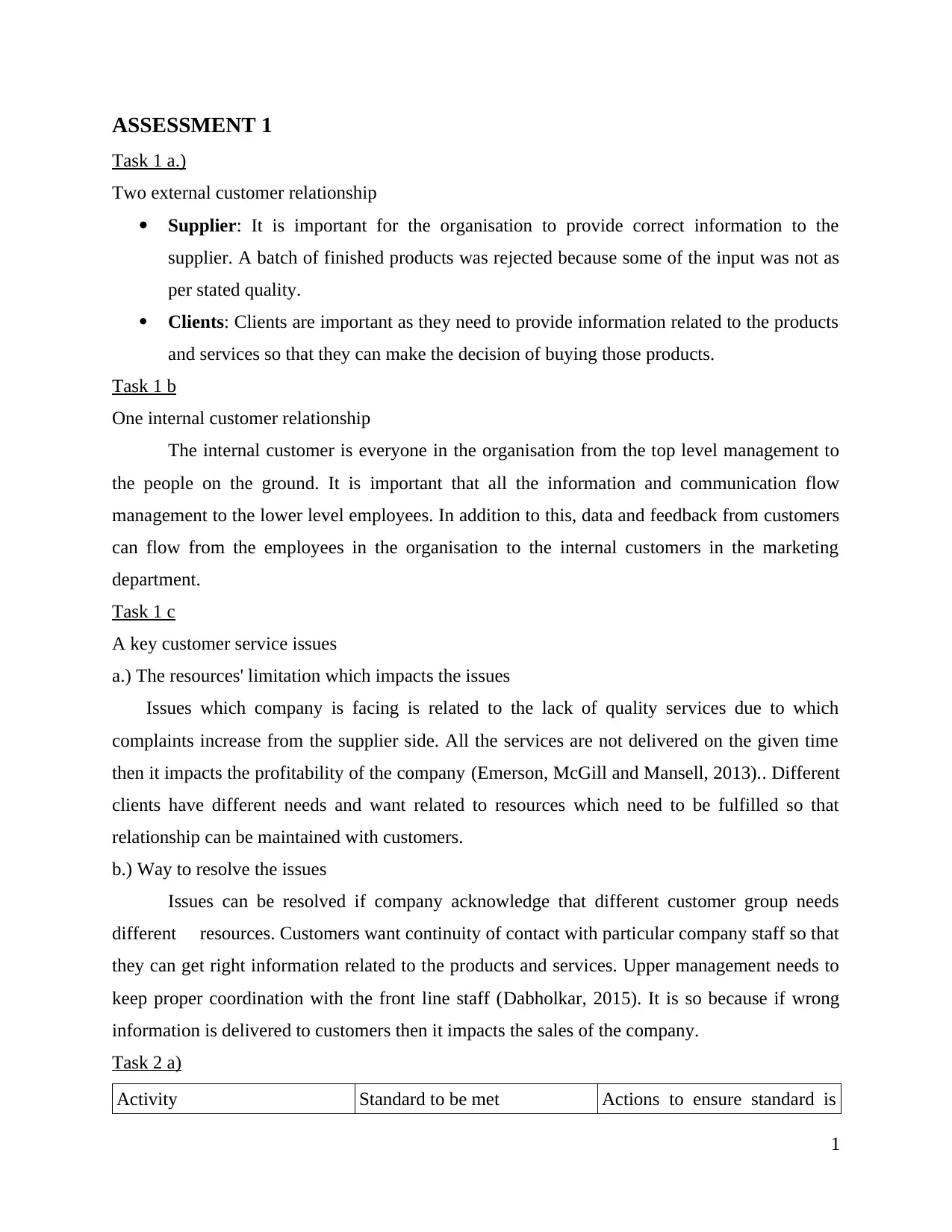
ASSESSMENT 1
Task 1 a.)
Two external customer relationship
ï‚· Supplier: It is important for the organisation to provide correct information to the
supplier. A batch of finished products was rejected because some of the input was not as
per stated quality.
ï‚· Clients: Clients are important as they need to provide information related to the products
and services so that they can make the decision of buying those products.
Task 1 b
One internal customer relationship
The internal customer is everyone in the organisation from the top level management to
the people on the ground. It is important that all the information and communication flow
management to the lower level employees. In addition to this, data and feedback from customers
can flow from the employees in the organisation to the internal customers in the marketing
department.
Task 1 c
A key customer service issues
a.) The resources' limitation which impacts the issues
Issues which company is facing is related to the lack of quality services due to which
complaints increase from the supplier side. All the services are not delivered on the given time
then it impacts the profitability of the company (Emerson, McGill and Mansell, 2013).. Different
clients have different needs and want related to resources which need to be fulfilled so that
relationship can be maintained with customers.
b.) Way to resolve the issues
Issues can be resolved if company acknowledge that different customer group needs
different resources. Customers want continuity of contact with particular company staff so that
they can get right information related to the products and services. Upper management needs to
keep proper coordination with the front line staff (Dabholkar, 2015). It is so because if wrong
information is delivered to customers then it impacts the sales of the company.
Task 2 a)
Activity Standard to be met Actions to ensure standard is
1
Task 1 a.)
Two external customer relationship
ï‚· Supplier: It is important for the organisation to provide correct information to the
supplier. A batch of finished products was rejected because some of the input was not as
per stated quality.
ï‚· Clients: Clients are important as they need to provide information related to the products
and services so that they can make the decision of buying those products.
Task 1 b
One internal customer relationship
The internal customer is everyone in the organisation from the top level management to
the people on the ground. It is important that all the information and communication flow
management to the lower level employees. In addition to this, data and feedback from customers
can flow from the employees in the organisation to the internal customers in the marketing
department.
Task 1 c
A key customer service issues
a.) The resources' limitation which impacts the issues
Issues which company is facing is related to the lack of quality services due to which
complaints increase from the supplier side. All the services are not delivered on the given time
then it impacts the profitability of the company (Emerson, McGill and Mansell, 2013).. Different
clients have different needs and want related to resources which need to be fulfilled so that
relationship can be maintained with customers.
b.) Way to resolve the issues
Issues can be resolved if company acknowledge that different customer group needs
different resources. Customers want continuity of contact with particular company staff so that
they can get right information related to the products and services. Upper management needs to
keep proper coordination with the front line staff (Dabholkar, 2015). It is so because if wrong
information is delivered to customers then it impacts the sales of the company.
Task 2 a)
Activity Standard to be met Actions to ensure standard is
1
⊘ This is a preview!⊘
Do you want full access?
Subscribe today to unlock all pages.

Trusted by 1+ million students worldwide

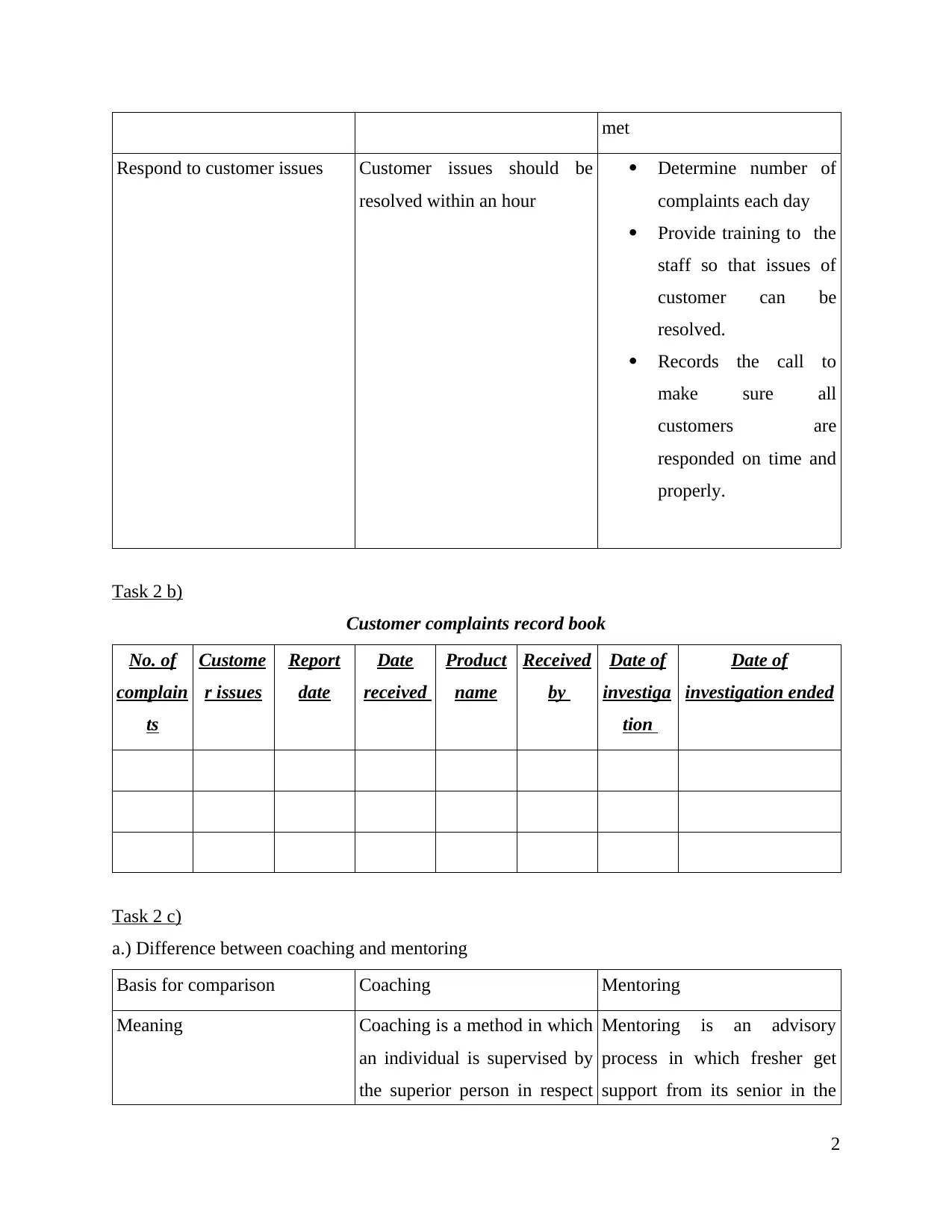
met
Respond to customer issues Customer issues should be
resolved within an hour
ï‚· Determine number of
complaints each day
ï‚· Provide training to the
staff so that issues of
customer can be
resolved.
ï‚· Records the call to
make sure all
customers are
responded on time and
properly.
Task 2 b)
Customer complaints record book
No. of
complain
ts
Custome
r issues
Report
date
Date
received
Product
name
Received
by
Date of
investiga
tion
Date of
investigation ended
Task 2 c)
a.) Difference between coaching and mentoring
Basis for comparison Coaching Mentoring
Meaning Coaching is a method in which
an individual is supervised by
the superior person in respect
Mentoring is an advisory
process in which fresher get
support from its senior in the
2
Respond to customer issues Customer issues should be
resolved within an hour
ï‚· Determine number of
complaints each day
ï‚· Provide training to the
staff so that issues of
customer can be
resolved.
ï‚· Records the call to
make sure all
customers are
responded on time and
properly.
Task 2 b)
Customer complaints record book
No. of
complain
ts
Custome
r issues
Report
date
Date
received
Product
name
Received
by
Date of
investiga
tion
Date of
investigation ended
Task 2 c)
a.) Difference between coaching and mentoring
Basis for comparison Coaching Mentoring
Meaning Coaching is a method in which
an individual is supervised by
the superior person in respect
Mentoring is an advisory
process in which fresher get
support from its senior in the
2
Paraphrase This Document
Need a fresh take? Get an instant paraphrase of this document with our AI Paraphraser

to improve skills and
capabilities.
organisation.
Orientation Coaching is task oriented as
the focus is on concrete issues
such as learning for thinking
strategically, managing more
effectively etc. Here, coach
help in developing these skills.
Mentoring is relationship
oriented. Mentoring is
customarily a planned pairing
of the more experienced
person in the same field with
the less experienced person.
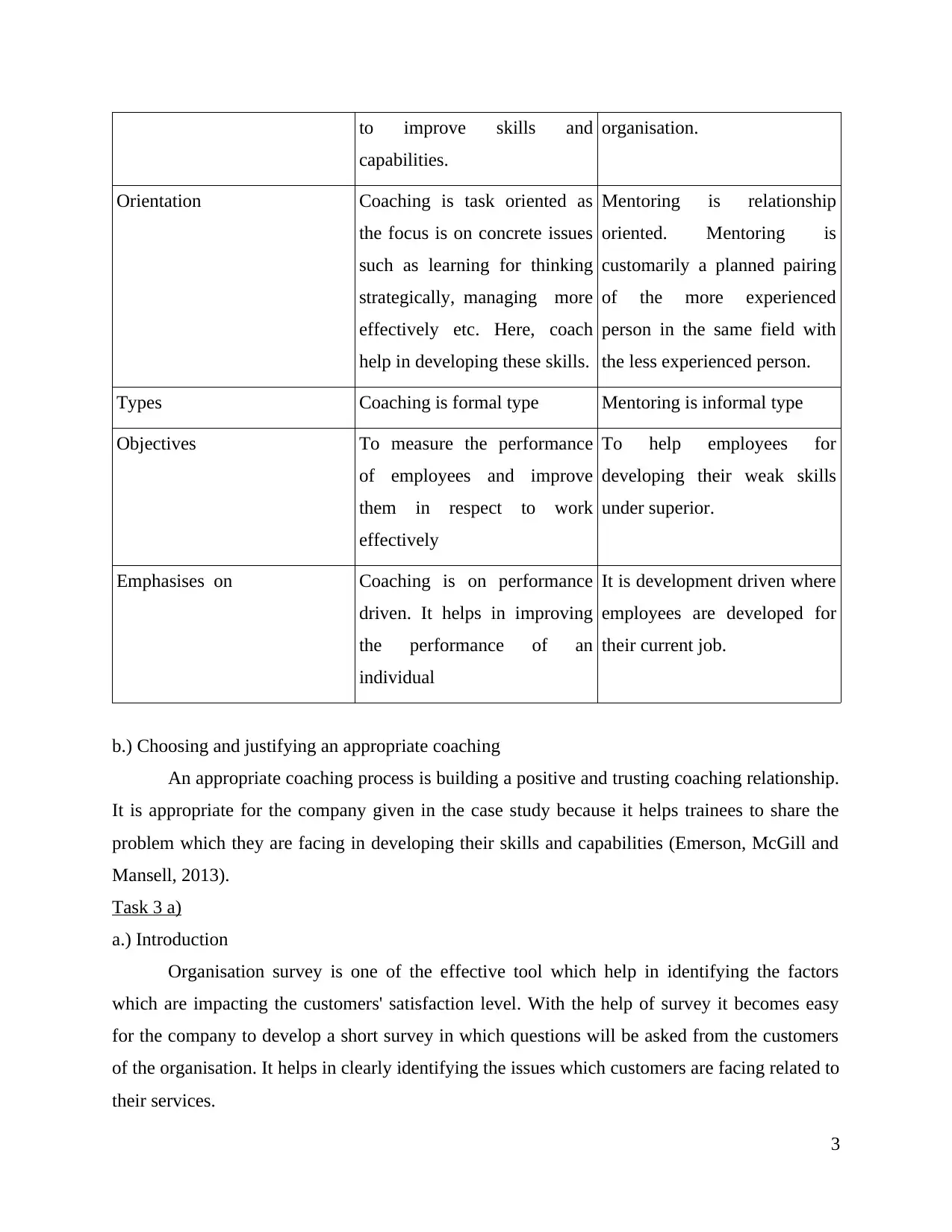
Types Coaching is formal type Mentoring is informal type
Objectives To measure the performance
of employees and improve
them in respect to work
effectively
To help employees for
developing their weak skills
under superior.
Emphasises on Coaching is on performance
driven. It helps in improving
the performance of an
individual
It is development driven where
employees are developed for
their current job.
b.) Choosing and justifying an appropriate coaching
An appropriate coaching process is building a positive and trusting coaching relationship.
It is appropriate for the company given in the case study because it helps trainees to share the
problem which they are facing in developing their skills and capabilities (Emerson, McGill and
Mansell, 2013).
Task 3 a)
a.) Introduction
Organisation survey is one of the effective tool which help in identifying the factors
which are impacting the customers' satisfaction level. With the help of survey it becomes easy
for the company to develop a short survey in which questions will be asked from the customers
of the organisation. It helps in clearly identifying the issues which customers are facing related to
their services.
3
capabilities.
organisation.
Orientation Coaching is task oriented as
the focus is on concrete issues
such as learning for thinking
strategically, managing more
effectively etc. Here, coach
help in developing these skills.
Mentoring is relationship
oriented. Mentoring is
customarily a planned pairing
of the more experienced
person in the same field with
the less experienced person.
Types Coaching is formal type Mentoring is informal type
Objectives To measure the performance
of employees and improve
them in respect to work
effectively
To help employees for
developing their weak skills
under superior.
Emphasises on Coaching is on performance
driven. It helps in improving
the performance of an
individual
It is development driven where
employees are developed for
their current job.
b.) Choosing and justifying an appropriate coaching
An appropriate coaching process is building a positive and trusting coaching relationship.
It is appropriate for the company given in the case study because it helps trainees to share the
problem which they are facing in developing their skills and capabilities (Emerson, McGill and
Mansell, 2013).
Task 3 a)
a.) Introduction
Organisation survey is one of the effective tool which help in identifying the factors
which are impacting the customers' satisfaction level. With the help of survey it becomes easy
for the company to develop a short survey in which questions will be asked from the customers
of the organisation. It helps in clearly identifying the issues which customers are facing related to
their services.
3

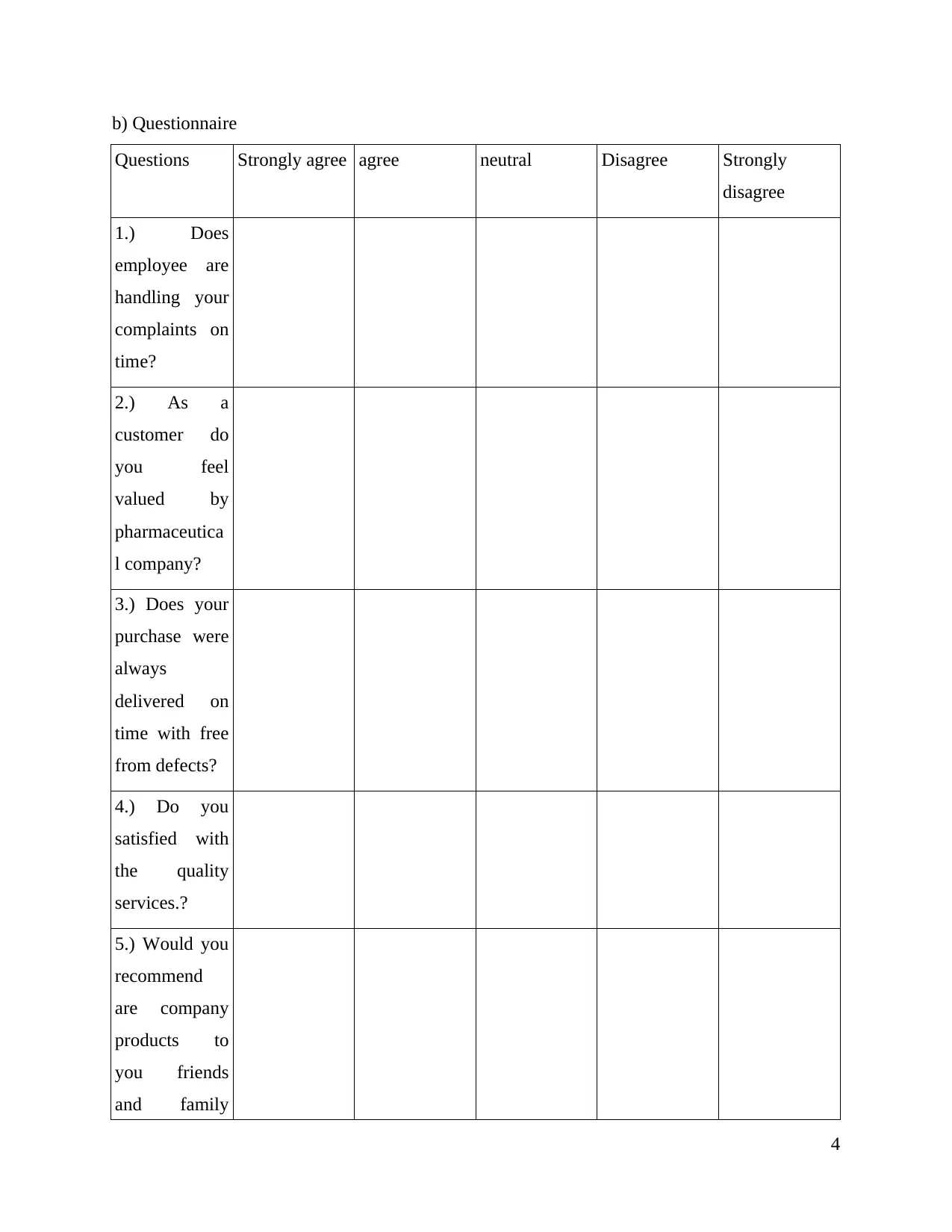
b) Questionnaire
Questions Strongly agree agree neutral Disagree Strongly
disagree
1.) Does
employee are
handling your
complaints on
time?
2.) As a
customer do
you feel
valued by
pharmaceutica
l company?
3.) Does your
purchase were
always
delivered on
time with free
from defects?
4.) Do you
satisfied with
the quality
services.?
5.) Would you
recommend
are company
products to
you friends
and family
4
Questions Strongly agree agree neutral Disagree Strongly
disagree
1.) Does
employee are
handling your
complaints on
time?
2.) As a
customer do
you feel
valued by
pharmaceutica
l company?
3.) Does your
purchase were
always
delivered on
time with free
from defects?
4.) Do you
satisfied with
the quality
services.?
5.) Would you
recommend
are company
products to
you friends
and family
4
⊘ This is a preview!⊘
Do you want full access?
Subscribe today to unlock all pages.

Trusted by 1+ million students worldwide

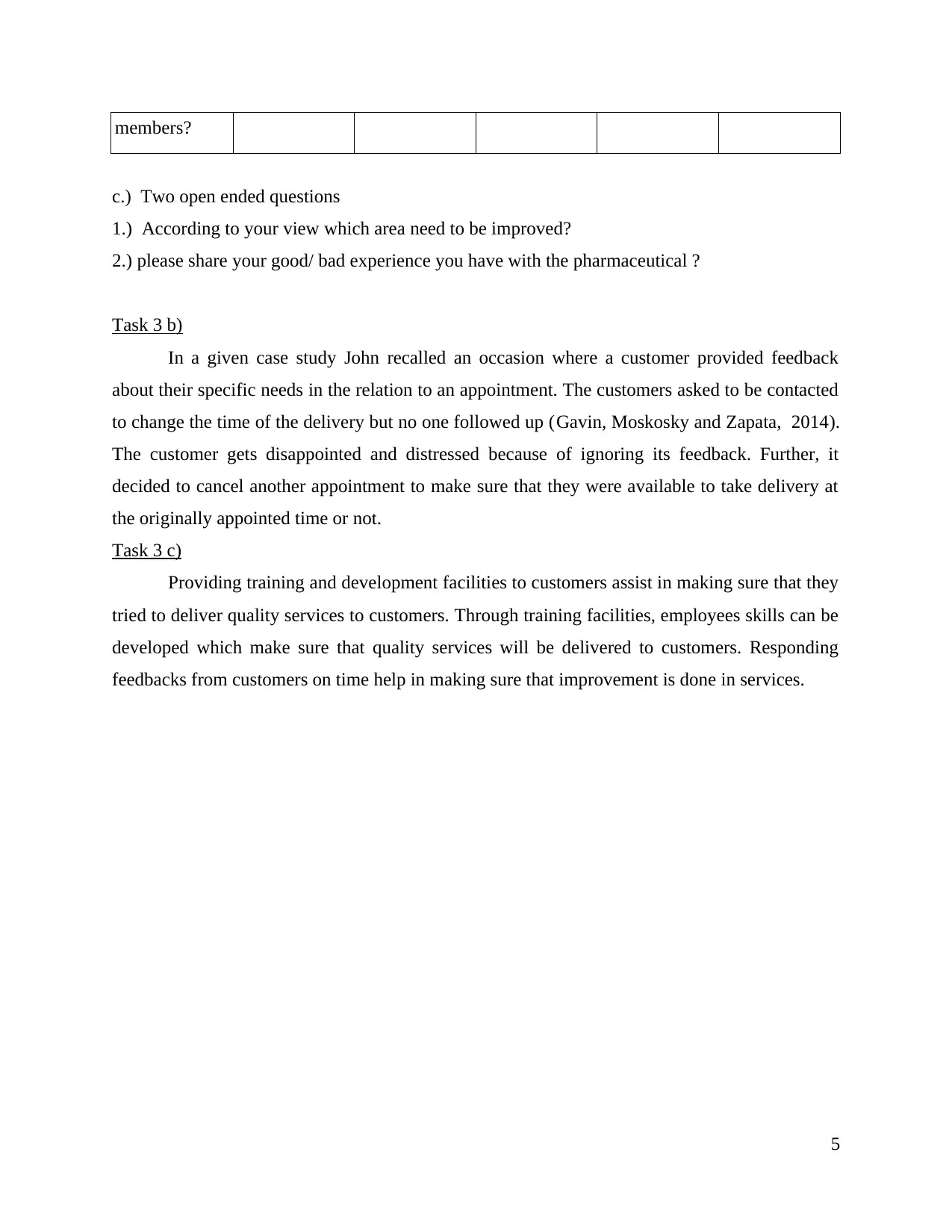
members?
c.) Two open ended questions
1.) According to your view which area need to be improved?
2.) please share your good/ bad experience you have with the pharmaceutical ?
Task 3 b)
In a given case study John recalled an occasion where a customer provided feedback
about their specific needs in the relation to an appointment. The customers asked to be contacted
to change the time of the delivery but no one followed up (Gavin, Moskosky and Zapata, 2014).
The customer gets disappointed and distressed because of ignoring its feedback. Further, it
decided to cancel another appointment to make sure that they were available to take delivery at
the originally appointed time or not.
Task 3 c)
Providing training and development facilities to customers assist in making sure that they
tried to deliver quality services to customers. Through training facilities, employees skills can be
developed which make sure that quality services will be delivered to customers. Responding
feedbacks from customers on time help in making sure that improvement is done in services.
5
c.) Two open ended questions
1.) According to your view which area need to be improved?
2.) please share your good/ bad experience you have with the pharmaceutical ?
Task 3 b)
In a given case study John recalled an occasion where a customer provided feedback
about their specific needs in the relation to an appointment. The customers asked to be contacted
to change the time of the delivery but no one followed up (Gavin, Moskosky and Zapata, 2014).
The customer gets disappointed and distressed because of ignoring its feedback. Further, it
decided to cancel another appointment to make sure that they were available to take delivery at
the originally appointed time or not.
Task 3 c)
Providing training and development facilities to customers assist in making sure that they
tried to deliver quality services to customers. Through training facilities, employees skills can be
developed which make sure that quality services will be delivered to customers. Responding
feedbacks from customers on time help in making sure that improvement is done in services.
5
Paraphrase This Document
Need a fresh take? Get an instant paraphrase of this document with our AI Paraphraser

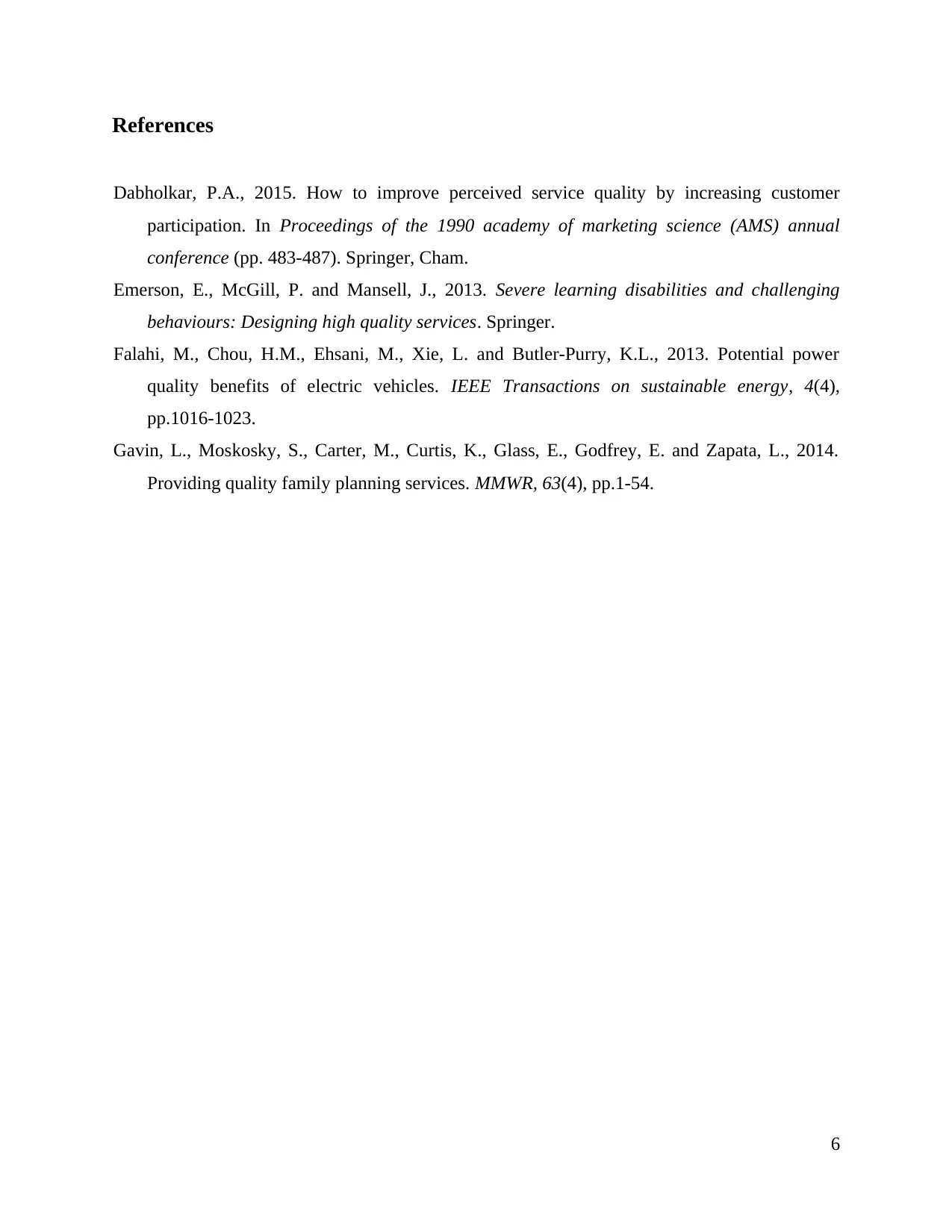
References
Dabholkar, P.A., 2015. How to improve perceived service quality by increasing customer
participation. In Proceedings of the 1990 academy of marketing science (AMS) annual
conference (pp. 483-487). Springer, Cham.
Emerson, E., McGill, P. and Mansell, J., 2013. Severe learning disabilities and challenging
behaviours: Designing high quality services. Springer.
Falahi, M., Chou, H.M., Ehsani, M., Xie, L. and Butler-Purry, K.L., 2013. Potential power
quality benefits of electric vehicles. IEEE Transactions on sustainable energy, 4(4),
pp.1016-1023.
Gavin, L., Moskosky, S., Carter, M., Curtis, K., Glass, E., Godfrey, E. and Zapata, L., 2014.
Providing quality family planning services. MMWR, 63(4), pp.1-54.
6
Dabholkar, P.A., 2015. How to improve perceived service quality by increasing customer
participation. In Proceedings of the 1990 academy of marketing science (AMS) annual
conference (pp. 483-487). Springer, Cham.
Emerson, E., McGill, P. and Mansell, J., 2013. Severe learning disabilities and challenging
behaviours: Designing high quality services. Springer.
Falahi, M., Chou, H.M., Ehsani, M., Xie, L. and Butler-Purry, K.L., 2013. Potential power
quality benefits of electric vehicles. IEEE Transactions on sustainable energy, 4(4),
pp.1016-1023.
Gavin, L., Moskosky, S., Carter, M., Curtis, K., Glass, E., Godfrey, E. and Zapata, L., 2014.
Providing quality family planning services. MMWR, 63(4), pp.1-54.
6
1 out of 8
Related Documents
Your All-in-One AI-Powered Toolkit for Academic Success.
 +13062052269
info@desklib.com
Available 24*7 on WhatsApp / Email
Unlock your academic potential
Copyright © 2020–2025 A2Z Services. All Rights Reserved. Developed and managed by ZUCOL.