School of Hotel Administration: SHA510 Revenue Management Action Plan

Verified

Added on  2022/08/27

|4
|1464
|21
Project
AI Summary
This assignment is a comprehensive action plan focused on managing revenue within a restaurant's service cycle. It identifies duration control as a key business problem, stemming from the inability to predict customer dining times, leading to table bottlenecks and potential revenue loss. The plan proposes strategies like redesigning the food menu for faster ordering and enhancing service speed. It outlines specific steps, including menu redesign, staff training, and analysis of POS reports and customer feedback. The timeline spans a few months, with measurable results assessed through financial data, customer numbers, and feedback. Successful implementation is expected to increase revenue, customer satisfaction, and operational efficiency by improving service speed and reducing customer dining time. The action plan also includes references to relevant academic literature on revenue management and service cycle optimization.
Document Page
SHA510: Managing Revenue with Service Cycle
The School of Hotel Administration of Cornell University
Managing Revenue with Service Cycle Action Plan
Name of the Student:
Name of the University:
© 2014 eCornell. All rights reserved. All other copyrights, trademarks, trade names, and logos are the sole property of their respective
owners.
1
tabler-icon-diamond-filled.svg

Paraphrase This Document

Need a fresh take? Get an instant paraphrase of this document with our AI Paraphraser
Document Page
SHA510: Managing Revenue with Service Cycle
The School of Hotel Administration of Cornell University
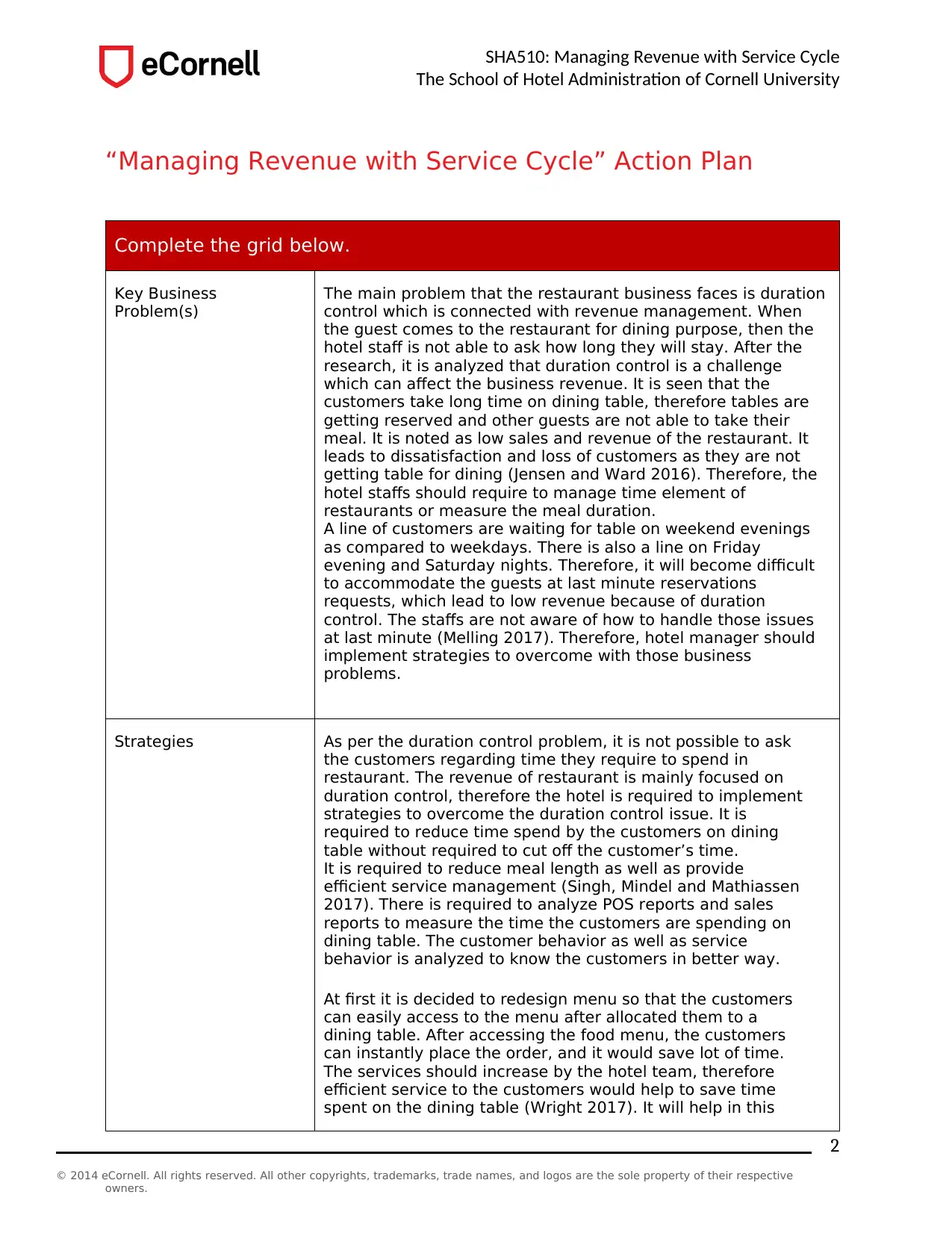
“Managing Revenue with Service Cycle” Action Plan
Complete the grid below.
Key Business
Problem(s)
The main problem that the restaurant business faces is duration
control which is connected with revenue management. When
the guest comes to the restaurant for dining purpose, then the
hotel staff is not able to ask how long they will stay. After the
research, it is analyzed that duration control is a challenge
which can affect the business revenue. It is seen that the
customers take long time on dining table, therefore tables are
getting reserved and other guests are not able to take their
meal. It is noted as low sales and revenue of the restaurant. It
leads to dissatisfaction and loss of customers as they are not
getting table for dining (Jensen and Ward 2016). Therefore, the
hotel staffs should require to manage time element of
restaurants or measure the meal duration.
A line of customers are waiting for table on weekend evenings
as compared to weekdays. There is also a line on Friday
evening and Saturday nights. Therefore, it will become difficult
to accommodate the guests at last minute reservations
requests, which lead to low revenue because of duration
control. The staffs are not aware of how to handle those issues
at last minute (Melling 2017). Therefore, hotel manager should
implement strategies to overcome with those business
problems.
Strategies As per the duration control problem, it is not possible to ask
the customers regarding time they require to spend in
restaurant. The revenue of restaurant is mainly focused on
duration control, therefore the hotel is required to implement
strategies to overcome the duration control issue. It is
required to reduce time spend by the customers on dining
table without required to cut off the customer’s time.
It is required to reduce meal length as well as provide
efficient service management (Singh, Mindel and Mathiassen
2017). There is required to analyze POS reports and sales
reports to measure the time the customers are spending on
dining table. The customer behavior as well as service
behavior is analyzed to know the customers in better way.
At first it is decided to redesign menu so that the customers
can easily access to the menu after allocated them to a
dining table. After accessing the food menu, the customers
can instantly place the order, and it would save lot of time.
The services should increase by the hotel team, therefore
efficient service to the customers would help to save time
spent on the dining table (Wright 2017). It will help in this
© 2014 eCornell. All rights reserved. All other copyrights, trademarks, trade names, and logos are the sole property of their respective
owners.
2
Document Page
SHA510: Managing Revenue with Service Cycle
The School of Hotel Administration of Cornell University
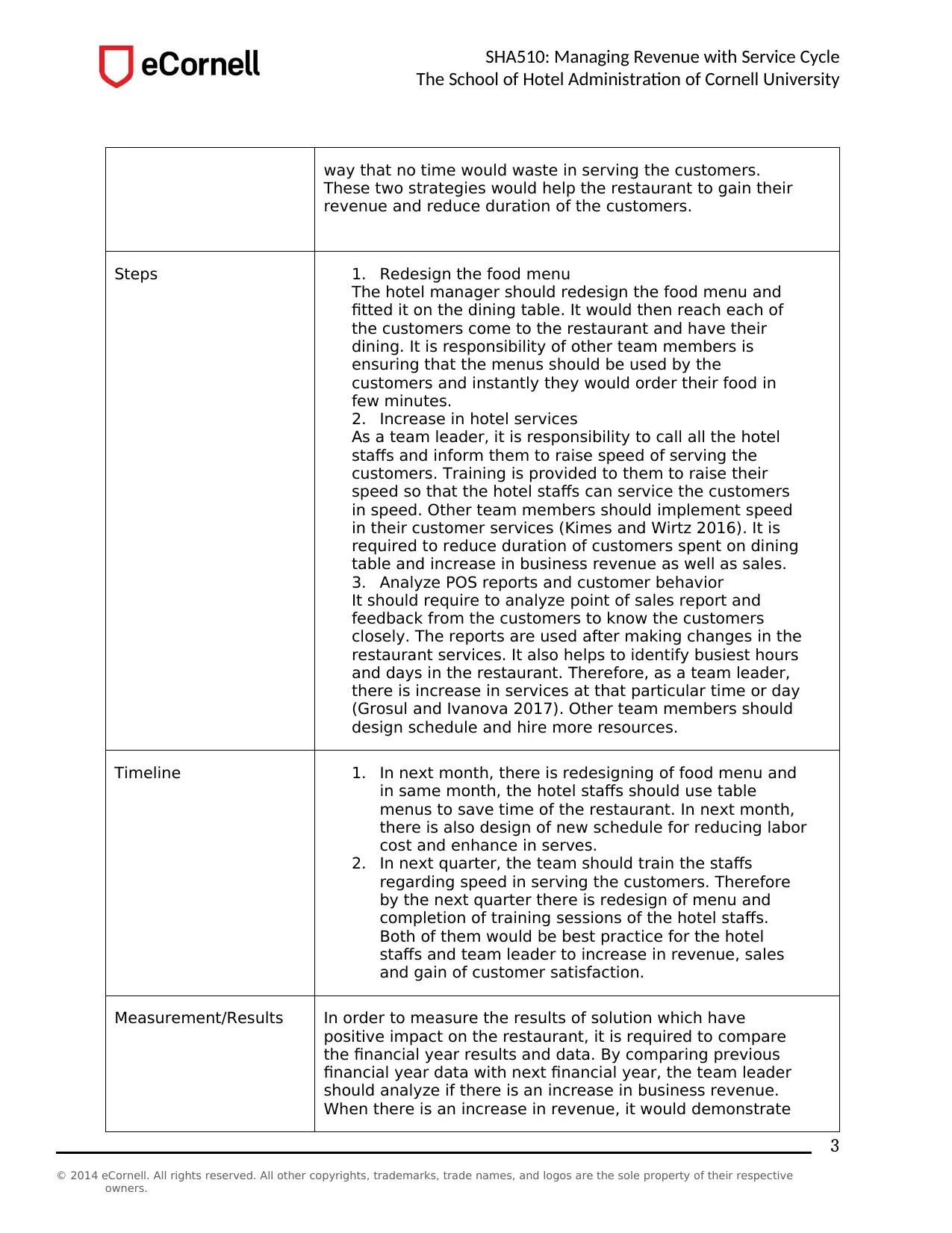
way that no time would waste in serving the customers.
These two strategies would help the restaurant to gain their
revenue and reduce duration of the customers.
Steps 1. Redesign the food menu
The hotel manager should redesign the food menu and
fitted it on the dining table. It would then reach each of
the customers come to the restaurant and have their
dining. It is responsibility of other team members is
ensuring that the menus should be used by the
customers and instantly they would order their food in
few minutes.
2. Increase in hotel services
As a team leader, it is responsibility to call all the hotel
staffs and inform them to raise speed of serving the
customers. Training is provided to them to raise their
speed so that the hotel staffs can service the customers
in speed. Other team members should implement speed
in their customer services (Kimes and Wirtz 2016). It is
required to reduce duration of customers spent on dining
table and increase in business revenue as well as sales.
3. Analyze POS reports and customer behavior
It should require to analyze point of sales report and
feedback from the customers to know the customers
closely. The reports are used after making changes in the
restaurant services. It also helps to identify busiest hours
and days in the restaurant. Therefore, as a team leader,
there is increase in services at that particular time or day
(Grosul and Ivanova 2017). Other team members should
design schedule and hire more resources.
Timeline 1. In next month, there is redesigning of food menu and
in same month, the hotel staffs should use table
menus to save time of the restaurant. In next month,
there is also design of new schedule for reducing labor
cost and enhance in serves.
2. In next quarter, the team should train the staffs
regarding speed in serving the customers. Therefore
by the next quarter there is redesign of menu and
completion of training sessions of the hotel staffs.
Both of them would be best practice for the hotel
staffs and team leader to increase in revenue, sales
and gain of customer satisfaction.
Measurement/Results In order to measure the results of solution which have
positive impact on the restaurant, it is required to compare
the financial year results and data. By comparing previous
financial year data with next financial year, the team leader
should analyze if there is an increase in business revenue.
When there is an increase in revenue, it would demonstrate
© 2014 eCornell. All rights reserved. All other copyrights, trademarks, trade names, and logos are the sole property of their respective
owners.
3
Document Page
SHA510: Managing Revenue with Service Cycle
The School of Hotel Administration of Cornell University
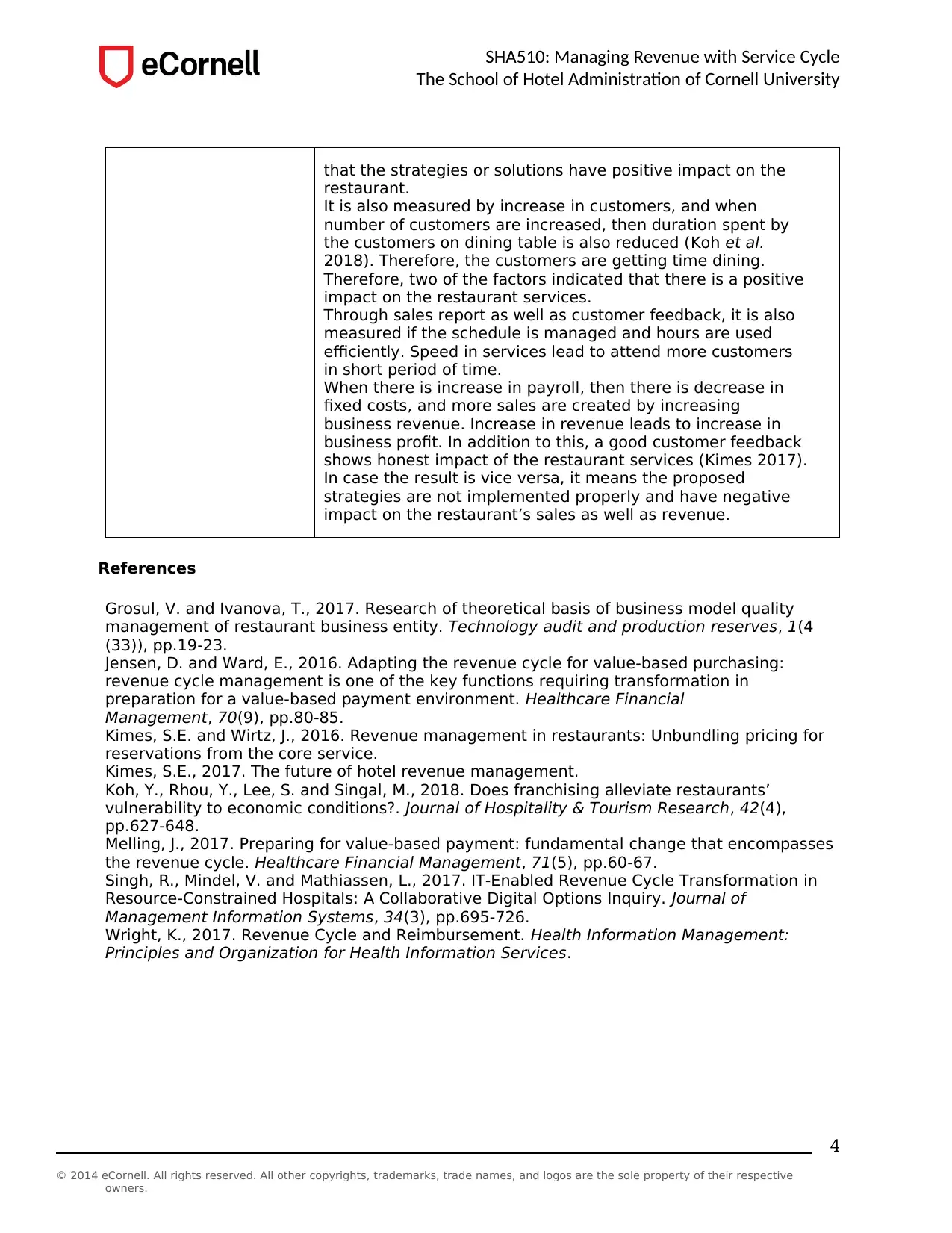
that the strategies or solutions have positive impact on the
restaurant.
It is also measured by increase in customers, and when
number of customers are increased, then duration spent by
the customers on dining table is also reduced (Koh et al.
2018). Therefore, the customers are getting time dining.
Therefore, two of the factors indicated that there is a positive
impact on the restaurant services.
Through sales report as well as customer feedback, it is also
measured if the schedule is managed and hours are used
efficiently. Speed in services lead to attend more customers
in short period of time.
When there is increase in payroll, then there is decrease in
fixed costs, and more sales are created by increasing
business revenue. Increase in revenue leads to increase in
business profit. In addition to this, a good customer feedback
shows honest impact of the restaurant services (Kimes 2017).
In case the result is vice versa, it means the proposed
strategies are not implemented properly and have negative
impact on the restaurant’s sales as well as revenue.
References
Grosul, V. and Ivanova, T., 2017. Research of theoretical basis of business model quality
management of restaurant business entity. Technology audit and production reserves, 1(4
(33)), pp.19-23.
Jensen, D. and Ward, E., 2016. Adapting the revenue cycle for value-based purchasing:
revenue cycle management is one of the key functions requiring transformation in
preparation for a value-based payment environment. Healthcare Financial
Management, 70(9), pp.80-85.
Kimes, S.E. and Wirtz, J., 2016. Revenue management in restaurants: Unbundling pricing for
reservations from the core service.
Kimes, S.E., 2017. The future of hotel revenue management.
Koh, Y., Rhou, Y., Lee, S. and Singal, M., 2018. Does franchising alleviate restaurants’
vulnerability to economic conditions?. Journal of Hospitality & Tourism Research, 42(4),
pp.627-648.
Melling, J., 2017. Preparing for value-based payment: fundamental change that encompasses
the revenue cycle. Healthcare Financial Management, 71(5), pp.60-67.
Singh, R., Mindel, V. and Mathiassen, L., 2017. IT-Enabled Revenue Cycle Transformation in
Resource-Constrained Hospitals: A Collaborative Digital Options Inquiry. Journal of
Management Information Systems, 34(3), pp.695-726.
Wright, K., 2017. Revenue Cycle and Reimbursement. Health Information Management:
Principles and Organization for Health Information Services.
© 2014 eCornell. All rights reserved. All other copyrights, trademarks, trade names, and logos are the sole property of their respective
owners.
4
chevron_up_icon
1 out of 4
circle_padding
hide_on_mobile
zoom_out_icon
[object Object]