Report on Managing and Running a Small Business - Unit 29
VerifiedAdded on 2023/01/18
|19
|5568
|76
Report
AI Summary
This report provides a detailed analysis of managing and running a small business, covering crucial aspects such as resource planning and allocation to achieve business objectives. It delves into the processes of maintaining Customer Relationship Management (CRM), exploring strategies to enhance customer satisfaction and retention. The report also examines how businesses can develop transnationally, discussing the associated merits and demerits. Furthermore, it highlights key legislation and regulations that impact small businesses, providing a comprehensive overview of the challenges and opportunities in the current business landscape. The report uses the example of OC&C, a strategy consulting boutique, to illustrate the points and provide real-world context. The report also covers the consideration of financial statements, customer portfolio analysis, and different customer handling techniques.
UNIT 29: MANAGING & RUNNING A SMALL BUSINESS
1
1

Paraphrase This Document
Need a fresh take? Get an instant paraphrase of this document with our AI Paraphraser
Table of Contents
INTRODUCTION...........................................................................................................................1
Main consideration regarding planning and allocating resources to achieve business objective
................................................................................................................................................1
Different process of maintaining Customer relationship management..................................3
How business can develop the transnationally and different merits and demerits of the same
................................................................................................................................................6
Discussion of key legislation and regulations that have implications on small businesses. 13
CONCLUSION..............................................................................................................................15
REFERENCES..............................................................................................................................17
2
INTRODUCTION...........................................................................................................................1
Main consideration regarding planning and allocating resources to achieve business objective
................................................................................................................................................1
Different process of maintaining Customer relationship management..................................3
How business can develop the transnationally and different merits and demerits of the same
................................................................................................................................................6
Discussion of key legislation and regulations that have implications on small businesses. 13
CONCLUSION..............................................................................................................................15
REFERENCES..............................................................................................................................17
2
INTRODUCTION
Small and medium-sized enterprises (SMEs) or small and medium-sized businesses
(SMBs) are the businesses whose personnel numbers fall below certain limit. OC&C is a
strategy consulting boutique, and prides itself on the high share of strategy work it conducts for
the clients. Companies headquarter is based in London, United Kingdom. The company was
founded by the founder Chris Outram and Geoff Cullinan. This report highlights the different
consideration which has to be taken into considers for achieving the business objective. After
that the report goes on to highlights the different process which can be used in the organization
to improve the customer relationship management in the organization. After that the report goes
on to explain the different ways through the small organization can adopt the transnationally and
determine the different benefits and the drawbacks of the same. After that the report goes on to
highlights the annual itemised monthly cash flow forecaster showing fixed and
the variable cost set against income for a specific organization (Nickols,
2016). After that the report goes on to highlights how the break-even
analysis can be applied on the organizational situation. In the end the report
goes on to highlights the different key legislation and regulation that have
implication on small business or enterprise.
Main consideration regarding planning and allocating resources to achieve business objective
Small businesses:
Small businesses are the business which used to operate at the limited size and the firm
who used to have less than 250 employee in the organization. Some of the feature of small
business enterprises are lower revenue and profitability, small team of employee, small market
area and generally sole proprietorship.
Before allocating and planning resources in the organization there are many consideration-
Financial statement which has to be taken by the organization as resources are the one
with the help of the same the organization is able to perform the different activity in the
1
Small and medium-sized enterprises (SMEs) or small and medium-sized businesses
(SMBs) are the businesses whose personnel numbers fall below certain limit. OC&C is a
strategy consulting boutique, and prides itself on the high share of strategy work it conducts for
the clients. Companies headquarter is based in London, United Kingdom. The company was
founded by the founder Chris Outram and Geoff Cullinan. This report highlights the different
consideration which has to be taken into considers for achieving the business objective. After
that the report goes on to highlights the different process which can be used in the organization
to improve the customer relationship management in the organization. After that the report goes
on to explain the different ways through the small organization can adopt the transnationally and
determine the different benefits and the drawbacks of the same. After that the report goes on to
highlights the annual itemised monthly cash flow forecaster showing fixed and
the variable cost set against income for a specific organization (Nickols,
2016). After that the report goes on to highlights how the break-even
analysis can be applied on the organizational situation. In the end the report
goes on to highlights the different key legislation and regulation that have
implication on small business or enterprise.
Main consideration regarding planning and allocating resources to achieve business objective
Small businesses:
Small businesses are the business which used to operate at the limited size and the firm
who used to have less than 250 employee in the organization. Some of the feature of small
business enterprises are lower revenue and profitability, small team of employee, small market
area and generally sole proprietorship.
Before allocating and planning resources in the organization there are many consideration-
Financial statement which has to be taken by the organization as resources are the one
with the help of the same the organization is able to perform the different activity in the
1
⊘ This is a preview!⊘
Do you want full access?
Subscribe today to unlock all pages.

Trusted by 1+ million students worldwide
organization so that the goal of the business can be achieved efficiently. So some of the main
consideration which has to be taken into consider by the allocator and the planner are as follows:
Understanding of the Project and the scope: Before allocating resources to the business,
allocator in the business must has the idea about the project for which the resources are being
allotted and the scope of the project for which they are intending to allocate the resources. As
with the help of the same the allocator will have the proper idea about what are the resources
which will be require and how many of them will be require in the business to achieve the goal
of the business (Havur and et.al., 2016). As the amount of the project will be clear to the
allocation it will get easy for the allocator to understand the amount of the resources require in
the organization.
Identity of Resources: It is another consideration which has to be seen by the allocator
in the organization at the time of the planning of the resources. As allocation of the resources
includes allocating the mixture of the resources to the business project to achieve the goal of the
business. So before allocating at the time of the planning the resources organization has to make
sure that they see the current resources which are available in front of them and what are the
different way through which the resources can be procure within the given budget which has
been prescribed in the organization. As it is not necessary that all the resources which is require
by the company will be available at the time of the need for the organization. As a result the
organization has to make sure that they identify the resources beforehand itself.
Cost of the Resources: It is another consideration which has to be looked at the time of
allocation of the resources and also at the time of planning of the resources in the business. As
resource planner has to make sure that the resources they are looking to procure in the
organization do not increase the cost of the company. So the planer in the organization generally
used to look for the different sources through which resources can be procure in the organization.
At the same time the allocator has to make sure that the resources they are allocating to the
business does not increase the production cost of the company as the value of the project and the
cost of the resources used to have a relation in them (Cassidy, 2016). As if the organization will
be allocating the higher value resources for the simple project in the organization this will
eventually increase the cost of the simple project outcome in the organization.
Over allocation: It is the consideration which has to be looked by the allocator in the
organization. Allocator has to make sure that they do not over allocate the resources to the
2
consideration which has to be taken into consider by the allocator and the planner are as follows:
Understanding of the Project and the scope: Before allocating resources to the business,
allocator in the business must has the idea about the project for which the resources are being
allotted and the scope of the project for which they are intending to allocate the resources. As
with the help of the same the allocator will have the proper idea about what are the resources
which will be require and how many of them will be require in the business to achieve the goal
of the business (Havur and et.al., 2016). As the amount of the project will be clear to the
allocation it will get easy for the allocator to understand the amount of the resources require in
the organization.
Identity of Resources: It is another consideration which has to be seen by the allocator
in the organization at the time of the planning of the resources. As allocation of the resources
includes allocating the mixture of the resources to the business project to achieve the goal of the
business. So before allocating at the time of the planning the resources organization has to make
sure that they see the current resources which are available in front of them and what are the
different way through which the resources can be procure within the given budget which has
been prescribed in the organization. As it is not necessary that all the resources which is require
by the company will be available at the time of the need for the organization. As a result the
organization has to make sure that they identify the resources beforehand itself.
Cost of the Resources: It is another consideration which has to be looked at the time of
allocation of the resources and also at the time of planning of the resources in the business. As
resource planner has to make sure that the resources they are looking to procure in the
organization do not increase the cost of the company. So the planer in the organization generally
used to look for the different sources through which resources can be procure in the organization.
At the same time the allocator has to make sure that the resources they are allocating to the
business does not increase the production cost of the company as the value of the project and the
cost of the resources used to have a relation in them (Cassidy, 2016). As if the organization will
be allocating the higher value resources for the simple project in the organization this will
eventually increase the cost of the simple project outcome in the organization.
Over allocation: It is the consideration which has to be looked by the allocator in the
organization. Allocator has to make sure that they do not over allocate the resources to the
2
Paraphrase This Document
Need a fresh take? Get an instant paraphrase of this document with our AI Paraphraser
business as over allocation will eventually result in wasting of the resources for the organization
which will eventually affects the efficiency of the business. As same amount of the product will
be manufactured with the help of the larger amount of the resources, this will result in wastage of
some amount of the resources.
Know Your Resources: It is another consideration which has to be seen by the allocator
and the planner as it will be difficult for them to manger the thing which they are not knowing.
So the allocator has to make sure that they are having the proper idea of the resources which they
are having. Information may include experience, skills and personality of every resource that
you’ve tasked or allocated to support the project.
Track Time: It is the another consideration which has to be taken care by the allocator at
the time of allocating the resources that the organization used to track the time taken by the
resources to complete the task in the organization on the fixed basis so that the efficiency of the
resource never get affected in the organization (Russell, Pferdehirt and Nelson, 2018). This also
help the allocator in knowing the proper requirement of the resources in the organization.
At the time of allotting the resource organization has to make sure following point
Department using resource: Organization has to look at the department to whom the resources
are allocating is the department is capable enough to manage the same resources or not.
Requirement of the resources: Allocator has to make sure that the resources which are
allocated to the organization is in requirement of the resources or not otherwise it will affect the
efficiency of work in the organization.
Different process of maintaining Customer relationship management
CRM
Customer relationship management (CRM) is an approach which used to manage a company
interaction with the current and the potential customer in the market. This is generally used to
improve customer retention and sales growth.
Customer value assessment is the tool which is set of the criteria in the four categories
which used to see the need, wants and expectation. Using these criteria, organizations gain
insight into the customer’s perception of their organization.
3
which will eventually affects the efficiency of the business. As same amount of the product will
be manufactured with the help of the larger amount of the resources, this will result in wastage of
some amount of the resources.
Know Your Resources: It is another consideration which has to be seen by the allocator
and the planner as it will be difficult for them to manger the thing which they are not knowing.
So the allocator has to make sure that they are having the proper idea of the resources which they
are having. Information may include experience, skills and personality of every resource that
you’ve tasked or allocated to support the project.
Track Time: It is the another consideration which has to be taken care by the allocator at
the time of allocating the resources that the organization used to track the time taken by the
resources to complete the task in the organization on the fixed basis so that the efficiency of the
resource never get affected in the organization (Russell, Pferdehirt and Nelson, 2018). This also
help the allocator in knowing the proper requirement of the resources in the organization.
At the time of allotting the resource organization has to make sure following point
Department using resource: Organization has to look at the department to whom the resources
are allocating is the department is capable enough to manage the same resources or not.
Requirement of the resources: Allocator has to make sure that the resources which are
allocated to the organization is in requirement of the resources or not otherwise it will affect the
efficiency of work in the organization.
Different process of maintaining Customer relationship management
CRM
Customer relationship management (CRM) is an approach which used to manage a company
interaction with the current and the potential customer in the market. This is generally used to
improve customer retention and sales growth.
Customer value assessment is the tool which is set of the criteria in the four categories
which used to see the need, wants and expectation. Using these criteria, organizations gain
insight into the customer’s perception of their organization.
3
There are two type of the process of Customer relationship management which is
followed by all the organization to improve the customer satisfaction in the organization. Both
the process includes a five sub steps which need to be followed in the organization.
Processes for successful customer relationship management - Process 1
(Step 1) Customer Portfolio Analysis: It is the step in which the organization has to
make sure that used to analyse the market of the organization and on the basis of the
same the organization have to select the best customer base which can be targeted by the
company to sell the product.
(Step 2) Customer intimacy: It is the step at which the organization look to build the
bond with the customer in the market. In this process step the individual try to fix out the
relation with the customer from the selected customer base. This step usually includes
building a customer database to store the gathered information.
(Step 3) Network Development: It is the next step of the customer relationship
management in which organization used to identify and develop the strong relationship
with all the pates who are critical in the success of the organization (Wertheimer, 2016).
(Step 4) Value proportion development: It is the step in the process which used to build
the different information from the time of following the customer intimacy step. As after
identifying the targeted customer organization can go forward to create the value for the
customer which has been selected. In the process of creating a value organization has to
make sure it also create the value for themselves also.
(Step 5) Customer Life cycle management: It is the last step in which the organization
used to make sure that the organization used to maintain the Customer life cycle in the
organization on the regular basis. For maintain the customer life cycle in the organization
the customer has to make sure that proper structure and the process used to attend by the
organization for attaining the Customer in the organization.
Processes for successful customer relationship management - Process 2
(Step 1) Identify the target market and proposition: This step is same as the first step
of the process 1. In this step organization used to decide the customer base of the
company and try to fix out the targeted customer base of the company to be targeted to
sell the product of the organization (Williams and Dobelman, 2017). Generally all the
4
followed by all the organization to improve the customer satisfaction in the organization. Both
the process includes a five sub steps which need to be followed in the organization.
Processes for successful customer relationship management - Process 1
(Step 1) Customer Portfolio Analysis: It is the step in which the organization has to
make sure that used to analyse the market of the organization and on the basis of the
same the organization have to select the best customer base which can be targeted by the
company to sell the product.
(Step 2) Customer intimacy: It is the step at which the organization look to build the
bond with the customer in the market. In this process step the individual try to fix out the
relation with the customer from the selected customer base. This step usually includes
building a customer database to store the gathered information.
(Step 3) Network Development: It is the next step of the customer relationship
management in which organization used to identify and develop the strong relationship
with all the pates who are critical in the success of the organization (Wertheimer, 2016).
(Step 4) Value proportion development: It is the step in the process which used to build
the different information from the time of following the customer intimacy step. As after
identifying the targeted customer organization can go forward to create the value for the
customer which has been selected. In the process of creating a value organization has to
make sure it also create the value for themselves also.
(Step 5) Customer Life cycle management: It is the last step in which the organization
used to make sure that the organization used to maintain the Customer life cycle in the
organization on the regular basis. For maintain the customer life cycle in the organization
the customer has to make sure that proper structure and the process used to attend by the
organization for attaining the Customer in the organization.
Processes for successful customer relationship management - Process 2
(Step 1) Identify the target market and proposition: This step is same as the first step
of the process 1. In this step organization used to decide the customer base of the
company and try to fix out the targeted customer base of the company to be targeted to
sell the product of the organization (Williams and Dobelman, 2017). Generally all the
4
⊘ This is a preview!⊘
Do you want full access?
Subscribe today to unlock all pages.
Trusted by 1+ million students worldwide
organization in this step used to take help of the STP tool to determine the best customer
base in the organization.
(Step 2) Overall CRM Strategy and Consider Costs: It is the step of the process in
which the organization has to decide the best available CRM strategy which can be used
by the organization to attract the customer as well as with the help of the same the
concern of the customer can be easily solve in the organization. At the same time the
organization used to perform this function in the organization by considering the cost
which will be required to implement the strategy in the organization.
(Step 3) Customer handling technique: It is the step in the process in which the
organization used to define how different customer type can be handle in the
organization. As every customer used to have the different need and requirement. The
organization has to decide the best way through which different type of customer can be
handle in the market. As there will be many customer who will require support for more
than one time and some will be the one who will require the help for just one time.
(Step 4) Measurement of the performance: It is the step in which the organization used
to measure the performance of the business on the basis of the different technique which
has been taught in the step 3. Generally the organization used to take the help of the
different tool to measure the performance (Guay, Samuels and Taylor, 2016). This tool
used to compare the real performance with the benchmark which has been set in the
organization and try to find out the deviation. So that the necessary step can be taken to
overcome the deviation.
(Step 5) Re-engage Customer: It is the step in the process in which the organization try
to engage the customer of the company in the organization to bring the perfection in the
organization. Some of the common technique which are used are Survey, Email and
Social Media. As organization used to consult the survey and ask for the different
suggestion from the customer side, also used to email them the different wishes
throughout the year which help the organization in passing on the message that
organization used to think about them.
Benefit of CRM
CRM help the company in improving the sales productivity in the organization as CRM
houses for all the important customer in one. Also it helps the company in improving the
5
base in the organization.
(Step 2) Overall CRM Strategy and Consider Costs: It is the step of the process in
which the organization has to decide the best available CRM strategy which can be used
by the organization to attract the customer as well as with the help of the same the
concern of the customer can be easily solve in the organization. At the same time the
organization used to perform this function in the organization by considering the cost
which will be required to implement the strategy in the organization.
(Step 3) Customer handling technique: It is the step in the process in which the
organization used to define how different customer type can be handle in the
organization. As every customer used to have the different need and requirement. The
organization has to decide the best way through which different type of customer can be
handle in the market. As there will be many customer who will require support for more
than one time and some will be the one who will require the help for just one time.
(Step 4) Measurement of the performance: It is the step in which the organization used
to measure the performance of the business on the basis of the different technique which
has been taught in the step 3. Generally the organization used to take the help of the
different tool to measure the performance (Guay, Samuels and Taylor, 2016). This tool
used to compare the real performance with the benchmark which has been set in the
organization and try to find out the deviation. So that the necessary step can be taken to
overcome the deviation.
(Step 5) Re-engage Customer: It is the step in the process in which the organization try
to engage the customer of the company in the organization to bring the perfection in the
organization. Some of the common technique which are used are Survey, Email and
Social Media. As organization used to consult the survey and ask for the different
suggestion from the customer side, also used to email them the different wishes
throughout the year which help the organization in passing on the message that
organization used to think about them.
Benefit of CRM
CRM help the company in improving the sales productivity in the organization as CRM
houses for all the important customer in one. Also it helps the company in improving the
5
Paraphrase This Document
Need a fresh take? Get an instant paraphrase of this document with our AI Paraphraser
customer satisfaction in the organization as all the customer get a platform to consult with the
organization.
Evaluate different digital platforms for effective customer relationships
Operation CRM: It is the CRM in which used to streamlines the business process that
includes Sales automation, Marketing automation and Service automation. This will help the
company in understanding the need of the customer and on the basis of the same customer
relationship can be improved.
Analytical CRM: Analytical CRM (Customer Relationship Management) denotes the
systematic electronic analysis of collated customer data. On the basis of the same different
decision are taken to improve the customer relationship.
How business can develop the transnationally and different merits and demerits of the same
3.1 Transnational business
Transnational business
Transnationally is the state of the business which used to carry out the business all across the
international boundaries. Transnationally is the model in which the organization used to invest in
the foreign assets and operations, making them effectively tied to each nation in which they do
business. There are many ways through which the small business also can transact in the
international business environment. Some of them are as follows:
Merger: In this way the small organization can joined hand with the organization
operating in the global market and can offer the services of the company in the new market also
(Gupta and et.al., 2019). This step will help the company in understanding the local market also
as the company with whom the merger will take place will having the idea of the local market
trend and customer preference.
Joint venture: It is another way through which the small business can operate in the
international market also. In this the local company in the international market and organization
has to give birth to the new venture in the international market. This will eventually help the
company in saving the cost of opening new venture as risk and profit will be shared between
both the organizations on agreed proportion.
6
organization.
Evaluate different digital platforms for effective customer relationships
Operation CRM: It is the CRM in which used to streamlines the business process that
includes Sales automation, Marketing automation and Service automation. This will help the
company in understanding the need of the customer and on the basis of the same customer
relationship can be improved.
Analytical CRM: Analytical CRM (Customer Relationship Management) denotes the
systematic electronic analysis of collated customer data. On the basis of the same different
decision are taken to improve the customer relationship.
How business can develop the transnationally and different merits and demerits of the same
3.1 Transnational business
Transnational business
Transnationally is the state of the business which used to carry out the business all across the
international boundaries. Transnationally is the model in which the organization used to invest in
the foreign assets and operations, making them effectively tied to each nation in which they do
business. There are many ways through which the small business also can transact in the
international business environment. Some of them are as follows:
Merger: In this way the small organization can joined hand with the organization
operating in the global market and can offer the services of the company in the new market also
(Gupta and et.al., 2019). This step will help the company in understanding the local market also
as the company with whom the merger will take place will having the idea of the local market
trend and customer preference.
Joint venture: It is another way through which the small business can operate in the
international market also. In this the local company in the international market and organization
has to give birth to the new venture in the international market. This will eventually help the
company in saving the cost of opening new venture as risk and profit will be shared between
both the organizations on agreed proportion.
6
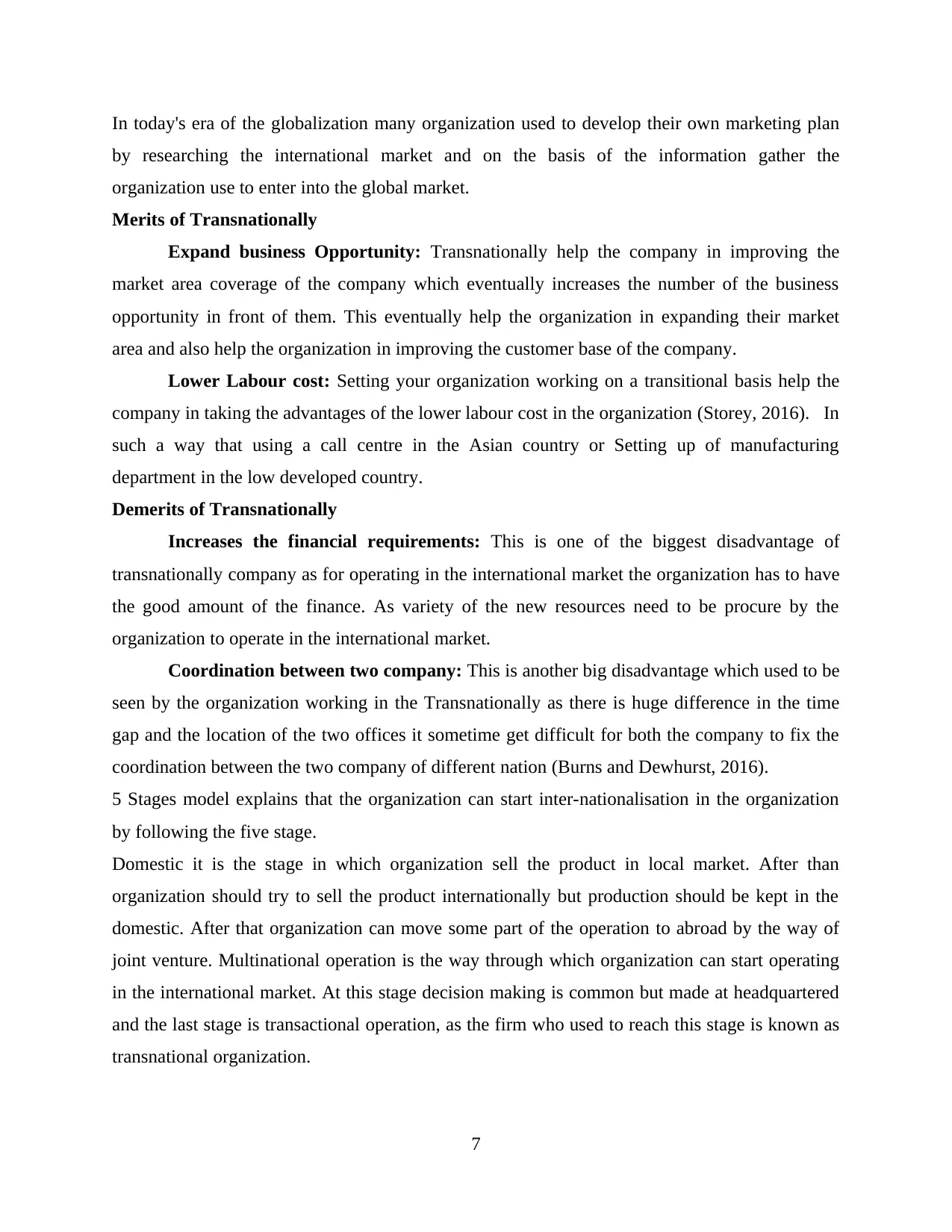
In today's era of the globalization many organization used to develop their own marketing plan
by researching the international market and on the basis of the information gather the
organization use to enter into the global market.
Merits of Transnationally
Expand business Opportunity: Transnationally help the company in improving the
market area coverage of the company which eventually increases the number of the business
opportunity in front of them. This eventually help the organization in expanding their market
area and also help the organization in improving the customer base of the company.
Lower Labour cost: Setting your organization working on a transitional basis help the
company in taking the advantages of the lower labour cost in the organization (Storey, 2016). In
such a way that using a call centre in the Asian country or Setting up of manufacturing
department in the low developed country.
Demerits of Transnationally
Increases the financial requirements: This is one of the biggest disadvantage of
transnationally company as for operating in the international market the organization has to have
the good amount of the finance. As variety of the new resources need to be procure by the
organization to operate in the international market.
Coordination between two company: This is another big disadvantage which used to be
seen by the organization working in the Transnationally as there is huge difference in the time
gap and the location of the two offices it sometime get difficult for both the company to fix the
coordination between the two company of different nation (Burns and Dewhurst, 2016).
5 Stages model explains that the organization can start inter-nationalisation in the organization
by following the five stage.
Domestic it is the stage in which organization sell the product in local market. After than
organization should try to sell the product internationally but production should be kept in the
domestic. After that organization can move some part of the operation to abroad by the way of
joint venture. Multinational operation is the way through which organization can start operating
in the international market. At this stage decision making is common but made at headquartered
and the last stage is transactional operation, as the firm who used to reach this stage is known as
transnational organization.
7
by researching the international market and on the basis of the information gather the
organization use to enter into the global market.
Merits of Transnationally
Expand business Opportunity: Transnationally help the company in improving the
market area coverage of the company which eventually increases the number of the business
opportunity in front of them. This eventually help the organization in expanding their market
area and also help the organization in improving the customer base of the company.
Lower Labour cost: Setting your organization working on a transitional basis help the
company in taking the advantages of the lower labour cost in the organization (Storey, 2016). In
such a way that using a call centre in the Asian country or Setting up of manufacturing
department in the low developed country.
Demerits of Transnationally
Increases the financial requirements: This is one of the biggest disadvantage of
transnationally company as for operating in the international market the organization has to have
the good amount of the finance. As variety of the new resources need to be procure by the
organization to operate in the international market.
Coordination between two company: This is another big disadvantage which used to be
seen by the organization working in the Transnationally as there is huge difference in the time
gap and the location of the two offices it sometime get difficult for both the company to fix the
coordination between the two company of different nation (Burns and Dewhurst, 2016).
5 Stages model explains that the organization can start inter-nationalisation in the organization
by following the five stage.
Domestic it is the stage in which organization sell the product in local market. After than
organization should try to sell the product internationally but production should be kept in the
domestic. After that organization can move some part of the operation to abroad by the way of
joint venture. Multinational operation is the way through which organization can start operating
in the international market. At this stage decision making is common but made at headquartered
and the last stage is transactional operation, as the firm who used to reach this stage is known as
transnational organization.
7
⊘ This is a preview!⊘
Do you want full access?
Subscribe today to unlock all pages.
Trusted by 1+ million students worldwide
Introduction of the organization
OC&C is a strategy consulting boutique, and prides itself on the high share of strategy
work it conducts for its clients. Company is headquarter in London, United Kingdom. The
company was founded by the founder Chris Outram and Geoff Cullinan.
Fixed and variable cost
Fixed cost: Fixed cost is the cost which do not used to change during the operation in the
business. Example rent, buildings, machinery, etc.
Variable cost: Variable cost is the cost which used to change with the level of the output
is increases in the course of manufacturing in the organization.
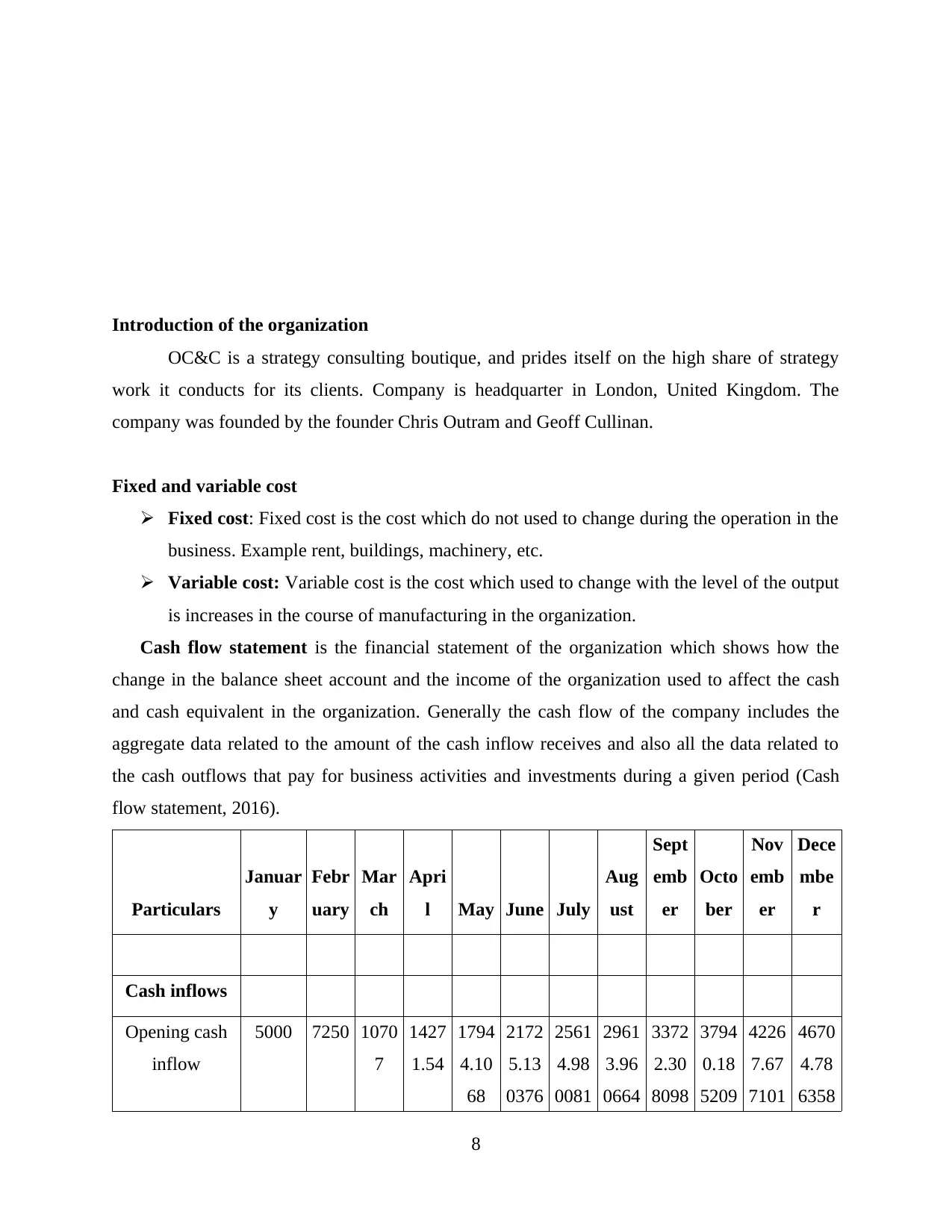
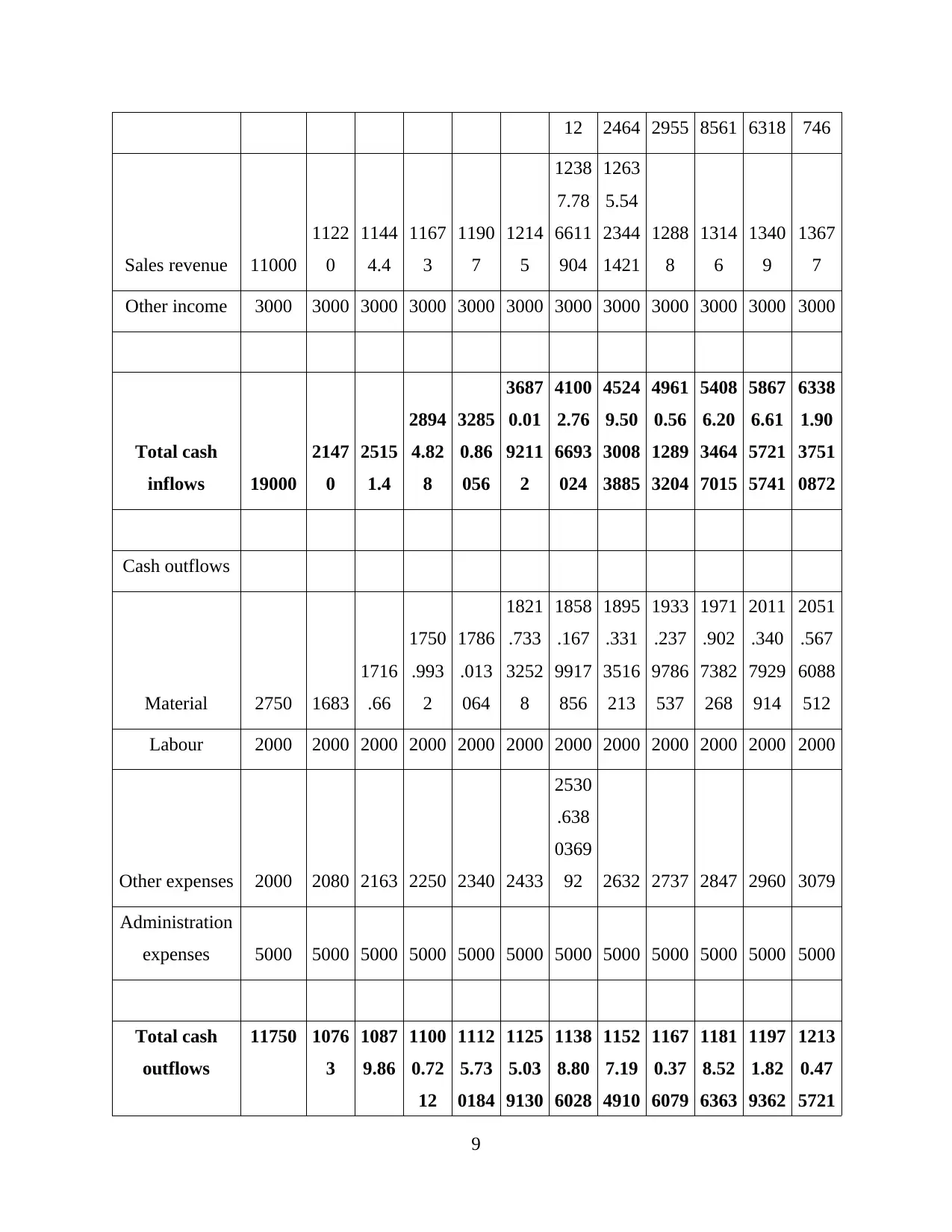
Cash flow statement is the financial statement of the organization which shows how the
change in the balance sheet account and the income of the organization used to affect the cash
and cash equivalent in the organization. Generally the cash flow of the company includes the
aggregate data related to the amount of the cash inflow receives and also all the data related to
the cash outflows that pay for business activities and investments during a given period (Cash
flow statement, 2016).
Particulars
Januar
y
Febr
uary
Mar
ch
Apri
l May June July
Aug
ust
Sept
emb
er
Octo
ber
Nov
emb
er
Dece
mbe
r
Cash inflows
Opening cash
inflow
5000 7250 1070
7
1427
1.54
1794
4.10
68
2172
5.13
0376
2561
4.98
0081
2961
3.96
0664
3372
2.30
8098
3794
0.18
5209
4226
7.67
7101
4670
4.78
6358
8
OC&C is a strategy consulting boutique, and prides itself on the high share of strategy
work it conducts for its clients. Company is headquarter in London, United Kingdom. The
company was founded by the founder Chris Outram and Geoff Cullinan.
Fixed and variable cost
Fixed cost: Fixed cost is the cost which do not used to change during the operation in the
business. Example rent, buildings, machinery, etc.
Variable cost: Variable cost is the cost which used to change with the level of the output
is increases in the course of manufacturing in the organization.
Cash flow statement is the financial statement of the organization which shows how the
change in the balance sheet account and the income of the organization used to affect the cash
and cash equivalent in the organization. Generally the cash flow of the company includes the
aggregate data related to the amount of the cash inflow receives and also all the data related to
the cash outflows that pay for business activities and investments during a given period (Cash
flow statement, 2016).
Particulars
Januar
y
Febr
uary
Mar
ch
Apri
l May June July
Aug
ust
Sept
emb
er
Octo
ber
Nov
emb
er
Dece
mbe
r
Cash inflows
Opening cash
inflow
5000 7250 1070
7
1427
1.54
1794
4.10
68
2172
5.13
0376
2561
4.98
0081
2961
3.96
0664
3372
2.30
8098
3794
0.18
5209
4226
7.67
7101
4670
4.78
6358
8
Paraphrase This Document
Need a fresh take? Get an instant paraphrase of this document with our AI Paraphraser
12 2464 2955 8561 6318 746
Sales revenue 11000
1122
0
1144
4.4
1167
3
1190
7
1214
5
1238
7.78
6611
904
1263
5.54
2344
1421
1288
8
1314
6
1340
9
1367
7
Other income 3000 3000 3000 3000 3000 3000 3000 3000 3000 3000 3000 3000
Total cash
inflows 19000
2147
0
2515
1.4
2894
4.82
8
3285
0.86
056
3687
0.01
9211
2
4100
2.76
6693
024
4524
9.50
3008
3885
4961
0.56
1289
3204
5408
6.20
3464
7015
5867
6.61
5721
5741
6338
1.90
3751
0872
Cash outflows
Material 2750 1683
1716
.66
1750
.993
2
1786
.013
064
1821
.733
3252
8
1858
.167
9917
856
1895
.331
3516
213
1933
.237
9786
537
1971
.902
7382
268
2011
.340
7929
914
2051
.567
6088
512
Labour 2000 2000 2000 2000 2000 2000 2000 2000 2000 2000 2000 2000
Other expenses 2000 2080 2163 2250 2340 2433
2530
.638
0369
92 2632 2737 2847 2960 3079
Administration
expenses 5000 5000 5000 5000 5000 5000 5000 5000 5000 5000 5000 5000
Total cash
outflows
11750 1076
3
1087
9.86
1100
0.72
12
1112
5.73
0184
1125
5.03
9130
1138
8.80
6028
1152
7.19
4910
1167
0.37
6079
1181
8.52
6363
1197
1.82
9362
1213
0.47
5721
9
Sales revenue 11000
1122
0
1144
4.4
1167
3
1190
7
1214
5
1238
7.78
6611
904
1263
5.54
2344
1421
1288
8
1314
6
1340
9
1367
7
Other income 3000 3000 3000 3000 3000 3000 3000 3000 3000 3000 3000 3000
Total cash
inflows 19000
2147
0
2515
1.4
2894
4.82
8
3285
0.86
056
3687
0.01
9211
2
4100
2.76
6693
024
4524
9.50
3008
3885
4961
0.56
1289
3204
5408
6.20
3464
7015
5867
6.61
5721
5741
6338
1.90
3751
0872
Cash outflows
Material 2750 1683
1716
.66
1750
.993
2
1786
.013
064
1821
.733
3252
8
1858
.167
9917
856
1895
.331
3516
213
1933
.237
9786
537
1971
.902
7382
268
2011
.340
7929
914
2051
.567
6088
512
Labour 2000 2000 2000 2000 2000 2000 2000 2000 2000 2000 2000 2000
Other expenses 2000 2080 2163 2250 2340 2433
2530
.638
0369
92 2632 2737 2847 2960 3079
Administration
expenses 5000 5000 5000 5000 5000 5000 5000 5000 5000 5000 5000 5000
Total cash
outflows
11750 1076
3
1087
9.86
1100
0.72
12
1112
5.73
0184
1125
5.03
9130
1138
8.80
6028
1152
7.19
4910
1167
0.37
6079
1181
8.52
6363
1197
1.82
9362
1213
0.47
5721
9
08 7776 093 4643 0698 828 4813
Cash deficit /
surplus or
closing cash
balance 7250
1070
7
1427
2
1794
4
2172
5
2561
5
2961
3.96
0664
2464
3372
2
3794
0
4226
8
4670
5
5125
1
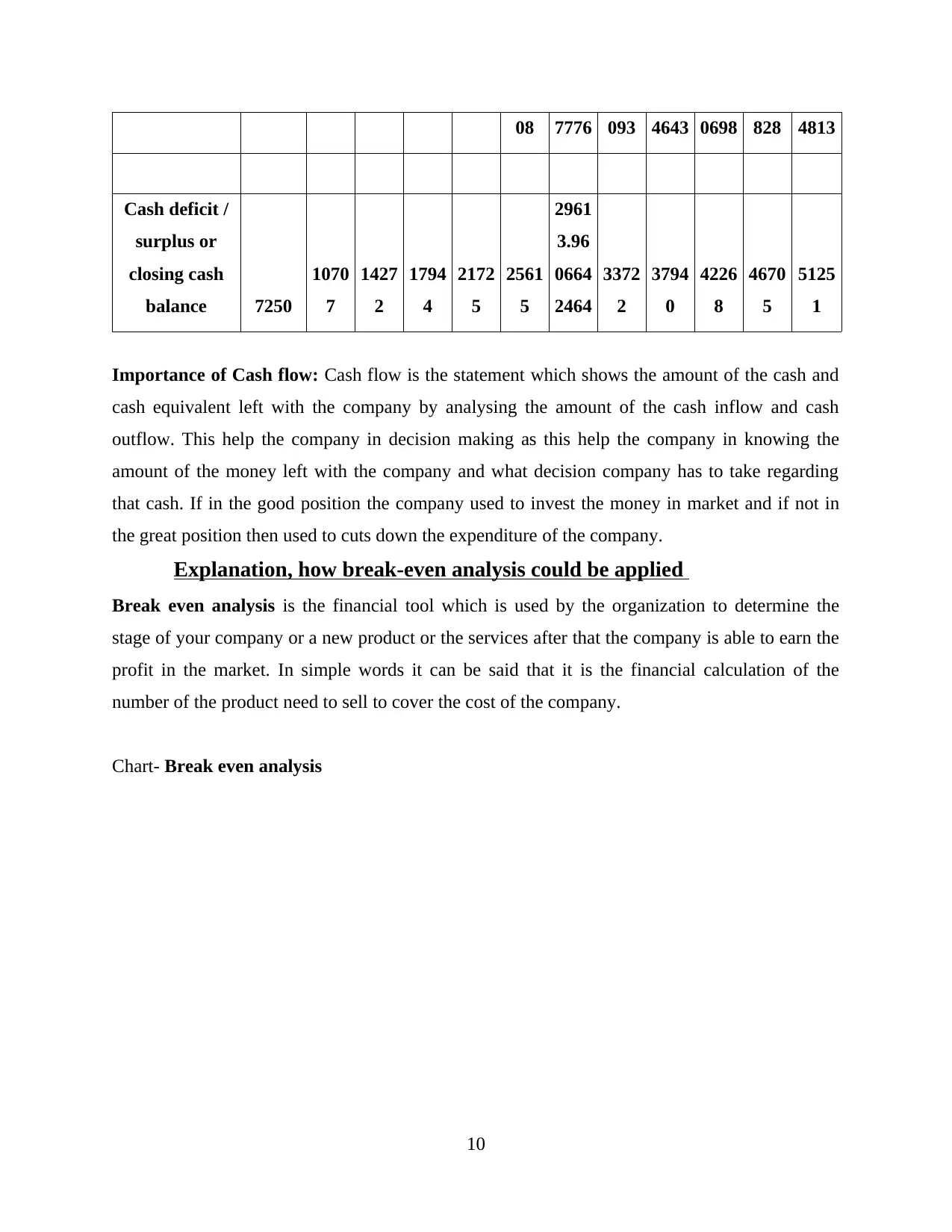
Importance of Cash flow: Cash flow is the statement which shows the amount of the cash and
cash equivalent left with the company by analysing the amount of the cash inflow and cash
outflow. This help the company in decision making as this help the company in knowing the
amount of the money left with the company and what decision company has to take regarding
that cash. If in the good position the company used to invest the money in market and if not in
the great position then used to cuts down the expenditure of the company.
Explanation, how break-even analysis could be applied
Break even analysis is the financial tool which is used by the organization to determine the
stage of your company or a new product or the services after that the company is able to earn the
profit in the market. In simple words it can be said that it is the financial calculation of the
number of the product need to sell to cover the cost of the company.
Chart- Break even analysis
10
Cash deficit /
surplus or
closing cash
balance 7250
1070
7
1427
2
1794
4
2172
5
2561
5
2961
3.96
0664
2464
3372
2
3794
0
4226
8
4670
5
5125
1
Importance of Cash flow: Cash flow is the statement which shows the amount of the cash and
cash equivalent left with the company by analysing the amount of the cash inflow and cash
outflow. This help the company in decision making as this help the company in knowing the
amount of the money left with the company and what decision company has to take regarding
that cash. If in the good position the company used to invest the money in market and if not in
the great position then used to cuts down the expenditure of the company.
Explanation, how break-even analysis could be applied
Break even analysis is the financial tool which is used by the organization to determine the
stage of your company or a new product or the services after that the company is able to earn the
profit in the market. In simple words it can be said that it is the financial calculation of the
number of the product need to sell to cover the cost of the company.
Chart- Break even analysis
10
⊘ This is a preview!⊘
Do you want full access?
Subscribe today to unlock all pages.
Trusted by 1+ million students worldwide

1 out of 19


Related Documents


Your All-in-One AI-Powered Toolkit for Academic Success.
+13062052269
info@desklib.com
Available 24*7 on WhatsApp / Email
![[object Object]](/_next/static/media/star-bottom.7253800d.svg)
Unlock your academic potential
Copyright © 2020–2026 A2Z Services. All Rights Reserved. Developed and managed by ZUCOL.