Report on Managing SMEs: Growth Strategies for The Furniture Practice
VerifiedAdded on 2022/12/15
|10
|2925
|423
Report
AI Summary
This report evaluates The Furniture Practice, a UK-based furniture manufacturing SME, analyzing its business model, competitive environment, and growth strategies. It examines the nature of the entrepreneur, the SME start-up process, and sources of competitive advantage using Porter's Five Forces and PEST analysis. The report details various development strategies such as business, operational, and transformational strategies, alongside challenges in running and managing a business. It explores the company's current growth and development strategies, including market and product development, and discusses available government support measures for SMEs in the UK. The report concludes with recommendations based on the findings.
Managing SMEs

Paraphrase This Document
Need a fresh take? Get an instant paraphrase of this document with our AI Paraphraser
Executive summary
The current project is based on evaluation of exiting UK SME and along with design better
growth and development strategy for the business. The current study is based on The furniture
practice that was founded in 1997, with a vision of creating and providing furniture for office
and house space. Along with this the Furniture practice is working for last 24 years in this sector
with interior professionals to gain improved success. The current study is based on secondary
sources of information which comprises of discussion about the nature of the entrepreneur
behind the venture, SME start-up processes, current level of demand and the competitive
environment, challenges of managing and running the business and SMEs current growth and
development strategy.
Table of Contents
Managing SMEs.......................................................................................................1
Executive summary..........................................................................................................................2
INTRODUCTION...........................................................................................................................1
FINDINGS.......................................................................................................................................1
The nature of entrepreneur behind venture.................................................................................1
Process of SME start-up..............................................................................................................2
Concept of business and competitive advantage sources............................................................2
Demand and competitive environment.......................................................................................3
Development and growth of business.........................................................................................3
challenges to run and manage a business:...................................................................................4
Current growth and development strategy of organisation.........................................................5
Available government support measures for SMEs....................................................................5
CONCLUSION................................................................................................................................6
RECOMMANDATIONS................................................................................................................6
REFERENCES................................................................................................................................7
The current project is based on evaluation of exiting UK SME and along with design better
growth and development strategy for the business. The current study is based on The furniture
practice that was founded in 1997, with a vision of creating and providing furniture for office
and house space. Along with this the Furniture practice is working for last 24 years in this sector
with interior professionals to gain improved success. The current study is based on secondary
sources of information which comprises of discussion about the nature of the entrepreneur
behind the venture, SME start-up processes, current level of demand and the competitive
environment, challenges of managing and running the business and SMEs current growth and
development strategy.
Table of Contents
Managing SMEs.......................................................................................................1
Executive summary..........................................................................................................................2
INTRODUCTION...........................................................................................................................1
FINDINGS.......................................................................................................................................1
The nature of entrepreneur behind venture.................................................................................1
Process of SME start-up..............................................................................................................2
Concept of business and competitive advantage sources............................................................2
Demand and competitive environment.......................................................................................3
Development and growth of business.........................................................................................3
challenges to run and manage a business:...................................................................................4
Current growth and development strategy of organisation.........................................................5
Available government support measures for SMEs....................................................................5
CONCLUSION................................................................................................................................6
RECOMMANDATIONS................................................................................................................6
REFERENCES................................................................................................................................7

⊘ This is a preview!⊘
Do you want full access?
Subscribe today to unlock all pages.

Trusted by 1+ million students worldwide
INTRODUCTION
SMEs stand for small and mid-sized enterprises, which have to keep a certain number of
employees, assets and specific turnover or revenue for particular period. Every country defines
SMEs in different way because they have set a limit for employees turnover and way of working
for such organisations. A small a according to section 382 and 465 of the companies act 2006 in
the UK, should not have a turnover of more than £6.5 million, and balance sheet of such
companies should not exceed more than £3.26 million. Maximum number of employees in such
organisations cannot be more than 50 employees. According to companies act of UK a medium
sized company should have a turnover under £12.9 million and it should have less than 250
employees. This assessment is in context of UK based company ‘The Furniture practice’ which
is a furniture manufacturing company for architects and home designers. The current report is
based in analysis of secondary sources of information collected with the help of online article
and journals.
FINDINGS
In this report is based on an independent furniture company, further this assessment is
describing process of starting a SME business along with various sources of competitive
advantage and concept of business. Porter's five forces framework is used in finding competitive
advantage of business . To measure and analyse competitive environment PEST analysis is used.
Various development strategies such as business strategy, operational strategy and
transformational strategy are also explained as well as challenges to run and manage a business
are also explained in this report. Growth strategies for business and help or support measures
which are provided by government to SMEs are also described in this report.
The nature of entrepreneur behind venture
The furniture practice was founded in 1997, with a vision of creating and providing
furniture for office and house space. Company is working for last 24 years in this sector with
interior professionals. Firm was started as an independent furniture company and currently
company have 450 suppliers and manufacturers. Owner of company started this venture to
provide furniture for hotels, restaurants, co-working spaces, rent properties and sports stadiums.
1
SMEs stand for small and mid-sized enterprises, which have to keep a certain number of
employees, assets and specific turnover or revenue for particular period. Every country defines
SMEs in different way because they have set a limit for employees turnover and way of working
for such organisations. A small a according to section 382 and 465 of the companies act 2006 in
the UK, should not have a turnover of more than £6.5 million, and balance sheet of such
companies should not exceed more than £3.26 million. Maximum number of employees in such
organisations cannot be more than 50 employees. According to companies act of UK a medium
sized company should have a turnover under £12.9 million and it should have less than 250
employees. This assessment is in context of UK based company ‘The Furniture practice’ which
is a furniture manufacturing company for architects and home designers. The current report is
based in analysis of secondary sources of information collected with the help of online article
and journals.
FINDINGS
In this report is based on an independent furniture company, further this assessment is
describing process of starting a SME business along with various sources of competitive
advantage and concept of business. Porter's five forces framework is used in finding competitive
advantage of business . To measure and analyse competitive environment PEST analysis is used.
Various development strategies such as business strategy, operational strategy and
transformational strategy are also explained as well as challenges to run and manage a business
are also explained in this report. Growth strategies for business and help or support measures
which are provided by government to SMEs are also described in this report.
The nature of entrepreneur behind venture
The furniture practice was founded in 1997, with a vision of creating and providing
furniture for office and house space. Company is working for last 24 years in this sector with
interior professionals. Firm was started as an independent furniture company and currently
company have 450 suppliers and manufacturers. Owner of company started this venture to
provide furniture for hotels, restaurants, co-working spaces, rent properties and sports stadiums.
1
Paraphrase This Document
Need a fresh take? Get an instant paraphrase of this document with our AI Paraphraser
Process of SME start-up
To start a business first of all entrepreneur should have an effective business plan. In that
business plan unique selling point, business model, competition target market of company should
be clarified. Business name and logo should be decided by entrepreneur along with structure of
business. Company should be registered with HMRC, a billing system should be framed and if
business needs fund for starting then loan should be assessed. A small business account can be
open in a bank for financial transactions and requirements of company(Centobelli, Cerchione,
and Ertz, 2020). For setting up company all the legalities such as contracts, employment
documentation and intellectual property should be prepared and filed with government
registrations offices online or offline.
Concept of business and competitive advantage sources
To start a new business, competition in the market should be analysed for better
establishment of firm in new market. Porter’s five forces model is a framework to analyse
competition in market for business. In this framework 5 forces are used such as supplier’s power,
buyer’s power, competitive rivalry, threat of new entrance, threat of substitute. All these forces
are explained below for chosen company.
Bargaining power of suppliers: for a furniture making company wood or timber is most
valuable resource. There are number of timber suppliers in market so businessman can easily get
raw material but getting pure timber or wood is very hard so maintain a good relation with
suppliers is necessary. Thus bargaining power of suppliers is low in this market.
Bargaining power of buyer: Buyers can impact strategies or policies of company by
reducing or increasing demands in the market(Centobelli, Cerchione, and Esposito, 2019). Local
and international furniture buyers have a huge impact on business’s sales and profit so
bargaining power of buyers is high in this business.
Competitive rivalry: There are number of furniture suppliers in local and international
market so there is a lot of competitive rivalry in market.
Threat of new entrance: New furniture companies come in market every day and they
can provide company a tough competition. A small furnishing business can be started with a
small finance and less hurdles so threat of new entrance in this industry is high.
2
To start a business first of all entrepreneur should have an effective business plan. In that
business plan unique selling point, business model, competition target market of company should
be clarified. Business name and logo should be decided by entrepreneur along with structure of
business. Company should be registered with HMRC, a billing system should be framed and if
business needs fund for starting then loan should be assessed. A small business account can be
open in a bank for financial transactions and requirements of company(Centobelli, Cerchione,
and Ertz, 2020). For setting up company all the legalities such as contracts, employment
documentation and intellectual property should be prepared and filed with government
registrations offices online or offline.
Concept of business and competitive advantage sources
To start a new business, competition in the market should be analysed for better
establishment of firm in new market. Porter’s five forces model is a framework to analyse
competition in market for business. In this framework 5 forces are used such as supplier’s power,
buyer’s power, competitive rivalry, threat of new entrance, threat of substitute. All these forces
are explained below for chosen company.
Bargaining power of suppliers: for a furniture making company wood or timber is most
valuable resource. There are number of timber suppliers in market so businessman can easily get
raw material but getting pure timber or wood is very hard so maintain a good relation with
suppliers is necessary. Thus bargaining power of suppliers is low in this market.
Bargaining power of buyer: Buyers can impact strategies or policies of company by
reducing or increasing demands in the market(Centobelli, Cerchione, and Esposito, 2019). Local
and international furniture buyers have a huge impact on business’s sales and profit so
bargaining power of buyers is high in this business.
Competitive rivalry: There are number of furniture suppliers in local and international
market so there is a lot of competitive rivalry in market.
Threat of new entrance: New furniture companies come in market every day and they
can provide company a tough competition. A small furnishing business can be started with a
small finance and less hurdles so threat of new entrance in this industry is high.
2
Threat of substitution: There are few substitutes of furniture product in market but these
products are not successful in substituting furniture products so threat of substitute in furniture
market is very low.
Demand and competitive environment
Any small and mid-sized business or a big enterprise if that business wants to stay in
demand and competitive in market, company will have to do research of particular market’s
environment(Cooper, 2018). Company can research market of industry with help of PEST
analysis which contains political, environmental, social, technological all these factors. This
framework is explained below for furniture industry.
Political: Political leaders, views of these leaders, and governing policies of any country
can impact business of company. United kingdom’s government is a stable government so it can
be helpful for expansion of furniture business.
Environmental: Wood is a natural resource which is collected from trees, and cutting
trees can impact climate of nation as well as world. So company have to follow all the
environmental laws prevailed by government and find other sustainable resources for raw
material.
Social: Cultural trends, age gape, income disposal and global warming can be some of
the social factors which can hamper company’s business. Change in attitude or behaviour of
consumers can also decrease or increase demand of furniture for business.
Technological: With help of latest technology business demand and sales can be
increased rapidly. If company goes with latest technological trends it can be helpful for success
of business. Digital marketing and online selling is also part of technological trends it can make a
huge impact on profit and sales of company also it can reduce cost of product.
Development and growth of business
Companies may use various growth and development strategies for evolving business
opportunities. Development strategy is a process of reducing cost, appropriate allocation of
resources, identifying and analysing effective plan of actions along with development and
growth of organisation as a whole(Ključnikov, Mura, and Sklenár, 2019). Following are some
development strategies used by companies.
Business strategy: This strategy is used by companies to decide what geographical
locations company have to cover, what segment of customers can be targeted by company, what
3
products are not successful in substituting furniture products so threat of substitute in furniture
market is very low.
Demand and competitive environment
Any small and mid-sized business or a big enterprise if that business wants to stay in
demand and competitive in market, company will have to do research of particular market’s
environment(Cooper, 2018). Company can research market of industry with help of PEST
analysis which contains political, environmental, social, technological all these factors. This
framework is explained below for furniture industry.
Political: Political leaders, views of these leaders, and governing policies of any country
can impact business of company. United kingdom’s government is a stable government so it can
be helpful for expansion of furniture business.
Environmental: Wood is a natural resource which is collected from trees, and cutting
trees can impact climate of nation as well as world. So company have to follow all the
environmental laws prevailed by government and find other sustainable resources for raw
material.
Social: Cultural trends, age gape, income disposal and global warming can be some of
the social factors which can hamper company’s business. Change in attitude or behaviour of
consumers can also decrease or increase demand of furniture for business.
Technological: With help of latest technology business demand and sales can be
increased rapidly. If company goes with latest technological trends it can be helpful for success
of business. Digital marketing and online selling is also part of technological trends it can make a
huge impact on profit and sales of company also it can reduce cost of product.
Development and growth of business
Companies may use various growth and development strategies for evolving business
opportunities. Development strategy is a process of reducing cost, appropriate allocation of
resources, identifying and analysing effective plan of actions along with development and
growth of organisation as a whole(Ključnikov, Mura, and Sklenár, 2019). Following are some
development strategies used by companies.
Business strategy: This strategy is used by companies to decide what geographical
locations company have to cover, what segment of customers can be targeted by company, what
3
⊘ This is a preview!⊘
Do you want full access?
Subscribe today to unlock all pages.
Trusted by 1+ million students worldwide
are the product and services which company can introduce to attract more customers. Senior
management of company creates business strategy and implant it for growth of organisation.
Transformational strategy: This strategy is basically used for transformation of
organisation as a whole. These strategies are generally used to change or transform human
resources, consultants, or organisational development(Nuseir, 2018.Písař, 2019). These
strategies are very complex to work on so these methods provide a significant result.
Operational strategy: In this strategy all processes and operations of organisation are
covered and strategies are made for them. What kind of technology company needs, which
operation or process needs improvement, what is the need of human resources, what capabilities
are needed to create or enhance in company for sustainable growth of company. All these
elements are controlled and directed with help of operational strategies of organisation.
challenges to run and manage a business:
Starting a business is a very big achievement in itself but maintain and running that
business in a sustainable way in future is very difficult. An entrepreneur has to face so many
difficulties such as managing brand, building a customer base, hiring right people for right work
and so on(SINGH, MONDAL, and DAS, 2020). Thus any small or large business have to face
numerous challenges for growth, some of these challenges are described further.
Balancing quality and growth: To grow company businessmen have to increase sale
and profit margin of company but sometimes small entrepreneurs have to compromise with
quality of their product to do so. Thus it can be very difficult for balancing quality of product or
service and growing business at the same time.
Tax compliances: There are various tax compliances which a businessman have to
follow for smooth running of business. These compliances can be time consuming and costly and
it can hamper SMEs business very much if company do not complete these.
Money management: SMEs doesn’t always have sufficient funds to manage all
operations of running a business. So sometimes it can be very difficult to allocate capital or
funds of company for management of different activities and operations of organisation.
Business transactions, tax compliances everything is dependent upon cash flow of company.
Client dependence: For a small business client diversification is very necessary because
if half income of business comes from 1 or 2 clients then businessman becomes dependent on
those clients. In such situation growth of business is impossible and business can be handicapped
4
management of company creates business strategy and implant it for growth of organisation.
Transformational strategy: This strategy is basically used for transformation of
organisation as a whole. These strategies are generally used to change or transform human
resources, consultants, or organisational development(Nuseir, 2018.Písař, 2019). These
strategies are very complex to work on so these methods provide a significant result.
Operational strategy: In this strategy all processes and operations of organisation are
covered and strategies are made for them. What kind of technology company needs, which
operation or process needs improvement, what is the need of human resources, what capabilities
are needed to create or enhance in company for sustainable growth of company. All these
elements are controlled and directed with help of operational strategies of organisation.
challenges to run and manage a business:
Starting a business is a very big achievement in itself but maintain and running that
business in a sustainable way in future is very difficult. An entrepreneur has to face so many
difficulties such as managing brand, building a customer base, hiring right people for right work
and so on(SINGH, MONDAL, and DAS, 2020). Thus any small or large business have to face
numerous challenges for growth, some of these challenges are described further.
Balancing quality and growth: To grow company businessmen have to increase sale
and profit margin of company but sometimes small entrepreneurs have to compromise with
quality of their product to do so. Thus it can be very difficult for balancing quality of product or
service and growing business at the same time.
Tax compliances: There are various tax compliances which a businessman have to
follow for smooth running of business. These compliances can be time consuming and costly and
it can hamper SMEs business very much if company do not complete these.
Money management: SMEs doesn’t always have sufficient funds to manage all
operations of running a business. So sometimes it can be very difficult to allocate capital or
funds of company for management of different activities and operations of organisation.
Business transactions, tax compliances everything is dependent upon cash flow of company.
Client dependence: For a small business client diversification is very necessary because
if half income of business comes from 1 or 2 clients then businessman becomes dependent on
those clients. In such situation growth of business is impossible and business can be handicapped
4
Paraphrase This Document
Need a fresh take? Get an instant paraphrase of this document with our AI Paraphraser
without financial resources. Thus it is essential to have more clients who are willing to pay on
time for a small and mid-sized business.
Hiring new employees: Hiring employees can be costly for a SME because of
insufficient funds. Hiring an employee includes so many things such as equipment, salary,
allowances and facilities so it can cost an entrepreneur a lot. Managing human resources is also
costly for small businesses.
Current growth and development strategy of organisation
Every business weather it is furniture or other business, it has to face competition in
market which creates existence threat and dominance of other competitors can also hamper
business of company(Singh, 2018). The furniture practice is using various growth strategies for
development and growth of company some of them are enlightened below.
Market development: This strategy is used to increase new customers in same
geographic location or developing market for existing product or services. The furniture practice
is increasing market for its furniture products in the UK market with help of market development
strategy.
Product development: The furniture practice serves numerous products to its customers,
so whenever company launches a new product firm uses product development strategy for
growth of that product in existing and new market. This strategy helps in researching market for
new product of company and launching of that product in market.
Market penetration: According to this growth strategy company has to sale in a
particular market. For rapid growth of small companies this strategy can be helpful because it
suggests to sale more to existing customers of company and SMEs such as The furniture practice
do not have much scope to increase their customers faster.
Available government support measures for SMEs
UK government helps and provides so many aids to small and mid-sized enterprises for
opening and growth of such organisations(Usman, and et. al. 2018). Following are some of the
support measures which are provided by government to SMEs.
The national loan guarantee scheme (NLGS): This scheme was launch on 20th march,
2012, it helps businesses to accesses loans at cheaper rates of interest such as 1%. According to
this scheme government provides guarantee on unsecured borrowings by bank.
5
time for a small and mid-sized business.
Hiring new employees: Hiring employees can be costly for a SME because of
insufficient funds. Hiring an employee includes so many things such as equipment, salary,
allowances and facilities so it can cost an entrepreneur a lot. Managing human resources is also
costly for small businesses.
Current growth and development strategy of organisation
Every business weather it is furniture or other business, it has to face competition in
market which creates existence threat and dominance of other competitors can also hamper
business of company(Singh, 2018). The furniture practice is using various growth strategies for
development and growth of company some of them are enlightened below.
Market development: This strategy is used to increase new customers in same
geographic location or developing market for existing product or services. The furniture practice
is increasing market for its furniture products in the UK market with help of market development
strategy.
Product development: The furniture practice serves numerous products to its customers,
so whenever company launches a new product firm uses product development strategy for
growth of that product in existing and new market. This strategy helps in researching market for
new product of company and launching of that product in market.
Market penetration: According to this growth strategy company has to sale in a
particular market. For rapid growth of small companies this strategy can be helpful because it
suggests to sale more to existing customers of company and SMEs such as The furniture practice
do not have much scope to increase their customers faster.
Available government support measures for SMEs
UK government helps and provides so many aids to small and mid-sized enterprises for
opening and growth of such organisations(Usman, and et. al. 2018). Following are some of the
support measures which are provided by government to SMEs.
The national loan guarantee scheme (NLGS): This scheme was launch on 20th march,
2012, it helps businesses to accesses loans at cheaper rates of interest such as 1%. According to
this scheme government provides guarantee on unsecured borrowings by bank.
5
Start-up loans: Government provides loan to those people who do not have sufficient
assets for keeping a track record to achieve traditional form of finance. In this scheme
government provides loan to young people between age of 18-30 who are living in England and
interested in starting a business, to help them stablish their own business government support
them.
Business finance partnership (BFP): Small business tranche: According to this
scheme the department of business, innovations and skills of UK invest through BFP up to
£100million in small businesses with help of non-traditional landing channels. Businesses who
have their turnover below £75 million can take this aid, this help is provided to increase non-
tradition finance.
CONCLUSION
This report concludes management of small and medium size enterprises business
development, growth process, various support measures provided by government and challenges
in running and managing such organisations are also explained in this assessment. Further, a
summarisation can also be made that Porter’s five forces model is a framework to analyse
competition in market for business comprises of discussion about Bargaining power of suppliers
Bargaining power of buyer, Competitive rivalry, Threat of new entrance and Threat of
substitution. A conclusion about the challenges to run and manage a business are also made
which consists of Balancing quality and growth, Tax compliances, Money management, Client
dependence and Hiring new employees.
RECOMMANDATIONS
For growth of SMEs, such organisations should try to balance quality of their product or
services with growth of company. These organisations can take help from government aids
provided for SMEs. By getting appropriate funding such small organisations can grow and
expand their business easily and can play an important role in supporting country's economy.
Further, making use of available government support measures for SMEs like The national loan
guarantee scheme (NLGS), Start-up loans and Business finance partnership (BFP) are also
recommend to support improved growth and development of SME within UK.
6
assets for keeping a track record to achieve traditional form of finance. In this scheme
government provides loan to young people between age of 18-30 who are living in England and
interested in starting a business, to help them stablish their own business government support
them.
Business finance partnership (BFP): Small business tranche: According to this
scheme the department of business, innovations and skills of UK invest through BFP up to
£100million in small businesses with help of non-traditional landing channels. Businesses who
have their turnover below £75 million can take this aid, this help is provided to increase non-
tradition finance.
CONCLUSION
This report concludes management of small and medium size enterprises business
development, growth process, various support measures provided by government and challenges
in running and managing such organisations are also explained in this assessment. Further, a
summarisation can also be made that Porter’s five forces model is a framework to analyse
competition in market for business comprises of discussion about Bargaining power of suppliers
Bargaining power of buyer, Competitive rivalry, Threat of new entrance and Threat of
substitution. A conclusion about the challenges to run and manage a business are also made
which consists of Balancing quality and growth, Tax compliances, Money management, Client
dependence and Hiring new employees.
RECOMMANDATIONS
For growth of SMEs, such organisations should try to balance quality of their product or
services with growth of company. These organisations can take help from government aids
provided for SMEs. By getting appropriate funding such small organisations can grow and
expand their business easily and can play an important role in supporting country's economy.
Further, making use of available government support measures for SMEs like The national loan
guarantee scheme (NLGS), Start-up loans and Business finance partnership (BFP) are also
recommend to support improved growth and development of SME within UK.
6
⊘ This is a preview!⊘
Do you want full access?
Subscribe today to unlock all pages.
Trusted by 1+ million students worldwide
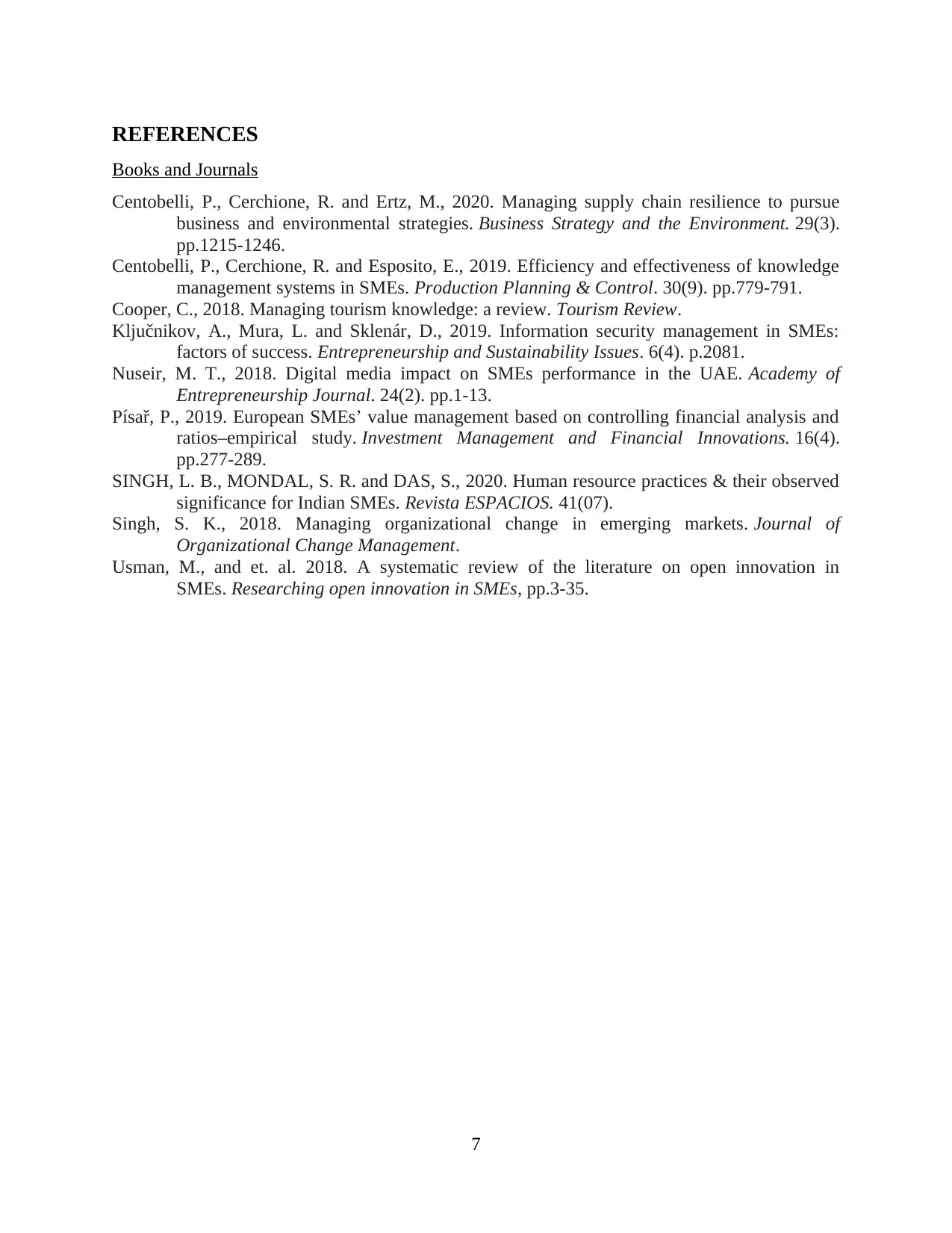
REFERENCES
Books and Journals
Centobelli, P., Cerchione, R. and Ertz, M., 2020. Managing supply chain resilience to pursue
business and environmental strategies. Business Strategy and the Environment. 29(3).
pp.1215-1246.
Centobelli, P., Cerchione, R. and Esposito, E., 2019. Efficiency and effectiveness of knowledge
management systems in SMEs. Production Planning & Control. 30(9). pp.779-791.
Cooper, C., 2018. Managing tourism knowledge: a review. Tourism Review.
Ključnikov, A., Mura, L. and Sklenár, D., 2019. Information security management in SMEs:
factors of success. Entrepreneurship and Sustainability Issues. 6(4). p.2081.
Nuseir, M. T., 2018. Digital media impact on SMEs performance in the UAE. Academy of
Entrepreneurship Journal. 24(2). pp.1-13.
Písař, P., 2019. European SMEs’ value management based on controlling financial analysis and
ratios–empirical study. Investment Management and Financial Innovations. 16(4).
pp.277-289.
SINGH, L. B., MONDAL, S. R. and DAS, S., 2020. Human resource practices & their observed
significance for Indian SMEs. Revista ESPACIOS. 41(07).
Singh, S. K., 2018. Managing organizational change in emerging markets. Journal of
Organizational Change Management.
Usman, M., and et. al. 2018. A systematic review of the literature on open innovation in
SMEs. Researching open innovation in SMEs, pp.3-35.
7
Books and Journals
Centobelli, P., Cerchione, R. and Ertz, M., 2020. Managing supply chain resilience to pursue
business and environmental strategies. Business Strategy and the Environment. 29(3).
pp.1215-1246.
Centobelli, P., Cerchione, R. and Esposito, E., 2019. Efficiency and effectiveness of knowledge
management systems in SMEs. Production Planning & Control. 30(9). pp.779-791.
Cooper, C., 2018. Managing tourism knowledge: a review. Tourism Review.
Ključnikov, A., Mura, L. and Sklenár, D., 2019. Information security management in SMEs:
factors of success. Entrepreneurship and Sustainability Issues. 6(4). p.2081.
Nuseir, M. T., 2018. Digital media impact on SMEs performance in the UAE. Academy of
Entrepreneurship Journal. 24(2). pp.1-13.
Písař, P., 2019. European SMEs’ value management based on controlling financial analysis and
ratios–empirical study. Investment Management and Financial Innovations. 16(4).
pp.277-289.
SINGH, L. B., MONDAL, S. R. and DAS, S., 2020. Human resource practices & their observed
significance for Indian SMEs. Revista ESPACIOS. 41(07).
Singh, S. K., 2018. Managing organizational change in emerging markets. Journal of
Organizational Change Management.
Usman, M., and et. al. 2018. A systematic review of the literature on open innovation in
SMEs. Researching open innovation in SMEs, pp.3-35.
7

1 out of 10


Related Documents


Your All-in-One AI-Powered Toolkit for Academic Success.
+13062052269
info@desklib.com
Available 24*7 on WhatsApp / Email
![[object Object]](/_next/static/media/star-bottom.7253800d.svg)
Unlock your academic potential
Copyright © 2020–2026 A2Z Services. All Rights Reserved. Developed and managed by ZUCOL.