Stakeholder Salience Analysis and Sustainability Management Report

Verified

Added on  2022/09/18

|5
|874
|24
Report
AI Summary
This report provides a comprehensive analysis of stakeholder salience, drawing upon the Mitchell et al. Typology Model to categorize stakeholders based on power, legitimacy, and urgency. It examines the application of this model to Metropolitan Inc., identifying internal stakeholders like shareholders and employees, and external stakeholders including clients, government agencies, and NGOs. The report highlights the neglect of discretionary and dangerous stakeholders within the company, emphasizing the importance of recognizing and involving all stakeholders in decision-making processes. Recommendations include acknowledging all stakeholders, treating them as equal partners, and reforming organizational culture to accommodate their needs. The analysis underscores the significance of stakeholder management for achieving sustainable business practices and overall company success. The report also includes references to relevant academic literature on stakeholder theory and management.
Document Page
Running head: MANAGING FOR SUSTAINABILITY 1
Managing for Sustainability
Name
Institution
tabler-icon-diamond-filled.svg

Paraphrase This Document

Need a fresh take? Get an instant paraphrase of this document with our AI Paraphraser
Document Page
MANAGING FOR SUSTAINABILITY 2
Managing for Sustainability
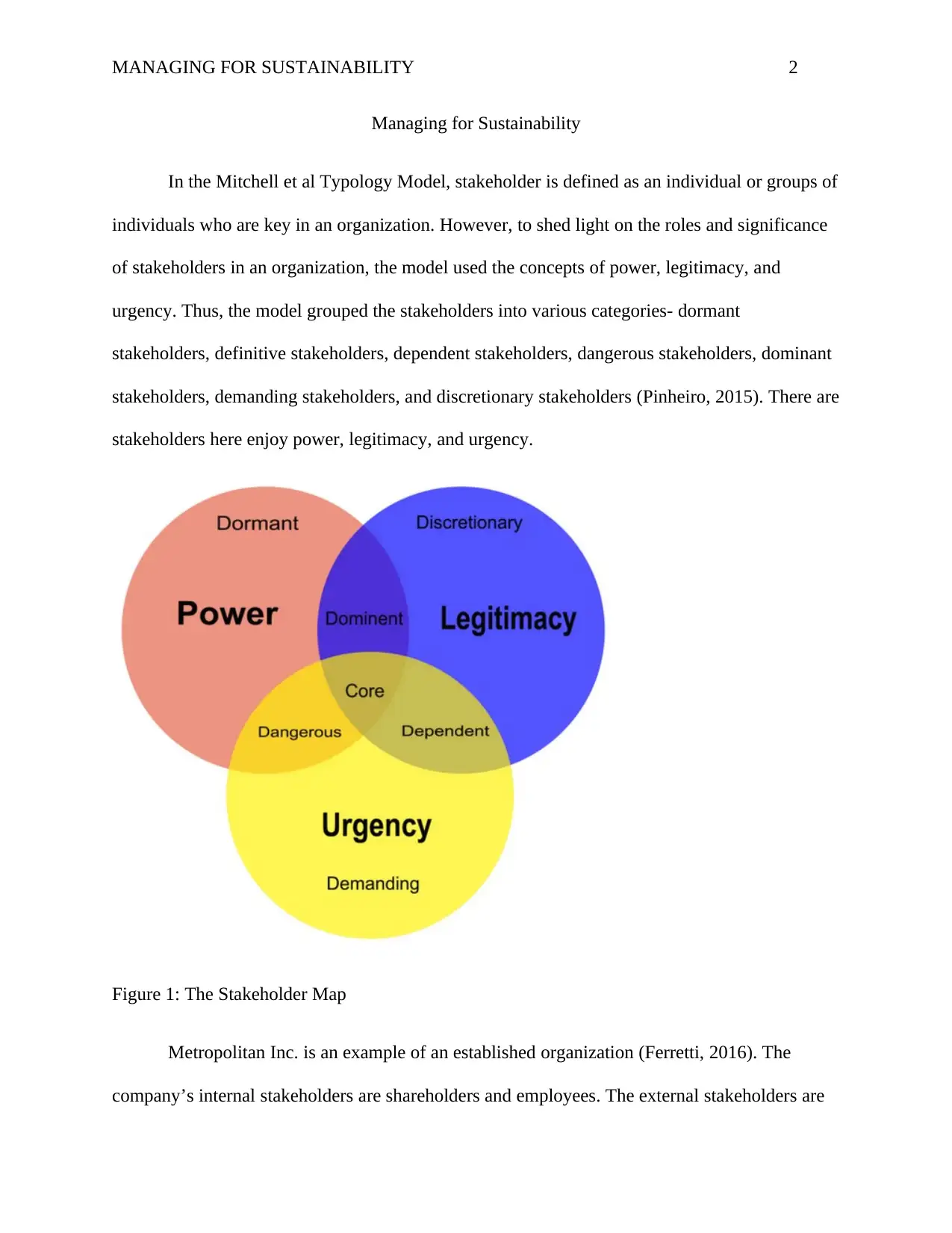
In the Mitchell et al Typology Model, stakeholder is defined as an individual or groups of
individuals who are key in an organization. However, to shed light on the roles and significance
of stakeholders in an organization, the model used the concepts of power, legitimacy, and
urgency. Thus, the model grouped the stakeholders into various categories- dormant
stakeholders, definitive stakeholders, dependent stakeholders, dangerous stakeholders, dominant
stakeholders, demanding stakeholders, and discretionary stakeholders (Pinheiro, 2015). There are
stakeholders here enjoy power, legitimacy, and urgency.
Figure 1: The Stakeholder Map
Metropolitan Inc. is an example of an established organization (Ferretti, 2016). The
company’s internal stakeholders are shareholders and employees. The external stakeholders are
Document Page
MANAGING FOR SUSTAINABILITY 3
clients, labor unions, distributors, suppliers, professional associations, government agencies,
local communities, general public, research centers, NGOs, media, future generations, schools,
and competitors. Unfortunately, there is a section of the company’s stakeholders which is
largely-ignored.
The first category of stakeholders which is neglected in the company is the discretionary
stakeholders. As its name suggests, discretionary stakeholders are external stakeholders who are
mere recipients of the company’s philanthropy. It includes the Non-Governmental Organizations
(NGOs) and other charities which depend on the company’s Corporate Social Responsibility
(CSR) initiatives. From the research conducted, it is evident that the management of this
organization has been largely-ignoring these stakeholders.
The second category of the stakeholders which is neglected in the company is the
dangerous stakeholders. Indeed, dangerous stakeholders pose danger to the company because
they enjoy a high urgency. The category comprises of external stakeholders like the employees,
local community, professional associations, and trade union movements. The coercive means
might be dangerous as it might entail some elements of violence, revolt, and sabotage. In this
company, the dangerous stakeholders are seriously-ignored (Burga & Rezania, 2016). Although
the management considers them as stakeholders, their demands are rarely addressed.
The Rectification of the Situation
What is happening at the Metropolitan Inc. is not good at all. It is a clear sign that the
management of this company has been mismanaging its stakeholders. In the Mitchell et al
Typology Model, the dormant stakeholders, definitive stakeholders, dependent stakeholders,
dangerous stakeholders, dominant stakeholders, demanding stakeholders, and discretionary
Document Page
MANAGING FOR SUSTAINABILITY 4
stakeholders are all important. Although their contributions vary, each of these stakeholders
needs not to be neglected whatever costs. In this regard, to rectify the situation, the paper gives
some recommendations.
First and foremost, all the stakeholders must be acknowledged. None of them should be
ignored or neglected because they all have important contributions to make towards the
prosperity of the company. The company should refrain from such kind of discrimination. It is
unethical to give some stakeholders preferential treatment while ignoring others. Instead, what
should be done is to recognize everyone and treat them as equal partners regardless of the
position that they hold in the company (Ali, 2017). The management must be concerned about
the internal and external stakeholders since it might not be possible to succeed without them.
Any form of dissatisfaction or dissent can cripple the company and prevent it from
accomplishing its ultimate goals. Secondly, the management should involve all the stakeholders
in the major decision-making processes (Aaltonen & Kujala, 2016). Involvement is good because
it brings cohesion, understanding, motivates, and enhances the achievement of goals. Hence, it is
a high-time the company reforms its organizational culture and policies so as to bring changes
aimed at accommodating all its stakeholders.
tabler-icon-diamond-filled.svg

Paraphrase This Document

Need a fresh take? Get an instant paraphrase of this document with our AI Paraphraser
Document Page
MANAGING FOR SUSTAINABILITY 5
References
Aaltonen, K., & Kujala, J. (2016). Towards an improved understanding of project stakeholder
landscapes. International Journal of Project Management, 34(8), 1537-1552.
Ali, M. A. (2017). Stakeholder salience for stakeholder firms: An attempt to reframe an
important heuristic device. Journal of Business Ethics, 144(1), 153-168.
Burga, R., & Rezania, D. (2016). Stakeholder theory in social entrepreneurship: a descriptive
case study. Journal of Global Entrepreneurship Research, 6(1), 4.
Ferretti, V. (2016). From stakeholders analysis to cognitive mapping and Multi-Attribute Value
Theory: An integrated approach for policy support. European Journal of Operational
Research, 253(2), 524-541.
Pinheiro, R. (2015). The role of internal and external stakeholders. In Higher Education in the
BRICS Countries (pp. 43-57). Springer, Dordrecht.
chevron_up_icon
1 out of 5
circle_padding
hide_on_mobile
zoom_out_icon
[object Object]