Detailed Reflection Report: Managing Strategy Business Simulation
VerifiedAdded on 2020/04/13
|18
|5157
|169
Report
AI Summary
This report provides a detailed reflection on a business simulation game focused on managing strategy within the pharmaceutical industry. It analyzes the competitive strategies employed by B Pharmaceutical Company, examining product, process, marketing, and organizational innovations to achieve a competitive edge in a market characterized by both intense competition and the potential for mergers and acquisitions. The report includes an industry overview using PESTEL and SWOT analyses, evaluating strengths, weaknesses, opportunities, and threats. The company overview explores B Pharmaceutical's mission, vision, market structure, and competitive landscape. The report also delves into decision-making processes, the analysis of final results, and the application of underlying strategic principles. Key learning points about strategy are highlighted, offering a comprehensive understanding of strategic management, visioning, and thinking within the context of the business simulation game.
Running Head: MANAGING STRATEGY 1
MANAGING STRATEGY
Name:
Institution:
Course Code:
MANAGING STRATEGY
Name:
Institution:
Course Code:

Paraphrase This Document
Need a fresh take? Get an instant paraphrase of this document with our AI Paraphraser
MANAGING STRATEGY 2
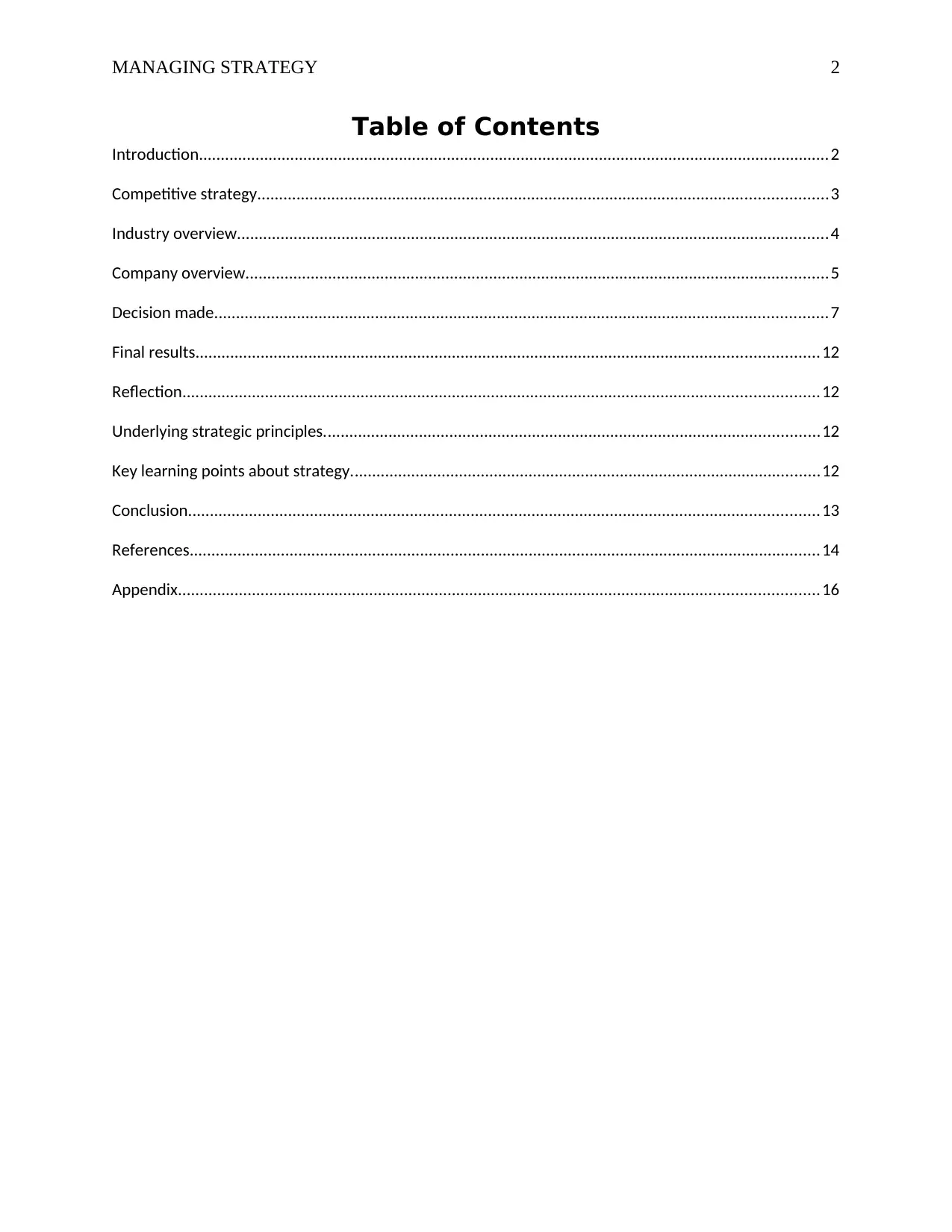
Table of Contents
Introduction.................................................................................................................................................2
Competitive strategy...................................................................................................................................3
Industry overview........................................................................................................................................4
Company overview......................................................................................................................................5
Decision made.............................................................................................................................................7
Final results...............................................................................................................................................12
Reflection..................................................................................................................................................12
Underlying strategic principles..................................................................................................................12
Key learning points about strategy............................................................................................................12
Conclusion.................................................................................................................................................13
References.................................................................................................................................................14
Appendix...................................................................................................................................................16
Table of Contents
Introduction.................................................................................................................................................2
Competitive strategy...................................................................................................................................3
Industry overview........................................................................................................................................4
Company overview......................................................................................................................................5
Decision made.............................................................................................................................................7
Final results...............................................................................................................................................12
Reflection..................................................................................................................................................12
Underlying strategic principles..................................................................................................................12
Key learning points about strategy............................................................................................................12
Conclusion.................................................................................................................................................13
References.................................................................................................................................................14
Appendix...................................................................................................................................................16
MANAGING STRATEGY 3
Introduction.
The main objectives of this particular report is to critically analyze different events or sequence
of events that follow under business simulation game as a reflection report. The main items to be
considered in the reflection report include competitive strategy, industry overview, company
overview, decision making, analysis of final results, reflection of these results, analysis of
underlying strategic principles and key learning points about strategy. Finally, all these events
will be summarized so as to generate a conclusive reflection report. For the analysis of
competitive strategy, the main consideration is mechanism applied by B-Company so as to
achieve competitive advantage in the market (Arnold, 2010). What the company have done along
with what need to be done so as to outdo the competitors. In order to determine whether the
company has achieved competitive advantage in the market, various ratios can be considered
such as earning per share, return on equity, operating profit margin, net profit margin, operating
ratios, credit rating ratios along with other financial ratio measures.
In addition, the overview of the industry under consideration involve analysis of macro
environment based on PESTEL model and SWOT analysis. In that case, we will be in clear and
distinct position to determine the strengths weaknesses, opportunities and threats facing our B-
Company. Another event to be considered is company overview. This section involves initiation
of missions and visions of the company. We also consider the type of company based on
products and services to be offer to consumers and potential customers (Arnold, 2010). In that
case, a market structure need to be determined so as to lay down specific strategies to achieve
competitive advantage. By assessing all those requirements, we will be in a position to determine
strengths and weaknesses of the company and what the company can potentially achieve in the
long run.
Another aspect is strategic principles along with key learning points about those strategic
principles. Aspects to be considered in strategic principles will include strategic management,
strategic visioning and strategic thinking.
I believe if all the above sequence of events are to be analyzed critically, then the business
simulation game reflection report will be on significant use to B-Company.
Introduction.
The main objectives of this particular report is to critically analyze different events or sequence
of events that follow under business simulation game as a reflection report. The main items to be
considered in the reflection report include competitive strategy, industry overview, company
overview, decision making, analysis of final results, reflection of these results, analysis of
underlying strategic principles and key learning points about strategy. Finally, all these events
will be summarized so as to generate a conclusive reflection report. For the analysis of
competitive strategy, the main consideration is mechanism applied by B-Company so as to
achieve competitive advantage in the market (Arnold, 2010). What the company have done along
with what need to be done so as to outdo the competitors. In order to determine whether the
company has achieved competitive advantage in the market, various ratios can be considered
such as earning per share, return on equity, operating profit margin, net profit margin, operating
ratios, credit rating ratios along with other financial ratio measures.
In addition, the overview of the industry under consideration involve analysis of macro
environment based on PESTEL model and SWOT analysis. In that case, we will be in clear and
distinct position to determine the strengths weaknesses, opportunities and threats facing our B-
Company. Another event to be considered is company overview. This section involves initiation
of missions and visions of the company. We also consider the type of company based on
products and services to be offer to consumers and potential customers (Arnold, 2010). In that
case, a market structure need to be determined so as to lay down specific strategies to achieve
competitive advantage. By assessing all those requirements, we will be in a position to determine
strengths and weaknesses of the company and what the company can potentially achieve in the
long run.
Another aspect is strategic principles along with key learning points about those strategic
principles. Aspects to be considered in strategic principles will include strategic management,
strategic visioning and strategic thinking.
I believe if all the above sequence of events are to be analyzed critically, then the business
simulation game reflection report will be on significant use to B-Company.
⊘ This is a preview!⊘
Do you want full access?
Subscribe today to unlock all pages.

Trusted by 1+ million students worldwide
MANAGING STRATEGY 4
Competitive strategy.
In a marketplace, a company need to lay down strategies that can be incorporated and integrated
with other aspect of business operations so as to offer positive progress in business growth and
development. In that connection, we find out that different companies aim at laying out strategies
to outdo their competitors. In a perfect market structure, the level of competition is quite high
although there are large number of buyers and sellers of goods and service (Arnold, 2010). In a
monopoly market structure, the level of competition is reduced. From business simulation game,
the type of structure in terms of market is not monopoly but a perfect market structure. In that
case, the business need strong business and profit oriented strategies o as to outdo the
competitors. In the long run, the company will be able to achieve competitive advantage.
One of competitive strategy to be considered relate to products and services offered by the
company. There is need to incorporate focal innovations which can be primarily categorized into
product innovation, process innovation, marketing innovation and organizational innovation. The
focal innovation will assist the company to improve the four critical aspects underlying the
company (Clardy, 2013). In product innovation, the company need to advance the products in
terms of product management, product design, product promotion and pricing. These aspects are
likely to attract many consumers and potential customers into an advantage to the company.
Process innovation involves improvement in production process in terms of instrument and
machinery. Marketing innovation involves venturing into wider markets to recruit more future
customers. These aspects will facilitate business growth and will pave way to achieving
competitive advantage.
Another competitive strategy applicable to B-Company is mergers, acquisition and
amalgamation. These processes involves identification of smaller business operating in similar
capacity as B-Company. In that case, the company may decide to absorb them so as to operate as
a single entity (Clardy, 2013). In that case, the company will reduce competition by creation of
mergers, amalgamation and acquisition enterprises. All the consumers and potential customers
are redirected to a common pool. This create a form of monopoly making the company to
achieve competitive advantage.
Competitive strategy.
In a marketplace, a company need to lay down strategies that can be incorporated and integrated
with other aspect of business operations so as to offer positive progress in business growth and
development. In that connection, we find out that different companies aim at laying out strategies
to outdo their competitors. In a perfect market structure, the level of competition is quite high
although there are large number of buyers and sellers of goods and service (Arnold, 2010). In a
monopoly market structure, the level of competition is reduced. From business simulation game,
the type of structure in terms of market is not monopoly but a perfect market structure. In that
case, the business need strong business and profit oriented strategies o as to outdo the
competitors. In the long run, the company will be able to achieve competitive advantage.
One of competitive strategy to be considered relate to products and services offered by the
company. There is need to incorporate focal innovations which can be primarily categorized into
product innovation, process innovation, marketing innovation and organizational innovation. The
focal innovation will assist the company to improve the four critical aspects underlying the
company (Clardy, 2013). In product innovation, the company need to advance the products in
terms of product management, product design, product promotion and pricing. These aspects are
likely to attract many consumers and potential customers into an advantage to the company.
Process innovation involves improvement in production process in terms of instrument and
machinery. Marketing innovation involves venturing into wider markets to recruit more future
customers. These aspects will facilitate business growth and will pave way to achieving
competitive advantage.
Another competitive strategy applicable to B-Company is mergers, acquisition and
amalgamation. These processes involves identification of smaller business operating in similar
capacity as B-Company. In that case, the company may decide to absorb them so as to operate as
a single entity (Clardy, 2013). In that case, the company will reduce competition by creation of
mergers, amalgamation and acquisition enterprises. All the consumers and potential customers
are redirected to a common pool. This create a form of monopoly making the company to
achieve competitive advantage.
Paraphrase This Document
Need a fresh take? Get an instant paraphrase of this document with our AI Paraphraser
MANAGING STRATEGY 5
Industry overview.
In this section, we consider PESTEL model that can be integrated with macro environmental
factors affecting the performance of the company. PESTEL model can be defined typically as a
framework that marketers and business operators apply to monitor as well as to analyze macro
environmental factors (Chopra, 2012). These factors relate to external marketing environment.
Again, in order to analyze strengths, weaknesses, opportunities and threats in an organization,
then marketers apply SWOT analysis. To start with, SWOT analysis is a four sided analysis
applied by investors and business analysts so as to assess viability, feasibility and vulnerability
of a given organization (Chopra, 2012). Strengths of B-Company can be stated as follows. The
company has potential customers who maintain cash flows. In that case, the company is able to
maintain general operation reserves. Chances of insolvency are limited by potential customers.
Another strength is human resource. The employees of the company are highly skilled. This
make them flexible in performance. It also create diversity of activities. The other aspect of
SWOT analysis is weaknesses. The main weakness that B-Company face is meeting the demand
of consumers at good time. There are times when the company is faced by over demand from
consumers. In this case, we term such a period as boom season. This is a weakness because the
company is not able to determine the approach period for boom. We therefore maintain normal
supply for normal demand (Christopher, 2011). Again, SWOT analysis involves opportunities.
There are gaps that have not been filled in the market. These opportunities include venturing to
different areas for purposes of creating business. This in return is going to generate a lot of
reserve for the company. The last aspect of SWOT analysis is threat. There are certain threats
that arise in the process of business operations. These include unfavorable trade restriction set by
governing bodies and regulation authorities, unhealthy competition, unfavorable terms of sale
and high costs of operations. SWOT analysis can be applied to address those factors.
On the other hand, PESTEL model represent the following macro environmental factors.
P-political, E-economic, S- social, T-technological, E-environmental and L-legal. To begin with,
political factors involve the level of business intervention by the government (Clardy, 2013). The
government has great influence in business operation in terms of policies, political stability, and
policies on foreign trade, taxation process, trade restrictions and labour law. Therefore, business
operators need to have those aspects in the formulation plan so as to fully adhere to all these
Industry overview.
In this section, we consider PESTEL model that can be integrated with macro environmental
factors affecting the performance of the company. PESTEL model can be defined typically as a
framework that marketers and business operators apply to monitor as well as to analyze macro
environmental factors (Chopra, 2012). These factors relate to external marketing environment.
Again, in order to analyze strengths, weaknesses, opportunities and threats in an organization,
then marketers apply SWOT analysis. To start with, SWOT analysis is a four sided analysis
applied by investors and business analysts so as to assess viability, feasibility and vulnerability
of a given organization (Chopra, 2012). Strengths of B-Company can be stated as follows. The
company has potential customers who maintain cash flows. In that case, the company is able to
maintain general operation reserves. Chances of insolvency are limited by potential customers.
Another strength is human resource. The employees of the company are highly skilled. This
make them flexible in performance. It also create diversity of activities. The other aspect of
SWOT analysis is weaknesses. The main weakness that B-Company face is meeting the demand
of consumers at good time. There are times when the company is faced by over demand from
consumers. In this case, we term such a period as boom season. This is a weakness because the
company is not able to determine the approach period for boom. We therefore maintain normal
supply for normal demand (Christopher, 2011). Again, SWOT analysis involves opportunities.
There are gaps that have not been filled in the market. These opportunities include venturing to
different areas for purposes of creating business. This in return is going to generate a lot of
reserve for the company. The last aspect of SWOT analysis is threat. There are certain threats
that arise in the process of business operations. These include unfavorable trade restriction set by
governing bodies and regulation authorities, unhealthy competition, unfavorable terms of sale
and high costs of operations. SWOT analysis can be applied to address those factors.
On the other hand, PESTEL model represent the following macro environmental factors.
P-political, E-economic, S- social, T-technological, E-environmental and L-legal. To begin with,
political factors involve the level of business intervention by the government (Clardy, 2013). The
government has great influence in business operation in terms of policies, political stability, and
policies on foreign trade, taxation process, trade restrictions and labour law. Therefore, business
operators need to have those aspects in the formulation plan so as to fully adhere to all these
MANAGING STRATEGY 6
political factors. The company need to respond to these policies so as to adhere to current and
future adjustments in the market.
Economic factors cannot be underestimated in the performance of any organization. These
factors determine profitability index of the business. They can be addressed in terms of economic
growth, rates of interests, inflationary and deflationary gaps, exchange rates as well as disposable
income of consumers. Moreover, social factors can be utilized via PESTEL model to determine
the level of attitude in a population under which the business operate. It is good to identify a
promising population so as prevent negative social cultural implication from affecting the
company (Cocca & Alberti, 2012). In addition, the aspect of technological factors fall under the
current trend in business operations. Technology is changing the mode of operation and
production process. This make work easier and time saving. Thus, the company need to employ
such factors so as to satisfy consumer’s lists of preference. For the case of environmental factors,
PESTEL model assert that the processes applied by the company need to be environmental
friendly. These factors integrate with legal factors where rules and regulations are set to monitor
and regulate the activities of the business under consideration.
Company overview.
Our company is called B Pharmaceutical Company. The company was set to deal with
production of drugs in medical sectors along with prescription of these drugs (Combs, Clapp-
Smith & Nadkarni, 2010). Therefore, the company operate as a service delivery unit as well
product delivery unit with the main objective of profit making. Although B Pharmaceutical
Company aims at making profits from production and sale of medical drugs, the company is
governed by ethical considerations so as to protect the consumers and to protect our workers in
the working environment (Daft, 2015). This can be demonstrated clearly and distinctly as stated
in our mission and vision.
Mission: To be a center of healthcare improvement and empowerment to the community through
well designed medical drugs.
Vision: To create self-awareness in health issues so as to prevent destruction of human life since
human life is our first priority.
From the above mission and vision, B Pharmaceutical Company tend to burn midnight oil so as
to innovate new medicinal drugs so as to mitigate damages caused by numerous diseases
political factors. The company need to respond to these policies so as to adhere to current and
future adjustments in the market.
Economic factors cannot be underestimated in the performance of any organization. These
factors determine profitability index of the business. They can be addressed in terms of economic
growth, rates of interests, inflationary and deflationary gaps, exchange rates as well as disposable
income of consumers. Moreover, social factors can be utilized via PESTEL model to determine
the level of attitude in a population under which the business operate. It is good to identify a
promising population so as prevent negative social cultural implication from affecting the
company (Cocca & Alberti, 2012). In addition, the aspect of technological factors fall under the
current trend in business operations. Technology is changing the mode of operation and
production process. This make work easier and time saving. Thus, the company need to employ
such factors so as to satisfy consumer’s lists of preference. For the case of environmental factors,
PESTEL model assert that the processes applied by the company need to be environmental
friendly. These factors integrate with legal factors where rules and regulations are set to monitor
and regulate the activities of the business under consideration.
Company overview.
Our company is called B Pharmaceutical Company. The company was set to deal with
production of drugs in medical sectors along with prescription of these drugs (Combs, Clapp-
Smith & Nadkarni, 2010). Therefore, the company operate as a service delivery unit as well
product delivery unit with the main objective of profit making. Although B Pharmaceutical
Company aims at making profits from production and sale of medical drugs, the company is
governed by ethical considerations so as to protect the consumers and to protect our workers in
the working environment (Daft, 2015). This can be demonstrated clearly and distinctly as stated
in our mission and vision.
Mission: To be a center of healthcare improvement and empowerment to the community through
well designed medical drugs.
Vision: To create self-awareness in health issues so as to prevent destruction of human life since
human life is our first priority.
From the above mission and vision, B Pharmaceutical Company tend to burn midnight oil so as
to innovate new medicinal drugs so as to mitigate damages caused by numerous diseases
⊘ This is a preview!⊘
Do you want full access?
Subscribe today to unlock all pages.
Trusted by 1+ million students worldwide
MANAGING STRATEGY 7
affecting human beings all over the globe (DeTombe, 2012). For that reason, B Pharmaceutical
Company is a global company. The company is operated by a team of highly qualified staffs in
all departments. The organizational structure of B Pharmaceutical Company is well established
so as to monitor business activities from all parts of the globe where the company hold shares.
Since B Pharmaceutical Company operate globally, the market structure is quite big. This is a
perfect market structure with many buyers and sellers. In that case, it is absolutely true that the
levels of competition is also quite high (Fletcher, 2012). Nevertheless, B Pharmaceutical
Company has managed to venture many market destinations all over the globe. The head office
for B Pharmaceutical Company is based in China. Many outlets are operating on behalf of B
Pharmaceutical Company within China and other parts of the world such as America. Africa,
other parts of Asia and Europe. The company have employed over 750,000 employees in the
entire globe.
The most important thing to note is that despite that wide venture, B Pharmaceutical Company
face a lot of competition from several firms that deal with production and sales of medical drugs
(Gogu, 2017). There is healthy competition from at least five firms. The reason for stating that
the competition is healthy is based in the area of coverage. A single company such as B
Pharmaceutical Company cannot satisfy the enormous demand for medical drugs all over the
globe. However, each firm aim at becoming the major producer and supplier of these
commodity. This is where the competition generate. In the near future, B Pharmaceutical
Company aim at absorbing smaller producers and suppliers of medical drugs via mergers,
amalgamation and acquisition. This will help the company to achieve competitive advantage
over the other five firms.
B Pharmaceutical Company has demonstrated great potentials. However, there has been several
bottlenecks which become a weakness to B Pharmaceutical Company (Heranz, 2010). The main
potential strength for the company is ability to produce quality medical drugs to treat many
illnesses. The company has a team of researchers whose main objective is to research on various
illnesses along with most appropriate medical recommendations. On the other hand, B
Pharmaceutical Company has weakness to meet the demand of consumers within the most
appropriate time. This is because the stock for shipment to overseas market is faced by delays in
shipment process. This open a gap that become an advantage to our competitors. However, B
Pharmaceutical Company has a clear competitive position since there are some markets that
affecting human beings all over the globe (DeTombe, 2012). For that reason, B Pharmaceutical
Company is a global company. The company is operated by a team of highly qualified staffs in
all departments. The organizational structure of B Pharmaceutical Company is well established
so as to monitor business activities from all parts of the globe where the company hold shares.
Since B Pharmaceutical Company operate globally, the market structure is quite big. This is a
perfect market structure with many buyers and sellers. In that case, it is absolutely true that the
levels of competition is also quite high (Fletcher, 2012). Nevertheless, B Pharmaceutical
Company has managed to venture many market destinations all over the globe. The head office
for B Pharmaceutical Company is based in China. Many outlets are operating on behalf of B
Pharmaceutical Company within China and other parts of the world such as America. Africa,
other parts of Asia and Europe. The company have employed over 750,000 employees in the
entire globe.
The most important thing to note is that despite that wide venture, B Pharmaceutical Company
face a lot of competition from several firms that deal with production and sales of medical drugs
(Gogu, 2017). There is healthy competition from at least five firms. The reason for stating that
the competition is healthy is based in the area of coverage. A single company such as B
Pharmaceutical Company cannot satisfy the enormous demand for medical drugs all over the
globe. However, each firm aim at becoming the major producer and supplier of these
commodity. This is where the competition generate. In the near future, B Pharmaceutical
Company aim at absorbing smaller producers and suppliers of medical drugs via mergers,
amalgamation and acquisition. This will help the company to achieve competitive advantage
over the other five firms.
B Pharmaceutical Company has demonstrated great potentials. However, there has been several
bottlenecks which become a weakness to B Pharmaceutical Company (Heranz, 2010). The main
potential strength for the company is ability to produce quality medical drugs to treat many
illnesses. The company has a team of researchers whose main objective is to research on various
illnesses along with most appropriate medical recommendations. On the other hand, B
Pharmaceutical Company has weakness to meet the demand of consumers within the most
appropriate time. This is because the stock for shipment to overseas market is faced by delays in
shipment process. This open a gap that become an advantage to our competitors. However, B
Pharmaceutical Company has a clear competitive position since there are some markets that
Paraphrase This Document
Need a fresh take? Get an instant paraphrase of this document with our AI Paraphraser
MANAGING STRATEGY 8
demand on our supply alone. African market have been dominated by B Pharmaceutical
Company. This is our main consumer (Ikerionwu, Edgar & Gray, 2017). In that case, B
Pharmaceutical Company achieve competitive advantage over the other four firms since they
have not been able to venture African market.
Decision made.
From year 11 to 15, B Pharmaceutical Company has managed to make decisions which have
brought positive changes to the company. In that case, the company has managed to prepare
decision round schedule so as to govern the anticipated time to clear each decision. In this
section, the report will analyze the events that took place each year so as to determine the level
of decisions made along with corresponding implications.
Year 11.
Decision made.
Year 1, B Pharmaceutical Company made several decisions which intended to improve local
supply and sales of medical drugs within China.
1. B Pharmaceutical Company decided to sign a memorandum of understating with Medical
and Drugs Regulation Board of China (MDRBC).
2. B Pharmaceutical Company decided to offer free delivery to customers who buy medical
drugs beyond $ 300.
3. The company decided to reduce consultation fees to potential customers.
4. The company decide to sign a contract with the government for taxation purposes.
Reasons for making the decisions.
1. Signing a memorandum of understanding with Medical and Drugs Regulation Board of
China (MDRBC) was to get clearance to operate in international market in the future.
2. Free delivery to customers who buy medical drugs beyond $ 300 acts a way of
motivation to these customers (Kang, 2010). This is also a mechanism to make our
consumers to increase their purchase. In return, the company will be able to have a series
of potential consumers and customers.
3. Reduction in consultation fees will encourage people seek medical recommendations
with ease.
4. The government will ease the process of taxation so as to ease future shipment.
demand on our supply alone. African market have been dominated by B Pharmaceutical
Company. This is our main consumer (Ikerionwu, Edgar & Gray, 2017). In that case, B
Pharmaceutical Company achieve competitive advantage over the other four firms since they
have not been able to venture African market.
Decision made.
From year 11 to 15, B Pharmaceutical Company has managed to make decisions which have
brought positive changes to the company. In that case, the company has managed to prepare
decision round schedule so as to govern the anticipated time to clear each decision. In this
section, the report will analyze the events that took place each year so as to determine the level
of decisions made along with corresponding implications.
Year 11.
Decision made.
Year 1, B Pharmaceutical Company made several decisions which intended to improve local
supply and sales of medical drugs within China.
1. B Pharmaceutical Company decided to sign a memorandum of understating with Medical
and Drugs Regulation Board of China (MDRBC).
2. B Pharmaceutical Company decided to offer free delivery to customers who buy medical
drugs beyond $ 300.
3. The company decided to reduce consultation fees to potential customers.
4. The company decide to sign a contract with the government for taxation purposes.
Reasons for making the decisions.
1. Signing a memorandum of understanding with Medical and Drugs Regulation Board of
China (MDRBC) was to get clearance to operate in international market in the future.
2. Free delivery to customers who buy medical drugs beyond $ 300 acts a way of
motivation to these customers (Kang, 2010). This is also a mechanism to make our
consumers to increase their purchase. In return, the company will be able to have a series
of potential consumers and customers.
3. Reduction in consultation fees will encourage people seek medical recommendations
with ease.
4. The government will ease the process of taxation so as to ease future shipment.
MANAGING STRATEGY 9
Anticipated results.
From the decisions made during year 11, there are several anticipated results for the company.
First, the company aimed at getting clearance certificate to venture to overseas markets. The
company also aimed at increasing sales due to attraction of customers and consumers via free
delivery services. The company anticipated taxation process to be friendly and effective.
Company place in the industry.
These decisions placed B Pharmaceutical Company in a very desirable condition in this industry.
The company was able to dominate local market (Kanungo & Manuel, 2014). Many consumers
and customers were attracted to services and products offered by B Pharmaceutical Company.
The government also rated our company as the leading producer and supplier of medical drugs in
the entire industry.
Demand.
The forces of demand and supply mechanisms cannot be underestimated in any business
operation. Therefore, decisions need to be focused to increase the demand. From decisions made
in year 11, the demand increased by 7.7% (Krishnamurthy, 2011). This growth was very
significant to the company. The market where the demand increased was from wholesale and
retail outlets within production areas. The demand also increased due to incentives offered by the
government in taxation policy.
Market share.
The market share of B Pharmaceutical Company also increased by 2.7%. This was contributed
by the decision made by the government in rating our company as the best company in the
industry. A lot of customers decided to trade in our shares.
Retail coverage.
Retail coverage increased by 2.5% (Kumar & Gopinath, 2016). This was brought about by
creation of wholesale and retail outlets. In that case, consumers were able to access the products
in good time.
Expectations of investors.
A lot of people had invested in B Pharmaceutical Company. From the decisions made in year 11,
they had positive expectation on share prices and market shares (Lee, 2016). This would result to
better revenue for each investor based on individual level of investment.
Performance
Anticipated results.
From the decisions made during year 11, there are several anticipated results for the company.
First, the company aimed at getting clearance certificate to venture to overseas markets. The
company also aimed at increasing sales due to attraction of customers and consumers via free
delivery services. The company anticipated taxation process to be friendly and effective.
Company place in the industry.
These decisions placed B Pharmaceutical Company in a very desirable condition in this industry.
The company was able to dominate local market (Kanungo & Manuel, 2014). Many consumers
and customers were attracted to services and products offered by B Pharmaceutical Company.
The government also rated our company as the leading producer and supplier of medical drugs in
the entire industry.
Demand.
The forces of demand and supply mechanisms cannot be underestimated in any business
operation. Therefore, decisions need to be focused to increase the demand. From decisions made
in year 11, the demand increased by 7.7% (Krishnamurthy, 2011). This growth was very
significant to the company. The market where the demand increased was from wholesale and
retail outlets within production areas. The demand also increased due to incentives offered by the
government in taxation policy.
Market share.
The market share of B Pharmaceutical Company also increased by 2.7%. This was contributed
by the decision made by the government in rating our company as the best company in the
industry. A lot of customers decided to trade in our shares.
Retail coverage.
Retail coverage increased by 2.5% (Kumar & Gopinath, 2016). This was brought about by
creation of wholesale and retail outlets. In that case, consumers were able to access the products
in good time.
Expectations of investors.
A lot of people had invested in B Pharmaceutical Company. From the decisions made in year 11,
they had positive expectation on share prices and market shares (Lee, 2016). This would result to
better revenue for each investor based on individual level of investment.
Performance
⊘ This is a preview!⊘
Do you want full access?
Subscribe today to unlock all pages.
Trusted by 1+ million students worldwide
MANAGING STRATEGY 10
Despite very tight competition, B Pharmaceutical Company performed very well. This is
because, more sales were made in year 11 in local market as compared to other firms in the
industry.
Year 12.
Decisions made.
1. Increasing production of medical drugs.
2. Recruiting more workforce.
Reasons for making decisions.
B Pharmaceutical Company aimed at venturing other markets especially overseas market
(Maslow, 2013). The reason for recruiting more worker into the industry was to facilitate
business operations.
Anticipated results.
B Pharmaceutical Company anticipated that more sales would be made from increased quantity
produced.
Company place in the industry.
The government rated B Pharmaceutical Company as the leading producer and supplier of
medical drugs in the entire industry.
Demand.
This action was anticipated to raise the demand to a reasonable growth rate of 12% from extra
production. The market will be overseas.
Market share.
Market share increased by 3.5% since the number of investors increased.
Retail coverage.
Retail coverage increased by 4.9% (McGregor, 2012). This was brought about by creation of
wholesale and retail outlets. In that case, consumers were able to access the products in good
time.
Expectations of investors.
A lot of people had invested in B Pharmaceutical Company (Marylene, 2014). From the
decisions made in year 11, they had positive expectation on share prices and market shares. This
would result to better revenue for each investor based on individual level of investment.
Performance
Despite very tight competition, B Pharmaceutical Company performed very well. This is
because, more sales were made in year 11 in local market as compared to other firms in the
industry.
Year 12.
Decisions made.
1. Increasing production of medical drugs.
2. Recruiting more workforce.
Reasons for making decisions.
B Pharmaceutical Company aimed at venturing other markets especially overseas market
(Maslow, 2013). The reason for recruiting more worker into the industry was to facilitate
business operations.
Anticipated results.
B Pharmaceutical Company anticipated that more sales would be made from increased quantity
produced.
Company place in the industry.
The government rated B Pharmaceutical Company as the leading producer and supplier of
medical drugs in the entire industry.
Demand.
This action was anticipated to raise the demand to a reasonable growth rate of 12% from extra
production. The market will be overseas.
Market share.
Market share increased by 3.5% since the number of investors increased.
Retail coverage.
Retail coverage increased by 4.9% (McGregor, 2012). This was brought about by creation of
wholesale and retail outlets. In that case, consumers were able to access the products in good
time.
Expectations of investors.
A lot of people had invested in B Pharmaceutical Company (Marylene, 2014). From the
decisions made in year 11, they had positive expectation on share prices and market shares. This
would result to better revenue for each investor based on individual level of investment.
Performance
Paraphrase This Document
Need a fresh take? Get an instant paraphrase of this document with our AI Paraphraser
MANAGING STRATEGY 11
Despite very tight competition, B Pharmaceutical Company performed very well (Netsch &
Bach, 2015). This is because, more sales were made in year 11 in local market as compared to
other firms in the industry.
Year 13.
Decisions made.
1. Enquiring on export to overseas market.
2. Conducting market research in oversea market.
Reasons for demand.
To prepare the process of shipment.
Results anticipated.
The team for the research was to give data relating to overseas market so as to determine our
venture.
Company place in the industry.
If the process become smooth, the company become an international business.
Demand.
Demand increased by 23%
Market share.
Market share increased by 15%
Retail coverage.
This would increase because more outlets would be done in the new market.
Expectations of investors.
More reserves would be generated due to increased market.
Performance.
Growth of the industry in demand and market share indicate positive performance.
Year 14.
Decisions made.
1. To begin shipment of medical drugs to overseas markets.
2. To recruit workers in overseas markets.
Reasons for decision.
These decisions were triggered by the objective of expanding business operations in global level.
Anticipated results.
Despite very tight competition, B Pharmaceutical Company performed very well (Netsch &
Bach, 2015). This is because, more sales were made in year 11 in local market as compared to
other firms in the industry.
Year 13.
Decisions made.
1. Enquiring on export to overseas market.
2. Conducting market research in oversea market.
Reasons for demand.
To prepare the process of shipment.
Results anticipated.
The team for the research was to give data relating to overseas market so as to determine our
venture.
Company place in the industry.
If the process become smooth, the company become an international business.
Demand.
Demand increased by 23%
Market share.
Market share increased by 15%
Retail coverage.
This would increase because more outlets would be done in the new market.
Expectations of investors.
More reserves would be generated due to increased market.
Performance.
Growth of the industry in demand and market share indicate positive performance.
Year 14.
Decisions made.
1. To begin shipment of medical drugs to overseas markets.
2. To recruit workers in overseas markets.
Reasons for decision.
These decisions were triggered by the objective of expanding business operations in global level.
Anticipated results.
MANAGING STRATEGY 12
International consumers to respond positively towards our products.
Company place in the industry.
If the process become smooth, the company become an international business.
Demand.
Demand increased by 33%
Market share.
Market share increased by 23%
Retail coverage.
This would increase because more outlets would be done in the new market.
Expectations of investors.
More reserves would be generated due to increased market.
Performance.
Growth of the industry in demand and market share indicate positive performance.
Year 15.
Decision made.
1. Set branches in overseas markets.
Reason for decision.
To reduce operation costs.
Anticipated results.
More savings would be made instead of operating directly.
Company place in industry.
If the process become smooth, the company become an international business.
Demand.
Demand increased by 35%
Market share.
Market share increased by 33%
Retail coverage.
This would increase because more outlets would be done in the new market.
Expectations of investors.
More reserves would be generated due to increased market.
Performance.
International consumers to respond positively towards our products.
Company place in the industry.
If the process become smooth, the company become an international business.
Demand.
Demand increased by 33%
Market share.
Market share increased by 23%
Retail coverage.
This would increase because more outlets would be done in the new market.
Expectations of investors.
More reserves would be generated due to increased market.
Performance.
Growth of the industry in demand and market share indicate positive performance.
Year 15.
Decision made.
1. Set branches in overseas markets.
Reason for decision.
To reduce operation costs.
Anticipated results.
More savings would be made instead of operating directly.
Company place in industry.
If the process become smooth, the company become an international business.
Demand.
Demand increased by 35%
Market share.
Market share increased by 33%
Retail coverage.
This would increase because more outlets would be done in the new market.
Expectations of investors.
More reserves would be generated due to increased market.
Performance.
⊘ This is a preview!⊘
Do you want full access?
Subscribe today to unlock all pages.
Trusted by 1+ million students worldwide

1 out of 18


Related Documents


Your All-in-One AI-Powered Toolkit for Academic Success.
+13062052269
info@desklib.com
Available 24*7 on WhatsApp / Email
![[object Object]](/_next/static/media/star-bottom.7253800d.svg)
Unlock your academic potential
Copyright © 2020–2026 A2Z Services. All Rights Reserved. Developed and managed by ZUCOL.