Business Analysis and Valuation: Manufacturing Homes Financial Report
VerifiedAdded on 2023/01/05
|7
|1120
|49
Report
AI Summary
This report provides a financial analysis of Manufacturing Homes, focusing on key accounting policies, financial performance, and potential risks. The analysis includes an examination of revenue recognition, gross and net profit margins, and the impact of financial leverage. The report also assesses the company's financial position, highlighting factors such as declining gross profit, increasing expenses, and rising interest expense. It further explores the company's performance in relation to industry benchmarks and assesses the impact of credit sales and contingent liabilities. The analysis concludes with an evaluation of the company's future potential and offers insights into the measures needed to improve the financial health of the company. The report utilizes financial statements to evaluate the company's performance and position in the market.
Running head: MANUFACTURING HOMES 1
MANUFACTURING HOMES
MANUFACTURING HOMES
Paraphrase This Document
Need a fresh take? Get an instant paraphrase of this document with our AI Paraphraser

MANUFACTURING HOMES 2
Table of Contents
Question 1........................................................................................................................................3
Question 2........................................................................................................................................4
Question 3........................................................................................................................................5
References........................................................................................................................................7
Table of Contents
Question 1........................................................................................................................................3
Question 2........................................................................................................................................4
Question 3........................................................................................................................................5
References........................................................................................................................................7

MANUFACTURING HOMES 3
Question 1
The accounting policies of Manufactured Homes that have the most significant impact on
the company’s financial statements are determined below. The consolidated financial statements
include the accounting policies related to the Manufactured Homes and all of its subsidiaries as
well. From the inception the company is engaged in the business of the retail sale of new as well
as occupied as used manufactured single family homes. These policies are namely revenue
recognition, reserve for losses on credit to sales and sale of receivables (Len & Glivenko, 2019).
Generally the sales are recognized when the down payment is made by the customer, and the
down payment is around 10%. Further this is also means entering into the installment contract.
The other policies also present the receivables and payments to customers on the specific interest
rates. The inventories are also recorded at cost or market value whichever is lower. The
depreciation is allocated on the straight line basis (Jianu, Jianu and Țurlea, 2017). Further if the
transaction is to be presented in the form of the sale, the receivables must follow the rule such as
be surrendered unequivocally to the buyer
the buyer shall be subjected to the reasonable obligation
the total amount of the bad debts as well as costs relating to the repercussions
the overall prepaid amounts
The seller cannot be required to buy back the receivable from the buyer except if the
recourse provisions are met.
Question 1
The accounting policies of Manufactured Homes that have the most significant impact on
the company’s financial statements are determined below. The consolidated financial statements
include the accounting policies related to the Manufactured Homes and all of its subsidiaries as
well. From the inception the company is engaged in the business of the retail sale of new as well
as occupied as used manufactured single family homes. These policies are namely revenue
recognition, reserve for losses on credit to sales and sale of receivables (Len & Glivenko, 2019).
Generally the sales are recognized when the down payment is made by the customer, and the
down payment is around 10%. Further this is also means entering into the installment contract.
The other policies also present the receivables and payments to customers on the specific interest
rates. The inventories are also recorded at cost or market value whichever is lower. The
depreciation is allocated on the straight line basis (Jianu, Jianu and Țurlea, 2017). Further if the
transaction is to be presented in the form of the sale, the receivables must follow the rule such as
be surrendered unequivocally to the buyer
the buyer shall be subjected to the reasonable obligation
the total amount of the bad debts as well as costs relating to the repercussions
the overall prepaid amounts
The seller cannot be required to buy back the receivable from the buyer except if the
recourse provisions are met.
⊘ This is a preview!⊘
Do you want full access?
Subscribe today to unlock all pages.

Trusted by 1+ million students worldwide

MANUFACTURING HOMES 4
Question 2
The company’s operating and the financial performance can be judged on the basis of the
analysis of the gross profit as well as the net profit over the period of the years. The participation
in the analysis of the ascertaining the financial position of the Manufactured Homes could be
essential to get an understanding of how much the company is healthy and valuable. There was a
decrease in the gross profit margin of the company due to the less number of units. The net
earnings increased from 1984 to 1985 by $278102. On the overall basis the financial
participation income tends to be negative on the increasing front from $521030 to $778939 due
to the decrease in the 15% in homes sold in 1986 (Benedettini, Swink & Neely, 2018). The
selling general and administrative expenses increased over a percent of net sales from 1985 on
out. Interest expense is expected to increase when liabilities are recognized as debt and the debt
component of the company. The accounts payable increased by 100% and in case of the long
term liabilities bearing the interest component, the amount increased to $43000000 from
$18609987. The sudden increase is the critical risk to the company as the financial leverage is
increasing on the company. The overall potential growth of the assets is less than the liabilities
and the company is overloaded by financial leverage. On the other hand the company’s latest 10-
Q statement reported $148 million revenues for the nine months ended September 30, 1987
(Jianu, Jianu & Țurlea, 2017).
Question 2
The company’s operating and the financial performance can be judged on the basis of the
analysis of the gross profit as well as the net profit over the period of the years. The participation
in the analysis of the ascertaining the financial position of the Manufactured Homes could be
essential to get an understanding of how much the company is healthy and valuable. There was a
decrease in the gross profit margin of the company due to the less number of units. The net
earnings increased from 1984 to 1985 by $278102. On the overall basis the financial
participation income tends to be negative on the increasing front from $521030 to $778939 due
to the decrease in the 15% in homes sold in 1986 (Benedettini, Swink & Neely, 2018). The
selling general and administrative expenses increased over a percent of net sales from 1985 on
out. Interest expense is expected to increase when liabilities are recognized as debt and the debt
component of the company. The accounts payable increased by 100% and in case of the long
term liabilities bearing the interest component, the amount increased to $43000000 from
$18609987. The sudden increase is the critical risk to the company as the financial leverage is
increasing on the company. The overall potential growth of the assets is less than the liabilities
and the company is overloaded by financial leverage. On the other hand the company’s latest 10-
Q statement reported $148 million revenues for the nine months ended September 30, 1987
(Jianu, Jianu & Țurlea, 2017).
Paraphrase This Document
Need a fresh take? Get an instant paraphrase of this document with our AI Paraphraser

MANUFACTURING HOMES 5
Question 3
The earnings have increased but not to an acceptable level. Since the home sales are their
revenue driver, it does not seem to add the value to the investors as well as shareholders. From
the point of view of the future potential the expenses are going to see an upside surge on a
substantial basis. Also the earnings are associated with the huge risks. The crucial reason is
majorly due to the sales of the credit nature (Rodríguez Bolívar & Galera, 2016). The customers
also failed to pay the down payment of more than 10% and the reserve balance of $3 million and
the same tends to be lower in comparison to the reserve balance of 3.01 million in the financial
year 1986. The next best assumption of the decrease of the net profit is the huge amount of the
contingent liabilities piled up from the installment sale contracts which have been sold to the
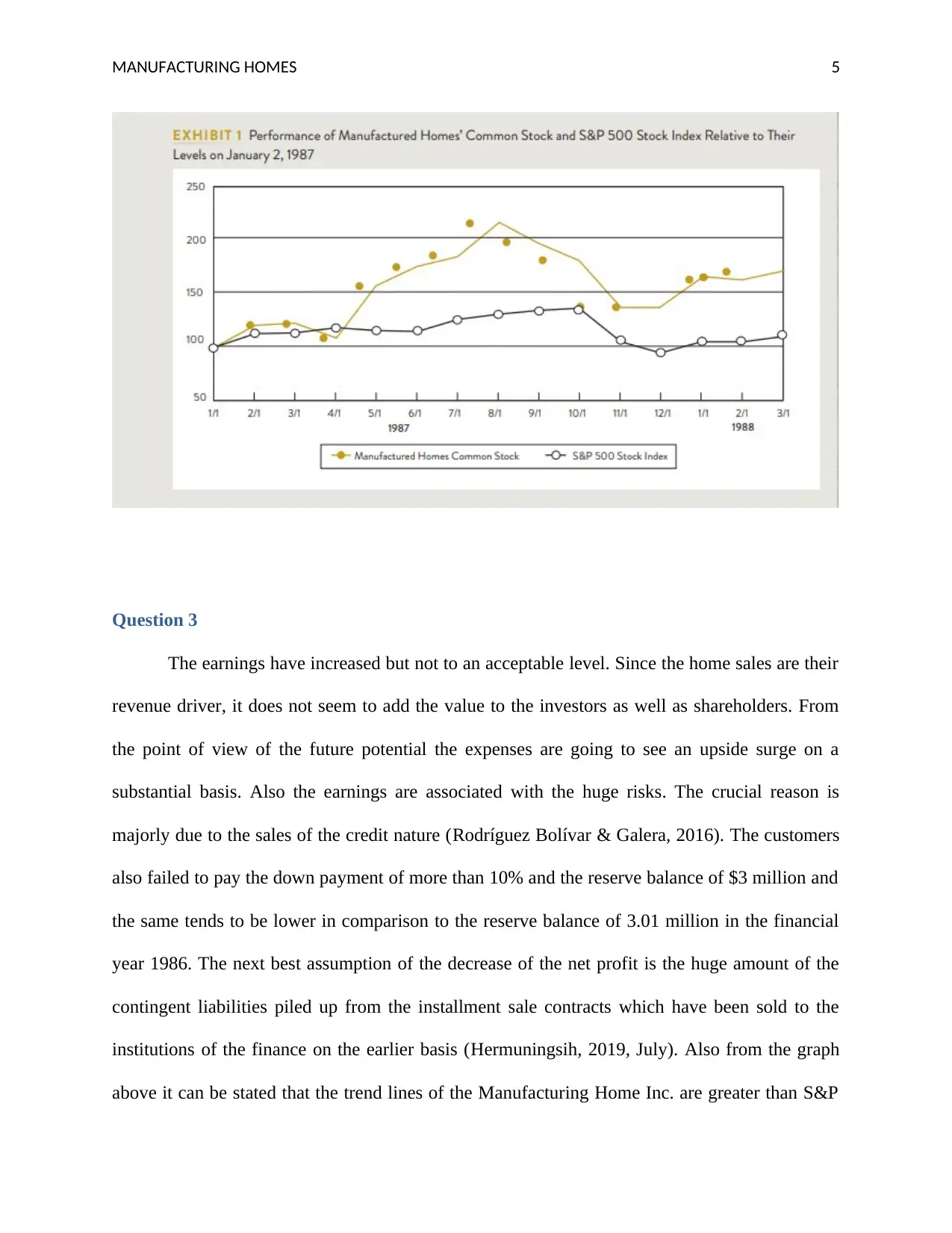
institutions of the finance on the earlier basis (Hermuningsih, 2019, July). Also from the graph
above it can be stated that the trend lines of the Manufacturing Home Inc. are greater than S&P
Question 3
The earnings have increased but not to an acceptable level. Since the home sales are their
revenue driver, it does not seem to add the value to the investors as well as shareholders. From
the point of view of the future potential the expenses are going to see an upside surge on a
substantial basis. Also the earnings are associated with the huge risks. The crucial reason is
majorly due to the sales of the credit nature (Rodríguez Bolívar & Galera, 2016). The customers
also failed to pay the down payment of more than 10% and the reserve balance of $3 million and
the same tends to be lower in comparison to the reserve balance of 3.01 million in the financial
year 1986. The next best assumption of the decrease of the net profit is the huge amount of the
contingent liabilities piled up from the installment sale contracts which have been sold to the
institutions of the finance on the earlier basis (Hermuningsih, 2019, July). Also from the graph
above it can be stated that the trend lines of the Manufacturing Home Inc. are greater than S&P

MANUFACTURING HOMES 6
500 stock and it can be stated that management is seeking to average 100 units per store as these
sales locations mature. The figure rose by 20% in the first nine months of the financial year 1987
(Palepu & Wright, 2017). The market tends to be very competitive and yet the company is able
to handle the inventory efficiently. Hence it can be concluded that the position of the company in
few scenarios is positive whereas in some areas it is negative for which immediate measures
needs to be taken.
500 stock and it can be stated that management is seeking to average 100 units per store as these
sales locations mature. The figure rose by 20% in the first nine months of the financial year 1987
(Palepu & Wright, 2017). The market tends to be very competitive and yet the company is able
to handle the inventory efficiently. Hence it can be concluded that the position of the company in
few scenarios is positive whereas in some areas it is negative for which immediate measures
needs to be taken.
⊘ This is a preview!⊘
Do you want full access?
Subscribe today to unlock all pages.

Trusted by 1+ million students worldwide

MANUFACTURING HOMES 7
References
Benedettini, O., Swink, M., & Neely, A. (2018). Service offering and financial performance: the
role of company characteristics.
Palepu., K. G., & Wright, S. (2017). Business analysis and valuation. Retrieved from
file:///C:/Users/System04087/Downloads/3349074_1289098697_BusinessAnalysisandVa
luationUs.pdf
Rodríguez Bolívar, M. P., & Galera, A. N. (2016). The effect of changes in public sector
accounting policies on administrative reforms addressed to citizens. Administration &
Society, 48(1), 31-72.
Len, V., & Glivenko, V. (2019). Accounting Policies and Its Components. Accounting and
Finance, (2), 26-35.
Jianu, I., Jianu, I. & Țurlea, C., (2017). Measuring the company’s real performance by physical
capital maintenance. Economic Computation and Economic Cybernetics Studies and
Research, (1).
Hermuningsih, S. (2019, July). Effect of Financial Performance on Company Growth with
Company Size as Moderating Variable. In 1st International Conference on Life,
Innovation, Change and Knowledge (ICLICK 2018). Atlantis Press.
References
Benedettini, O., Swink, M., & Neely, A. (2018). Service offering and financial performance: the
role of company characteristics.
Palepu., K. G., & Wright, S. (2017). Business analysis and valuation. Retrieved from
file:///C:/Users/System04087/Downloads/3349074_1289098697_BusinessAnalysisandVa
luationUs.pdf
Rodríguez Bolívar, M. P., & Galera, A. N. (2016). The effect of changes in public sector
accounting policies on administrative reforms addressed to citizens. Administration &
Society, 48(1), 31-72.
Len, V., & Glivenko, V. (2019). Accounting Policies and Its Components. Accounting and
Finance, (2), 26-35.
Jianu, I., Jianu, I. & Țurlea, C., (2017). Measuring the company’s real performance by physical
capital maintenance. Economic Computation and Economic Cybernetics Studies and
Research, (1).
Hermuningsih, S. (2019, July). Effect of Financial Performance on Company Growth with
Company Size as Moderating Variable. In 1st International Conference on Life,
Innovation, Change and Knowledge (ICLICK 2018). Atlantis Press.
1 out of 7
Related Documents
Your All-in-One AI-Powered Toolkit for Academic Success.
+13062052269
info@desklib.com
Available 24*7 on WhatsApp / Email
Unlock your academic potential
Copyright © 2020–2025 A2Z Services. All Rights Reserved. Developed and managed by ZUCOL.