Analysis of Marcus Theatres: Market Structure and Strategy
VerifiedAdded on 2022/08/14
|7
|2133
|16
Report
AI Summary
This report analyzes Marcus Theatres, a US movie theatre chain, examining its customer base, which includes schools, students, households, movie lovers, and businesses across several states. The market structure is assessed by considering competitors like AMC Theatres and Regal, product similarity, barriers to entry (taxation, changing consumer trends, and licensing complexities), and the importance of non-price competition. The geographic nature of the market is primarily national, and the report discusses Marcus Theatres' pricing power within an oligopoly context. Additionally, the report considers economies of scale as a barrier and reviews key economic indicators, such as decreasing returns to scale, that influence the company's competitiveness. The report concludes that the emergence of streaming services like Netflix has decreased the number of people visiting theatres, which leads to low profits, and challenges for new market entrants.
The Marcus Theaters
Marcus Theatres is a United States movie theatre chain. Other screens or branches of Marcus Theatres,
are situated in Wisconsin, Iowa, Illinois, Missouri, Minnesota, Nebraska, Ohio, North Dakota. The chain also
partnered with websites like movietickets.com.. All these indicate to a wide range of customers possessed by
Marcus Theatres, they are- schools as well as college students from the States like- Wisconsin, Iowa, Illinois,
Missouri, Minnesota, Nebraska, Ohio, and North Dakota. Also, the households from the states where Marcus
Theatres has expanded its theatre chains are the customers of Marcus Theatres. Again, the movie lovers,
businessmen as well as the admirers of theatre culture who in spite of being engaged into their respective
occupations and having extremely busy schedule, make the effort to book tickets online. Thus they keep the
tradition or culture of watching movie in theatres alive, even in the era of ‘Netflix’ (Tepe & Vanhuysse, 2014).
(1) the number of competitors, : There are several competitors of Marcus Theatres -AMC Theatres,
Harkins Theatres, Regal , iPic, IMAX, SMG, Cinemaxx Theater, Flix Brewhouse, Cinemark, A. Worldtech
(Guangzhou)
(2) product similarity:
The service provided by all the competitors like- AMC Theatres, Harkins Theatres, Regal , iPic, IMAX,
SMG, Cinemaxx Theater, Flix Brewhouse, Cinemark, A. Worldtech (Guangzhou); are homogeneous. In other
words, all the competitors sell services like showing movies. This is indicative of the fact that, the services sold
by all the competitors possess similar characteristics, such as, all competitors sell services which entertain
people, which contain attractive visuals, realistic sounds. Al the movie theatres arrange for extended services to
the audience like comfortable seating, tasty snacks, and convenient restrooms and so on (Marich, 2013).
(3) Barriers to entry:
There are several barriers to enter the theatre market in United States of which three will be highlighted.
One is the barriers is the taxation imposed by the government. The second most important barrier is the massive
transition in the trends as well as the lifestyle of customers at United States as well as the customers all over the
globe. The third most significant barrier is the complexities in achieving the trade license. The amount of tax
Marcus Theatres is a United States movie theatre chain. Other screens or branches of Marcus Theatres,
are situated in Wisconsin, Iowa, Illinois, Missouri, Minnesota, Nebraska, Ohio, North Dakota. The chain also
partnered with websites like movietickets.com.. All these indicate to a wide range of customers possessed by
Marcus Theatres, they are- schools as well as college students from the States like- Wisconsin, Iowa, Illinois,
Missouri, Minnesota, Nebraska, Ohio, and North Dakota. Also, the households from the states where Marcus
Theatres has expanded its theatre chains are the customers of Marcus Theatres. Again, the movie lovers,
businessmen as well as the admirers of theatre culture who in spite of being engaged into their respective
occupations and having extremely busy schedule, make the effort to book tickets online. Thus they keep the
tradition or culture of watching movie in theatres alive, even in the era of ‘Netflix’ (Tepe & Vanhuysse, 2014).
(1) the number of competitors, : There are several competitors of Marcus Theatres -AMC Theatres,
Harkins Theatres, Regal , iPic, IMAX, SMG, Cinemaxx Theater, Flix Brewhouse, Cinemark, A. Worldtech
(Guangzhou)
(2) product similarity:
The service provided by all the competitors like- AMC Theatres, Harkins Theatres, Regal , iPic, IMAX,
SMG, Cinemaxx Theater, Flix Brewhouse, Cinemark, A. Worldtech (Guangzhou); are homogeneous. In other
words, all the competitors sell services like showing movies. This is indicative of the fact that, the services sold
by all the competitors possess similar characteristics, such as, all competitors sell services which entertain
people, which contain attractive visuals, realistic sounds. Al the movie theatres arrange for extended services to
the audience like comfortable seating, tasty snacks, and convenient restrooms and so on (Marich, 2013).
(3) Barriers to entry:
There are several barriers to enter the theatre market in United States of which three will be highlighted.
One is the barriers is the taxation imposed by the government. The second most important barrier is the massive
transition in the trends as well as the lifestyle of customers at United States as well as the customers all over the
globe. The third most significant barrier is the complexities in achieving the trade license. The amount of tax

Paraphrase This Document
Need a fresh take? Get an instant paraphrase of this document with our AI Paraphraser
that the theatres needs to pay to the government in the country of United States to enter the theatre market, is
exorbitant. On the other hand due to the lack of time as well as increasing demand for watching movie over the
internet, the number of customers in the several theatres of United States are declining substantially. Hence the
revenues of the theatres in the country of United States are decreasing at a faster pace. In this situation paying
an exorbitant amount of tax to the government is curbing a significant ratio of the profit earned by the existing
theatres in the country of United States (Warne & Drake-Brooks, 2016)). This is one of the significant obstacles
to enter the market for theatre in the country of United States, which demotivates new theatres to enter into the
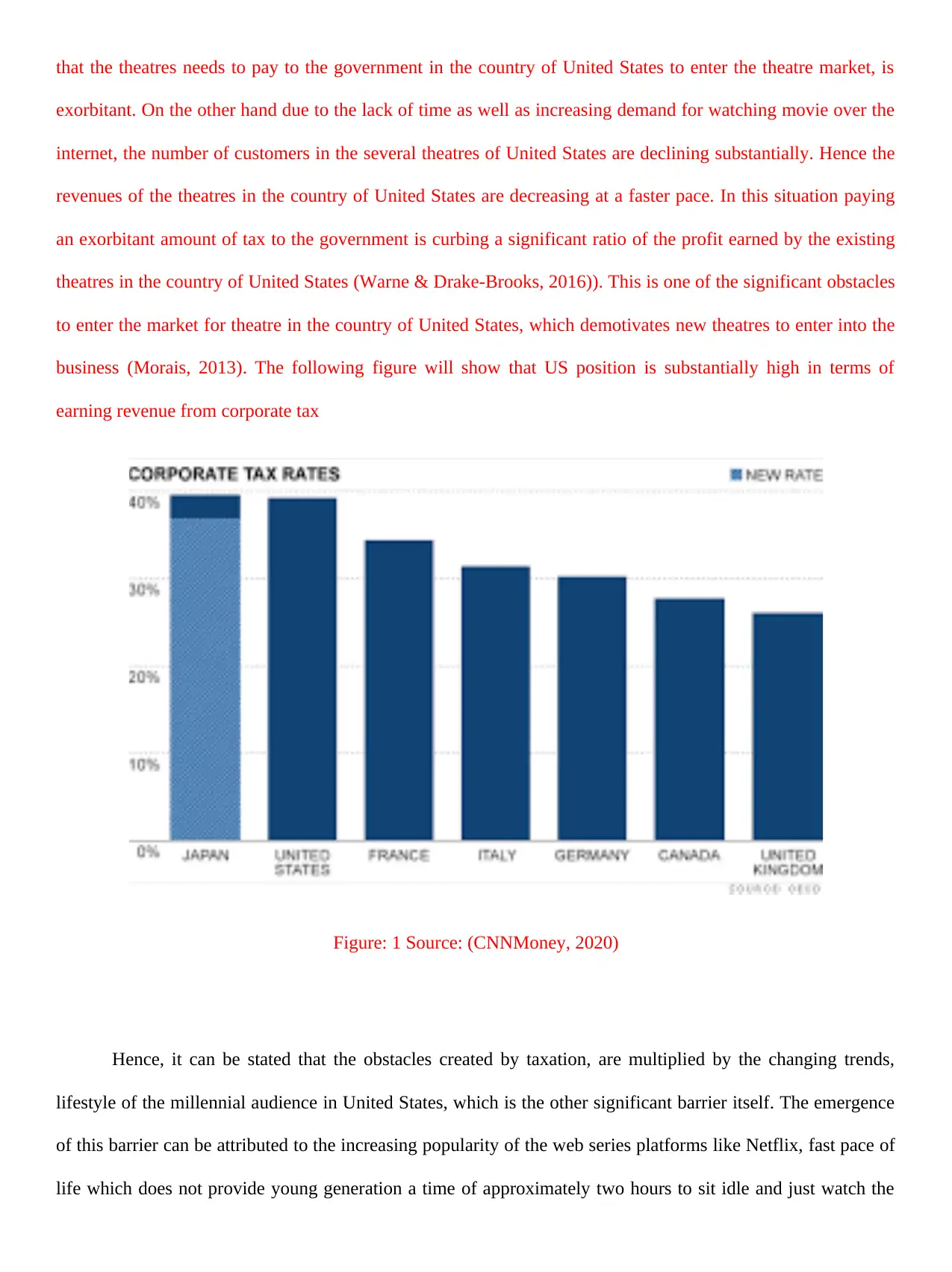
business (Morais, 2013). The following figure will show that US position is substantially high in terms of
earning revenue from corporate tax
Figure: 1 Source: (CNNMoney, 2020)
Hence, it can be stated that the obstacles created by taxation, are multiplied by the changing trends,
lifestyle of the millennial audience in United States, which is the other significant barrier itself. The emergence
of this barrier can be attributed to the increasing popularity of the web series platforms like Netflix, fast pace of
life which does not provide young generation a time of approximately two hours to sit idle and just watch the
exorbitant. On the other hand due to the lack of time as well as increasing demand for watching movie over the
internet, the number of customers in the several theatres of United States are declining substantially. Hence the
revenues of the theatres in the country of United States are decreasing at a faster pace. In this situation paying
an exorbitant amount of tax to the government is curbing a significant ratio of the profit earned by the existing
theatres in the country of United States (Warne & Drake-Brooks, 2016)). This is one of the significant obstacles
to enter the market for theatre in the country of United States, which demotivates new theatres to enter into the
business (Morais, 2013). The following figure will show that US position is substantially high in terms of
earning revenue from corporate tax
Figure: 1 Source: (CNNMoney, 2020)
Hence, it can be stated that the obstacles created by taxation, are multiplied by the changing trends,
lifestyle of the millennial audience in United States, which is the other significant barrier itself. The emergence
of this barrier can be attributed to the increasing popularity of the web series platforms like Netflix, fast pace of
life which does not provide young generation a time of approximately two hours to sit idle and just watch the
movie. Rather they prefer to watch movies in their home theatres, laptops, mobile phones, where they can pause
the movie whenever they need to other works, simultaneously. More specifically, the movies on electronic
gadgets, web series in Netflix provides the busiest generation a chance of multitasking, instead of sitting idle for
two hours or more. This severe transition in the trend has decreased the number of audiences in theatres
substantially. This severe transition in the trends, make the existing theatre owners feel that there are lack of
chances to incur profit in the theatre market. Again, foreseeing the lack of opportunities to incur profit, new
theatre owners are reluctant to enter the market (Bernstein, 2017). Earning the trade license in the business of
theatre have become a lengthy as well as complicated process. Often the result of the verification process for
licensing is negative, as the estimated demand for theaters are found low during the verification process. This is
considered to be a major obstacle to enter the US theater market by the new theater owners (Labaronne, 2013).
As per the analysis of the geographic nature of the market, it has been identified that screens or branches
of Marcus Theatres, are situated in Wisconsin, Iowa, Illinois, Missouri, Minnesota, Nebraska, Ohio, and North
Dakota. Moreover, ‘Jumanji: The Next Level’, ‘Birds of Prey’, Dolittle, The Gentlemen, The Rhythm Section ,
Gretel & Hansel, Little Women, are the type of movies which is screened in Marcus Theatres. The services
offered in the market are national as well as international services. Hence, the market in which Marcus Theater
operates, can be best described as international market (Chowhan, 2015).
Non-price competition is very important, in the theater market of United States. In order to increase the
number of visitors in the theater, non-price competition is considered to be more significant instrument, as
compared to the pricing method. Thus adopting the method of non-price competition Marcus Theater can
enhance the quality of the services as well as the extended services they provide to the visitor. This involve,
making provision for better food as well as more comfortable sitting arrangement, providing personalized
services to the viewers, providing the viewers a more realistic experience of watching a movie by upgrading the
sound system as well as quality of the movie screen (Roll, Emes & Horst, 2017).
The pricing power of Marcus in this case can be explained using the concept of pricing power of the
oligopoly firms. Prior to the popularization of web series as well as movies over the internet, the theater market
in the country of United States used to be categoized as oligopoly market consisting of a few seller and multiple
the movie whenever they need to other works, simultaneously. More specifically, the movies on electronic
gadgets, web series in Netflix provides the busiest generation a chance of multitasking, instead of sitting idle for
two hours or more. This severe transition in the trend has decreased the number of audiences in theatres
substantially. This severe transition in the trends, make the existing theatre owners feel that there are lack of
chances to incur profit in the theatre market. Again, foreseeing the lack of opportunities to incur profit, new
theatre owners are reluctant to enter the market (Bernstein, 2017). Earning the trade license in the business of
theatre have become a lengthy as well as complicated process. Often the result of the verification process for
licensing is negative, as the estimated demand for theaters are found low during the verification process. This is
considered to be a major obstacle to enter the US theater market by the new theater owners (Labaronne, 2013).
As per the analysis of the geographic nature of the market, it has been identified that screens or branches
of Marcus Theatres, are situated in Wisconsin, Iowa, Illinois, Missouri, Minnesota, Nebraska, Ohio, and North
Dakota. Moreover, ‘Jumanji: The Next Level’, ‘Birds of Prey’, Dolittle, The Gentlemen, The Rhythm Section ,
Gretel & Hansel, Little Women, are the type of movies which is screened in Marcus Theatres. The services
offered in the market are national as well as international services. Hence, the market in which Marcus Theater
operates, can be best described as international market (Chowhan, 2015).
Non-price competition is very important, in the theater market of United States. In order to increase the
number of visitors in the theater, non-price competition is considered to be more significant instrument, as
compared to the pricing method. Thus adopting the method of non-price competition Marcus Theater can
enhance the quality of the services as well as the extended services they provide to the visitor. This involve,
making provision for better food as well as more comfortable sitting arrangement, providing personalized
services to the viewers, providing the viewers a more realistic experience of watching a movie by upgrading the
sound system as well as quality of the movie screen (Roll, Emes & Horst, 2017).
The pricing power of Marcus in this case can be explained using the concept of pricing power of the
oligopoly firms. Prior to the popularization of web series as well as movies over the internet, the theater market
in the country of United States used to be categoized as oligopoly market consisting of a few seller and multiple
⊘ This is a preview!⊘
Do you want full access?
Subscribe today to unlock all pages.

Trusted by 1+ million students worldwide
buyers. Similar to the feature of the other oligopoly markets, the price in this market used to be determined by
the sellers. Due to drastic change in the trends of watching movies among youngsters as well as the
appurtenance of web series over Netflix, movie watching opportunities by Amazon prime, the number of buyers
have been decreased substantially and Netflix , amazon prime have been emerged as powerful competitors. This
has compelled theaters in US to curb their ticket prices. In other words theaters in US are now possess an
insignificant pricing power. The price is dominated by the few number of buyers (Warne & Drake-Brooks,
2016).
The economies of scale is a barrier to entry, in this industry. The theater market in the country of United
States, is experiencing a decreasing economies of scale or a decreasing returns to scale. This is indicative of the
fact that, even if, theaters emphasizes on non-price competition and invest more to make provision for better
food as well as more comfortable sitting arrangement, provide personalized services to the viewers, provide the
viewers a more realistic experience of watching a movie by upgrading the sound system as well as quality of the
movie screen; the estimated return to scale will be very low indicating to the less or no increase in the number
of viewers.
In spite of all these the year 2018 was a bit different. The entertainment tax, which is collected by the
government of United States was reduced to 5% in the year 2018. This was the reason for the increase in the
revenue on the theater market, in the same year.
the sellers. Due to drastic change in the trends of watching movies among youngsters as well as the
appurtenance of web series over Netflix, movie watching opportunities by Amazon prime, the number of buyers
have been decreased substantially and Netflix , amazon prime have been emerged as powerful competitors. This
has compelled theaters in US to curb their ticket prices. In other words theaters in US are now possess an
insignificant pricing power. The price is dominated by the few number of buyers (Warne & Drake-Brooks,
2016).
The economies of scale is a barrier to entry, in this industry. The theater market in the country of United
States, is experiencing a decreasing economies of scale or a decreasing returns to scale. This is indicative of the
fact that, even if, theaters emphasizes on non-price competition and invest more to make provision for better
food as well as more comfortable sitting arrangement, provide personalized services to the viewers, provide the
viewers a more realistic experience of watching a movie by upgrading the sound system as well as quality of the
movie screen; the estimated return to scale will be very low indicating to the less or no increase in the number
of viewers.
In spite of all these the year 2018 was a bit different. The entertainment tax, which is collected by the
government of United States was reduced to 5% in the year 2018. This was the reason for the increase in the
revenue on the theater market, in the same year.
Paraphrase This Document
Need a fresh take? Get an instant paraphrase of this document with our AI Paraphraser
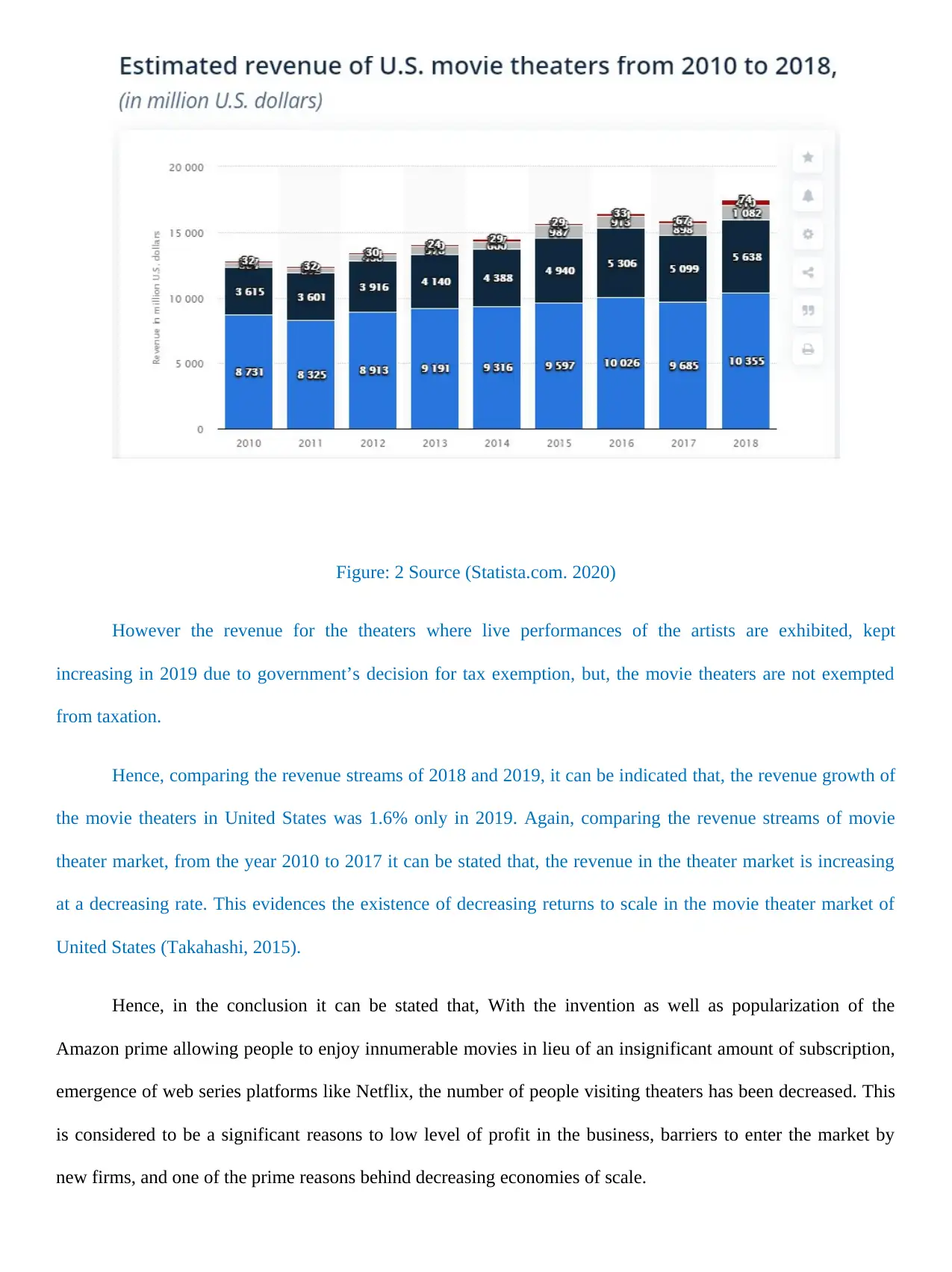
Figure: 2 Source (Statista.com. 2020)
However the revenue for the theaters where live performances of the artists are exhibited, kept
increasing in 2019 due to government’s decision for tax exemption, but, the movie theaters are not exempted
from taxation.
Hence, comparing the revenue streams of 2018 and 2019, it can be indicated that, the revenue growth of
the movie theaters in United States was 1.6% only in 2019. Again, comparing the revenue streams of movie
theater market, from the year 2010 to 2017 it can be stated that, the revenue in the theater market is increasing
at a decreasing rate. This evidences the existence of decreasing returns to scale in the movie theater market of
United States (Takahashi, 2015).
Hence, in the conclusion it can be stated that, With the invention as well as popularization of the
Amazon prime allowing people to enjoy innumerable movies in lieu of an insignificant amount of subscription,
emergence of web series platforms like Netflix, the number of people visiting theaters has been decreased. This
is considered to be a significant reasons to low level of profit in the business, barriers to enter the market by
new firms, and one of the prime reasons behind decreasing economies of scale.
However the revenue for the theaters where live performances of the artists are exhibited, kept
increasing in 2019 due to government’s decision for tax exemption, but, the movie theaters are not exempted
from taxation.
Hence, comparing the revenue streams of 2018 and 2019, it can be indicated that, the revenue growth of
the movie theaters in United States was 1.6% only in 2019. Again, comparing the revenue streams of movie
theater market, from the year 2010 to 2017 it can be stated that, the revenue in the theater market is increasing
at a decreasing rate. This evidences the existence of decreasing returns to scale in the movie theater market of
United States (Takahashi, 2015).
Hence, in the conclusion it can be stated that, With the invention as well as popularization of the
Amazon prime allowing people to enjoy innumerable movies in lieu of an insignificant amount of subscription,
emergence of web series platforms like Netflix, the number of people visiting theaters has been decreased. This
is considered to be a significant reasons to low level of profit in the business, barriers to enter the market by
new firms, and one of the prime reasons behind decreasing economies of scale.

⊘ This is a preview!⊘
Do you want full access?
Subscribe today to unlock all pages.
Trusted by 1+ million students worldwide
References:
Bernstein, J. (2017). Standing room only: Marketing insights for engaging performing arts audiences. Springer.
Chowhan, S. S. (2015). Marketing of services.
CNNMoney. (2020). U.S. corporate tax rate: No. 1 in the world. CNNMoney.
Fisk, R. P., Grove, S. J., & John, J. (2013). Services marketing interactive approach. Cengage Learning.
Labaronne, L. (2013). Yield management for public theaters?. In Academy of Marketing Conference 2013,
Cardiff, July 8-11, 2013 (pp. 71-79).
Marich, R. (2013). Marketing to moviegoers: a handbook of strategies and tactics. SIU Press.
Morais, D. G. (2013). Branding Iron: Eugen Sandow's “Modern” Marketing Strategies, 1887-1925. Journal of
Sport History, 40(2), 193-214.
Roll, J., Emes, J., & Horst, S. O. (2017). Cultural Marketing in the Digital Age. Journal of Marketing
Trends, 4(2), 31-37.
Statista.com. (2020). Revenue of U.S. movie theaters by source 2018 | Statista. Statista.
Takahashi, Y. (2015). Estimating a war of attrition: The case of the us movie theater industry. American
Economic Review, 105(7), 2204-41.
Tepe, M., & Vanhuysse, P. (2014). A vote at the opera? The political economy of public theaters and orchestras
in the German states. European Journal of Political Economy, 36, 254-273. Hausmann, A., & Poellmann, L.
(2016). eWOM in the performing arts: exploratory insights for the marketing of theaters. Arts and the Market.
Warne, R. T., & Drake-Brooks, M. M. (2016). Comparing the persuasiveness and professionalism of
newspaper, blog, and social media sources of information in marketing and reviewing theatre. Arts and the
Market.
Bernstein, J. (2017). Standing room only: Marketing insights for engaging performing arts audiences. Springer.
Chowhan, S. S. (2015). Marketing of services.
CNNMoney. (2020). U.S. corporate tax rate: No. 1 in the world. CNNMoney.
Fisk, R. P., Grove, S. J., & John, J. (2013). Services marketing interactive approach. Cengage Learning.
Labaronne, L. (2013). Yield management for public theaters?. In Academy of Marketing Conference 2013,
Cardiff, July 8-11, 2013 (pp. 71-79).
Marich, R. (2013). Marketing to moviegoers: a handbook of strategies and tactics. SIU Press.
Morais, D. G. (2013). Branding Iron: Eugen Sandow's “Modern” Marketing Strategies, 1887-1925. Journal of
Sport History, 40(2), 193-214.
Roll, J., Emes, J., & Horst, S. O. (2017). Cultural Marketing in the Digital Age. Journal of Marketing
Trends, 4(2), 31-37.
Statista.com. (2020). Revenue of U.S. movie theaters by source 2018 | Statista. Statista.
Takahashi, Y. (2015). Estimating a war of attrition: The case of the us movie theater industry. American
Economic Review, 105(7), 2204-41.
Tepe, M., & Vanhuysse, P. (2014). A vote at the opera? The political economy of public theaters and orchestras
in the German states. European Journal of Political Economy, 36, 254-273. Hausmann, A., & Poellmann, L.
(2016). eWOM in the performing arts: exploratory insights for the marketing of theaters. Arts and the Market.
Warne, R. T., & Drake-Brooks, M. M. (2016). Comparing the persuasiveness and professionalism of
newspaper, blog, and social media sources of information in marketing and reviewing theatre. Arts and the
Market.

1 out of 7


Your All-in-One AI-Powered Toolkit for Academic Success.
+13062052269
info@desklib.com
Available 24*7 on WhatsApp / Email
![[object Object]](/_next/static/media/star-bottom.7253800d.svg)
Unlock your academic potential
Copyright © 2020–2025 A2Z Services. All Rights Reserved. Developed and managed by ZUCOL.