Management Accounting Report: Marginal vs. Absorption Costing Analysis
VerifiedAdded on 2020/07/23
|10
|2369
|33
Report
AI Summary
This report delves into the core principles of management accounting, elucidating its role in financial decision-making and providing essential requirements for various management accounting systems. It explores diverse methods employed in management accounting reporting, including cost accounting, performance reports, and throughput accounting, while also contrasting accrual accounting. The report further analyzes the preparation of income statements using both marginal and absorption costing methods, highlighting their differences and implications for profit calculation. It presents detailed tables illustrating profit calculations under each method and emphasizes the significance of both approaches for managerial decision-making. The report concludes by underscoring the importance of utilizing both marginal and absorption costing to gain comprehensive insights into a company's financial performance, ultimately aiding in strategic planning and operational efficiency.

MANAGEMENT ACCOUNTING

Paraphrase This Document
Need a fresh take? Get an instant paraphrase of this document with our AI Paraphraser
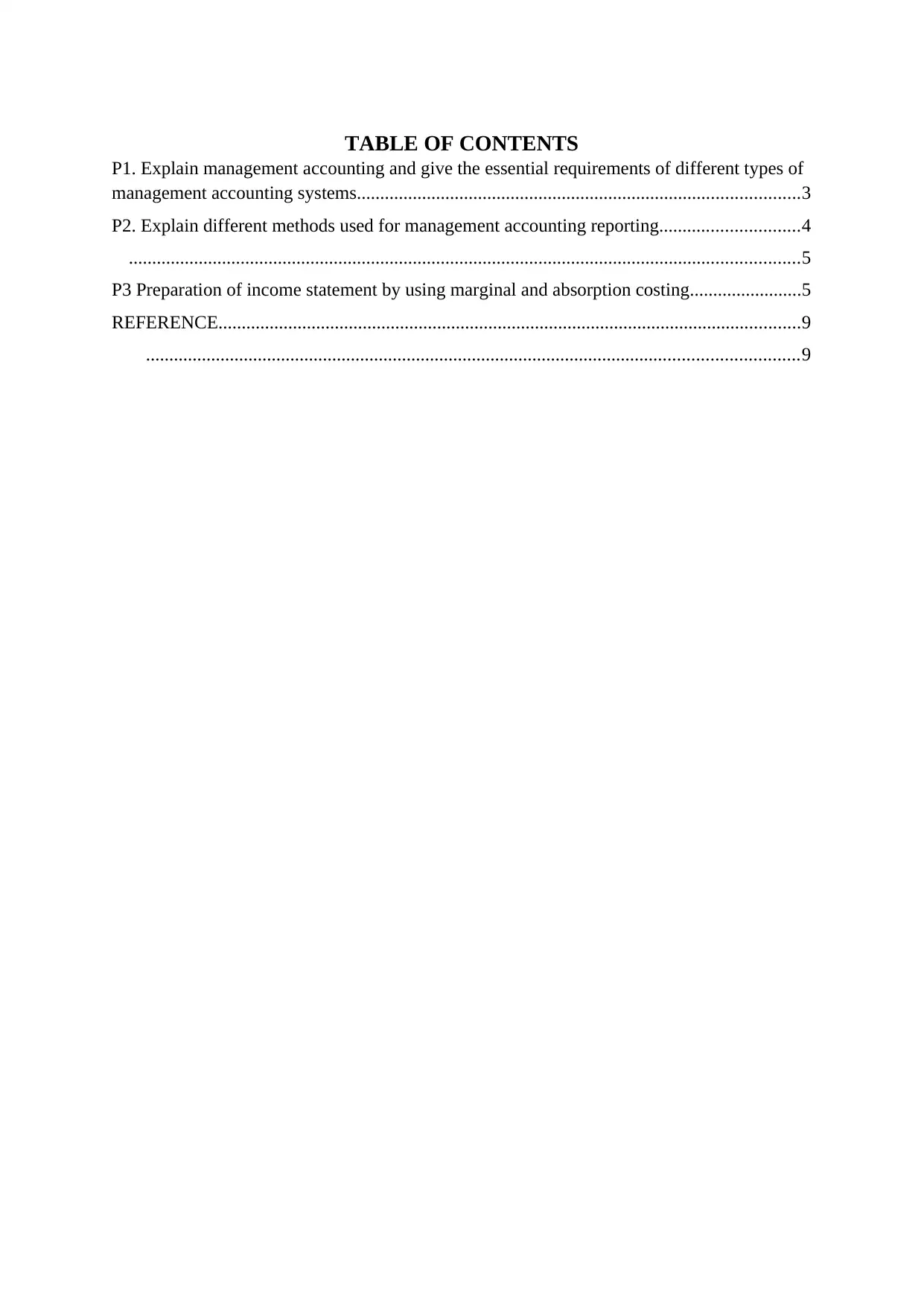
TABLE OF CONTENTS
P1. Explain management accounting and give the essential requirements of different types of
management accounting systems...............................................................................................3
P2. Explain different methods used for management accounting reporting..............................4
................................................................................................................................................5
P3 Preparation of income statement by using marginal and absorption costing........................5
REFERENCE.............................................................................................................................9
............................................................................................................................................9
P1. Explain management accounting and give the essential requirements of different types of
management accounting systems...............................................................................................3
P2. Explain different methods used for management accounting reporting..............................4
................................................................................................................................................5
P3 Preparation of income statement by using marginal and absorption costing........................5
REFERENCE.............................................................................................................................9
............................................................................................................................................9
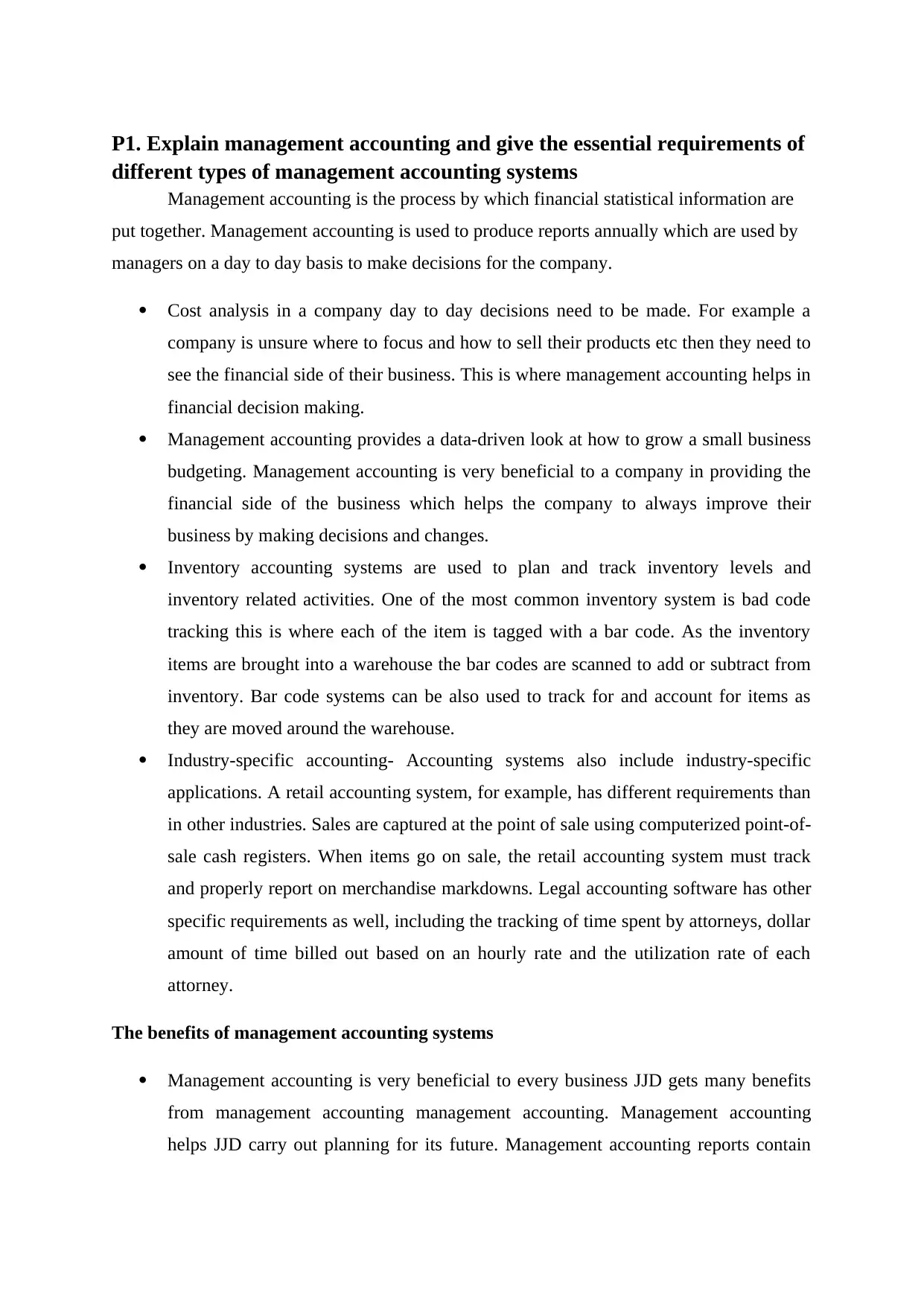
P1. Explain management accounting and give the essential requirements of
different types of management accounting systems
Management accounting is the process by which financial statistical information are
put together. Management accounting is used to produce reports annually which are used by
managers on a day to day basis to make decisions for the company.
Cost analysis in a company day to day decisions need to be made. For example a
company is unsure where to focus and how to sell their products etc then they need to
see the financial side of their business. This is where management accounting helps in
financial decision making.
Management accounting provides a data-driven look at how to grow a small business
budgeting. Management accounting is very beneficial to a company in providing the
financial side of the business which helps the company to always improve their
business by making decisions and changes.
Inventory accounting systems are used to plan and track inventory levels and
inventory related activities. One of the most common inventory system is bad code
tracking this is where each of the item is tagged with a bar code. As the inventory
items are brought into a warehouse the bar codes are scanned to add or subtract from
inventory. Bar code systems can be also used to track for and account for items as
they are moved around the warehouse.
Industry-specific accounting- Accounting systems also include industry-specific
applications. A retail accounting system, for example, has different requirements than
in other industries. Sales are captured at the point of sale using computerized point-of-
sale cash registers. When items go on sale, the retail accounting system must track
and properly report on merchandise markdowns. Legal accounting software has other
specific requirements as well, including the tracking of time spent by attorneys, dollar
amount of time billed out based on an hourly rate and the utilization rate of each
attorney.
The benefits of management accounting systems
Management accounting is very beneficial to every business JJD gets many benefits
from management accounting management accounting. Management accounting
helps JJD carry out planning for its future. Management accounting reports contain
different types of management accounting systems
Management accounting is the process by which financial statistical information are
put together. Management accounting is used to produce reports annually which are used by
managers on a day to day basis to make decisions for the company.
Cost analysis in a company day to day decisions need to be made. For example a
company is unsure where to focus and how to sell their products etc then they need to
see the financial side of their business. This is where management accounting helps in
financial decision making.
Management accounting provides a data-driven look at how to grow a small business
budgeting. Management accounting is very beneficial to a company in providing the
financial side of the business which helps the company to always improve their
business by making decisions and changes.
Inventory accounting systems are used to plan and track inventory levels and
inventory related activities. One of the most common inventory system is bad code
tracking this is where each of the item is tagged with a bar code. As the inventory
items are brought into a warehouse the bar codes are scanned to add or subtract from
inventory. Bar code systems can be also used to track for and account for items as
they are moved around the warehouse.
Industry-specific accounting- Accounting systems also include industry-specific
applications. A retail accounting system, for example, has different requirements than
in other industries. Sales are captured at the point of sale using computerized point-of-
sale cash registers. When items go on sale, the retail accounting system must track
and properly report on merchandise markdowns. Legal accounting software has other
specific requirements as well, including the tracking of time spent by attorneys, dollar
amount of time billed out based on an hourly rate and the utilization rate of each
attorney.
The benefits of management accounting systems
Management accounting is very beneficial to every business JJD gets many benefits
from management accounting management accounting. Management accounting
helps JJD carry out planning for its future. Management accounting reports contain
⊘ This is a preview!⊘
Do you want full access?
Subscribe today to unlock all pages.

Trusted by 1+ million students worldwide
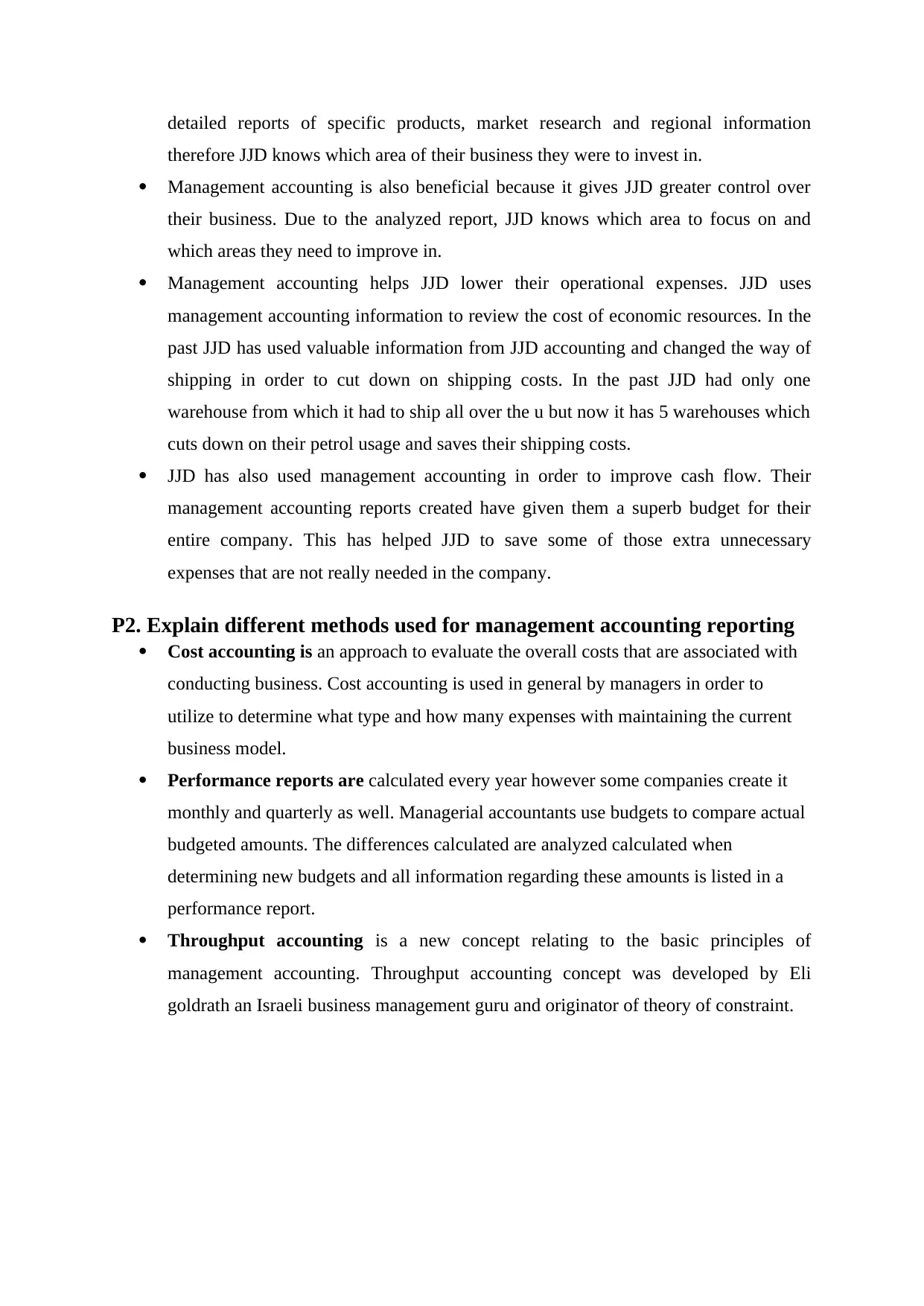
detailed reports of specific products, market research and regional information
therefore JJD knows which area of their business they were to invest in.
Management accounting is also beneficial because it gives JJD greater control over
their business. Due to the analyzed report, JJD knows which area to focus on and
which areas they need to improve in.
Management accounting helps JJD lower their operational expenses. JJD uses
management accounting information to review the cost of economic resources. In the
past JJD has used valuable information from JJD accounting and changed the way of
shipping in order to cut down on shipping costs. In the past JJD had only one
warehouse from which it had to ship all over the u but now it has 5 warehouses which
cuts down on their petrol usage and saves their shipping costs.
JJD has also used management accounting in order to improve cash flow. Their
management accounting reports created have given them a superb budget for their
entire company. This has helped JJD to save some of those extra unnecessary
expenses that are not really needed in the company.
P2. Explain different methods used for management accounting reporting
Cost accounting is an approach to evaluate the overall costs that are associated with
conducting business. Cost accounting is used in general by managers in order to
utilize to determine what type and how many expenses with maintaining the current
business model.
Performance reports are calculated every year however some companies create it
monthly and quarterly as well. Managerial accountants use budgets to compare actual
budgeted amounts. The differences calculated are analyzed calculated when
determining new budgets and all information regarding these amounts is listed in a
performance report.
Throughput accounting is a new concept relating to the basic principles of
management accounting. Throughput accounting concept was developed by Eli
goldrath an Israeli business management guru and originator of theory of constraint.
therefore JJD knows which area of their business they were to invest in.
Management accounting is also beneficial because it gives JJD greater control over
their business. Due to the analyzed report, JJD knows which area to focus on and
which areas they need to improve in.
Management accounting helps JJD lower their operational expenses. JJD uses
management accounting information to review the cost of economic resources. In the
past JJD has used valuable information from JJD accounting and changed the way of
shipping in order to cut down on shipping costs. In the past JJD had only one
warehouse from which it had to ship all over the u but now it has 5 warehouses which
cuts down on their petrol usage and saves their shipping costs.
JJD has also used management accounting in order to improve cash flow. Their
management accounting reports created have given them a superb budget for their
entire company. This has helped JJD to save some of those extra unnecessary
expenses that are not really needed in the company.
P2. Explain different methods used for management accounting reporting
Cost accounting is an approach to evaluate the overall costs that are associated with
conducting business. Cost accounting is used in general by managers in order to
utilize to determine what type and how many expenses with maintaining the current
business model.
Performance reports are calculated every year however some companies create it
monthly and quarterly as well. Managerial accountants use budgets to compare actual
budgeted amounts. The differences calculated are analyzed calculated when
determining new budgets and all information regarding these amounts is listed in a
performance report.
Throughput accounting is a new concept relating to the basic principles of
management accounting. Throughput accounting concept was developed by Eli
goldrath an Israeli business management guru and originator of theory of constraint.
Paraphrase This Document
Need a fresh take? Get an instant paraphrase of this document with our AI Paraphraser
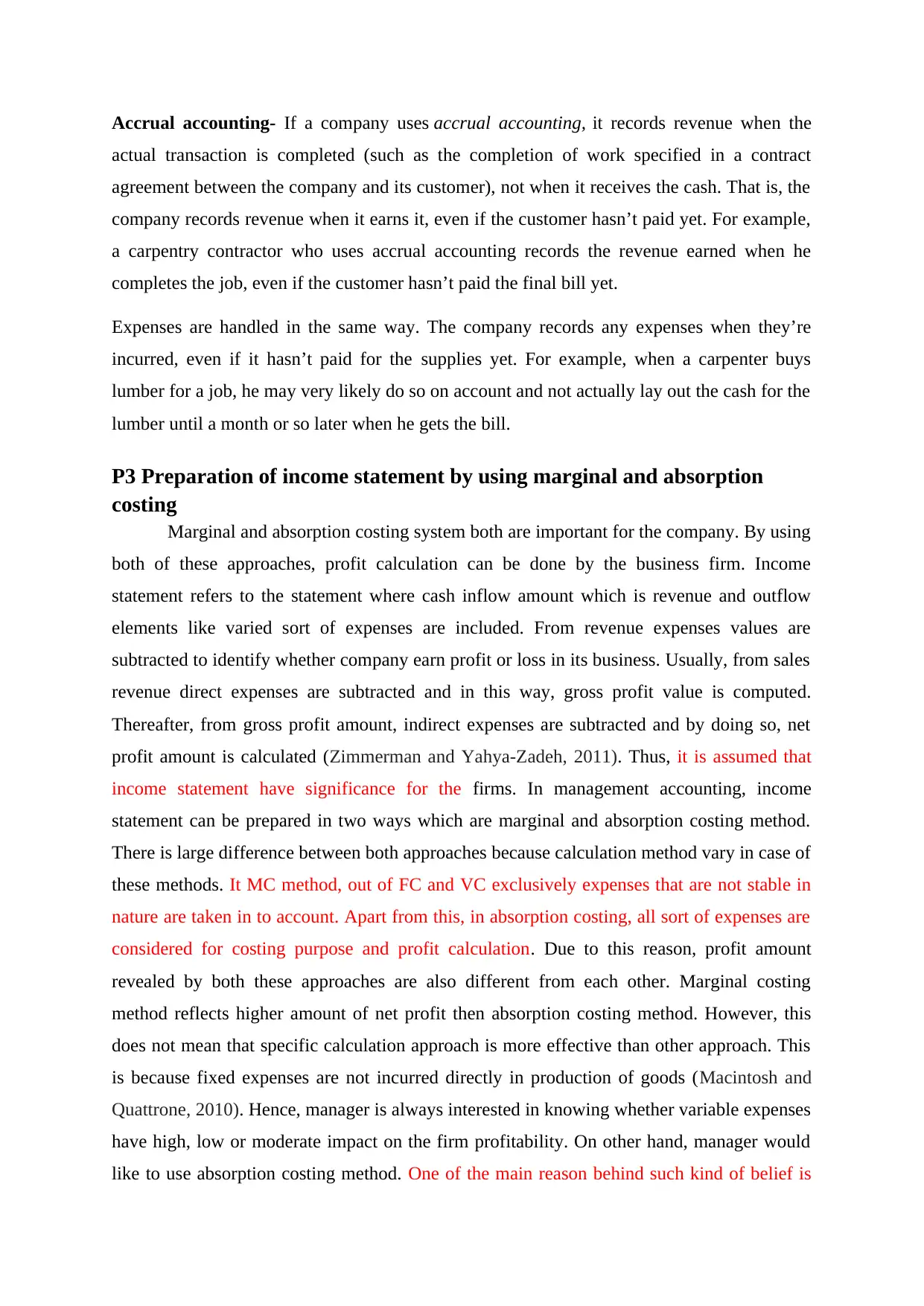
Accrual accounting- If a company uses accrual accounting, it records revenue when the
actual transaction is completed (such as the completion of work specified in a contract
agreement between the company and its customer), not when it receives the cash. That is, the
company records revenue when it earns it, even if the customer hasn’t paid yet. For example,
a carpentry contractor who uses accrual accounting records the revenue earned when he
completes the job, even if the customer hasn’t paid the final bill yet.
Expenses are handled in the same way. The company records any expenses when they’re
incurred, even if it hasn’t paid for the supplies yet. For example, when a carpenter buys
lumber for a job, he may very likely do so on account and not actually lay out the cash for the
lumber until a month or so later when he gets the bill.
P3 Preparation of income statement by using marginal and absorption
costing
Marginal and absorption costing system both are important for the company. By using
both of these approaches, profit calculation can be done by the business firm. Income
statement refers to the statement where cash inflow amount which is revenue and outflow
elements like varied sort of expenses are included. From revenue expenses values are
subtracted to identify whether company earn profit or loss in its business. Usually, from sales
revenue direct expenses are subtracted and in this way, gross profit value is computed.
Thereafter, from gross profit amount, indirect expenses are subtracted and by doing so, net
profit amount is calculated (Zimmerman and Yahya-Zadeh, 2011). Thus, it is assumed that
income statement have significance for the firms. In management accounting, income
statement can be prepared in two ways which are marginal and absorption costing method.
There is large difference between both approaches because calculation method vary in case of
these methods. It MC method, out of FC and VC exclusively expenses that are not stable in
nature are taken in to account. Apart from this, in absorption costing, all sort of expenses are
considered for costing purpose and profit calculation. Due to this reason, profit amount
revealed by both these approaches are also different from each other. Marginal costing
method reflects higher amount of net profit then absorption costing method. However, this
does not mean that specific calculation approach is more effective than other approach. This
is because fixed expenses are not incurred directly in production of goods (Macintosh and
Quattrone, 2010). Hence, manager is always interested in knowing whether variable expenses
have high, low or moderate impact on the firm profitability. On other hand, manager would
like to use absorption costing method. One of the main reason behind such kind of belief is
actual transaction is completed (such as the completion of work specified in a contract
agreement between the company and its customer), not when it receives the cash. That is, the
company records revenue when it earns it, even if the customer hasn’t paid yet. For example,
a carpentry contractor who uses accrual accounting records the revenue earned when he
completes the job, even if the customer hasn’t paid the final bill yet.
Expenses are handled in the same way. The company records any expenses when they’re
incurred, even if it hasn’t paid for the supplies yet. For example, when a carpenter buys
lumber for a job, he may very likely do so on account and not actually lay out the cash for the
lumber until a month or so later when he gets the bill.
P3 Preparation of income statement by using marginal and absorption
costing
Marginal and absorption costing system both are important for the company. By using
both of these approaches, profit calculation can be done by the business firm. Income
statement refers to the statement where cash inflow amount which is revenue and outflow
elements like varied sort of expenses are included. From revenue expenses values are
subtracted to identify whether company earn profit or loss in its business. Usually, from sales
revenue direct expenses are subtracted and in this way, gross profit value is computed.
Thereafter, from gross profit amount, indirect expenses are subtracted and by doing so, net
profit amount is calculated (Zimmerman and Yahya-Zadeh, 2011). Thus, it is assumed that
income statement have significance for the firms. In management accounting, income
statement can be prepared in two ways which are marginal and absorption costing method.
There is large difference between both approaches because calculation method vary in case of
these methods. It MC method, out of FC and VC exclusively expenses that are not stable in
nature are taken in to account. Apart from this, in absorption costing, all sort of expenses are
considered for costing purpose and profit calculation. Due to this reason, profit amount
revealed by both these approaches are also different from each other. Marginal costing
method reflects higher amount of net profit then absorption costing method. However, this
does not mean that specific calculation approach is more effective than other approach. This
is because fixed expenses are not incurred directly in production of goods (Macintosh and
Quattrone, 2010). Hence, manager is always interested in knowing whether variable expenses
have high, low or moderate impact on the firm profitability. On other hand, manager would
like to use absorption costing method. One of the main reason behind such kind of belief is
that all sort of expenditures are included in the calculation process. Fixed expenses are
directly not related to production of goods and services but fixed assets are used by the
business firms for production of goods. Hence, it can be said that it is very important to take
in to account fixed expenses in profit calculation. So, there is significance of both marginal
and absorption costing methods for the business firms (Baldvinsdottir, Mitchell and
Nørreklit, 2010). It depends on the manager requirements and discretion that which approach
of profit calculation it think is more appropriate for the company. It means that there are
advantages of using both approaches to managers in respect to making business decisions.
However, most of times managers prefer to use marginal costing method in the business. This
is because they give much importance to the expenses that are directly related to the
production of goods and services at workplace.
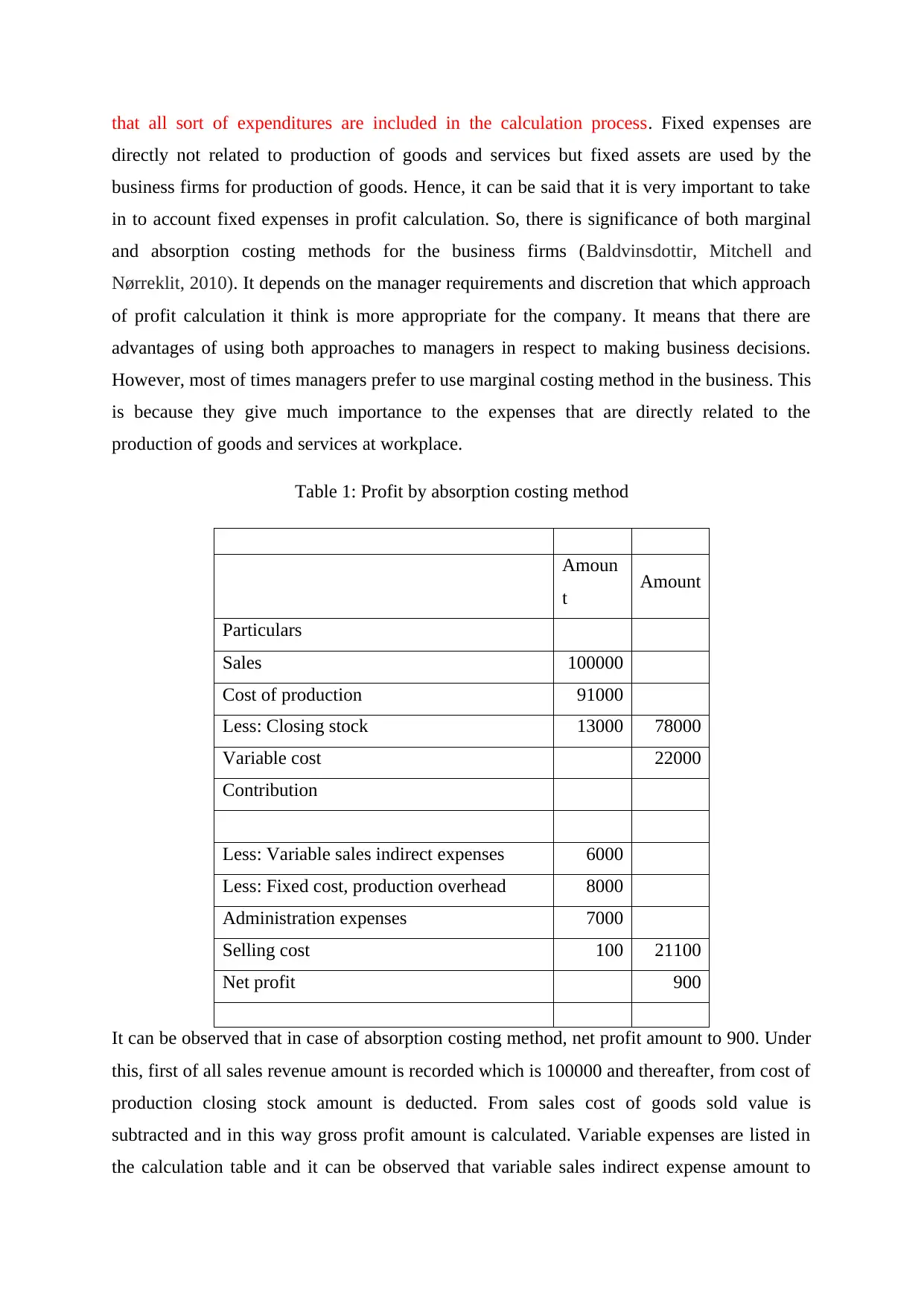
Table 1: Profit by absorption costing method
Amoun
t Amount
Particulars
Sales 100000
Cost of production 91000
Less: Closing stock 13000 78000
Variable cost 22000
Contribution
Less: Variable sales indirect expenses 6000
Less: Fixed cost, production overhead 8000
Administration expenses 7000
Selling cost 100 21100
Net profit 900
It can be observed that in case of absorption costing method, net profit amount to 900. Under
this, first of all sales revenue amount is recorded which is 100000 and thereafter, from cost of
production closing stock amount is deducted. From sales cost of goods sold value is
subtracted and in this way gross profit amount is calculated. Variable expenses are listed in
the calculation table and it can be observed that variable sales indirect expense amount to
directly not related to production of goods and services but fixed assets are used by the
business firms for production of goods. Hence, it can be said that it is very important to take
in to account fixed expenses in profit calculation. So, there is significance of both marginal
and absorption costing methods for the business firms (Baldvinsdottir, Mitchell and
Nørreklit, 2010). It depends on the manager requirements and discretion that which approach
of profit calculation it think is more appropriate for the company. It means that there are
advantages of using both approaches to managers in respect to making business decisions.
However, most of times managers prefer to use marginal costing method in the business. This
is because they give much importance to the expenses that are directly related to the
production of goods and services at workplace.
Table 1: Profit by absorption costing method
Amoun
t Amount
Particulars
Sales 100000
Cost of production 91000
Less: Closing stock 13000 78000
Variable cost 22000
Contribution
Less: Variable sales indirect expenses 6000
Less: Fixed cost, production overhead 8000
Administration expenses 7000
Selling cost 100 21100
Net profit 900
It can be observed that in case of absorption costing method, net profit amount to 900. Under
this, first of all sales revenue amount is recorded which is 100000 and thereafter, from cost of
production closing stock amount is deducted. From sales cost of goods sold value is
subtracted and in this way gross profit amount is calculated. Variable expenses are listed in
the calculation table and it can be observed that variable sales indirect expense amount to
⊘ This is a preview!⊘
Do you want full access?
Subscribe today to unlock all pages.
Trusted by 1+ million students worldwide
6000 followed by fixed cost production overhead value which is 8000 and administration
expenses whose value is 7000 followed by selling cost whose value is 100. On this basis, it
can be said that systematic approach is followed for calculation purpose. From gross profit
amount, all expenses are subtracted and by doing so, net profit is computed whose value is
900.
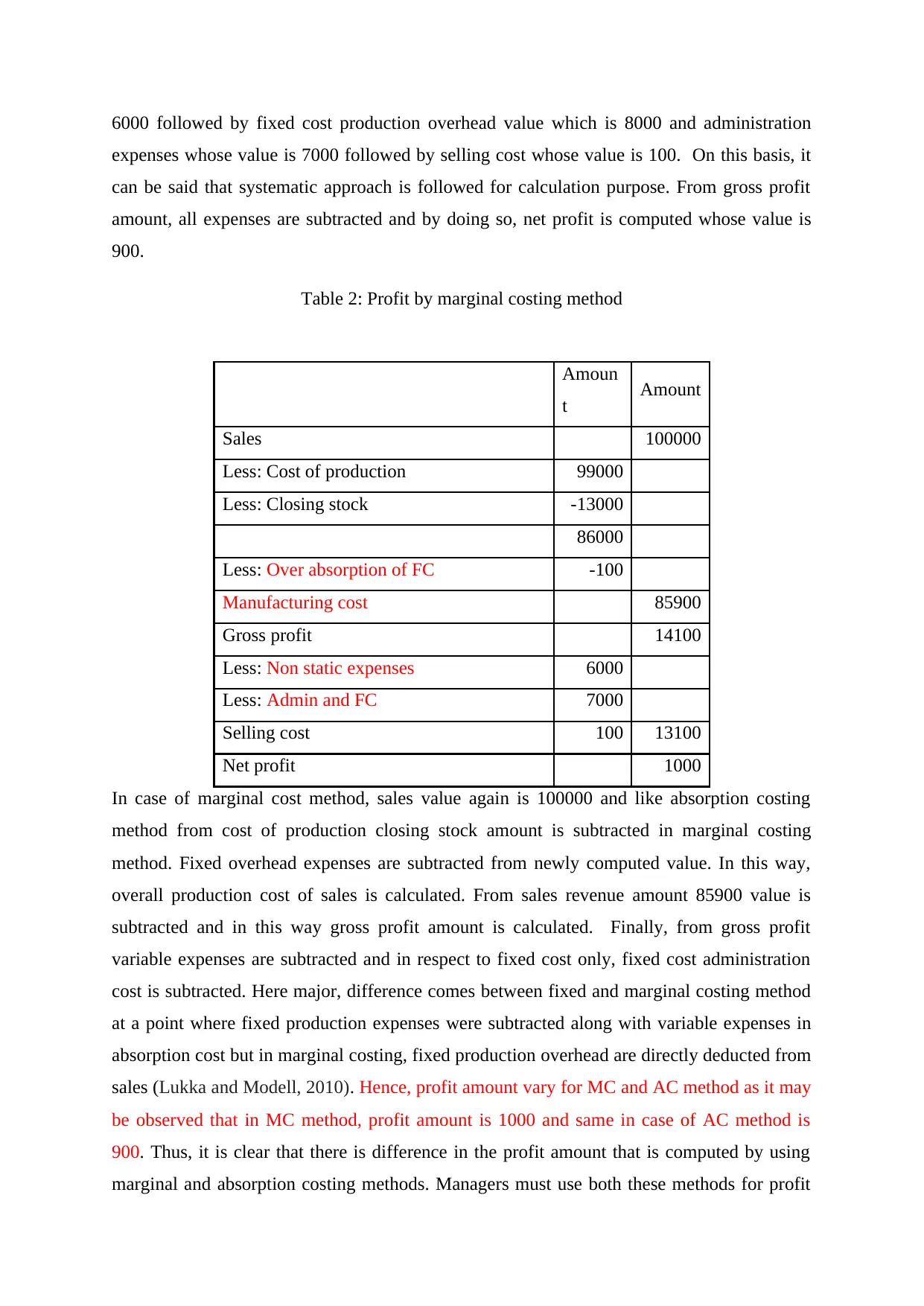
Table 2: Profit by marginal costing method
Amoun
t Amount
Sales 100000
Less: Cost of production 99000
Less: Closing stock -13000
86000
Less: Over absorption of FC -100
Manufacturing cost 85900
Gross profit 14100
Less: Non static expenses 6000
Less: Admin and FC 7000
Selling cost 100 13100
Net profit 1000
In case of marginal cost method, sales value again is 100000 and like absorption costing
method from cost of production closing stock amount is subtracted in marginal costing
method. Fixed overhead expenses are subtracted from newly computed value. In this way,
overall production cost of sales is calculated. From sales revenue amount 85900 value is
subtracted and in this way gross profit amount is calculated. Finally, from gross profit
variable expenses are subtracted and in respect to fixed cost only, fixed cost administration
cost is subtracted. Here major, difference comes between fixed and marginal costing method
at a point where fixed production expenses were subtracted along with variable expenses in
absorption cost but in marginal costing, fixed production overhead are directly deducted from
sales (Lukka and Modell, 2010). Hence, profit amount vary for MC and AC method as it may
be observed that in MC method, profit amount is 1000 and same in case of AC method is
900. Thus, it is clear that there is difference in the profit amount that is computed by using
marginal and absorption costing methods. Managers must use both these methods for profit
expenses whose value is 7000 followed by selling cost whose value is 100. On this basis, it
can be said that systematic approach is followed for calculation purpose. From gross profit
amount, all expenses are subtracted and by doing so, net profit is computed whose value is
900.
Table 2: Profit by marginal costing method
Amoun
t Amount
Sales 100000
Less: Cost of production 99000
Less: Closing stock -13000
86000
Less: Over absorption of FC -100
Manufacturing cost 85900
Gross profit 14100
Less: Non static expenses 6000
Less: Admin and FC 7000
Selling cost 100 13100
Net profit 1000
In case of marginal cost method, sales value again is 100000 and like absorption costing
method from cost of production closing stock amount is subtracted in marginal costing
method. Fixed overhead expenses are subtracted from newly computed value. In this way,
overall production cost of sales is calculated. From sales revenue amount 85900 value is
subtracted and in this way gross profit amount is calculated. Finally, from gross profit
variable expenses are subtracted and in respect to fixed cost only, fixed cost administration
cost is subtracted. Here major, difference comes between fixed and marginal costing method
at a point where fixed production expenses were subtracted along with variable expenses in
absorption cost but in marginal costing, fixed production overhead are directly deducted from
sales (Lukka and Modell, 2010). Hence, profit amount vary for MC and AC method as it may
be observed that in MC method, profit amount is 1000 and same in case of AC method is
900. Thus, it is clear that there is difference in the profit amount that is computed by using
marginal and absorption costing methods. Managers must use both these methods for profit
Paraphrase This Document
Need a fresh take? Get an instant paraphrase of this document with our AI Paraphraser
calculation and must use both of them to make business decisions. Like financial models,
calculation models in respect to marginal and absorption costing can be developed and by
changing values of fixed and variable expenses, it can be identified that with change in these
expenses, what sort of variation comes in profit amount. Such kind of models can assist firm
in making business decisions in respect to setting of target for fixed and variable expenses
which assist firm in earning determined amount of profit in the business. It may be assumed
that MC and AC method have significance for the firms and managers because by using these
approaches in different manner profit calculation can be done and performance can be
accessed. Hence, managers must use both these approaches to make business decisions.
calculation models in respect to marginal and absorption costing can be developed and by
changing values of fixed and variable expenses, it can be identified that with change in these
expenses, what sort of variation comes in profit amount. Such kind of models can assist firm
in making business decisions in respect to setting of target for fixed and variable expenses
which assist firm in earning determined amount of profit in the business. It may be assumed
that MC and AC method have significance for the firms and managers because by using these
approaches in different manner profit calculation can be done and performance can be
accessed. Hence, managers must use both these approaches to make business decisions.
REFERENCE
TARVER, E.
What are common concepts and techniques of managerial accounting?
http://www.investopedia.com/ask/answers/062915/what-are-common-concepts-and-
techniques-managerial-accounting.asp
In-text: (Tarver, 2017)
Your Bibliography: Tarver, E. (2017). What are common concepts and techniques of
managerial accounting?. [online] Investopedia. Available at:
http://www.investopedia.com/ask/answers/062915/what-are-common-concepts-and-
techniques-managerial-accounting.asp [Accessed 30 Oct. 2017].
HE IMPORTANCE OF MANAGEMENT ACCOUNTING FOR PROFESSIONAL
ACCOUNTANTS IN BUSINESS – GAA ACCOUNTING
Drilling data Much of management accounting focuses on the analysis of data, experts say,
and how that data is acquired and analysed differentiates the management accountant from
the auditor. As K.M. Wong, Group Manager, Finance and Accounting, at Power Assets
Holdings and an Institute Council member, points out, “one of an accountant’s essential
functions is providing useful information to company management.”
In-text: (Gaaaccounting.com, 2017)
Your Bibliography: Gaaaccounting.com. (2017). The Importance of Management Accounting
for Professional Accountants in Business – GAA Accounting. [online] Available at:
http://www.gaaaccounting.com/the-
Baldvinsdottir, G., Mitchell, F. and Nørreklit, H., 2010. Issues in the relationship between
theory and practice in management accounting. Management Accounting
Research. 21(2). pp.79-82.
Lukka, K. and Modell, S., 2010. Validation in interpretive management accounting
research. Accounting, organizations and society. 35(4). pp.462-477.
Macintosh, N.B. and Quattrone, P., 2010. Management accounting and control systems: An
organizational and sociological approach. John Wiley & Sons.
TARVER, E.
What are common concepts and techniques of managerial accounting?
http://www.investopedia.com/ask/answers/062915/what-are-common-concepts-and-
techniques-managerial-accounting.asp
In-text: (Tarver, 2017)
Your Bibliography: Tarver, E. (2017). What are common concepts and techniques of
managerial accounting?. [online] Investopedia. Available at:
http://www.investopedia.com/ask/answers/062915/what-are-common-concepts-and-
techniques-managerial-accounting.asp [Accessed 30 Oct. 2017].
HE IMPORTANCE OF MANAGEMENT ACCOUNTING FOR PROFESSIONAL
ACCOUNTANTS IN BUSINESS – GAA ACCOUNTING
Drilling data Much of management accounting focuses on the analysis of data, experts say,
and how that data is acquired and analysed differentiates the management accountant from
the auditor. As K.M. Wong, Group Manager, Finance and Accounting, at Power Assets
Holdings and an Institute Council member, points out, “one of an accountant’s essential
functions is providing useful information to company management.”
In-text: (Gaaaccounting.com, 2017)
Your Bibliography: Gaaaccounting.com. (2017). The Importance of Management Accounting
for Professional Accountants in Business – GAA Accounting. [online] Available at:
http://www.gaaaccounting.com/the-
Baldvinsdottir, G., Mitchell, F. and Nørreklit, H., 2010. Issues in the relationship between
theory and practice in management accounting. Management Accounting
Research. 21(2). pp.79-82.
Lukka, K. and Modell, S., 2010. Validation in interpretive management accounting
research. Accounting, organizations and society. 35(4). pp.462-477.
Macintosh, N.B. and Quattrone, P., 2010. Management accounting and control systems: An
organizational and sociological approach. John Wiley & Sons.
⊘ This is a preview!⊘
Do you want full access?
Subscribe today to unlock all pages.
Trusted by 1+ million students worldwide

Zimmerman, J.L. and Yahya-Zadeh, M., 2011. Accounting for decision making and
control. Issues in Accounting Education. 26(1). pp.258-259.
control. Issues in Accounting Education. 26(1). pp.258-259.

1 out of 10


Related Documents


Your All-in-One AI-Powered Toolkit for Academic Success.
+13062052269
info@desklib.com
Available 24*7 on WhatsApp / Email
![[object Object]](/_next/static/media/star-bottom.7253800d.svg)
Unlock your academic potential
Copyright © 2020–2026 A2Z Services. All Rights Reserved. Developed and managed by ZUCOL.