Marine Industry Report: Structure, Trends, and Global Influences
VerifiedAdded on 2022/10/01
|15
|3055
|160
Report
AI Summary
This report provides a detailed analysis of the marine industry, exploring its structure, key roles, and global trends. It begins with an introduction to the industry, highlighting its global significance and the importance of environmental protection and safety regulations. The report then delves into the various roles within the industry, including ship owners, managers, charterers, and classification societies. It examines the structure of the world fleet, providing statistics on ship numbers and tonnage, and discusses the factors influencing these trends, such as the world economy, seaborne commodity trades, competition, and political events. The report also addresses practical scenarios, such as handling delays in cargo pump room surveys and provides a detailed overview of pre-purchase survey reports, including report sections and inspection summaries. The report includes real-world examples and statistical data to support its analysis. The report concludes by emphasizing the importance of understanding the marine industry's complexities and the factors that drive its evolution.
Running head: THE MARINE INDUSTRY 1
The Marine Industry
Name of Student
Institution Affiliation
The Marine Industry
Name of Student
Institution Affiliation

Paraphrase This Document
Need a fresh take? Get an instant paraphrase of this document with our AI Paraphraser
THE MARINE INDUSTRY 2
Introduction
The marine industry is a well-established and global concern that has been grounded
for over many years. However, it is still developing with regards to the various technological
advancements in terms of environmental protection, efficiency, safety, as well as the welfare
of the workers on the board ships. Currently, the regulations from the international maritime
organization stipulate the various steps to incorporate the sustainability aspects of protecting
the environment in the modern shipping environment (Ahmed, Eich, & Bernhard, 2015).
Also, the developments in the ballast water management regulations have resulted in a shift
on the plastics that enter the oceans and seas. There are other developments in the maritime
industry which are characterized with various recommendations, legislations, as well as
guidelines and rules which have to be agreed upon and implemented on the global
perspective by various governments who are members of the international maritime
organization (Akyuz, Celik, & Cebi, 2016). Hence, the maritime industry is responsible for
ensuring that both the legislative as well
Structure of the maritime
Oceans and seas cover a great portion of the earth surface. This simply implies that
the maritime industry has to take responsibility for protecting the water bodies so that it does
not result in causing harmful effects on the environment (Bhattacharya et al., 2016). The
maritime industry structure, however, seems complex to comprehend as it keeps on changing
and not static. This is greatly sponsored by the legislation standards, which keeps on varying
on a daily basis. Thus to have a clear view of the maritime industry, our focus will be directed
towards the various roles on a daily basis (Albrecht & Muc, 2018).
The common roles in the marine industry Ship-owner
Introduction
The marine industry is a well-established and global concern that has been grounded
for over many years. However, it is still developing with regards to the various technological
advancements in terms of environmental protection, efficiency, safety, as well as the welfare
of the workers on the board ships. Currently, the regulations from the international maritime
organization stipulate the various steps to incorporate the sustainability aspects of protecting
the environment in the modern shipping environment (Ahmed, Eich, & Bernhard, 2015).
Also, the developments in the ballast water management regulations have resulted in a shift
on the plastics that enter the oceans and seas. There are other developments in the maritime
industry which are characterized with various recommendations, legislations, as well as
guidelines and rules which have to be agreed upon and implemented on the global
perspective by various governments who are members of the international maritime
organization (Akyuz, Celik, & Cebi, 2016). Hence, the maritime industry is responsible for
ensuring that both the legislative as well
Structure of the maritime
Oceans and seas cover a great portion of the earth surface. This simply implies that
the maritime industry has to take responsibility for protecting the water bodies so that it does
not result in causing harmful effects on the environment (Bhattacharya et al., 2016). The
maritime industry structure, however, seems complex to comprehend as it keeps on changing
and not static. This is greatly sponsored by the legislation standards, which keeps on varying
on a daily basis. Thus to have a clear view of the maritime industry, our focus will be directed
towards the various roles on a daily basis (Albrecht & Muc, 2018).
The common roles in the marine industry Ship-owner
THE MARINE INDUSTRY 3
The ship-owner is the commercial owner of the ship. They can either accompany, group of
individuals, or just an individual who has purchased the ship and is responsible for the
mortgage which is to be paid on it. They are not liable for the operation of the vessel. Ship manager
This refers to a company or an individual who have taken full responsibility for the
operations of the vessel (Cottier-Cook et al., 2016). Company
This refers to a group of individuals or an individual, or manager that has agreed to be in
charge of all the responsibilities which have been put into place by the international
management code for the prevention of pollution as well as the safe operation of the vessel. Charterer
This can be a group of individuals or just an individual who has hired a vessel for operational
purposes (Davies, 2017) Classification societies
This is a non-governmental organization which is responsible for the stipulation of rules as
well as regulations for the survey and the construction of offshore floating units and ships.
The surveys are performed on both the equipment used in the construction of the ship, as well
as the ship; during construction and through the lifetime of the ship. Recognized
organizations can delegate duties to the classified societies on state administrative operations
(Hedderwick & Turney, 2017) Rules
These include the requirements of a classification society, which are not enforceable by law.
Regulations
The ship-owner is the commercial owner of the ship. They can either accompany, group of
individuals, or just an individual who has purchased the ship and is responsible for the
mortgage which is to be paid on it. They are not liable for the operation of the vessel. Ship manager
This refers to a company or an individual who have taken full responsibility for the
operations of the vessel (Cottier-Cook et al., 2016). Company
This refers to a group of individuals or an individual, or manager that has agreed to be in
charge of all the responsibilities which have been put into place by the international
management code for the prevention of pollution as well as the safe operation of the vessel. Charterer
This can be a group of individuals or just an individual who has hired a vessel for operational
purposes (Davies, 2017) Classification societies
This is a non-governmental organization which is responsible for the stipulation of rules as
well as regulations for the survey and the construction of offshore floating units and ships.
The surveys are performed on both the equipment used in the construction of the ship, as well
as the ship; during construction and through the lifetime of the ship. Recognized
organizations can delegate duties to the classified societies on state administrative operations
(Hedderwick & Turney, 2017) Rules
These include the requirements of a classification society, which are not enforceable by law.
Regulations
⊘ This is a preview!⊘
Do you want full access?
Subscribe today to unlock all pages.

Trusted by 1+ million students worldwide
THE MARINE INDUSTRY 4
These comprise of the statutory recommendation’s which are proposed by the coastal state
administrators or the flag state administration and are enforceable by law. Most of these
requirements are generated by the international maritime organization. Flag state administration
This is a government body which is responsible for the enacting of the on-hip regulations that
are recorded on its register. Several members are from the international maritime
organization (Jones, 2017). Coastal state administration
This is a government body in charge of ensuring that all vessels which are operating along its
border boundaries comply with the regulations which have been stipulated. The international association of classification societies
This is an association of twelve members which is responsible for defining the procedural
regulations for various member societies. The international maritime organization
This is the body responsible for the operation of maritime activities on a global perspective
(Kamsu-Foguem, 2016). Port state control
This is a government body which is mandated for the inspection of foreign vessels within the
home country, and they ensure that the vessels comply with the stipulated regulations. The
port state control officers are mandated to detain vessels which are not in compliance with the
regulations.
These comprise of the statutory recommendation’s which are proposed by the coastal state
administrators or the flag state administration and are enforceable by law. Most of these
requirements are generated by the international maritime organization. Flag state administration
This is a government body which is responsible for the enacting of the on-hip regulations that
are recorded on its register. Several members are from the international maritime
organization (Jones, 2017). Coastal state administration
This is a government body in charge of ensuring that all vessels which are operating along its
border boundaries comply with the regulations which have been stipulated. The international association of classification societies
This is an association of twelve members which is responsible for defining the procedural
regulations for various member societies. The international maritime organization
This is the body responsible for the operation of maritime activities on a global perspective
(Kamsu-Foguem, 2016). Port state control
This is a government body which is mandated for the inspection of foreign vessels within the
home country, and they ensure that the vessels comply with the stipulated regulations. The
port state control officers are mandated to detain vessels which are not in compliance with the
regulations.
Paraphrase This Document
Need a fresh take? Get an instant paraphrase of this document with our AI Paraphraser
THE MARINE INDUSTRY 5
Trends in the maritime industry
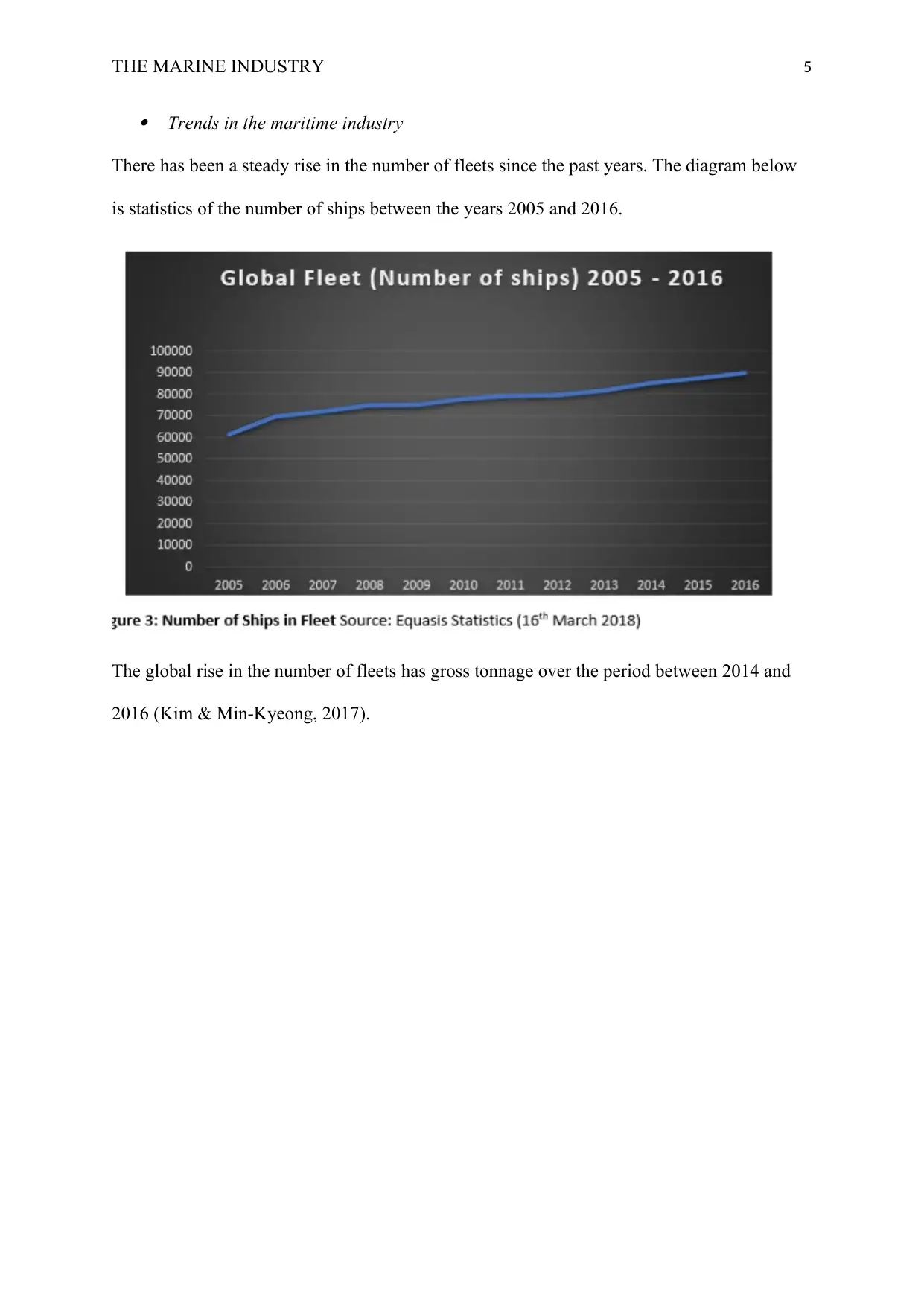
There has been a steady rise in the number of fleets since the past years. The diagram below
is statistics of the number of ships between the years 2005 and 2016.
The global rise in the number of fleets has gross tonnage over the period between 2014 and
2016 (Kim & Min-Kyeong, 2017).
Trends in the maritime industry
There has been a steady rise in the number of fleets since the past years. The diagram below
is statistics of the number of ships between the years 2005 and 2016.
The global rise in the number of fleets has gross tonnage over the period between 2014 and
2016 (Kim & Min-Kyeong, 2017).
THE MARINE INDUSTRY 6
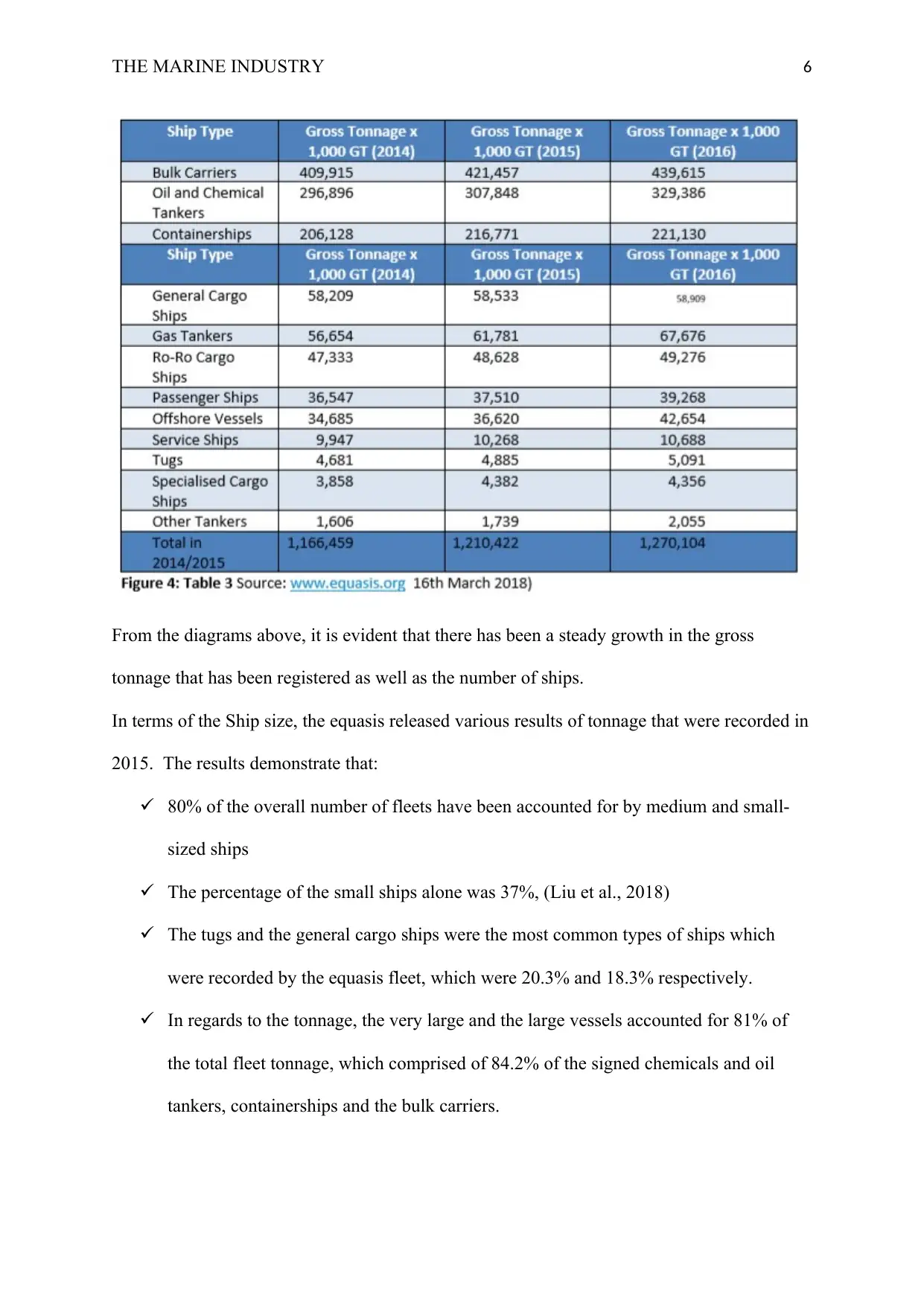
From the diagrams above, it is evident that there has been a steady growth in the gross
tonnage that has been registered as well as the number of ships.
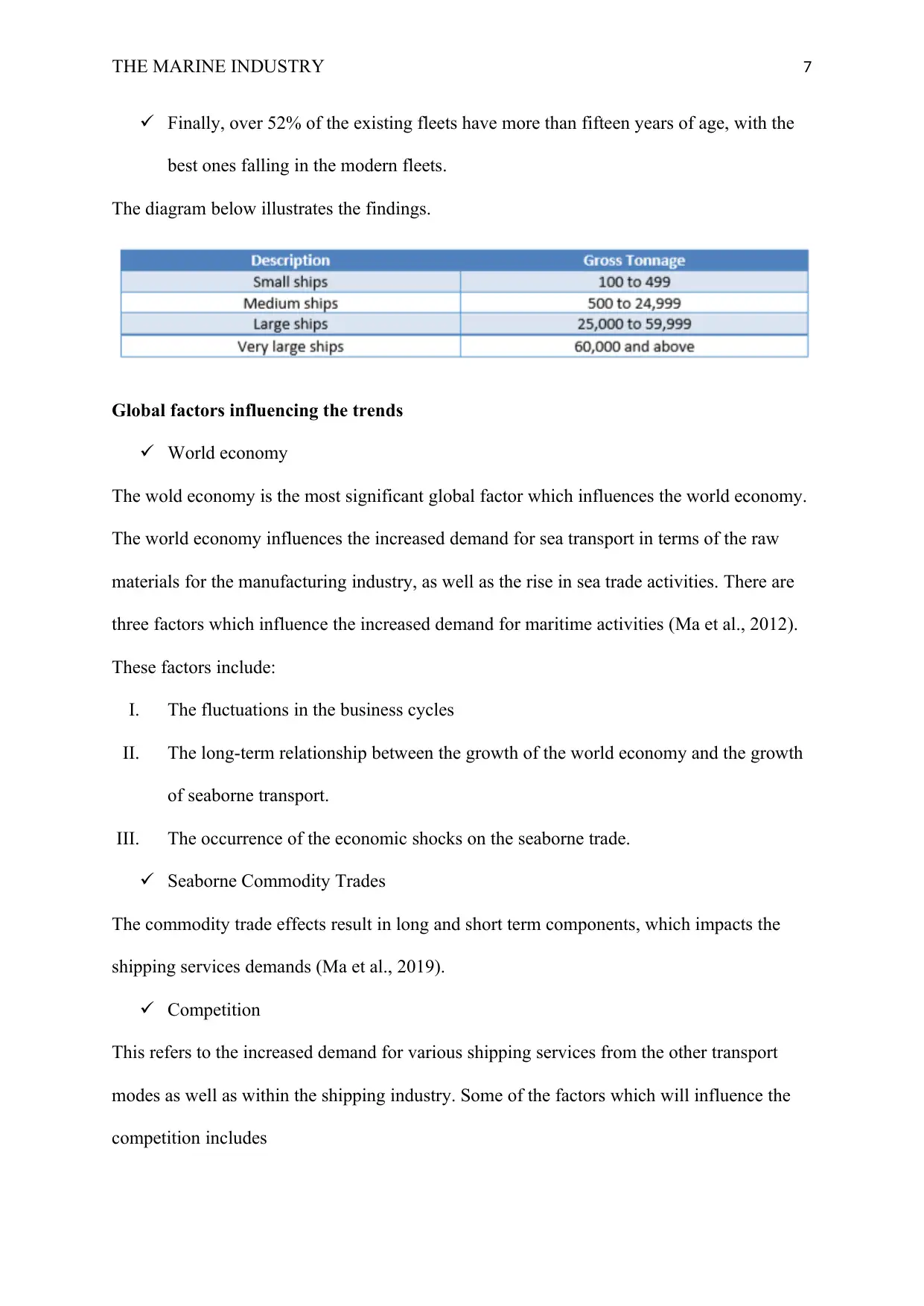
In terms of the Ship size, the equasis released various results of tonnage that were recorded in
2015. The results demonstrate that:
80% of the overall number of fleets have been accounted for by medium and small-
sized ships
The percentage of the small ships alone was 37%, (Liu et al., 2018)
The tugs and the general cargo ships were the most common types of ships which
were recorded by the equasis fleet, which were 20.3% and 18.3% respectively.
In regards to the tonnage, the very large and the large vessels accounted for 81% of
the total fleet tonnage, which comprised of 84.2% of the signed chemicals and oil
tankers, containerships and the bulk carriers.
From the diagrams above, it is evident that there has been a steady growth in the gross
tonnage that has been registered as well as the number of ships.
In terms of the Ship size, the equasis released various results of tonnage that were recorded in
2015. The results demonstrate that:
80% of the overall number of fleets have been accounted for by medium and small-
sized ships
The percentage of the small ships alone was 37%, (Liu et al., 2018)
The tugs and the general cargo ships were the most common types of ships which
were recorded by the equasis fleet, which were 20.3% and 18.3% respectively.
In regards to the tonnage, the very large and the large vessels accounted for 81% of
the total fleet tonnage, which comprised of 84.2% of the signed chemicals and oil
tankers, containerships and the bulk carriers.
⊘ This is a preview!⊘
Do you want full access?
Subscribe today to unlock all pages.
Trusted by 1+ million students worldwide
THE MARINE INDUSTRY 7
Finally, over 52% of the existing fleets have more than fifteen years of age, with the
best ones falling in the modern fleets.
The diagram below illustrates the findings.
Global factors influencing the trends
World economy
The wold economy is the most significant global factor which influences the world economy.
The world economy influences the increased demand for sea transport in terms of the raw
materials for the manufacturing industry, as well as the rise in sea trade activities. There are
three factors which influence the increased demand for maritime activities (Ma et al., 2012).
These factors include:
I. The fluctuations in the business cycles
II. The long-term relationship between the growth of the world economy and the growth
of seaborne transport.
III. The occurrence of the economic shocks on the seaborne trade.
Seaborne Commodity Trades
The commodity trade effects result in long and short term components, which impacts the
shipping services demands (Ma et al., 2019).
Competition
This refers to the increased demand for various shipping services from the other transport
modes as well as within the shipping industry. Some of the factors which will influence the
competition includes
Finally, over 52% of the existing fleets have more than fifteen years of age, with the
best ones falling in the modern fleets.
The diagram below illustrates the findings.
Global factors influencing the trends
World economy
The wold economy is the most significant global factor which influences the world economy.
The world economy influences the increased demand for sea transport in terms of the raw
materials for the manufacturing industry, as well as the rise in sea trade activities. There are
three factors which influence the increased demand for maritime activities (Ma et al., 2012).
These factors include:
I. The fluctuations in the business cycles
II. The long-term relationship between the growth of the world economy and the growth
of seaborne transport.
III. The occurrence of the economic shocks on the seaborne trade.
Seaborne Commodity Trades
The commodity trade effects result in long and short term components, which impacts the
shipping services demands (Ma et al., 2019).
Competition
This refers to the increased demand for various shipping services from the other transport
modes as well as within the shipping industry. Some of the factors which will influence the
competition includes
Paraphrase This Document
Need a fresh take? Get an instant paraphrase of this document with our AI Paraphraser
THE MARINE INDUSTRY 8
The freight costs, the reliability/efficiency, the frequency of services, the economies of scale,
as well as the speed. The customers will thus asses these factors and then decide on the best
suitable mode of service.
Elasticity of demand
By definition, this refers to the responsiveness of the quantity which is demanded to the
change in price. In terms of the economics of maritime, it is denoted as the responsiveness of
the demand for various shipping services to an alteration in the various freight prices. For
instance, the freight rates are inversely proportional to the demand. The responsiveness is
dependent upon the:
I. Availability of alternative modes of transport, such that the elasticity of the demand
calls for a substitution of other forms of transport
II. The time over which adjustment takes place (Selvaraju & Ilaiyavel, 2011)
III. The income of the individuals determining the income.
Political events
These are events which bring about unexpected alternation in demand. For instance;
government policies, localized war, as well as the political nationalization of the foreign
assets. Some of these include the world wars I and ii. The OPEC production cutbacks. The
tap oil line closure, among others.
The average haul
The distance over which cargo is to be shipped influences the demand for sea transport.
Various groups of supplies across also influences the average haul in oil trade, which
influences the overall maritime industry.
The freight costs, the reliability/efficiency, the frequency of services, the economies of scale,
as well as the speed. The customers will thus asses these factors and then decide on the best
suitable mode of service.
Elasticity of demand
By definition, this refers to the responsiveness of the quantity which is demanded to the
change in price. In terms of the economics of maritime, it is denoted as the responsiveness of
the demand for various shipping services to an alteration in the various freight prices. For
instance, the freight rates are inversely proportional to the demand. The responsiveness is
dependent upon the:
I. Availability of alternative modes of transport, such that the elasticity of the demand
calls for a substitution of other forms of transport
II. The time over which adjustment takes place (Selvaraju & Ilaiyavel, 2011)
III. The income of the individuals determining the income.
Political events
These are events which bring about unexpected alternation in demand. For instance;
government policies, localized war, as well as the political nationalization of the foreign
assets. Some of these include the world wars I and ii. The OPEC production cutbacks. The
tap oil line closure, among others.
The average haul
The distance over which cargo is to be shipped influences the demand for sea transport.
Various groups of supplies across also influences the average haul in oil trade, which
influences the overall maritime industry.
THE MARINE INDUSTRY 9
Dealing with a situation involving a delay of the cargo pump room
In the case of performing the survey of the cargo pump room, it is in no doubt that the delay
is coming from the side of the client. However, such a case will call for the surveyor refusing
to perform the survey as it matters a lot on the reputation of the surveyor. If the scope of the
survey shall not be complete by the time of the departure from the current oil terminal, it
implies that quality, as well as the integrity of the surveyor, shall be in question, and this is
not acceptable. Additionally, the client shall be in full awareness of the fact that the surveyor
there were planed preparations before which were not adhered to. In such a case, the surveyor
will then inform the client of the terms of the abandonment of the survey (Sønvisen &
Standal, 2019).
Dealing with a situation involving a delay of the cargo pump room
In the case of performing the survey of the cargo pump room, it is in no doubt that the delay
is coming from the side of the client. However, such a case will call for the surveyor refusing
to perform the survey as it matters a lot on the reputation of the surveyor. If the scope of the
survey shall not be complete by the time of the departure from the current oil terminal, it
implies that quality, as well as the integrity of the surveyor, shall be in question, and this is
not acceptable. Additionally, the client shall be in full awareness of the fact that the surveyor
there were planed preparations before which were not adhered to. In such a case, the surveyor
will then inform the client of the terms of the abandonment of the survey (Sønvisen &
Standal, 2019).
⊘ This is a preview!⊘
Do you want full access?
Subscribe today to unlock all pages.
Trusted by 1+ million students worldwide
THE MARINE INDUSTRY 10
The pre-purchase survey report
Report sections
The cover page of the report
This section will include the name of the report, the author affiliation of the report, the date of
release, as well as any useful additional information.
By extension, a photograph of the ship shall also be applicable in this situation.
The declaration of the report- indicates that there is no prejudice in the generated report and
that the work is owned by the author.
Acknowledgment
This section will detail the people who have assisted the author in generating the report.
The table of contents- highlighting the various section of the report. It includes just the
normal format of a technical report. For instance, (executive summary, introduction, purpose
and scope, assumptions, limitations, technical section, survey work, accident investigation,
legal report, conclusion, references and then appendix section (Wang & Wang, 2019).
Report
Executive summary
The report is intended to provide a concise summary of the condition of the vessel as at the
time of the survey. It generally includes the vessel grading based on the items for
improvement, defects, deficiencies, as well as the positive features.
Report
On 20th March, 2018
Attended the vessel together with five other interested parties- French, German, Greek,
Portugal and conducted the inspection as shown below
The pre-purchase survey report
Report sections
The cover page of the report
This section will include the name of the report, the author affiliation of the report, the date of
release, as well as any useful additional information.
By extension, a photograph of the ship shall also be applicable in this situation.
The declaration of the report- indicates that there is no prejudice in the generated report and
that the work is owned by the author.
Acknowledgment
This section will detail the people who have assisted the author in generating the report.
The table of contents- highlighting the various section of the report. It includes just the
normal format of a technical report. For instance, (executive summary, introduction, purpose
and scope, assumptions, limitations, technical section, survey work, accident investigation,
legal report, conclusion, references and then appendix section (Wang & Wang, 2019).
Report
Executive summary
The report is intended to provide a concise summary of the condition of the vessel as at the
time of the survey. It generally includes the vessel grading based on the items for
improvement, defects, deficiencies, as well as the positive features.
Report
On 20th March, 2018
Attended the vessel together with five other interested parties- French, German, Greek,
Portugal and conducted the inspection as shown below
Paraphrase This Document
Need a fresh take? Get an instant paraphrase of this document with our AI Paraphraser
THE MARINE INDUSTRY 11
The single hull crude oil is a single oil tanker having the following particulars
Owners: Transport Inc., Tokyo
Managers : Tankship Management Ltd, USA
Type : Crude oil tanker
Port of registry : Indonesia
Class : Nippon Kaiji Kyokai
IMO No : 9018476
Class Notations : NS* (TOB) (ESP), MNS*
CHG, MPP, LSA, RCF, MO, IWS
GRT : 67554
NRT : 65534
Delivered : 20th February 2012
Dimensions : 313.04m (LOA) x 36.00m (B) x 33.80m (D)
Summer Draft : 22.07m
Deadweight (Summer): 144,100 tonnes
Lightship : 20,281 tonnes
Shipbuilder : Griffins Ochieng’, Texas
Service speed : 13~14 knots (laden), 15~ 16 knots (ballast)
Inspection summary
The sample offshore vessel is a 4577 supply vessel built under a sample class
supervision and delivered in Australia in March 2018. A general survey of the vessel was
done between 0850 to 1800 on 20th march 2018 while awaiting orders by the client. At the
time of inspection, the vessel was in good condition, well maintained with no significant
defects reported by the crew staff.
Hull
The single hull crude oil is a single oil tanker having the following particulars
Owners: Transport Inc., Tokyo
Managers : Tankship Management Ltd, USA
Type : Crude oil tanker
Port of registry : Indonesia
Class : Nippon Kaiji Kyokai
IMO No : 9018476
Class Notations : NS* (TOB) (ESP), MNS*
CHG, MPP, LSA, RCF, MO, IWS
GRT : 67554
NRT : 65534
Delivered : 20th February 2012
Dimensions : 313.04m (LOA) x 36.00m (B) x 33.80m (D)
Summer Draft : 22.07m
Deadweight (Summer): 144,100 tonnes
Lightship : 20,281 tonnes
Shipbuilder : Griffins Ochieng’, Texas
Service speed : 13~14 knots (laden), 15~ 16 knots (ballast)
Inspection summary
The sample offshore vessel is a 4577 supply vessel built under a sample class
supervision and delivered in Australia in March 2018. A general survey of the vessel was
done between 0850 to 1800 on 20th march 2018 while awaiting orders by the client. At the
time of inspection, the vessel was in good condition, well maintained with no significant
defects reported by the crew staff.
Hull
THE MARINE INDUSTRY 12
The external hull was freshly painted and was in good condition without any physical
defect.
The main deck and the poop
They were in good and well-maintained condition. However, minor defects were realized on
the deck area, with the timber deck reported missing. However, this was not deemed to be
among the serious defects.
The ballast tanks and the forepeak tanks
The tanks were in good condition as well; in fact, a recent survey by ships ballast tank rated
the tanks to be 'good.'
Accommodation area
There was well maintenance of the accommodation areas as well as the bridge (Wright,
2015).
Engine systems
The engine room, as well as the engine systems, were also certified to be in good condition
and were running effectively. However, there is no inventory documentation of the
hazardous materials, which might be required for European trading waters from 2020.
Licensing
The validity period of the IOPP certificate is less than five years and would require an
instalment of approved ballast water treatment.
Cargo systems
All the cargo systems were generally in good order and operational. The performance of the
ship was excellent, and the history of the port state control of the ship was very good. Given
the condition of the vessel was good, the expectation is that the levels of the OPEX will be in
accordance with the industry norms for this vessel type and size.
The external hull was freshly painted and was in good condition without any physical
defect.
The main deck and the poop
They were in good and well-maintained condition. However, minor defects were realized on
the deck area, with the timber deck reported missing. However, this was not deemed to be
among the serious defects.
The ballast tanks and the forepeak tanks
The tanks were in good condition as well; in fact, a recent survey by ships ballast tank rated
the tanks to be 'good.'
Accommodation area
There was well maintenance of the accommodation areas as well as the bridge (Wright,
2015).
Engine systems
The engine room, as well as the engine systems, were also certified to be in good condition
and were running effectively. However, there is no inventory documentation of the
hazardous materials, which might be required for European trading waters from 2020.
Licensing
The validity period of the IOPP certificate is less than five years and would require an
instalment of approved ballast water treatment.
Cargo systems
All the cargo systems were generally in good order and operational. The performance of the
ship was excellent, and the history of the port state control of the ship was very good. Given
the condition of the vessel was good, the expectation is that the levels of the OPEX will be in
accordance with the industry norms for this vessel type and size.
⊘ This is a preview!⊘
Do you want full access?
Subscribe today to unlock all pages.
Trusted by 1+ million students worldwide

1 out of 15


Related Documents


Your All-in-One AI-Powered Toolkit for Academic Success.
+13062052269
info@desklib.com
Available 24*7 on WhatsApp / Email
![[object Object]](/_next/static/media/star-bottom.7253800d.svg)
Unlock your academic potential
Copyright © 2020–2026 A2Z Services. All Rights Reserved. Developed and managed by ZUCOL.