Marine Paints Manufacturing: Latest Antifouling Technologies Analysis
VerifiedAdded on 2023/01/12
|38
|15135
|33
Report
AI Summary
This report provides a comprehensive analysis of marine paints manufacturing, specifically focusing on the advancements in antifouling technologies. The research investigates the ecological sustainability of new biocides compared to older, environmentally damaging products, and determines the advantages and disadvantages of these new antifouling solutions. Furthermore, the report evaluates key factors considered by manufacturers, such as Chugoku Marine Paints, to enhance sustainability. The study examines the shift from Tributyltin (TBT) to alternative biocides, highlighting the importance of reducing biofouling on ships to improve durability and reduce fuel consumption. The report includes a literature review and discusses the rationale, objectives, and research questions. The research methodology includes qualitative data collection via interviews. The findings and conclusions aim to provide valuable information regarding the future of marine paint manufacturing and its impact on the marine environment.
Abstract
The current research project is based on the topic of Marine Paints Manufacturing along with
analysing the latest technologies used in the Antifouling Paint Industry. The main aim of the
dissertation is to compare the sustainability of new ecological biocides with products that have
damaging effects on the environment along with determining the advantages and disadvantages
of new Antifouling products. Apart from this, an evaluation of the model of the key factors for
consideration by the anti-fouling manufacturers that contribute to sustainability is also made. A
viable research method is developed which consists of a qualitative form of data collection to
provide an in-depth form of information. The interview method is used for effective data
collection that facilitates a better understanding of the views of selected participants in the
research topic to draw a valid and viable conclusion. The main findings and conclusion of the
current research project will lead better information about the substitute of TBT (Tributyltin
chloride) which is one of the environmental contaminants used as a biocide in antifouling paints
along with the fact manufacturing new antifouling product helps in bridging the gap in the
marine paint industry, by reducing fuel consumption. This study effectively investigates the
Marine paint manufacturing. The latest technology utilised in antifouling paint industry. There
are some key factors which assist in maximizing the contribution of Chugoku marine paints as
well as other manufacturers contribute to sustainability by a balance of improved ecological
sustainability or energy saving. This would also help in increasing the durability of a ship by
reducing the biofouling rate i.e. organism growth on the hull of the ship.
1
The current research project is based on the topic of Marine Paints Manufacturing along with
analysing the latest technologies used in the Antifouling Paint Industry. The main aim of the
dissertation is to compare the sustainability of new ecological biocides with products that have
damaging effects on the environment along with determining the advantages and disadvantages
of new Antifouling products. Apart from this, an evaluation of the model of the key factors for
consideration by the anti-fouling manufacturers that contribute to sustainability is also made. A
viable research method is developed which consists of a qualitative form of data collection to
provide an in-depth form of information. The interview method is used for effective data
collection that facilitates a better understanding of the views of selected participants in the
research topic to draw a valid and viable conclusion. The main findings and conclusion of the
current research project will lead better information about the substitute of TBT (Tributyltin
chloride) which is one of the environmental contaminants used as a biocide in antifouling paints
along with the fact manufacturing new antifouling product helps in bridging the gap in the
marine paint industry, by reducing fuel consumption. This study effectively investigates the
Marine paint manufacturing. The latest technology utilised in antifouling paint industry. There
are some key factors which assist in maximizing the contribution of Chugoku marine paints as
well as other manufacturers contribute to sustainability by a balance of improved ecological
sustainability or energy saving. This would also help in increasing the durability of a ship by
reducing the biofouling rate i.e. organism growth on the hull of the ship.
1

Paraphrase This Document
Need a fresh take? Get an instant paraphrase of this document with our AI Paraphraser

2
Chapter 1: INTRODUCTION
Background of research
Marine coating systems are mainly applied to offshore structures and ships both in the
ocean and fresh water going vessels. It serves a dual purpose to protect the structure of the ship
from deterioration, as well as keep its durability (de Wit-de Vries and et. al. 2019). The merchant
fleet at a worldwide level is comprised of bulk carriers, ships, tankers, cargo ships, cruise ships,
container ships, and passenger vessels. Marine coatings possess specific functional properties
which help in protecting the surface of ships from corrosion from fouling (Dawoud 2012). Along
with this, such coatings also protect submerged materials other than ships like yachts, vessels,
and more from seawater, which also improves their durability as well as overall performance.
TBT refers to Tributyltin that is mainly used as a biocide in the bottom or anti-fouling
paint, which is applied to ocean hulls, to improve the performance of ship (Martins and et. al.,
2019). This would also help in increasing the durability of a ship by reducing the biofouling rate
i.e. organism growth on the hull of the ship. But applying such a type of biocide which contains
(C4H9)3 Sn group, when it leaches out into the marine environment proves highly toxic for other
non-targeted organisms (Bhadbhade 2019). This toxin which is also an obesogen has been used
as a fungicide, bactericide, insecticide, and wood preservative. So, it is affecting aquatic life and
led to the collapse of the number of organisms. The high concentrations of TBT and/or other
organo toxins are found in coastal waters at several locations worldwide. Therefore, to preserve
the life of other organisms, the usage of TBT was completely banned in 2003, in antifouling
coatings. This ban has forced marine organizations to reconstruct the formulation of
accommodating various biocides, which contain copper designated materials and supplemented
with the booster biocidal products (Debnath 2014). Thus, new technology needs to implement
for antifouling coatings, which are expected to drive efficient market growth. For this purpose,
this research focuses on the latest technologies used today, in the antifouling paint industry for
preventing ships from corrosion in seawater.
Overview of research
Chugoku Marine Paints Limited is known for its advancements in technology and also
accountable for developing the technology regarding leading antifouling. It is known as one of
the world's famous paint producers, originated from Japan (Hou 2020). It was founded in 1917
and has headquarters in Hiroshima City of Japan. This manufacturing firm paints color
3
Background of research
Marine coating systems are mainly applied to offshore structures and ships both in the
ocean and fresh water going vessels. It serves a dual purpose to protect the structure of the ship
from deterioration, as well as keep its durability (de Wit-de Vries and et. al. 2019). The merchant
fleet at a worldwide level is comprised of bulk carriers, ships, tankers, cargo ships, cruise ships,
container ships, and passenger vessels. Marine coatings possess specific functional properties
which help in protecting the surface of ships from corrosion from fouling (Dawoud 2012). Along
with this, such coatings also protect submerged materials other than ships like yachts, vessels,
and more from seawater, which also improves their durability as well as overall performance.
TBT refers to Tributyltin that is mainly used as a biocide in the bottom or anti-fouling
paint, which is applied to ocean hulls, to improve the performance of ship (Martins and et. al.,
2019). This would also help in increasing the durability of a ship by reducing the biofouling rate
i.e. organism growth on the hull of the ship. But applying such a type of biocide which contains
(C4H9)3 Sn group, when it leaches out into the marine environment proves highly toxic for other
non-targeted organisms (Bhadbhade 2019). This toxin which is also an obesogen has been used
as a fungicide, bactericide, insecticide, and wood preservative. So, it is affecting aquatic life and
led to the collapse of the number of organisms. The high concentrations of TBT and/or other
organo toxins are found in coastal waters at several locations worldwide. Therefore, to preserve
the life of other organisms, the usage of TBT was completely banned in 2003, in antifouling
coatings. This ban has forced marine organizations to reconstruct the formulation of
accommodating various biocides, which contain copper designated materials and supplemented
with the booster biocidal products (Debnath 2014). Thus, new technology needs to implement
for antifouling coatings, which are expected to drive efficient market growth. For this purpose,
this research focuses on the latest technologies used today, in the antifouling paint industry for
preventing ships from corrosion in seawater.
Overview of research
Chugoku Marine Paints Limited is known for its advancements in technology and also
accountable for developing the technology regarding leading antifouling. It is known as one of
the world's famous paint producers, originated from Japan (Hou 2020). It was founded in 1917
and has headquarters in Hiroshima City of Japan. This manufacturing firm paints color
3
⊘ This is a preview!⊘
Do you want full access?
Subscribe today to unlock all pages.

Trusted by 1+ million students worldwide
townscapes beautifully and the living environment surrounding the sea, by protecting materials
from deterioration and corrosion. After its foundation, Chugoku Marine Paints, Ltd. or CMP
group has dedicated its business to protect materials like steel in harsh fouling, corrosive marine
environments, and other, through its antifouling products and anti-corrosive technologies
(Bhadbhade 2019). In addition to this, innovative technologies of respective firms produce
several products or services to support industrial development, such as paints for boats,
woodworking, and curable paints for underwater materials, which are represented by the first
UV-curable paints of Japan. Standing on this development spirit via high dedication and
innovation, lead the CMP group to become one of the innovative marine paints manufacturing
firm (Aykin 2019). Following the ban of TBT, the company has developed innovations to adopt
that enhance the efficiency and durability of ships, including protecting the marine organisms,
research is conducted in present research by De Groot and Spiekerman (2020). the use of TBT is
associated with Tributyltin (TBT) is an active ingredient in certain antifouling paints used on
ships and is one of the most dangerous substances ever deliberately introduced into the marine
environment. It includes enzyme based coating systems; low energy and hydrophobic foul-
release coatings; biocide-free and two-component of fouling release coatings; anti-fouling
copper-free system; and Nano antifouling coatings.
Rationale of research
The main purpose of conducting the present research is to analyse the efficiency of the
latest technologies, which are used by Marine Paints Manufacturing like Chugoku Marine Paints,
for antifouling coatings (Ali 2020). This would help in evaluating the key factors of the
respective industry, for improving ecological sustainability and maintaining the durability of
ships by manufacturing new biocide products.
Title
To investigate “Marine Paints Manufacturing”. The latest technologies used in Antifouling
Paint Industry
Aim
“To investigate the key factors that help to maximize the contribution of Chugoku Marine
Paints and other manufactures contribute to sustainability through a balance of improved
ecological sustainability or energy-saving”.
4
from deterioration and corrosion. After its foundation, Chugoku Marine Paints, Ltd. or CMP
group has dedicated its business to protect materials like steel in harsh fouling, corrosive marine
environments, and other, through its antifouling products and anti-corrosive technologies
(Bhadbhade 2019). In addition to this, innovative technologies of respective firms produce
several products or services to support industrial development, such as paints for boats,
woodworking, and curable paints for underwater materials, which are represented by the first
UV-curable paints of Japan. Standing on this development spirit via high dedication and
innovation, lead the CMP group to become one of the innovative marine paints manufacturing
firm (Aykin 2019). Following the ban of TBT, the company has developed innovations to adopt
that enhance the efficiency and durability of ships, including protecting the marine organisms,
research is conducted in present research by De Groot and Spiekerman (2020). the use of TBT is
associated with Tributyltin (TBT) is an active ingredient in certain antifouling paints used on
ships and is one of the most dangerous substances ever deliberately introduced into the marine
environment. It includes enzyme based coating systems; low energy and hydrophobic foul-
release coatings; biocide-free and two-component of fouling release coatings; anti-fouling
copper-free system; and Nano antifouling coatings.
Rationale of research
The main purpose of conducting the present research is to analyse the efficiency of the
latest technologies, which are used by Marine Paints Manufacturing like Chugoku Marine Paints,
for antifouling coatings (Ali 2020). This would help in evaluating the key factors of the
respective industry, for improving ecological sustainability and maintaining the durability of
ships by manufacturing new biocide products.
Title
To investigate “Marine Paints Manufacturing”. The latest technologies used in Antifouling
Paint Industry
Aim
“To investigate the key factors that help to maximize the contribution of Chugoku Marine
Paints and other manufactures contribute to sustainability through a balance of improved
ecological sustainability or energy-saving”.
4
Paraphrase This Document
Need a fresh take? Get an instant paraphrase of this document with our AI Paraphraser
Objective
To improve the ecological sustainability of new biocides and compare with products that
damaging effects on the environment.
To determine the advantages and disadvantages of new Antifouling products.
To evaluate the model of the key factors for consideration by the anti-fouling
manufacturers that contribute to sustainability.
Research Questions
How can we improve the ecological sustainability of new biocides and compare them
with products that damaging effects on the environment?
What are the advantages and disadvantages of the new Antifouling product?
What is the model of the key factors for consideration by the anti-fouling manufacturers
that contribute to sustainability?
Summary of the dissertation
The current dissertation comprises of many sections the beginning of which is made
through an introduction that facilitates information about the selected research topic along with
the aim and objectives set out and needed to be evaluated. After that in the second chapter
literature review is conducted that provides systematic information and analysis of secondary
sources of data that leads out a base for the current investigation. Further, chapter 3 includes a
detailed discussion about the research methodology that provides information about the proposed
methodology used for conducting the current investigation. Chapter 4, comprises an analysis of
findings collected with the help of interviews as a research tool. At last, appropriate and viable
conclusions are made out in chapter 5 which comprises the conclusion of the current dissertation.
Chapter 2: Literature Review
Introduction
It refers to a comprehensive part of the research, which summarises past collected
information through various researchers’ views on a certain topic. It creates a landscape of the
information about significant works done by previous researchers, through numerous
methodologies according to Mullarkey and Hevner (2019). With this assistance, present
researchers can collect vast data and address the main objectives of projects, efficiently.
Considered a particular form of research which reviews, critiques as well as synthesizes
5
To improve the ecological sustainability of new biocides and compare with products that
damaging effects on the environment.
To determine the advantages and disadvantages of new Antifouling products.
To evaluate the model of the key factors for consideration by the anti-fouling
manufacturers that contribute to sustainability.
Research Questions
How can we improve the ecological sustainability of new biocides and compare them
with products that damaging effects on the environment?
What are the advantages and disadvantages of the new Antifouling product?
What is the model of the key factors for consideration by the anti-fouling manufacturers
that contribute to sustainability?
Summary of the dissertation
The current dissertation comprises of many sections the beginning of which is made
through an introduction that facilitates information about the selected research topic along with
the aim and objectives set out and needed to be evaluated. After that in the second chapter
literature review is conducted that provides systematic information and analysis of secondary
sources of data that leads out a base for the current investigation. Further, chapter 3 includes a
detailed discussion about the research methodology that provides information about the proposed
methodology used for conducting the current investigation. Chapter 4, comprises an analysis of
findings collected with the help of interviews as a research tool. At last, appropriate and viable
conclusions are made out in chapter 5 which comprises the conclusion of the current dissertation.
Chapter 2: Literature Review
Introduction
It refers to a comprehensive part of the research, which summarises past collected
information through various researchers’ views on a certain topic. It creates a landscape of the
information about significant works done by previous researchers, through numerous
methodologies according to Mullarkey and Hevner (2019). With this assistance, present
researchers can collect vast data and address the main objectives of projects, efficiently.
Considered a particular form of research which reviews, critiques as well as synthesizes
5
representative literature on a certain topic, in a systematically and integrated way, so that new
frameworks and perspectives on the same, can be generated. Along with this, the body of the
literature review also includes entire studies that address the related or identical hypotheses to
meet research objectives effectively. Furthermore, a well-mannered way of integrative review
helps in meeting the same standards as compared to primary research with regards to clarity,
rigor, and accuracy (Snyder 2019). For this purpose, to carry out a literature review, several
concepts can be integrated such as theoretical, systematic, methodological, and historical
reviews, so that research problems can be addressed efficiently. The purpose of such a form of
reviewing a theory is to examine the importance and corpus of theory, which has accumulated
concerning particular issues and phenomena according to Aksnes, Langfeldt, and Wouters
(2019). In addition to this, the theoretical literature review also allows researchers to establish
theories on antifouling products and technologies that have been developed yet, to develop new
hypotheses for meeting present problems.
Theme 1: The New Antifouling product
Hou (2020) said that high-performance antifouling is based on the combination of various
types of techniques which provides a spectacular result. This type of antifouling technique
provides high performance in different conditions and also operating in worldwide. Initially,
marine coating systems after then applied to ships as well as on offshore structures within
freshwater and sea environments (Aykin 2019). It serves a dual purpose in terms of protecting
the structure of ships from deterioration, also keeping the same looks good. Since the world
merchant fleet is encompassed with bulk carriers, container ships, tankers, cargo, passenger, and
cruise ships (Snyder 2019). So, marine coatings which have specific functional properties, help
these fleets in protecting the surface of ships from significant corrosion. Such coatings also
protect submerged materials like vessels, and more from seawater, corrosion, and abrasion. In
addition to this, the application of marine coatings also improves the durability of the vessel and
its overall performance. Antifouling coatings are considered specialized paints that are applied to
the hull of ships, for slowing the marine growth that affects vessel performance and its durability
in the underwater area (Bhadbhade 2019). For preventing marine growth, this type of hull
coating also acts as a barrier for the occurrence of any type of hull corrosion, which degrades the
metal and weakens it. Furthermore, it improves water flow that passing the hull of the fishing
vessel.
6
frameworks and perspectives on the same, can be generated. Along with this, the body of the
literature review also includes entire studies that address the related or identical hypotheses to
meet research objectives effectively. Furthermore, a well-mannered way of integrative review
helps in meeting the same standards as compared to primary research with regards to clarity,
rigor, and accuracy (Snyder 2019). For this purpose, to carry out a literature review, several
concepts can be integrated such as theoretical, systematic, methodological, and historical
reviews, so that research problems can be addressed efficiently. The purpose of such a form of
reviewing a theory is to examine the importance and corpus of theory, which has accumulated
concerning particular issues and phenomena according to Aksnes, Langfeldt, and Wouters
(2019). In addition to this, the theoretical literature review also allows researchers to establish
theories on antifouling products and technologies that have been developed yet, to develop new
hypotheses for meeting present problems.
Theme 1: The New Antifouling product
Hou (2020) said that high-performance antifouling is based on the combination of various
types of techniques which provides a spectacular result. This type of antifouling technique
provides high performance in different conditions and also operating in worldwide. Initially,
marine coating systems after then applied to ships as well as on offshore structures within
freshwater and sea environments (Aykin 2019). It serves a dual purpose in terms of protecting
the structure of ships from deterioration, also keeping the same looks good. Since the world
merchant fleet is encompassed with bulk carriers, container ships, tankers, cargo, passenger, and
cruise ships (Snyder 2019). So, marine coatings which have specific functional properties, help
these fleets in protecting the surface of ships from significant corrosion. Such coatings also
protect submerged materials like vessels, and more from seawater, corrosion, and abrasion. In
addition to this, the application of marine coatings also improves the durability of the vessel and
its overall performance. Antifouling coatings are considered specialized paints that are applied to
the hull of ships, for slowing the marine growth that affects vessel performance and its durability
in the underwater area (Bhadbhade 2019). For preventing marine growth, this type of hull
coating also acts as a barrier for the occurrence of any type of hull corrosion, which degrades the
metal and weakens it. Furthermore, it improves water flow that passing the hull of the fishing
vessel.
6
⊘ This is a preview!⊘
Do you want full access?
Subscribe today to unlock all pages.
Trusted by 1+ million students worldwide
According to Malcolm Latarche (2016), it has been evaluated that active compounds of
TBT which are used in antifouling coatings are slowly released within the marine environment.
So, it consequently results in the killing of marine life, which attaches itself to the bottom side of
ships. In this regard, after observing these causes, the shipping industry reflects on the global ban
of using TBT as an active biocide (Hou 2020). They have moved for using the reinforcing
biocides like Diuron (3-(3,4-dicholorophenyl), Irgarol 1051 (2-methylthio-4-tert-butylamine-6-
cyclopropylamine-s-trazine), copper pyrithione, and more. While using these co-biocides it has
further evaluated that Zineb and zinc pyrithione are least harmful as compared to TBT for the
marine organism but Irgarol and Diuron are evaluated as very harmful (Subramanian 2016).
Afterward, the products with biocides for this purpose are grouped under 3 main categories, tin-
free self-polishing paints (TF-SPCs), controlled depletion paints (CDPs), and hybrid systems,
with the inclusion of co-biocides and copper oxide. In this regard, after considering the
ecological these paints are completely free of TBT (Verma 2019). They are based on the amount
of release of biocides and co-biocides, however, the action of them is not fully clarified,
therefore, paint manufacturers move towards fully biocide-free antifouling paints.
For this purpose, a new Antifouling product is developed by using the biomimetics
approach, which deals with a design based on bio-inspired, instead of direct copying the natural
biological functions. This approach mainly implies the usage of the natural world – a model
based on a ‘bottom-up’ strategy for the formation of hierarchical structures (Dawoud 2012). The
application of this kind of approach for coatings mainly includes deposition control of
inorganics, like silver and silica by biomolecules. This approach is developed by investigating
the diverse mechanisms used by marine organisms for protecting their surfaces from fouling.
Furthermore, the biomimetic approach within the marine ecosystem allowed for the development
of some specific antifouling properties (Ali 2020). Natural chemical defence methods which
include chemical prospecting for pharmaceuticals, including a molecular approach for
antifouling have yielded potential compounds with a wide variety. Under this approach, a key
chemical antifouling mechanism related to marine organisms usually occurs through the
production of secondary metabolites, which are also known as natural products and are classified
as per metabolic pathway or biosynthesis (Snyder 2019). Such natural products include Sponges
(Porifera), Corals (Cnidaria), Algae, Sea-urchins (Echinodermata), Sea-squirts (Tunicates),
Bacteria, and Bryozoa. The performance of these natural products as antifoulants is initially
7
TBT which are used in antifouling coatings are slowly released within the marine environment.
So, it consequently results in the killing of marine life, which attaches itself to the bottom side of
ships. In this regard, after observing these causes, the shipping industry reflects on the global ban
of using TBT as an active biocide (Hou 2020). They have moved for using the reinforcing
biocides like Diuron (3-(3,4-dicholorophenyl), Irgarol 1051 (2-methylthio-4-tert-butylamine-6-
cyclopropylamine-s-trazine), copper pyrithione, and more. While using these co-biocides it has
further evaluated that Zineb and zinc pyrithione are least harmful as compared to TBT for the
marine organism but Irgarol and Diuron are evaluated as very harmful (Subramanian 2016).
Afterward, the products with biocides for this purpose are grouped under 3 main categories, tin-
free self-polishing paints (TF-SPCs), controlled depletion paints (CDPs), and hybrid systems,
with the inclusion of co-biocides and copper oxide. In this regard, after considering the
ecological these paints are completely free of TBT (Verma 2019). They are based on the amount
of release of biocides and co-biocides, however, the action of them is not fully clarified,
therefore, paint manufacturers move towards fully biocide-free antifouling paints.
For this purpose, a new Antifouling product is developed by using the biomimetics
approach, which deals with a design based on bio-inspired, instead of direct copying the natural
biological functions. This approach mainly implies the usage of the natural world – a model
based on a ‘bottom-up’ strategy for the formation of hierarchical structures (Dawoud 2012). The
application of this kind of approach for coatings mainly includes deposition control of
inorganics, like silver and silica by biomolecules. This approach is developed by investigating
the diverse mechanisms used by marine organisms for protecting their surfaces from fouling.
Furthermore, the biomimetic approach within the marine ecosystem allowed for the development
of some specific antifouling properties (Ali 2020). Natural chemical defence methods which
include chemical prospecting for pharmaceuticals, including a molecular approach for
antifouling have yielded potential compounds with a wide variety. Under this approach, a key
chemical antifouling mechanism related to marine organisms usually occurs through the
production of secondary metabolites, which are also known as natural products and are classified
as per metabolic pathway or biosynthesis (Snyder 2019). Such natural products include Sponges
(Porifera), Corals (Cnidaria), Algae, Sea-urchins (Echinodermata), Sea-squirts (Tunicates),
Bacteria, and Bryozoa. The performance of these natural products as antifoulants is initially
7
Paraphrase This Document
Need a fresh take? Get an instant paraphrase of this document with our AI Paraphraser
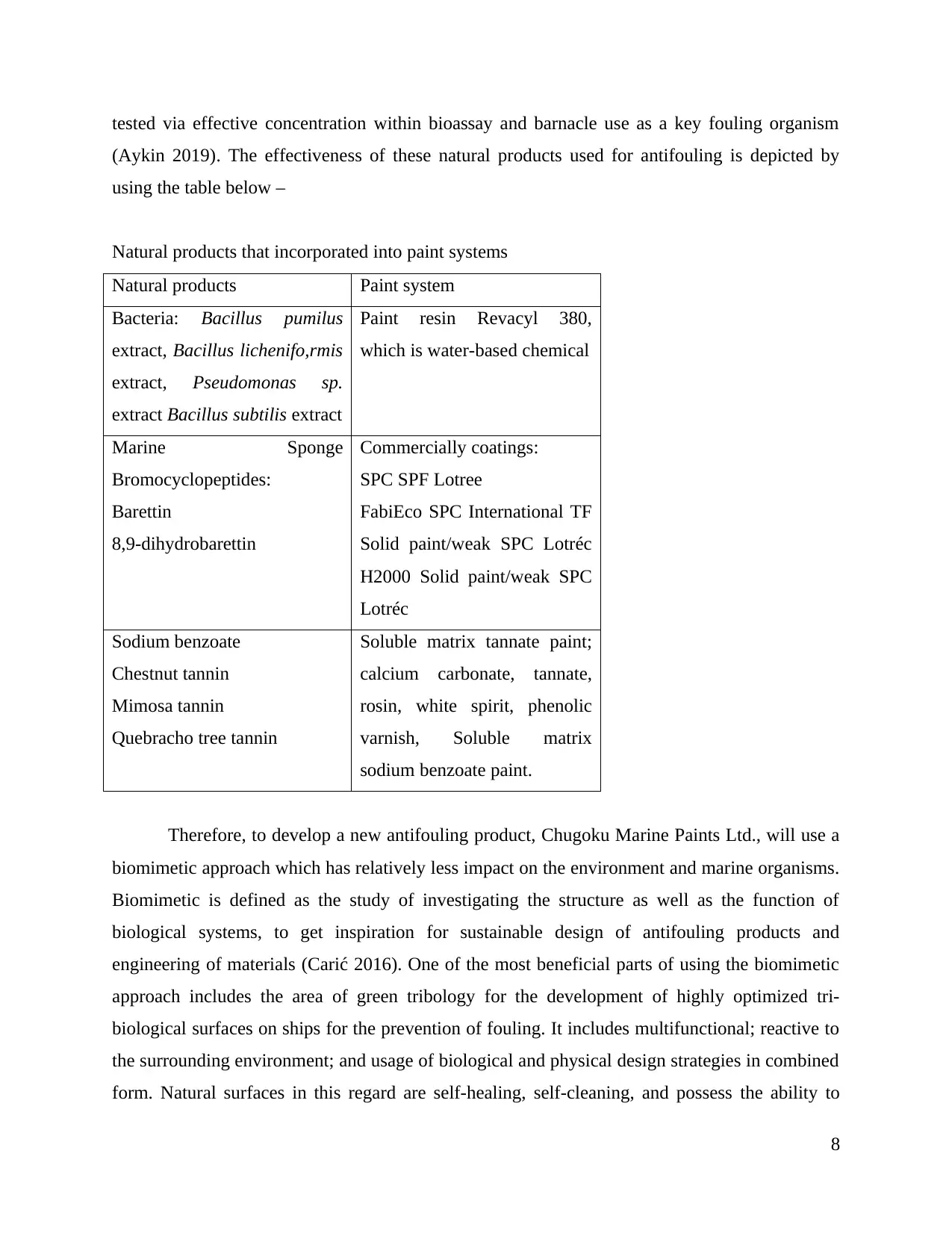
tested via effective concentration within bioassay and barnacle use as a key fouling organism
(Aykin 2019). The effectiveness of these natural products used for antifouling is depicted by
using the table below –
Natural products that incorporated into paint systems
Natural products Paint system
Bacteria: Bacillus pumilus
extract, Bacillus lichenifo,rmis
extract, Pseudomonas sp.
extract Bacillus subtilis extract
Paint resin Revacyl 380,
which is water-based chemical
Marine Sponge
Bromocyclopeptides:
Barettin
8,9-dihydrobarettin
Commercially coatings:
SPC SPF Lotree
FabiEco SPC International TF
Solid paint/weak SPC Lotréc
H2000 Solid paint/weak SPC
Lotréc
Sodium benzoate
Chestnut tannin
Mimosa tannin
Quebracho tree tannin
Soluble matrix tannate paint;
calcium carbonate, tannate,
rosin, white spirit, phenolic
varnish, Soluble matrix
sodium benzoate paint.
Therefore, to develop a new antifouling product, Chugoku Marine Paints Ltd., will use a
biomimetic approach which has relatively less impact on the environment and marine organisms.
Biomimetic is defined as the study of investigating the structure as well as the function of
biological systems, to get inspiration for sustainable design of antifouling products and
engineering of materials (Carić 2016). One of the most beneficial parts of using the biomimetic
approach includes the area of green tribology for the development of highly optimized tri-
biological surfaces on ships for the prevention of fouling. It includes multifunctional; reactive to
the surrounding environment; and usage of biological and physical design strategies in combined
form. Natural surfaces in this regard are self-healing, self-cleaning, and possess the ability to
8
(Aykin 2019). The effectiveness of these natural products used for antifouling is depicted by
using the table below –
Natural products that incorporated into paint systems
Natural products Paint system
Bacteria: Bacillus pumilus
extract, Bacillus lichenifo,rmis
extract, Pseudomonas sp.
extract Bacillus subtilis extract
Paint resin Revacyl 380,
which is water-based chemical
Marine Sponge
Bromocyclopeptides:
Barettin
8,9-dihydrobarettin
Commercially coatings:
SPC SPF Lotree
FabiEco SPC International TF
Solid paint/weak SPC Lotréc
H2000 Solid paint/weak SPC
Lotréc
Sodium benzoate
Chestnut tannin
Mimosa tannin
Quebracho tree tannin
Soluble matrix tannate paint;
calcium carbonate, tannate,
rosin, white spirit, phenolic
varnish, Soluble matrix
sodium benzoate paint.
Therefore, to develop a new antifouling product, Chugoku Marine Paints Ltd., will use a
biomimetic approach which has relatively less impact on the environment and marine organisms.
Biomimetic is defined as the study of investigating the structure as well as the function of
biological systems, to get inspiration for sustainable design of antifouling products and
engineering of materials (Carić 2016). One of the most beneficial parts of using the biomimetic
approach includes the area of green tribology for the development of highly optimized tri-
biological surfaces on ships for the prevention of fouling. It includes multifunctional; reactive to
the surrounding environment; and usage of biological and physical design strategies in combined
form. Natural surfaces in this regard are self-healing, self-cleaning, and possess the ability to
8
produce cell-to-cell communication signals for the prevention of colonization (Nasir 2017).
Under this process, tribology includes interfacial science in terms of flowing fluid over the solid
surface, including friction which is induced by the same. Drag reduction of hulls of ships helps in
increasing vessel availability, fuel efficiency, and invasive species of translocation, which
ultimately reduce the life-cycle costs.
Through the perception of Selim (2020), it has evaluated that key biomimetic surface
features that are related to resistance and fouling exclusion from shells of over thirty-six species
of marine mollusks are characterized into five parameters that are positively correlated with
fouling resistance (Reijnders 2012). These parameters include low fractal dimension; high
skewness regarding waviness and roughness profiles; higher values of isotropy; and last is mean
surface roughness having lower values. Among all these surface parameters, which are strongly
correlated with 20% fouling removal is waviness, including the highest waviness profiles and
weakest fouling adherence (Debnath 2014). While considering the importance of mechanical
properties and structure of mollusk shells from synthetic biomimetic materials’ perspective.
Foul-release coatings which are based on silicone elastomers having low surface free energies
seem to be successful for the fast-moving vessels only, because the decrease in the linkage of
strength facilitates, removes at speeds more than 20 knots (Reijnders, 2012). Apart from this,
diatoms having the higher attachment strength upon the hydrophobic surfaces remain on Foul-
release coatings (FRCs) is 30 knots.
Theme 2: Advantages and disadvantages of the new Antifouling product
As per the perception of Bhadbhade (2019), it has been evaluated overall that Marine
biofouling which is an accumulation of the biological material on the underwater surfaces, has
plagued commercial as well as naval fleets. In this regard, integrating the concept of biomimetic
approaches will provide new insights for designing and developing alternative, surface-active
antifouling (AF) technologies and non-toxic antifouling products (Selim 2020). In the marine
environment, entire submerged surfaces are mainly affected by fouling organism attachment, like
bacteria, algae, invertebrates, and diatoms, which causes an increase in hydrodynamic resistance,
resulting in increased fuel consumption, with a reduction in speed and operational range. Along
with this, other economic factors that raise demand for new antifouling products include
additional costs of dry-docking, including an increase in fuel costs and corrosion, etc. Past
solutions to antifouling which includes TBT are generally used in toxic paints which has a
9
Under this process, tribology includes interfacial science in terms of flowing fluid over the solid
surface, including friction which is induced by the same. Drag reduction of hulls of ships helps in
increasing vessel availability, fuel efficiency, and invasive species of translocation, which
ultimately reduce the life-cycle costs.
Through the perception of Selim (2020), it has evaluated that key biomimetic surface
features that are related to resistance and fouling exclusion from shells of over thirty-six species
of marine mollusks are characterized into five parameters that are positively correlated with
fouling resistance (Reijnders 2012). These parameters include low fractal dimension; high
skewness regarding waviness and roughness profiles; higher values of isotropy; and last is mean
surface roughness having lower values. Among all these surface parameters, which are strongly
correlated with 20% fouling removal is waviness, including the highest waviness profiles and
weakest fouling adherence (Debnath 2014). While considering the importance of mechanical
properties and structure of mollusk shells from synthetic biomimetic materials’ perspective.
Foul-release coatings which are based on silicone elastomers having low surface free energies
seem to be successful for the fast-moving vessels only, because the decrease in the linkage of
strength facilitates, removes at speeds more than 20 knots (Reijnders, 2012). Apart from this,
diatoms having the higher attachment strength upon the hydrophobic surfaces remain on Foul-
release coatings (FRCs) is 30 knots.
Theme 2: Advantages and disadvantages of the new Antifouling product
As per the perception of Bhadbhade (2019), it has been evaluated overall that Marine
biofouling which is an accumulation of the biological material on the underwater surfaces, has
plagued commercial as well as naval fleets. In this regard, integrating the concept of biomimetic
approaches will provide new insights for designing and developing alternative, surface-active
antifouling (AF) technologies and non-toxic antifouling products (Selim 2020). In the marine
environment, entire submerged surfaces are mainly affected by fouling organism attachment, like
bacteria, algae, invertebrates, and diatoms, which causes an increase in hydrodynamic resistance,
resulting in increased fuel consumption, with a reduction in speed and operational range. Along
with this, other economic factors that raise demand for new antifouling products include
additional costs of dry-docking, including an increase in fuel costs and corrosion, etc. Past
solutions to antifouling which includes TBT are generally used in toxic paints which has a
9
⊘ This is a preview!⊘
Do you want full access?
Subscribe today to unlock all pages.
Trusted by 1+ million students worldwide
detrimental effect on the life of marine organisms worldwide (Solér 2020). Therefore, it
prohibited the use of such antifouling and it has led management to the search for new
biologically inspired antifouling strategies (Irwin and et. al. 2019). Therefore, for maintaining the
durability of ships, new biocide products are manufactured by using biomimetic approaches.
These antifouling coatings are special coatings that help in preventing the marine organisms’
accumulation on the surface of ships, increasing its durability. However, it has been analysed
that typical antifouling coatings marine paints are not biomimetic but it is based upon the
synthetic chemical compounds, having poisonous effects on the environment (Kura 2014). It
includes tributyltin or TBT compounds, which are considered as main components in marine
paints and used for preventing biofouling of ship hulls. Along with this, typical antifouling
components are highly effective at combatting the barnacles’ accumulation and other
problematic organisms, where paints containing organotin are also damaging to various
organisms, which may interrupt entire marine food chains (Martin 2019). Therefore, Chugoku
Marine Paints, Ltd., is going to use a biomimetic approach for producing a new marine
antifouling product, which helps in reducing the negative impact of coating on the environment.
Biomimetic antifouling coatings as a comparison, highly lucrative due to having a low
environmental impact. Marine coating refers to that category of antifouling paints that are mainly
formulated with CuO i.e. cuprous oxide. The demand for such marine coatings is, however,
increasing because of ship repair as well as maintenance activities, which is a significant reason
for the upsurge demand within the marine coatings market (Nakhaee and Arab Nasrabadi 2019).
To prevent ship hull from marine organisms, biomimetic antifouling coatings includes special
properties that have a low environmental impact, therefore, it is considered highly lucrative
within the marine coatings market. Some properties of this type of coating can be projected from
its contact angles, which are obtained from the Wenzel equation and calculated value of
Engineered Roughness Index as given beneath. Natural materials include making the biomimetic
antifouling coatings are shark skin surfaces, which helps in improving the coatings (Preparation,
anti-biofouling, and drag-reduction properties of a biomimetic shark skin surface, 2016). Such
skin consists of nanoscale overlapping plates, which exhibit parallel ridges and effectively help
in preventing sharks and other marine organisms from becoming fouled, even when the ship is
moving at slow speeds.
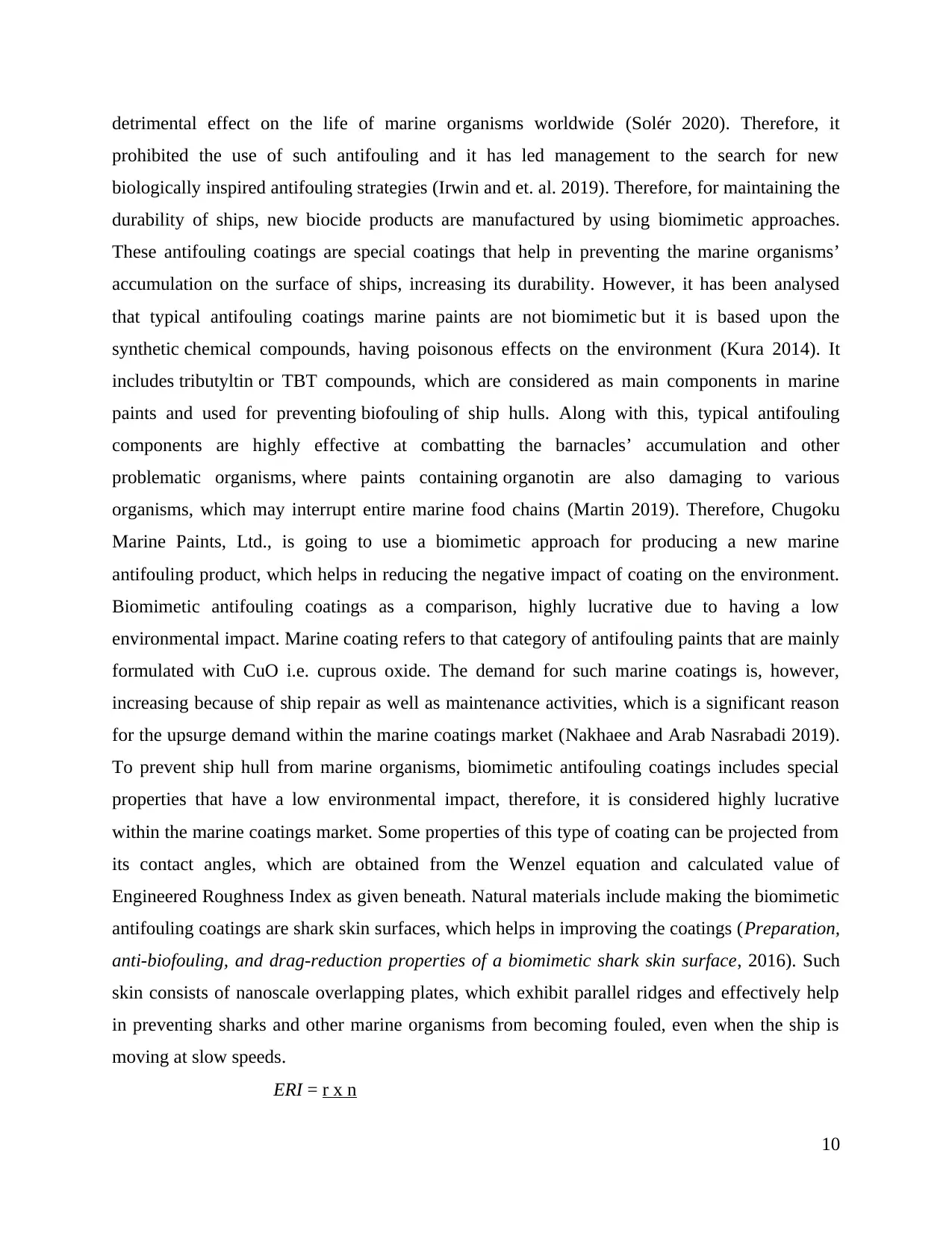
ERI = r x n
10
prohibited the use of such antifouling and it has led management to the search for new
biologically inspired antifouling strategies (Irwin and et. al. 2019). Therefore, for maintaining the
durability of ships, new biocide products are manufactured by using biomimetic approaches.
These antifouling coatings are special coatings that help in preventing the marine organisms’
accumulation on the surface of ships, increasing its durability. However, it has been analysed
that typical antifouling coatings marine paints are not biomimetic but it is based upon the
synthetic chemical compounds, having poisonous effects on the environment (Kura 2014). It
includes tributyltin or TBT compounds, which are considered as main components in marine
paints and used for preventing biofouling of ship hulls. Along with this, typical antifouling
components are highly effective at combatting the barnacles’ accumulation and other
problematic organisms, where paints containing organotin are also damaging to various
organisms, which may interrupt entire marine food chains (Martin 2019). Therefore, Chugoku
Marine Paints, Ltd., is going to use a biomimetic approach for producing a new marine
antifouling product, which helps in reducing the negative impact of coating on the environment.
Biomimetic antifouling coatings as a comparison, highly lucrative due to having a low
environmental impact. Marine coating refers to that category of antifouling paints that are mainly
formulated with CuO i.e. cuprous oxide. The demand for such marine coatings is, however,
increasing because of ship repair as well as maintenance activities, which is a significant reason
for the upsurge demand within the marine coatings market (Nakhaee and Arab Nasrabadi 2019).
To prevent ship hull from marine organisms, biomimetic antifouling coatings includes special
properties that have a low environmental impact, therefore, it is considered highly lucrative
within the marine coatings market. Some properties of this type of coating can be projected from
its contact angles, which are obtained from the Wenzel equation and calculated value of
Engineered Roughness Index as given beneath. Natural materials include making the biomimetic
antifouling coatings are shark skin surfaces, which helps in improving the coatings (Preparation,
anti-biofouling, and drag-reduction properties of a biomimetic shark skin surface, 2016). Such
skin consists of nanoscale overlapping plates, which exhibit parallel ridges and effectively help
in preventing sharks and other marine organisms from becoming fouled, even when the ship is
moving at slow speeds.
ERI = r x n
10
Paraphrase This Document
Need a fresh take? Get an instant paraphrase of this document with our AI Paraphraser
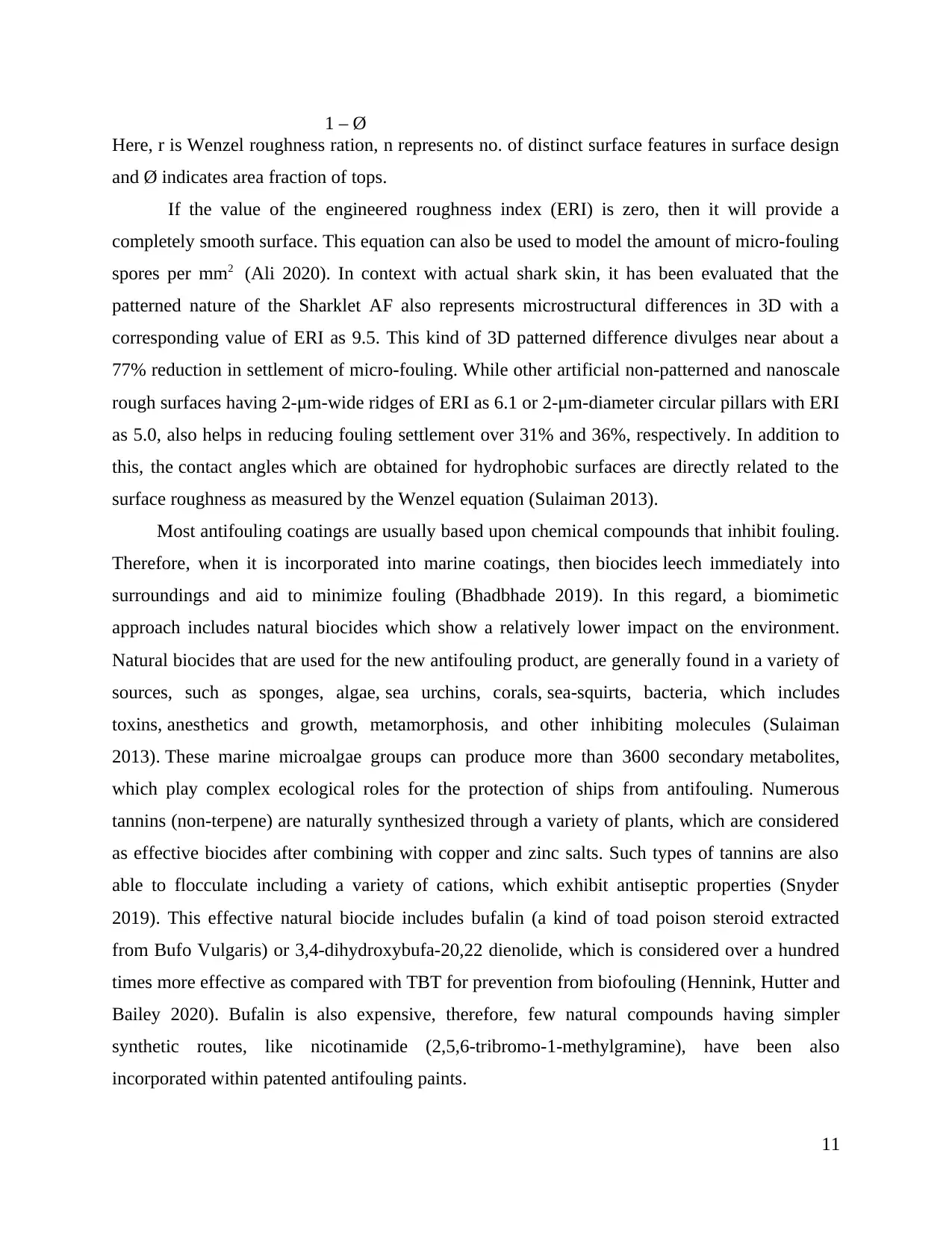
1 – Ø
Here, r is Wenzel roughness ration, n represents no. of distinct surface features in surface design
and Ø indicates area fraction of tops.
If the value of the engineered roughness index (ERI) is zero, then it will provide a
completely smooth surface. This equation can also be used to model the amount of micro-fouling
spores per mm2 (Ali 2020). In context with actual shark skin, it has been evaluated that the
patterned nature of the Sharklet AF also represents microstructural differences in 3D with a
corresponding value of ERI as 9.5. This kind of 3D patterned difference divulges near about a
77% reduction in settlement of micro-fouling. While other artificial non-patterned and nanoscale
rough surfaces having 2-μm-wide ridges of ERI as 6.1 or 2-μm-diameter circular pillars with ERI
as 5.0, also helps in reducing fouling settlement over 31% and 36%, respectively. In addition to
this, the contact angles which are obtained for hydrophobic surfaces are directly related to the
surface roughness as measured by the Wenzel equation (Sulaiman 2013).
Most antifouling coatings are usually based upon chemical compounds that inhibit fouling.
Therefore, when it is incorporated into marine coatings, then biocides leech immediately into
surroundings and aid to minimize fouling (Bhadbhade 2019). In this regard, a biomimetic
approach includes natural biocides which show a relatively lower impact on the environment.
Natural biocides that are used for the new antifouling product, are generally found in a variety of
sources, such as sponges, algae, sea urchins, corals, sea-squirts, bacteria, which includes
toxins, anesthetics and growth, metamorphosis, and other inhibiting molecules (Sulaiman
2013). These marine microalgae groups can produce more than 3600 secondary metabolites,
which play complex ecological roles for the protection of ships from antifouling. Numerous
tannins (non-terpene) are naturally synthesized through a variety of plants, which are considered
as effective biocides after combining with copper and zinc salts. Such types of tannins are also
able to flocculate including a variety of cations, which exhibit antiseptic properties (Snyder
2019). This effective natural biocide includes bufalin (a kind of toad poison steroid extracted
from Bufo Vulgaris) or 3,4-dihydroxybufa-20,22 dienolide, which is considered over a hundred
times more effective as compared with TBT for prevention from biofouling (Hennink, Hutter and
Bailey 2020). Bufalin is also expensive, therefore, few natural compounds having simpler
synthetic routes, like nicotinamide (2,5,6-tribromo-1-methylgramine), have been also
incorporated within patented antifouling paints.
11
Here, r is Wenzel roughness ration, n represents no. of distinct surface features in surface design
and Ø indicates area fraction of tops.
If the value of the engineered roughness index (ERI) is zero, then it will provide a
completely smooth surface. This equation can also be used to model the amount of micro-fouling
spores per mm2 (Ali 2020). In context with actual shark skin, it has been evaluated that the
patterned nature of the Sharklet AF also represents microstructural differences in 3D with a
corresponding value of ERI as 9.5. This kind of 3D patterned difference divulges near about a
77% reduction in settlement of micro-fouling. While other artificial non-patterned and nanoscale
rough surfaces having 2-μm-wide ridges of ERI as 6.1 or 2-μm-diameter circular pillars with ERI
as 5.0, also helps in reducing fouling settlement over 31% and 36%, respectively. In addition to
this, the contact angles which are obtained for hydrophobic surfaces are directly related to the
surface roughness as measured by the Wenzel equation (Sulaiman 2013).
Most antifouling coatings are usually based upon chemical compounds that inhibit fouling.
Therefore, when it is incorporated into marine coatings, then biocides leech immediately into
surroundings and aid to minimize fouling (Bhadbhade 2019). In this regard, a biomimetic
approach includes natural biocides which show a relatively lower impact on the environment.
Natural biocides that are used for the new antifouling product, are generally found in a variety of
sources, such as sponges, algae, sea urchins, corals, sea-squirts, bacteria, which includes
toxins, anesthetics and growth, metamorphosis, and other inhibiting molecules (Sulaiman
2013). These marine microalgae groups can produce more than 3600 secondary metabolites,
which play complex ecological roles for the protection of ships from antifouling. Numerous
tannins (non-terpene) are naturally synthesized through a variety of plants, which are considered
as effective biocides after combining with copper and zinc salts. Such types of tannins are also
able to flocculate including a variety of cations, which exhibit antiseptic properties (Snyder
2019). This effective natural biocide includes bufalin (a kind of toad poison steroid extracted
from Bufo Vulgaris) or 3,4-dihydroxybufa-20,22 dienolide, which is considered over a hundred
times more effective as compared with TBT for prevention from biofouling (Hennink, Hutter and
Bailey 2020). Bufalin is also expensive, therefore, few natural compounds having simpler
synthetic routes, like nicotinamide (2,5,6-tribromo-1-methylgramine), have been also
incorporated within patented antifouling paints.
11
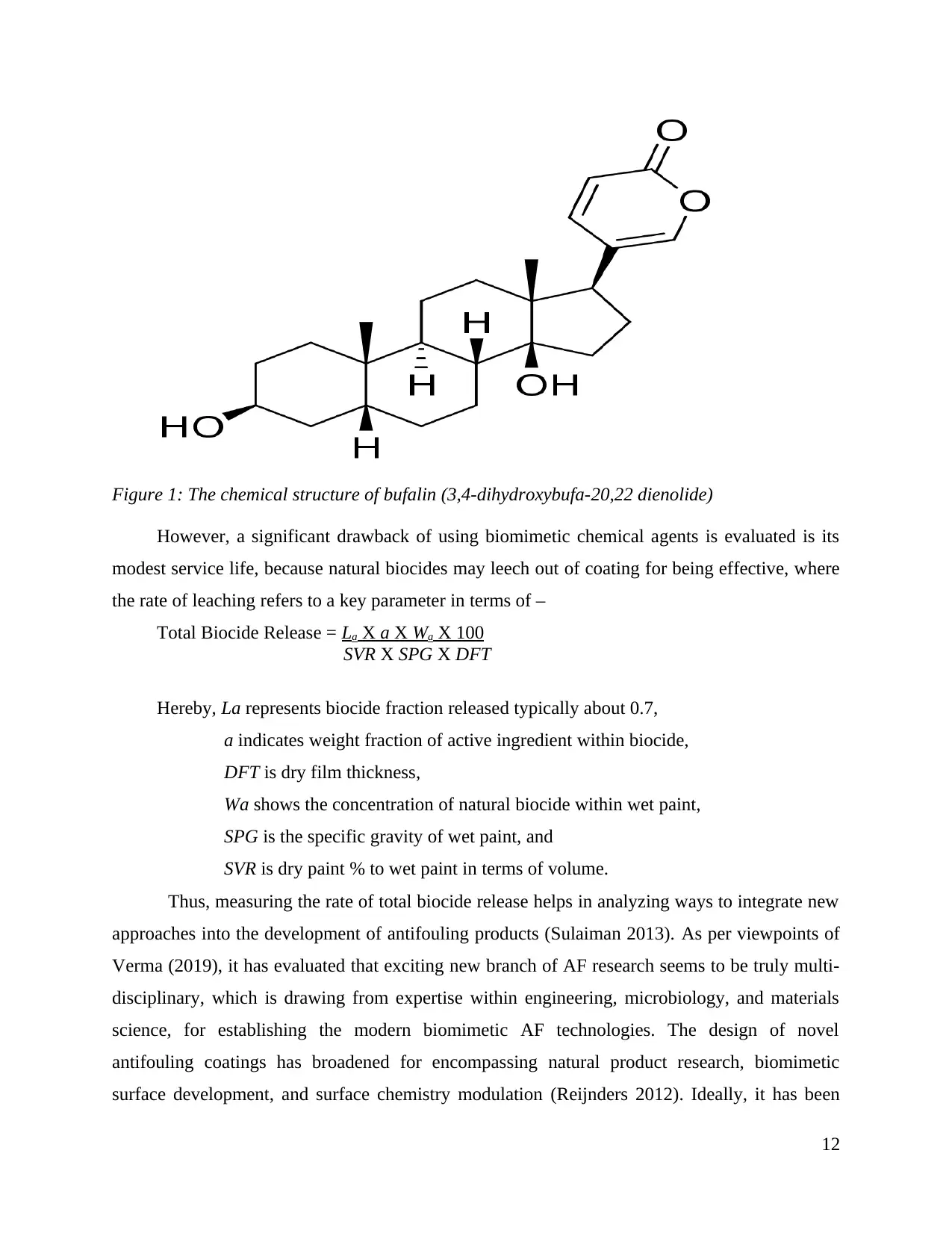
Figure 1: The chemical structure of bufalin (3,4-dihydroxybufa-20,22 dienolide)
However, a significant drawback of using biomimetic chemical agents is evaluated is its
modest service life, because natural biocides may leech out of coating for being effective, where
the rate of leaching refers to a key parameter in terms of –
Total Biocide Release = La X a X Wa X 100
SVR X SPG X DFT
Hereby, La represents biocide fraction released typically about 0.7,
a indicates weight fraction of active ingredient within biocide,
DFT is dry film thickness,
Wa shows the concentration of natural biocide within wet paint,
SPG is the specific gravity of wet paint, and
SVR is dry paint % to wet paint in terms of volume.
Thus, measuring the rate of total biocide release helps in analyzing ways to integrate new
approaches into the development of antifouling products (Sulaiman 2013). As per viewpoints of
Verma (2019), it has evaluated that exciting new branch of AF research seems to be truly multi-
disciplinary, which is drawing from expertise within engineering, microbiology, and materials
science, for establishing the modern biomimetic AF technologies. The design of novel
antifouling coatings has broadened for encompassing natural product research, biomimetic
surface development, and surface chemistry modulation (Reijnders 2012). Ideally, it has been
12
However, a significant drawback of using biomimetic chemical agents is evaluated is its
modest service life, because natural biocides may leech out of coating for being effective, where
the rate of leaching refers to a key parameter in terms of –
Total Biocide Release = La X a X Wa X 100
SVR X SPG X DFT
Hereby, La represents biocide fraction released typically about 0.7,
a indicates weight fraction of active ingredient within biocide,
DFT is dry film thickness,
Wa shows the concentration of natural biocide within wet paint,
SPG is the specific gravity of wet paint, and
SVR is dry paint % to wet paint in terms of volume.
Thus, measuring the rate of total biocide release helps in analyzing ways to integrate new
approaches into the development of antifouling products (Sulaiman 2013). As per viewpoints of
Verma (2019), it has evaluated that exciting new branch of AF research seems to be truly multi-
disciplinary, which is drawing from expertise within engineering, microbiology, and materials
science, for establishing the modern biomimetic AF technologies. The design of novel
antifouling coatings has broadened for encompassing natural product research, biomimetic
surface development, and surface chemistry modulation (Reijnders 2012). Ideally, it has been
12
⊘ This is a preview!⊘
Do you want full access?
Subscribe today to unlock all pages.
Trusted by 1+ million students worldwide

1 out of 38


Your All-in-One AI-Powered Toolkit for Academic Success.
+13062052269
info@desklib.com
Available 24*7 on WhatsApp / Email
![[object Object]](/_next/static/media/star-bottom.7253800d.svg)
Unlock your academic potential
Copyright © 2020–2026 A2Z Services. All Rights Reserved. Developed and managed by ZUCOL.