Business Capstone Project: Analyzing Maritime Safety Problems
VerifiedAdded on 2021/05/31
|12
|2713
|265
Project
AI Summary
This business capstone project examines the internal issues of a company operating in the maritime safety industry. The company, after decades of successful service, faces challenges in adapting to market changes and internal performance issues. The project delves into the background of these issues, exploring the causes, which include a lack of independent oversight and resistance to change. It presents several alternatives, including a SWOT analysis, enhancement of the Internal Rate of Return (IRR), improvements in organizational capabilities through lean management and talent operations, and root cause analysis. Each alternative is evaluated based on decision criteria such as ease of implementation, flexibility, return on investment, and cost. The project also addresses the ethical considerations of implementing these solutions, particularly concerning employee loyalty and the potential need for external consultants. The project concludes with recommendations for implementation and the implications of each approach, offering a comprehensive analysis of the company's situation and potential paths forward.

Running head: BUSINESS CAPSTONE PROJECT
Name of the Project
Name of the Student
Author note
Name of the Project
Name of the Student
Author note

Paraphrase This Document
Need a fresh take? Get an instant paraphrase of this document with our AI Paraphraser
1BUSINESS CAPSTONE PROJECT
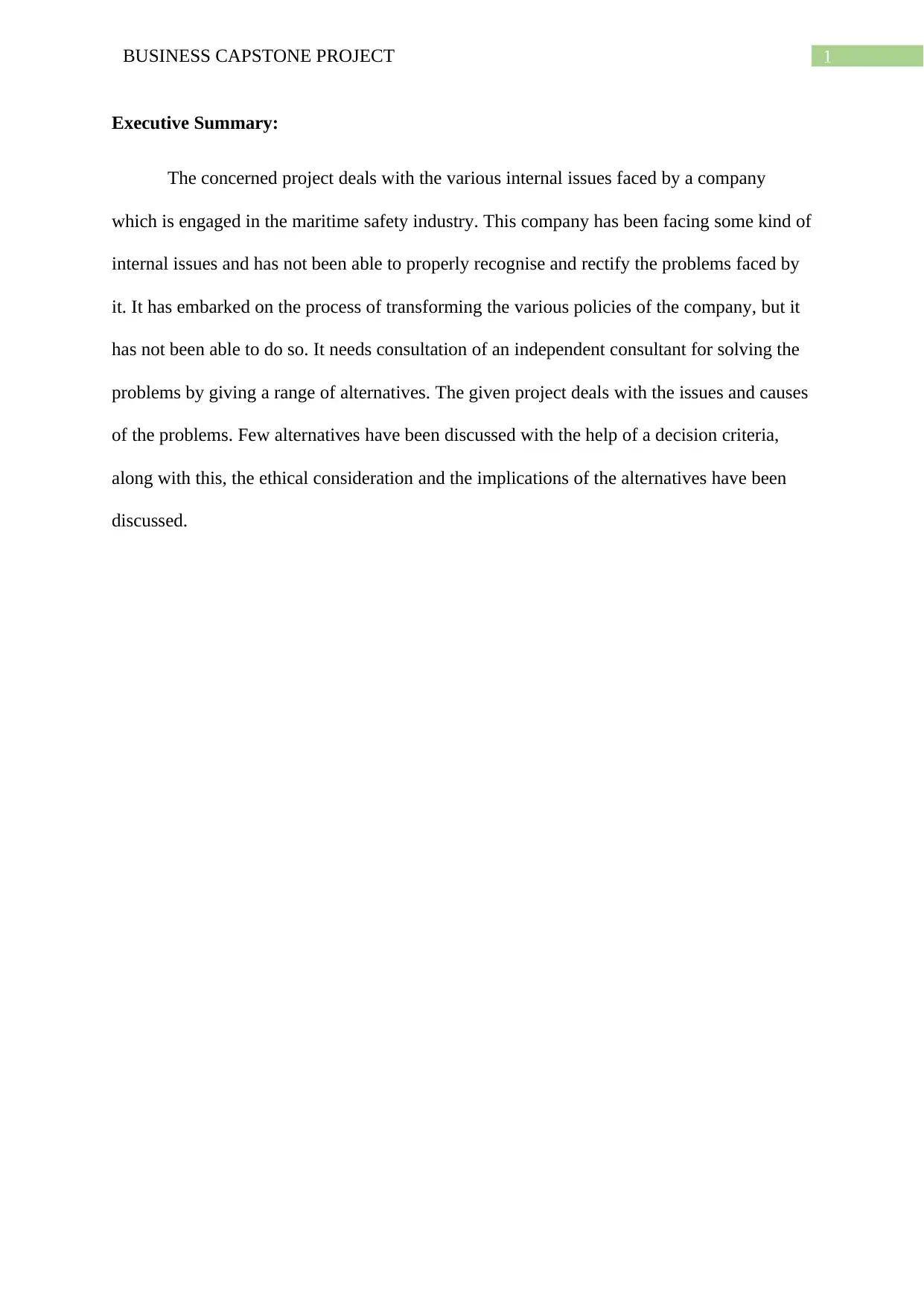
Executive Summary:
The concerned project deals with the various internal issues faced by a company
which is engaged in the maritime safety industry. This company has been facing some kind of
internal issues and has not been able to properly recognise and rectify the problems faced by
it. It has embarked on the process of transforming the various policies of the company, but it
has not been able to do so. It needs consultation of an independent consultant for solving the
problems by giving a range of alternatives. The given project deals with the issues and causes
of the problems. Few alternatives have been discussed with the help of a decision criteria,
along with this, the ethical consideration and the implications of the alternatives have been
discussed.
Executive Summary:
The concerned project deals with the various internal issues faced by a company
which is engaged in the maritime safety industry. This company has been facing some kind of
internal issues and has not been able to properly recognise and rectify the problems faced by
it. It has embarked on the process of transforming the various policies of the company, but it
has not been able to do so. It needs consultation of an independent consultant for solving the
problems by giving a range of alternatives. The given project deals with the issues and causes
of the problems. Few alternatives have been discussed with the help of a decision criteria,
along with this, the ethical consideration and the implications of the alternatives have been
discussed.
2BUSINESS CAPSTONE PROJECT
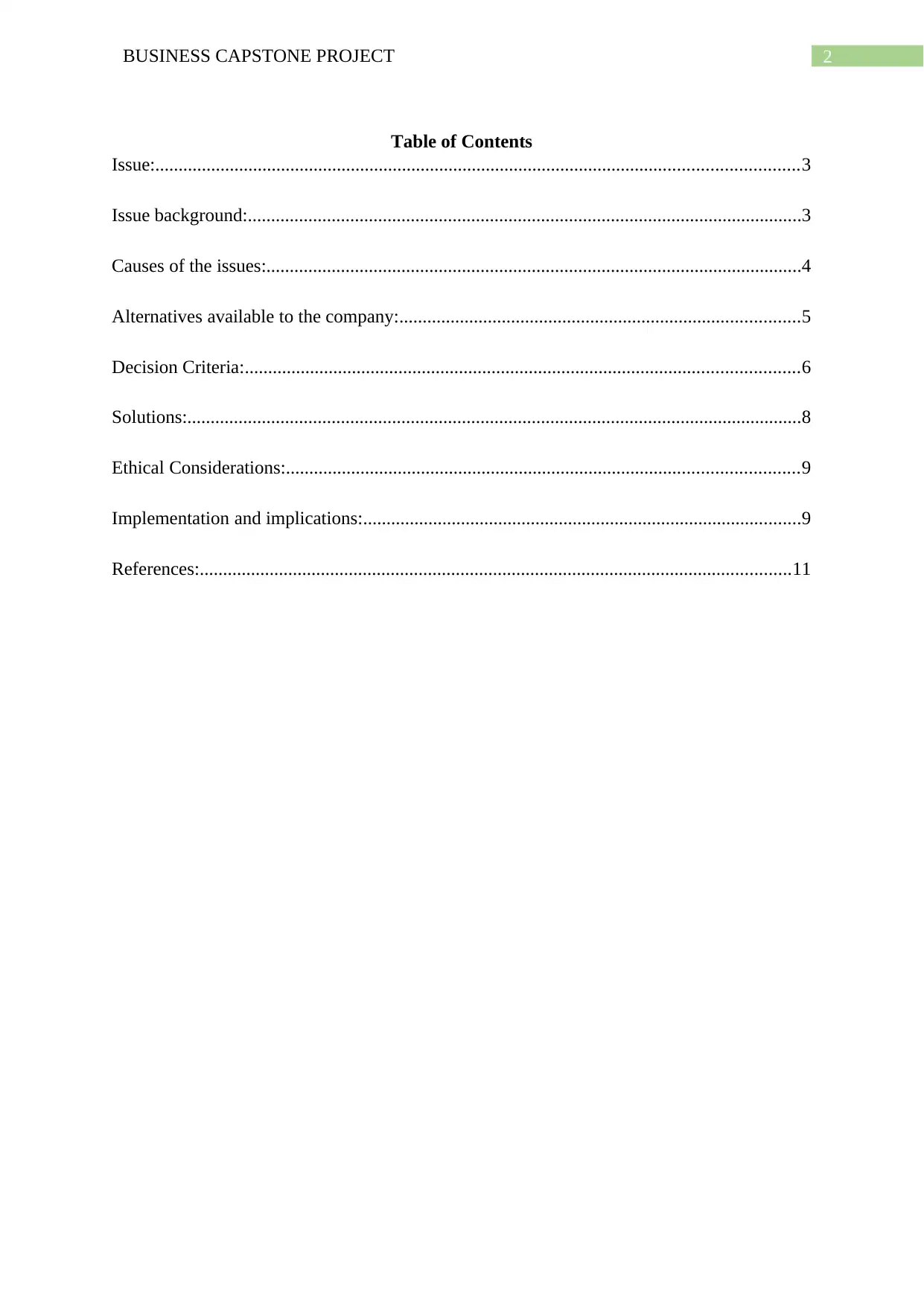
Table of Contents
Issue:..........................................................................................................................................3
Issue background:.......................................................................................................................3
Causes of the issues:...................................................................................................................4
Alternatives available to the company:......................................................................................5
Decision Criteria:.......................................................................................................................6
Solutions:....................................................................................................................................8
Ethical Considerations:..............................................................................................................9
Implementation and implications:..............................................................................................9
References:...............................................................................................................................11
Table of Contents
Issue:..........................................................................................................................................3
Issue background:.......................................................................................................................3
Causes of the issues:...................................................................................................................4
Alternatives available to the company:......................................................................................5
Decision Criteria:.......................................................................................................................6
Solutions:....................................................................................................................................8
Ethical Considerations:..............................................................................................................9
Implementation and implications:..............................................................................................9
References:...............................................................................................................................11
⊘ This is a preview!⊘
Do you want full access?
Subscribe today to unlock all pages.

Trusted by 1+ million students worldwide
3BUSINESS CAPSTONE PROJECT
Issue:
The issue in hand deals with the problems faced by a private sector organisation
which was involved in the maritime safety industry. The said company operated in the
maritime safety industry and it provided a number of services on a global scale to a variety of
different organisation around the world. The issue had arrived only when the company faced
a point a point of inflexion, after providing faithful and dedicated service to a number of their
clients across a span of thirty to forty years in the field of maritime safety industry. Till a
period of thirty to forty years, the company had provided a wide range of services to its
clients and customers. As a result of which, the clients of the company had unrestrained faith
over the different kinds of services which had been provided by the company to them. The
clients were very satisfied with the kind of consistent service provided by them and thus, they
had developed a solid reputation in the market and its brand had garnered significant amount
of success. Lately, the company had realised that the company’s performance policies could
become banal in the long run, if they fail to infuse a fresh set of policies and rejuvenate their
way of performing. Thus, the company’s management had shifted gears and had identified
three inflection points, but was confused as to which path to take. On the other hand, the
competitors were growing by leaps and bounds Schwartz and Mark, 2013). Thus they needed
an independent assessment in this regard by an expert consultant, to help them out.
Issue background:
The background of the issue played a significant role in management’s recognition of
the problems and the dilemma of selecting the appropriate path to tread on. The company had
provided top notch services for almost a period of thirty to forty years in the field of maritime
security. When the management realised that the competitors’ internal rate of return, they
came to the conclusion, that there is a serious trouble as, if the trend continues, them the
Issue:
The issue in hand deals with the problems faced by a private sector organisation
which was involved in the maritime safety industry. The said company operated in the
maritime safety industry and it provided a number of services on a global scale to a variety of
different organisation around the world. The issue had arrived only when the company faced
a point a point of inflexion, after providing faithful and dedicated service to a number of their
clients across a span of thirty to forty years in the field of maritime safety industry. Till a
period of thirty to forty years, the company had provided a wide range of services to its
clients and customers. As a result of which, the clients of the company had unrestrained faith
over the different kinds of services which had been provided by the company to them. The
clients were very satisfied with the kind of consistent service provided by them and thus, they
had developed a solid reputation in the market and its brand had garnered significant amount
of success. Lately, the company had realised that the company’s performance policies could
become banal in the long run, if they fail to infuse a fresh set of policies and rejuvenate their
way of performing. Thus, the company’s management had shifted gears and had identified
three inflection points, but was confused as to which path to take. On the other hand, the
competitors were growing by leaps and bounds Schwartz and Mark, 2013). Thus they needed
an independent assessment in this regard by an expert consultant, to help them out.
Issue background:
The background of the issue played a significant role in management’s recognition of
the problems and the dilemma of selecting the appropriate path to tread on. The company had
provided top notch services for almost a period of thirty to forty years in the field of maritime
security. When the management realised that the competitors’ internal rate of return, they
came to the conclusion, that there is a serious trouble as, if the trend continues, them the
Paraphrase This Document
Need a fresh take? Get an instant paraphrase of this document with our AI Paraphraser
4BUSINESS CAPSTONE PROJECT
competitors ‘s internal rate of return would comprehensively surpass theirs. They undertook
to transform their organisation and came to three different inflection points. These different
inflection points had become their cause of concern. Consequently, they wanted to stop this
transformation process and again restart the same. This lead to a string of problems for the
company in terms of regulatory problems, financial problems and even the risk of losing the
reputation, it had gathered over the years. More importantly, the risk of losing the
sustainability of the services provided by them was at stake. This would impact the Maritime
Safety and they realised that the process and the structure, must be abandoned at the earliest.
Thus, the immediate assessment and assistance of an expert in was required.
Causes of the issues:
The issue had cropped up due to a number of important reasons, which had the
capability of derailing the company from its track of sustained economic and all round
success. The primary and the most significant reason behind this problem is the failure of the
organisation in having an independent and separate perspective on the success path for
initiating and completing a complete transformation.
Moreover, the company had very little independent oversight on the actual transformation
process. Along with this, there the organisational capability which was missing and was not
verified on an independent basis. As has been mentioned above, the company was quite
successful in the Maritime Safety industry and it was running quiet well. As a result of which,
there was absence of any desire or the need to change the way the company was operating
(Martinez et al., 2014). The company was running successfully, and they had felt that there
was no need to undertake any kind of elaborate steps to make the company ready for the
future changes, that might occur in due time. They were under the impression that the
company was running successfully in its traditional procedures, as a result of which, even if
competitors ‘s internal rate of return would comprehensively surpass theirs. They undertook
to transform their organisation and came to three different inflection points. These different
inflection points had become their cause of concern. Consequently, they wanted to stop this
transformation process and again restart the same. This lead to a string of problems for the
company in terms of regulatory problems, financial problems and even the risk of losing the
reputation, it had gathered over the years. More importantly, the risk of losing the
sustainability of the services provided by them was at stake. This would impact the Maritime
Safety and they realised that the process and the structure, must be abandoned at the earliest.
Thus, the immediate assessment and assistance of an expert in was required.
Causes of the issues:
The issue had cropped up due to a number of important reasons, which had the
capability of derailing the company from its track of sustained economic and all round
success. The primary and the most significant reason behind this problem is the failure of the
organisation in having an independent and separate perspective on the success path for
initiating and completing a complete transformation.
Moreover, the company had very little independent oversight on the actual transformation
process. Along with this, there the organisational capability which was missing and was not
verified on an independent basis. As has been mentioned above, the company was quite
successful in the Maritime Safety industry and it was running quiet well. As a result of which,
there was absence of any desire or the need to change the way the company was operating
(Martinez et al., 2014). The company was running successfully, and they had felt that there
was no need to undertake any kind of elaborate steps to make the company ready for the
future changes, that might occur in due time. They were under the impression that the
company was running successfully in its traditional procedures, as a result of which, even if
5BUSINESS CAPSTONE PROJECT
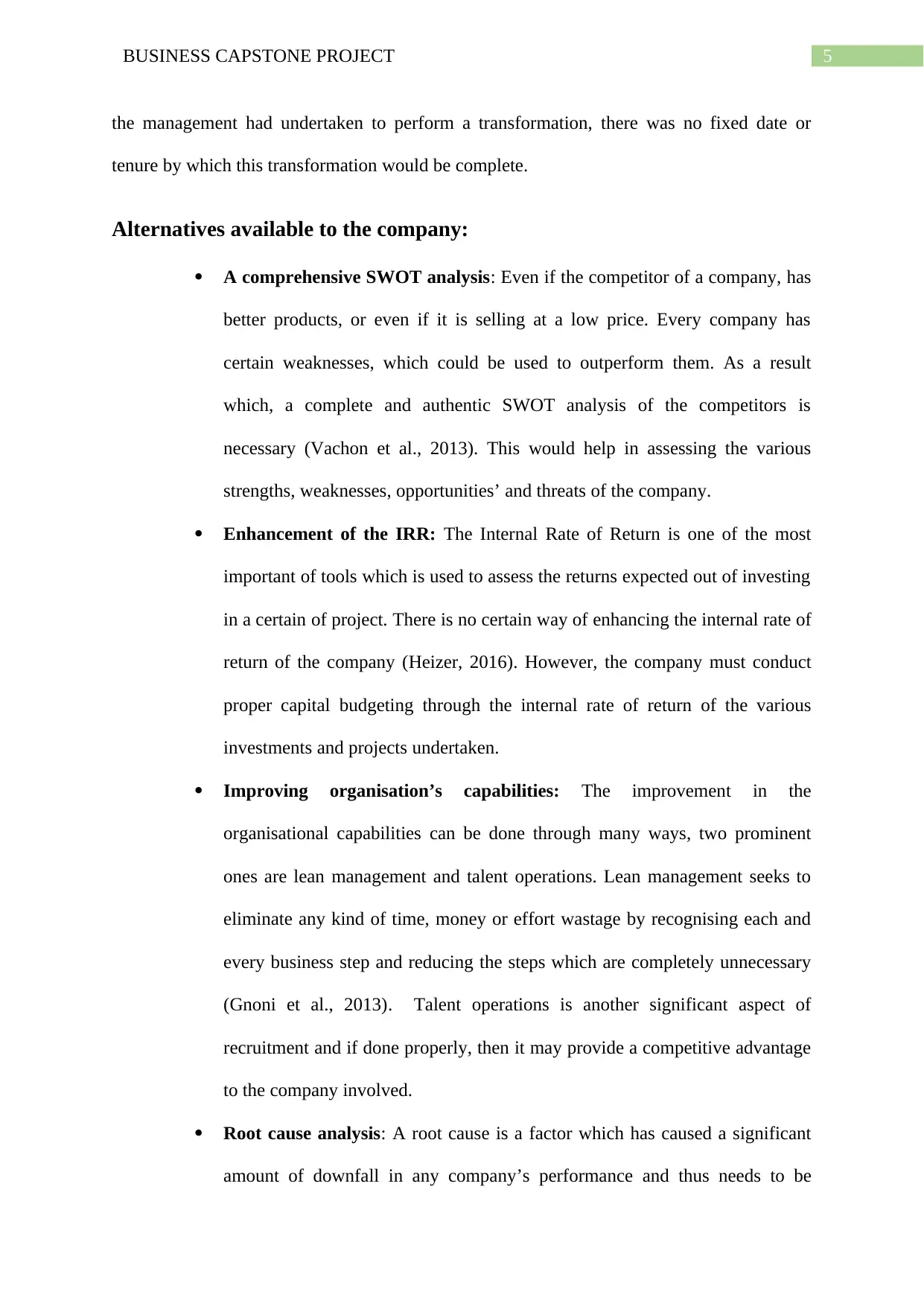
the management had undertaken to perform a transformation, there was no fixed date or
tenure by which this transformation would be complete.
Alternatives available to the company:
A comprehensive SWOT analysis: Even if the competitor of a company, has
better products, or even if it is selling at a low price. Every company has
certain weaknesses, which could be used to outperform them. As a result
which, a complete and authentic SWOT analysis of the competitors is
necessary (Vachon et al., 2013). This would help in assessing the various
strengths, weaknesses, opportunities’ and threats of the company.
Enhancement of the IRR: The Internal Rate of Return is one of the most
important of tools which is used to assess the returns expected out of investing
in a certain of project. There is no certain way of enhancing the internal rate of
return of the company (Heizer, 2016). However, the company must conduct
proper capital budgeting through the internal rate of return of the various
investments and projects undertaken.
Improving organisation’s capabilities: The improvement in the
organisational capabilities can be done through many ways, two prominent
ones are lean management and talent operations. Lean management seeks to
eliminate any kind of time, money or effort wastage by recognising each and
every business step and reducing the steps which are completely unnecessary
(Gnoni et al., 2013). Talent operations is another significant aspect of
recruitment and if done properly, then it may provide a competitive advantage
to the company involved.
Root cause analysis: A root cause is a factor which has caused a significant
amount of downfall in any company’s performance and thus needs to be
the management had undertaken to perform a transformation, there was no fixed date or
tenure by which this transformation would be complete.
Alternatives available to the company:
A comprehensive SWOT analysis: Even if the competitor of a company, has
better products, or even if it is selling at a low price. Every company has
certain weaknesses, which could be used to outperform them. As a result
which, a complete and authentic SWOT analysis of the competitors is
necessary (Vachon et al., 2013). This would help in assessing the various
strengths, weaknesses, opportunities’ and threats of the company.
Enhancement of the IRR: The Internal Rate of Return is one of the most
important of tools which is used to assess the returns expected out of investing
in a certain of project. There is no certain way of enhancing the internal rate of
return of the company (Heizer, 2016). However, the company must conduct
proper capital budgeting through the internal rate of return of the various
investments and projects undertaken.
Improving organisation’s capabilities: The improvement in the
organisational capabilities can be done through many ways, two prominent
ones are lean management and talent operations. Lean management seeks to
eliminate any kind of time, money or effort wastage by recognising each and
every business step and reducing the steps which are completely unnecessary
(Gnoni et al., 2013). Talent operations is another significant aspect of
recruitment and if done properly, then it may provide a competitive advantage
to the company involved.
Root cause analysis: A root cause is a factor which has caused a significant
amount of downfall in any company’s performance and thus needs to be
⊘ This is a preview!⊘
Do you want full access?
Subscribe today to unlock all pages.
Trusted by 1+ million students worldwide
6BUSINESS CAPSTONE PROJECT
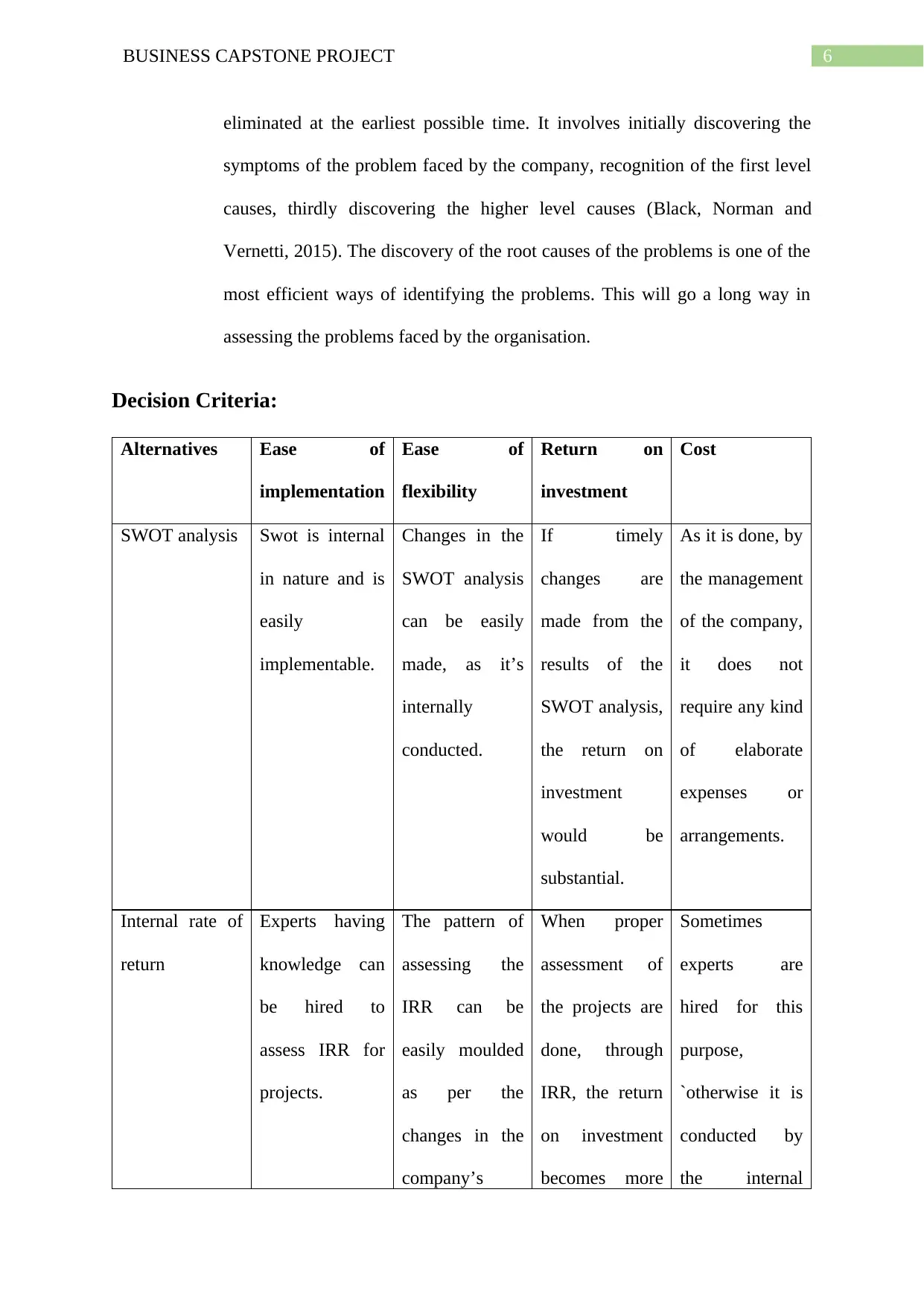
eliminated at the earliest possible time. It involves initially discovering the
symptoms of the problem faced by the company, recognition of the first level
causes, thirdly discovering the higher level causes (Black, Norman and
Vernetti, 2015). The discovery of the root causes of the problems is one of the
most efficient ways of identifying the problems. This will go a long way in
assessing the problems faced by the organisation.
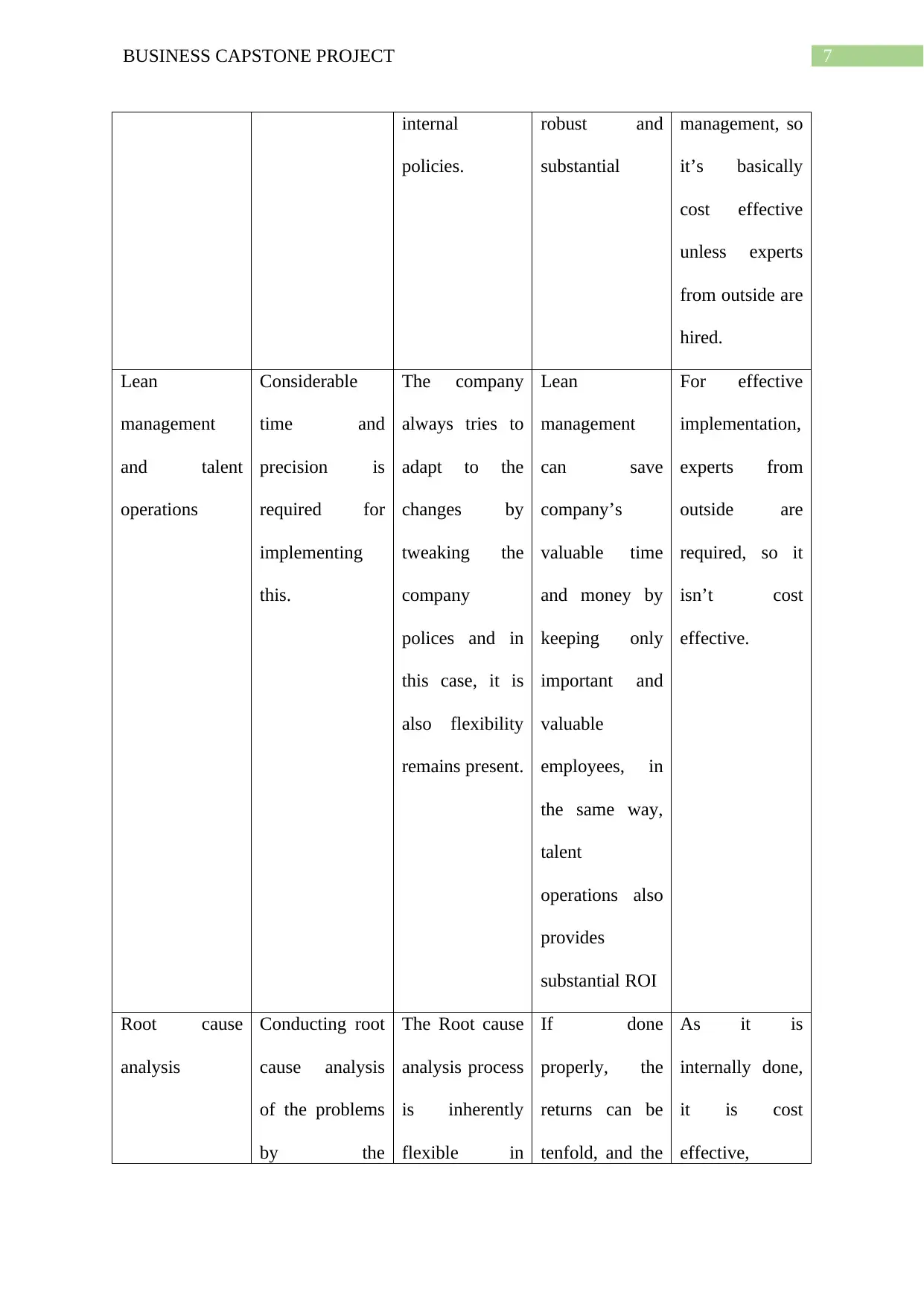
Decision Criteria:
Alternatives Ease of
implementation
Ease of
flexibility
Return on
investment
Cost
SWOT analysis Swot is internal
in nature and is
easily
implementable.
Changes in the
SWOT analysis
can be easily
made, as it’s
internally
conducted.
If timely
changes are
made from the
results of the
SWOT analysis,
the return on
investment
would be
substantial.
As it is done, by
the management
of the company,
it does not
require any kind
of elaborate
expenses or
arrangements.
Internal rate of
return
Experts having
knowledge can
be hired to
assess IRR for
projects.
The pattern of
assessing the
IRR can be
easily moulded
as per the
changes in the
company’s
When proper
assessment of
the projects are
done, through
IRR, the return
on investment
becomes more
Sometimes
experts are
hired for this
purpose,
`otherwise it is
conducted by
the internal
eliminated at the earliest possible time. It involves initially discovering the
symptoms of the problem faced by the company, recognition of the first level
causes, thirdly discovering the higher level causes (Black, Norman and
Vernetti, 2015). The discovery of the root causes of the problems is one of the
most efficient ways of identifying the problems. This will go a long way in
assessing the problems faced by the organisation.
Decision Criteria:
Alternatives Ease of
implementation
Ease of
flexibility
Return on
investment
Cost
SWOT analysis Swot is internal
in nature and is
easily
implementable.
Changes in the
SWOT analysis
can be easily
made, as it’s
internally
conducted.
If timely
changes are
made from the
results of the
SWOT analysis,
the return on
investment
would be
substantial.
As it is done, by
the management
of the company,
it does not
require any kind
of elaborate
expenses or
arrangements.
Internal rate of
return
Experts having
knowledge can
be hired to
assess IRR for
projects.
The pattern of
assessing the
IRR can be
easily moulded
as per the
changes in the
company’s
When proper
assessment of
the projects are
done, through
IRR, the return
on investment
becomes more
Sometimes
experts are
hired for this
purpose,
`otherwise it is
conducted by
the internal
Paraphrase This Document
Need a fresh take? Get an instant paraphrase of this document with our AI Paraphraser
7BUSINESS CAPSTONE PROJECT
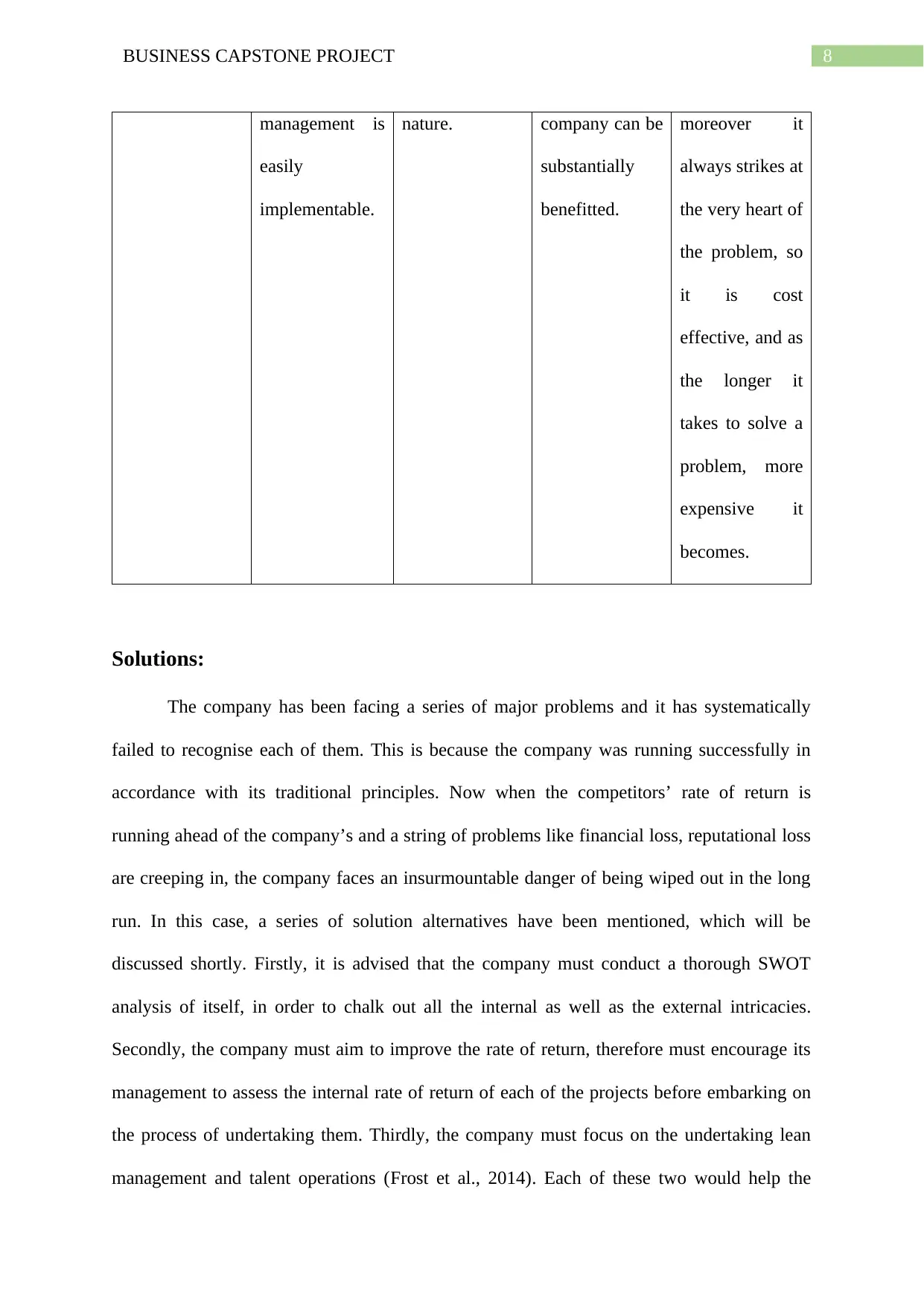
internal
policies.
robust and
substantial
management, so
it’s basically
cost effective
unless experts
from outside are
hired.
Lean
management
and talent
operations
Considerable
time and
precision is
required for
implementing
this.
The company
always tries to
adapt to the
changes by
tweaking the
company
polices and in
this case, it is
also flexibility
remains present.
Lean
management
can save
company’s
valuable time
and money by
keeping only
important and
valuable
employees, in
the same way,
talent
operations also
provides
substantial ROI
For effective
implementation,
experts from
outside are
required, so it
isn’t cost
effective.
Root cause
analysis
Conducting root
cause analysis
of the problems
by the
The Root cause
analysis process
is inherently
flexible in
If done
properly, the
returns can be
tenfold, and the
As it is
internally done,
it is cost
effective,
internal
policies.
robust and
substantial
management, so
it’s basically
cost effective
unless experts
from outside are
hired.
Lean
management
and talent
operations
Considerable
time and
precision is
required for
implementing
this.
The company
always tries to
adapt to the
changes by
tweaking the
company
polices and in
this case, it is
also flexibility
remains present.
Lean
management
can save
company’s
valuable time
and money by
keeping only
important and
valuable
employees, in
the same way,
talent
operations also
provides
substantial ROI
For effective
implementation,
experts from
outside are
required, so it
isn’t cost
effective.
Root cause
analysis
Conducting root
cause analysis
of the problems
by the
The Root cause
analysis process
is inherently
flexible in
If done
properly, the
returns can be
tenfold, and the
As it is
internally done,
it is cost
effective,
8BUSINESS CAPSTONE PROJECT
management is
easily
implementable.
nature. company can be
substantially
benefitted.
moreover it
always strikes at
the very heart of
the problem, so
it is cost
effective, and as
the longer it
takes to solve a
problem, more
expensive it
becomes.
Solutions:
The company has been facing a series of major problems and it has systematically
failed to recognise each of them. This is because the company was running successfully in
accordance with its traditional principles. Now when the competitors’ rate of return is
running ahead of the company’s and a string of problems like financial loss, reputational loss
are creeping in, the company faces an insurmountable danger of being wiped out in the long
run. In this case, a series of solution alternatives have been mentioned, which will be
discussed shortly. Firstly, it is advised that the company must conduct a thorough SWOT
analysis of itself, in order to chalk out all the internal as well as the external intricacies.
Secondly, the company must aim to improve the rate of return, therefore must encourage its
management to assess the internal rate of return of each of the projects before embarking on
the process of undertaking them. Thirdly, the company must focus on the undertaking lean
management and talent operations (Frost et al., 2014). Each of these two would help the
management is
easily
implementable.
nature. company can be
substantially
benefitted.
moreover it
always strikes at
the very heart of
the problem, so
it is cost
effective, and as
the longer it
takes to solve a
problem, more
expensive it
becomes.
Solutions:
The company has been facing a series of major problems and it has systematically
failed to recognise each of them. This is because the company was running successfully in
accordance with its traditional principles. Now when the competitors’ rate of return is
running ahead of the company’s and a string of problems like financial loss, reputational loss
are creeping in, the company faces an insurmountable danger of being wiped out in the long
run. In this case, a series of solution alternatives have been mentioned, which will be
discussed shortly. Firstly, it is advised that the company must conduct a thorough SWOT
analysis of itself, in order to chalk out all the internal as well as the external intricacies.
Secondly, the company must aim to improve the rate of return, therefore must encourage its
management to assess the internal rate of return of each of the projects before embarking on
the process of undertaking them. Thirdly, the company must focus on the undertaking lean
management and talent operations (Frost et al., 2014). Each of these two would help the
⊘ This is a preview!⊘
Do you want full access?
Subscribe today to unlock all pages.
Trusted by 1+ million students worldwide
9BUSINESS CAPSTONE PROJECT
company in saving of time and money, as it aims to keep only the valuable employees in the
company and offload the inefficient ones. Fourthly, the company must focus on undertaking a
comprehensive root cause analysis on different problems faced by the company. The
ineffectiveness of the transformation process of the company must be looked into by a robust
root cause analysis. If all these points are taken care of, then the company would be able to
get back to its best and effectively serve its clients and customers.
Ethical Considerations:
Each and every aspect of any business venture has an ethical consideration attached to
it, which presents an ethical dilemma for its implementation. The application of the
alternatives, in the same way has some ethical dilemmas attached to it. If properly analysed, it
could be seen that due to the lean management operations, the loyal employees would be
ousted out in the wake of new and efficient employees hired by the employees. The company
would want to keep the efficient employees but the loyal employees who are under
performing would need to be fired. This presents an ethical dilemma for the company.
Similarly, the company would need to conduct a thorough root cause analysis for the
problems faced by it, which would require some help from the outside professionals too,
apart from the management. This presents an ethical dilemma too, as the management would
feel that they have not performed well, which has caused them to overlook these crucial
problems, which is now being looked onto by the outside professionals.
Implementation and implications:
The company must have a proper and effective implementation procedure in place for
the smooth application of all these alternatives. Effective involvement of the management of
the company is necessary, right from the CEO of the company to the other executives of the
board, everyone should be involved in the very heart of the implementation process. Be it the
company in saving of time and money, as it aims to keep only the valuable employees in the
company and offload the inefficient ones. Fourthly, the company must focus on undertaking a
comprehensive root cause analysis on different problems faced by the company. The
ineffectiveness of the transformation process of the company must be looked into by a robust
root cause analysis. If all these points are taken care of, then the company would be able to
get back to its best and effectively serve its clients and customers.
Ethical Considerations:
Each and every aspect of any business venture has an ethical consideration attached to
it, which presents an ethical dilemma for its implementation. The application of the
alternatives, in the same way has some ethical dilemmas attached to it. If properly analysed, it
could be seen that due to the lean management operations, the loyal employees would be
ousted out in the wake of new and efficient employees hired by the employees. The company
would want to keep the efficient employees but the loyal employees who are under
performing would need to be fired. This presents an ethical dilemma for the company.
Similarly, the company would need to conduct a thorough root cause analysis for the
problems faced by it, which would require some help from the outside professionals too,
apart from the management. This presents an ethical dilemma too, as the management would
feel that they have not performed well, which has caused them to overlook these crucial
problems, which is now being looked onto by the outside professionals.
Implementation and implications:
The company must have a proper and effective implementation procedure in place for
the smooth application of all these alternatives. Effective involvement of the management of
the company is necessary, right from the CEO of the company to the other executives of the
board, everyone should be involved in the very heart of the implementation process. Be it the
Paraphrase This Document
Need a fresh take? Get an instant paraphrase of this document with our AI Paraphraser
10BUSINESS CAPSTONE PROJECT
root cause analysis, the internal rate of return, lean management or talent operations or even
the SWOT analysis, active involvement of the management is imperative. Separate division
must be made, under the direct leadership of the CEO, which would actively look into the
entire solution procedure. Any deviations or problems would be immediately reported to the
top management or the CEO. The major implications of this would be an increase in the
expenditure of the implementation procedures of the company. The creation of separate
division, hiring of experts for conducting the root cause analysis, lean management and talent
operations would put some pressure on the financial front of the company. If all these
alternatives are properly implemented, then the company would be able to solve the inherent
problems which has existed for such a long period of time.
root cause analysis, the internal rate of return, lean management or talent operations or even
the SWOT analysis, active involvement of the management is imperative. Separate division
must be made, under the direct leadership of the CEO, which would actively look into the
entire solution procedure. Any deviations or problems would be immediately reported to the
top management or the CEO. The major implications of this would be an increase in the
expenditure of the implementation procedures of the company. The creation of separate
division, hiring of experts for conducting the root cause analysis, lean management and talent
operations would put some pressure on the financial front of the company. If all these
alternatives are properly implemented, then the company would be able to solve the inherent
problems which has existed for such a long period of time.
11BUSINESS CAPSTONE PROJECT
References:
"Forbes Welcome". 2018. Forbes.Com. https://www.forbes.com/forbes/welcome/?
toURL=https://www.forbes.com/sites/gurufocus/2015/10/15/how-to-calculate-the-
opportunity-cost-of-different-investments/&refURL=https://www.google.com/
&referrer=https://www.google.com/.
Black, Norman H., and B. J. Vernetti. "Root-Cause Analysis." Professional Safety (2015):
60-62.
Frost, Jennifer J., Adam Sonfield, Mia R. Zolna, and Lawrence B. Finer. "Return on
investment: a fuller assessment of the benefits and cost savings of the US publicly funded
family planning program." The Milbank Quarterly 92, no. 4 (2014): 696-749.
Gnoni, M.G., Andriulo, S., Maggio, G. and Nardone, P., 2013. “Lean occupational” safety:
an application for a near-miss management system design. Safety science, 53, pp.96-104.
Hajmohammad, S., Vachon, S., Klassen, R.D. and Gavronski, I., 2013. Reprint of Lean
management and supply management: their role in green practices and performance. Journal
of Cleaner Production, 56, pp.86-93.
Heizer, Jay. Operations Management, 11/e. Pearson Education India, 2016.
Ho, Joseph Kim-Keung. "Formulation of a systemic PEST analysis for strategic analysis."
European academic research 2, no. 5 (2014): 6478-6492.
Martínez-Jurado, Pedro José, and José Moyano-Fuentes. "Lean management, supply chain
management and sustainability: a literature review." Journal of Cleaner Production 85
(2014): 134-150.
References:
"Forbes Welcome". 2018. Forbes.Com. https://www.forbes.com/forbes/welcome/?
toURL=https://www.forbes.com/sites/gurufocus/2015/10/15/how-to-calculate-the-
opportunity-cost-of-different-investments/&refURL=https://www.google.com/
&referrer=https://www.google.com/.
Black, Norman H., and B. J. Vernetti. "Root-Cause Analysis." Professional Safety (2015):
60-62.
Frost, Jennifer J., Adam Sonfield, Mia R. Zolna, and Lawrence B. Finer. "Return on
investment: a fuller assessment of the benefits and cost savings of the US publicly funded
family planning program." The Milbank Quarterly 92, no. 4 (2014): 696-749.
Gnoni, M.G., Andriulo, S., Maggio, G. and Nardone, P., 2013. “Lean occupational” safety:
an application for a near-miss management system design. Safety science, 53, pp.96-104.
Hajmohammad, S., Vachon, S., Klassen, R.D. and Gavronski, I., 2013. Reprint of Lean
management and supply management: their role in green practices and performance. Journal
of Cleaner Production, 56, pp.86-93.
Heizer, Jay. Operations Management, 11/e. Pearson Education India, 2016.
Ho, Joseph Kim-Keung. "Formulation of a systemic PEST analysis for strategic analysis."
European academic research 2, no. 5 (2014): 6478-6492.
Martínez-Jurado, Pedro José, and José Moyano-Fuentes. "Lean management, supply chain
management and sustainability: a literature review." Journal of Cleaner Production 85
(2014): 134-150.
⊘ This is a preview!⊘
Do you want full access?
Subscribe today to unlock all pages.
Trusted by 1+ million students worldwide

1 out of 12


Related Documents


Your All-in-One AI-Powered Toolkit for Academic Success.
+13062052269
info@desklib.com
Available 24*7 on WhatsApp / Email
![[object Object]](/_next/static/media/star-bottom.7253800d.svg)
Unlock your academic potential
Copyright © 2020–2026 A2Z Services. All Rights Reserved. Developed and managed by ZUCOL.