Report on Sainsbury's Market Development Strategy Implementation
VerifiedAdded on 2020/02/05
|9
|1498
|46
Report
AI Summary
This report focuses on Sainsbury's market development strategy for international expansion. It details the roles and responsibilities of personnel at different management levels (top, middle, and lower), business partners, and project teams involved in strategic implementation. The report also evaluates the resource requirements, including financial, human, and technical resources, needed to support the strategy. Furthermore, it outlines smart objectives for Sainsbury's expansion, such as increasing sales and reducing costs, and discusses the use of a balanced scorecard to monitor and assess the strategy's effectiveness. The analysis highlights the importance of a strong financial position and the selection of appropriate markets like China and India for achieving the set objectives. Overall, the report emphasizes that the effective implementation of the market development strategy has helped Sainsbury in achieving its aims and objectives.
Business strategy (Task 4)
Paraphrase This Document
Need a fresh take? Get an instant paraphrase of this document with our AI Paraphraser

TABLE OF CONTENTS
No table of contents entries found.

TABLE OF FIGURES
No table of figures entries found.
LIST OF TABLES
No table of figures entries found.
LIST OF TABLES
No table of figures entries found.
⊘ This is a preview!⊘
Do you want full access?
Subscribe today to unlock all pages.

Trusted by 1+ million students worldwide

The current research project is based on Sainsbury which is one of the leading
organization of UK. But now it needs to adopt market development strategy for international
expansion of the business (Hensmans, Johnson and Yip, 2013). The current research project
includes roles and responsibilities of different personnel at the time of implementation of
business strategy. Further, it also comprises different resources which are required for
implementing business strategies
TASK 4
4.1 Roles and responsibilities of the personnel who are charged with strategy implementation
Execution of the strategic plan in appropriate way is known as strategic implementation
process. As per the analysis market development will be considered as one of the major strategy
for Sainsbury which will help Sainsbury in international expansion of the organization. There are
number of personnel which will be accountable for accomplishment of strategic implementation
process in effective manner (Paswan and et.al, 2011). These personnel belongs to top, middle
and lower level management of Sainsbury. Along with this, business partners, project teams are
also accountable for various responsibilities.
Top level management: Formulating business objectives, vision and mission towards the
market development strategy of Sainsbury is one of the major responsibility of top level
managers of Sainsbury. Along with this, managers also accountable for developing and
future plan for strategic implementation. Along with this, they play important role in
decision making process of the organization. In addition, responsibilities of senior
managers include continuous monitoring and reviewing of the business performance after
strategic implementation (Singer and et.al, 2007). Accomplishment of all these
responsibilities in effective manner will help Sainsbury in attaining all objectives of
success.
Middle level managers: Management, communication, planning and control of different
functions of strategic implementation is major accountability of middle level managers of
Sainsbury. They also make appropriate decisions for different aspects. Along with this,
middle level managers allocate roles and responsibilities to all personnel as per their
skills and knowledge. They assure about the completion of every activity on time. In
addition, analysis of the working environment and development of schedule for different
tasks of strategic implementation are also included in the responsibilities of Sainsbury
4 | P a g e
organization of UK. But now it needs to adopt market development strategy for international
expansion of the business (Hensmans, Johnson and Yip, 2013). The current research project
includes roles and responsibilities of different personnel at the time of implementation of
business strategy. Further, it also comprises different resources which are required for
implementing business strategies
TASK 4
4.1 Roles and responsibilities of the personnel who are charged with strategy implementation
Execution of the strategic plan in appropriate way is known as strategic implementation
process. As per the analysis market development will be considered as one of the major strategy
for Sainsbury which will help Sainsbury in international expansion of the organization. There are
number of personnel which will be accountable for accomplishment of strategic implementation
process in effective manner (Paswan and et.al, 2011). These personnel belongs to top, middle
and lower level management of Sainsbury. Along with this, business partners, project teams are
also accountable for various responsibilities.
Top level management: Formulating business objectives, vision and mission towards the
market development strategy of Sainsbury is one of the major responsibility of top level
managers of Sainsbury. Along with this, managers also accountable for developing and
future plan for strategic implementation. Along with this, they play important role in
decision making process of the organization. In addition, responsibilities of senior
managers include continuous monitoring and reviewing of the business performance after
strategic implementation (Singer and et.al, 2007). Accomplishment of all these
responsibilities in effective manner will help Sainsbury in attaining all objectives of
success.
Middle level managers: Management, communication, planning and control of different
functions of strategic implementation is major accountability of middle level managers of
Sainsbury. They also make appropriate decisions for different aspects. Along with this,
middle level managers allocate roles and responsibilities to all personnel as per their
skills and knowledge. They assure about the completion of every activity on time. In
addition, analysis of the working environment and development of schedule for different
tasks of strategic implementation are also included in the responsibilities of Sainsbury
4 | P a g e
Paraphrase This Document
Need a fresh take? Get an instant paraphrase of this document with our AI Paraphraser

(Galliers and Leidner, 2013). Along with this, role of middle level managers are
formulating new organizational policies, developing new measures and measuring
performance of the organization.
Lower level managers: Accomplishment of day to day activities and daily operations are
strategic implementation process. Employees of and team members of strategic
implementation process are included in the lower level management of Sainsbury.
Involvement and participation of employees in different activities is one of the major
requirement for strategic implementation. Overall, employees and project team members
are accountable for managing each and every task in effective manner (Doole and Lowe,
2005).
Business partners: taking appropriate decisions for Sainsbury is one of the major
responsibility of business partners. Along with this they also play important role
increasing and managing financial capital of the organization for market development
process.
Overall, above discussed personnel of Sainsbury play very important role in strategic
implementation of the organization.
4.2 Evaluation of the resource requirements to implement the new strategy
Resource management function is one of the major function of implementation of market
development strategy. There are number of resources which will be required for strategic
implementation, these include financial, personnel, operational and technical resources.
Financial resources: As per the above discussion development of new market is one of
the most appropriate strategy for Sainsbury. It is big project for organization, so company
will require huge amount of investment. Company will require funds for advertisement
and marketing of products and services in new market. Along with this, adoption of new
and latest technologies will also requires huge amount of money (Al-turki, 2011).
Human resources: Skills and experience employees are major requirements for
implementing market development strategy in effective manner. Senior, middle and
lower level managers are the major human resources for this project. Along with this,
project teams and business partners are also required for stating implementation process.
Further, Sainsbury needs to hire appropriate human resources as per the needs and
5 | P a g e
formulating new organizational policies, developing new measures and measuring
performance of the organization.
Lower level managers: Accomplishment of day to day activities and daily operations are
strategic implementation process. Employees of and team members of strategic
implementation process are included in the lower level management of Sainsbury.
Involvement and participation of employees in different activities is one of the major
requirement for strategic implementation. Overall, employees and project team members
are accountable for managing each and every task in effective manner (Doole and Lowe,
2005).
Business partners: taking appropriate decisions for Sainsbury is one of the major
responsibility of business partners. Along with this they also play important role
increasing and managing financial capital of the organization for market development
process.
Overall, above discussed personnel of Sainsbury play very important role in strategic
implementation of the organization.
4.2 Evaluation of the resource requirements to implement the new strategy
Resource management function is one of the major function of implementation of market
development strategy. There are number of resources which will be required for strategic
implementation, these include financial, personnel, operational and technical resources.
Financial resources: As per the above discussion development of new market is one of
the most appropriate strategy for Sainsbury. It is big project for organization, so company
will require huge amount of investment. Company will require funds for advertisement
and marketing of products and services in new market. Along with this, adoption of new
and latest technologies will also requires huge amount of money (Al-turki, 2011).
Human resources: Skills and experience employees are major requirements for
implementing market development strategy in effective manner. Senior, middle and
lower level managers are the major human resources for this project. Along with this,
project teams and business partners are also required for stating implementation process.
Further, Sainsbury needs to hire appropriate human resources as per the needs and
5 | P a g e

requirements of the company. It will help in improving overall performance of the
company and attaining organization’s objectives in effective manner (Abraham, 2012).
Technical resources: International expansion of the organization is one of the major
project. Regarding this, Sainsbury will require number of technical sources such as
internet, computer system, telephones, software, hardware, etc. All these technical
resources are required for making communication between different team members of the
organization (Elbanna, 2010).
4.3 Discussion of the target and timescale for achievement in Sainsbury to monitor a given
strategy
Strong financial position of Sainsbury has helped in international expansion project of the
organization. As per the above discussion market development strategy will be most appropriate
strategy for business success and these strategy focuses on the following smart objectives:
Smart objectives:
To expand business operations of Sainsbury at international level.
To increase the awareness of international customers about the products and services of
Sainsbury.
To increase the sales of Sainsbury by 30% in future three years.
To reduce the overall production cost of the company by 20% in coming one year
(Balanced Scorecard Basics, 2016).
Strategic implementation process of Sainsbury focuses on all above discussed objectives.
Organization needs to start its business operation in a developing nation such as china and Indi
because of the high population area increases the demand of products and services of
organization. It will help in attaining pother objective in effective manner such as increment in
sales, etc.
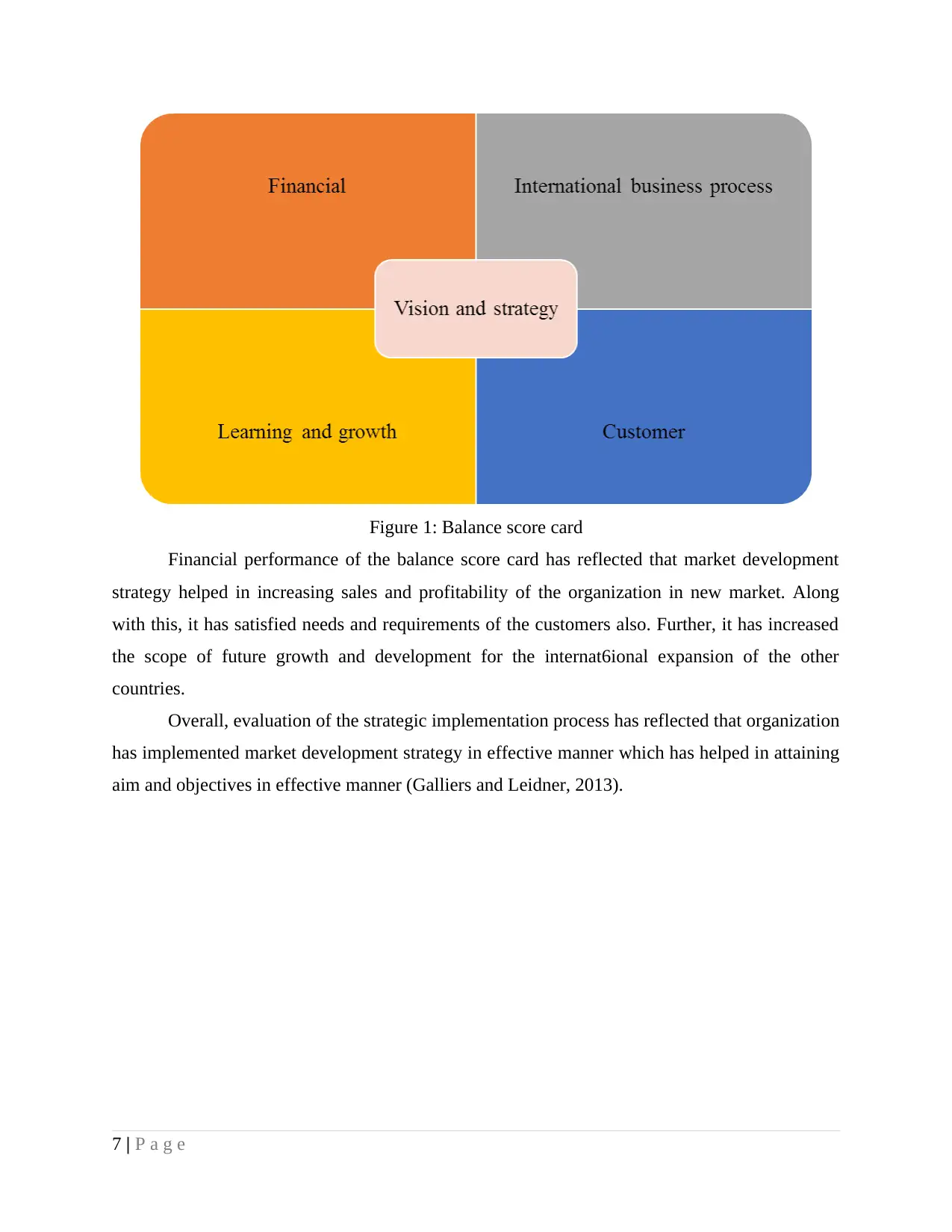
Balance score card:
It is one of the most appropriate tool for developing a new strategy and aligning it with
organizational performance. It plays important role in evaluating performance of the company
after implementation of the different strategies. By which, Sainsbury can determine that whether
strategy helps in attaining objectives or not (Hensmans, Johnson and Yip, 2013).
6 | P a g e
company and attaining organization’s objectives in effective manner (Abraham, 2012).
Technical resources: International expansion of the organization is one of the major
project. Regarding this, Sainsbury will require number of technical sources such as
internet, computer system, telephones, software, hardware, etc. All these technical
resources are required for making communication between different team members of the
organization (Elbanna, 2010).
4.3 Discussion of the target and timescale for achievement in Sainsbury to monitor a given
strategy
Strong financial position of Sainsbury has helped in international expansion project of the
organization. As per the above discussion market development strategy will be most appropriate
strategy for business success and these strategy focuses on the following smart objectives:
Smart objectives:
To expand business operations of Sainsbury at international level.
To increase the awareness of international customers about the products and services of
Sainsbury.
To increase the sales of Sainsbury by 30% in future three years.
To reduce the overall production cost of the company by 20% in coming one year
(Balanced Scorecard Basics, 2016).
Strategic implementation process of Sainsbury focuses on all above discussed objectives.
Organization needs to start its business operation in a developing nation such as china and Indi
because of the high population area increases the demand of products and services of
organization. It will help in attaining pother objective in effective manner such as increment in
sales, etc.
Balance score card:
It is one of the most appropriate tool for developing a new strategy and aligning it with
organizational performance. It plays important role in evaluating performance of the company
after implementation of the different strategies. By which, Sainsbury can determine that whether
strategy helps in attaining objectives or not (Hensmans, Johnson and Yip, 2013).
6 | P a g e
⊘ This is a preview!⊘
Do you want full access?
Subscribe today to unlock all pages.

Trusted by 1+ million students worldwide

Figure 1: Balance score card
Financial performance of the balance score card has reflected that market development
strategy helped in increasing sales and profitability of the organization in new market. Along
with this, it has satisfied needs and requirements of the customers also. Further, it has increased
the scope of future growth and development for the internat6ional expansion of the other
countries.
Overall, evaluation of the strategic implementation process has reflected that organization
has implemented market development strategy in effective manner which has helped in attaining
aim and objectives in effective manner (Galliers and Leidner, 2013).
7 | P a g e
Financial performance of the balance score card has reflected that market development
strategy helped in increasing sales and profitability of the organization in new market. Along
with this, it has satisfied needs and requirements of the customers also. Further, it has increased
the scope of future growth and development for the internat6ional expansion of the other
countries.
Overall, evaluation of the strategic implementation process has reflected that organization
has implemented market development strategy in effective manner which has helped in attaining
aim and objectives in effective manner (Galliers and Leidner, 2013).
7 | P a g e
Paraphrase This Document
Need a fresh take? Get an instant paraphrase of this document with our AI Paraphraser

REFERENCES
Books and journals
Abraham, C. S., 2012. Strategic Planning: A Practical Guide for Competitive Success. 2nd ed.
Emerald Group Publishing.
Al-turki, U., 2011. A framework for strategic planning in maintenance. Journal of Quality in
Maintenance Engineering. 17(2). pp.150–162.
Doole, I. and Lowe, R., 2005. Strategic Marketing Decisions in Global Markets. Cengage
Learning EMEA.
Elbanna, S., 2010. Strategic planning in the United Arab Emirates. International Journal of
Commerce and Management. 20(1). pp.26–40.
Galliers, D. R. and Leidner, E. D., 2013. Strategic Information Management. Routledge
Publication.
Hensmans, M., Johnson, G. and Yip, G., 2013. Strategic Transformation: Changing While
Winning. Palgrave Macmillan Publication.
Paswan, K. A., and et. al., 2011. Relationalism in marketing channels and marketing strategy.
European Journal of Marketing. 45(3). pp.311–333.
Singer, P. B. and et. al., 2007. Corporate real estate and competitive strategy. Journal of
Corporate Real Estate. 9(1). pp.25–38.
Online
Balanced Scorecard Basics. 2016. [Online]. Available through:
<http://balancedscorecard.org/Resources/About-the-Balanced-Scorecard>. [Accessed on
22nd April 2016].
8 | P a g e
Books and journals
Abraham, C. S., 2012. Strategic Planning: A Practical Guide for Competitive Success. 2nd ed.
Emerald Group Publishing.
Al-turki, U., 2011. A framework for strategic planning in maintenance. Journal of Quality in
Maintenance Engineering. 17(2). pp.150–162.
Doole, I. and Lowe, R., 2005. Strategic Marketing Decisions in Global Markets. Cengage
Learning EMEA.
Elbanna, S., 2010. Strategic planning in the United Arab Emirates. International Journal of
Commerce and Management. 20(1). pp.26–40.
Galliers, D. R. and Leidner, E. D., 2013. Strategic Information Management. Routledge
Publication.
Hensmans, M., Johnson, G. and Yip, G., 2013. Strategic Transformation: Changing While
Winning. Palgrave Macmillan Publication.
Paswan, K. A., and et. al., 2011. Relationalism in marketing channels and marketing strategy.
European Journal of Marketing. 45(3). pp.311–333.
Singer, P. B. and et. al., 2007. Corporate real estate and competitive strategy. Journal of
Corporate Real Estate. 9(1). pp.25–38.
Online
Balanced Scorecard Basics. 2016. [Online]. Available through:
<http://balancedscorecard.org/Resources/About-the-Balanced-Scorecard>. [Accessed on
22nd April 2016].
8 | P a g e

9 | P a g e
⊘ This is a preview!⊘
Do you want full access?
Subscribe today to unlock all pages.

Trusted by 1+ million students worldwide
1 out of 9
Related Documents
Your All-in-One AI-Powered Toolkit for Academic Success.
+13062052269
info@desklib.com
Available 24*7 on WhatsApp / Email
Unlock your academic potential
Copyright © 2020–2026 A2Z Services. All Rights Reserved. Developed and managed by ZUCOL.