Analyzing Market Entry Strategy for Organic Foods in Saudi Arabia
VerifiedAdded on 2020/04/29
|24
|5984
|80
Report
AI Summary
This report analyzes the development of a market entry strategy for Abdullah AlOthaim Markets to launch organic food products in Saudi Arabia. The research employs a case study approach and literature review, utilizing both qualitative and quantitative methodologies to analyze secondary data from various sources. The study examines the competitive landscape, including key players like Al Raya, Carrefour, and Panda, and identifies market opportunities. Findings indicate a declining inflation rate in Saudi Arabia, which is beneficial for launching organic food products. The report explores different market entry strategies like licensing and direct investment, considering factors such as transaction costs and product characteristics. The research also delves into the motivations for market entry and factors influencing entry strategy decisions. The conclusion recommends that the management should implement effective market entry strategies to successfully launch organic food products in Saudi Arabia, capitalizing on the growing market and organizational capabilities.
Running head: MARKETING MANAGEMENT
To analyze the development of a market entry strategy for Abdullah AlOthaim Markets to
launch the organic food product in Saudi Arabia
To analyze the development of a market entry strategy for Abdullah AlOthaim Markets to
launch the organic food product in Saudi Arabia

Paraphrase This Document
Need a fresh take? Get an instant paraphrase of this document with our AI Paraphraser
MARKETING MANAGEMENT 2
Executive summary
The main purpose of this project is to analyze the development of a market entry strategy for
Abdullah AlOthaim Markets to launch the organic food product in Saudi Arabia. Further,
different research method is used to systematic analysis of the project. In this way, case study
research method and literature review method is used as research methodology to complete the
research. It is also evaluated that both qualitative and quantitative research methodology is used
to analyze the data in a methodological manner. Further, secondary data collection is used to
gather the data from different existing resources. Along with this, content data analysis is used to
analyze the pooled information. From the result of the finding, it is analyzed that inflation rate is
declined in Saudi Arabia that is beneficial to launch the organic food products. In the last, it can
be recommended that management should use effective market entry strategy to launch the
organic food product in Saudi Arabia.
Executive summary
The main purpose of this project is to analyze the development of a market entry strategy for
Abdullah AlOthaim Markets to launch the organic food product in Saudi Arabia. Further,
different research method is used to systematic analysis of the project. In this way, case study
research method and literature review method is used as research methodology to complete the
research. It is also evaluated that both qualitative and quantitative research methodology is used
to analyze the data in a methodological manner. Further, secondary data collection is used to
gather the data from different existing resources. Along with this, content data analysis is used to
analyze the pooled information. From the result of the finding, it is analyzed that inflation rate is
declined in Saudi Arabia that is beneficial to launch the organic food products. In the last, it can
be recommended that management should use effective market entry strategy to launch the
organic food product in Saudi Arabia.
MARKETING MANAGEMENT 3
Table of Contents
Part 1 Project Statement..............................................................................................................................4
Background.................................................................................................................................................4
Project topic.............................................................................................................................................4
Purpose of this research...........................................................................................................................5
Literature review.....................................................................................................................................5
Research methodology............................................................................................................................5
Part 2: Project Report..................................................................................................................................5
2. Literature Review................................................................................................................................5
3. Research methodology.......................................................................................................................10
3.1 Case study method.......................................................................................................................10
3.2 Data collection.............................................................................................................................11
4. Presentation of findings.....................................................................................................................12
4.1 Analyzing the data.......................................................................................................................12
4.2 Reflection on findings..................................................................................................................19
5. Implications and recommendations...................................................................................................21
6. Conclusion.........................................................................................................................................22
References.................................................................................................................................................25
Table of Contents
Part 1 Project Statement..............................................................................................................................4
Background.................................................................................................................................................4
Project topic.............................................................................................................................................4
Purpose of this research...........................................................................................................................5
Literature review.....................................................................................................................................5
Research methodology............................................................................................................................5
Part 2: Project Report..................................................................................................................................5
2. Literature Review................................................................................................................................5
3. Research methodology.......................................................................................................................10
3.1 Case study method.......................................................................................................................10
3.2 Data collection.............................................................................................................................11
4. Presentation of findings.....................................................................................................................12
4.1 Analyzing the data.......................................................................................................................12
4.2 Reflection on findings..................................................................................................................19
5. Implications and recommendations...................................................................................................21
6. Conclusion.........................................................................................................................................22
References.................................................................................................................................................25
⊘ This is a preview!⊘
Do you want full access?
Subscribe today to unlock all pages.

Trusted by 1+ million students worldwide
MARKETING MANAGEMENT 4
Part 1 Project Statement
Background
Abdullah AlOthaim Markets is joint stock Corporation that is existing dealing in Saudi Arabia.
Its core activities are grocery stores, malls and wholesaling. It also deals in approximately 183
stores, 13 wholesale outlets, 27 convenience stores, and 143 supermarkets and hypermarket in
Saudi Arabia. Abdullah AlOthaim Markets had completely changed from Private Corporation to
public listed corporation (Abdullah AlOthaim Market, 2017). It is analyzed that market share of
Abdullah AlOthaim Market was 3.4% in Saudi Arabia in 2014 that was increasing. Further,
revenue of Abdullah AlOthaim Market is US$1.4 billion in 2015 that shows the higher market
growth.
Project topic
Abdullah AlOthaim Markets will launch the organic food product into the market of Saudi
Arabia in order to increase their business growth. Initially, the company faces different issues
due to tough competition from local competitors who already presented in the retail sector of
Saudi Arabia. These competitors are Al Raya, Carrefour, Bin Dawood/Danube, and Panda which
also focuses on organic food products. In the current scenario, the economy of the nation is doing
well hence its competitors has rapidly grown in the market by launching their products and
services in Saudi Arabian market (Al Mallakh, and el Mallakh, 2015).
There are different opportunities for Abdullah AlOthaim Markets that motivates it to launch the
organic food product into Saudi Arabia. These opportunities are gaining access to a large number
of new customers, lowering cost and enhancing the competitive position of the company in the
organic food retail market. This market development strategy will also provide an opportunity to
capitalize the organizational capabilities and core competencies to the company. Consequently,
Part 1 Project Statement
Background
Abdullah AlOthaim Markets is joint stock Corporation that is existing dealing in Saudi Arabia.
Its core activities are grocery stores, malls and wholesaling. It also deals in approximately 183
stores, 13 wholesale outlets, 27 convenience stores, and 143 supermarkets and hypermarket in
Saudi Arabia. Abdullah AlOthaim Markets had completely changed from Private Corporation to
public listed corporation (Abdullah AlOthaim Market, 2017). It is analyzed that market share of
Abdullah AlOthaim Market was 3.4% in Saudi Arabia in 2014 that was increasing. Further,
revenue of Abdullah AlOthaim Market is US$1.4 billion in 2015 that shows the higher market
growth.
Project topic
Abdullah AlOthaim Markets will launch the organic food product into the market of Saudi
Arabia in order to increase their business growth. Initially, the company faces different issues
due to tough competition from local competitors who already presented in the retail sector of
Saudi Arabia. These competitors are Al Raya, Carrefour, Bin Dawood/Danube, and Panda which
also focuses on organic food products. In the current scenario, the economy of the nation is doing
well hence its competitors has rapidly grown in the market by launching their products and
services in Saudi Arabian market (Al Mallakh, and el Mallakh, 2015).
There are different opportunities for Abdullah AlOthaim Markets that motivates it to launch the
organic food product into Saudi Arabia. These opportunities are gaining access to a large number
of new customers, lowering cost and enhancing the competitive position of the company in the
organic food retail market. This market development strategy will also provide an opportunity to
capitalize the organizational capabilities and core competencies to the company. Consequently,
Paraphrase This Document
Need a fresh take? Get an instant paraphrase of this document with our AI Paraphraser
MARKETING MANAGEMENT 5
Abdullah AlOthaim Markets should analyze the development of a market entry strategy for
launching their organic food product in Saudi Arabia because; it will aid the company to
generate the higher revenue and growth (Alrashidi, 2016).
Purpose of this research
The key purpose of this research is to gain understanding regarding the development of a market
entry strategy for Abdullah AlOthaim Markets to launch the organic food product in Saudi
Arabia. In this way, this research identifies the different modes of market entry and also
addresses the factor affecting the selection of entry mode. This research also recommends the
strategies to avoid the factors which may affect the selection of entry mode.
Literature review
The following theories (concepts or frameworks) that relate to this topic are:
Market entry strategies
Transaction cost theory
Research methodology
For collecting the qualitative data, 3 case studies will be selected related to the research topic. It
is beneficial to get the data regarding the development of a market entry strategy. For
quantitative data, different online sites will be used to statistical measure the information
regarding research issue. Further, secondary data will gather from government publication
(Export.gov, 2017), online websites, and company websites. These data would be effective to
support the quantitative information.
Part 2: Project Report
2. Literature Review
Development of Market entry strategy
Abdullah AlOthaim Markets should analyze the development of a market entry strategy for
launching their organic food product in Saudi Arabia because; it will aid the company to
generate the higher revenue and growth (Alrashidi, 2016).
Purpose of this research
The key purpose of this research is to gain understanding regarding the development of a market
entry strategy for Abdullah AlOthaim Markets to launch the organic food product in Saudi
Arabia. In this way, this research identifies the different modes of market entry and also
addresses the factor affecting the selection of entry mode. This research also recommends the
strategies to avoid the factors which may affect the selection of entry mode.
Literature review
The following theories (concepts or frameworks) that relate to this topic are:
Market entry strategies
Transaction cost theory
Research methodology
For collecting the qualitative data, 3 case studies will be selected related to the research topic. It
is beneficial to get the data regarding the development of a market entry strategy. For
quantitative data, different online sites will be used to statistical measure the information
regarding research issue. Further, secondary data will gather from government publication
(Export.gov, 2017), online websites, and company websites. These data would be effective to
support the quantitative information.
Part 2: Project Report
2. Literature Review
Development of Market entry strategy
MARKETING MANAGEMENT 6
This chapter offers detail understanding regarding conceptual structure for the thesis. It also
focuses on different concept and theories that are appropriate in foreign market entry tactic.
There are different ways of market entry by which Abdullah AlOthaim Markets can launch the
organic food products in Saudi Arabia. These are direct and indirect export and production in an
international market. According to Ayden et al. (2018), License is a significant technique in
which manufacturer can engage in expanding international operations beyond exporting.
Licensing is a feasible way for Abdullah AlOthaim Markets to launch the organic products in the
Saudi Arabia because there is lack of difficult to make direct investment and exporting the
organic food products.
In opposed to this, Behar and Ritz (2017) stated that contract manufacturing is another strategy
to market entry. It also entails contracting with the manufacture and gathering of products by
producer who is in the abroad nation. There is need for effective marketing strategy for Abdullah
AlOthaim Markets. This approach can be also implemented for launching the organic food
products and services as it will enable the company to decline the cost of production.
In the view of Michael (2014), management contacting is an effective development strategy for
market entry. This strategy focuses on domestic investors in global market who provide the
capital for a company while a company from outside facilitates the required know-how to
organize the business. This market entry strategy creates low risk for Abdullah AlOthaim
Markets in case they use a different type of purchase option.
On the other hand, Boddewyn and Boddewyn (2017) stated that the decision of manufacturing in
the overseas market creates an obligation for Abdullah AlOthaim Markets to launch the organic
food products in Saudi Arabia. Since, there are high market demand, government restriction, and
competitive pressure on the import of products and services and government actions. These are a
This chapter offers detail understanding regarding conceptual structure for the thesis. It also
focuses on different concept and theories that are appropriate in foreign market entry tactic.
There are different ways of market entry by which Abdullah AlOthaim Markets can launch the
organic food products in Saudi Arabia. These are direct and indirect export and production in an
international market. According to Ayden et al. (2018), License is a significant technique in
which manufacturer can engage in expanding international operations beyond exporting.
Licensing is a feasible way for Abdullah AlOthaim Markets to launch the organic products in the
Saudi Arabia because there is lack of difficult to make direct investment and exporting the
organic food products.
In opposed to this, Behar and Ritz (2017) stated that contract manufacturing is another strategy
to market entry. It also entails contracting with the manufacture and gathering of products by
producer who is in the abroad nation. There is need for effective marketing strategy for Abdullah
AlOthaim Markets. This approach can be also implemented for launching the organic food
products and services as it will enable the company to decline the cost of production.
In the view of Michael (2014), management contacting is an effective development strategy for
market entry. This strategy focuses on domestic investors in global market who provide the
capital for a company while a company from outside facilitates the required know-how to
organize the business. This market entry strategy creates low risk for Abdullah AlOthaim
Markets in case they use a different type of purchase option.
On the other hand, Boddewyn and Boddewyn (2017) stated that the decision of manufacturing in
the overseas market creates an obligation for Abdullah AlOthaim Markets to launch the organic
food products in Saudi Arabia. Since, there are high market demand, government restriction, and
competitive pressure on the import of products and services and government actions. These are a
⊘ This is a preview!⊘
Do you want full access?
Subscribe today to unlock all pages.
Trusted by 1+ million students worldwide
MARKETING MANAGEMENT 7
consequence of import which is created at the disadvantages. The judgment can be
essentialelements of the long-term plan of the company to generate an effective worldwide
operation.
Behar and Ritz (2017) evaluated that directs investment is defined as providing direct possession
of services in the target nation. Direct ownership facilitates a high extent of control in the
operation of Abdullah AlOthaim Markets as well as defines the competencies to better
understand the competitive atmosphere and consumer. As a result, it could be beneficial to
launch the organic food products in Saudi Arabia. But, there is need for the high extent of
material and commitment of employees.
Motivation for Market Entry
According to Holtgrave and Onay (2017), market entry is the integration of factors that should be
measured by the company in a right circumstance for internationalizing the products. There are
large numbers of motives for Abdullah AlOthaim Markets to use market entry. These motives
entail both pulling and pushing motives to internationalize. These motivational factors can be
differentiated as per proactive and reactive motivation factor.
Following chart shows the factor of motivation that motivates Abdullah AlOthaim Markets to
launch the organic food products into the Saudi Arabia food retail market:
Figure 1:
consequence of import which is created at the disadvantages. The judgment can be
essentialelements of the long-term plan of the company to generate an effective worldwide
operation.
Behar and Ritz (2017) evaluated that directs investment is defined as providing direct possession
of services in the target nation. Direct ownership facilitates a high extent of control in the
operation of Abdullah AlOthaim Markets as well as defines the competencies to better
understand the competitive atmosphere and consumer. As a result, it could be beneficial to
launch the organic food products in Saudi Arabia. But, there is need for the high extent of
material and commitment of employees.
Motivation for Market Entry
According to Holtgrave and Onay (2017), market entry is the integration of factors that should be
measured by the company in a right circumstance for internationalizing the products. There are
large numbers of motives for Abdullah AlOthaim Markets to use market entry. These motives
entail both pulling and pushing motives to internationalize. These motivational factors can be
differentiated as per proactive and reactive motivation factor.
Following chart shows the factor of motivation that motivates Abdullah AlOthaim Markets to
launch the organic food products into the Saudi Arabia food retail market:
Figure 1:
Paraphrase This Document
Need a fresh take? Get an instant paraphrase of this document with our AI Paraphraser
MARKETING MANAGEMENT 8
(Sources: Holtgrave and Onay (2017).
Transaction cost theory
According to Al Mallakh and el Mallakh (2015), the transaction cost theory defines that
institution and market organize and coordinate the economic transaction in different forms.
While, external transaction expenses are greater than the internal bureaucratic cost of Abdullah
AlOthaim Markets then, it will grow. Since, the corporation is making plan to launch the organic
food products at cheap rate as compared to perform the activities in the market.
In contrast to this, Alharbi (2014) stated that every company can expand their business by
obtaining the activities at a cheaper rate within an organization as compared to outsourcing the
business activities to external activator in the market. Furthermore, transaction cost can occur
while goods and services are relocated across the technologically detachable edge.
Factors Influencing the Entry Strategy Decision
According to Asiri (2017), the target market is a factor that influencing to make market entry
decision. It is also stated that there are different market-related variables for Abdullah AlOthaim
Markets which deal with determinants of international marketing channel. However, it may
create complexities for induction the organic food products into the Saudi Arabia. It can be
classified into different groups named geographical and demographic distribution of customers,
economic development among customers, and preference, need and requirement of customers.
Along with this, legal issues, and political stability can be effective determinants of entry mode.
In contrast to this, Ayden et al. (2018) evaluated that organic food product is another factor
which may affect the market entry decision. Further, variation in organic food product
characteristics has major impact on the selection of channel. These variations are technical
complexities, perishability, weight and bulk, and unit value. For instance, organic food products
(Sources: Holtgrave and Onay (2017).
Transaction cost theory
According to Al Mallakh and el Mallakh (2015), the transaction cost theory defines that
institution and market organize and coordinate the economic transaction in different forms.
While, external transaction expenses are greater than the internal bureaucratic cost of Abdullah
AlOthaim Markets then, it will grow. Since, the corporation is making plan to launch the organic
food products at cheap rate as compared to perform the activities in the market.
In contrast to this, Alharbi (2014) stated that every company can expand their business by
obtaining the activities at a cheaper rate within an organization as compared to outsourcing the
business activities to external activator in the market. Furthermore, transaction cost can occur
while goods and services are relocated across the technologically detachable edge.
Factors Influencing the Entry Strategy Decision
According to Asiri (2017), the target market is a factor that influencing to make market entry
decision. It is also stated that there are different market-related variables for Abdullah AlOthaim
Markets which deal with determinants of international marketing channel. However, it may
create complexities for induction the organic food products into the Saudi Arabia. It can be
classified into different groups named geographical and demographic distribution of customers,
economic development among customers, and preference, need and requirement of customers.
Along with this, legal issues, and political stability can be effective determinants of entry mode.
In contrast to this, Ayden et al. (2018) evaluated that organic food product is another factor
which may affect the market entry decision. Further, variation in organic food product
characteristics has major impact on the selection of channel. These variations are technical
complexities, perishability, weight and bulk, and unit value. For instance, organic food products
MARKETING MANAGEMENT 9
and service may need both after and before sale services. The phase of product development and
its comparative newness in international market can have confronted by Abdullah AlOthaim
Markets for developing market entry decision in terms of launching the organic food products in
Saudi Arabia. Moreover, if Abdullah AlOthaim Markets has comparatively unknown products
and services then it should rely on the agents rather than selling directly to gain productivity.
3. Research methodology
3.1 Case study method
A case study is popular research technique in the business field. The main aim of the case study
is to assess particular issue within the limit of particular circumstances, environment, and
organization. Case study research can be classified into different parts as per the nature of
design. These are descriptive, explanatory and exploratory (Behar and Ritz, 2017).
For this research, explanatory case study is used because it is beneficial to gather the data in the
context of development of market entry strategy to launch the organic food product in Saudi
Arabia. I have selected the case study on the basis of information regarding Abdullah AlOthaim
Markets. Further, company case study is used to identify the research issue. In addition, this case
study entails both quantitative and qualitative information in data analysis. It increases the
capability of readers to detain complexities of real-life circumstances. Thus, the situation can be
identified to the higher extent of depth (Boddewyn and Boddewyn, 2017).This case study is
supported by literature review to get a reliable and valid outcome.
3.2 Data collection
Data collection can be segmented into two broad manners named primary and secondary data
collection. For this research, secondary data collection method is used to attain the research
objectives. These data is collected from different existing sources like government sources
and service may need both after and before sale services. The phase of product development and
its comparative newness in international market can have confronted by Abdullah AlOthaim
Markets for developing market entry decision in terms of launching the organic food products in
Saudi Arabia. Moreover, if Abdullah AlOthaim Markets has comparatively unknown products
and services then it should rely on the agents rather than selling directly to gain productivity.
3. Research methodology
3.1 Case study method
A case study is popular research technique in the business field. The main aim of the case study
is to assess particular issue within the limit of particular circumstances, environment, and
organization. Case study research can be classified into different parts as per the nature of
design. These are descriptive, explanatory and exploratory (Behar and Ritz, 2017).
For this research, explanatory case study is used because it is beneficial to gather the data in the
context of development of market entry strategy to launch the organic food product in Saudi
Arabia. I have selected the case study on the basis of information regarding Abdullah AlOthaim
Markets. Further, company case study is used to identify the research issue. In addition, this case
study entails both quantitative and qualitative information in data analysis. It increases the
capability of readers to detain complexities of real-life circumstances. Thus, the situation can be
identified to the higher extent of depth (Boddewyn and Boddewyn, 2017).This case study is
supported by literature review to get a reliable and valid outcome.
3.2 Data collection
Data collection can be segmented into two broad manners named primary and secondary data
collection. For this research, secondary data collection method is used to attain the research
objectives. These data is collected from different existing sources like government sources
⊘ This is a preview!⊘
Do you want full access?
Subscribe today to unlock all pages.
Trusted by 1+ million students worldwide
MARKETING MANAGEMENT 10
(Export.gov, 2017), industry related journals, books, recent academic article like (Ayden, et. al.,
2018), and (Asiri, 2017), online portals such as, Investing.com (2017), Trading Economics
(2017), and annual report (Al-Othaim Market (2017). These data is selected because it takes less
time and provides authentic information regarding development of market entry strategy to
launch the organic food products in Saudi Arabia. There is a large amount of data existed in
these sources regarding the research issue. Hence, feasible set of criteria should be used to
choose secondary data (Behar and Ritz, 2017).
Along with this, both qualitative and quantitative research methodology is used for this research.
In this way, qualitative research methodology is used to generate the theoretical information
regarding development of market entry strategy to launch the organic food product in Saudi
Arabia. In contrast to this, quantitative research methodology is used to measure the data
regarding research issue in the graphical and tabular form (Alrashidi, 2016).
4. Presentation of findings
This chapter presents the information by analyzing different case study. These case studies
define the reliable and valid information regarding research issues as it is beneficial to complete
the research in a specified time period (Ayden, et. al., 2018).
4.1 Analyzing the data
Data is analyzed to comprehend the research issue in an effective manner. Following case study
is analyzed in this research:
Case1: Variability of new store openings
Following chart depicts the contribution of each activity of market entry to launch the food
product into Saudi Arabia:
(Export.gov, 2017), industry related journals, books, recent academic article like (Ayden, et. al.,
2018), and (Asiri, 2017), online portals such as, Investing.com (2017), Trading Economics
(2017), and annual report (Al-Othaim Market (2017). These data is selected because it takes less
time and provides authentic information regarding development of market entry strategy to
launch the organic food products in Saudi Arabia. There is a large amount of data existed in
these sources regarding the research issue. Hence, feasible set of criteria should be used to
choose secondary data (Behar and Ritz, 2017).
Along with this, both qualitative and quantitative research methodology is used for this research.
In this way, qualitative research methodology is used to generate the theoretical information
regarding development of market entry strategy to launch the organic food product in Saudi
Arabia. In contrast to this, quantitative research methodology is used to measure the data
regarding research issue in the graphical and tabular form (Alrashidi, 2016).
4. Presentation of findings
This chapter presents the information by analyzing different case study. These case studies
define the reliable and valid information regarding research issues as it is beneficial to complete
the research in a specified time period (Ayden, et. al., 2018).
4.1 Analyzing the data
Data is analyzed to comprehend the research issue in an effective manner. Following case study
is analyzed in this research:
Case1: Variability of new store openings
Following chart depicts the contribution of each activity of market entry to launch the food
product into Saudi Arabia:
Paraphrase This Document
Need a fresh take? Get an instant paraphrase of this document with our AI Paraphraser
MARKETING MANAGEMENT 11
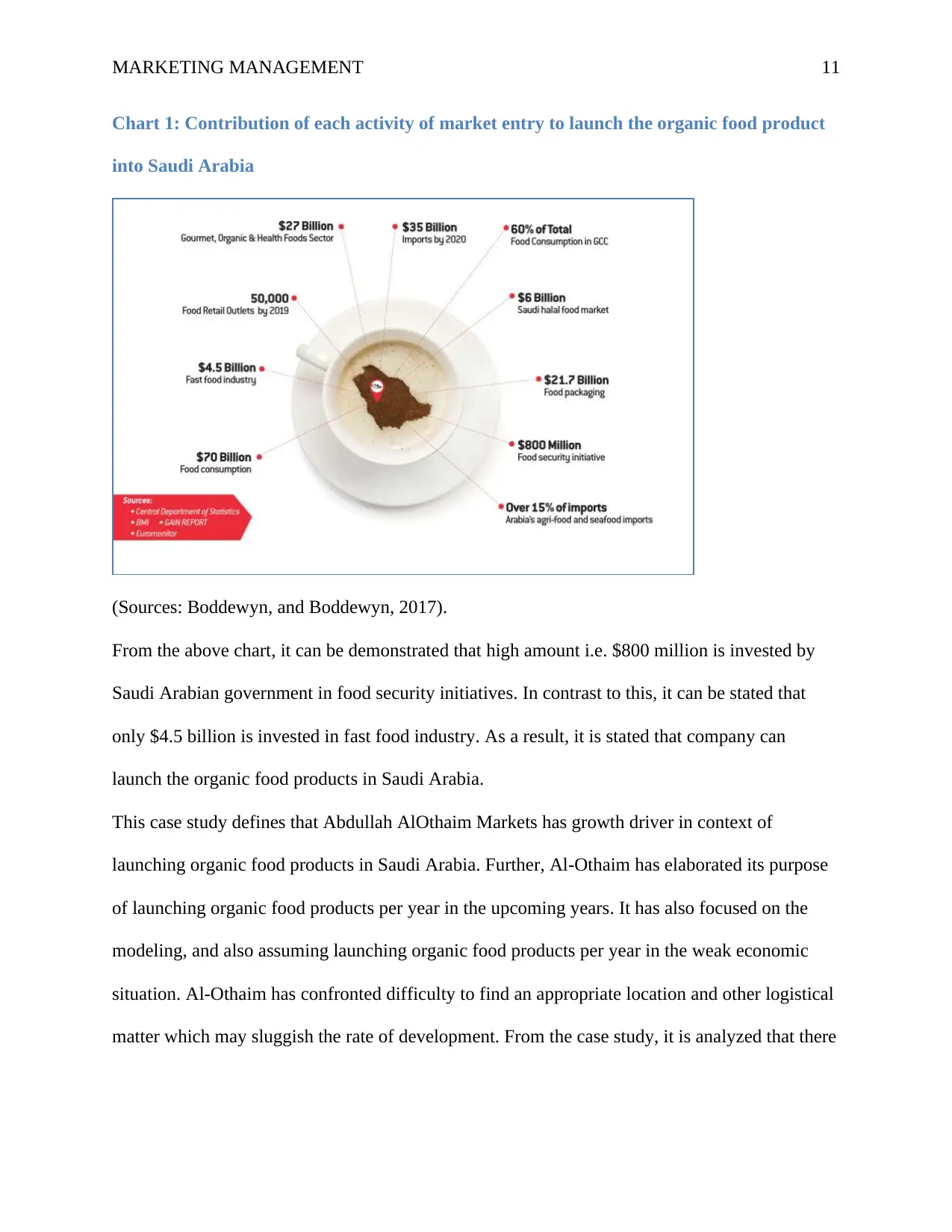
Chart 1: Contribution of each activity of market entry to launch the organic food product
into Saudi Arabia
(Sources: Boddewyn, and Boddewyn, 2017).
From the above chart, it can be demonstrated that high amount i.e. $800 million is invested by
Saudi Arabian government in food security initiatives. In contrast to this, it can be stated that
only $4.5 billion is invested in fast food industry. As a result, it is stated that company can
launch the organic food products in Saudi Arabia.
This case study defines that Abdullah AlOthaim Markets has growth driver in context of
launching organic food products in Saudi Arabia. Further, Al-Othaim has elaborated its purpose
of launching organic food products per year in the upcoming years. It has also focused on the
modeling, and also assuming launching organic food products per year in the weak economic
situation. Al-Othaim has confronted difficulty to find an appropriate location and other logistical
matter which may sluggish the rate of development. From the case study, it is analyzed that there
Chart 1: Contribution of each activity of market entry to launch the organic food product
into Saudi Arabia
(Sources: Boddewyn, and Boddewyn, 2017).
From the above chart, it can be demonstrated that high amount i.e. $800 million is invested by
Saudi Arabian government in food security initiatives. In contrast to this, it can be stated that
only $4.5 billion is invested in fast food industry. As a result, it is stated that company can
launch the organic food products in Saudi Arabia.
This case study defines that Abdullah AlOthaim Markets has growth driver in context of
launching organic food products in Saudi Arabia. Further, Al-Othaim has elaborated its purpose
of launching organic food products per year in the upcoming years. It has also focused on the
modeling, and also assuming launching organic food products per year in the weak economic
situation. Al-Othaim has confronted difficulty to find an appropriate location and other logistical
matter which may sluggish the rate of development. From the case study, it is analyzed that there
MARKETING MANAGEMENT 12
is a deviation in the number of Al Othaim products as it should focus on offering a large amount
of value attribution in organic food products to the business (Alharbi, 2014).
Case 2: Threat of Agflation
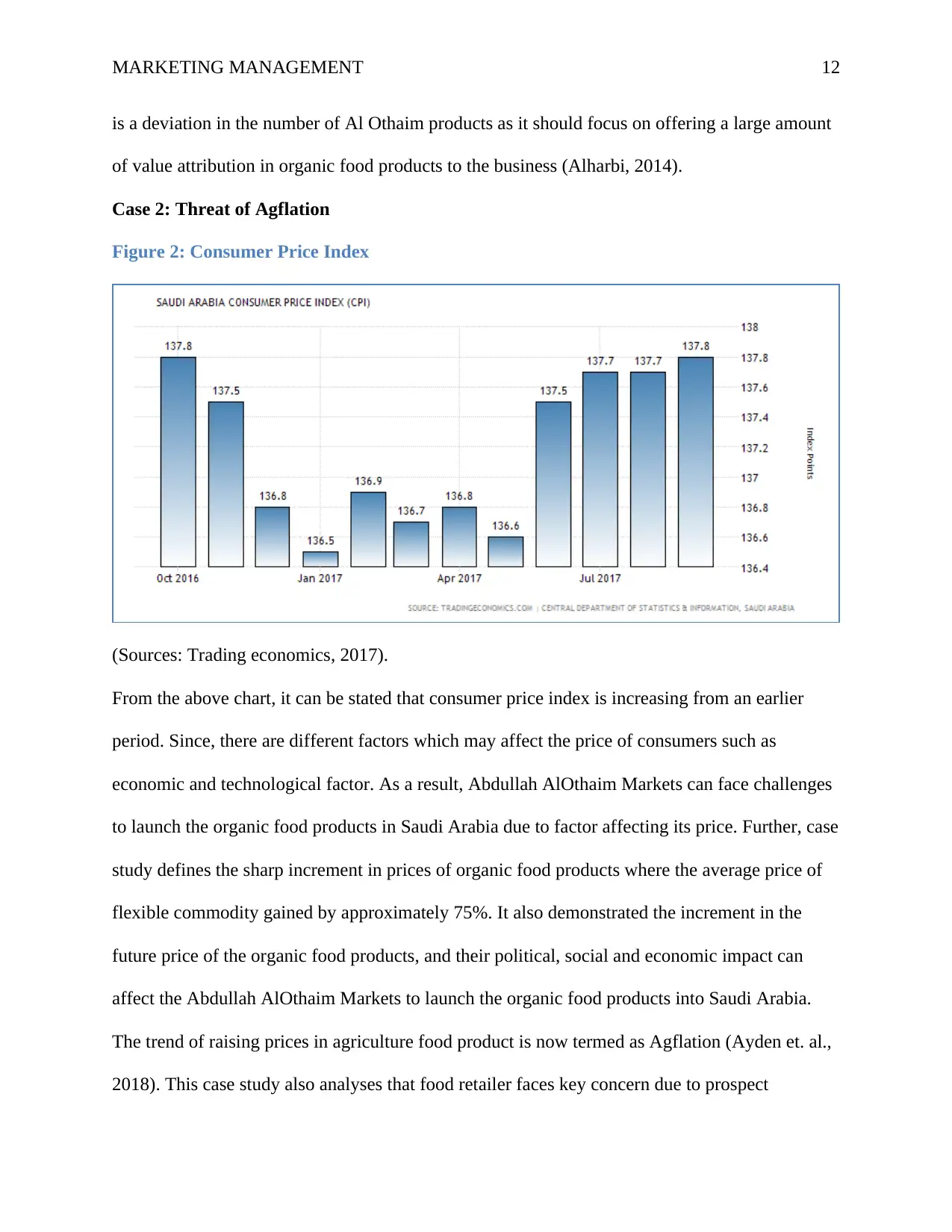
Figure 2: Consumer Price Index
(Sources: Trading economics, 2017).
From the above chart, it can be stated that consumer price index is increasing from an earlier
period. Since, there are different factors which may affect the price of consumers such as
economic and technological factor. As a result, Abdullah AlOthaim Markets can face challenges
to launch the organic food products in Saudi Arabia due to factor affecting its price. Further, case
study defines the sharp increment in prices of organic food products where the average price of
flexible commodity gained by approximately 75%. It also demonstrated the increment in the
future price of the organic food products, and their political, social and economic impact can
affect the Abdullah AlOthaim Markets to launch the organic food products into Saudi Arabia.
The trend of raising prices in agriculture food product is now termed as Agflation (Ayden et. al.,
2018). This case study also analyses that food retailer faces key concern due to prospect
is a deviation in the number of Al Othaim products as it should focus on offering a large amount
of value attribution in organic food products to the business (Alharbi, 2014).
Case 2: Threat of Agflation
Figure 2: Consumer Price Index
(Sources: Trading economics, 2017).
From the above chart, it can be stated that consumer price index is increasing from an earlier
period. Since, there are different factors which may affect the price of consumers such as
economic and technological factor. As a result, Abdullah AlOthaim Markets can face challenges
to launch the organic food products in Saudi Arabia due to factor affecting its price. Further, case
study defines the sharp increment in prices of organic food products where the average price of
flexible commodity gained by approximately 75%. It also demonstrated the increment in the
future price of the organic food products, and their political, social and economic impact can
affect the Abdullah AlOthaim Markets to launch the organic food products into Saudi Arabia.
The trend of raising prices in agriculture food product is now termed as Agflation (Ayden et. al.,
2018). This case study also analyses that food retailer faces key concern due to prospect
⊘ This is a preview!⊘
Do you want full access?
Subscribe today to unlock all pages.
Trusted by 1+ million students worldwide

1 out of 24


Related Documents


Your All-in-One AI-Powered Toolkit for Academic Success.
+13062052269
info@desklib.com
Available 24*7 on WhatsApp / Email
![[object Object]](/_next/static/media/star-bottom.7253800d.svg)
Unlock your academic potential
Copyright © 2020–2026 A2Z Services. All Rights Reserved. Developed and managed by ZUCOL.