Market Structure Analysis: Types, Determinants and Significance
VerifiedAdded on 2019/09/26
|9
|2753
|441
Essay
AI Summary
This essay provides a comprehensive overview of market structure, beginning with a definition of the term and its significance in economics. It then delves into the major determinants that shape market structures, including the number of sellers and buyers, product characteristics, and barriers to entry and exit. The essay thoroughly examines the four main types of market structures: perfect competition, monopolistic competition, oligopoly, and monopoly, detailing their key features, assumptions, and real-world examples. It highlights the differences between these structures, such as the degree of competition, product differentiation, and pricing power of firms. Finally, the essay discusses the impact of different market structures on an economy, emphasizing how they influence pricing, consumer welfare, and overall market efficiency, concluding with the significance of market structure in economic and marketing decision-making.
BLOG: MARKET STRUCTURE
WHAT IS CALLED MARKET AND MARKET
STRUCTURE?
WHAT IS CALLED MARKET AND MARKET
STRUCTURE?

Paraphrase This Document
Need a fresh take? Get an instant paraphrase of this document with our AI Paraphraser
MARKET STRUCTURE
31st July 2019
In common assertion, market refers to a particular place where goods and services are purchased
and sold by manufacturers or produces at wholesale or retail prices. Thus, market is a place that
consists of several small size shops and big shops, stalls and a number of hawkers selling
different types of products and services. In a market there are two parties who use to facilitate the
process associated with the exchange of product and services. Among these two parties, one
stands as a seller and another one stands as a buyer. A market might be physical in form, like a
wholesale or retail outlet where people gather and communicated face-to-face and get involved
in purchase and sale, or virtual such as an online market where no physical contact established
between the sellers and buyers but goods are exchanged. However, in Economics, market is not
just a particular place but it denotes a market which is solely associated with commodities.
As per economic term, market refers to a specific arrangement whereby sellers and buyers come
close and contact with each other indirectly or directly to buy and sell goods or services.
Furthermore, it also says that for a market’s existence, sellers and buyers do not need to meet
with each other personally at a specific place and they might contact or communicate each other
by using any means of communication such as fax, telephone or mail. Thus, in economics
‘Market’ is a term that used in a specialised and typical sense and it does not indicate a pre-fixed
location. It indicates to the entire area of operating supply and demand. Again, it means the
conditions as well as the commercial relationships between sellers and buyers those who are
involved in facilitating transactions. Therefore, the term market signifies all kind of
arrangements in which purchase and sale of goods and services take place.
Definition of Market and Market Structure
Antoine Augustin Cournot, a French economist has defined market as not a particular place of
market from where things are sold out and bought but the entire area of a region where the sellers
31st July 2019
In common assertion, market refers to a particular place where goods and services are purchased
and sold by manufacturers or produces at wholesale or retail prices. Thus, market is a place that
consists of several small size shops and big shops, stalls and a number of hawkers selling
different types of products and services. In a market there are two parties who use to facilitate the
process associated with the exchange of product and services. Among these two parties, one
stands as a seller and another one stands as a buyer. A market might be physical in form, like a
wholesale or retail outlet where people gather and communicated face-to-face and get involved
in purchase and sale, or virtual such as an online market where no physical contact established
between the sellers and buyers but goods are exchanged. However, in Economics, market is not
just a particular place but it denotes a market which is solely associated with commodities.
As per economic term, market refers to a specific arrangement whereby sellers and buyers come
close and contact with each other indirectly or directly to buy and sell goods or services.
Furthermore, it also says that for a market’s existence, sellers and buyers do not need to meet
with each other personally at a specific place and they might contact or communicate each other
by using any means of communication such as fax, telephone or mail. Thus, in economics
‘Market’ is a term that used in a specialised and typical sense and it does not indicate a pre-fixed
location. It indicates to the entire area of operating supply and demand. Again, it means the
conditions as well as the commercial relationships between sellers and buyers those who are
involved in facilitating transactions. Therefore, the term market signifies all kind of
arrangements in which purchase and sale of goods and services take place.
Definition of Market and Market Structure
Antoine Augustin Cournot, a French economist has defined market as not a particular place of
market from where things are sold out and bought but the entire area of a region where the sellers
and buyers involved in such intercourse with each other that the end prices of the same products
and services tend to easily, equality and quickly. This particular definition of market indicates
some essential points such as a market is not any specific place where sellers and buyers use to
assemble but it might be an area or region which belongs to a particular country, state, district or
even the entire world from where sellers and buyers are drawn. There must be business
intercourse among the dealers, i.e., buyers and sellers. Along with this, another point rises which
says that the buyers and sellers need to be in touch with each other to become aware of the prices
accepted or offered by other sellers and buyers, and the same price rules the market during the
same thing same time.
On the other side, as per some other definitions of market as provided by different scholars
market refers not only to a place but also to the commodities as well as the sellers and buyers of
commodities who are involved in competition with one another directly. From different
definitions of market, some facts are identified that there are always some commodities exited in
a market, sellers and buyers get in touch or communicate with each other either through
telegraph, telephone, post, or through some middlemen, and there is always a perfect competition
exists among sellers and buyers and due to such competition, final or selling price of
commodities get influenced. There are different types of market depending upon the degree of
competition, and the presence of buyers and sellers. Moreover, market structures are also based
on the nature of different markets.
Market structure stands as a set of characteristics of a market either competitive or organizational
which describes the degree and nature of competition as well as the prevailing pricing policy in a
market. Thus, market structure referred to the number of companies producing similar products
and services and operated in a particular market and the structure of whom is determined as per
the prevailing competition in that particular market. Structure of a market indicates the practices
followed by market players i.e. the practices of the sellers and buyers present in a market.
Major Determinants of Market Structure
There are some major determinants which decide the structure and formation of a market. These
major determinants of a market structure are as follows –
and services tend to easily, equality and quickly. This particular definition of market indicates
some essential points such as a market is not any specific place where sellers and buyers use to
assemble but it might be an area or region which belongs to a particular country, state, district or
even the entire world from where sellers and buyers are drawn. There must be business
intercourse among the dealers, i.e., buyers and sellers. Along with this, another point rises which
says that the buyers and sellers need to be in touch with each other to become aware of the prices
accepted or offered by other sellers and buyers, and the same price rules the market during the
same thing same time.
On the other side, as per some other definitions of market as provided by different scholars
market refers not only to a place but also to the commodities as well as the sellers and buyers of
commodities who are involved in competition with one another directly. From different
definitions of market, some facts are identified that there are always some commodities exited in
a market, sellers and buyers get in touch or communicate with each other either through
telegraph, telephone, post, or through some middlemen, and there is always a perfect competition
exists among sellers and buyers and due to such competition, final or selling price of
commodities get influenced. There are different types of market depending upon the degree of
competition, and the presence of buyers and sellers. Moreover, market structures are also based
on the nature of different markets.
Market structure stands as a set of characteristics of a market either competitive or organizational
which describes the degree and nature of competition as well as the prevailing pricing policy in a
market. Thus, market structure referred to the number of companies producing similar products
and services and operated in a particular market and the structure of whom is determined as per
the prevailing competition in that particular market. Structure of a market indicates the practices
followed by market players i.e. the practices of the sellers and buyers present in a market.
Major Determinants of Market Structure
There are some major determinants which decide the structure and formation of a market. These
major determinants of a market structure are as follows –
⊘ This is a preview!⊘
Do you want full access?
Subscribe today to unlock all pages.

Trusted by 1+ million students worldwide
The number of sellers selling their products and services in a market.
The number of customers present in the market.
The characteristics and nature of products and services selling by companies.
The degree of concentration of a company shows its market shares i.e. the more a
company becomes able to concentrate on a market the great it becomes able to hold
market shares.
Every market structure includes its own entry rules and exit barriers whereas some
markets are free to enter and exit.
The degree of combination between different operational stages of a company such as
production, distribution is handled by a single company.
The degree of differentiation in relation to products and services which says the way a
company’s offerings use to differ from the offerings of other companies.
The concept of economies of scale, which says a firm's cost efficient behavior in terms of
producing products or services by incurring less cost.
The rate of customer turnover which is the volume of customers intending to change or
switch their choices with respect to products and services while an adverse situation
arises in a market.
Thus, marker structure affects how a company prices its products and supply the same, how it
handles all the barriers it faces while entering into a market and exiting from the market, and
how efficiently it can carry out all its regular business operations.
Types of Market Structure and their Features
A country’s economy includes different types of market structures that indicate the depth of
competition and the nature of the sellers and buyers associated with the market. The major
determinants of different market structures include the nature of products and services, number
The number of customers present in the market.
The characteristics and nature of products and services selling by companies.
The degree of concentration of a company shows its market shares i.e. the more a
company becomes able to concentrate on a market the great it becomes able to hold
market shares.
Every market structure includes its own entry rules and exit barriers whereas some
markets are free to enter and exit.
The degree of combination between different operational stages of a company such as
production, distribution is handled by a single company.
The degree of differentiation in relation to products and services which says the way a
company’s offerings use to differ from the offerings of other companies.
The concept of economies of scale, which says a firm's cost efficient behavior in terms of
producing products or services by incurring less cost.
The rate of customer turnover which is the volume of customers intending to change or
switch their choices with respect to products and services while an adverse situation
arises in a market.
Thus, marker structure affects how a company prices its products and supply the same, how it
handles all the barriers it faces while entering into a market and exiting from the market, and
how efficiently it can carry out all its regular business operations.
Types of Market Structure and their Features
A country’s economy includes different types of market structures that indicate the depth of
competition and the nature of the sellers and buyers associated with the market. The major
determinants of different market structures include the nature of products and services, number
Paraphrase This Document
Need a fresh take? Get an instant paraphrase of this document with our AI Paraphraser
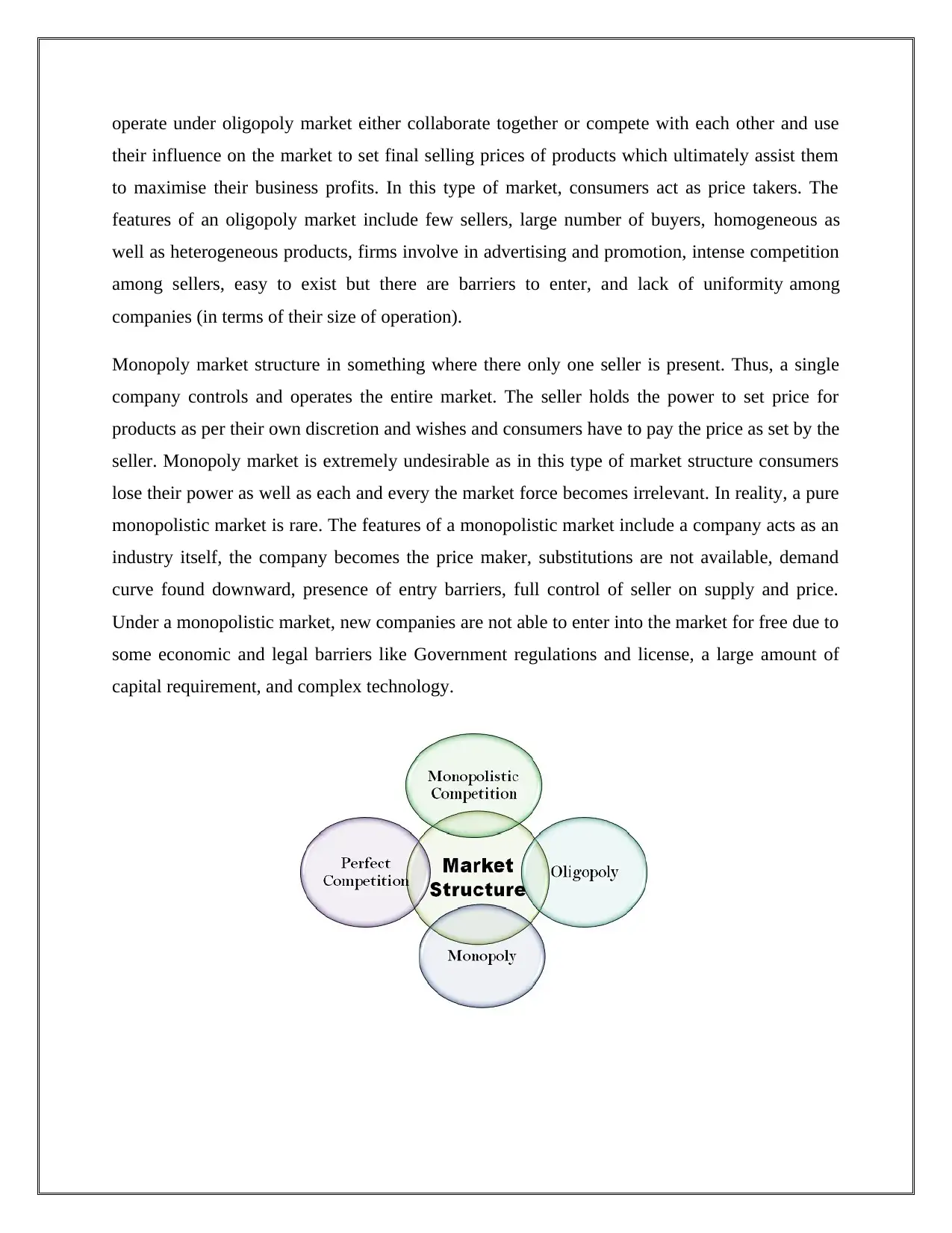
of buyers and sellers, economies of scale and more. The four common market structures found in
any economy are Perfect Competition, Monopolistic Competition, Monoply, and Oligopoly.
In the perfect competition structure of a market, the number of sellers and buyers are large and
all the sellers are small in size and they compete with each other. No big seller is present in a
perfect competition market and that is why all the companies i.e. sellers act as price takers. The
assumptions made while discussing perfect competition market are that the products purchased
and sold in the market are completely identical i.e. homogeneous, every company aims to
maximise their profit. The other assumptions include firms do not need to incur any cost for
entering into the market and they are free to exit anytime without spending a penny, and
customer preference not much entertained, absence of artificial restrictions and other trade-
oriented government restrictions, absence of transportation cost, and buyers and sellers have
perfect knowledge about technology and price of products.
Monopolistic competition is another market structure which is comprised of a huge number of
sellers as well as buyers. The sellers do not sell identical or homogeneous products and services
though the products and services are similar, but all are slightly different from one another.
Monopolistic competition is a real-world scenario of a market. In this type of market, buyers
perform their ability to choose one product or service over another and the sellers are free to
charge a higher price because of enjoying some power over the market. Due to this, to some
extent, sellers act as the price setters in a monopolistic competition market. For instance, the
cereals market refers to a market with monopolistic competition structure as the products sold in
this market are similar but in terms of flavors and taste, they are slightly different from each
other. Another example of monopolistic competition market is toothpaste. The features of
monopolistic competition market include free entry and exit, variation of products, differentiated
products, control over price, and heavy expenditure on marketing and promotion as well as on
some other sales oriented activities.
Oligopoly market is characterised by a small number of sellers those who use to sell
differentiated or homogeneous products. In some other words, an oligopoly market lies between
monopolistic competition and pure monopoly market which is operated by a few sellers who
dominate the marketplace and hold control over products’ price. In an oligopoly market, the
number of buyers or consumers is much higher compared to the number of sellers. The firms
any economy are Perfect Competition, Monopolistic Competition, Monoply, and Oligopoly.
In the perfect competition structure of a market, the number of sellers and buyers are large and
all the sellers are small in size and they compete with each other. No big seller is present in a
perfect competition market and that is why all the companies i.e. sellers act as price takers. The
assumptions made while discussing perfect competition market are that the products purchased
and sold in the market are completely identical i.e. homogeneous, every company aims to
maximise their profit. The other assumptions include firms do not need to incur any cost for
entering into the market and they are free to exit anytime without spending a penny, and
customer preference not much entertained, absence of artificial restrictions and other trade-
oriented government restrictions, absence of transportation cost, and buyers and sellers have
perfect knowledge about technology and price of products.
Monopolistic competition is another market structure which is comprised of a huge number of
sellers as well as buyers. The sellers do not sell identical or homogeneous products and services
though the products and services are similar, but all are slightly different from one another.
Monopolistic competition is a real-world scenario of a market. In this type of market, buyers
perform their ability to choose one product or service over another and the sellers are free to
charge a higher price because of enjoying some power over the market. Due to this, to some
extent, sellers act as the price setters in a monopolistic competition market. For instance, the
cereals market refers to a market with monopolistic competition structure as the products sold in
this market are similar but in terms of flavors and taste, they are slightly different from each
other. Another example of monopolistic competition market is toothpaste. The features of
monopolistic competition market include free entry and exit, variation of products, differentiated
products, control over price, and heavy expenditure on marketing and promotion as well as on
some other sales oriented activities.
Oligopoly market is characterised by a small number of sellers those who use to sell
differentiated or homogeneous products. In some other words, an oligopoly market lies between
monopolistic competition and pure monopoly market which is operated by a few sellers who
dominate the marketplace and hold control over products’ price. In an oligopoly market, the
number of buyers or consumers is much higher compared to the number of sellers. The firms
operate under oligopoly market either collaborate together or compete with each other and use
their influence on the market to set final selling prices of products which ultimately assist them
to maximise their business profits. In this type of market, consumers act as price takers. The
features of an oligopoly market include few sellers, large number of buyers, homogeneous as
well as heterogeneous products, firms involve in advertising and promotion, intense competition
among sellers, easy to exist but there are barriers to enter, and lack of uniformity among
companies (in terms of their size of operation).
Monopoly market structure in something where there only one seller is present. Thus, a single
company controls and operates the entire market. The seller holds the power to set price for
products as per their own discretion and wishes and consumers have to pay the price as set by the
seller. Monopoly market is extremely undesirable as in this type of market structure consumers
lose their power as well as each and every the market force becomes irrelevant. In reality, a pure
monopolistic market is rare. The features of a monopolistic market include a company acts as an
industry itself, the company becomes the price maker, substitutions are not available, demand
curve found downward, presence of entry barriers, full control of seller on supply and price.
Under a monopolistic market, new companies are not able to enter into the market for free due to
some economic and legal barriers like Government regulations and license, a large amount of
capital requirement, and complex technology.
their influence on the market to set final selling prices of products which ultimately assist them
to maximise their business profits. In this type of market, consumers act as price takers. The
features of an oligopoly market include few sellers, large number of buyers, homogeneous as
well as heterogeneous products, firms involve in advertising and promotion, intense competition
among sellers, easy to exist but there are barriers to enter, and lack of uniformity among
companies (in terms of their size of operation).
Monopoly market structure in something where there only one seller is present. Thus, a single
company controls and operates the entire market. The seller holds the power to set price for
products as per their own discretion and wishes and consumers have to pay the price as set by the
seller. Monopoly market is extremely undesirable as in this type of market structure consumers
lose their power as well as each and every the market force becomes irrelevant. In reality, a pure
monopolistic market is rare. The features of a monopolistic market include a company acts as an
industry itself, the company becomes the price maker, substitutions are not available, demand
curve found downward, presence of entry barriers, full control of seller on supply and price.
Under a monopolistic market, new companies are not able to enter into the market for free due to
some economic and legal barriers like Government regulations and license, a large amount of
capital requirement, and complex technology.
⊘ This is a preview!⊘
Do you want full access?
Subscribe today to unlock all pages.
Trusted by 1+ million students worldwide
Significance of Market Structure on Economy
The concept attached to market structure is fundamental to economics as well as in marketing.
Both of these two disciplines are solely concerned with decision making which strategic in
nature. In the analysis of decision-making, market structure plays a vital role due to its impact on
decision-making environment. The characteristics and extent of competition (monopoly,
oligopoly, perfect competition) in a market affect the behavior of the actors. Market structure
influences the pricing of products because it defined as the interconnections of several elements
that bind buyers, sellers, and products together. The elements that interconnect sellers, buyers,
and products together are as follows –
number of sellers or buyers or both
selling/buying strength of the agents (sellers and buyers) and the ability of sellers and
buyers to influence the final price of products
potential collusion among sellers and buyers
level of production
forms and degree of competition in a market
degree of differentiation in relation to product and services sellers use to offer
ease of exit from or entry to the market
Different forms of market structure influence a country's economy in a different way. A market
formed under perfect competition always supports consumers as it reduces the degree of
customer exploitation by companies. This is because in a perfect competition market structure
sellers are not allowed to practice the power of monopoly pricing and for this reason, they do not
influence products' price i.e. they are not able to charge a higher price for the same product than
the normal price from consumers. It is a much more idealised structure of a market than other
market structures as it ensures efficient resource allocation which is highly significant for a
country’s economic development. Such efficiency is resource allocation is achieved because a
company produces exactly the quantity of product which it needs for maximizing its profit that
ultimately establishes equality between marginal cost and price. On the other side, a
The concept attached to market structure is fundamental to economics as well as in marketing.
Both of these two disciplines are solely concerned with decision making which strategic in
nature. In the analysis of decision-making, market structure plays a vital role due to its impact on
decision-making environment. The characteristics and extent of competition (monopoly,
oligopoly, perfect competition) in a market affect the behavior of the actors. Market structure
influences the pricing of products because it defined as the interconnections of several elements
that bind buyers, sellers, and products together. The elements that interconnect sellers, buyers,
and products together are as follows –
number of sellers or buyers or both
selling/buying strength of the agents (sellers and buyers) and the ability of sellers and
buyers to influence the final price of products
potential collusion among sellers and buyers
level of production
forms and degree of competition in a market
degree of differentiation in relation to product and services sellers use to offer
ease of exit from or entry to the market
Different forms of market structure influence a country's economy in a different way. A market
formed under perfect competition always supports consumers as it reduces the degree of
customer exploitation by companies. This is because in a perfect competition market structure
sellers are not allowed to practice the power of monopoly pricing and for this reason, they do not
influence products' price i.e. they are not able to charge a higher price for the same product than
the normal price from consumers. It is a much more idealised structure of a market than other
market structures as it ensures efficient resource allocation which is highly significant for a
country’s economic development. Such efficiency is resource allocation is achieved because a
company produces exactly the quantity of product which it needs for maximizing its profit that
ultimately establishes equality between marginal cost and price. On the other side, a
Paraphrase This Document
Need a fresh take? Get an instant paraphrase of this document with our AI Paraphraser
monopolistic market structure is not acceptable, specifically by consumers. Usually, this
particular market structure is discouraged in the market economies as the negative impacts on the
economy are well-recognised.
Monopolies have the power to charge any price for their products and services as they want
because they do not have to face any competition in the market. In this situation, customers have
no other choice to pay the prices charged by the monopoly market suppliers which is dangerous
if the suppliers use to supplies necessary products or services. In a monopoly market, customers
are bound to pay more price than the true costs of the products or services and this makes
customers have less amount of disposable income. Furthermore, in a monopoly market, supply is
entirely controlled by the suppliers due to which they got the power to inflate prices by reducing
or restricting supply and the suppliers often deprive consumers by providing them low-quality
products at a high price to maximise their business profit. Conversely, a natural monopolistic
market like water supply system is good as it prevents infrastructure related duplication and thus
reduces potential costs of such supply to consumers.
Again, natural monopolies which are operated by local governments and non-profit organisations
hold the power to control prices and keep it low enough to provide required services to the
public. On the other hand, when a monopoly market is fully controlled by privately owned for-
profit companies, prices of products stand significantly higher compared to the price prevailing
in a perfectly competitive market. It results in higher prices of products and fewer consumers
become able to afford the products or services which often become detrimental in the
impoverished or a rural setting. Another influential market structure is oligopoly which creates
some negative effects on a country’s economy. In some of the oligopoly markets, the producers
also aim to share the markets which lead to price inflation. Oligopoly market uses to put
restrictions on the total output which implies that this market results in high prices and small
output compared perfect competition market and other markets.
While entering into an oligopoly market, new companies face a number of restriction or entry
barriers which force the companies to demand more prices for their products than the true
average costs of such products. Therefore, customers are bound to pay extra or more prices for a
product in an oligopoly market. Oligopoly companies fail to achieve and build optimum output
and optimum scales of economies respectively which ultimately reduce market efficiency. Under
particular market structure is discouraged in the market economies as the negative impacts on the
economy are well-recognised.
Monopolies have the power to charge any price for their products and services as they want
because they do not have to face any competition in the market. In this situation, customers have
no other choice to pay the prices charged by the monopoly market suppliers which is dangerous
if the suppliers use to supplies necessary products or services. In a monopoly market, customers
are bound to pay more price than the true costs of the products or services and this makes
customers have less amount of disposable income. Furthermore, in a monopoly market, supply is
entirely controlled by the suppliers due to which they got the power to inflate prices by reducing
or restricting supply and the suppliers often deprive consumers by providing them low-quality
products at a high price to maximise their business profit. Conversely, a natural monopolistic
market like water supply system is good as it prevents infrastructure related duplication and thus
reduces potential costs of such supply to consumers.
Again, natural monopolies which are operated by local governments and non-profit organisations
hold the power to control prices and keep it low enough to provide required services to the
public. On the other hand, when a monopoly market is fully controlled by privately owned for-
profit companies, prices of products stand significantly higher compared to the price prevailing
in a perfectly competitive market. It results in higher prices of products and fewer consumers
become able to afford the products or services which often become detrimental in the
impoverished or a rural setting. Another influential market structure is oligopoly which creates
some negative effects on a country’s economy. In some of the oligopoly markets, the producers
also aim to share the markets which lead to price inflation. Oligopoly market uses to put
restrictions on the total output which implies that this market results in high prices and small
output compared perfect competition market and other markets.
While entering into an oligopoly market, new companies face a number of restriction or entry
barriers which force the companies to demand more prices for their products than the true
average costs of such products. Therefore, customers are bound to pay extra or more prices for a
product in an oligopoly market. Oligopoly companies fail to achieve and build optimum output
and optimum scales of economies respectively which ultimately reduce market efficiency. Under
an oligopoly market, companies spend a lot as promotional costs to capture market share from
rivals which result in wastage of resources, high selling price and dissatisfaction of customers.
Overall perfect competition market is the best market structure as it creates a positive impact on
a nation's economy and accelerates its growth and development over-times.
rivals which result in wastage of resources, high selling price and dissatisfaction of customers.
Overall perfect competition market is the best market structure as it creates a positive impact on
a nation's economy and accelerates its growth and development over-times.
⊘ This is a preview!⊘
Do you want full access?
Subscribe today to unlock all pages.
Trusted by 1+ million students worldwide

1 out of 9


Related Documents


Your All-in-One AI-Powered Toolkit for Academic Success.
+13062052269
info@desklib.com
Available 24*7 on WhatsApp / Email
![[object Object]](/_next/static/media/star-bottom.7253800d.svg)
Unlock your academic potential
Copyright © 2020–2026 A2Z Services. All Rights Reserved. Developed and managed by ZUCOL.