Pearson BTEC HND Business Management Unit 2 Marketing Report
VerifiedAdded on 2021/05/05
|12
|3323
|39
Report
AI Summary
This report, prepared for a Pearson BTEC Higher National Diploma in Business Management, Unit 2 (Marketing Essentials), provides a comprehensive overview of marketing concepts, strategies, and their application in the business world. The first part of the report focuses on defining marketing processes, the role and responsibilities of a marketing manager, and how marketing interrelates with other functional departments within an organization. The second part delves into a comparative analysis of how Colgate-Palmolive and Simple Skincare apply the 7Ps marketing mix to achieve their business objectives within the same competitive market. The report examines the marketing mix elements for both organizations, including product, price, place, promotion, people, process, and physical evidence, along with a marketing plan, including marketing goals, objectives, and a tactical action plan. The report concludes with measures for monitoring and evaluating progress. The report provides valuable insights into marketing practices, strategy development, and the application of marketing principles in real-world business scenarios.
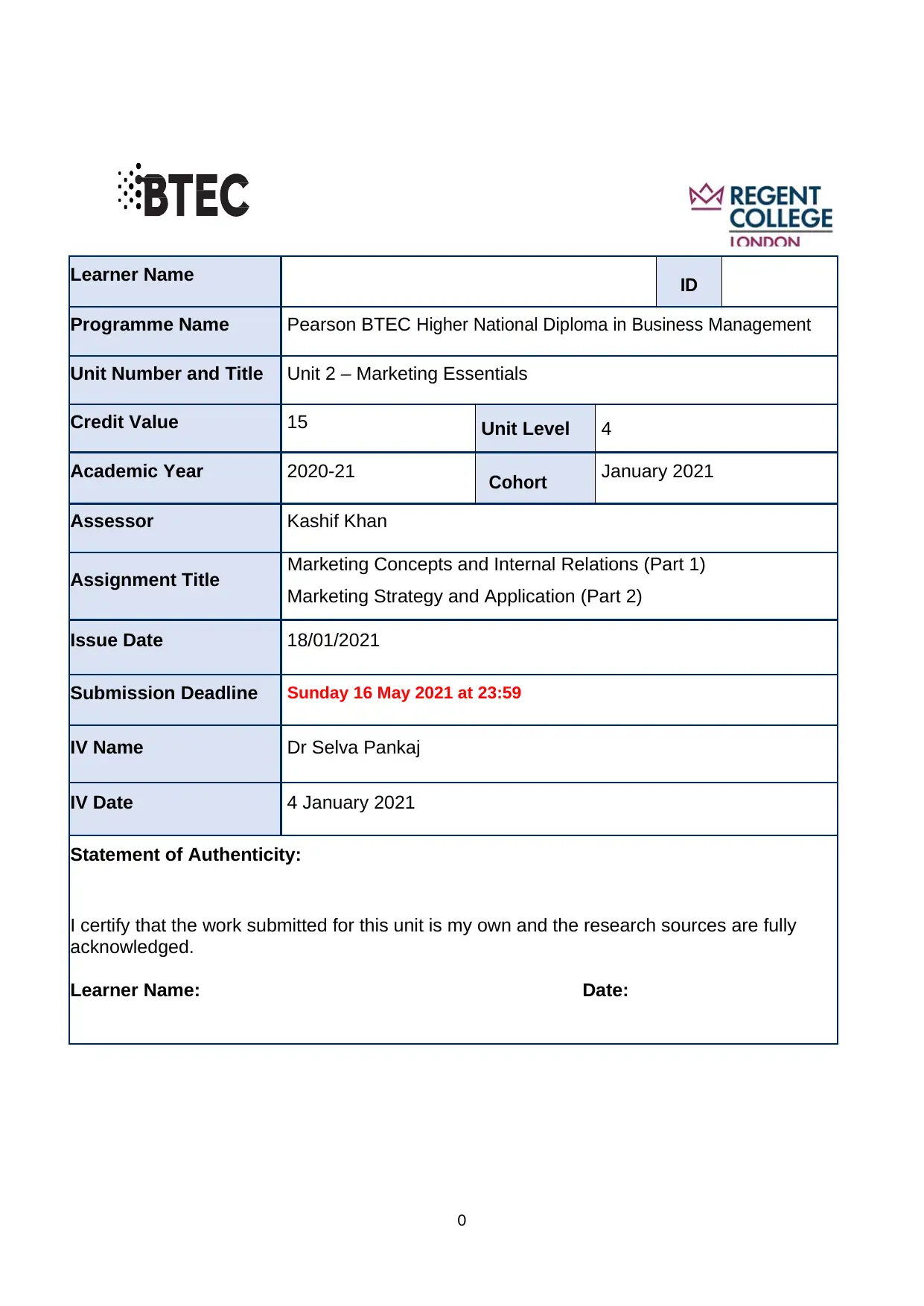
Learner Name ID
Programme Name Pearson BTEC Higher National Diploma in Business Management
Unit Number and Title Unit 2 – Marketing Essentials
Credit Value 15 Unit Level 4
Academic Year 2020-21 Cohort January 2021
Assessor Kashif Khan
Assignment Title Marketing Concepts and Internal Relations (Part 1)
Marketing Strategy and Application (Part 2)
Issue Date 18/01/2021
Submission Deadline Sunday 16 May 2021 at 23:59
IV Name Dr Selva Pankaj
IV Date 4 January 2021
Statement of Authenticity:
I certify that the work submitted for this unit is my own and the research sources are fully
acknowledged.
Learner Name: Date:
0
Programme Name Pearson BTEC Higher National Diploma in Business Management
Unit Number and Title Unit 2 – Marketing Essentials
Credit Value 15 Unit Level 4
Academic Year 2020-21 Cohort January 2021
Assessor Kashif Khan
Assignment Title Marketing Concepts and Internal Relations (Part 1)
Marketing Strategy and Application (Part 2)
Issue Date 18/01/2021
Submission Deadline Sunday 16 May 2021 at 23:59
IV Name Dr Selva Pankaj
IV Date 4 January 2021
Statement of Authenticity:
I certify that the work submitted for this unit is my own and the research sources are fully
acknowledged.
Learner Name: Date:
0

Paraphrase This Document
Need a fresh take? Get an instant paraphrase of this document with our AI Paraphraser
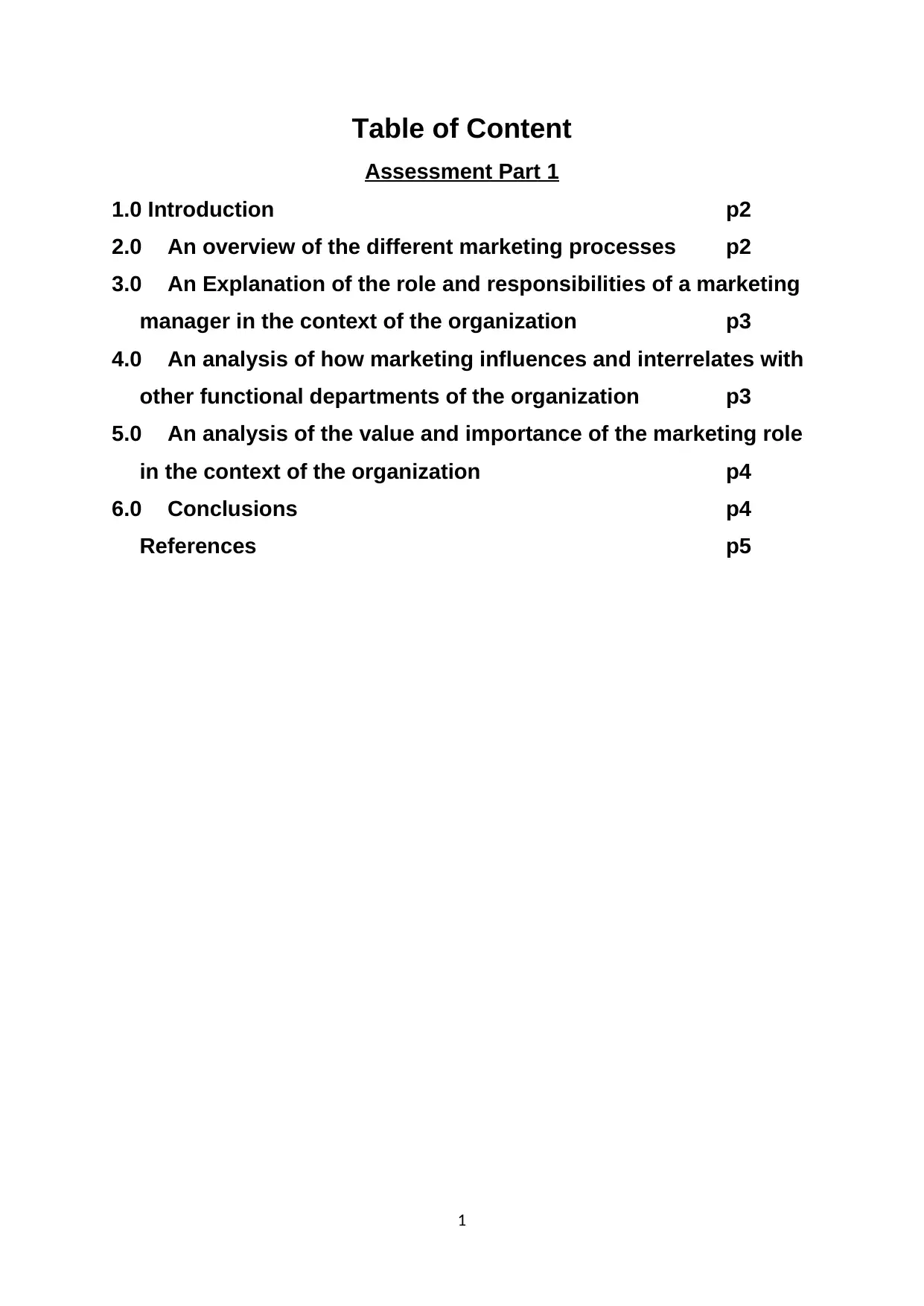
Table of Content
Assessment Part 1
1.0 Introduction p2
2.0 An overview of the different marketing processes p2
3.0 An Explanation of the role and responsibilities of a marketing
manager in the context of the organization p3
4.0 An analysis of how marketing influences and interrelates with
other functional departments of the organization p3
5.0 An analysis of the value and importance of the marketing role
in the context of the organization p4
6.0 Conclusions p4
References p5
1
Assessment Part 1
1.0 Introduction p2
2.0 An overview of the different marketing processes p2
3.0 An Explanation of the role and responsibilities of a marketing
manager in the context of the organization p3
4.0 An analysis of how marketing influences and interrelates with
other functional departments of the organization p3
5.0 An analysis of the value and importance of the marketing role
in the context of the organization p4
6.0 Conclusions p4
References p5
1
1. Introduction
Marketing analysis is the position that connects the marketer to the client, customer,
and general public through data—data that is used to identify and define marketing
opportunities and problems, develop, refine, and analyse marketing activity, monitor
marketing performance, and improve understanding of marketing as a process.
(Armstrong, 2018)
Previously, an organization's primary concern was the manufacture of merchandise.
It used to be focused on bulk manufacturing and paying little or little heed to product
quality or consumer demand. After a period of time, the organization's focus changed
from commodity development to product selling. After the manufacturing and
distribution period, the philosophy of marketing steadily originated in the 1970s.
Organizations took a long time to understand that a buyer is the secret to long-term
profitability. The marketing concept goes through many phases of growth:
1.Sales evolution: The sales era began in the 1920s and lasted until the mid-to-late
1950s. The Great Depression of 1923 ushered in this era. The Great Depression
demonstrated that producing goods was not enough; organizations needed to sell
their products in order to make a profit. As a result, designing marketing and delivery
methods to market goods became essential. To boost revenue, the companies
began selling their goods. Many businesses developed specialist market analysis
divisions to gather and interpret market data. (Ervin, 1997)
2.Product evolution: The manufacturing age started in the 17th century with the
Industrial Revolution and lasted until the early 1900s. In this period, Say's rule –
supply generates its own market – was applicable. The world's appetite for goods
was higher than its stock, rendering it a seller's market. During the manufacturing
age, an organization's primary goal was to produce goods more quickly and at a
lower cost. Customers in this period were only concerned with product availability
and paid little attention to product specifications or consistency.
3.Marketing evolution:
The sales age was mostly concerned with marketing products, ignoring the wishes
and demands of customers. In the year 1970, the marketing era began. During the
marketing age, businesses understood the worth of consumers and began
developing goods to suit their needs. Customer-centred activities have taken
precedence over production and sales as a result of the marketing era. Customer
polls, for example, have been designed to collect and analyse data in order to better
understand the customer's needs, wishes, and desires. (Giles,1994)
An overview of the different marketing processes
2
Marketing analysis is the position that connects the marketer to the client, customer,
and general public through data—data that is used to identify and define marketing
opportunities and problems, develop, refine, and analyse marketing activity, monitor
marketing performance, and improve understanding of marketing as a process.
(Armstrong, 2018)
Previously, an organization's primary concern was the manufacture of merchandise.
It used to be focused on bulk manufacturing and paying little or little heed to product
quality or consumer demand. After a period of time, the organization's focus changed
from commodity development to product selling. After the manufacturing and
distribution period, the philosophy of marketing steadily originated in the 1970s.
Organizations took a long time to understand that a buyer is the secret to long-term
profitability. The marketing concept goes through many phases of growth:
1.Sales evolution: The sales era began in the 1920s and lasted until the mid-to-late
1950s. The Great Depression of 1923 ushered in this era. The Great Depression
demonstrated that producing goods was not enough; organizations needed to sell
their products in order to make a profit. As a result, designing marketing and delivery
methods to market goods became essential. To boost revenue, the companies
began selling their goods. Many businesses developed specialist market analysis
divisions to gather and interpret market data. (Ervin, 1997)
2.Product evolution: The manufacturing age started in the 17th century with the
Industrial Revolution and lasted until the early 1900s. In this period, Say's rule –
supply generates its own market – was applicable. The world's appetite for goods
was higher than its stock, rendering it a seller's market. During the manufacturing
age, an organization's primary goal was to produce goods more quickly and at a
lower cost. Customers in this period were only concerned with product availability
and paid little attention to product specifications or consistency.
3.Marketing evolution:
The sales age was mostly concerned with marketing products, ignoring the wishes
and demands of customers. In the year 1970, the marketing era began. During the
marketing age, businesses understood the worth of consumers and began
developing goods to suit their needs. Customer-centred activities have taken
precedence over production and sales as a result of the marketing era. Customer
polls, for example, have been designed to collect and analyse data in order to better
understand the customer's needs, wishes, and desires. (Giles,1994)
An overview of the different marketing processes
2
⊘ This is a preview!⊘
Do you want full access?
Subscribe today to unlock all pages.

Trusted by 1+ million students worldwide
The marketing method entails generating value for customers in order to meet their
needs. It is a never-ending series of actions and reactions between customers and
businesses in an attempt to generate interest and meet customer needs.
The scenario is analysed to identify opportunities, a value proposition strategy is
created, tactical decisions are taken, the plan is adopted, and results are monitored
throughout the marketing process. The following phases are included in the
marketing process:
1.The marketing strategy plan: following the identification of campaign tactics, a plan
of action is developed to investigate such alternatives. Following an inquiry, the best
available solution is chosen, and a plan or method for that choice is created.
2.The situation analysis of the marketing plan: the analysis of the company's current
position serves as a basis for determining how to solve unmet customer needs.
Situational and environmental analysis is performed to identify targeting options,
understand the organization's own capabilities, and understand the world in which
the business operates.
3.The management and control plan: The marketing strategy is carried out, and the
results of marketing campaigns are tracked so that the marketing mix can be
adjusted in response to market shifts.
An Explanation of the role and responsibilities of a
marketing manager in the context of the organization
Marketing managers are in charge of a range of activities, including predicting and
budgeting marketing plans and submitting them for approval, coordinating with
promotional agencies, holding meetings, preparing sales and endorsement
contracts, and reviewing advertising material such as newspaper ads, TV
promotions, and online advertisements.
The roles of a marketing manager vary depending on the company and industry.
Many brand managers, on the other hand, have general responsibilities:
-generating promotional materials to boost sales
-identifying new marketing possibilities
-establishing contacts with the media
-assessing the results of marketing campaigns
-devising innovative strategies for marketing new goods
An analysis of how marketing influences and interrelates
with other functional departments of the organization.
3
needs. It is a never-ending series of actions and reactions between customers and
businesses in an attempt to generate interest and meet customer needs.
The scenario is analysed to identify opportunities, a value proposition strategy is
created, tactical decisions are taken, the plan is adopted, and results are monitored
throughout the marketing process. The following phases are included in the
marketing process:
1.The marketing strategy plan: following the identification of campaign tactics, a plan
of action is developed to investigate such alternatives. Following an inquiry, the best
available solution is chosen, and a plan or method for that choice is created.
2.The situation analysis of the marketing plan: the analysis of the company's current
position serves as a basis for determining how to solve unmet customer needs.
Situational and environmental analysis is performed to identify targeting options,
understand the organization's own capabilities, and understand the world in which
the business operates.
3.The management and control plan: The marketing strategy is carried out, and the
results of marketing campaigns are tracked so that the marketing mix can be
adjusted in response to market shifts.
An Explanation of the role and responsibilities of a
marketing manager in the context of the organization
Marketing managers are in charge of a range of activities, including predicting and
budgeting marketing plans and submitting them for approval, coordinating with
promotional agencies, holding meetings, preparing sales and endorsement
contracts, and reviewing advertising material such as newspaper ads, TV
promotions, and online advertisements.
The roles of a marketing manager vary depending on the company and industry.
Many brand managers, on the other hand, have general responsibilities:
-generating promotional materials to boost sales
-identifying new marketing possibilities
-establishing contacts with the media
-assessing the results of marketing campaigns
-devising innovative strategies for marketing new goods
An analysis of how marketing influences and interrelates
with other functional departments of the organization.
3
Paraphrase This Document
Need a fresh take? Get an instant paraphrase of this document with our AI Paraphraser
The marketing function of a business organization is defined as the functions that
help it identify and source potentially successful products for the market, as well as
assist in their promotion. In business organizations, product planning, marketing
research, the development process, sales, promotion, finance, customer care, and
other processes are common.
Marketing roles oversee the company's development and encompass a variety of
tasks within the organization. Marketing roles include strategy management,
marketing analytics, sales support system, product creation, delivery systems, and
human resource departments. (Shital P., n. d.)
The following describes the interrelationship between marketing functions and other
organizational functions: Since marketing functions are part of a corporate
enterprise, they are connected to other departments and functional units. This can
be explained by the fact that marketing functions need assistance from the
company's other operating units in order to function properly. If an organization has
to prepare and implement a marketing campaign, it will require the assistance of the
finance, human resources, sales, and production departments.
An analysis of the value and importance of the marketing
role in the context of the organization
A company's success is dependent on effective marketing strategies. Marketing
determines the nature of a company's product's production and distribution networks.
Marketing is concerned with the sales through public relations, advertising, and
promotions. The most obvious advantage of selling to a corporation is that it helps
the company's credibility grow. Marketers have learned that establishing a brand
identity from which people will remember their business helps them to subdue the
entire industry. (Shital P., n. d.)
This strategy, also known as brand recall, assists customers in quickly separating
the organization's products from those of rivals. The purpose of this strategy is to
improve brand loyalty by creating a brand name that is easily recognizable through
media ads that include logos, pictures, or captions. (Armstrong & Kotler, 2011)
Conclusions
All things considered, marketing has developed from a ‘inward looking' discipline era
that only concentrated on the company created to a ‘outward looking' discipline era
that brings a deeper awareness of the market and customer into the organization.
Shital P. (n. d.)
Even though market orientation has become common knowledge in the organization
today, certain segments of the organization, especially small and medium
businesses, are still stuck in the development or selling orientation phase due to a
lack of understanding of marketing. However, marketing will begin to grow, and as
Kotler and Armstrong (2008, 2009) note, the marketing process will become the
most critical action before a product hits the market, regardless of the scale of the
business.
4
help it identify and source potentially successful products for the market, as well as
assist in their promotion. In business organizations, product planning, marketing
research, the development process, sales, promotion, finance, customer care, and
other processes are common.
Marketing roles oversee the company's development and encompass a variety of
tasks within the organization. Marketing roles include strategy management,
marketing analytics, sales support system, product creation, delivery systems, and
human resource departments. (Shital P., n. d.)
The following describes the interrelationship between marketing functions and other
organizational functions: Since marketing functions are part of a corporate
enterprise, they are connected to other departments and functional units. This can
be explained by the fact that marketing functions need assistance from the
company's other operating units in order to function properly. If an organization has
to prepare and implement a marketing campaign, it will require the assistance of the
finance, human resources, sales, and production departments.
An analysis of the value and importance of the marketing
role in the context of the organization
A company's success is dependent on effective marketing strategies. Marketing
determines the nature of a company's product's production and distribution networks.
Marketing is concerned with the sales through public relations, advertising, and
promotions. The most obvious advantage of selling to a corporation is that it helps
the company's credibility grow. Marketers have learned that establishing a brand
identity from which people will remember their business helps them to subdue the
entire industry. (Shital P., n. d.)
This strategy, also known as brand recall, assists customers in quickly separating
the organization's products from those of rivals. The purpose of this strategy is to
improve brand loyalty by creating a brand name that is easily recognizable through
media ads that include logos, pictures, or captions. (Armstrong & Kotler, 2011)
Conclusions
All things considered, marketing has developed from a ‘inward looking' discipline era
that only concentrated on the company created to a ‘outward looking' discipline era
that brings a deeper awareness of the market and customer into the organization.
Shital P. (n. d.)
Even though market orientation has become common knowledge in the organization
today, certain segments of the organization, especially small and medium
businesses, are still stuck in the development or selling orientation phase due to a
lack of understanding of marketing. However, marketing will begin to grow, and as
Kotler and Armstrong (2008, 2009) note, the marketing process will become the
most critical action before a product hits the market, regardless of the scale of the
business.
4
References
Kumar, V., Leone, Robert P., Aaker, David A. and Day, George S. (2009) Marketing
research
Armstrong, G. (2018). Principles of marketing. 17th ed. Hoboken: Pearson Higher
Education.
Chand S. (n.d) Role of Marketing (online)
https://www.yourarticlelibrary.com/marketing/role-of-marketing-top-10-important-role-
of-marketing-in-making-a-product-successful/32289 [Accessed 17 Mar. 2021].
Shital P. (n. d.)Marketing Strategy: Meaning, Types, Process, Aspects and
Conclusion (online) https://www.businessmanagementideas.com/marketing-
management/marketing-strategy-marketing-management/marketing-strategy-
meaning-types-process-aspects-and-conclusion/11259 [Accessed 17 Mar.2021]
Lamb, C.W., Hair, J.F. and McDaniel, C.D. (2012). Essentials of marketing.
5
Kumar, V., Leone, Robert P., Aaker, David A. and Day, George S. (2009) Marketing
research
Armstrong, G. (2018). Principles of marketing. 17th ed. Hoboken: Pearson Higher
Education.
Chand S. (n.d) Role of Marketing (online)
https://www.yourarticlelibrary.com/marketing/role-of-marketing-top-10-important-role-
of-marketing-in-making-a-product-successful/32289 [Accessed 17 Mar. 2021].
Shital P. (n. d.)Marketing Strategy: Meaning, Types, Process, Aspects and
Conclusion (online) https://www.businessmanagementideas.com/marketing-
management/marketing-strategy-marketing-management/marketing-strategy-
meaning-types-process-aspects-and-conclusion/11259 [Accessed 17 Mar.2021]
Lamb, C.W., Hair, J.F. and McDaniel, C.D. (2012). Essentials of marketing.
5
⊘ This is a preview!⊘
Do you want full access?
Subscribe today to unlock all pages.
Trusted by 1+ million students worldwide
Table of Content
Assessment Part 2
Section A: Briefing Paper p-p
Comparing how two different organisations within the same
competitive market apply the various elements of the 7Ps
marketing mix p
How the marketing mix is applied to achieve business objectives,
relating to the two chosen organisations p
Section B: Marketing Plan p8
Marketing goals and objectives based on marketing mix
analysis/situation analysis p8
7Ps marketing plan p9
Tactical action plan p10
Measures for monitoring and evaluating progress p10
References p11
Section A: Briefing Paper
6
Assessment Part 2
Section A: Briefing Paper p-p
Comparing how two different organisations within the same
competitive market apply the various elements of the 7Ps
marketing mix p
How the marketing mix is applied to achieve business objectives,
relating to the two chosen organisations p
Section B: Marketing Plan p8
Marketing goals and objectives based on marketing mix
analysis/situation analysis p8
7Ps marketing plan p9
Tactical action plan p10
Measures for monitoring and evaluating progress p10
References p11
Section A: Briefing Paper
6
Paraphrase This Document
Need a fresh take? Get an instant paraphrase of this document with our AI Paraphraser
Comparing how two different organisations within the
same competitive market apply the various elements of the
7Ps marketing mix
The organisations that I will use to show a comparison in this competitive
environment are Colgate-Palmolive and Simple Skincare. Simple Skincare was firstly
centred around the skincare and personal care of people that suffered of very
sensitive skin, then it developed products for all types of skin. It was founded in 1960
and for those times it was a big innovation to design a product perfume-free and
non-irritant in order to not harm the customer’s skin (Guardian, 2012) Colgate-
Palmolive is a multinational firm specializing in consumer products centred around
health care and personal care. It is fairly popular for the mouthwash and toothpaste
products as it was launched through mouth care products first. It was founded in
1806, a major global brand with. It has firstly become popular with the slogan "It
Cleans Your Breath While It Cleans Your Teeth", in 1950. (Cross M. ,2002) This
slogan is a marketing technique that was truly beneficial for Colgate and its
campaign as people used this brand afterwards only for toothpaste, and then after
years and years they expanded the products that they are mainly used for. The
company has a total. Colgate-Palmolive is extended to many different products that
fall under the same name: Colgate, Palmolive, Ajax, while Simple Skincare only sells
products with the name of Simple. (Colgate, 2021)
How the marketing mix is applied to achieve business
objectives, relating to the two chosen organisations
As Colgate is operating globally in over 200 countries, therefore the products are
placed all around the world increasing the customer base, demographics and
increasing the recognition in the brand. While the Simple Skincare is only based in
UK for UK residents.
The price is somehow similar for both, however Simple offers their products at a
much cheaper price. For example, a facial washing gel that is £3,25 is confirmed to
be extremely cheap and qualitative and below the average market value, as
Guardian(2012) states. They use the price penetration strategy effectively. Colgate,
on the other hand, has products that are in 3 ranges: cheap, affordable, and more
7
same competitive market apply the various elements of the
7Ps marketing mix
The organisations that I will use to show a comparison in this competitive
environment are Colgate-Palmolive and Simple Skincare. Simple Skincare was firstly
centred around the skincare and personal care of people that suffered of very
sensitive skin, then it developed products for all types of skin. It was founded in 1960
and for those times it was a big innovation to design a product perfume-free and
non-irritant in order to not harm the customer’s skin (Guardian, 2012) Colgate-
Palmolive is a multinational firm specializing in consumer products centred around
health care and personal care. It is fairly popular for the mouthwash and toothpaste
products as it was launched through mouth care products first. It was founded in
1806, a major global brand with. It has firstly become popular with the slogan "It
Cleans Your Breath While It Cleans Your Teeth", in 1950. (Cross M. ,2002) This
slogan is a marketing technique that was truly beneficial for Colgate and its
campaign as people used this brand afterwards only for toothpaste, and then after
years and years they expanded the products that they are mainly used for. The
company has a total. Colgate-Palmolive is extended to many different products that
fall under the same name: Colgate, Palmolive, Ajax, while Simple Skincare only sells
products with the name of Simple. (Colgate, 2021)
How the marketing mix is applied to achieve business
objectives, relating to the two chosen organisations
As Colgate is operating globally in over 200 countries, therefore the products are
placed all around the world increasing the customer base, demographics and
increasing the recognition in the brand. While the Simple Skincare is only based in
UK for UK residents.
The price is somehow similar for both, however Simple offers their products at a
much cheaper price. For example, a facial washing gel that is £3,25 is confirmed to
be extremely cheap and qualitative and below the average market value, as
Guardian(2012) states. They use the price penetration strategy effectively. Colgate,
on the other hand, has products that are in 3 ranges: cheap, affordable, and more
7
expensive, and the price reflects on the quality and the different benefits that the
product can offer.
In terms of employee culture, they are providing many new employee-oriented
programs both for senior level and entry level people, needing candidates for roles
varying from production-line workers, marketers, managers, chemical engineers,
chemists, and managers. (Colgate, 2021) As both companies need these employees
in order to reach their goals and objectives, they rely on effective talent management
techniques and good motivational strategies to attract and retain the talented
employees.
In terms of advertising both of the companies have done a good job when creating
an image for their product. One factor that provides a large share of the other two
competitors in Colgate's campaign is to look at how smart the brand is, in this
business study I will illustrate the main position and responsibilities and discuss the
positions and marketing responsibilities in the light of the business world. Simple
also had a good advertising campaign called Gilding the Lily, which was launched on
a national UK channel, which showed a flower being sprayed by their products,
inspiring beauty, and safety to the customers. (Armstrong, G.,2018) (Guardian, 2012)
Section B: Marketing Plan
Marketing goals and objectives based on marketing mix
analysis/situation analysis
The goals and objectives of the company are to increase the quality of the formula
for their product, diversify the target customer in terms of gender, age, profession,
etc. and increase the customer satisfaction in their brand. Moreover, the secondary
goal is to analyse health trends and make a product that is necessary to all the
customers in the future or in the present for the long term. By analysis of the health
trends, they can make predictions on the product that they are going to use. The
marketing team has to be prepared and create different marketing techniques on the
everchanging human lifestyles, for example purchasing an electric toothbrush or
whitening mouthwash, which were not trends for the target customer in the past,
however there are now with the present technological advancements and the overall
decrease in oral health due to poor eating and cleaning habits.
7Ps marketing strategy
8
product can offer.
In terms of employee culture, they are providing many new employee-oriented
programs both for senior level and entry level people, needing candidates for roles
varying from production-line workers, marketers, managers, chemical engineers,
chemists, and managers. (Colgate, 2021) As both companies need these employees
in order to reach their goals and objectives, they rely on effective talent management
techniques and good motivational strategies to attract and retain the talented
employees.
In terms of advertising both of the companies have done a good job when creating
an image for their product. One factor that provides a large share of the other two
competitors in Colgate's campaign is to look at how smart the brand is, in this
business study I will illustrate the main position and responsibilities and discuss the
positions and marketing responsibilities in the light of the business world. Simple
also had a good advertising campaign called Gilding the Lily, which was launched on
a national UK channel, which showed a flower being sprayed by their products,
inspiring beauty, and safety to the customers. (Armstrong, G.,2018) (Guardian, 2012)
Section B: Marketing Plan
Marketing goals and objectives based on marketing mix
analysis/situation analysis
The goals and objectives of the company are to increase the quality of the formula
for their product, diversify the target customer in terms of gender, age, profession,
etc. and increase the customer satisfaction in their brand. Moreover, the secondary
goal is to analyse health trends and make a product that is necessary to all the
customers in the future or in the present for the long term. By analysis of the health
trends, they can make predictions on the product that they are going to use. The
marketing team has to be prepared and create different marketing techniques on the
everchanging human lifestyles, for example purchasing an electric toothbrush or
whitening mouthwash, which were not trends for the target customer in the past,
however there are now with the present technological advancements and the overall
decrease in oral health due to poor eating and cleaning habits.
7Ps marketing strategy
8
⊘ This is a preview!⊘
Do you want full access?
Subscribe today to unlock all pages.
Trusted by 1+ million students worldwide
In terms of the 7P marketing strategy, I can say that Colgate excels at it.
Consistency is the key feature in their product’s quality, but besides this there are
many other key links when regarding the product of Colgate as the size, the design,
the shape, the material it is made from, the style, formula or content of it, colour, the
quality of the packaging, the ethical factors around the quality of the product and how
visible is the trademark. (Armstrong, G.,2018).
The promotion of their product was always realised through different approaches of
the customers, for example through slogans stated above, TV commercials,
recommendations from doctors, health facts and presentation of the overall product.
(Lamb, 2012)
As for price, how to value the company's best value, through which many marketing
techniques can be used, as the price penetration strategy. A good or service is
priced in several different ways such as expense, product value or competition.
In terms of the place of the product, it was initially placed in USA, however it has
expanded rapidly to Europe and Asia, now having over 200 countries in which it
operates. The usage of the product is essential to the sales and the impact made.
(Lamb, 2012)
One of the most essential parts is that the people, the heart of any organisation,
have to be pleased with the product and they have to be listened to by the customer
service department for any enquiries, recommendations, and complaints. These can
be later on used to improve the efficiency of the product.
The main objective of the organization is to have the process of the product as
efficient and ethical as possible. For example, Colgate is manufacturing their
packaging to be as eco-friendly as possible. This can increase the customer
satisfaction and increase the sales, as the customer would feel as it would have a
say in the organisation’s big decisions.
And lastly, the instore customer experience has to be perfect, as the customer’s
mind will assimilate and process this experience linked to the product bought. This
can increase the sales volumes as the customer would choose to shop another time.
9
Consistency is the key feature in their product’s quality, but besides this there are
many other key links when regarding the product of Colgate as the size, the design,
the shape, the material it is made from, the style, formula or content of it, colour, the
quality of the packaging, the ethical factors around the quality of the product and how
visible is the trademark. (Armstrong, G.,2018).
The promotion of their product was always realised through different approaches of
the customers, for example through slogans stated above, TV commercials,
recommendations from doctors, health facts and presentation of the overall product.
(Lamb, 2012)
As for price, how to value the company's best value, through which many marketing
techniques can be used, as the price penetration strategy. A good or service is
priced in several different ways such as expense, product value or competition.
In terms of the place of the product, it was initially placed in USA, however it has
expanded rapidly to Europe and Asia, now having over 200 countries in which it
operates. The usage of the product is essential to the sales and the impact made.
(Lamb, 2012)
One of the most essential parts is that the people, the heart of any organisation,
have to be pleased with the product and they have to be listened to by the customer
service department for any enquiries, recommendations, and complaints. These can
be later on used to improve the efficiency of the product.
The main objective of the organization is to have the process of the product as
efficient and ethical as possible. For example, Colgate is manufacturing their
packaging to be as eco-friendly as possible. This can increase the customer
satisfaction and increase the sales, as the customer would feel as it would have a
say in the organisation’s big decisions.
And lastly, the instore customer experience has to be perfect, as the customer’s
mind will assimilate and process this experience linked to the product bought. This
can increase the sales volumes as the customer would choose to shop another time.
9
Paraphrase This Document
Need a fresh take? Get an instant paraphrase of this document with our AI Paraphraser
Tactical action plan
The tactical plan should be centred around increasing the sales volume by
distributing their products worldwide, expanding to many other countries. They could
also market their merchandise on social media with different celebrities that can
showcase their good oral health. One more thing that could take place as a
marketing technique, is to improve their product’s appearance or formula in order to
make it more appealing for the customer and more effective in use. (Lamb, 2012)The
steps for an effective tactical action plan are to analyse the market and the potential
buyers, and the marketing process that influences the company. This can be done
using a spreadsheet, a Gantt Chart, a daily briefing plan.
Measures for monitoring and evaluating progress
You can measure and evaluate the progress by the sales volume of the phone sales;
however, the in-shop ones are more popular nowadays. Moreover, because of the
recent pandemic, another type of sales number should be reviewed from the online
sales. Colgate-Palmolive focuses on choosing and testing agreements that
concentrate in on the monetary feasibility of the inventory network, allowing cycle
sharing and ensuring costs align with simple business needs and business
management strategies. Another way to measure the effectiveness of these
management strategies is through surveys of the target customer and primary and
secondary staff in order to find out the employee and customer satisfaction. Progress
will be then decided by the marketing and general managers and it will be discussed
later on if there is any space for improvements that will push the product or the
company forward. (Armstrong, G.,2018)
References
10
The tactical plan should be centred around increasing the sales volume by
distributing their products worldwide, expanding to many other countries. They could
also market their merchandise on social media with different celebrities that can
showcase their good oral health. One more thing that could take place as a
marketing technique, is to improve their product’s appearance or formula in order to
make it more appealing for the customer and more effective in use. (Lamb, 2012)The
steps for an effective tactical action plan are to analyse the market and the potential
buyers, and the marketing process that influences the company. This can be done
using a spreadsheet, a Gantt Chart, a daily briefing plan.
Measures for monitoring and evaluating progress
You can measure and evaluate the progress by the sales volume of the phone sales;
however, the in-shop ones are more popular nowadays. Moreover, because of the
recent pandemic, another type of sales number should be reviewed from the online
sales. Colgate-Palmolive focuses on choosing and testing agreements that
concentrate in on the monetary feasibility of the inventory network, allowing cycle
sharing and ensuring costs align with simple business needs and business
management strategies. Another way to measure the effectiveness of these
management strategies is through surveys of the target customer and primary and
secondary staff in order to find out the employee and customer satisfaction. Progress
will be then decided by the marketing and general managers and it will be discussed
later on if there is any space for improvements that will push the product or the
company forward. (Armstrong, G.,2018)
References
10
Guardian (2012) A brief history of Simple (online)
https://www.theguardian.com/fashion/fashion-blog/2012/feb/13/brief-history-of-
simple-skincare [Accessed 17/03/2021]
Cross, Mary (2002). A Century of American Icons: 100 Products and Slogans from
the 20th-Century Consumer Culture
(online)https://archive.org/details/centuryofamerica00cros/page/116/ [Accessed
18/03/2021]
Colgate(2021) Information (online) https://www.colgate.com/en-gb [Accessed
17/03/2021]
Lamb, C.W., Hair, J.F. and McDaniel, C.D. (2012). Essentials of marketing.
11
https://www.theguardian.com/fashion/fashion-blog/2012/feb/13/brief-history-of-
simple-skincare [Accessed 17/03/2021]
Cross, Mary (2002). A Century of American Icons: 100 Products and Slogans from
the 20th-Century Consumer Culture
(online)https://archive.org/details/centuryofamerica00cros/page/116/ [Accessed
18/03/2021]
Colgate(2021) Information (online) https://www.colgate.com/en-gb [Accessed
17/03/2021]
Lamb, C.W., Hair, J.F. and McDaniel, C.D. (2012). Essentials of marketing.
11
⊘ This is a preview!⊘
Do you want full access?
Subscribe today to unlock all pages.
Trusted by 1+ million students worldwide

1 out of 12


Related Documents


Your All-in-One AI-Powered Toolkit for Academic Success.
+13062052269
info@desklib.com
Available 24*7 on WhatsApp / Email
![[object Object]](/_next/static/media/star-bottom.7253800d.svg)
Unlock your academic potential
Copyright © 2020–2026 A2Z Services. All Rights Reserved. Developed and managed by ZUCOL.