Strategic Marketing: Product Positioning and Repositioning Analysis

Verified

Added on  2023/04/08

|6
|1244
|160
Report
AI Summary
This report examines the critical concepts of product positioning and repositioning within marketing, offering a comprehensive analysis of their significance and application. It begins by defining product positioning as a core marketing strategy that shapes how consumers perceive a product relative to its competitors, emphasizing the importance of aligning marketing messages with consumer demands and competitive landscapes. The report then details the process of repositioning, highlighting its role in adapting a brand's existing position to enhance competitiveness, analyzing brand performance over time, and informing future marketing strategies. The analysis includes a positioning map, using examples like Burberry and Gucci to illustrate how businesses use price and performance to position their products. The report also explores real and psychological repositioning methods, explaining how companies can modify product attributes or alter consumer perceptions to maintain or enhance market share. The report concludes by providing a list of references used to support the analysis.
Document Page
Running head: POSITIONING AND RE-POSITIONING IN MARKETING
Positioning and Re-Positioning in Marketing
Name of the Student
Name of the University
Author Note
tabler-icon-diamond-filled.svg

Paraphrase This Document

Need a fresh take? Get an instant paraphrase of this document with our AI Paraphraser
Document Page
1POSITIONING AND RE-POSITIONING IN MARKETING
Response to Question 1
Positioning of a product is an important part and parcel of a proper marketing plan. It is the
way or process which is used by the marketers to regulate the best available way to advertise
the products’ characteristics to their targeted customers depending on the customer demands,
competitive pressures, availability of communication channels and cautiously arranged key
messages. Productive product positioning makes secure that the marketing messages
resounds with targeted customers and enforce them to take actions. Product positioning can
be referred as a very important mechanism for a productive marketing strategic planning. It
creates a picture of the organization’s products in the consumers’ attention, featuring the most
important advantages that makes their product different from the other products available in
the market. Product positioning also helps to identify the marks and equalities of
differentiation that helps a company’s product to accommodate the marketing standards while
contributing additional value of the consumers on key range like quality, new changes, price,
leadership, performances and many others. The positioning also helps to adjust with other
distributions and current corporate aims, as well as supplies long-term continuousness and
remain appropriate for product variations and future market plots.
The repositioning process has an unlike starting point like that of positioning process. It
judges the already established position of a brand and targets on the way to change the
positioning to develop the competitiveness. It helps in brand hitting of a particular product in
a different way already positioned for a targeted market. It helps to watch a brand’s position
over a stipulated time. This helps in evaluation of the working position about the current
position of that brand and to generate feedback to instruct future positioning strategies.
Positioning and repositioning is successful when a business has an increased rate of customer
flow. This indicates the changes has been accepted by the customers. It helps a particular
Document Page
2POSITIONING AND RE-POSITIONING IN MARKETING
business to gain a stronger competitive position in this high competitive world. It also
improves the sales of a particular product or service which is either positioned or repositioned
or both. It also helps to change a target market from where the company is not earning a good
amount of revenue. Positioning and repositioning also helps to adjust the demand of the
current market in a better way. It also helps to make an entire company market-oriented, i.e.,
matching the characteristics of the product with the taste and preference of the consumers
more effectively than competing with other companies. Positioning and repositioning also
helps to manage with the changes in the market accordingly. It helps to meet the expectations
or desires of the buyers and also to promote consumer goodwill and faithfulness. One of the
prime objective is that it helps to design the promotional strategy according to the acceptance
of a particular brand by its consumers, to win the interest as well as attraction of consumers to
have a competitive advantage over its competitors, and also to attract a totally different set of
customers, so that the new product or service can be introduced successfully.
Response to Question 2
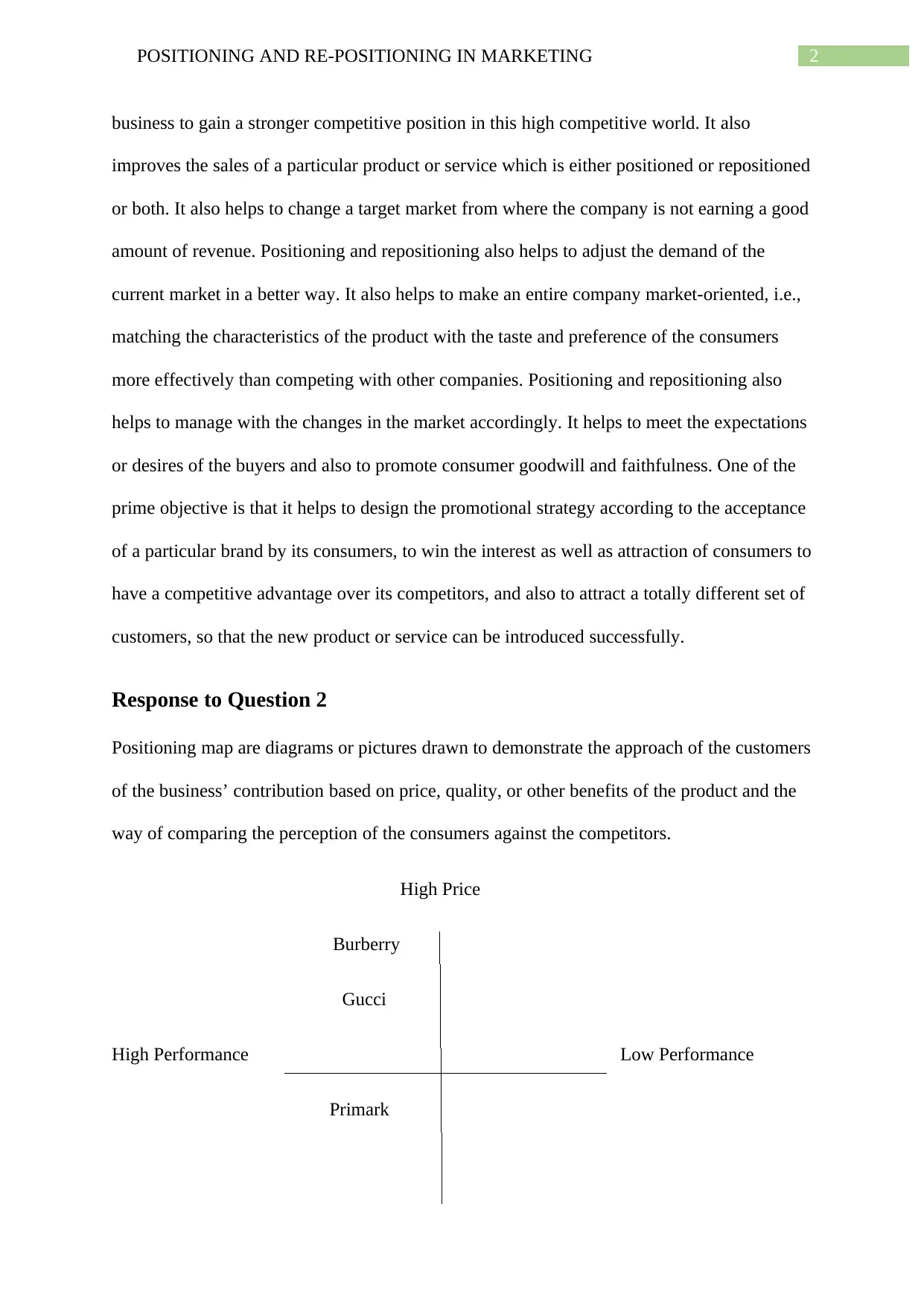
Positioning map are diagrams or pictures drawn to demonstrate the approach of the customers
of the business’ contribution based on price, quality, or other benefits of the product and the
way of comparing the perception of the consumers against the competitors.
High Price
Burberry
Gucci
High Performance Low Performance
Primark
Document Page
3POSITIONING AND RE-POSITIONING IN MARKETING
Low Price
As Burberry in the UK saw a double-digit sales growth for the last 6 months, and the
accessories represent the 37% of the total group revenue, with the sales in this category
increasing by 10% during the first half of 2017. Full-price sales for bags increased by 16%
for the year ended 31 March 2017, directed by the newly launched Bridle and Buckle
bags. Handbags and small leather goods performed well in the category of products.
Burberry will focus on the bags category as it has the greatest growth potential in the
next few years. Though Burberry has to reposition itself in the luxury sector. The
company will also create new luxury leather goods as well as accessories to catch the
eyeballs of the new high-end customers. Gucci is providing a tough competition and will
do the same in the coming years, but another company Primark, having the same kind of
products, are behind the place of Burberry as well as Gucci.
Response to Question 3
The two ways or methods which brands like Burberry can follow to achieve repositioning are
discussed below:
1. Real Repositioning - Here the company changes the characteristics of the product
so that it matches with the customer processes. Here, the company first have to
survey about their existing product or service or any brand, what are the tastes
and preferences of the consumers towards that particular brand and accordingly
changes the characteristics or attributes of that particular brand, to reposition it to
the existing target market or a totally new targeted marketed to earn more
revenue and gain the competitive edge over the competitors who are selling the
same kind of staff. Burberry is increasing their selling in digital platforms as
people are more tech-savvy nowadays and uses the digital platform to buy any
tabler-icon-diamond-filled.svg

Paraphrase This Document

Need a fresh take? Get an instant paraphrase of this document with our AI Paraphraser
Document Page
4POSITIONING AND RE-POSITIONING IN MARKETING
bags or leather accessories. They are also going to manufacture new luxury
leather goods and accessories to attract a new targeted market comprising of
new high-end customers.
2. Psychological Repositioning – In this method, attempts are made to change the
beliefs of the customers for a particular brand. In this method, efforts are made
by the companies to change the assumption or acceptance of the end customers
towards a particular brand or product or service. This can be done by showing
new advertisements of that existing brand or showcasing on the different
characteristics of that brand, or delivering some social messages, maybe
contributing in corporate social responsibility activities. Here, Burberry do not
want to loose the young generation customers like its competitors, who are very
much important for a company to earn more profits and have a competitive edge
over the competitors.
Document Page
5POSITIONING AND RE-POSITIONING IN MARKETING
Reference
Claudiu-Cătălin, M., 2014. Brand extensions positioning guidelines for competitive
differentiation. Business Management Dynamics, 4(4), p.19.
Florin-Mihai, M., 2013. The implications of marketing activity in risk analysis, core element
of lending policy to commercial banks. Annals of the „Constantin Brâncuşi” University of
TârguJiu, Economy Series, 2, pp.186-196.
GHERGHINA, L. (2015). POSITIONING STRATEGIES OF COMPETING FIRMS ON
THE MARKET. Analele Universitatii'Eftimie Murgu'Resita. Fascicola II. Studii Economice.
Gherghina, L., 2014. The importance of image and communication of a brand or trademark
positioning. Analele Universitatii'Eftimie Murgu'Resita. Fascicola II. Studii Economice,
pp.83-87.
Shakhshir, G., 2014. Positioning strategies development. The Annals Of The University Of
Oradea, 977, pp.416-437.
Sweeting, A., 2013. Dynamic product positioning in differentiated product markets: The
effect of fees for musical performance rights on the commercial radio
industry. Econometrica, 81(5), pp.1763-1803.
Vazifehdoust, H. and Golpour, B., 2013. Evaluation the Impact of Different Facets of Brand
on Brand Performance and International Marketing. Journal of American Science, 9(7s).
Zahid, S. and Raja, N.S., 2014. Effect of rebranding and repositioning on brand equity
considering brand loyalty as a mediating variable. Journal of Business and
Management, 16(1), pp.55-63.
chevron_up_icon
1 out of 6
circle_padding
hide_on_mobile
zoom_out_icon
[object Object]